
What you’ll learn in this article…
- Only UAB and Faulkner University hold active CACREP accreditation for master's counseling programs in Alabama as of 2026.
- Alabama meets just 28.4 percent of its mental health provider need, fueling strong demand for licensed counselors statewide.
- Tuscaloosa and Huntsville offer the highest median counselor pay among Alabama metro areas, per BLS state data.
- LPC licensure in Alabama requires a full 60-credit master's degree, not a standalone graduate certificate.
Alabama meets only 28.4 percent of its mental health provider need, according to 2025 Kaiser Family Foundation data, pushing demand for licensed counselors higher each year. Net prices across the eight ranked programs span from $12,684 to $24,323, with online and hybrid options now standard. That range reflects a genuine tradeoff: lower tuition often means larger cohort sizes or fewer on-campus connections, while higher-priced programs may offer stronger clinical placement networks.
State licensure as a Licensed Professional Counselor requires a 60-credit master's degree, and currently only two programs, UAB and Faulkner, hold active CACREP accreditation. Students weighing their options across different counseling degree levels will find that in Alabama, the decision often comes down to whether the accreditation premium is worth the flexibility and savings of non-accredited pathways.
Best Master's in Counseling Programs in Alabama
Alabama offers a surprisingly strong mix of affordable, flexible counseling programs for students pursuing clinical mental health or school counseling careers. The programs below are ranked with an emphasis on net price, graduation outcomes, and online or hybrid availability, factors that matter most to working adults and distance learners. All graduation rates cited are institution-wide figures reported to the federal government, not specific to the counseling program at each school.
- Net price and affordability
- Graduation and retention outcomes
- Online and hybrid availability
- Institutional earnings data
- Program accreditation status
- NCES-IPEDS federal institutional data — nces.ed.gov
- College Scorecard graduate earnings — collegescorecard.ed.gov
- Internal program database
- Independent program research

Athens State University
Athens State University is a transfer-friendly public institution in northern Alabama known for keeping costs low, with in-state tuition around $10,020 and a 14:1 student-to-faculty ratio. Its online Behavioral Science bachelor's program serves as an economical on-ramp for students planning to enter a counseling master's program. Median earnings for graduates reach roughly $50,273 ten years after enrollment, and median graduate debt sits at about $18,051, one of the lowest figures among Alabama schools on this list.
- Fully online bachelor's program with flexible scheduling
- Blends psychology and sociology perspectives
- Designed as a stepping stone to graduate counseling study
- Emphasizes sociocultural diversity and human behavior
- Accessible admissions for transfer students
- Low median graduate debt compared to Alabama peers
Behavioral Science, B.S. — Online

Jacksonville State University
Jacksonville State University pairs a CACREP-accredited School Counseling master's program with a hybrid delivery model that lets working professionals in Alabama complete coursework around their schedules. The program is built explicitly around Alabama P-12 school counselor certification requirements. The university's net price of roughly $14,279 makes it one of the more cost-effective public options, and median graduate debt is approximately $22,189.
- CACREP-accredited hybrid program
- 60 to 63 credit hours required
- Directly aligned with Alabama P-12 certification standards
- Includes practicum and internship field experiences
- Requires 3.25 GPA for graduation
- Background check and professional references required
- Covers counseling theories, ethics, and career development
Counselor Education, School Counseling P-12, M.S. — Hybrid

University of West Alabama
The University of West Alabama consistently appears on national lists of the most affordable online CACREP-accredited counseling degrees. Its fully online Clinical Mental Health Counseling master's program is priced at roughly $429 per credit hour and requires only a short four-day residency, making it practical for students across Alabama and neighboring states. UWA may accept up to nine hours of graduate transfer credit, further reducing cost and time to completion.
- Fully online with a brief four-day residency requirement
- CACREP accredited, 60 credit hours
- Portfolio-based admissions including video interview
- May accept up to nine graduate transfer credits
- Fingerprinting and background clearance required per Alabama standards
- Designed for licensure preparation in diverse mental health settings
- Typical completion in two to three years
Master's in Clinical Mental Health Counseling — Online

Auburn University at Montgomery
Auburn University at Montgomery offers a hybrid Master of Education in School Counseling geared toward Alabama P-12 certification. With a net price near $13,224 and a 13:1 student-to-faculty ratio, AUM provides relatively personalized attention at a public-university price point. The program emphasizes ethical counseling practice and requires a supervised internship, preparing graduates for careers in educational and community settings across the Montgomery region and beyond.
- Hybrid format blending online and in-person components
- Structured around Alabama school counselor certification
- Supervised internship experience required
- Focus on ethical behavior and client change
- No teaching experience prerequisite for admission
- Accessible to diverse bachelor's degree holders
Master of Education in School Counseling — Hybrid

Troy University
Troy University stands out for the breadth of its counseling-related offerings, spanning a School Counseling master's, an Addictions Counseling certificate, a Post-Master's Certificate in Clinical Mental Health Counseling, and a specialized Infant and Early Childhood Mental Health Counseling certificate aligned with Alabama competency guidelines. Most programs are delivered online or in a hybrid format with rolling admissions, making Troy a flexible hub for counselors at various career stages.
- Flexible online format with blended delivery options
- Accredited by CAEP for educator preparation
- No application deadline, rolling admissions
- Covers crisis management and advanced counseling theories
- Prepares graduates for leadership roles in K-12 settings
- Competitive in-state tuition around $8,550
- Hybrid: online coursework plus two intensive face-to-face days
- 15 semester hours in a one-year cohort model
- 400-hour internship aligned with Alabama guidelines
- Covers attachment, neurobiology, and clinical skills
- Requires a master's degree or current graduate enrollment
- Includes reflective supervision component
- Fully online graduate certificate
- Focuses on treatment planning and diagnosis strategies
- Covers pathological development and intervention theory
- No application deadline
- Flexible scheduling for working professionals
- Designed as a post-master's specialization
- Fully online, 15 semester hours
- Enhances clinical diagnosis and treatment planning skills
- Elective courses allow personalized focus areas
- Internship component included
- Requires existing master's degree in a related field
- Admission interview and professional references required
School Counseling, M.S. — Online
Certificate in Infant and Early Childhood Mental Health Counseling — Hybrid
Addictions Counseling Certificate — Online
Post-Master's Certificate in Clinical Mental Health Counseling — Online

University of South Alabama
The University of South Alabama in Mobile serves Gulf Coast and southern Alabama students with two hybrid counseling master's programs: an M.Ed. in School Counseling aligned with the ASCA National Model and a CACREP-accredited M.S. in Clinical Mental Health Counseling. Both are designed for commuters and working adults, with five- or seven-semester progression options for school counseling. Median ten-year earnings for USA graduates are approximately $49,379.
- Hybrid delivery designed for working professionals
- Aligned with ASCA National Model and Alabama standards
- No teaching experience required for admission
- Five- or seven-semester progression tracks available
- Covers multicultural counseling and ethical issues
- Prepares graduates for data-driven program design in preK-12
- CACREP-accredited 60-hour hybrid program
- Two-semester internship with diverse practicum sites
- Focus on cultural competency and professional certification
- Prepares students for Alabama professional counselor licensure
- Serves Gulf Coast and south Alabama communities
- Hybrid format accommodates students working in local agencies
Master of Education in School Counseling — Hybrid
Master of Science in Clinical Mental Health Counseling — Hybrid

Faulkner University
Faulkner University is a private, faith-based institution in Montgomery offering a hybrid M.S. in Clinical Mental Health Counseling and a fully online M.A. in Christian Counseling and Family Ministry. Both programs integrate a Christian worldview while meeting Alabama licensure criteria, a combination that distinguishes Faulkner from public alternatives. Approximately 85% of coursework is online, supplemented by brief on-campus intensives, keeping the program accessible for students across the state.
- 61-hour hybrid program, roughly 85% online
- Integrates Christian worldview with clinical training
- Two five-day on-campus intensive sessions required
- Priced at $555 per semester hour
- Prepares graduates for Alabama LPC licensure
- Includes practicum and internship experiences
- Flexible part-time options for working students
- Fully online delivery for maximum flexibility
- Meets Alabama licensure criteria despite faith integration
- 61 credit hours with practicum component
- Emphasizes ethical practice and cultural sensitivity
- Requires 2.75 minimum undergraduate GPA
- Three recommendation forms and goal statement required
Master of Science in Clinical Mental Health Counseling — Hybrid
Master of Arts in Christian Counseling and Family Ministry — Online

Auburn University
Auburn University brings the strongest institutional graduation rate on this list at 82% and the highest median ten-year earnings among listed schools at roughly $65,337. Its Clinical Mental Health Counseling M.Ed. follows a two-year, step-lock cohort model with hybrid delivery, and students complete 100 practicum hours plus 600 internship hours. The Counselor Education doctoral program offers graduate assistantships with stipends and tuition waivers, a rare affordability advantage for advanced study.
- Two-year step-lock cohort with hybrid delivery
- CACREP-aligned curriculum covering eight core areas
- 100 practicum hours and 600 internship hours required
- Placements in inpatient, outpatient, and community settings
- Specialized coursework in crisis and adolescent counseling
- Available to both full-time and part-time students
- 64 credit hours over approximately three years
- Graduate assistantships with stipends and tuition waivers
- Post-master's requirement, CACREP-accredited master's preferred
- Focus on social justice, diversity, and equity
- Includes research and teaching practica
- 600-hour doctoral internship included
- February 1 application deadline
Clinical Mental Health Counseling, M.Ed. — Hybrid
Counselor Education, Ph.D. — Hybrid
How We Ranked Alabama Counseling Programs
Affordability is not a secondary concern for graduate counseling students in Alabama, so it should not be a secondary concern in how programs are ranked. This list treats cost and financial aid access as primary filters, not tiebreakers.
Affordability Comes First
Net price, the amount students actually pay after grants and institutional aid, carries more weight here than sticker tuition. A program with a high published tuition but generous aid packages can outperform a nominally cheaper option that offers little financial support. Graduation rates and earnings outcomes inform the return-on-investment picture, though earnings figures reflect institution-wide or broad program-level data where available. Program-specific earnings data is not always published, and this guide will say so plainly rather than substitute a broader figure without context.
Delivery Format as a Hard Filter
Every program on this list offers online or hybrid delivery. That requirement is not negotiable. Alabama has students in rural counties, students working full-time clinical jobs, and students raising families, and purely on-campus programs simply do not serve that population. If a program requires full residential attendance, it does not appear here regardless of its reputation or price. Students exploring a broader national view of flexible graduate options can compare best online master's in counseling programs to see how Alabama schools stack up.
Accreditation as a Quality Signal
CACREP accreditation from the Council for Accreditation of Counseling and Related Educational Programs functions as a quality threshold rather than a ranking variable. Programs with CACREP standing signal that their curriculum aligns with national standards for clinical training, which matters enormously for Alabama licensure pathways. Non-CACREP programs are not automatically excluded, but their inclusion requires other strong indicators of outcome quality.
What the Data Cannot Tell You
Institution-wide graduation rates do not capture completion patterns within a single counseling department. Earnings outcomes from national datasets reflect broad populations, not the specific experience of an Alabama counseling graduate. These limitations are acknowledged throughout the rankings rather than papered over, because a student making a multi-year financial and professional commitment deserves an honest picture of what the data does and does not show.
Questions to Ask Yourself
CACREP-Accredited Counseling Programs in Alabama
Only two master's-level counseling programs in Alabama currently hold active CACREP accreditation: the University of Alabama at Birmingham (UAB) and Faulkner University, both verified through the CACREP directory for 2025-2026.1 That number is small relative to the total number of counseling programs in the state, which makes knowing which programs carry this credential especially important before you enroll.
What CACREP Accreditation Actually Means
CACREP stands for the Council for Accreditation of Counseling and Related Educational Programs. It is a programmatic credential, meaning it applies to a specific degree program rather than to the institution as a whole. This is a critical distinction. Every college and university you consider will carry regional institutional accreditation, which confirms the school meets broad academic standards. CACREP accreditation goes further by verifying that a counseling program's curriculum, faculty qualifications, clinical training requirements, and student outcomes meet standards set specifically for the counseling profession.
For Alabama licensure as a Licensed Professional Counselor, graduating from a CACREP-accredited program can streamline your path considerably. Alabama's licensing board recognizes CACREP programs as meeting the required coursework standards, which reduces the risk of being asked to complete additional coursework after graduation. The benefit extends beyond Alabama as well. If you relocate or pursue licensure in another state, many licensing boards across the country give preferential treatment to CACREP graduates, making your credential more portable.
The Two CACREP-Accredited Programs in Alabama
UAB's Counseling program includes a Clinical Mental Health Counseling concentration and holds active CACREP accreditation.2 Faulkner University's Master of Science in Clinical Mental Health Counseling is also CACREP-accredited and is structured as a hybrid program with the majority of coursework completed online.3
Several other programs in the state, including those at Jacksonville State University and the University of West Alabama, describe their curricula as CACREP-aligned, meaning they model their coursework after CACREP standards without holding formal accreditation status. That distinction matters.
Graduating from a Non-CACREP Program
If you complete a program that is CACREP-aligned but not CACREP-accredited, you may still qualify for Alabama LPC licensure, but the path can be more complicated. Some licensing boards will require a course-by-course review to confirm that your graduate education covered all required content areas. In other states, the review process can require additional supervised hours or supplemental coursework before you can sit for the licensure exam. For those interested in the broader requirements of this career path, understanding how to become a mental health counselor provides helpful context. Before enrolling in any program, confirm directly with the Alabama Board of Examiners in Counseling how that specific program's graduates have been evaluated for licensure eligibility.
Related Articles
Child and Adolescent Counseling Tracks in Alabama
Most Alabama counseling programs embed child and adolescent training inside broader clinical mental health or school counseling tracks rather than offering it as a standalone degree, which means students need to dig past the catalog headline to find the coursework they actually want. The good news: between CACREP accreditation requirements, professional association resources, and direct outreach to program coordinators, you can confirm child-focused content before you apply.
Read the Degree Plan, Not Just the Brochure
Program landing pages tend to advertise specializations in broad strokes. The real detail lives in the degree plan PDFs and course catalog. Pull these documents from each school's official site and scan core and elective course descriptions for keywords like "child," "adolescent," "play therapy," "family systems," or "developmental." A program that lists Play Therapy or Counseling Children and Adolescents as a standing elective is signaling a faculty member with expertise in that area, which usually translates into practicum supervision and research opportunities too. For a broader look at the steps and qualifications involved, see our guide on how to become a child counselor.
Use the CACREP Directory as a Filter
CACREP maintains a public directory of accredited programs searchable by specialty area. Filter for Clinical Mental Health Counseling or School Counseling in Alabama, then click into individual program profiles. Accredited programs publish their required clinical hours, internship structures, and often their specialization options. School counseling tracks by definition involve K-12 placements, so any Alabama CACREP-accredited school counseling program will give you supervised work with minors.
Ask Program Coordinators Directly
Email or call the program coordinator. Specific questions worth asking:
- Do practicum and internship placements include sites that serve children, such as elementary schools, pediatric behavioral health clinics, or community agencies with youth caseloads?
- Is registered play therapist (RPT) coursework available, and does the program align with Association for Play Therapy training requirements?
- Are counseling graduate certificate programs offered alongside the master's, or as post-master's options?
Tap Professional Association Resources
The Alabama Counseling Association (ALCA) hosts state conferences and division meetings, including divisions focused on school counseling and child specialties. The American Counseling Association (ACA) and Association for Play Therapy publish continuing education listings and credential pathways. These networks frequently surface practicum sites, supervisors credentialed in child work, and workshop opportunities that program websites do not advertise.
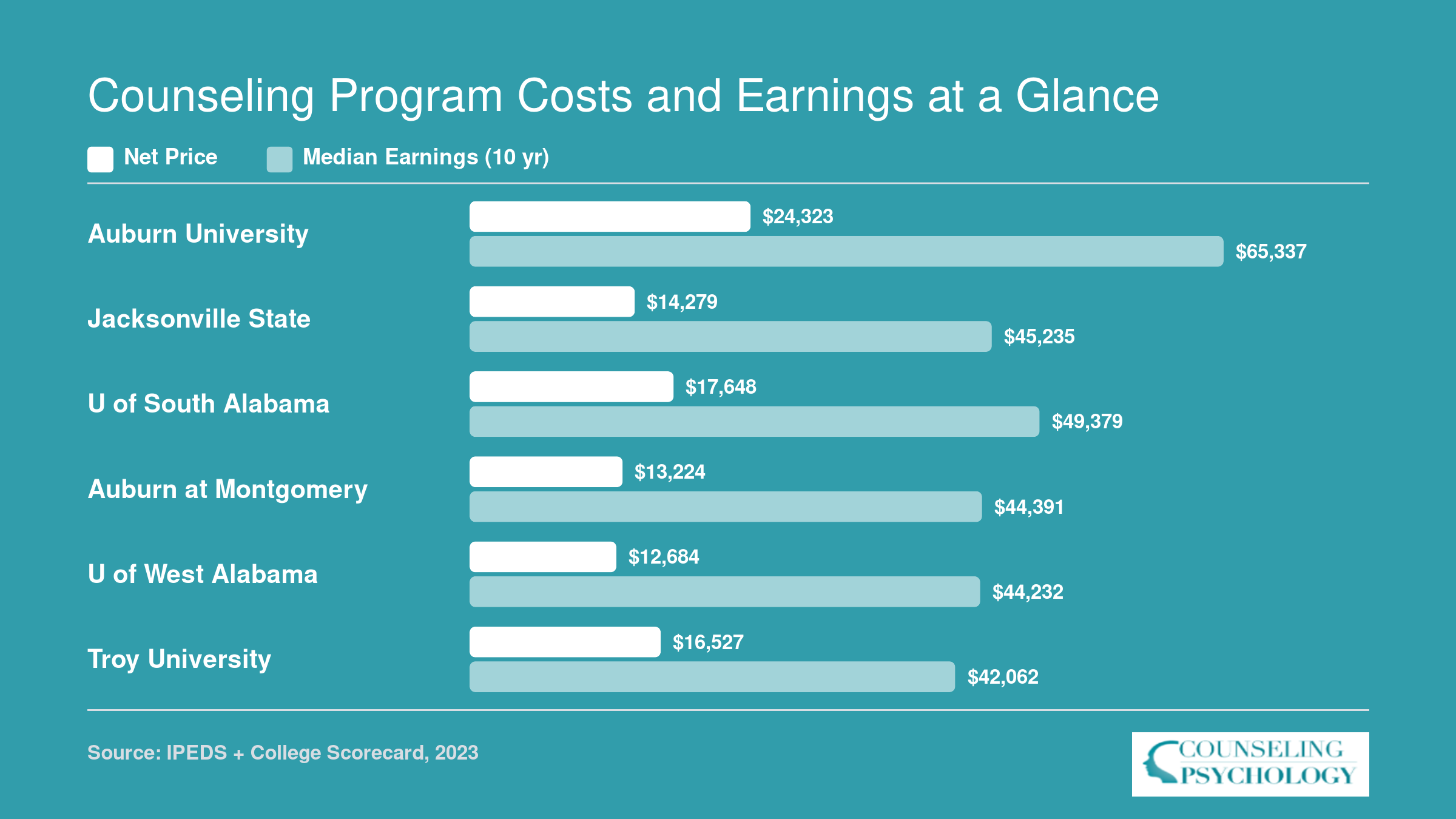
Counseling Program Costs and Earnings at a Glance
How do Alabama's top counseling programs compare on affordability and long-term earning potential? The chart below pairs each institution's average net price with its median earnings ten years after enrollment. Note that program-level post-completion earnings are not yet available for these schools, so the institution-wide median is shown instead. A wider gap between cost and earnings generally signals stronger return on investment.
Online Vs. On-Campus Counseling Programs in Alabama
Choosing between online and on-campus formats is one of the most consequential decisions you will make when pursuing a master's in counseling in Alabama. Both paths can lead to the same licensure outcome, but the day-to-day experience, cost structure, and networking opportunities differ significantly. The good news: CACREP-accredited online programs carry the same professional weight as their on-campus counterparts, and Alabama licensing boards do not distinguish between the two formats.
Pros
- Online programs offer scheduling flexibility that lets working adults in Alabama complete coursework evenings and weekends without relocating.
- Effective tuition for online programs is often lower because students avoid commuting, parking, and campus fee costs.
- Rural Alabama students gain access to top CACREP-accredited programs without moving to the Birmingham or Auburn corridor.
- On-campus programs typically come with built-in clinical placement networks, simplifying the practicum and internship search.
- Face-to-face cohort models foster stronger peer bonding and organic study groups that can become lasting professional networks.
- On-campus students benefit from direct faculty mentorship, including impromptu office visits and research collaboration opportunities.
Cons
- Online students must still complete 600 or more supervised practicum and internship hours in person, which requires arranging local placements independently.
- Virtual formats offer fewer spontaneous networking moments, making it harder to build the informal professional relationships that support early career growth.
- On-campus schedules are rigid, often requiring daytime attendance that conflicts with full-time employment obligations.
- Students attending on-campus programs outside major metro areas face limited institutional options and potentially long commutes.
- Commute, housing, and campus fees can raise the true cost of on-campus attendance well beyond posted tuition rates.
Counseling Program Costs and ROI in Alabama
How much will you pay for a master's in counseling in Alabama, and when will that investment pay off?
Understanding program costs alongside expected earnings is essential for any prospective counseling student. Alabama's counseling programs vary widely in tuition, and your return on investment depends on both what you pay and what you earn after graduation.
Tuition and Program Costs
Alabama counseling programs charge between approximately $8,000 and $35,000 in total tuition for a master's degree. In-state students at public universities such as the University of Alabama and Auburn University typically pay lower rates, often under $15,000 for the full program, while out-of-state and private-institution tuition can exceed $30,000. When comparing schools, visit official program websites to confirm current tuition, mandatory fees, technology charges, and any additional costs for practicum or internship placements. Also review graduation rates and licensure pass rates published by each institution, and cross-check those pass rates with data from the Alabama Board of Examiners in Counseling to gauge program quality and student outcomes.
Alabama Counselor Salaries
According to the U.S. Bureau of Labor Statistics (BLS) Occupational Employment and Wage Statistics, the median annual wage for Substance Abuse and Mental Health Counselors (SOC 21-1018) in Alabama was $47,710 as of May 2023. Nationally, the median for this occupation stood at $53,710 during the same period. Alabama's median reflects the state's lower cost of living compared to the national average, and regional economic factors influence salaries across different metro areas within the state. The BLS Occupational Outlook Handbook projects 18 percent employment growth for mental health counselors nationwide from 2022 to 2032, much faster than the average for all occupations, indicating strong demand for new practitioners.
Calculating Your ROI
To estimate return on investment, divide your total program cost by the difference between your expected post-graduation salary and your current earnings. For example, a $12,000 program that increases your salary by $20,000 annually would pay for itself in less than a year. Adjust national salary benchmarks using cost-of-living indices from sources like the Council for Community and Economic Research to reflect Alabama's economic conditions. Contact the Alabama Counseling Association or similar professional groups for state-specific salary surveys, ROI calculators, and guidance on negotiating compensation based on your experience, credentials, and geographic location within Alabama. Many counselors also increase earnings through private practice, supervision roles, or specialized certifications over time, and exploring broader counseling careers can help you identify higher-earning specializations.
Alabama Counselor Salary by Metro Area
Salaries for substance abuse, behavioral disorder, and mental health counselors vary meaningfully across Alabama metro areas. According to BLS data specific to Alabama, the highest median pay appears in Tuscaloosa and Huntsville, while smaller metros such as Florence and Gadsden tend to fall at the lower end. Keep in mind that Alabama's overall cost of living is below the national average, so even lower metro salaries here can stretch further than similar figures in many other states.
| Metro Area | Total Employed | 25th Percentile | Median Salary | 75th Percentile | Mean Salary |
|---|---|---|---|---|---|
| Birmingham | 890 | $41,720 | $50,650 | $60,110 | $54,060 |
| Montgomery | 300 | $41,920 | $51,170 | $67,650 | $57,990 |
| Tuscaloosa | 240 | $46,390 | $51,980 | $54,790 | $53,650 |
| Huntsville | 250 | $44,550 | $51,580 | $60,890 | $53,660 |
| Decatur | 150 | $44,650 | $51,070 | $59,630 | $56,420 |
| Auburn, Opelika | 100 | $42,670 | $50,880 | $61,860 | $54,550 |
| Mobile | 330 | $39,940 | $49,900 | $55,600 | $50,950 |
| Daphne, Fairhope, Foley | 150 | $39,370 | $48,680 | $58,270 | $50,120 |
| Dothan | 120 | $37,630 | $48,140 | $57,170 | $48,370 |
| Anniston, Oxford | 90 | $37,010 | $47,920 | $55,530 | $49,200 |
| Gadsden | 70 | $35,500 | $45,650 | $56,620 | $47,850 |
| Florence, Muscle Shoals | 50 | $37,670 | $43,930 | $48,870 | $45,390 |
Alabama Counselor Licensure Requirements
Earning your Licensed Professional Counselor (LPC) credential in Alabama follows a clearly defined path. Note that a standalone graduate certificate does not qualify for licensure; you must complete a full 60-credit master's degree from a CACREP-accredited program for degrees started on or after January 1, 2024.
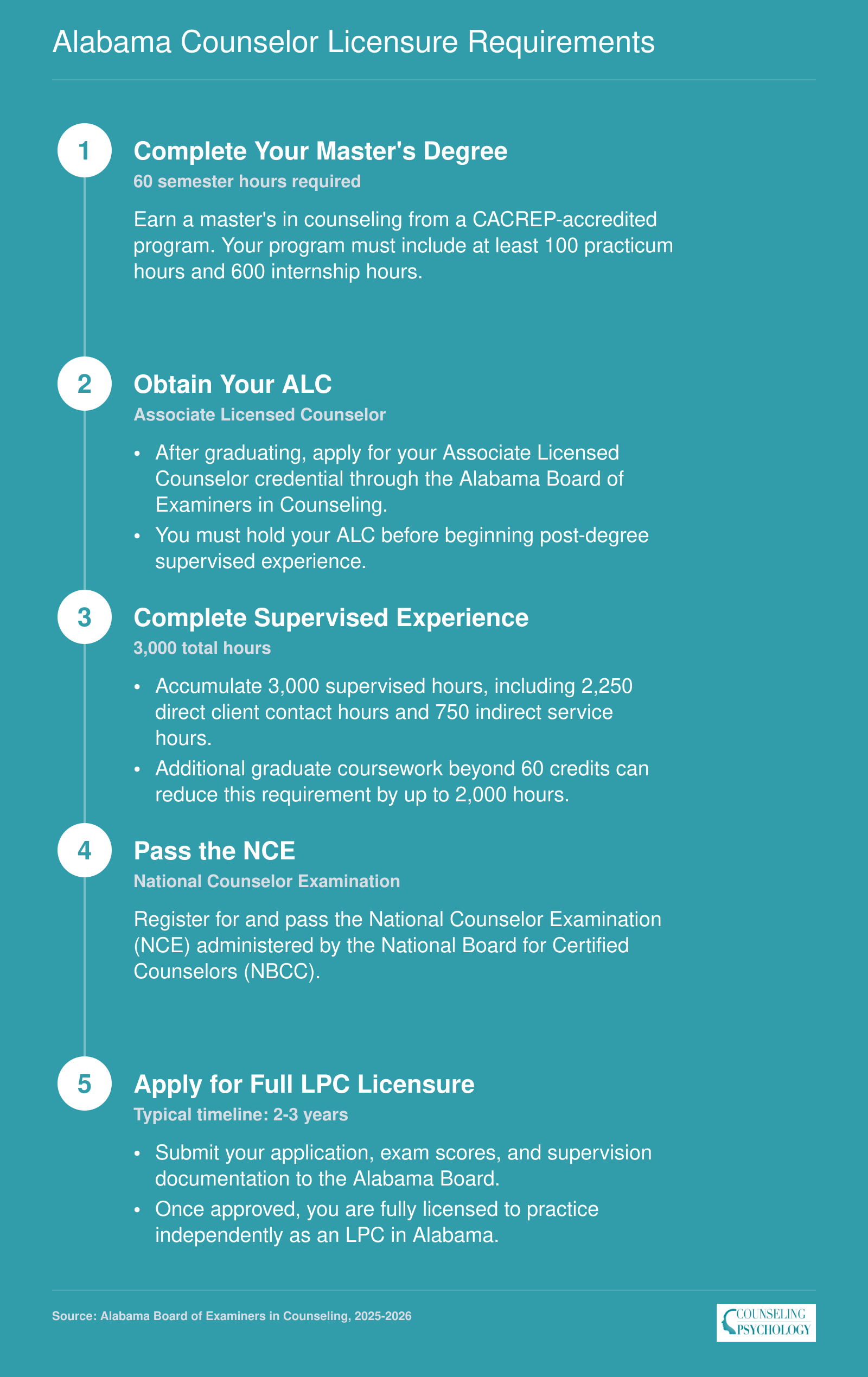
Alabama meets only 28.4 percent of its mental health care provider need, according to 2025 data from the Kaiser Family Foundation. This severe workforce shortage means opportunities for licensed counselors are growing rapidly across the state, particularly in rural and underserved counties designated as Health Professional Shortage Areas.
Frequently Asked Questions About Alabama Counseling Programs
Choosing the right counseling program involves navigating questions about format, cost, licensure, and specialization. Below are answers to the most common questions prospective students ask about master's in counseling programs in Alabama.