
What you’ll learn in this article…
- CACREP accreditation directly affects licensure eligibility, national exam access, and employer credibility in every U.S. state.
- Total counseling degree costs often run $1,000 to $5,000 beyond tuition due to practicum fees, liability insurance, and supervision charges.
- From bachelor's enrollment through independent licensure, expect the full counseling career timeline to span roughly 6 to 8 years.
- Most master's programs require 600 to 1,000 supervised clinical hours, with 2,000 to 4,000 more needed post-graduation for licensure.
The Bureau of Labor Statistics projects 19 percent growth for mental health counselors through 2034, far outpacing average occupations. That makes program choice a high-stakes decision. Location, cost, and schedule constraints can derail a candidate before licensure. Fully online programs, ranked by a quality composite, let you bypass geography while maintaining CACREP alignment. Yet not all online degrees open equal doors. Accreditation remains the filter: without it, coursework may not satisfy state boards, and clinical hours may not count. Whether you are exploring counseling master's programs online or comparing local options, this credential gap demands attention before enrollment, not after graduation.
Best Fully Online Counseling Programs
The programs below are 100% online counseling pathways, ranked by a composite that balances graduate earnings outcomes, net price, median debt, and completion rates. Every entry was verified for fully remote delivery so you can complete coursework from anywhere, though some may require local practicum placements. Program-level earnings data is not yet available for most of these offerings, so the institutional figures shown reflect school-wide outcomes reported by the College Scorecard.
Details
- NCES-IPEDS federal institutional data — nces.ed.gov
- Internal program database
- College Scorecard graduate earnings — collegescorecard.ed.gov
- Independent program research

University of Florida
The University of Florida pairs a low net price of $6,541 with a 91.1% completion rate and institution-wide median earnings of $71,588 ten years after enrollment. Its online Graduate Certificate in Addiction and Recovery is an 18-credit, one-year track housed in the UF College of Medicine, and the broader counselor education unit ranked No. 2 nationally in U.S. News' 2026 graduate rankings. Note that UF is not accepting counseling applications for Fall 2026; prospective students should target the Fall 2027 cycle with a November 15 deadline.
- 18 credit hours, completable in one year
- $590 per credit hour ($10,620 total)
- Covers neurobiology, ethics, and treatment of substance use disorders
- Prepares students for CAP and CAC certification exams
- No residency or on-campus requirement
- Housed within UF's College of Medicine faculty
Graduate Certificate in Addiction and Recovery — Online

Florida State University
Florida State University offers a CACREP-accredited online School Counseling program that combines a master's and specialist degree in one track. With a net price of $11,297 and median graduate debt of $18,000, FSU keeps costs moderate while maintaining an 85.6% completion rate. The program waives the GRE through Fall 2026 and focuses on K-12 academic, career, and social-emotional development with a data-driven approach to closing achievement gaps.
- CACREP-accredited master's and specialist pathway
- No GRE required through Fall 2026
- Requires a bachelor's degree and 3.0 GPA
- Emphasizes data-driven strategies for achievement gaps
- Close faculty mentorship model
- Prepares graduates for K-12 licensure nationwide
School Counseling (M.S./Ed.S.) — Online

Southeastern Baptist Theological Seminary
Southeastern Baptist Theological Seminary provides a 12-credit Certificate in Biblical Counseling at just $300 per credit, making it one of the most affordable graduate-level options on this list. With a 9:1 student-to-faculty ratio, students receive substantial individual attention. This is a ministry-oriented, non-clinical certificate, so it is best suited for those integrating counseling skills into pastoral or church settings rather than pursuing clinical licensure.
- 12 credit hours at $300 per credit
- Covers trauma, abuse, marital, and parenting counseling
- Credits transferable to a master's degree
- Flexible pacing for working professionals
- Biblical foundation with practical ministry application
- Small classes with a 9:1 student-to-faculty ratio
Certificate in Biblical Counseling — Online

University of Georgia
The University of Georgia's online Graduate Certificate in Substance Use Counseling is a 12-semester-hour program designed for current graduate students or professionals who already hold a graduate degree. Graduates meet the educational requirements for Georgia's Certified Advanced Alcohol and Drug Counselor credential. UGA's institutional metrics are strong: an 89.7% completion rate, median earnings of $68,726, and median graduate debt of $18,500.
- 12 semester hours, fully online
- Meets Georgia CAADC licensure education requirements
- Covers evidence-based treatment approaches and trauma assessment
- Includes a dedicated group work course
- Multidisciplinary faculty with clinical expertise
- Requires an existing graduate degree or current enrollment
Graduate Certificate in Substance Use Counseling — Online

Arizona State University
Arizona State University fields multiple online counseling pathways, from a bachelor's in Counseling and Applied Psychological Science to a Master of Counseling and a graduate certificate in Addiction and Substance-Use Related Disorders. The certificate meets Arizona's state board requirements for substance abuse counseling licensure. ASU's broad access model (89.9% admission rate) and 7.5-week class format appeal to working professionals, though the 68% completion rate and $19,500 median debt are worth weighing.
- 21 credit hours, fully online
- Meets Arizona licensure requirements
- Covers psychopharmacology, multicultural issues, and ethics
- Requires a bachelor's or master's in a related field
- Minimum 3.0 GPA for admission
- Focus on evidence-based interventions
- 120 total credit hours in 7.5-week sessions
- Concentration in Substance Abuse and Addictions
- 135-hour required internship
- Leads to Licensed Substance Abuse Technician credential
- Prepares students for graduate counseling programs
- First-of-its-kind online undergraduate pathway
- 33 credit hours, fully online
- Includes practicum and applied project
- Meets national certification standards
- Flexible schedule designed for working professionals
- Bachelor's degree required for admission
- Strong projected job growth in the field
- 60-credit comprehensive program
- Approved by Arizona Board of Behavioral Health
- Prepares for professional counselor licensure
- Multicultural counseling emphasis throughout
- Practicum and internship components included
- Thesis or comprehensive exam pathway options
Graduate Certificate in Addiction and Substance-Use Related Disorders — Online
B.S. in Counseling and Applied Psychological Science — Online
Addiction Psychology, M.S. — Online
Master of Counseling (Clinical Mental Health) — Online

William & Mary
William & Mary's online M.Ed. in Counseling carries CACREP accreditation and posts the highest institutional median earnings on this list at $73,490. The school counseling concentration can be finished in as few as three years, while a clinical mental health track offers a Military and Veterans Counseling focus. A 12:1 student-to-faculty ratio and 89.4% completion rate reflect a selective, high-support environment, though the $19,096 net price is on the higher end.
- CACREP-accredited, completable in three years
- Prepares for K-12 school counseling licensure
- Curriculum grounded in social justice and diversity
- Small class sizes with dynamic online platform
- Includes required practicum and internship
- Covers academic planning, career exploration, emotional support
- 60-credit CACREP-accredited program
- Specialized concentration for military populations
- Online format with fieldwork opportunities
- Prepares for Virginia licensure
- Dedicated faculty with clinical backgrounds
- Three recommendation letters required for admission
M.Ed. in Counseling, School Counseling Concentration — Online
M.Ed. in Counseling, Clinical Mental Health (Military & Veterans) — Online

The College of New Jersey
The College of New Jersey offers a 15-credit Post-Master's Certificate in Clinical Mental Health Counseling aimed at MA-level counseling graduates pursuing licensure. At $686 per credit, total tuition stays under $11,000. TCNJ blends synchronous and asynchronous sessions and requires no GRE, with rolling admissions. Institution-wide median earnings reach $73,323, and the 85.9% completion rate signals solid academic support, though the $27,646 net price reflects the school's broader undergraduate cost structure rather than certificate-specific costs.
- 15 credits at $686 per credit (under $11,000 total)
- Mix of synchronous and asynchronous online sessions
- No GRE required, rolling admissions
- Covers psychopathology, addiction, trauma, and ethics
- Designed for MA holders seeking clinical licensure
- Faculty with active clinical practice backgrounds
Post-Master's Certificate in Clinical Mental Health Counseling — Online

Manna University
Manna University is a small, faith-based institution in Fayetteville, NC, with a 10:1 student-to-faculty ratio and a 100% first-year retention rate. Its Graduate Certificate in Christian Counseling is a 24-credit, non-clinical program that integrates biblical and psychological frameworks. At $335 per credit the program is affordable, though graduates should understand this certificate does not lead to clinical licensure. Median graduate debt across the institution is $13,450, the lowest figure on this list.
- 24 credit hours at $335 per credit
- Completable in approximately two years online
- Non-clinical, ministry-focused curriculum
- Integrates biblical theology with counseling theory
- Covers crisis intervention and ethics
- Scholarships available; no clinical licensure provided
Graduate Certificate in Christian Counseling — Online

North Carolina State University at Raleigh
NC State offers both School Counseling and Clinical Mental Health Counseling at the master's level online, each built on a 60-credit, CACREP-accredited framework. Neither track requires GRE scores, and the clinical mental health option follows a three-year, part-time cohort model ideal for working professionals. Institutional median earnings sit at $68,758 with a median graduate debt of $20,121 and an 84.8% completion rate.
- 60-credit CACREP-accredited program
- No GRE required; 3.0 GPA minimum
- Prepares for NC licensure and National Counselor Exam
- Multicultural and crisis intervention curriculum
- Practicum and internship experiences required
- Personal statement and three recommendations needed
- Online master's with three-year part-time format
- Cohort-based learning model
- Prepares for North Carolina professional licensure
- No entrance exam required
- Multicultural curriculum focus throughout
- Field experience embedded in program
M.Ed. in School Counseling — Online
M.S. in Clinical Mental Health Counseling — Online

University of Kentucky
The University of Kentucky's CACREP-accredited M.A. in Counseling with a Clinical Mental Health concentration delivers evidence-based, culturally competent training entirely online. Admission does not require a GRE, though a personal interview and three recommendation letters are part of the process. UK's median earnings of $59,025 and median graduate debt of $22,500 place it at the value-oriented end of the spectrum, with a 71.4% completion rate that prospective students should factor into their decision.
- CACREP-accredited, fully online program
- No GRE required; 2.75 GPA minimum
- Personal interview and three recommendation letters needed
- Emphasizes socially just, culturally competent practice
- Students must maintain a 3.0 GPA while enrolled
- Evidence-based skill development with flexible scheduling
M.A. in Counseling, Clinical Mental Health Concentration — On-Campus
How to Find the Best Counseling Schools Near You
Relying solely on a Google search for "counseling schools near me" yields a chaotic mix of paid ads, outdated listings, and programs that may lack proper accreditation. A methodical approach using official directories and data sources will save you hours of filtering and reduce the risk of pursuing a counseling degree that doesn't lead to licensure.
Start with CACREP's Official Directory
The Council for Accreditation of Counseling and Related Educational Programs (CACREP) maintains the most reliable and up-to-date list of accredited counseling programs. As of 2026, there are over 900 CACREP-accredited programs nationwide, with roughly 30% located in the South, 25% in the Midwest, 25% in the Northeast, and 20% in the West. Visit the CACREP website and use the directory search to filter by state, degree level, or program type. This gives you an exact count of accredited options in your area, not just promotional listings. Be aware that some schools may be in the process of seeking accreditation; CACREP will note that status explicitly, so you can decide if a developing program fits your timeline.
Cross-Reference with BLS Data for Regional Demand
The Bureau of Labor Statistics (BLS.gov) provides occupational outlook data that can help you gauge demand for counselors in your state or metropolitan area. Look up the specific counseling specialty you're interested in, such as school counselor, mental health counselor, or marriage and family therapist, to see projected job growth and median wages for your region. While BLS does not recommend specific schools, their regional employment trends can guide you toward states where the profession is expanding, helping you target your search to areas with stronger job prospects after graduation.
Tap Professional Associations and State Boards
Both the American Counseling Association (ACA) and your state's counseling licensure board publish resources that go beyond simple accreditation lists. Many state boards provide a roster of approved programs that meet local licensure requirements, which sometimes differ slightly from national accreditation. ACA chapters often have regional program guides or directories compiled by working professionals. These insider perspectives can surface well-regarded programs that may not dominate search engine results but have strong local reputations and practicum placement networks. For a broader look at steps, timelines, and what to expect from the licensing process, see our guide on how to become a counselor.
Audit School Websites and Build a Comparison
Once you have a shortlist, visit each school's website to confirm current accreditation status (look for CACREP mention in the program description, not just university-wide accreditation) and specific tracks, such as clinical mental health or school counseling. Take note of delivery format (online, in-person, hybrid), practicum requirements, and faculty expertise. For a clear side-by-side view, manually compile the details in a spreadsheet or even a simple note-taking app. This small upfront effort prevents you from overlooking critical differences in cost, graduation timelines, or internship support that can dramatically shape your career readiness.
Questions to Ask Yourself
Do you need a program that lets you complete clinical hours in your home state, or are you flexible on relocation?
Are you looking for a career change into counseling, or advancing within a role you already hold?
Can you commit to full-time study, or do you need part-time, evening, or weekend scheduling?
Types of Counseling Degrees You Can Pursue
The right counseling degree depends on a tradeoff most students face early: how quickly you want to enter the field versus how independently you want to practice once you arrive. A certificate gets you working sooner; a master's unlocks licensure; a doctorate opens supervision, teaching, and specialized clinical roles. Cost and time scale accordingly.
Compare the Four Degree Levels
- Post-Bachelor's Certificate: 9 to 12 months, 12 to 24 credits, typically the fastest counseling credential for students who already hold a related bachelor's. Prepares graduates for paraprofessional and support roles, but does not independently qualify you for state licensure as an LPC or LMHC.
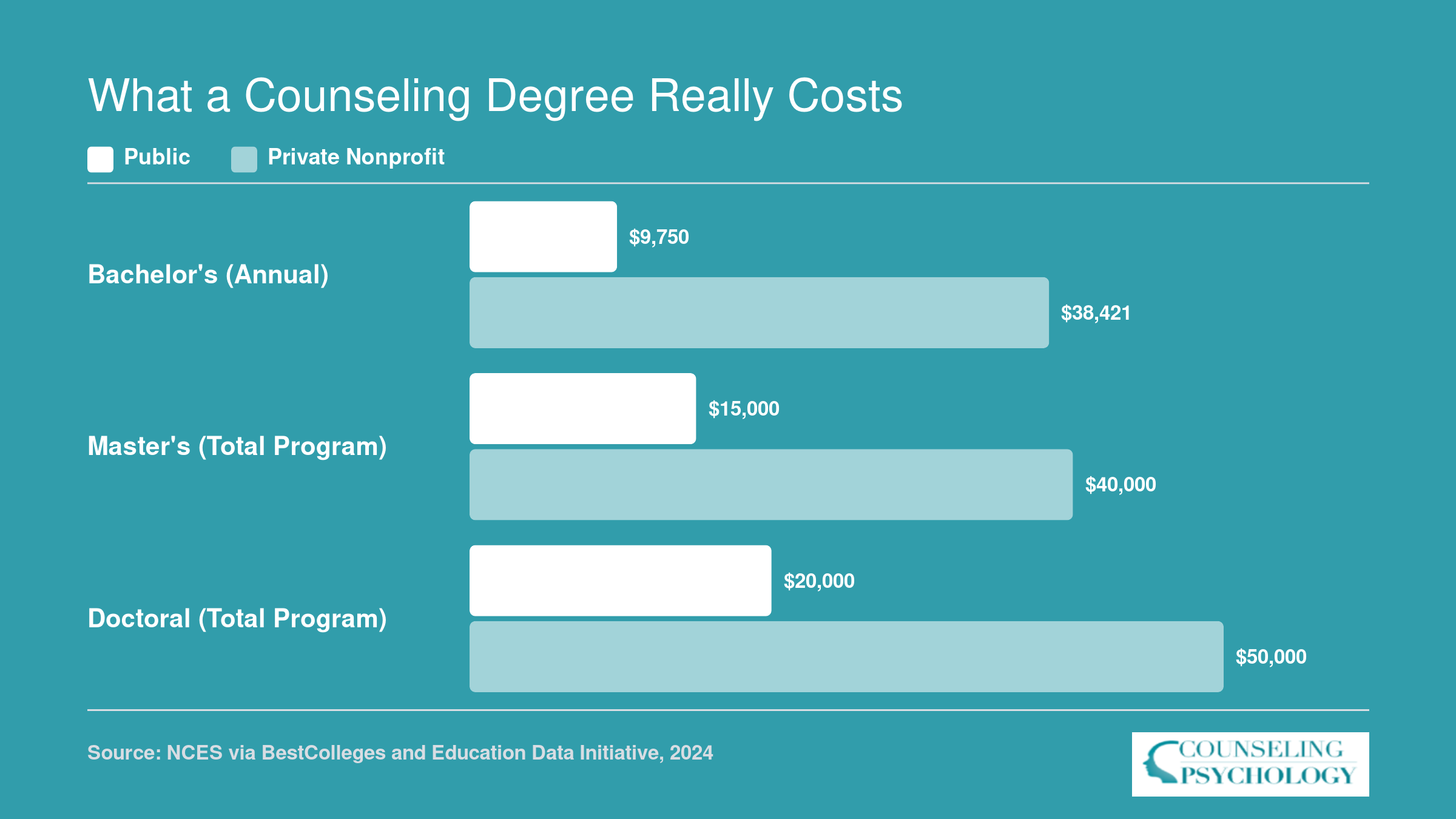
- Bachelor's Degree (Human Services or Behavioral Health): Roughly 48 months, with in-state tuition often falling between $7,000 and $10,000 per year. Graduates work as case managers, behavioral health technicians, or community outreach staff. Not licensure-eligible on its own.
- Master's Degree in Counseling: 24 to 36 months and typically 60 credits, with total program costs ranging from about $15,000 at affordable public programs to well over $130,000 at private institutions like NYU (listed at $2,272 per credit, or roughly $136,320 total).3 East Carolina University's online master's, by comparison, runs $4,987 in-state per year. This is the minimum degree for independent licensure as an LPC or LMHC in every U.S. state.4
- Doctoral Degree (PhD or EdD in Counseling): 48 to 72 months, with tuition spanning $14,000 to $60,000 depending on whether the program is public or private.4 Doctoral graduates pursue counselor education faculty roles, advanced clinical supervision, and research positions. Licensure-eligible, but most clinicians do not need a doctorate to practice.
The Practical Answer on "Best Degree"
If you want to see clients independently, the master's is the answer. Every state's licensure board requires at least a 60-credit master's in counseling or a closely related field, along with supervised post-graduate hours. Students interested in going further can explore counseling doctoral programs for faculty, supervision, or research-focused careers.
Counseling vs. Psychology Degrees
These fields overlap but train you differently. Counseling master's programs are applied and clinical: you complete practicum and internship hours, develop assessment and intervention skills, and prepare for state licensure through pathways like licensed professional clinical counselor programs. Psychology programs, by contrast, lean research-oriented, with the exception of PsyD clinical tracks that train doctoral-level practicing psychologists.
Explore By State
- Alabama
- Alaska
- Arizona
- Arkansas
- California
- Colorado
- Connecticut
- Delaware
- Florida
- Georgia
- Hawaii
- Idaho
- Illinois
- Indiana
- Iowa
- Kansas
- Kentucky
- Louisiana
- Maine
- Maryland
- Massachusetts
- Michigan
- Minnesota
- Mississippi
- Missouri
- Montana
- Nebraska
- Nevada
- New Hampshire
- New Jersey
- New Mexico
- New York
- North Carolina
- North Dakota
- Ohio
- Oklahoma
- Oregon
- Pennsylvania
- Rhode Island
- South Carolina
- South Dakota
- Tennessee
- Texas
- Utah
- Vermont
- Virginia
- Washington
- Washington DC
- West Virginia
- Wisconsin
- Wyoming
Related Articles
Counseling Program Accreditation: Why CACREP Matters
Accredited versus non-accredited: that distinction can determine whether your degree qualifies you for licensure in your state, whether you can sit for a national certification exam, and ultimately whether employers take your application seriously. Understanding how accreditation works before you enroll is one of the most practical steps you can take.
What CACREP Is and Why It Sets the Standard
The Council for Accreditation of Counseling and Related Educational Programs (CACREP) is the primary accrediting body for master's and doctoral counseling programs in the United States.1 A CACREP-accredited program has undergone a rigorous review confirming that its curriculum, faculty qualifications, and clinical training requirements meet a uniform national standard. For students, that consistency matters: a CACREP program at one university is built around the same core framework as one across the country.
The standards themselves were updated in 2024. The 2024 CACREP Standards, organized into six sections, took effect July 1, 2024, replacing the 2016 Standards.2 Programs had a transition window running through June 30, 2026, to align their curricula with the new requirements.3 Among the clinical training benchmarks embedded in these standards: students must complete a minimum of 600 internship hours, and group supervision sessions are capped at 12 students, preserving meaningful faculty oversight.4
The Licensure Connection You Cannot Ignore
Many state licensing boards already require or strongly prefer that applicants hold degrees from CACREP-accredited programs. That trend is accelerating. Several states are moving toward making CACREP graduation a firm requirement, with timelines converging around 2026 and 2027. At the national level, the National Board for Certified Counselors (NBCC) has announced that beginning January 1, 2027, graduation from a CACREP-accredited program will be required to earn the National Certified Counselor (NCC) credential. If NCC certification is part of your professional goals, this deadline is not abstract. For those pursuing clinical mental health work specifically, understanding the full licensed professional counselor online degree path can help you plan ahead.
Other Accreditors Worth Knowing
CACREP is not the only accreditor in this space, but the others serve distinct tracks. CORE (the Council on Rehabilitation Education) accredits rehabilitation counseling programs specifically. The American Psychological Association (APA) accredits counseling doctoral programs in counseling psychology. If your path leads toward one of those specializations, those accreditors are what matter. For the broad range of clinical mental health, school, and career counseling programs, CACREP remains the benchmark.
Ask About NCE Pass Rates
CACREP-accredited programs are expected to report aggregate pass rates for the National Counselor Examination (NCE) as part of ongoing accountability. No comprehensive national dataset comparing CACREP and non-CACREP NCE outcomes is publicly available, but individual programs can and should be able to share their own figures. When you are evaluating schools, ask the admissions office directly for their program's NCE pass rate. A program that cannot or will not provide that number is telling you something worth knowing.
What a Counseling Degree Really Costs
Tuition is only part of the picture. Practicum and internship fees, including site placement charges, professional liability insurance, and clinical supervision, can add $1,000 to $5,000 on top of advertised prices. Three primary funding levers can help offset these costs: federal student loans (Stafford and GradPLUS), HRSA Behavioral Health Workforce scholarships, and employer tuition reimbursement programs. The figures below reflect approximate annual tuition benchmarks; total program costs will be higher after factoring in fees, living expenses, and practicum-related charges.
Online Vs. On-Campus Counseling Programs: Which Format Fits?
Choosing between online and on-campus counseling programs depends on your lifestyle, learning style, and professional goals. Both formats can lead to the same license and the same career outcomes, but the day-to-day experience differs in meaningful ways. Note that this page ranks 100% online programs specifically; hybrid programs that require campus residencies are excluded from our listings.
- Schedule flexibility lets working adults complete coursework on evenings and weekends without leaving a job.
- No relocation required, so you can stay in your community while earning a degree from a distant institution.
- Total cost is often lower because you avoid campus fees, parking, and housing expenses tied to on-campus enrollment.
- You can complete coursework from any state, which is especially useful for military families or frequent movers.
- Part-time pacing is common: many online programs allow two courses per semester, stretching a two-year program to three years.
- Clinical placements must still be arranged locally, and securing a quality site is usually the student's responsibility.
- Organic peer networking is harder to build when classmates are spread across multiple time zones and never share a physical space.
- Strong self-discipline is essential because asynchronous coursework offers fewer built-in accountability checkpoints than a set class schedule.
- Group counseling practice and role-play exercises can feel less immersive when conducted through video rather than in person.
- Some employers or supervisors still perceive on-campus degrees as more rigorous, though CACREP accreditation levels that playing field.
From Enrollment to Licensed Counselor: Your Timeline
How long do counselors go to college? From the start of a bachelor's degree through full independent licensure, the entire journey typically spans 6-8 years. The master's program itself takes 2-3 years (or as few as 20 months in accelerated full-time online formats), but post-graduate supervised practice adds 1-3 years depending on your state's requirements.
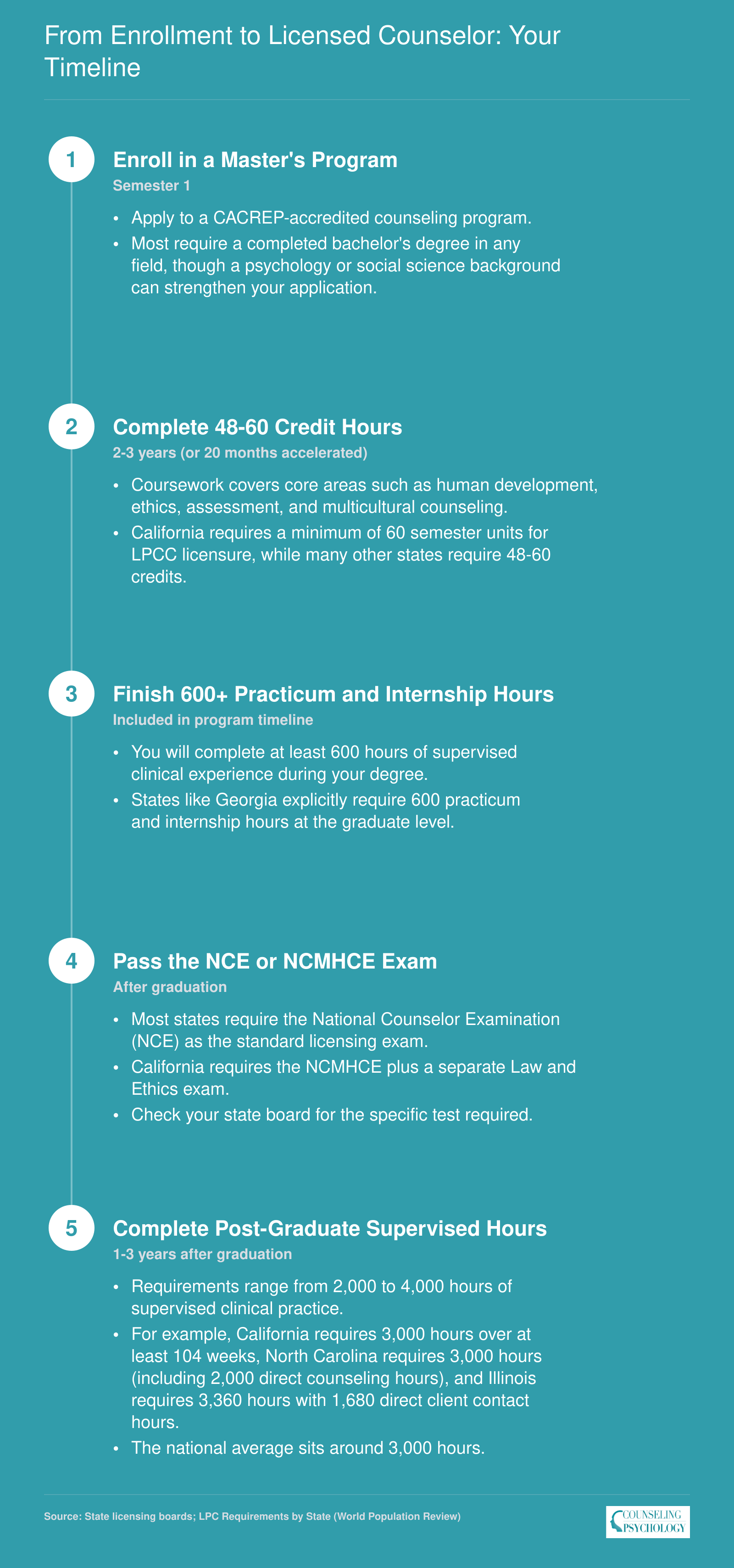
Most CACREP master's programs require 600 to 1,000 supervised hours during the program (practicum and internship). After graduation, you'll need 2,000 to 4,000 more supervised hours for licensure. Plan your time and finances for both stages now.
Frequently Asked Questions About Counseling Schools
Choosing a counseling program raises practical questions about timelines, credentials, and admissions. Below are answers to the questions prospective students ask most often, drawn from current CACREP standards and program data for the 2025-2026 cycle.
- What is the quickest counseling degree to get?
- A certificate or associate degree in human services can be completed in one to two years, but these credentials do not qualify you for licensure as a professional counselor. The fastest path to licensure is a 60-credit master's degree in counseling, which most full-time students finish in two to three years. Accelerated formats and year-round scheduling can shorten that timeline slightly.
- What degree is best for counseling?
- A master's degree in counseling from a CACREP-accredited program is widely considered the gold standard. It meets licensure requirements in every U.S. state and covers the clinical training, practicum hours, and coursework that employers expect. Specializations such as clinical mental health counseling, school counseling, and marriage and family therapy let you tailor the degree to your career goals.
- How long do counselors go to college?
- Most licensed counselors complete four years of undergraduate study followed by two to three years of graduate work, totaling six to seven years of college. After earning a master's degree, you will also need one to two years of supervised post-graduate clinical experience before you can apply for independent licensure in most states.
- How do I find accredited counseling programs near me?
- Start with the CACREP directory, which lets you search accredited programs by state and specialization. You can also use the program finder on counselingpsychology.org to compare nearby schools by format, cost, and outcomes. Always verify that a program's accreditation is current before applying, because accreditation status can change between review cycles.
- What is the difference between a counseling degree and a psychology degree?
- A counseling degree emphasizes applied clinical skills, practicum training, and direct client work. A psychology degree leans more toward research methodology, assessment, and theory. At the master's level, counseling graduates typically pursue Licensed Professional Counselor (LPC) credentials, while psychology graduates may aim for roles in research, testing, or further doctoral study to become licensed psychologists.
- Can I get a counseling degree online?
- Yes. Many CACREP-accredited programs now offer fully online coursework, including schools like Sacred Heart University and Walden University. Keep in mind that every accredited program still requires in-person practicum and internship hours at an approved clinical site near you. Online formats are especially popular among working professionals and career changers who need scheduling flexibility.
- What GPA and test scores do I need to get into a counseling master's program?
- Most CACREP-accredited programs require a minimum undergraduate GPA between 2.7 and 3.0. The GRE is increasingly optional; schools such as Northwestern University and Butler University now offer GRE waivers. Programs also consider personal statements, recommendation letters, and relevant experience, so a slightly lower GPA does not automatically disqualify you.
- Do counseling programs accept career changers without a psychology undergraduate degree?
- Yes. CACREP-accredited master's programs require a bachelor's degree but do not mandate a specific major. Career changers from fields like education, social work, business, and nursing are commonly admitted. Some programs may ask you to complete a few prerequisite courses in human development or introductory psychology, but these can often be taken alongside your graduate coursework.
Explore Schools
Explore More
- Best Online Addiction Psychology Degree
- Best Online Graduate Certificate in Counseling
- Counseling Careers
- Counseling Degrees
- Counseling Licensure Acronyms
- Counseling Master's Textbooks
- Counseling Psychology Master's Degree Guide
- Counselor Resume Guide
- Counselor Salary
- Online Counselor
- How to Get a Counseling License
- Should I Become a Therapist? How to Know If It's Right