

What you’ll learn in this article…
- BLS projects substance abuse, behavioral disorder, and mental health counselor jobs to grow 19% from 2022 to 2032, well above average.
- State supervised-hour requirements range from about 2,000 to 4,000, meaning your location can shift your licensure timeline by years.
- National median pay for mental health counselors is roughly $53,710, while marriage and family therapists earn about $58,510.
- Most counseling careers require a master's degree, a supervised practice period, and passing a national licensing exam.
BLS projects 19% growth for mental health and substance abuse counselors over the 2024 to 2034 decade, roughly four times the projected average for all U.S. jobs. That expansion translates into demand across school, clinical, and private practice settings, but not all specialties grow at the same rate or require the same credentials. Becoming a licensed professional clinical counselor, marriage and family therapist, or school counselor means committing to a master's degree, 2,000 to 4,000 supervised hours, and a state exam. Pay varies sharply by specialty and geography: the national median for these counselors sits near $53,710, while the top quarter earns over $75,000. Your specialization choice determines the clients you see and the license you carry for decades.
What Does a Counselor Do?
Core Responsibilities
Counselors help clients navigate emotional, psychological, and behavioral challenges through a structured therapeutic process. At the center of this work is assessment: gathering client history, identifying presenting concerns, and sometimes using standardized tools to clarify diagnoses or treatment needs. From there, counselors collaborate with clients to develop individualized treatment plans with clear goals. The bulk of the work involves one-on-one or group therapy sessions, where counselors use evidence-based techniques like cognitive-behavioral therapy, motivational interviewing, or solution-focused approaches. Crisis intervention is another critical duty; counselors must quickly assess risk, stabilize a situation, and coordinate emergency care when needed. Throughout, they maintain thorough clinical documentation and regularly connect clients with external resources through referrals to psychiatrists, support groups, or social services.
A Typical Day's Rhythm
A counselor's daily schedule depends heavily on their work setting, but a few patterns are common. In outpatient settings, many counselors see 4 to 6 clients per day, with each session lasting about one hour.1 For those in community mental health, that might mean 4 to 6 sessions, with the remaining time filled by team meetings, care coordination calls, and triage duties.2 Private practitioners may block off mornings for documentation and administrative tasks, then see three clients in the afternoon, though some spread sessions across the day with a free hour for notes.3 Documentation generally takes dedicated time daily, whether it happens between sessions or in a block at the end of the day. Non-clinical tasks like scheduling, billing, phone follow-ups, and consultation with other providers are woven throughout. For a closer look at how these hours break down, see our guide on a typical work day for a Licensed Professional Counselor.
How Counselors Differ from Other Mental Health Professionals
It is easy to confuse counselors with other roles, but key distinctions exist. Counselors focus on talk therapy and skill-building for specific life challenges, mental health conditions, and personal growth. Their training is typically a master's degree in counseling, followed by supervised clinical hours and a state license. Psychologists hold a doctoral degree (PhD or PsyD) and often specialize in psychological testing, research, and treating complex disorders. Those interested in clinical work at the doctoral level can explore how to become a clinical psychologist. Psychiatrists are medical doctors who can prescribe medication and manage the biological aspects of mental health. Social workers share many counseling skills but approach care from a broader systems perspective, often connecting clients to community resources and advocating for policy changes. While there is overlap, counselors' scope is rooted in therapeutic relationships and wellness-oriented models rather than medical diagnosis or case management alone.
Where Counselors Work
Counselors practice in a wide range of environments, each shaping the pace and focus of their day. Private practice offers autonomy but also demands business acumen. Schools employ counselors to support academic, career, and social-emotional development. Hospitals and clinics integrate counselors into interdisciplinary teams, often working with patients facing acute or chronic conditions. Community mental health agencies serve diverse populations with high needs, frequently blending therapy with case coordination. Telehealth has expanded rapidly, allowing counselors to serve clients remotely. This variety means that no two counseling careers are identical, a theme the next section explores in depth.
Types of Counseling Careers and Specialties
What can you actually do with a master's degree in counseling? The answer depends heavily on which specialty you choose, because counseling is not a single profession but a broad field with distinct paths, client populations, and licensure credentials tied to each one.
Core Counseling Specialties
- Mental health counseling: The most common path for master's graduates, mental health counselors work with individuals, families, and groups dealing with anxiety, depression, trauma, and other psychological concerns. Settings range from outpatient clinics and community mental health centers to private practice. Licensure typically falls under titles like Licensed Professional Counselor (LPC) or Licensed Mental Health Counselor (LMHC), depending on the state.
- School counseling: School counselors support students from kindergarten through high school, addressing academic planning, social-emotional development, and crisis intervention. Most positions require a state-issued school counseling credential in addition to a master's degree, separate from a clinical counseling license. For a detailed look at the education and credentialing process, see our guide on how to become a school counselor.
- Substance abuse and addiction counseling: Counselors in this specialty work with individuals struggling with alcohol, drug, or behavioral addictions in settings such as residential treatment programs, outpatient clinics, and correctional facilities. Many states offer a dedicated credential, such as a Licensed Alcohol and Drug Counselor (LADC) or Certified Alcohol and Drug Counselor (CADC).
- Marriage and family therapy (MFT): MFTs focus on relational and systemic issues, treating couples and family units rather than solely individuals. This specialty has its own licensure pathway in most states and is recognized as a distinct profession from general mental health counseling.
- Career counseling: Career counselors help clients navigate job transitions, educational decisions, and career development. They work in college career centers, workforce development agencies, and private practice. The National Certified Career Counselor (NCCC) credential is one recognized certification in this area.
- Rehabilitation counseling: These counselors assist people with physical, developmental, or psychiatric disabilities in achieving independence and employment goals. Settings include vocational rehabilitation agencies, hospitals, and nonprofit organizations. The Certified Rehabilitation Counselor (CRC) credential is the primary certification for this specialty.
- Crisis counseling: Crisis counselors respond to acute psychological emergencies, including suicide risk, domestic violence, and community disasters. This work appears in hospital emergency departments, crisis hotlines, and disaster response teams. It requires strong de-escalation skills and often intersects with other specialties.
- Grief counseling: Grief counselors support individuals and families processing loss, whether from death, divorce, or major life change. Many licensed mental health counselors incorporate grief work into their practice, and some pursue additional training through certifications offered by professional associations.
Emerging and Growth Areas
Two niches are expanding rapidly and are worth noting for anyone mapping out a counseling career path. Telehealth counseling has moved from a workaround to a mainstream delivery model, opening geographic flexibility for both counselors and clients; those interested can explore the specifics of becoming a telehealth therapist. Integrated behavioral health places counselors directly inside primary care settings, where they collaborate with physicians and nurses to address mental health as part of whole-person care. Both areas reward counselors who are comfortable with interdisciplinary teamwork and technology-assisted service delivery. For a broader look at which roles are seeing the highest demand, our overview of the nation's most needed counseling specialists is a useful starting point.
Because each specialty can require a different license, certification, or both, it pays to research the specific credential requirements in your state early in the process, ideally before selecting a graduate program.
Counseling Career Comparison Table
Choosing among counseling specialties often comes down to balancing how much education you are willing to invest against how quickly the field is growing and how many positions open each year. The table below puts the most common counseling career paths side by side so you can weigh those tradeoffs at a glance.
How to Read the Table
Each row represents a distinct occupation as classified by the Bureau of Labor Statistics. Projected job growth covers the decade from 2024 to 2034, and the "typical entry education" column reflects the minimum credential most employers expect for entry-level roles. Keep in mind that licensure requirements in many states exceed the BLS entry-level benchmark: for example, substance abuse and mental health counselors often need a master's degree for independent licensure even though some entry positions accept a bachelor's. If you are still weighing degree types, our comparison of counseling, psychology, or social work degrees can help you narrow the options.
| Counseling Occupation | Typical Entry Education | Projected Growth (2024-2034) | Estimated Annual Openings |
|---|---|---|---|
| Substance Abuse, Behavioral Disorder, and Mental Health Counselors | Bachelor's degree | 17% | 48,300 |
| Marriage and Family Therapists | Master's degree | 15% | Not yet published |
| School and Career Counselors and Advisors | Master's degree | 4% | Not yet published |
| Rehabilitation Counselors | Master's degree | Data not yet available | Data not yet available |
Key Takeaways from the Numbers
A few patterns are worth calling out.
- Fastest growth: Substance abuse, behavioral disorder, and mental health counselors lead the pack with 17% projected growth, more than triple the rate for school and career counselors.1 That translates to roughly 48,300 openings per year across the country, driven by expanded insurance coverage for behavioral health and growing public demand for mental health services.2
- Marriage and family therapy: At 15% projected growth, this specialty is also expanding well above the average for all occupations.2 Annual opening estimates for this category have not yet been published by BLS for the current projection window.
- School and career counseling: The 4% growth rate is more modest, but the field is large and stable, anchored by K-12 systems and higher education institutions that maintain counseling staff regardless of economic cycles.3
- Rehabilitation counseling: BLS has not released updated growth projections for this occupation under the current projection period. If you are considering this path, check back with the Occupational Outlook Handbook for the latest figures.
What the Table Does Not Show
Salary, licensure timelines, and day-to-day work environments vary significantly within each of these categories. A mental health counselor in private practice, for instance, faces a very different compensation structure than one employed by a community health center. You can explore counselor salary by state for a detailed look at regional pay differences, and the sections that follow on this page dig into licensure steps and the pros and cons of each path so you can layer those details on top of the growth picture above.
Total employment for substance abuse, behavioral disorder, and mental health counselors stood at roughly 483,500 as of 2024, making it the largest single counseling occupation by headcount.1 That scale means more job listings to choose from but also more competition in popular metro areas, a dynamic explored further in the salary comparison tables below.
Questions to Ask Yourself
Counseling Salaries by State and Metro Area
Counselor pay varies considerably depending on where you practice and which specialty you pursue. The table below draws on BLS state-level data for two common counseling occupations: Substance Abuse, Behavioral Disorder, and Mental Health Counselors (SOC 21-1018) and Marriage and Family Therapists (SOC 21-1013). Salaries reflect annual medians for each state, so you can compare earning potential across regions before choosing a counseling career path.
| State | Mental Health Counselor Median Salary | Marriage and Family Therapist Median Salary |
|---|---|---|
| Alaska | $79,220 | $62,220 |
| New Jersey | $64,710 | $89,030 |
| Utah | $65,920 | $81,170 |
| Oregon | $69,660 | $79,890 |
| Connecticut | $62,960 | $76,930 |
| New Mexico | $70,770 | $67,990 |
| Colorado | $59,190 | $69,990 |
| New York | $62,070 | $65,020 |
| California | $61,310 | $63,780 |
| Illinois | $59,570 | $60,140 |
| Vermont | $60,410 | $61,060 |
| Maine | $60,970 | $68,670 |
| Iowa | $60,880 | $61,450 |
| Nebraska | $64,410 | $68,550 |
| Massachusetts | $59,030 | $62,290 |
| Washington | $64,220 | $59,660 |
| Arizona | $63,830 | N/A |
| Wisconsin | $62,470 | N/A |
| Texas | $60,630 | N/A |
| North Dakota | $66,450 | N/A |
| District of Columbia | $66,140 | N/A |
| Idaho | $65,240 | N/A |
| Wyoming | $61,640 | N/A |
| Michigan | $59,530 | N/A |
| Nevada | $59,470 | N/A |
Related Articles
Highest-Paying Metro Areas for Counselors
Geography plays a major role in counseling salaries. The table below highlights metro areas where substance abuse, behavioral disorder, and mental health counselors or marriage and family therapists earn the highest median wages, according to BLS data. Keep in mind that metros with higher pay often carry a higher cost of living, so weigh salary figures against local expenses before making a move.
| Metro Area | Counseling Occupation | Total Employment | Median Annual Wage | 25th Percentile | 75th Percentile |
|---|---|---|---|---|---|
| San Jose-Sunnyvale-Santa Clara, CA | Marriage and Family Therapists | 1,220 | $88,950 | $59,560 | $123,430 |
| New York-Newark-Jersey City, NY-NJ | Marriage and Family Therapists | 2,900 | $86,120 | $70,660 | $97,670 |
| Portland-Vancouver-Hillsboro, OR-WA | Marriage and Family Therapists | 700 | $84,810 | $65,400 | $137,950 |
| Salt Lake City-Murray, UT | Marriage and Family Therapists | 760 | $81,170 | $60,780 | $95,570 |
| Philadelphia-Camden-Wilmington, PA-NJ-DE-MD | Marriage and Family Therapists | 2,060 | $80,090 | $62,830 | $89,030 |
| San Francisco-Oakland-Fremont, CA | Marriage and Family Therapists | 3,400 | $76,980 | $57,980 | $104,970 |
| Minneapolis-St. Paul-Bloomington, MN-WI | Marriage and Family Therapists | 2,490 | $72,910 | $59,780 | $83,830 |
| San Francisco-Oakland-Fremont, CA | Substance Abuse, Behavioral Disorder, and Mental Health Counselors | 8,080 | $72,950 | $54,110 | $108,410 |
| Sacramento-Roseville-Folsom, CA | Marriage and Family Therapists | 1,270 | $72,810 | $49,010 | $96,480 |
| Seattle-Tacoma-Bellevue, WA | Substance Abuse, Behavioral Disorder, and Mental Health Counselors | 7,040 | $65,290 | $53,890 | $81,230 |
| New York-Newark-Jersey City, NY-NJ | Substance Abuse, Behavioral Disorder, and Mental Health Counselors | 23,790 | $64,900 | $52,770 | $81,680 |
| Los Angeles-Long Beach-Anaheim, CA | Marriage and Family Therapists | 12,400 | $64,420 | $47,050 | $91,580 |
| Phoenix-Mesa-Chandler, AZ | Substance Abuse, Behavioral Disorder, and Mental Health Counselors | 6,830 | $63,990 | $50,190 | $82,350 |
| Washington-Arlington-Alexandria, DC-VA-MD-WV | Substance Abuse, Behavioral Disorder, and Mental Health Counselors | 7,590 | $63,170 | $50,280 | $83,780 |
| Chicago-Naperville-Elgin, IL-IN | Substance Abuse, Behavioral Disorder, and Mental Health Counselors | 14,010 | $61,150 | $47,980 | $83,770 |
National Salary Snapshot for Counseling Occupations
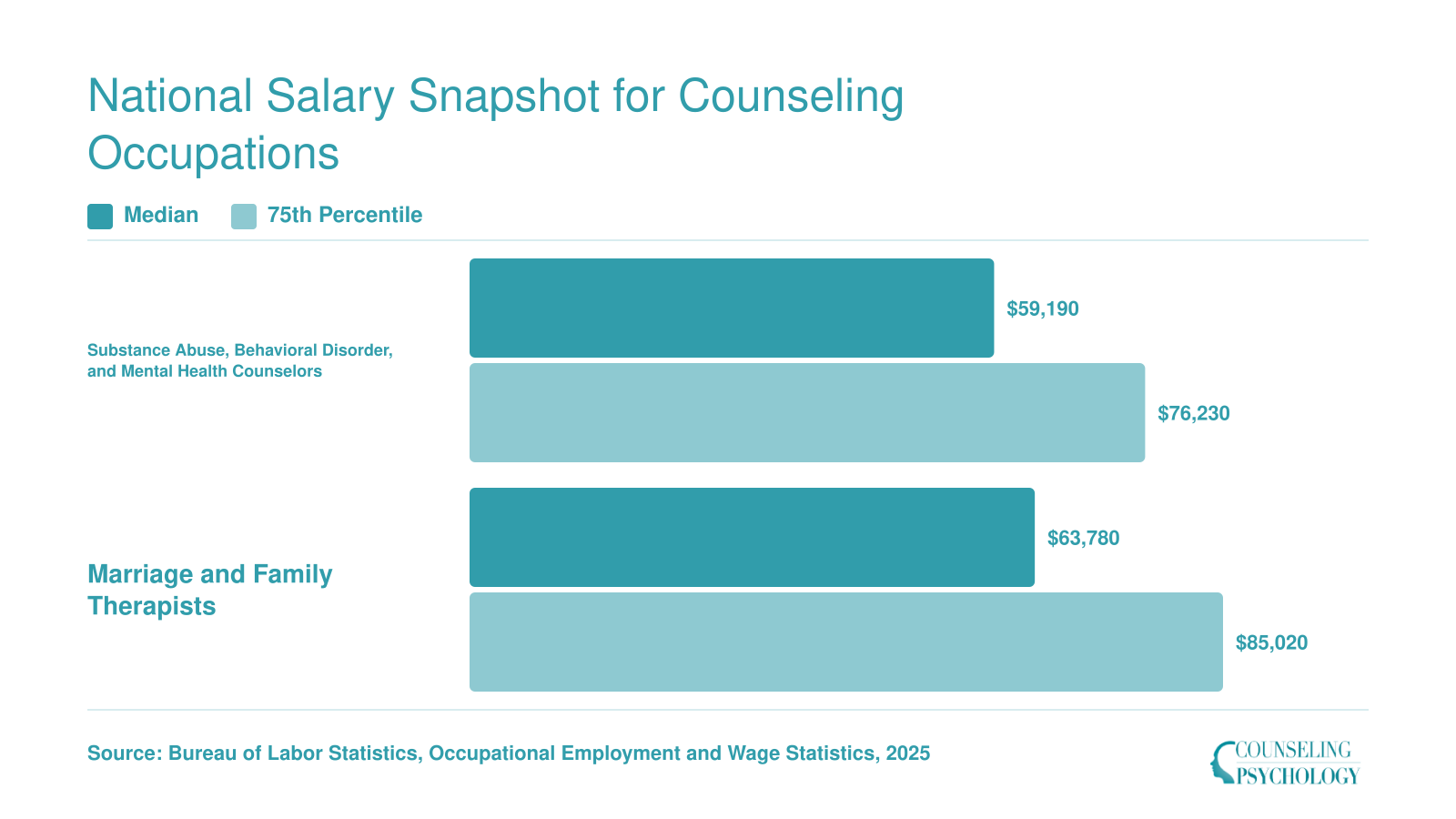
How do salaries compare across two of the largest counseling occupations? The chart below uses national BLS data to illustrate median and 75th-percentile annual wages. Substance abuse, behavioral disorder, and mental health counselors represent roughly 440,380 employed professionals, with salaries ranging from about $47,170 at the 25th percentile to $76,230 at the 75th percentile. Marriage and family therapists, a smaller field of approximately 65,870 workers, earn from roughly $48,600 to $85,020 across the same span.
How to Become a Counselor: Step-By-Step
Becoming a licensed counselor is a structured, multi-year process, and every step builds directly on the one before it.
Step 1: Earn a Bachelor's Degree
Most aspiring counselors begin with an undergraduate degree in psychology, social work, sociology, or a closely related field. Your bachelor's major does not lock you into a single counseling specialty, but coursework in human development, research methods, and abnormal psychology gives you a meaningful head start. Plan on four years for this stage.
Step 2: Complete a Master's Degree in Counseling
A master's degree is the minimum credential required for licensure in every state. There are no exceptions. Programs accredited by the Council for Accreditation of Counseling and Related Educational Programs (CACREP) are the gold standard, and some states explicitly require or prefer graduation from a CACREP-accredited program. These programs typically run 60 credit hours and take two to three years to complete. They combine coursework in counseling theory, ethics, multicultural competency, and diagnosis with a supervised practicum and internship embedded in the curriculum.
Career changers coming from unrelated fields have options. Post-baccalaureate certificate programs can build foundational knowledge before master's-level enrollment, and accelerated master's tracks compress the timeline for students who can commit to a heavier course load. Some states also accept a related master's degree in psychology or social work if the applicant completes specific bridge coursework in counseling.
Step 3: Accumulate Supervised Clinical Hours
After graduation, candidates must log supervised post-degree clinical hours before sitting for a licensure exam. The required number varies by state, typically falling somewhere between 2,000 and 4,000 hours. This work is usually performed under a licensed clinical supervisor and often takes two to three years at full-time pace.
Step 4: Pass a Licensure Exam
The two most common national exams are the National Counselor Examination (NCE) and the National Clinical Mental Health Counseling Examination (NCMHCE). Which exam a state accepts, or requires, depends on the license type being sought.
Step 5: Apply for State Licensure and Enter Independent Practice
Once exam scores are verified, candidates submit a formal application to their state licensing board. After approval, the licensed counselor can practice independently, open a private practice, bill insurance, and pursue additional specialty certifications. Some counselors choose to specialize further; for example, those drawn to K-12 settings can explore how to become a school counselor.
End to end, the journey from the first day of a bachelor's program to full independent licensure typically spans seven to nine years. For state-specific hour requirements, exam rules, and application procedures, the licensure section of counselingpsychology.org provides detailed breakdowns by state.
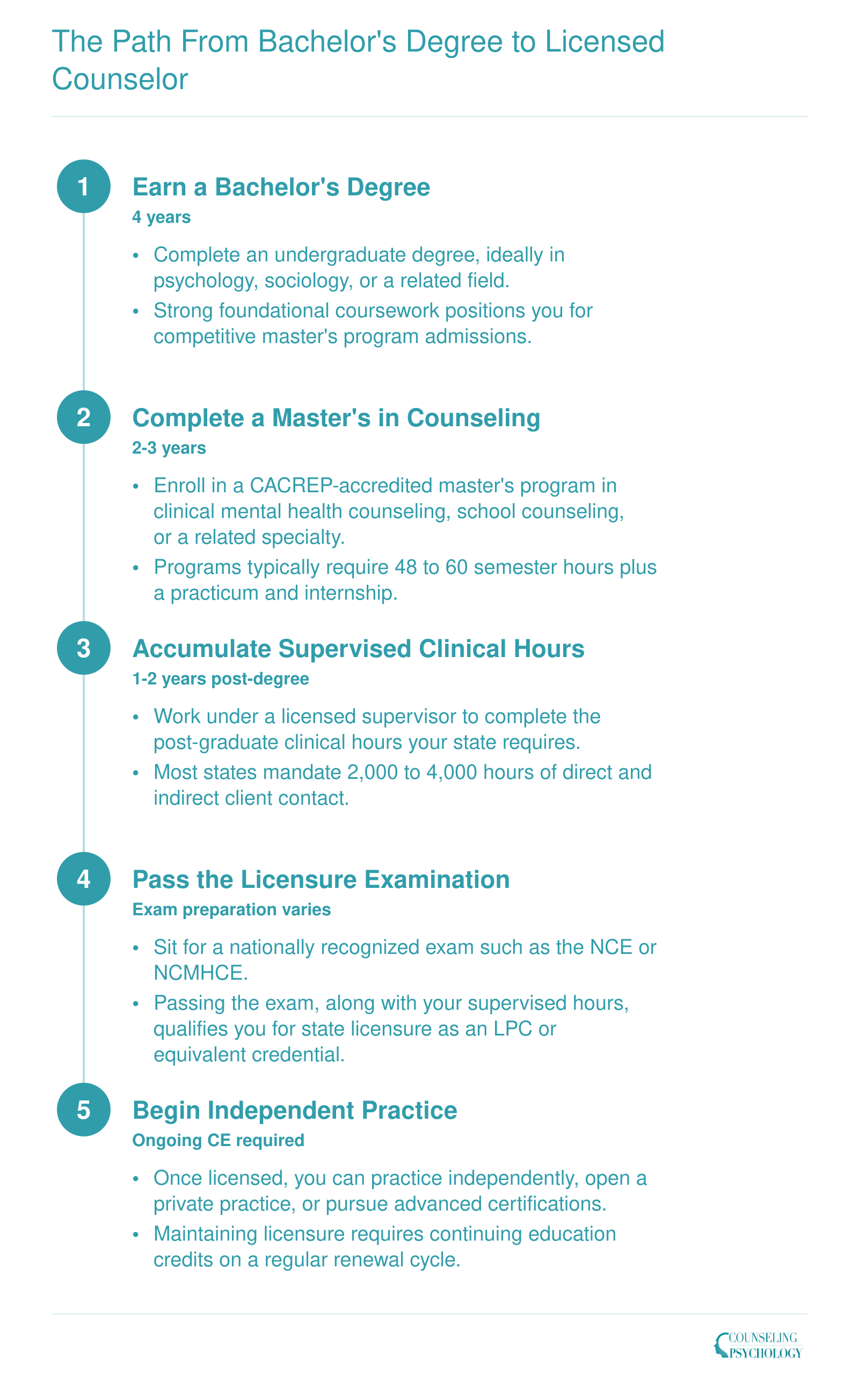
The Path From Bachelor's Degree to Licensed Counselor
Most counseling careers follow a clear credentialing ladder. From start to finish, expect roughly five to eight years of education, supervised practice, and examination before you can practice independently.
Counseling Licensure Requirements by State
Supervised postgraduate hours required for independent counseling licensure range from roughly 2,000 to 4,000 across U.S. states, which means where you train and plan to practice can shape your timeline by years.1 Understanding the key variables before you choose a program or a state to settle in is one of the most practical steps you can take early in your career.
Credential Titles and What They Signal
The most common independent licenses are the Licensed Professional Counselor (LPC), the Licensed Mental Health Counselor (LMHC), and the Licensed Clinical Professional Counselor (LCPC).1 A handful of states use variations like LPC-MHSP. The title alone does not reflect a difference in scope of practice so much as the tradition each state legislature followed when it created its counseling statute. Regardless of title, all licensing exams are administered through the National Board for Certified Counselors (NBCC), which offers two primary exams: the NCE and the NCMHCE.2
States that issue LPC-type licenses generally require the NCE, while states using the LMHC credential, including Florida, typically require the NCMHCE.3 California, which licenses counselors as Licensed Professional Clinical Counselors (LPCC), also requires the NCMHCE.
How States Differ on Supervised Hours
The hour requirements illustrate just how wide the variation is:
- Florida (LMHC): 1,500 supervised hours, completed within a two-year period3
- Colorado: 2,000 hours
- Georgia: 2,400 hours
- Alabama, Arizona, and California (LPCC): 3,000 hours each
Some states push toward 4,000 hours, particularly those that distinguish between hours of direct client contact and broader supervised experience. Most states also require a master's degree aligned with CACREP standards or an equivalent program of study, so accreditation matters when you are selecting a graduate program.2
Interstate Practice and the Counseling Compact
Telehealth has made the question of where your license is valid far more consequential than it once was. A counselor licensed in one state cannot legally see clients in another state without separate licensure, unless both states participate in the Counseling Compact. As of early 2026, more than 35 states and the District of Columbia have enacted the Compact, though only a small group, including Arizona, Louisiana, Minnesota, and Ohio, had moved to live operational status by April 2026.4 More states are expected to go live through 2026 and beyond.
For counselors who see clients across state lines or who relocate frequently, compact membership can eliminate what would otherwise be a lengthy and costly relicensure process in each new state. You can review the full process for getting a counseling license to see how these requirements fit into the broader credentialing pathway.
Where to Find State-Specific Details
Because requirements change when state legislatures update their statutes, the figures above reflect conditions as reported in 2025 and should be verified against current state licensing board publications before you rely on them for planning.
Burnout in the helping professions is more common than many students expect. An American Psychological Association survey found that 45% of U.S. licensed psychologists reported feeling burned out in 2022. While that figure covers psychologists specifically, it points to real wellness challenges across counseling-related fields.
Pros and Cons of a Counseling Career
Is a counseling career worth the emotional demands? That is one of the most practical questions prospective counselors ask, and it deserves a candid answer. Like most helping professions, counseling offers deep personal rewards alongside real workplace challenges. Understanding both sides before you commit to the path can save you from costly surprises later.
The Rewards
The most consistently cited benefit of counseling work is what researchers call compassion satisfaction: the sense of fulfillment that comes from making a meaningful difference in someone's life.1 For many counselors, this intrinsic reward is strong enough to sustain a long career even when the work is difficult.
Flexibility is another genuine advantage, particularly for counselors who move into private practice. Setting your own schedule, choosing your client load, and deciding how you structure your week are freedoms that most salaried professionals do not have. The expansion of telehealth has added another layer of flexibility, with many counselors reporting improved work-life balance since remote sessions became standard practice.2 Work-life balance consistently ranks among the top factors workers say makes their job sustainable.2
Counselors who rely on evidence-based practices also report lower burnout rates compared to peers who do not, which means professional development directly protects your well-being.3 If you are still weighing whether to enter the field, exploring the pros and cons of enrolling in an online master's degree in psychology can help you evaluate the educational investment alongside these career benefits.
The Challenges
Burnout is a documented occupational hazard in this field. A 2022 American Psychological Association report found that roughly 45 percent of psychologists showed signs of burnout, a figure that reflects the broader strain the pandemic placed on mental health professionals.4 Counselors are not immune to the same pressures.
Heavy caseloads and difficult work settings are the two factors most strongly linked to burnout among mental health professionals.1 Counselors working in community mental health centers, correctional facilities, or inpatient settings often carry large caseloads with limited administrative support, which compounds the emotional weight of the work.
Other practical drawbacks include modest starting salaries relative to the level of graduate education required, significant licensure hurdles that vary by state, and the ongoing emotional cost of working with clients in crisis.
How to Weigh Both Sides
The counselors who thrive long-term tend to be intentional about their specialty, their work setting, and their own self-care practices. Going in with clear eyes about the challenges, while recognizing the genuine rewards, puts you in a stronger position to build a sustainable career rather than burning out in the first five years.
Counseling Career Outlook and Job Growth
The counseling profession is expanding at a pace that far exceeds the average for all U.S. occupations, creating a promising landscape for both new graduates and experienced practitioners.
Projected Growth Outpaces National Averages
The Bureau of Labor Statistics projects particularly strong growth for substance abuse, behavioral disorder, and mental health counselors, with a 17% increase in jobs from 2024 to 2034.1 That rate is more than five times the 3.1% average for all occupations combined.2 School and career counselors are expected to see 4% growth, generating roughly 31,000 openings each year.3 Other specialties also show momentum: marriage and family therapists are experiencing demand similar to mental health counselors, while rehabilitation counselors will see more modest but steady expansion as the field adapts to evolving healthcare delivery models. For context, community and social service occupations as a whole are projected to grow 6.6%, and the broader healthcare and social assistance sector is growing at 8.4%, underscoring that counseling sits at the heart of one of the economy's fastest-growing segments.2
What's Driving Demand for Counselors?
Several forces are converging to fuel the need for counselors: - Insurance coverage and parity: Expanded mental health benefits under the Affordable Care Act and stronger enforcement of parity laws mean more Americans can access counseling services without prohibitive out-of-pocket costs. - Post-pandemic awareness: The COVID-19 pandemic accelerated public acceptance of mental health support, reducing stigma and increasing help-seeking across all age groups. - Substance-use crisis: Federal and state investments in opioid treatment and prevention programs continue to create new positions for addiction and behavioral disorder counselors. - School counselor mandates: A growing number of states are mandating lower student-to-counselor ratios, directly boosting hiring in K-12 settings.
To understand which roles are seeing the strongest demand, explore the best jobs for a mental health counselor.
Telehealth Expands Access and Job Opportunities
The rapid adoption of telehealth has fundamentally altered where and how counselors can work. Practitioners in rural or underserved areas can now build caseloads that include clients from across their state, or even multiple states, thanks to the Counseling Compact, which streamlines licensure portability among participating states. This flexibility not only improves client access but also allows counselors to live in lower-cost areas while serving higher-demand markets, broadening the geography of opportunity.
Where Hiring Is Accelerating Fastest
Certain settings are adding counseling positions at an especially brisk clip: - Community mental health centers provide safety-net services and are often the first stop for individuals newly covered by expanded insurance. - Veterans Affairs and military facilities are ramping up behavioral health staffing to meet the needs of service members and veterans. - School districts are hiring additional counselors as student wellness initiatives grow and state mandates tighten caseload limits. - Integrated primary-care settings embed counselors alongside physicians and nurses, recognizing that mental and physical health are inseparable, a model that continues to gain traction in large health systems.
The ongoing mental health workforce shortage reinforces these trends. Taken together, they point to a durable, multi-decade expansion for counseling professions. While growth rates vary by specialty and location, the overall trajectory is one of increasing opportunity and societal investment in mental health.
Frequently Asked Questions About Counseling Careers
Below are answers to some of the most common questions prospective counselors ask. Where possible, we reference specific sections of this guide so you can dig deeper into the topics that matter most to you.
Explore Careers
Explore More
- Best Counseling Schools Near Me
- Best Online Addiction Psychology Degree
- Best Online Graduate Certificate in Counseling
- Counseling Degrees
- Counseling Licensure Acronyms
- Counseling Master's Textbooks
- Counseling Psychology Master's Degree Guide
- Counselor Resume Guide
- Counselor Salary
- Online Counselor
- How to Get a Counseling License
- Should I Become a Therapist? How to Know If It's Right