
What you’ll learn in this article…
- CACREP accreditation ensures identical standards for online and on-campus counseling programs, simplifying licensure in most states.
- Annual in-state tuition across top-ranked programs ranges from roughly $6,650 to $12,140.
- BLS projects 17% employment growth for mental health and substance abuse counselors through 2033, adding about 81,100 jobs.
- Most students finish an online counseling master's in two to four years, depending on enrollment pace and clinical placement schedules.
Demand for licensed counselors is rising faster than most clinical fields: the Bureau of Labor Statistics projects 17% employment growth for mental health and substance abuse counselors through 2033, well above the national average for all occupations. Against that backdrop, more than two dozen accredited universities now offer master's-level counseling programs with fully online or hybrid delivery, including public flagships such as Florida State University and NC State as well as private institutions like Northwestern University.
Tuition spread across the 29 ranked programs is wide. Annual in-state rates start below $6,700 at some public universities and exceed $54,000 at selective private schools. That range makes program comparison genuinely complex, because cost alone does not determine value: CACREP accreditation status, clinical hour requirements, and your target state's licensure rules all bear directly on whether a degree leads to licensure at all.
Specialization choice adds another layer. Clinical mental health counseling, school counseling, and marriage and family therapy each carry distinct licensure tracks, supervised hour thresholds, and exam requirements that vary by state. Selecting a program without confirming its alignment to your state board's standards is the single most avoidable mistake prospective students make.
Best Online Master's in Counseling Programs
The programs below represent our 2026 picks for the best online master's in counseling, selected from accredited institutions that offer coursework primarily or entirely online. Rather than ranking by a single metric, we ordered them using a mixed quality composite that weighs institution-wide graduation rates, post-graduation earnings outcomes, and affordability signals such as net price and median graduate debt. The result is a balanced list that rewards programs combining strong completion records, solid career returns, and reasonable cost, giving you a well-rounded starting point for your search.
- Institution-wide graduation rates
- Post-graduation earnings outcomes
- Net price and affordability signals
- Program accreditation and specializations
- Clinical training and licensure alignment
- NCES-IPEDS federal institutional data — nces.ed.gov
- College Scorecard graduate earnings — collegescorecard.ed.gov
- Internal program database
- Independent program research

Florida State University
Florida State University pairs a CACREP-accredited online School Counseling program with a strong institutional track record: an 85.6% institution-wide graduation rate and a net price of $11,297. The program is tailored to prepare graduates for Florida K-12 school counselor certification using data-driven strategies to close achievement gaps, and faculty coordinate practicum and internship placements within Florida school districts. A GRE waiver remains in effect through Fall 2026, lowering one common barrier to entry for working educators.
- CACREP-accredited online program
- No GRE required through Fall 2026
- Prepares for Florida K-12 school counselor certification
- Faculty-coordinated practicum placements statewide
- Data-driven strategies for closing achievement gaps
- Combines master's and specialist degree options
- Minimum 3.0 GPA required for admission
Master's in School Counseling — Online

Northwestern University
Northwestern University stands out for the breadth of its online counseling offerings: a COAMFTE-accredited MS in Marriage and Family Therapy, a CACREP-accredited MA in Counseling with a Child and Adolescent specialization, and a general Clinical Mental Health Counseling track. Delivered through The Family Institute, all three programs use synchronous online classes and a nationwide clinical placement network. The institution-wide graduation rate is 95.1%, and a 6:1 student-to-faculty ratio supports close mentorship, though the sticker-price tuition of $54,655 is substantially higher than public-university peers.
- COAMFTE-accredited online program
- 400 clinical hours including 100 relational hours
- Full-time completion in as few as 21 months
- Part-time option extends to 36 months
- Synchronous live class sessions in small cohorts
- Nationwide clinical placement assistance
- No GRE required for admission
- CACREP-accredited with live online instruction
- 24 graduate-level courses required
- 200-hour practicum plus 600-hour internship
- Standard and Bridge program options available
- Faculty are practicing counselors
- Completion in 18 to 36 months
- CACREP-accredited child and adolescent focus
- One of few online programs with this specialty
- Designed for youth-focused agencies and schools
- Faculty-approved clinical field placements
- Self-reflective and experiential learning model
- 18 to 36 months to complete
Master of Science in Marriage and Family Therapy — Online
Master of Arts in Counseling, Clinical Mental Health Counseling — Online
Master of Arts in Counseling, Child and Adolescent Specialization — Online

University of Oklahoma-Norman Campus
The University of Oklahoma's 60-credit Master of Clinical Mental Health Counseling is built around a hybrid format with weekend and online coursework across Norman, Tulsa, and Oklahoma City. It prepares graduates for Oklahoma LPC licensure with a multicultural curriculum that emphasizes partnerships with tribal health agencies, VA facilities, and rural community mental health centers. In-state tuition sits at $9,353, making it one of the more affordable options on this list, and no GRE is required.
- 60-credit hour program preparing for LPC licensure
- Hybrid format with weekend and online coursework
- No GRE required for admission
- Minimum 2.5 GPA for application
- Non-thesis option available
- Partnerships with tribal and VA clinical sites
- Focus on multicultural and social justice competencies
- Serves Norman, Tulsa, and OKC learning sites
Master of Clinical Mental Health Counseling — Hybrid

William & Mary
William & Mary offers two distinct CACREP-accredited online counseling tracks: a School Counseling M.Ed. and a Clinical Mental Health Counseling M.Ed. with a Military and Veterans Counseling concentration. Both leverage Virginia-based field partnerships, including K-12 districts across Hampton Roads and military-connected organizations near major installations. The institution-wide graduation rate is 89.4%, and online students complete short campus residencies that double as networking events with Virginia school and agency leaders.
- CACREP-accredited online program
- Prepares for K-12 school counseling licensure
- Two on-campus residencies required
- Focus on social justice and diversity
- Can be completed in three years
- Small class sizes with a dynamic online platform
- CACREP-accredited 60-credit program
- Specialization in military and veterans populations
- Partnerships with VA facilities and military orgs
- Includes practicum and internship fieldwork
- Prepares for Virginia LPC licensure
- Online format with dedicated faculty mentorship
M.Ed. in Counseling, School Counseling — Online
M.Ed. in Counseling, Clinical Mental Health Counseling (Military and Veterans Counseling) — Online

The University of Texas Rio Grande Valley
The University of Texas Rio Grande Valley offers one of the lowest net prices on this list at $4,831, serving a student body deeply connected to the South Texas border region. Its CACREP-accredited M.Ed. in Counseling with a Clinical Mental Health Counseling concentration prepares graduates for Texas LPC licensure and optional School Counselor Certification. Coursework and clinical placements emphasize bilingual, bicultural competencies and draw on partnerships with school districts and nonprofits in Hidalgo, Cameron, and surrounding counties.
- CACREP-accredited hybrid program
- Prepares for Texas LPC licensure
- School Counselor Certification option available
- Courses offered in Edinburg, Brownsville, and Laredo
- Focus on bilingual and bicultural community needs
- Advocacy and leadership training embedded in curriculum
- Strong local practicum and internship partnerships
M.Ed. in Counseling, Clinical Mental Health Counseling — Hybrid

North Carolina State University at Raleigh
North Carolina State University offers both School Counseling and Clinical Mental Health Counseling tracks online, each mapped to North Carolina licensure standards. The School Counseling program is a 60-credit path to NC school counselor licensure and the National Counselor Examination, while the Clinical Mental Health Counseling program uses a cohort model and includes 700 hours of field placement. With an institution-wide graduation rate of 84.8% and in-state tuition of $12,101, NC State balances rigor and affordability for students who can access public-university pricing.
- CACREP-accredited 60-credit online program
- Prepares for NC school counselor licensure
- Eligible for National Counselor Examination
- No GRE required for admission
- Emphasis on multicultural and crisis intervention skills
- Three recommendation letters and interview required
- CACREP-accredited online and hybrid options
- Three-year part-time cohort-based model
- 700-hour supervised field placement
- No entrance exam required
- Prepares for NC LCMHC licensure
- Scientist-practitioner training framework
- Multicultural counseling curriculum emphasis
Master of Education in School Counseling — Online
Clinical Mental Health Counseling — Online

Arizona State University
Arizona State University provides two online counseling-related master's degrees: a 60-credit Master of Counseling approved by the Arizona Board of Behavioral Health Examiners and a 33-credit MS in Addiction Psychology designed for national certification pathways. Both programs draw on ASU's extensive behavioral health partnerships across the Phoenix metro area and statewide, with clinical placements that serve diverse and rural Arizona communities. In-state tuition is $13,587, and the institution-wide graduation rate is 68%.
- 60-credit program approved by Arizona behavioral health board
- Online and in-person pathway options
- Prepares for LAC and LPC licensure in Arizona
- Multicultural counseling focus with diverse clinical sites
- Thesis and practitioner tracks available
- Minimum 3.00 GPA required for admission
- 33-credit online program
- Prepares for national addiction certification
- Includes practicum and applied project
- Designed for working behavioral health professionals
- Strong projected job growth in the field
- Bachelor's degree with behavioral health background preferred
Master of Counseling — Online
MS in Addiction Psychology — Online

Touro University
Touro University in New York offers a 60-credit online Master's in School Counseling along with a 60-credit Counseling program featuring an Addiction Specialization. The School Counseling track includes a 600-hour internship and leads to New York State Initial and Professional School Counselor Certification, with placements frequently arranged in NYC-area districts. The Addiction Specialization supports students pursuing CASAC-related credentials. Touro's 10:1 student-to-faculty ratio and flexible evening and online scheduling accommodate working professionals, though the net price of $29,627 places it among the higher-cost options.
- 60-credit online program
- Prepares for New York State School Counselor Certification
- 600-hour supervised internship included
- Covers child development and high-risk behavior topics
- Three-year average completion timeline
- Flexible online format for working professionals
- 60-credit online program with addiction focus
- Supports NY CASAC-related credential requirements
- $500 per credit tuition rate
- Minimum 2.5 GPA required
- Scholarships available for eligible students
- Evening and online classes for working adults
Master's in School Counseling — Online
Counseling: Addiction Specialization — Online

University of North Florida
The University of North Florida delivers a 60-credit hybrid M.Ed. in Counselor Education focused on School Counseling, using a two-year cohort model built around Northeast Florida's school districts. Students complete more than 700 hours of supervised field experience in partnership with Duval, St. Johns, Clay, and surrounding counties. The program prepares graduates for Florida PK-12 School Counseling Certification, and financial aid options including assistantships help offset costs at an already low net price of $10,154.
- 60-credit hybrid cohort-based program
- Two-year completion timeline
- 700+ hours of supervised field experience
- Prepares for Florida PK-12 counseling certification
- Partnerships with Northeast Florida school districts
- Admission requires letter of intent and interview
- Financial aid and assistantships available
M.Ed. in Counselor Education, School Counseling — Hybrid

CUNY Lehman College
CUNY Lehman College offers two hybrid counseling programs rooted in an urban education framework: a School Counseling track leading to New York State School Counselor Certification and a Clinical Mental Health Counseling track that serves as a pathway to LMHC licensure. Both are 60-credit, CACREP-accredited programs with field placements concentrated in Bronx and wider NYC public schools, clinics, and community agencies. With a net price of just $3,148 for in-state students, Lehman is the most affordable option on this list, making it especially attractive for New York City residents committed to serving diverse urban communities.
- 60-credit CACREP and CAEP accredited program
- Part-time three-year hybrid format
- Prepares for NY State School Counselor Certification
- Urban educational and social justice framework
- Field placements in Bronx and NYC public schools
- Minimum 3.0 GPA required for admission
- 60-credit full-time cohort-based program
- Pathway to New York LMHC licensure
- Two-year completion timeline
- Multicultural and anti-racist counseling emphasis
- Practicum and internship in NYC agencies
- Fall admission only with group interview process
M.S.Ed. in Counselor Education, School Counseling — Hybrid
Counselor Education, Clinical Mental Health Counseling — Hybrid
How We Ranked These Counseling Programs
Ranked lists from commercial publishers versus transparent methodology grounded in federal data: the first invites skepticism, the second earns trust. This ranking relies exclusively on publicly verifiable data from the U.S. Department of Education's College Scorecard and the Integrated Postsecondary Education Data System (IPEDS), not advertiser relationships or undisclosed editorial judgment.
What the Quality Composite Measures
Each program receives a composite score weighted across four dimensions: graduation rate (150 percent of normal time for the institution's predominant degree level), median earnings of graduates one year after completion, net price (the average amount students pay after grant aid), and the robustness of online delivery infrastructure reported to IPEDS. Programs that graduate students on time, support strong early-career earnings, keep costs manageable, and invest in online pedagogy rank higher.
Known Limitations and What We Do Not Measure
Graduation rates reflect institution-wide cohorts, not individual counseling programs, because the federal government does not publish program-level completion data for most master's degrees. Net price figures represent sector-conditional averages (public in-state, public out-of-state, or private) and may not match your actual cost after institutional aid. CACREP accreditation status, while essential for licensure in most states, does not factor into the composite score because it is a binary credential rather than a quality gradient. We cover accreditation exhaustively in a dedicated section below.
This ranking also does not evaluate clinical placement quality, faculty-to-student ratios, supervision models, or alumni satisfaction. Those variables matter profoundly but lack standardized, comparable datasets. Treat this list as a starting point grounded in hard outcomes data, then investigate program-specific details like practicum partnerships, licensure pass rates, and faculty credentials before you apply. If you are weighing related pathways, our guides to counseling doctoral programs and online master's in psychology programs use the same methodology.
Explore By State
- Alabama
- Alaska
- Arizona
- Arkansas
- California
- Colorado
- Connecticut
- Delaware
- Florida
- Georgia
- Hawaii
- Idaho
- Illinois
- Indiana
- Iowa
- Kansas
- Kentucky
- Louisiana
- Maine
- Maryland
- Massachusetts
- Michigan
- Minnesota
- Mississippi
- Missouri
- Montana
- Nebraska
- Nevada
- New Hampshire
- New Jersey
- New Mexico
- New York
- North Carolina
- North Dakota
- Ohio
- Oklahoma
- Oregon
- Pennsylvania
- Rhode Island
- South Carolina
- South Dakota
- Tennessee
- Texas
- Utah
- Vermont
- Virginia
- Washington
- Washington DC
- West Virginia
- Wisconsin
- Wyoming
Questions to Ask Yourself
Counseling Specializations You Can Pursue Online
Choosing a counseling specialization today shapes which clients you can serve, where you can work, and how long your path to licensure will take. Most online master's programs offer one or more of five core tracks: Clinical Mental Health Counseling, School Counseling, Marriage and Family Therapy, Addiction/Substance Use Counseling, and Rehabilitation Counseling. Each leads to a distinct credential and career trajectory, and the stakes for picking the right fit are high.
Clinical Mental Health Counseling (CMHC)
Clinical Mental Health Counseling is the most flexible specialization. Graduates typically pursue licensure as a Licensed Professional Counselor (LPC), Licensed Mental Health Counselor (LMHC), or similar title depending on the state. This track prepares you for broad mental health practice in private clinics, community agencies, hospitals, and private practice settings. It is the default choice if you want maximum flexibility in clientele (individuals across the lifespan, couples, families, groups) and work environment. Most programs require 60 semester hours and 600 to 700 hours of practicum and internship combined. Students interested in this path can explore online clinical mental health counseling programs for a closer look at accredited options.
School Counseling
School counseling programs lead to a school counselor credential or Pupil Personnel Services credential for school counseling, not a clinical mental health license. You will work exclusively in K-12 settings, supporting academic, social, and career development rather than diagnosing or treating mental illness. If your goal is to work in schools, this is the only viable track. Practicum requirements are similar in total hours but must be completed in a school setting. Many states require separate teacher or educational experience before or during the program, so check your state's Department of Education requirements before enrolling.
Marriage and Family Therapy (MFT)
MFT programs train you in systemic, relational therapy and lead to the Licensed Marriage and Family Therapist (LMFT) credential. This track is best for students who want to specialize in couples and family systems from the outset. MFT licensure often requires 500 to 1,000 hours of direct client contact postgraduation (higher than LPC tracks in some states), and many states mandate that a significant portion involve relational work. If you envision a practice centered on relationship dynamics, MFT is the natural fit. If you prefer broader flexibility, CMHC may serve you better.
Addiction and Substance Use Counseling
Addiction counseling is often embedded as a concentration within a CMHC degree rather than a standalone master's track. Graduates typically pursue dual credentials: an LPC or LMHC plus a Master Addiction Counselor (MAC) or state-specific substance use credential (CADC, CAC, CAADC). Practicum hours may include required rotations in substance use treatment settings. Choose this path if you are committed to working in addiction treatment centers, correctional facilities, or integrated behavioral health programs. For a deeper look at dedicated programs, see our guide to online addiction counseling degrees.
Rehabilitation Counseling
Rehabilitation counseling focuses on helping individuals with disabilities achieve vocational and independent-living goals. Graduates often earn the Certified Rehabilitation Counselor (CRC) credential, and some states also allow LPC licensure.3 This is the least common track online but the right choice if you are drawn to disability services or want to become a vocational rehabilitation counselor. Practicum settings emphasize disability and employment contexts rather than traditional mental health clinics.
Related Articles
CACREP Accreditation: Why It Matters for Licensure
CACREP, the Council for Accreditation of Counseling and Related Educational Programs, is the independent accrediting body that evaluates master's and doctoral counseling programs against profession-specific standards.1 For aspiring licensed counselors, graduating from a CACREP-accredited program is the most direct and widely accepted route to meeting state licensure requirements.
The 2024 Standards: What Changed for Students
In July 2024, CACREP introduced updated standards that replaced the 2016 guidelines.2 These 2024 Standards streamline requirements, reduce unnecessary complexity, and now include specific addiction counseling competencies, reflecting the evolving scope of practice.3 Programs have a transition window through June 30, 2026, during which they may report under either the old or new standards.2 While CACREP and the National Board for Certified Counselors (NBCC) remain separate organizations, the NBCC announced that as of January 1, 2027, the National Certified Counselor (NCC) credential will require a CACREP-accredited degree.4 This alignment underscores the growing expectation that professional counselors complete an accredited program.
State Licensure Hinges on CACREP Status
Each state sets its own licensing rules, but a growing number explicitly require a CACREP-accredited degree for LPC or LMHC licensure. As of 2026, states with this mandate include Ohio, Kentucky, North Carolina, Idaho, Nevada, Arizona, and Utah.5 In other states, boards may not explicitly require CACREP, but they often view it as the gold standard. Graduates from non-CACREP programs can face additional scrutiny, such as needing to submit detailed course syllabi, complete extra post-graduate coursework, or accumulate more supervised clinical hours. In some cases, the path to licensure becomes significantly longer or, for certain states, impossible without a CACREP background. Understanding the full process to become a licensed professional counselor can help you see exactly where CACREP fits into the picture.
How CACREP Differs from Regional Accreditation
Regional accreditation (such as from the Higher Learning Commission or the Southern Association of Colleges and Schools Commission on Colleges) certifies the overall academic quality of a university. It is essential for federal financial aid and for your degree to be recognized. CACREP, by contrast, is a specialized, program-level accreditation that verifies a counseling program meets the specific curricular and clinical training standards set by the counseling profession.6 Both matter, but licensing boards look to CACREP to confirm you received the targeted education needed to practice safely. A regionally accredited master's in counseling without CACREP may still be a solid education, but it often requires extra steps, and added risk, when you seek licensure. Choosing a CACREP-accredited online master's program from the outset keeps your career pathway as straightforward as possible.
State Licensure Requirements for Online Counseling Graduates
One path leads to a smooth licensure application; the other leads to months of back-and-forth with a state board. The difference usually comes down to how thoroughly you researched your target state's requirements before you enrolled, not after.
Why Requirements Vary So Much
Licensure for counselors is governed at the state level, which means there is no single national standard. Depending on where you plan to practice, your credential may be called a Licensed Professional Counselor (LPC), a Licensed Mental Health Counselor (LMHC), or a Licensed Clinical Professional Counselor (LCPC), among other titles. Required graduate credit hours typically fall somewhere between 48 and 60, and post-master's supervised clinical hours commonly range from 2,000 to 4,000, though some states set the bar higher. A handful of states also formally require or strongly prefer graduation from a CACREP-accredited program, which can affect whether your online degree qualifies at all.
Where to Find Accurate, Current Information
Because requirements shift when legislatures update statutes or boards revise rules, you should rely on primary sources rather than secondhand summaries.
- American Counseling Association (ACA): The ACA maintains a licensure resource page that compiles state-by-state information on credit hours, supervised experience, and exam requirements. It is a solid starting point for a side-by-side comparison.
- BLS Occupational Outlook Handbook: The Bureau of Labor Statistics provides a general national overview of counselor licensure titles and typical requirements. It is useful for understanding the landscape but does not replace state-specific research.
- State licensing board websites: These are the authoritative source. Look for pages titled something like "licensure requirements" or "applicant information" and check the publication date to confirm you are reading the current version.
- Your program's licensure disclosures: Most online counseling programs publish state authorization or licensure disclosure pages that summarize whether their curriculum meets each state's requirements. Search the program's website for terms like "state authorizations" or "licensure disclosures" to find this section.
When You Are Still Uncertain
If any requirement reads as ambiguous, especially around online program restrictions or whether your state recognizes CACREP accreditation from a distance-learning institution, contact the state board directly. A brief email or phone call asking a specific, written question creates a paper trail and gets you a definitive answer. For a deeper look at the full journey toward professional practice, our guide on how to become a counselor walks through each stage from education to licensure. Reciprocity agreements between states are another area worth clarifying early, particularly if you think you might relocate after graduation. Boards are generally accustomed to fielding these questions and can save you significant trouble down the road.
How Much Does an Online Master's in Counseling Cost?
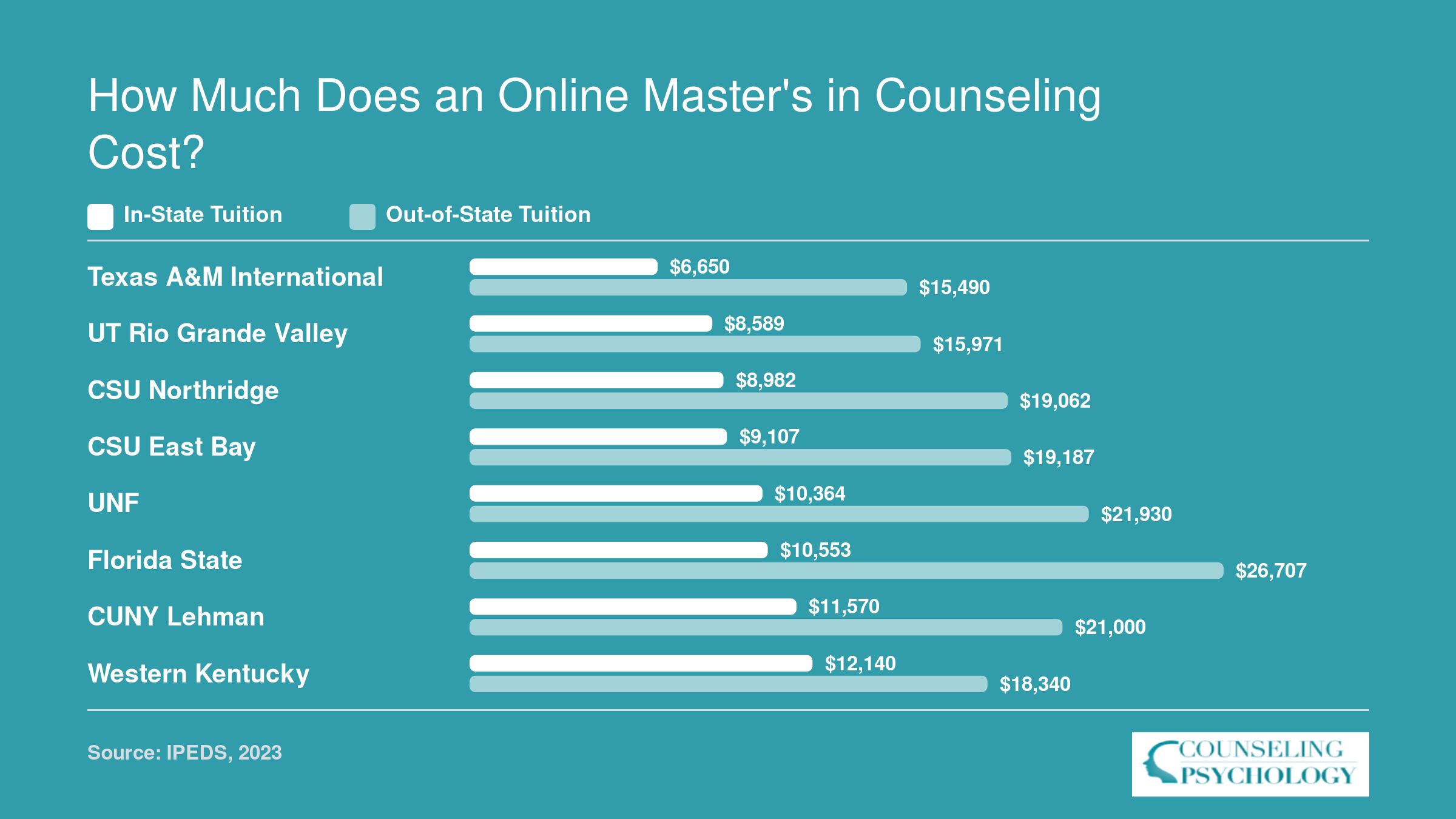
Tuition for an online master's in counseling varies dramatically depending on your residency status and the institution you choose. Across the top-ranked programs on counselingpsychology.org, annual in-state tuition ranges from roughly $6,650 to $12,140, while out-of-state rates climb as high as $26,707. Keep in mind that institution-wide average net price figures reflect all students (including undergraduates receiving aid) and may not accurately represent what a graduate student will pay out of pocket. Program-level debt and monthly repayment data are not yet available for most of these programs, so requesting a detailed cost estimate directly from each school's financial aid office is a smart move before you commit.
Counseling Vs. Social Work, MFT, and Clinical Psychology Degrees
A master's in counseling prepares you to become a Licensed Professional Counselor (LPC) or Licensed Mental Health Counselor (LMHC), focusing on individual and group therapy across diverse settings. It is one of four common graduate pathways to clinical mental health practice, alongside social work (LCSW), marriage and family therapy (LMFT), and clinical psychology (MA or PhD). Each degree leads to a distinct license, scope of practice, and set of employment contexts. Understanding these differences before you enroll can save you time, money, and misalignment with your career goals.
Scope of Practice and Licensure Pathways
Counselors (LPC/LMHC) typically assess, diagnose, and treat mental health and substance use disorders in clinical settings. Social workers (LCSW) trained through Master of Social Work (MSW) programs often emphasize systems-level intervention, case management, and advocacy alongside therapy. Marriage and family therapists (LMFT) specialize in relational and systemic approaches, focusing on couples, families, and intergenerational patterns. If you're drawn to the MFT path, our guide on how to become a marriage and family therapist breaks down the steps in detail. Clinical psychologists with a master's degree may conduct assessments and therapy in some states, but most independent practice roles require a doctoral degree.
Each profession has its own national professional association. The American Counseling Association (ACA) represents counselors, the National Association of Social Workers (NASW) represents social workers, and the American Association for Marriage and Family Therapy (AAMFT) represents MFTs. Visit these association websites to review official licensure pathways, ethical standards, and required clinical hours for each credential. Your state licensing board website will specify exactly which degrees qualify for LPC, LCSW, LMFT, or psychology licensure in your jurisdiction.
Program Length and Clinical Hour Requirements
Most counseling master's programs require 48 to 60 credit hours and include 600 to 1,000 supervised clinical practicum and internship hours, depending on state and accreditation standards. MSW programs typically require 60 credits and include 900 to 1,200 field placement hours across foundation and advanced practice years. MFT programs often require 48 to 60 credits and mandate 500 to 1,000 clinical contact hours focused on relational therapy. Understanding LMFT supervision hours and how they vary by state is critical for MFT candidates planning their timeline. Clinical psychology master's programs vary widely, from 36 to 60 credits, and may or may not fulfill licensure requirements in your state.
Compare curricula from multiple accredited programs to verify clinical hour requirements, course sequences, and elective options. CACREP-accredited counseling programs, CSWE-accredited MSW programs, and COAMFTE-accredited MFT programs follow standardized curriculum frameworks, making cross-program comparison easier.
Common Employer Settings
Counselors work in community mental health centers, private practice, hospitals, schools, and substance abuse treatment facilities. Social workers are employed in hospitals, child welfare agencies, schools, nursing homes, and policy organizations. Marriage and family therapists often work in private practice, family service agencies, and employee assistance programs. Clinical psychologists with master's degrees may find roles in research, residential treatment, or supervised clinical positions, but many states reserve independent practice for doctoral-level psychologists.
Check the Bureau of Labor Statistics (BLS) Occupational Outlook Handbook for detailed descriptions of job duties, work environments, and employment projections for each profession. The BLS categorizes these roles separately, providing occupation-specific salary data and growth forecasts that can inform your decision.
The Bureau of Labor Statistics projects that substance abuse, behavioral disorder, and mental health counselors will see employment growth of 17% through 2033, far outpacing the average for all occupations. This translates to roughly 81,100 new positions, making it one of the fastest-growing counseling fields.
Career Outcomes and Salary After Graduation
How much can you actually earn with a master's in counseling, and is the degree worth the investment?
The short answer: counseling is a growing field with solid employment numbers, though starting salaries vary widely by specialization, setting, and geography. Here is what the data shows.
What the National Wage Data Tells You
According to 2024 O*NET data, the national median annual wage for mental health counselors is $59,190.1 That figure represents the midpoint across roughly 483,500 employed professionals nationwide. The spread is significant: workers at the 10th percentile earn around $39,090, while those at the 90th percentile reach approximately $98,210. Your position in that range depends on years of experience, licensure status, clinical specialty, and where you practice.
Earlier BLS data (May 2023) groups substance abuse, behavioral disorder, and mental health counselors together, reporting a national median of $53,710 across nearly 398,000 jobs.2 The 10th-to-90th percentile range for that broader category runs from $36,700 to $89,920. These are national figures and should not be read as what any single state pays.
What Can You Do With a Master's in Counseling?
Graduates of online counseling master's programs move into a range of roles, including:
- Licensed Professional Counselor (LPC): Provides individual and group therapy in private practice, community mental health agencies, or hospital outpatient settings.
- School Counselor: Supports K-12 students with academic planning, social-emotional development, and crisis intervention in public or private school districts.
- Marriage and Family Therapist: Works with couples and families in private practice, faith-based organizations, or integrated health systems.
- Substance Abuse Counselor: Treats addiction and co-occurring disorders in residential treatment centers, VA facilities, or outpatient clinics.
- Clinical Mental Health Counselor: Serves diverse populations in community agencies, employee assistance programs, or telehealth platforms.
The setting you choose shapes both your daily work and your earning trajectory. Counselors in hospital systems and VA medical centers, for example, often access federal pay scales and benefits packages that push total compensation well above the national median.
Program-Level Earnings and ROI
Program-specific earnings data (such as median salary at one year and four years after graduation) are not yet available for the programs ranked in this article. That means we cannot quote exact figures for what graduates of these particular schools earn at early-career milestones.
What we can share is a rough return-on-investment picture using median graduate debt. Across the ranked programs, median institutional debt ranges from roughly $15,000 to $23,000. Comparing that against the national median wage for mental health counselors ($59,190), most graduates should be able to cover their educational debt within a relatively manageable timeframe, often within the first year or two of full-time work. Programs at public institutions like Cal State East Bay and the Citadel carry especially low debt loads relative to the field's earning potential.
Factors That Move the Needle on Salary
A few things reliably push counseling salaries higher after graduation:
- Earning full independent licensure (LPC, LMFT, or equivalent) rather than working under supervision at an associate level
- Pursuing specializations in high-demand areas such as childhood trauma counseling or integrated behavioral health
- Practicing in states or metro areas with higher cost of living and correspondingly higher pay scales
- Gaining experience in settings with structured advancement, such as school districts, federal agencies, or hospital systems
The bottom line is that a master's in counseling provides a clear path to stable, meaningful employment. While entry-level pay may feel modest compared to some other graduate-level professions, the combination of manageable program debt and strong job growth makes the financial picture more favorable than raw salary figures suggest on their own. Graduates who want to deepen their expertise further can explore masters in addiction counseling or other specialized tracks to boost both their clinical impact and earning potential.
How Long Does It Take to Complete an Online Counseling Master's?
The time required to earn an online master's in counseling depends on your enrollment pace, the program's credit requirements, and the clinical training schedule. Most students complete their degree in two to four years, though accelerated options exist for those who can commit to intensive coursework.
Full-Time, Part-Time, and Accelerated Tracks
Full-time students typically finish in two to three years, completing 48 to 60 credits depending on the program. CACREP-accredited programs require a minimum of 60 semester hours for clinical mental health counseling, while some non-CACREP programs may allow 48-hour tracks.1 Part-time enrollment is common among working professionals and usually extends the timeline to three to four years. A handful of schools offer accelerated 20-month tracks, though these demand a heavy course load and careful coordination of clinical hours.
Why Credit Requirements Vary
The difference in credit hours reflects accreditation standards and state licensure pathways. CACREP programs adhere to a 60-credit minimum to meet the organization's comprehensive curriculum standards, which align with licensure requirements in most states.1 Non-CACREP programs may offer 48-credit options, but graduates should verify that their state board accepts the lower credit total. Some states, including Ohio, accept programs ranging from 48 to 60 credits, but the majority now expect 60 hours for full licensure eligibility.2
Clinical Training Extends the Timeline
Regardless of how quickly you complete coursework, clinical training requirements often dictate the overall timeline. CACREP standards mandate 100 practicum hours and 600 internship hours, for a total of 700 hours of supervised fieldwork.1 The practicum must span at least 10 weeks, and internship hours are typically spread across two semesters. These hours are completed in person at approved sites, so even fully online programs require you to secure local placements. Many programs offer placement assistance, but the availability of sites in your area and your work schedule will influence how quickly you can log the required hours.
Balancing Flexibility and In-Person Requirements
Online programs offer flexibility for coursework, allowing you to complete lectures, readings, and assignments on your own schedule. However, practicum and internship hours are location-dependent and must be arranged with licensed supervisors in your community. This hybrid model suits working professionals, but it also means you cannot entirely avoid in-person commitments. Plan for at least one year of clinical training, and factor in potential delays if placements are competitive or your work schedule limits availability. If you are interested in continuing your education beyond a master's, online doctorate in counseling programs follow a similar hybrid format with even more extensive clinical requirements.
Online Vs. On-Campus Counseling Degrees: Quality and Employer Perception
One of the most common concerns prospective students raise is whether an online counseling degree carries the same weight as one earned on campus. The short answer: when both programs hold CACREP accreditation, the distinction largely disappears. CACREP applies identical standards regardless of delivery format, and the National Board for Certified Counselors (NBCC) accepts CACREP-accredited online degrees for certification exams without reservation. It is also worth noting that most "online" counseling master's programs are hybrid in practice, because accreditation standards require supervised clinical hours completed in person at approved sites in your community.
Pros
- Flexibility allows working professionals to complete coursework on their own schedule while maintaining employment and clinical placements.
- Geographic access to CACREP-accredited programs that may not exist within commuting distance of your home.
- Tuition is often comparable to on-campus rates, and you may save on relocation, commuting, and campus fees.
- Employers generally view online and on-campus graduates similarly when both hold CACREP accreditation, eligible licensure, and strong clinical experience.
- Online counselor education is now mainstream, and CACREP accreditation serves as the primary signal of program quality for hiring managers.
Cons
- Clinical placements typically must be self-sourced in your local area, which can be time-consuming and may limit options in rural regions.
- Less organic peer networking and fewer spontaneous mentoring opportunities compared to cohort-based, on-campus programs.
- A small number of state licensing boards or individual employers may still scrutinize online credentials, though this has diminished significantly in recent years.
- Self-discipline demands are higher; students must manage asynchronous coursework without the built-in structure of a physical classroom.
- Some residual stigma from earlier generations of online education persists, even though current evidence does not support quality differences for accredited programs.
Common Questions About Online Counseling Master's Programs
Prospective students often share similar concerns when evaluating online counseling master's programs. Below are straightforward answers to the questions we hear most frequently, drawing on current admissions trends and licensure standards.
More Online Counseling Programs to Consider
If you are still exploring options, this directory lists additional programs that earned high marks in our ranking methodology. Each entry includes school details, available specializations, and institutional graduation rates to help you compare programs side by side.
- Ed.M. with Certification in School Counseling
- Rehabilitation Counseling, Clinical Mental Health Counseling Track, M.S.
- School Counselor: Elementary and Secondary
- Master's of Arts in Counseling (Clinical Mental Health Counseling)
- Master of Science in Marriage and Family Therapy
- Master of Science in Marriage and Family Therapy
- Master of Education in School Counseling
- Clinical Mental Health Counseling
- Master of Education in Counselor Education (School Counseling)
- Counselor Education-Master of Education (Clinical Mental Health Counseling)
- Counselor Education-Master of Education (School Counseling)
- Counselor Education-Master of Education (Dual Track-Clinical Mental Health Counseling and School Counseling)
- Master of Education in Counselor Education (Elementary School Counseling)
- Master of Education in Counselor Education (Secondary School Counseling)
- Master of Counseling in School Counseling
- Master of Counseling in Clinical Mental Health
- Master of Arts in School Counseling
- Counseling, M.S. (School Counseling)
- Master of Science in School Counseling
- Rehabilitation and Mental Health Counseling (Clinical Mental Health Counseling)
- Master of Science in Addiction Studies
- Counseling: School Counseling (MA)
- Counseling: Mental Health Counseling (MA)
- Master of Arts in Education (School Counseling)
- Master of Arts in Clinical Mental Health Counseling
Explore Counseling Schools
Explore Programs
- Best Online Addiction Counseling Degree
- Best Online Bachelor's in Counseling Degrees
- Best Online Biblical Counseling Degree
- Best Online Clinical Mental Health Counseling
- Best Online Licensed Professional Clinical Counseling
- Best Online MFT
- Best Online Pastoral Counseling
- Best Online Ph.D. in Counseling
- Best Online School Counseling
- Counseling vs Psychology vs Social Work
- Online Genetic Counseling