
What you’ll learn in this article…
- Most states require a 60-credit master's degree, a national exam, and 1,800 to 3,200 supervised clinical hours for licensure.
- The Counseling Compact, operational since September 2025, lets licensed counselors practice across participating states without a new license.
- Total costs from degree through licensure typically range from $35,000 to over $90,000 depending on program and state.
- BLS projects 17% employment growth for mental health counselors, well above the average for all occupations.
What exactly does it take to become a counselor in your state? While licensing requirements differ across jurisdictions (some issue the Licensed Professional Counselor credential, others the Licensed Mental Health Counselor or Licensed Professional Clinical Counselor), the underlying path is remarkably uniform. Every state mandates a master's degree, a national exam, and a period of supervised clinical experience.
Plan on three to five years of graduate-level work and supervised practice after your bachelor's. This timeline isn't flexible; it's set by statute and board regulation.
The real variable is which state you choose, because that decision dictates the exact license title, exam, and hour count you'll need to navigate.
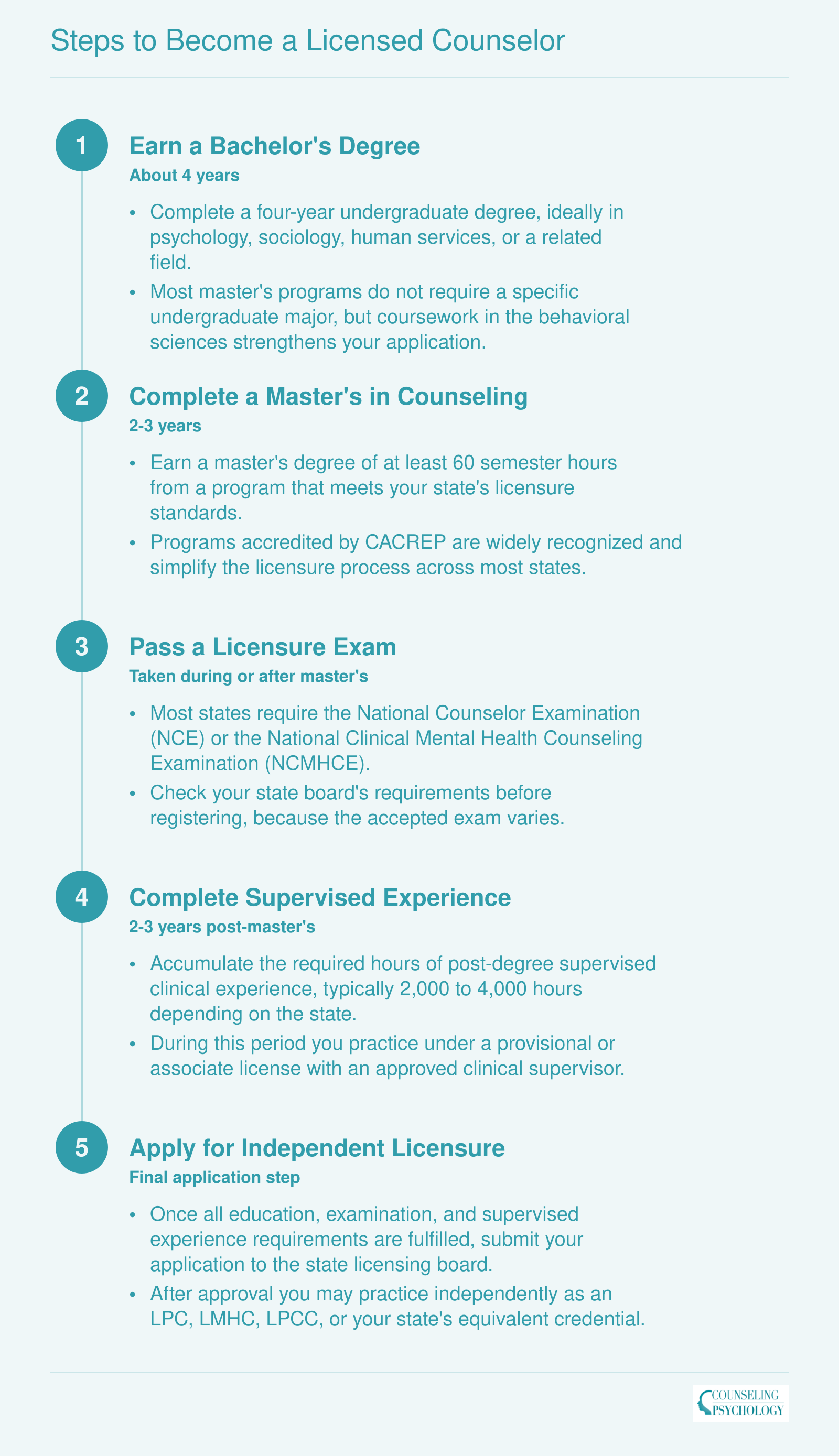
Steps to Become a Licensed Counselor
The path from your first college course to independent licensure as a professional counselor follows a predictable sequence, but the total investment of time is significant. Most aspiring counselors should plan for 8 to 10 years from the start of a bachelor's degree to full, independent licensure, or roughly 4 to 6 years if you already hold a bachelor's degree.
LPC Vs. LMHC Vs. LPCC: Counseling License Types Explained
More than 40 U.S. states and territories use the title Licensed Professional Counselor, making LPC the most widely recognized counseling credential in the country.1 Yet depending on where you plan to practice, the same role might be called a Licensed Mental Health Counselor or a Licensed Professional Clinical Counselor. Understanding why those titles differ, and what they share, prevents a great deal of confusion early in your career planning.
The Same Job, Different Names
The core point to internalize is this: LPC, LMHC, and LPCC are functionally equivalent credentials. They represent the same professional role, the same level of training, and a comparable scope of practice.2 The title you earn is simply the name your state legislature chose when it created its counseling licensure law. Switching states later does not mean starting over with a lower credential; it means applying for the equivalent license in your new state.
That said, the wording of each title does reflect how each state frames the scope of practice in its statutes. States using LMHC and LPCC tend to make the clinical and mental-health focus explicit in the title itself.
Title-by-Title Breakdown
- LPC (Licensed Professional Counselor): Used in the largest number of states, including Texas, Virginia, Georgia, Colorado, and roughly three dozen others, plus the U.S. Virgin Islands. Covers general and mental-health counseling functions, with specific scope defined at the state level.1
- LMHC (Licensed Mental Health Counselor): The primary title in Florida, Massachusetts, and New York. The title signals an explicit mental-health counseling scope, including authority to assess, diagnose, and treat mental illness.1
- LPCC (Licensed Professional Clinical Counselor): Used in California and Minnesota. Like LMHC, it typically indicates a clinical focus and carries authority to diagnose.1
- LCPC (Licensed Clinical Professional Counselor): A less common variant used in Illinois, Maryland, Maine, and Montana. It is also mental-health specific and generally includes diagnosis authority.1
Credentials You Should Not Confuse With These
Two titles that sometimes appear in the same conversation deserve a clear distinction. The Licensed Marriage and Family Therapist (LMFT) is a separate credential entirely, designed for practitioners who specialize in relational and family systems work. It is not an alternate name for a counseling license. Similarly, the LCPC designation, while related, carries its own state-specific requirements and should not be assumed interchangeable with LPC without checking your target state's licensing board rules.
For a deeper look at what the licensed professional counselor role involves day to day, including salary benchmarks and job outlook, review the career profile before choosing your degree path. If your goal specifically involves the LPCC credential, explore online licensed professional clinical counseling programs to compare CACREP-accredited options. And if you are still weighing whether counseling is the right field, our overview of counseling careers covers more than a dozen specializations side by side.
Regardless of which title applies in your state, the licensing board website for that state is the authoritative source, since statutory language can be updated between publication cycles of any reference guide.
Education and Degree Requirements for Counselor Licensure
Every state in the U.S. requires aspiring licensed professional counselors to complete a master's degree in counseling or a closely related field such as clinical mental health counseling, marriage and family therapy, or rehabilitation counseling. The typical program ranges from 48 to 60 credit hours, with states that mandate more extensive supervised clinical training often requiring programs at the higher end of that range. Before enrolling, prospective students should verify their target state's specific credit hour threshold to avoid needing additional coursework later. Exploring counseling master's programs online is a practical first step for comparing curricula and credit requirements across institutions.
Why CACREP Accreditation Matters
The Council for Accreditation of Counseling and Related Educational Programs (CACREP) sets the national standard for counselor education.1 Graduating from a CACREP-accredited program signals to licensing boards, employers, and clients that your training meets rigorous, peer-reviewed criteria. Beyond credibility, CACREP graduates often face a smoother licensure path: many states accept CACREP credentials without requiring course-by-course transcript reviews, and portability between states is generally easier.
A growing number of states now require or strongly prefer CACREP-accredited degrees. As of 2025, Florida, Kentucky, Ohio, and North Carolina have implemented mandates requiring applicants to graduate from CACREP-accredited programs, with effective dates beginning July 1, 2025, in several of these states.1 Additional states are actively considering similar requirements, making CACREP accreditation an increasingly important factor in program selection. If you plan to practice in multiple states over your career, choosing a CACREP-accredited program from the outset can save significant time and expense.
Online vs. In-Person Programs
Both online and traditional in-person licensed professional clinical counselor degree programs can lead to licensure, provided the program meets your state's educational standards. Online programs offer flexibility for working adults or those in rural areas without nearby counseling schools. However, students should confirm that any online program includes the required practicum and internship hours, which must be completed face-to-face with real clients under qualified supervision. Some states have specific residency or in-person requirements that certain fully online programs may not satisfy, so always verify compatibility with your target state's licensing board before enrolling.
Typical Required Coursework
Regardless of delivery format, accredited counseling master's programs share a common curricular foundation. Students should expect to complete coursework in the following areas:
- Professional ethics and legal issues: Covers confidentiality, informed consent, boundary management, and state-specific regulations.
- Multicultural counseling: Prepares counselors to work effectively with diverse populations across race, ethnicity, gender, sexual orientation, and socioeconomic backgrounds.
- Group counseling: Teaches facilitation skills, group dynamics, and therapeutic factors unique to group settings.
- Psychopathology and diagnosis: Provides training in the DSM-5-TR and diagnostic assessment for mental health conditions.
- Assessment and testing: Covers standardized instruments, intake interviews, and treatment planning.
- Practicum and internship: Requires 100 hours of practicum experience and 600 hours of internship under supervision, per CACREP standards.1
These foundational courses ensure that new counselors enter supervised practice with the clinical knowledge and ethical grounding necessary to serve clients competently. Taking time to research program curricula and accreditation status before applying is one of the most important steps in your journey toward licensure.
Questions to Ask Yourself
Counseling Licensure Exams: NCE Vs. NCMHCE
Most states require a national examination as part of the pathway to independent licensure, and counseling candidates choose between two primary assessments developed by the National Board for Certified Counselors (NBCC). The National Counselor Examination (NCE) and the National Clinical Mental Health Counseling Examination (NCMHCE) serve the same credentialing purpose but differ substantially in format, content focus, and state acceptance. Understanding which exam your state requires is a critical step before scheduling your test date.
NCE: The Multiple-Choice Standard
The NCE consists of 200 multiple-choice questions drawn from eight content domains that span the breadth of counseling knowledge, including human growth and development, career development, helping relationships, group counseling, assessment and testing, research and program evaluation, professional counseling orientation and ethical practice, and social and cultural diversity.1 Candidates have 225 minutes (3 hours and 45 minutes) to complete the exam.2 The NCE is accepted for licensure in the majority of states and also serves as the examination requirement for the National Certified Counselor (NCC) credential.1 As of the 2025-2026 exam cycle, the exam fee is $275, and tests are administered year-round through Pearson VUE test centers or OnVUE remote proctoring in six-month scheduling windows.3
NCMHCE: Clinical Simulation-Based Assessment
The NCMHCE takes a fundamentally different approach. Rather than multiple-choice questions, it presents 10 clinical simulations that require candidates to analyze client scenarios, make diagnostic and treatment decisions, and respond to evolving case material.2 Each simulation is interactive and assesses skills in assessment and diagnosis, counseling and psychotherapy, and administration, consultation, and supervision. Candidates have 180 minutes (3 hours) to complete the exam. The NCMHCE is most commonly required in states that mandate clinical mental health counselor (LMHC or LCMHC) credentials. If you are exploring how to become a mental health counselor, confirming which exam your state board requires should be one of your first steps. The NCMHCE is also accepted for NCC certification, and the exam fee is $275, identical to the NCE, with the same year-round availability through Pearson VUE.3
Which States Accept Which Exam
Most states accept the NCE for Licensed Professional Counselor (LPC) credentials, and a smaller but growing number require or accept the NCMHCE for clinical mental health counselor licensure. Some states offer candidates a choice between the two exams, while others specify one exclusively. A handful of states also permit alternative exams, such as the Certified Rehabilitation Counselor (CRC) examination administered by the Commission on Rehabilitation Counselor Certification for candidates specializing in rehabilitation counselor careers. Before registering for any exam, confirm your state board's current requirements, as regulations occasionally change and reciprocity rules vary.
Exam Fees, Scheduling, and Pass Rates
Both the NCE and NCMHCE cost $275 as of the 2025-2026 exam cycle.3 Candidates receive score reports within two to three weeks of testing, and both exams use scaled scoring systems that adjust for form difficulty. While NBCC does not publish real-time pass rate data publicly, historical data indicates that first-time pass rates for both exams typically range between 70 and 80 percent, with variations by candidate preparation and educational background. Test-takers who do not pass on their first attempt may retake the exam after a mandatory waiting period, which varies by state board policy and NBCC retake rules.
Supervised Experience Hours by State
After you complete your master's degree and pass the required licensure exam, you must accumulate supervised clinical hours before receiving your independent counseling license. The number of hours varies significantly by state, typically ranging from 1,800 to 3,200 hours, with most states requiring 2,000 to 3,000 total hours of post-degree supervised experience.
State-by-State Hour Requirements
The table below illustrates the range of supervised experience requirements across representative states:
| State | Total Hours Required | Direct Client Contact Minimum | Typical Time to Completion |
|---|---|---|---|
| Georgia | 1,800 hours | ~720-1,080 hours (40-60%) | 18-24 months full-time |
| Most States | 2,000-3,000 hours | 800-1,800 hours (40-60%) | 24-36 months full-time |
| California | 3,000 hours | 1,750 hours direct | 30-42 months full-time |
| Arizona | 3,200 hours | ~1,280-1,920 hours (40-60%) | 32-48 months full-time |
California requires weekly supervision throughout the experience period2, while most states follow a standard 1:20 supervision ratio, meaning one hour of clinical supervision for every 20 hours of client-facing work.4 Some states specify minimum direct client contact hours explicitly, while others establish a percentage requirement; typically 40 to 60 percent of total hours must involve direct client interaction.
Direct vs. Indirect Supervision Hours
Direct client contact hours include face-to-face or telehealth counseling sessions, intake assessments, group therapy facilitation, and crisis intervention. Indirect hours encompass treatment planning, case documentation, consultation with other professionals, administrative tasks related to client care, and professional development activities. States define these categories differently, so verify your licensing board's specific criteria early in your supervised experience.
Supervision itself typically occurs in individual or small-group formats. If you are pursuing marriage and family therapy credentials, be aware that LMFT supervision hours carry their own distinct requirements. Your supervisor must hold an active, independent counseling license in your state and meet any additional qualifications your board mandates, such as minimum years of practice or completion of supervisor training.
Finding a Supervisor and Managing Costs
Many counselors complete supervised hours through their employer, particularly if working in community mental health centers, hospitals, or group practices where supervision is provided as part of employment. If your workplace does not offer supervision, you will need to contract with an independent supervisor, which typically costs $50 to $150 per session. At a 1:20 ratio and $100 per session, expect to pay $10,000 to $16,000 over the full licensure period.
The path to becoming a how to become a licensed professional counselor involves careful planning during the supervised experience phase. To maximize efficiency:
- Clarify requirements early: Download your state board's supervision forms and guidelines before starting any clinical work. Hours accumulated before official registration or with an unqualified supervisor often do not count.
- Track meticulously: Use a spreadsheet or supervision tracking app to log hours weekly, noting direct vs. indirect time, supervision dates, and supervisor signatures.
- Choose a compatible supervisor: Look for someone whose theoretical orientation, clientele, and scheduling flexibility align with your needs. Professional associations, university career centers, and state counseling boards often maintain supervisor directories.
- Negotiate employment terms: When job hunting, ask whether supervision is included, how many hours per week you can expect, and whether the employer covers supervision costs.
Most full-time counselors accumulate 30 to 40 clinical hours per week, reaching 2,000 hours in approximately two years and 3,000 hours in roughly three years. Part-time work extends this timeline proportionally.
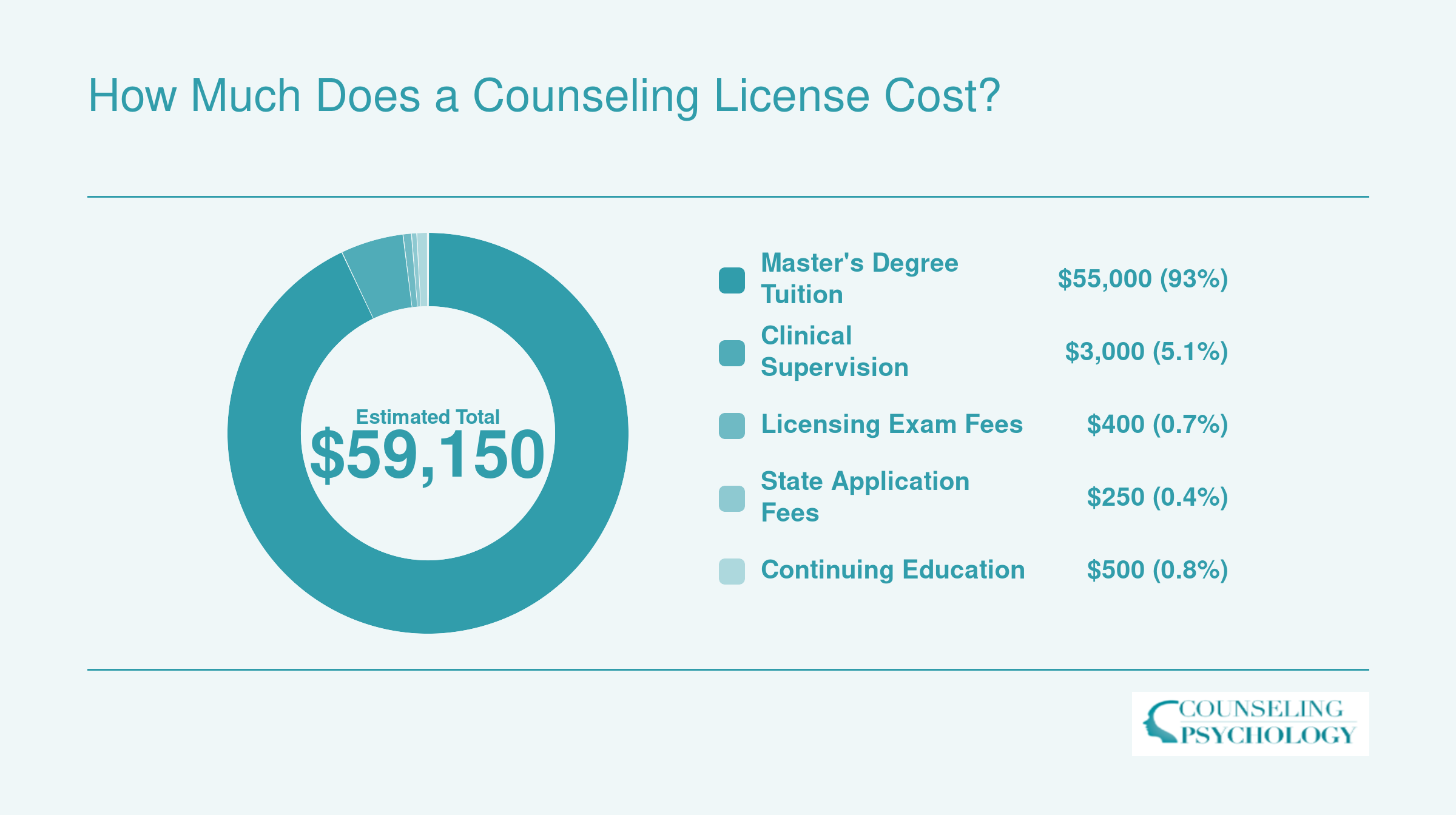
How Much Does a Counseling License Cost?
The total investment to become a licensed counselor can range from roughly $35,000 to well over $90,000, depending on your program, state, and supervision arrangement. Your master's degree accounts for the vast majority of that figure. Securing a position where your employer covers clinical supervision can save you thousands of dollars and is one of the most practical ways to reduce your out-of-pocket costs.
License Portability and the Counseling Compact
The Counseling Compact represents the most significant advance in counselor license portability in decades, allowing licensed professional counselors to practice across state lines without obtaining a new license in each jurisdiction. Launched operationally on September 30, 2025, the Compact addresses a longstanding barrier that forced counselors to navigate 50 different state licensure systems, often repeating exams, coursework reviews, and application fees each time they moved or sought to serve clients in another state.1
How the Counseling Compact Works
The Compact is an interstate agreement that grants participating counselors a privilege to practice in any member state, rather than requiring full licensure in each.2 As of April 2026, 40 states and jurisdictions have enacted the Compact, with four states currently live and accepting applications: Arizona, Louisiana, Minnesota, and Ohio.3 Arizona and Minnesota were the first to go live at the September 2025 launch, followed by Ohio in January 2026 and Louisiana in April 2026.4 The remaining states that have enacted the Compact are expected to become operational throughout 2026 and into 2027 as they complete administrative preparations.
Counselors apply through a centralized system called CompactConnect, which streamlines the process and eliminates the need to submit separate applications to each state board.5 Once approved, a counselor holds their home-state license and receives privileges to practice in other member states, subject to each state's scope-of-practice laws.
Eligibility Requirements for Compact Privileges
To qualify for Compact privileges, counselors must meet uniform licensure requirements:5
- Education: A master's degree from a CACREP-accredited program or its equivalent, ensuring consistent educational standards across states.
- Examination: Passage of either the National Counselor Examination (NCE) or the National Clinical Mental Health Counseling Examination (NCMHCE).6
- Licensure status: An active, unencumbered independent license (such as LPC or LPCC) in a member state where the counselor resides.
Counselors with disciplinary actions, license restrictions, or criminal backgrounds may be ineligible for Compact privileges, though each case is reviewed individually.
License Portability Without the Compact
For counselors in non-Compact states or those who do not meet Compact eligibility, the traditional endorsement or reciprocity process remains the only option. This path typically requires submitting transcripts for course-by-course review, verifying supervised hours, and sometimes retaking state-specific jurisprudence exams. Barriers to license transfer include differing credit-hour requirements (some states require 60 graduate credits, others 48), variations in accepted supervision models, and lack of mutual recognition agreements. Processing times can stretch from three to six months, and fees range from $200 to $600 per state. The Compact eliminates these obstacles for eligible counselors in member states, marking a shift toward national mobility for those pursuing counseling careers.
The fastest realistic path to independent licensure is to enroll in a 60-credit CACREP-accredited master's program, which typically embeds extensive practicum and internship hours into the curriculum. Schedule your licensing exam during your final semester so you can begin accumulating supervised clinical hours the moment you graduate. In states with lower post-degree hour requirements (around 2,000 hours), this approach can take you from bachelor's degree to full licensure in roughly four years.
Counselor Salary and Career Outlook After Licensure
Earning your counseling license opens the door to a career field with strong compensation and robust demand. According to the Bureau of Labor Statistics, employment for substance abuse, behavioral disorder, and mental health counselors is projected to grow 17% from 2024 to 2034, which is much faster than the 4% average for all occupations. With more than 440,000 professionals employed nationally in this category alone, licensed counselors enjoy a broad and expanding job market. One common question is whether therapists earn more than counselors. In practice, the titles 'therapist' and 'counselor' frequently overlap in occupational classification and licensing scope. The bigger pay differentiator is work setting: licensed counselors in private practice typically earn more than those employed by community agencies or nonprofit organizations, regardless of title.
| Occupational Category | National Employment | 25th Percentile Salary | National Median Salary | 75th Percentile Salary | Mean (Average) Salary |
|---|---|---|---|---|---|
| Substance Abuse, Behavioral Disorder, and Mental Health Counselors | 440,380 | $47,170 | $59,190 | $76,230 | $65,100 |
| Educational, Guidance, and Career Counselors and Advisors | 342,350 | $51,690 | $65,140 | $83,490 | $71,520 |
| Counselors (All Subcategories Combined) | 970,870 | $47,350 | $60,200 | $78,230 | $66,370 |
Highest-Paying States for Licensed Counselors
Compensation for licensed counselors varies dramatically by state and specialty area. The tables below draw on BLS state-level data for two key counseling occupation categories. Keep in mind that many of the highest-paying states, such as California, Washington, and New Jersey, also carry a significantly higher cost of living. Before relocating for a bigger paycheck, factor in housing, taxes, and everyday expenses. It is also worth noting that states with more rigorous licensure requirements often correlate with stronger demand and higher pay, reinforcing the value of meeting those higher bars to entry.
| State | Occupation Category | Total Employed | Median Annual Salary | 25th Percentile | 75th Percentile |
|---|---|---|---|---|---|
| California | Educational, Guidance, and Career Counselors and Advisors | 44,160 | $94,320 | $66,500 | $122,160 |
| Washington | Educational, Guidance, and Career Counselors and Advisors | 5,910 | $83,930 | $64,680 | $109,390 |
| District of Columbia | Educational, Guidance, and Career Counselors and Advisors | 1,800 | $80,280 | $61,930 | $101,050 |
| Alaska | Educational, Guidance, and Career Counselors and Advisors | 660 | $80,020 | $61,000 | $88,860 |
| Massachusetts | Educational, Guidance, and Career Counselors and Advisors | 11,850 | $78,840 | $63,800 | $100,250 |
| New Jersey | Educational, Guidance, and Career Counselors and Advisors | 7,590 | $77,940 | $64,900 | $99,180 |
| New Mexico | Educational, Guidance, and Career Counselors and Advisors | 1,760 | $76,490 | $56,930 | $84,460 |
| Maryland | Educational, Guidance, and Career Counselors and Advisors | 6,210 | $74,970 | $61,860 | $97,910 |
| Oregon | Educational, Guidance, and Career Counselors and Advisors | 3,330 | $74,000 | $57,540 | $98,090 |
| New York | Educational, Guidance, and Career Counselors and Advisors | 22,660 | $69,900 | $56,000 | $95,210 |
| Alaska | Substance Abuse, Behavioral Disorder, and Mental Health Counselors | 1,060 | $79,220 | $63,690 | $96,940 |
| New Mexico | Substance Abuse, Behavioral Disorder, and Mental Health Counselors | 2,070 | $70,770 | $55,060 | $80,840 |
| Oregon | Substance Abuse, Behavioral Disorder, and Mental Health Counselors | 6,410 | $69,660 | $56,290 | $84,970 |
| North Dakota | Substance Abuse, Behavioral Disorder, and Mental Health Counselors | 1,180 | $66,450 | $50,810 | $75,120 |
| District of Columbia | Substance Abuse, Behavioral Disorder, and Mental Health Counselors | 980 | $66,140 | $47,980 | $83,040 |
| Utah | Substance Abuse, Behavioral Disorder, and Mental Health Counselors | 4,720 | $65,920 | $42,210 | $94,630 |
| New Jersey | Substance Abuse, Behavioral Disorder, and Mental Health Counselors | 14,640 | $64,710 | $51,170 | $84,690 |
| Washington | Substance Abuse, Behavioral Disorder, and Mental Health Counselors | 13,150 | $64,220 | $52,070 | $80,440 |
| Arizona | Substance Abuse, Behavioral Disorder, and Mental Health Counselors | 8,970 | $63,830 | $50,650 | $79,990 |
| New York | Substance Abuse, Behavioral Disorder, and Mental Health Counselors | 22,450 | $62,070 | $50,880 | $76,680 |
Frequently Asked Questions About Counseling Licensure
Navigating the counseling licensure process raises a lot of practical questions, from costs to timelines to state portability. Below are answers to the most common questions prospective counselors ask, drawn from current requirements and industry standards.
Explore More
- Best Counseling Schools Near Me
- Best Online Addiction Psychology Degree
- Best Online Graduate Certificate in Counseling
- Counseling Careers
- Counseling Degrees
- Counseling Licensure Acronyms
- Counseling Master's Textbooks
- Counseling Psychology Master's Degree Guide
- Counselor Resume Guide
- Counselor Salary
- Online Counselor
- Should I Become a Therapist? How to Know If It's Right