
What you’ll learn in this article…
- Most aspiring counselors need 7 to 10 years total to complete a bachelor's degree, master's degree, and supervised clinical hours.
- State supervised-hour requirements range from 2,000 to 3,400, so choosing where you practice shapes your timeline significantly.
- Specialty and location can shift a counselor's annual salary by more than $25,000.
- Every U.S. state requires at least a master's degree before you can practice independently as a licensed counselor.
Licensed professional counselors, marriage and family therapists, and clinical social workers all face the same credential threshold: a master's degree plus two to three years of supervised clinical hours before independent practice. The Bureau of Labor Statistics projects 20 to 22 percent job growth for most counseling occupations through 2032, faster than nearly all other professions, yet entry salaries often start below $45,000 in many states.
The path from bachelor's degree to full licensure typically spans six to eight years when pursued full-time, longer if you work while studying or complete supervision hours part-time. Total degree costs range from under $20,000 at some public universities to more than $100,000 at private institutions, and those figures exclude application fees, exam costs, and supervision expenses.
State licensing boards set their own hour requirements, exam standards, and accreditation preferences, so planning your education without checking your target state's rules can delay licensure by a year or more. If you are exploring a specialty like working with younger populations, our guide on how to become a child counselor can help you understand the additional requirements. Counselor salaries vary just as widely: school counselors in California earn a median above $80,000, while substance abuse counselors in several Southern states earn closer to $40,000.
What Does a Counselor Do?
What exactly does a counselor do on a daily basis, and how is it different from what a psychologist or psychiatrist does?
Counselors help people work through mental health challenges, relationship difficulties, career transitions, substance use issues, and major life adjustments. They do this primarily through talk therapy and evidence-based interventions designed to build coping skills, clarify goals, and support lasting change. While the public sometimes imagines counselors simply "listening," the work involves structured techniques drawn from cognitive-behavioral therapy, motivational interviewing, solution-focused brief therapy, and other frameworks with documented effectiveness.
Clinical vs. Non-Clinical Counseling Work
Not all counselors do the same type of work, and understanding this distinction matters when planning your career path.
Clinical counselors conduct formal assessments, develop individualized treatment plans, provide crisis intervention, and work with clients managing conditions like depression, anxiety, trauma, and addiction. This work typically requires state licensure as a Licensed Professional Counselor (LPC), Licensed Mental Health Counselor (LMHC), or similar credential. To get a sense of the day-to-day rhythm, see what a typical work day looks like for a Licensed Professional Counselor.
Non-clinical counselors focus on guidance rather than treatment. School counselors help students navigate academic planning and social development. Career counselors assist clients with job searches, resume building, and professional transitions. These roles still require specialized training, but the emphasis falls on education and support rather than diagnosing or treating mental health conditions. If you're curious about the K-12 path specifically, our guide on how to become a school counselor breaks down the requirements.
Where Counselors Work
Counselors practice in diverse settings, each with its own pace, population, and professional demands:
- Private practice: Independent or group practices offering outpatient therapy, often with flexibility in scheduling and specialization.
- Hospitals and medical centers: Integrated behavioral health teams working alongside physicians and nurses.
- Schools: K-12 and higher education settings focused on student development, academic success, and crisis response.
- Community mental health centers: Publicly funded agencies serving underserved populations, often with sliding-scale fees.
- Substance abuse facilities: Residential and outpatient programs addressing addiction and co-occurring disorders.
- Corporate employee assistance programs (EAPs): Short-term counseling and referrals for employees dealing with personal or work-related issues.
Beyond these common paths, there are also careers you didn't know you could get with a counseling degree that expand the field in unexpected directions.
A Wellness-Focused Philosophy
One key philosophical difference separates counseling from psychiatry and some branches of clinical psychology. Counselors typically operate from a wellness and strengths-based model. Rather than centering on pathology or diagnosing severe mental illness, counselors focus on helping clients identify their existing resources, build resilience, and move toward their goals. This does not mean counselors ignore serious conditions, but their training emphasizes human development, prevention, and empowerment over medical diagnosis. For clients who need medication management or treatment for complex psychiatric disorders, counselors often collaborate with psychiatrists or psychologists who specialize in those areas.
Types of Counseling Specialties and Licenses
The counseling field offers several licensure tracks, each tailored to specific client populations and work settings. Understanding the distinctions between licenses helps you choose the educational path that aligns with your career goals. Below, we compare the core credentials by degree requirements, supervised experience, scope of practice, and typical workplaces.
Core Clinical Counseling Licenses
- Licensed Professional Counselor (LPC/LPCC/LMHC): Degree required: master's in counseling or clinical mental health counseling.1 Supervised hours: 2,000, 4,000 post-degree.2 Scope: psychotherapy, diagnosis, and treatment planning for individuals, couples, families, and groups. Common settings: outpatient clinics, private practice, community mental health centers. This is the broadest clinical mental health license, and while titles differ (e.g., LPC in Texas, LPCC in California, LMHC in New York), the scope is broadly equivalent across states.
- Licensed Marriage and Family Therapist (LMFT): Degree required: master's in marriage and family therapy or a related program with a systemic focus.1 Supervised hours: 2,000, 4,000 post-degree.1 Scope: systemic and relational psychotherapy, diagnosis of individuals, couples, and families.4 LMFTs specialize in family dynamics and relationship issues. Common settings: private practice, couple and family therapy clinics.
- Licensed Clinical Social Worker (LCSW): Degree required: Master of Social Work (MSW).4 Supervised hours: 2,000, 4,000 post-degree.6 Scope: psychotherapy, diagnosis, case management, advocacy, and community practice.6 Social work training emphasizes person-in-environment and resource linkage. Common settings: community mental health agencies, hospitals, private practice, social service organizations.
Specialized School and Substance Abuse Credentials
- School Counselor: Degree required: master's in school counseling or a related field from an accredited program.1 Supervised hours: typically a minimum of 600 hours of internship/practicum, often completed during the degree.1 Scope: academic, career, and social-emotional counseling in K-12 settings. Credentialing is usually governed by state departments of education rather than clinical licensing boards. Settings: public and private K-12 schools.
- Substance Abuse Counselor (Clinical): Degree required: for full clinical licensure, a master's in counseling, social work, or addiction counseling is standard. However, many states offer lower-tier certifications (e.g., CADC) that may require only a bachelor's degree plus specific training and certification. Supervised hours: 1,000, 4,000, varying widely by state and credential level. Scope: assessment, diagnosis, treatment of substance use disorders, and recovery support.4 Common settings: addiction treatment centers, rehabilitation facilities, outpatient programs.
For a deeper look at the licensure process across these tracks, review our guide to getting a counseling license, which covers state-by-state requirements and timelines. If you are weighing LMFT supervision timelines specifically, our breakdown of LMFT supervision hours details what to expect during the post-degree phase.
Questions to Ask Yourself
Explore By State
- Alabama
- Alaska
- Arizona
- Arkansas
- California
- Colorado
- Connecticut
- Delaware
- Florida
- Georgia
- Hawaii
- Idaho
- Illinois
- Indiana
- Iowa
- Kansas
- Kentucky
- Louisiana
- Maine
- Maryland
- Massachusetts
- Michigan
- Minnesota
- Mississippi
- Missouri
- Montana
- Nebraska
- Nevada
- New Hampshire
- New Jersey
- New Mexico
- New York
- North Carolina
- North Dakota
- Ohio
- Oklahoma
- Oregon
- Pennsylvania
- Rhode Island
- South Carolina
- South Dakota
- Tennessee
- Texas
- Utah
- Vermont
- Virginia
- Washington
- Washington DC
- West Virginia
- Wisconsin
- Wyoming
Steps to Become a Licensed Counselor
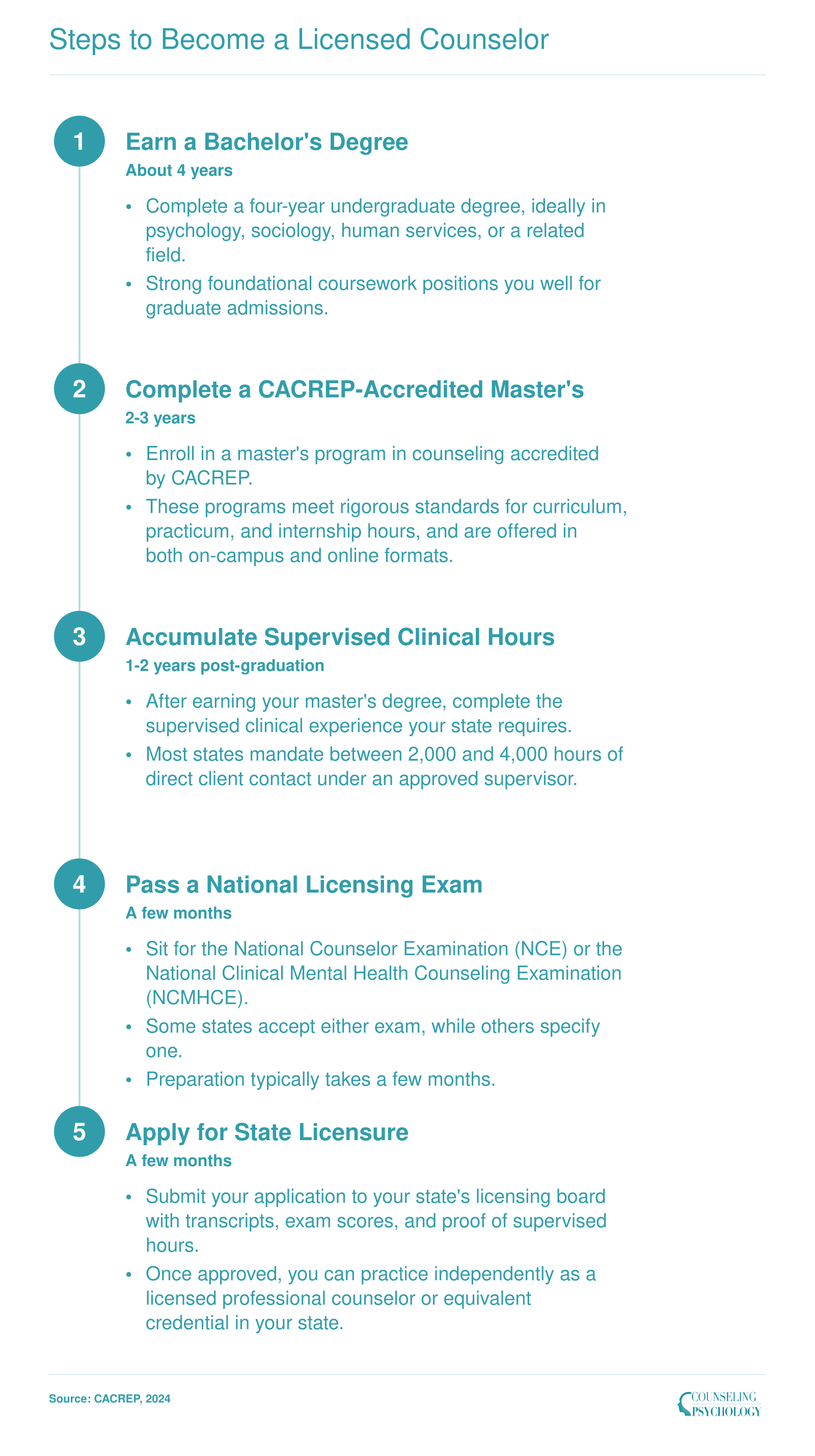
Becoming a licensed counselor follows a clear credentialing ladder. While exact timelines vary by state and program format, most aspiring counselors complete the full process in roughly 7 to 10 years. Choosing a CACREP-accredited master's program is widely considered the gold standard and is increasingly required for licensure portability across states.
Step-By-Step: Education, Exams, and Licensure Explained
Becoming a licensed professional counselor follows a predictable sequence, but each stage demands more time and effort than most candidates anticipate. Understanding the full path from undergraduate coursework through state licensure helps you plan realistically and avoid costly surprises.
Start With Any Bachelor's Degree
The bachelor's degree is your entry ticket, not your defining credential. While any major technically qualifies you for graduate school admission, coursework in psychology, sociology, human development, or human services strengthens your application and prepares you for rigorous master's-level theory. Admissions committees look for evidence that you understand human behavior and can handle clinical content. If your undergraduate major was unrelated, a master's degree in psychology can still be within reach once you complete a few psychology or counseling prerequisite courses before applying.
Complete a CACREP-Accredited Master's Program
The master's degree is the true gatekeeper to the profession. Most states require or strongly prefer graduation from a program accredited by the Council for Accreditation of Counseling and Related Educational Programs. These programs typically require 60 semester hours and cover counseling theories, ethics, multicultural competence, assessment, group work, career development, and research methods. You will also complete a practicum and internship totaling several hundred direct client contact hours before graduation.
Both on-campus and online formats are available, and many states now accept fully online CACREP-accredited programs for licensure purposes. Online options offer flexibility for working adults, though you will still need to complete supervised clinical hours in your local community.
Accumulate Post-Master's Supervised Hours
This stage is the bottleneck most aspiring counselors underestimate. After earning your master's degree, you must complete supervised clinical experience under an approved supervisor. Requirements vary by state, but most boards mandate between 2,000 and 4,000 hours of direct client contact. At a typical pace, this takes two to three years of full-time work, or longer if you work part-time. Finding a qualified supervisor and a clinical site that offers sufficient client hours requires planning well before graduation.
Pass a National Examination
Two national exams dominate the licensure landscape: the National Counselor Examination (NCE) and the National Clinical Mental Health Counseling Examination (NCMHCE). Your state board determines which exam you must take, and some states accept either.1
- NCE: A 200-question multiple-choice test administered over 3 hours and 45 minutes. It assesses knowledge, skills, and abilities important for effective counseling services.2
- NCMHCE: A clinical simulation exam featuring 10 case scenarios completed in 3 hours. It tests your ability to apply clinical judgment to realistic client situations.1
Both exams are administered through Pearson VUE testing centers.3 You register through the NBCC Credentialing Gateway, and scores are typically released within four weeks.4 If you need to reschedule, expect a fee of around $50, and you must wait at least 30 days before retesting if you do not pass.3 Exam fees generally fall in the $275 to $325 range, depending on your registration pathway and state requirements.
Apply for State Licensure
Once you have completed your degree, supervised hours, and national exam, you submit your application to your state licensing board. This package typically includes official transcripts, supervisor verification forms, exam score reports, and application fees. Processing times vary widely, from a few weeks in states with streamlined systems to several months in states with heavy backlogs or additional requirements. Build this waiting period into your job search timeline, as most employers cannot hire you in a licensed capacity until your credential is officially issued.
State-By-State Counseling Licensure Requirements
Licensure requirements for professional counselors vary significantly across the United States, with supervised clinical hour mandates ranging from 2,000 to 3,400 hours and differing exam and accreditation standards.1 Understanding these differences is critical if you plan to practice in a specific state or hope to relocate after licensure.
Licensure Comparison Across Key States
The table below summarizes requirements for ten states, highlighting the diversity in credential titles, supervised hours, accepted national exams, and CACREP accreditation expectations:
| State | License Title | Supervised Hours | Accepted Exam(s) | CACREP Required? |
|---|---|---|---|---|
| California | LPCC | 3,000 | NCMHCE | No |
| New York | LMHC | 3,000 | NCE or NCMHCE | No |
| Texas | LPC | 3,000 | NCE | No |
| Florida | LMHC | 2,000 | NCMHCE | No |
| Ohio | LPCC | 3,000 | NCMHCE | No |
| Illinois | LCPC | 3,360 | NCMHCE | No |
| Pennsylvania | LPC | 3,000 | NCE or NCMHCE | No |
| Virginia | LPC | 3,400 | NCE or NCMHCE | No |
| Colorado | LPC | 2,000 | NCE or NCMHCE | No |
| Washington | LMHC | 3,000 | NCE or NCMHCE | No |
Virginia requires the most supervised hours at 3,400, while Florida and Colorado set the floor at 2,000 hours. Illinois sits at 3,360 hours, reflecting a requirement for two full years of full-time post-master's supervised practice. Texas accepts only the NCE3, while California and Florida mandate the NCMHCE4; most other states offer applicants a choice between the two national exams.
CACREP Accreditation and Exam Flexibility
None of the states in this sample currently require graduation from a CACREP-accredited program for licensure, though CACREP accreditation can streamline the application process and is strongly preferred by many employers and doctoral programs. Some states grant exam waivers or reduced supervision requirements to CACREP graduates, so confirm your target state's policies early in your degree search.
Counseling Compact and Interstate Mobility
As of 2026, efforts to establish a Counseling Compact are underway to enable licensed counselors to practice across state lines without obtaining multiple licenses. The compact remains in early adoption, with only a handful of states having enacted enabling legislation. If you anticipate relocating or providing telehealth services to clients in multiple states, monitor compact developments and plan for the possibility of pursuing separate state licenses in the near term.
How Long Does It Take to Become a Counselor?
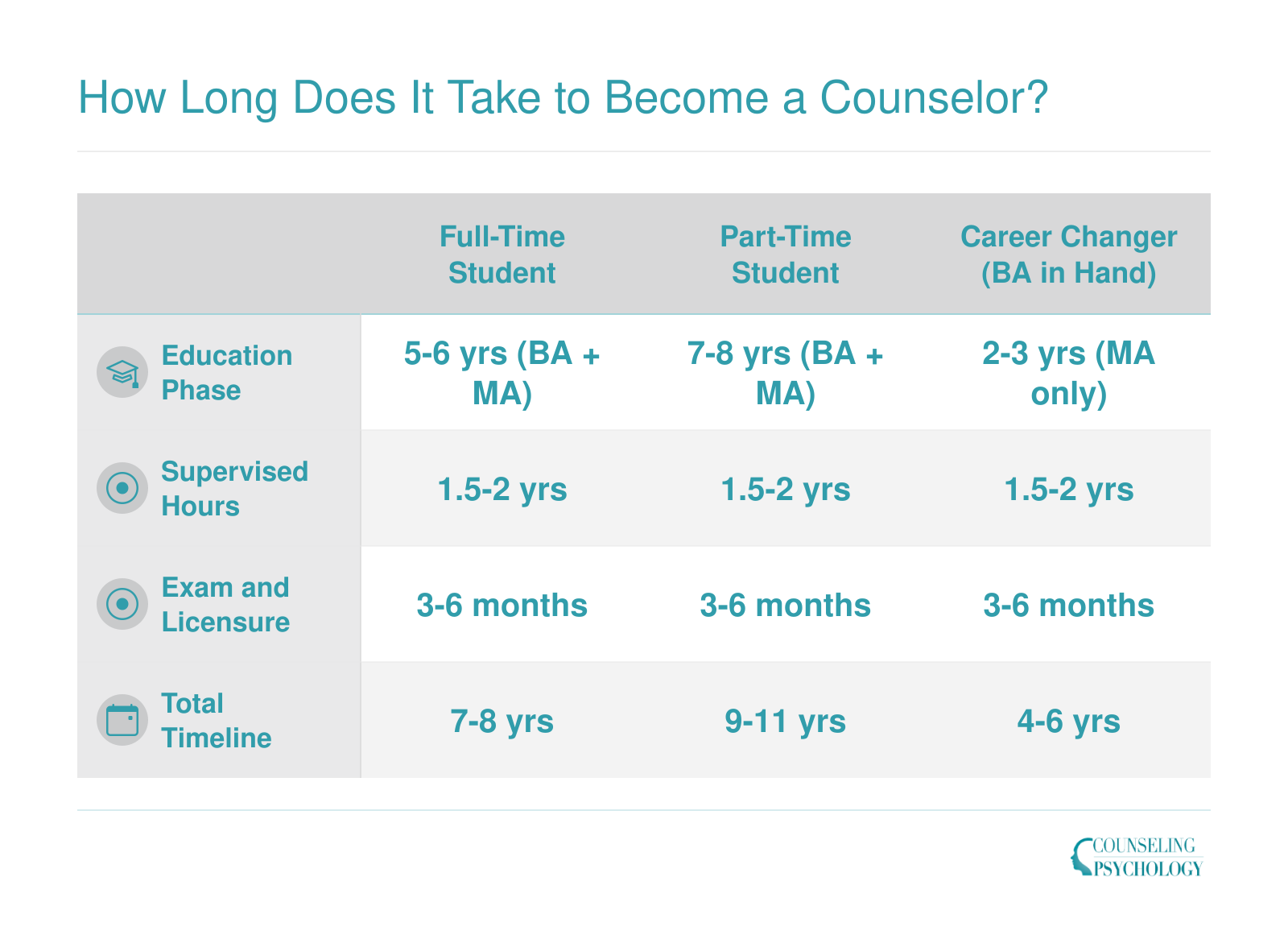
One of the most common questions prospective counselors ask is, "How fast can I become a counselor?" The answer depends on where you are starting and whether you attend school full-time or part-time. The fastest realistic path takes about four years if you already hold a bachelor's degree and pursue your master's and supervised experience on a full-time basis. Below is a side-by-side look at the three most common scenarios.
Counselor Salary and Job Outlook
Counseling is one of the faster-growing occupational groups in the United States, driven by rising demand for mental health services, expanded insurance coverage, and growing awareness of behavioral health needs. The table below summarizes national salary benchmarks and projected job growth for the most common counseling categories, based on data from the Bureau of Labor Statistics. Substance abuse, behavioral disorder, and mental health counselors are projected to see especially strong growth at 17% from 2024 to 2034, well above the average for all occupations. School and career counselors also show steady demand, with roughly 26,600 annual openings projected each year.
| Counseling Occupation | National Median Salary | 25th Percentile Salary | 75th Percentile Salary | Total Employment | Projected Growth Rate | Projected Annual Openings |
|---|---|---|---|---|---|---|
| Substance Abuse, Behavioral Disorder, and Mental Health Counselors | $59,190 | $47,170 | $76,230 | 440,380 | 17% (2024 to 2034) | 48,300 |
| Educational, Guidance, and Career Counselors and Advisors | $65,140 | $51,690 | $83,490 | 342,350 | 5% (2022 to 2032) | 26,600 |
| All Counselors (broad category) | $60,200 | $47,350 | $78,230 | 970,870 | N/A | N/A |
Counselor Salary by State: Where Do Counselors Earn the Most?
Counselor pay varies significantly by state, specialty, and cost of living. The tables below draw from BLS state-level data for two of the largest counseling occupation categories. If you are weighing where to practice, compare median wages alongside local housing costs and licensure reciprocity before making a move.
| State | Occupation Category | Total Employment | Median Annual Wage | 25th Percentile Wage | 75th Percentile Wage |
|---|---|---|---|---|---|
| California | Educational, Guidance, and Career Counselors and Advisors | 44,160 | $94,320 | $66,500 | $122,160 |
| Washington | Educational, Guidance, and Career Counselors and Advisors | 5,910 | $83,930 | $64,680 | $109,390 |
| District of Columbia | Educational, Guidance, and Career Counselors and Advisors | 1,800 | $80,280 | $61,930 | $101,050 |
| Alaska | Educational, Guidance, and Career Counselors and Advisors | 660 | $80,020 | $61,000 | $88,860 |
| Massachusetts | Educational, Guidance, and Career Counselors and Advisors | 11,850 | $78,840 | $63,800 | $100,250 |
| New Jersey | Educational, Guidance, and Career Counselors and Advisors | 7,590 | $77,940 | $64,900 | $99,180 |
| New Mexico | Educational, Guidance, and Career Counselors and Advisors | 1,760 | $76,490 | $56,930 | $84,460 |
| Maryland | Educational, Guidance, and Career Counselors and Advisors | 6,210 | $74,970 | $61,860 | $97,910 |
| Oregon | Educational, Guidance, and Career Counselors and Advisors | 3,330 | $74,000 | $57,540 | $98,090 |
| New York | Educational, Guidance, and Career Counselors and Advisors | 22,660 | $69,900 | $56,000 | $95,210 |
| Alaska | Substance Abuse, Behavioral Disorder, and Mental Health Counselors | 1,060 | $79,220 | $63,690 | $96,940 |
| New Mexico | Substance Abuse, Behavioral Disorder, and Mental Health Counselors | 2,070 | $70,770 | $55,060 | $80,840 |
| Oregon | Substance Abuse, Behavioral Disorder, and Mental Health Counselors | 6,410 | $69,660 | $56,290 | $84,970 |
| North Dakota | Substance Abuse, Behavioral Disorder, and Mental Health Counselors | 1,180 | $66,450 | $50,810 | $75,120 |
| District of Columbia | Substance Abuse, Behavioral Disorder, and Mental Health Counselors | 980 | $66,140 | $47,980 | $83,040 |
| Utah | Substance Abuse, Behavioral Disorder, and Mental Health Counselors | 4,720 | $65,920 | $42,210 | $94,630 |
| New Jersey | Substance Abuse, Behavioral Disorder, and Mental Health Counselors | 14,640 | $64,710 | $51,170 | $84,690 |
| Washington | Substance Abuse, Behavioral Disorder, and Mental Health Counselors | 13,150 | $64,220 | $52,070 | $80,440 |
| Arizona | Substance Abuse, Behavioral Disorder, and Mental Health Counselors | 8,970 | $63,830 | $50,650 | $79,990 |
| New York | Substance Abuse, Behavioral Disorder, and Mental Health Counselors | 22,450 | $62,070 | $50,880 | $76,680 |
Where you practice and what you specialize in can shift your salary by more than $25,000 a year. Counselors working in school settings, substance abuse treatment, or clinical mental health each fall into different pay ranges, and those ranges vary significantly from state to state. Factor both your specialty and your target location into your career planning from the start.
Cost of a Counseling Degree and How to Pay for It
The cost of a master's in counseling varies widely, but smart program selection can keep debt manageable even on a counselor's starting salary. A counseling degree is a career investment, and understanding the full price tag, hidden expenses, and funding options is the first step toward graduating with manageable debt.
Understanding the Price Tag
Tuition for a counseling master's depends heavily on the type of institution you choose. Public in-state programs are the most affordable, with total costs typically ranging from $28,000 to $40,000 according to 2026 data.1 Out-of-state public programs run higher, at $40,000 to $60,000. Private nonprofit programs often fall between $55,000 and $75,000, though some may exceed $100,000.
Online counseling degrees offer a wide cost spectrum. Many accredited online programs cost between $20,000 and $45,000 in total, with some highly affordable options dipping as low as $15,000. Rankings for 2026 show annual tuition for online counseling master's programs ranging from about $5,000 to $21,000. Students who want to finish faster may also consider accelerated online master's in counseling degrees, which can reduce overall living expenses by compressing the timeline.
Hidden Costs Beyond Tuition
The sticker price is only part of the story. Counseling students also face several additional expenses:
- Fees: Technology, student activity, and graduation fees can add hundreds per semester.
- Textbooks and materials: Budget $500 to $1,500 per year.
- Liability insurance: Required for practicum and internship, costing $50 to $150 per year.
- Supervision: Post-degree supervision for licensure often costs $50 to $150 per session. With up to 3,000 hours required in some states, this can total thousands.
- Exam fees: The NCE or NCMHCE exam fee is around $275 to $350.
Financial Aid and Loan Repayment Options
Several resources can reduce the burden:
- Federal loans: Graduate students are eligible for Direct Unsubsidized Loans and Grad PLUS Loans. Borrowing limits are higher, but interest accrues during school.
- HRSA behavioral health workforce programs: The Health Resources and Services Administration offers scholarships and loan repayment for students committed to working in underserved areas. The National Health Service Corps (NHSC) Loan Repayment Program can provide up to $75,000 in exchange for two years of service in a Health Professional Shortage Area.
- State-specific loan forgiveness: Many states run their own loan repayment programs for mental health professionals in high-need communities.
- Employer assistance: Some healthcare employers offer tuition reimbursement or sign-on bonuses that can offset student loans.
Is It Worth the Investment?
With national median salaries for counselors ranging from about $49,000 to $60,000, a $100,000-plus degree carries real debt risk. A high debt-to-income ratio can delay major life milestones and limit career flexibility. To maximize return on investment, look for CACREP-accredited public or online programs that keep total costs under $40,000. These programs not only lower debt but also streamline licensure across states, giving you more career mobility for your money.
Counselor vs Therapist vs Psychologist: What's the Difference?
Master's-level counselor versus doctoral-level psychologist represents the most significant educational divide in the mental health field, yet clients seeking talk therapy often experience similar treatment quality from both. Understanding these distinctions matters more for your career planning than for the clinical work itself.
What "Therapist" Actually Means
The term "therapist" functions as an umbrella designation rather than a specific credential. Licensed Professional Counselors, Licensed Marriage and Family Therapists, Licensed Clinical Social Workers, and psychologists can all accurately call themselves therapists when providing treatment. This explains why job listings and insurance panels use the terms somewhat interchangeably. The underlying licenses, however, reflect distinct training paths and regulatory frameworks.
Education and Training Requirements
Licensed Professional Counselors complete a master's degree in counseling, typically requiring two to three years of graduate study plus 2,000 to 4,000 hours of supervised clinical experience.1 LMFTs and LCSWs follow similar timelines with master's degrees in marriage and family therapy or social work, respectively.
Psychologists take a longer route. A doctoral degree (PhD or PsyD) requires five to seven years of graduate education, including a year-long predoctoral internship and often one to two years of postdoctoral supervision before full licensure. Those considering this path can explore what it takes to become a clinical psychologist. This extended training explains the salary differential: psychologists earn a national median of approximately $104,300 annually, compared to roughly $83,300 for licensed counselors and $62,300 for LMFTs and LCSWs.1
Scope of Practice Differences
The practical distinction that affects daily work centers on psychological testing. Psychologists can administer and interpret comprehensive psychological assessments, including IQ tests, personality inventories, and neuropsychological batteries.1 Counselors and most other master's-level therapists cannot perform these evaluations, which require doctoral-level training in psychometrics.
Regarding medication prescribing, neither counselors nor psychologists hold prescriptive authority in most states. Only psychiatrists (medical doctors) and certain advanced practice nurses routinely prescribe psychiatric medications, though a handful of states have created limited prescribing pathways for specially trained psychologists.
What This Means for Your Career Choice
If you want to provide talk therapy and help clients work through life challenges, a master's degree in counseling offers a more efficient path to practice. If psychological testing, research, or academic positions interest you, the doctoral route becomes necessary. Job posting growth has been strong across all three categories, with psychologist positions growing 40 percent and licensed counselor positions increasing 26 percent between 2021 and 2023.1
Can You Work in Counseling Without a Master's Degree?
A licensed clinical counselor, in every U.S. state, holds a master's degree at minimum. There is no shortcut around that requirement if your goal is to practice independently, diagnose mental health conditions, or bill insurance as a counselor. That said, the broader behavioral health field includes a number of meaningful roles you can enter with a bachelor's degree or even a specialized certification, and many of these positions serve as direct pipelines into graduate-level counseling careers.
Counseling-Adjacent Roles You Can Pursue Now
Several positions let you work alongside licensed counselors, gain hands-on client experience, and test whether the profession is the right fit before you invest in a master's program.
- Certified Peer Support Specialist: Requires lived experience with mental health or substance use recovery plus state-approved training. National median pay typically falls in the range of $35,000 to $42,000 per year.
- Substance Abuse Technician: Assists clients in detox and residential treatment settings. Salaries generally range from $30,000 to $40,000 depending on the facility and region.
- Behavioral Health Technician: Works in psychiatric units, group homes, or outpatient clinics under clinical supervision. Pay commonly ranges from $32,000 to $42,000.
- Case Manager: Coordinates services, referrals, and treatment plans for clients across social service agencies. Typical salaries fall between $38,000 and $48,000.
- Crisis Hotline Counselor: Provides immediate phone or text-based support. Some positions are volunteer-based, while paid roles generally start around $33,000 to $40,000.
- Community Health Worker: Connects underserved populations with health and social services. The BLS reports a national median annual wage of roughly $48,860 for this occupation as of the most recent data.
The CADC Path for Substance Use Counseling
Some states allow you to earn a Certified Alcohol and Drug Counselor credential with a bachelor's degree combined with specialized coursework and supervised hours in addiction treatment. Requirements vary by state, but this credential can open doors to substance abuse counselor careers without a master's, particularly in community-based and residential programs. It is worth checking your state's specific CADC requirements, as some states set the bar at a bachelor's while others require additional graduate-level coursework.
Using These Roles as Stepping Stones
Think of these positions not as consolation prizes but as strategic career investments. Working directly with clients in any of these capacities builds practical skills in assessment, crisis intervention, motivational interviewing, and documentation. Graduate admissions committees at counseling programs value this kind of experience, and so do future clinical supervisors. Many licensed counselors working today started in exactly these roles, using them to confirm their commitment to the field and to build a professional network before enrolling in a master's program. If you are exploring what options exist after earning your license, you might also review the best jobs for a mental health counselor. If you are weighing the time and cost of graduate school, spending a year or two in a bachelor's-level role is one of the most reliable ways to make a confident, informed decision.
Frequently Asked Questions About Becoming a Counselor
Below are answers to the most common questions prospective counselors ask when planning their career path. Each response is grounded in current licensing standards, salary data, and educational requirements as of 2026.
Explore Counseling
- Best Counseling Schools Near Me
- Best Online Addiction Psychology Degree
- Best Online Graduate Certificate in Counseling
- Counseling Careers
- Counseling Degrees
- Counseling Licensure Acronyms
- Counseling Master's Textbooks
- Counseling Psychology Master's Degree Guide
- Counselor Resume Guide
- Counselor Salary
- Online Counselor
- How to Get a Counseling License
- Should I Become a Therapist? How to Know If It's Right
Explore Careers
Explore Programs
- Best Online Addiction Counseling Degree
- Best Online Bachelor's in Counseling Degrees
- Best Online Biblical Counseling Degree
- Best Online Clinical Mental Health Counseling
- Best Online Licensed Professional Clinical Counseling
- Best Online Master's in Counseling
- Best Online MFT
- Best Online Pastoral Counseling
- Best Online Ph.D. in Counseling
- Best Online School Counseling
- Counseling vs Psychology vs Social Work
- Online Genetic Counseling