
What you’ll learn in this article…
- Psychology degrees span five levels from associate to doctoral, with the full path to licensure typically taking 8 to 12 years.
- PsyD programs focus on clinical practice, while PhD programs emphasize original research and academic careers.
- APA accreditation and regional institutional accreditation are two distinct layers that directly affect licensure eligibility.
- Industrial-organizational psychology is one of few specializations where a master's degree opens strong career doors without state licensure.
A psychology degree spans a spectrum from a two-year associate that qualifies you for behavioral health technician roles to a doctoral degree that requires 8 to 12 years of training before independent licensure. The path from enrollment to practice is rarely straightforward: a bachelor's in psychology alone does not lead to licensure, a PsyD and PhD serve different career ends, and some specializations demand accreditation that excludes online programs. As mental health demands grow, the degree you choose determines not only how quickly you enter the field but whether you can practice, teach, or conduct research.
Types of Psychology Degrees by Level: Associate Through Doctoral
Two-year associate vs. four-year bachelor: the first fork on the psychology degree path presents a choice between a fast entry into the workforce and deeper academic preparation. The psychology degree landscape spans five main levels, each with distinct timelines, prerequisites, and career implications.
Associate Degree in Psychology
An associate degree typically takes two years of full-time study and requires around 60 credits. The curriculum blends general education courses with introductory psychology topics such as human development, abnormal psychology, and research methods. Admission is straightforward: a high school diploma or GED with a minimum 2.0 GPA, and no standardized test is required. This degree qualifies graduates for entry-level roles in human services, like psychiatric aide or community outreach worker, but it is not a direct route to psychology licensure. Many students use it as a stepping stone to a bachelor's program, transferring credits to a four-year institution.
Bachelor's Degree in Psychology
The bachelor's degree is the most common entry point for careers in psychology. Spanning about 120 credits and four years, it provides a broad foundation in psychological theory, statistics, and research. Admission requirements vary: some programs like The New School's bachelor's in psychology rely on the Common App without a mandatory exam, while others may ask for a minimum high school GPA and SAT or ACT scores.2 This degree opens doors to fields such as case management, human resources, and market research, but it does not qualify graduates for licensure as psychologists. For many, it serves as the prerequisite for graduate study in counseling, social work, or psychology.
Master's Degree in Psychology
Master's degree in psychology programs generally demand 30 to 60 credits and two to three years of study, often culminating in a thesis or comprehensive exam. They focus on specialized areas like industrial-organizational psychology or mental health counseling. Prerequisites are more rigorous: Brooklyn College's M.A. in I-O psychology, for example, requires a 3.0 GPA and 12 undergraduate psychology credits with a B or better in statistics and research methods.3 Yeshiva University's Mental Health Counseling M.A. mandates 15 prior psychology credits including specific courses like abnormal psychology and research methods, though it does not require the GRE.4 A master's can lead to licensure in counseling (as an LPC or LMHC) but is usually a stepping stone to doctoral work for those pursuing psychologist licensure.
Graduate Certificates in Psychology
Graduate certificates are post-baccalaureate credentials, typically 12 to 18 credits completed in one year. They are designed for career pivots or specialization add-ons rather than standalone licensure paths. For instance, a certificate in applied behavior analysis or forensic psychology can supplement a master's degree or help a professional shift focus. Admission usually requires a bachelor's with a satisfactory GPA, and some may ask for related coursework. These programs do not lead to independent practice as a psychologist but enhance expertise for roles in education, business, or healthcare settings.
Doctoral Degrees: PhD and PsyD
At the doctoral level, students choose between a PhD, which emphasizes research, and a PsyD, which focuses on clinical practice. Both require 90 to 120 credits, a dissertation or doctoral project, and a yearlong internship, taking five to seven years on average. Admission is highly competitive. Yeshiva University's clinical PsyD requires the GRE General Test and at least 15 undergraduate psychology credits with specific coursework. Georgia State University's PhD in Psychology also demands the GRE (with strong scores), plus prerequisites in statistics, research methods, and advanced content courses.6 These degrees are the mandatory path to licensure as a psychologist in all states.
Explore By State
- Alabama
- Alaska
- Arizona
- Arkansas
- California
- Colorado
- Connecticut
- Delaware
- Florida
- Georgia
- Hawaii
- Idaho
- Illinois
- Indiana
- Iowa
- Kansas
- Kentucky
- Louisiana
- Maine
- Maryland
- Massachusetts
- Michigan
- Minnesota
- Mississippi
- Missouri
- Montana
- Nebraska
- Nevada
- New Hampshire
- New Jersey
- New Mexico
- New York
- North Carolina
- North Dakota
- Ohio
- Oklahoma
- Oregon
- Pennsylvania
- Rhode Island
- South Carolina
- South Dakota
- Tennessee
- Texas
- Utah
- Vermont
- Virginia
- Washington
- Washington DC
- West Virginia
- Wisconsin
- Wyoming
Psyd vs PHD in Psychology: How to Choose the Right Doctoral Path
At the doctoral level, the difference between a PsyD and a PhD in psychology comes down to a fundamental philosophical divide: PsyD programs are built to train expert clinicians, while PhD programs prepare you to produce original research and teach at the collegiate level. Both pathways lead to licensure as a psychologist, but the daily work, financial investment, and career opportunities diverge sharply.
Training Models: Practitioner-Scholar vs Scientist-Practitioner
The PsyD degree, emerging in the 1970s to address the need for more practice-oriented psychologists, follows a practitioner-scholar model. Coursework and supervised clinical experience take precedence over original research. In contrast, the PhD has long adhered to the scientist-practitioner model, where rigorous research training is woven into clinical preparation. PhD students typically complete a dissertation that makes a novel contribution to the field, while PsyD dissertations or doctoral projects often involve a literature review or program evaluation. This distinction means PhD graduates are equally at home designing studies or running therapy sessions, whereas PsyD graduates are primarily steeped in therapeutic technique and assessment.
Funding, Cost, and Admissions: A Numbers Game
The financial reality of each path can be startling. PhD programs in psychology, with an average admission rate of just 13% (range 10 to 15%), are highly competitive but frequently offer full funding. Tuition waivers and stipends from research or teaching assistantships are common, often covering the entire $30,000 to $60,000 annual sticker price. PsyD programs, by contrast, accept roughly 40% of applicants but pass much of the cost to students. Annual tuition runs $35,000 to $60,000, and while some PsyD programs provide assistantships, comprehensive funding is uncommon. The result: many PsyD graduates carry higher student loan debt, while most PhD students emerge with little to no debt.
Clinical Hours and Program Length
When it comes to hands-on training, the degrees are more alike than different. Both require intensive practicum placements (1,000 to 2,000 hours) and a full-time internship (1,500 to 2,000 hours). The real separation lies in duration. A PsyD can often be completed in 4 to 6 years, emphasizing early clinical immersion. A PhD stretches 5 to 8 years, with the extra time devoted to research milestones like a master's thesis, qualifying exams, and a dissertation. If your goal is to see clients as soon as possible, the PsyD's shorter timeline appeals. If you're drawn to an academic career, the PhD's built-in research years are essential.
Career Outcomes: Where Each Degree Takes You
Both degrees qualify you for state licensure as a psychologist, but your day-to-day work will differ. PhD holders populate research universities, academic medical centers, and think tanks alongside private practice and consulting roles. PsyD graduates overwhelmingly enter clinical roles, including private practice, community mental health, hospital administration, and clinical supervision. The likelihood of pursuing a research-focused career is markedly higher with a PhD. For those who want to treat patients without the demands of a lab or lecture hall, the PsyD offers a direct line to licensure and a path to become a clinical psychologist. For those who envision splitting time between therapy, teaching, and publishing, the PhD remains the gold standard.
Questions to Ask Yourself
Psychology Specializations and When to Choose One
Clinical and counseling psychology programs require a doctoral degree for independent licensure, while industrial-organizational psychology stands out as one of the few specializations where a master's degree alone opens strong career doors without state licensure. Understanding which specializations align with which degree levels saves years of planning and prevents costly missteps.
Degree Requirements by Specialization
Most psychology specializations require at least a master's degree to practice, and several demand a doctorate:
- Clinical psychology: Requires a PhD or PsyD for licensure. Practitioners diagnose and treat mental health disorders in hospitals, private practice, and community health centers.
- Counseling psychology: Also requires a PhD or PsyD. Counseling psychologists focus on developmental and adjustment issues across the lifespan, often working in university counseling centers, community agencies, and group practices.
- School psychology: Most states require an EdS (Educational Specialist degree) or doctorate. School psychologists assess learning and behavioral challenges, consult with teachers, and design interventions in K-12 settings.
- Forensic psychology: Typically requires a PhD or PsyD. Forensic psychologists evaluate defendants, consult on criminal cases, and testify in legal proceedings.
- Neuropsychology: Requires a PhD and postdoctoral fellowship. Neuropsychologists assess cognitive functioning following brain injury, stroke, or neurological disease.
- Health psychology: Available at the master's level for research and program coordinator roles, but independent practice requires a doctorate.
- Industrial-organizational (I-O) psychology: A master's degree qualifies graduates for roles in talent management, organizational development, employee training, and workplace assessment without licensure. This makes I-O psychology uniquely accessible and financially efficient compared to clinical or counseling tracks.
Distinguishing Psychology from Adjacent Degrees
Psychology specializations overlap with related fields but differ in training and scope:
- Master of Social Work (MSW): Social workers hold the LCSW credential, focus on case management and community resources, and typically complete two years of graduate training. Their scope includes therapy but emphasizes systemic intervention.
- Clinical Mental Health Counseling (CMHC): Counselors earn the LPC or LMHC license after a master's degree, often in 60 credits. Their training centers on therapeutic techniques and shorter-term treatment.
- Psychiatry (MD or DO): Psychiatrists are physicians who prescribe medication. Their training includes medical school, residency, and the ability to integrate biological and psychological treatment.
These distinctions matter when comparing job titles like "therapist," which can apply to psychologists, social workers, or counselors depending on credential and state law. If you are leaning toward the counseling route, understanding the steps to become a licensed professional counselor is essential before committing to a program.
Associate Degrees and the Specialization Timeline
An associate degree in psychology does not lead to specialization or independent practice. It serves as a transfer credential toward a bachelor's degree or qualifies graduates for support roles such as psychiatric technician, case management assistant, or residential counselor. These positions pay modestly but provide frontline clinical exposure that strengthens future graduate applications.
Students exploring counseling degrees alongside psychology tracks should note that the two fields share foundational coursework but diverge significantly at the graduate level. Most psychology programs encourage exploration during the first year of graduate study. Declaring a specialization too early can close doors, particularly in PhD programs where rotations and lab placements shape long-term focus. Keeping options open until coursework, practicum, and faculty mentorship clarify your interests is the smarter path.
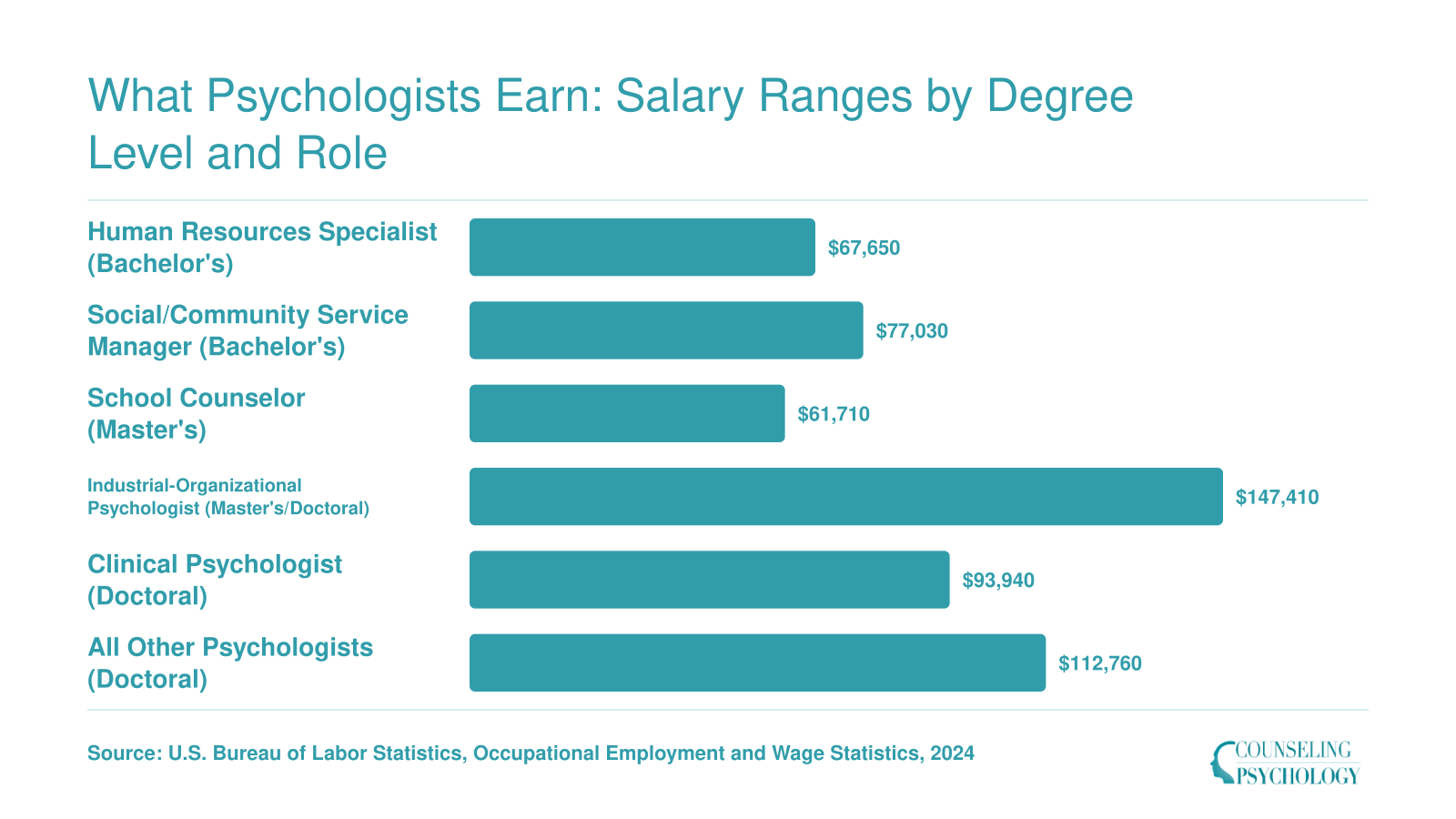
What Psychologists Earn: Salary Ranges by Degree Level and Role
Earning potential in psychology varies significantly depending on your degree level and the role you pursue. The figures below reflect national median annual wages from the Bureau of Labor Statistics. For the most current numbers, search by SOC code at bls.gov, and supplement with salary surveys from the APA or NASP for breakdowns by experience, setting, and region.
What Can You Do With a Psychology Degree?
The career map for psychology has widened considerably as employers across healthcare, tech, and education have started recruiting from psychology programs for roles that didn't exist a decade ago, from user research to behavioral health coaching. But the degree level you finish still determines which doors open, and the gap between a bachelor's and a doctorate is bigger than most prospective students realize.
Bachelor's-Level Careers: Versatile but Rarely Clinical
A bachelor's in psychology is one of the most flexible undergraduate degrees, but it almost never qualifies you for clinical work. Graduates typically land in human services, HR, market research, and education support. Common titles include case manager at a community mental health agency, behavioral health technician at a residential treatment center, HR coordinator inside a corporation, market research analyst at a consumer brands firm, or paraprofessional in a public school district. The work is real and often rewarding, but diagnosing or providing therapy is off the table without graduate training.
Master's-Level Careers: Where Licensure Begins
A master's opens the door to licensed clinical roles, though the title "psychologist" is typically reserved for doctoral holders in most states. Master's graduates work as licensed professional counselors in private practice, licensed marriage and family therapists in group practices, school psychologists in K-12 districts (often with a specialist degree), and industrial-organizational psychologist consultants inside corporations. Licensure here usually requires 2,000 to 3,000 post-master's supervised clinical hours, completed over roughly two years under an approved supervisor.
Doctoral-Level Careers: The Psychologist Title
A PhD or PsyD qualifies you to practice as a licensed psychologist. Settings range from hospital neuropsychology departments to VA medical centers, university counseling clinics, independent private practice, and tenure-track research positions. Most states require 1,500 to 2,000 post-doctoral supervised hours plus passing the EPPP before independent licensure. Job outlook is solid: the Bureau of Labor Statistics projects 11% employment growth for clinical and counseling psychologists through 2032, with roughly 4,100 openings per year.1
Is 25 Too Late to Become a Psychologist?
No, and it's worth saying plainly. The median age of incoming doctoral students in clinical and counseling psychology sits squarely in the late 20s, and cohorts routinely include applicants in their 30s and 40s. Career changers from teaching, nursing, social work, and even corporate roles are common, and admissions committees often view that life experience as an asset rather than a liability.
Accreditation and Licensure: What You Need to Know
Accreditation is not a single checkbox but two distinct layers that determine whether your psychology degree opens professional doors or leaves you ineligible for licensure. Understanding these layers before you enroll can save years of lost time and tuition.
Regional and Programmatic Accreditation: Why Both Matter
Regional accreditation applies to the entire institution and is granted by bodies recognized by the U.S. Department of Education. It qualifies students for federal financial aid and ensures that credits transfer to other regionally accredited schools. Every reputable college or university holds this baseline credential.
Programmatic accreditation evaluates individual degree programs against profession-specific standards. For doctoral psychology programs in clinical, counseling, and school psychology, the APA Commission on Accreditation sets the benchmark.1 The Commission reviews programs through a rigorous process that includes self-study, faculty resources, training policies, and outcome data.2 Programs must demonstrate competency-based education, embed supervised training, and prepare students for APA-accredited internships.1
For master's-level counseling programs, CACREP (Council for Accreditation of Counseling and Related Educational Programs) serves the same gatekeeping role. CACREP standards govern curriculum structure, faculty qualifications, and clinical training hours. If you are considering counseling licensure, verify that your target program holds current CACREP approval.
How Accreditation Maps to Licensure
Graduating from an APA-accredited doctoral program is required or strongly preferred in most states for psychology licensure. State psychology boards typically mandate completion of a doctorate from an APA-accredited program, followed by 1,500 to 2,000 hours of supervised postdoctoral experience and passing the Examination for Professional Practice in Psychology (EPPP).3 Without APA accreditation, you may be ineligible to sit for the exam in many jurisdictions, regardless of your degree's content or rigor.
Similarly, CACREP accreditation is increasingly required for licensure as a professional counselor. A growing number of states now mandate CACREP-accredited degrees for LPC credentials, and several more grant expedited pathways or reciprocity only to CACREP graduates.
What Degree Do You Need to Become a Licensed Psychologist?
The answer is unambiguous: a doctoral degree (PhD or PsyD) from an APA-accredited program, plus supervised postdoctoral hours and passing the EPPP.3 Master's-level degrees in psychology do not lead to licensure as a psychologist, though they may qualify graduates for counselor or therapist credentials under different titles. For example, those pursuing clinical work at the doctoral level can explore what it takes to become a clinical psychologist through dedicated career guides.
The Risk of Non-Accredited Programs
Attending a non-accredited program can make licensure impossible in some states, regardless of degree completion. If a program lacks APA or CACREP accreditation, verify with your target state's licensing board whether the degree will qualify you before you enroll. Some states offer case-by-case reviews, but many do not.
Online Programs and Accreditation
Online programs can hold APA or CACREP accreditation. Delivery format does not determine accreditation status, and fully online doctoral and master's programs exist within the accredited pool. Students interested in doctoral counseling options can review accredited online doctorate in counseling programs to see what is available. What matters for licensure is the accreditation seal, not whether you attend classes in person or remotely.
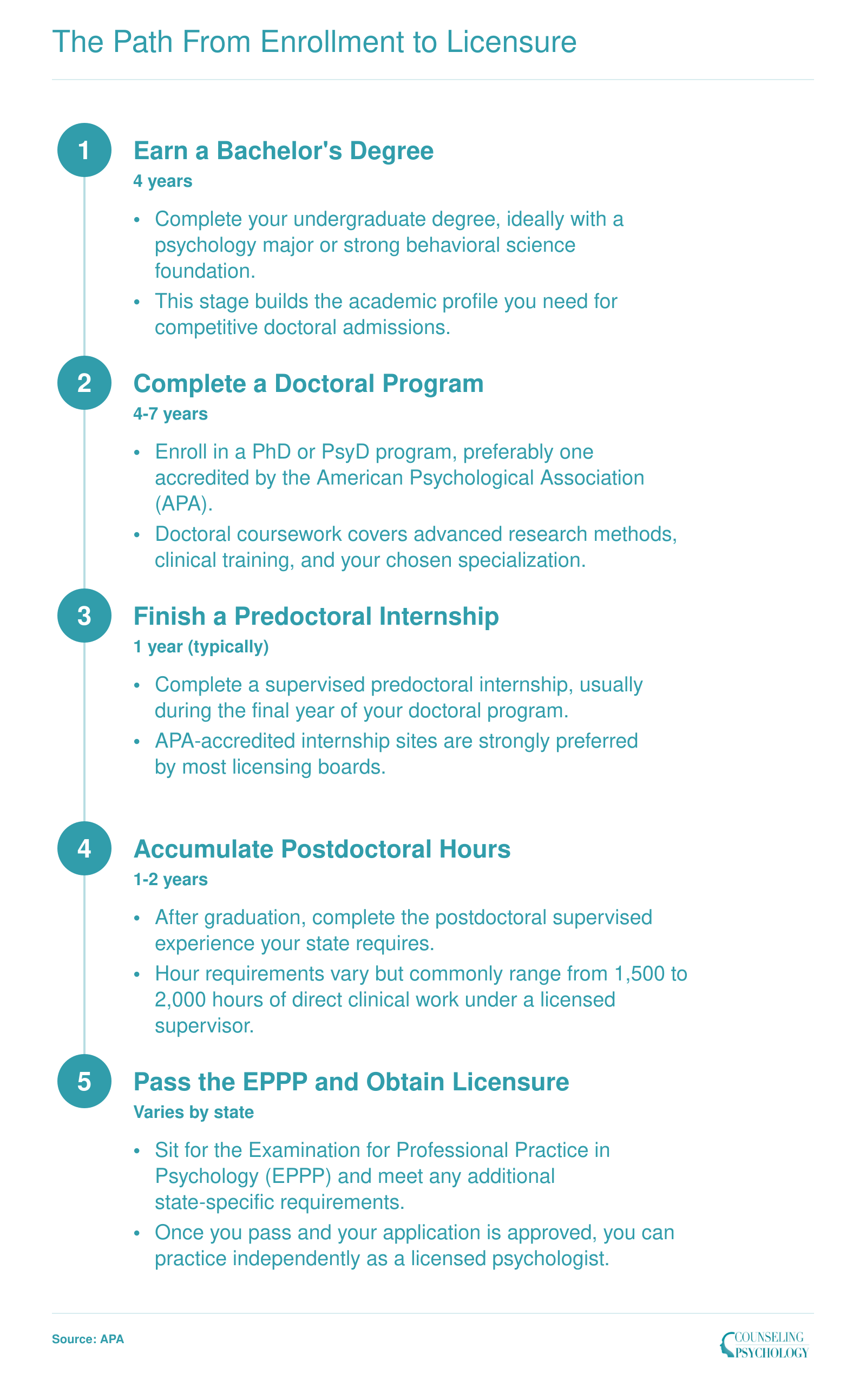
The Path From Enrollment to Licensure
Becoming a licensed psychologist is a marathon, not a sprint. From your first undergraduate course to independent practice, the full credentialing journey typically spans 8 to 12 years. Here is the five-step ladder most aspiring psychologists climb.
Online vs On-Campus Psychology Programs
Choosing between online and on-campus psychology programs is less about which format is objectively better and more about which one fits your life, your career goals, and your learning style. Both formats can lead to accredited, respected credentials. Hybrid models that blend online coursework with intensive on-campus residencies are also growing rapidly, offering a middle path worth exploring.
Pros
- Online programs offer scheduling flexibility that working adults and caregivers need, often with asynchronous coursework you can complete on your own timeline.
- Tuition for online programs is frequently lower, and you avoid housing, commuting, and relocation costs entirely.
- Geographic freedom lets you enroll in accredited programs anywhere in the country rather than limiting yourself to local options.
- On-campus programs provide structured clinical training sites and direct access to faculty mentors who can shape your professional development.
- The cohort experience on campus builds peer networks and professional relationships that often last an entire career.
- Hybrid models are increasingly common, combining the convenience of online learning with periodic in-person residencies for clinical skills and networking.
Cons
- Online students pursuing clinical degrees must coordinate local practicum placements on their own, which can be logistically challenging depending on your area.
- Built-in peer networking is weaker in online formats, requiring more intentional effort to form study groups and professional connections.
- Some employers still perceive online degrees differently, though accreditation status matters far more than delivery format in hiring decisions.
- On-campus programs carry higher total costs once you factor in housing, transportation, parking, and potential lost income from rigid class schedules.
- Rigid scheduling on campus can conflict with work or family obligations, making it harder for nontraditional students to complete their degrees on time.
- On-campus enrollment limits you to programs within commuting distance, which may narrow your choices for specialized concentrations.
Cost, Financial Aid, and ROI of Psychology Degrees
The degree level and funding structure you choose will shape your financial outcome as much as the field itself does.
Tuition Ranges by Degree Level
Costs vary widely depending on the type of institution and whether you attend in state or out of state. Community college associate programs are the most affordable entry point: in-state tuition at schools like Alvin Community College runs around $4,200 per year, while out-of-state students pay closer to $9,800.1 Online associate programs typically total around $10,900 for the full credential.2
At the bachelor's level, in-state tuition at a public university generally falls between $9,000 and $11,000 per year, putting the four-year total in the $36,000 to $44,000 range. Private universities cost significantly more, with annual tuition often between $40,000 and $45,000 and total program costs reaching $160,000 to $180,000.3
Master's programs land in the middle ground: public programs typically cost $10,000 to $20,000 per year (total: $20,000 to $40,000), while private master's programs can run $20,000 to $40,000 annually, with total costs from $40,000 to $80,000.3
Doctoral programs split sharply by type. Research-focused PhD programs at accredited universities frequently offer full funding through teaching and research assistantships, making the net tuition cost close to zero for admitted students. PsyD programs, which focus on clinical practice, are far less likely to offer full funding. Annual tuition commonly runs $30,000 to $50,000, and total program costs can reach $120,000 to $200,000.3
Return on Investment: A Realistic Look
ROI depends on what you study, not just how long you study. A bachelor's in psychology offers modest early-career earnings but genuine long-term flexibility across industries, from human resources to public health. A fully funded PhD delivers strong ROI because you earn a credential, often with a stipend, without accumulating tuition debt. An unfunded PsyD is the most financially precarious path: graduates can carry more than $150,000 in debt against a median salary that, for licensed clinical psychologists nationally, sits around $90,000. That ratio leaves little room for error.
Specialization matters here too. Industrial-organizational psychology master's graduates frequently out-earn clinical doctoral graduates in the first five years of their careers, largely because I-O roles in the private sector command higher starting salaries. Anyone weighing clinical work against applied psychology careers should factor that gap into the decision.
Financial Aid Levers Worth Using
Federal financial aid, including loans and Pell Grants, is only available at regionally accredited institutions. Verifying accreditation before applying is not just an academic formality; it determines whether federal aid is on the table at all.
Beyond federal aid, several funding sources are worth pursuing:
- Graduate assistantships: Common in PhD programs, these cover tuition and provide a modest stipend in exchange for teaching or research work.
- Employer tuition reimbursement: Many healthcare systems, school districts, and corporations offer partial or full reimbursement for employees pursuing graduate degrees aligned with their work.
- Military and veteran benefits: GI Bill benefits and tuition assistance programs can significantly reduce out-of-pocket costs at eligible institutions.
- Psychology-specific scholarships: The American Psychological Association and the Psi Chi honor society both offer scholarship and award programs for undergraduate and graduate students.
The core principle is straightforward: pursue funding aggressively before accepting debt, and weigh the total cost of a program against the realistic salary trajectory in your intended specialization, not the highest salary in the entire field.
How to Choose the Right Psychology Degree for You
No single degree is universally best for psychology. The right choice depends on where you want to work, how much time you can commit, and what you can afford. Selecting a psychology degree becomes clearer when you evaluate three variables: career goal, timeline, and budget.
Match Your Degree to Your Career Goal
If you want to practice therapy independently and diagnose mental health conditions, you need a doctoral degree (PhD or PsyD) followed by licensure as a psychologist. If you plan to do organizational consulting, program evaluation, or clinical work under supervision, a master's degree in counseling, industrial-organizational psychology, or applied behavior analysis is sufficient. If you are targeting adjacent fields like human resources, case management, or research coordination, a bachelor's degree combined with relevant experience often opens the door.
The question "What is the best degree for psychology?" has no universal answer. A PsyD is ideal for someone committed to clinical practice in private settings. A master's fits career-switchers seeking counseling roles within two to three years. A bachelor's works for undergraduates exploring psychology while keeping options open in business, education, or nonprofit sectors.
Align Timeline and Budget Realities
Timeline matters as much as content. Associate programs take two years and prepare you for support roles. Bachelor's degrees require four years and qualify you for entry-level positions or graduate school. Master's programs span two to three years and lead to licensure as a counselor. Doctoral programs demand six to eight years, with PhDs often funded through assistantships while PsyDs typically require tuition payments throughout.
Budget considerations diverge sharply at the doctoral level. PhD programs in clinical or counseling psychology usually offer stipends and tuition waivers in exchange for teaching or research work. PsyD programs rarely provide full funding, leaving graduates with debt loads that can exceed six figures. Weigh total borrowing against projected earnings in your target role and region.
Check State Licensure Rules Before Enrolling
Licensure requirements vary by state and change periodically. Some states accept PsyD credentials from regionally accredited but non-APA-accredited programs; others do not. Some states permit master's-level clinicians to practice independently after accruing supervised hours, while others reserve independent practice for doctoral-level psychologists. Verify your state's board rules before committing to a program, especially if you know where you intend to practice. Moving across state lines later can trigger additional coursework or examination requirements.
Use the specialization and career sections earlier in this guide as a decision map. Cross-reference program pages, compare curricula, and contact admissions offices with specific questions about licensure alignment and clinical training models.
Frequently Asked Questions About Psychology Degrees
Below are answers to some of the most common questions prospective students ask when exploring degrees in psychology. Each response is intentionally brief; the sections above go deeper on accreditation, specializations, and career outcomes.
Which psychology degree actually fits your goals? The answer depends on three things explored throughout this guide: matching your career ambition to the right degree level and specialization, confirming that any program you consider holds proper accreditation, and weighing tuition costs against realistic earning potential for the role you want.
Dig into the program-specific pages across counselingpsychology.org for admissions requirements, cost breakdowns, and outcome data that go deeper than any overview can. Those interested in adjacent helping professions should also explore careers in counseling to compare pathways side by side. Psychology careers are projected to grow faster than average, and demand for qualified professionals continues to climb. The right program is ultimately the one aligned with how you want to help people, so invest the time now to choose well.
Explore Psychology
Explore Careers
- Become a Behavior Interventionist
- BCaBA
- BCBA
- Biogerontologist
- Child Psychologist
- Clinical Psychologist
- Cognitive Neuroscientist
- Cognitive Psychologist
- Comparative Psychologist
- Consumer Psychologist
- Counseling Psychologist
- Criminal Psychologist
- Cultural Psychologist
- Forensic Psychologist
- Air Force Psychologist
- Applied Psychologist
- Army Psychologist
- Educational Psychologist
- Engineering Psychologist
- Environmental Psychologist
- Experimental Psychologist
- Navy Psychologist
- Neurologist
- Neuropsychologist
- Personnel Psychologist
- Physiatrist
- Police Psychologist
- Positive Psychologist
- Psychiatrist
- Psychological Anthropologist
- Psychometrician
- Registered Behavior Technician (RBT)
- Rehabilitation Psychologist
- School Psychologist
- Social Psychologist
- Spiritual Psychologist
- Sports Psychologist
Explore Programs
- Best Online Applied Behavior Analysis
- Best Online Applied Psychology Degree
- Best Online Associate Degrees in Psychology
- Best Online Autism Spectrum Disorders
- Best Online Bachelor's in Psychology
- Best Online Child Psychology Degree
- Best Online Clinical Psychology
- Best Online Cognitive Psychology Degree
- Best Online Counseling Psychology
- Best Online Developmental Psychology
- Best Online Educational Psychology Degrees
- Best Online Forensic Psychology Degree
- Best Online Graduate Certificate in Psychology
- Best Online Health Psychology
- Best Online I/O Psychology
- Best Online International Psychology
- Best Online Master's in Psychology
- Best Online Neuropsychology
- Best Online Ph.D. in Psychology
- Best Online Positive Psychology
- Best Online Psychopharmacology Programs for
- Best Online PsyD
- Best Online School Psychology
- Best Online Social Psychology
- Best Online Sports Psychology
- Engineering Psychology Degrees
- Online Geropsychology