
What you’ll learn in this article…
- CACREP accreditation, held by nearly 950 programs at 458 institutions, is the quality benchmark most state licensing boards require.
- Counseling employment is projected to grow 18.8 percent from 2023 to 2033, far outpacing the national average.
- A bachelor's in counseling opens support roles like case manager but does not qualify you for independent licensed practice.
- Master's programs typically require 600 to 1,000 supervised clinical hours before you can pursue LPC or LMFT licensure.
The Bureau of Labor Statistics projects nearly 19 percent growth for mental health counselors between 2023 and 2033, faster than almost any other professional field. That surge has produced a thicket of program options: bachelor's degrees in counseling, master's programs in clinical mental health counseling, doctoral tracks in counseling psychology, and dozens of specialty concentrations layered on top.
The terminology itself trips up most applicants. Counseling, counseling psychology, and clinical mental health counseling sound interchangeable but lead to different credentials, scopes of practice, and salary ranges. Add CACREP accreditation requirements, state-by-state licensure rules, and tuition that ranges from a few thousand dollars per year at public institutions to six figures at private universities, and the decision rarely comes down to academic interest alone. Whether you are exploring careers in counseling for the first time or narrowing your focus toward a career counseling degree, this guide breaks down what each program level requires, what it costs, and where it can take you professionally.
What Is a Counseling Degree?
Practice-focused counseling programs train students to work directly with clients on wellness, development, and mental health, while counseling psychology degrees blend clinical practice with research and nearly always require a doctoral credential. That distinction matters when you begin shopping for programs, because the curriculum, licensure pathway, and career timeline diverge sharply between the two.
Counseling as a Practice Discipline
Counseling degrees prepare graduates to assess, diagnose, and treat mental health conditions through evidence-based interventions. Unlike clinical psychology, which emphasizes psychological testing, research design, and longer-term therapy, counseling programs center on brief-to-moderate treatment modalities, community mental health counselor settings, and applied skill development. You will spend substantial time in supervised clinical placements, learning intake procedures, treatment planning, crisis intervention, and case documentation under real-world conditions.
Counseling also differs from social work in its theoretical foundation. Social work programs teach systems-level advocacy, resource navigation, and policy frameworks, whereas counseling curricula focus on individual and group therapy techniques, diagnostic assessment, and the therapeutic relationship itself.
Clinical Mental Health vs. School Counseling Tracks
Many prospective students search for "counseling degree" without realizing that graduate programs split into distinct specialty tracks at the master's level. Clinical mental health counseling prepares you to work in private practice, hospitals, substance-use treatment centers, and community agencies, treating clients across the lifespan for anxiety, depression, trauma, and related disorders. School counseling, by contrast, equips you to serve K-12 students in educational settings, addressing academic planning, social-emotional development, and college and career readiness. If you are drawn to younger populations, our guide on how to become a school counselor breaks down the specific degree and certification requirements. The two tracks share foundational coursework but diverge in practicum sites, state licensure exams, and day-to-day responsibilities.
Degree Levels and Professional Entry Points
Most licensed professional counselor positions require a master's degree, typically 60 semester credits and two to three years of full-time study. Bachelor's and associate degrees in counseling or related fields open doors to supportive roles such as case manager, behavioral health technician, or peer support specialist, but you cannot diagnose or provide independent therapy with only an undergraduate credential. Doctoral programs in counseling, counselor education, or counseling psychology exist for those pursuing academic appointments, advanced clinical specialties, or supervisory roles, though the majority of practicing counselors hold a terminal master's.
Each degree level unlocks different career doors, and understanding that progression helps you chart a realistic timeline from enrollment to licensure. The next section compares those levels side by side, detailing credit requirements, typical costs, and the roles each credential supports.
Counseling Degree Levels Compared: Associate's Through Doctorate
The counseling degree pathway is a four-tier ladder that leads from entry-level support roles to independent clinical practice, with each degree level unlocking a distinct scope of competency, credential, and earning potential.
Associate Degrees in Counseling
- Typical Duration: 2 years full-time; part-time options often extend to 3-4 years.
- Average Tuition: In-district community college rates average $3,500-$5,000 per year, according to NCES College Navigator data. Out-of-state and private two-year colleges can cost roughly twice as much.
- What You Can Do: This level prepares graduates for paraprofessional roles such as psychiatric aide, case management assistant, or substance abuse support staff. The BLS notes these positions usually require a high school diploma or an associate degree, with supervised on-the-job training.
- Articulation Agreements: Many associate programs are designed as transfer degrees, guaranteeing admission to a four-year bachelor's program. Ask the college about specific '2+2' agreements with counseling-pipeline universities.
Bachelor's Degrees in Counseling or Related Fields
- Typical Duration: 4 years full-time. Accelerated degree-completion programs exist for students with prior college credit, and many schools offer part-time evening or online tracks that take 5-6 years.
- Average Tuition: For the 2025-2026 academic year, in-state public four-year tuition averages about $10,000-$12,000 per year, while private non-profit institutions average $38,000-$42,000, per NCES. Always check the actual cost of attendance, which includes fees, room, and board.
- What You Can Do: Bachelor's-level employment includes behavioral health technician, intake coordinator, or human services caseworker. Licensure as a counselor requires a master's degree, but a bachelor's in psychology, social work, or a dedicated counseling major provides the foundational coursework needed for graduate admission.
- Fast-Track Option: Some universities now offer a combined '3+2' bachelor's-to-master's track, completing both degrees in five years and saving a year of tuition.
Master's Degrees in Counseling
- Typical Duration: 2-3 years of full-time study, typically 48-60 credit hours. Accelerated programs can be completed in as few as 12-18 months of intensive, year-round coursework. Part-time paths often run 3-5 years.
- Average Tuition: Master's in counseling tuition ranges widely. Public university programs may cost $12,000-$20,000 per year in-state, while private and out-of-state programs can exceed $30,000 annually. Use NCES College Navigator to filter by degree and state for precise figures.
- What You Can Do: A master's is the entry credential for licensure as a Licensed Professional Counselor (LPC) or Licensed Mental Health Counselor (LMHC). The BLS confirms that clinical mental health counselor positions require a master's degree and supervised clinical experience. Graduates also qualify for school counselor roles (with appropriate certification) and many private-practice trajectories.
- Accreditation Matters: CACREP-accredited master's programs are the gold standard for licensure portability. Contact the ACA or visit cacrep.org for a searchable list of accredited programs and their reported tuition.
Doctoral Degrees in Counseling or Counseling Psychology
- Typical Duration: 4-7 years post-master's, including a year-long internship and dissertation. PsyD programs may be slightly shorter than PhD programs, but both demand substantial clinical contact hours.
- Average Tuition: Doctoral programs often provide funding through assistantships, especially at research universities. Sticker prices range from $20,000 to $50,000 per year, but many students receive tuition waivers and stipends. Contact individual programs for current funding packages.
- What You Can Do: A doctoral degree qualifies graduates for psychologist licensure, university faculty positions, advanced clinical supervision, and specialty areas like neuropsychology or forensic counseling. The BLS emphasizes that psychologist roles typically require a doctoral degree in psychology or a related field.
Because costs and program lengths shift annually, prospective students should always verify details with NCES College Navigator, individual program websites, and professional bodies like the ACA. For a broader look at what each credential can lead to professionally, explore counseling careers and the steps required to become a counselor.
Questions to Ask Yourself
Do you want to work independently with clients, or in a supportive role under supervision?
Are you willing to invest 5 to 7 years in education, or do you need a faster path into the field?
Is licensure portability across states important to your career plan?
CACREP Accreditation: What It Is and Why It Matters
As of 2024, nearly 950 counseling programs across 458 institutions hold accreditation from the Council for Accreditation of Counseling and Related Educational Programs, better known as CACREP.1 That number reflects how thoroughly this accreditor has become the defining quality benchmark for master's and doctoral-level counseling education in the United States.
What CACREP Actually Does
CACREP sets the curriculum standards, clinical training requirements, and faculty qualifications that accredited programs must meet. When a program earns CACREP accreditation, it signals that the training you receive has been independently reviewed and meets nationally recognized thresholds, not just the minimum requirements of a regional accreditor. In 2024, CACREP released a revised set of standards that updated expectations around multicultural counseling competencies, technology in counseling practice, and supervision frameworks. Programs are currently in the process of aligning their curricula with those updated standards.
Why Licensure Boards Pay Attention
Graduating from a CACREP-accredited program is not just a resume credential. It has direct, practical consequences for licensure. Four states currently require graduation from a CACREP-accredited program as a condition of LPC licensure: Florida, Kentucky, North Carolina, and Ohio.2 Florida's requirement became effective July 1, 2025.3 Beyond those four states, all 50 state licensing boards have aligned their core curricular requirements with CACREP's content areas, meaning that even in states without a hard mandate, a non-CACREP degree may leave you scrambling to document coursework equivalencies or complete additional supervised hours before you can sit for a licensing exam.
The practical risk is real: students who enroll in non-CACREP programs sometimes discover mid-career that their degree creates obstacles to licensure when they relocate or when a state tightens its requirements.
Credentials and Federal Employment
CACREP accreditation also affects eligibility for the National Certified Counselor credential, issued by the National Board for Certified Counselors. Graduates of CACREP programs can apply for the NCC under a streamlined pathway. Beyond private practice and agency work, federal employers including the Department of Veterans Affairs and the Department of Defense routinely give preference to, or require, applicants whose counseling degrees come from CACREP-accredited programs.
How to Verify a Program's Status
Before enrolling, check the program's accreditation status directly on the CACREP website rather than relying solely on a school's marketing materials.2 Accreditation can lapse, and some programs are candidates for accreditation rather than fully accredited. Candidate status does not carry the same licensure and credentialing benefits as full accreditation, so the distinction matters.
Explore By State
- Alabama
- Alaska
- Arizona
- Arkansas
- California
- Colorado
- Connecticut
- Delaware
- Florida
- Georgia
- Hawaii
- Idaho
- Illinois
- Indiana
- Iowa
- Kansas
- Kentucky
- Louisiana
- Maine
- Maryland
- Massachusetts
- Michigan
- Minnesota
- Mississippi
- Missouri
- Montana
- Nebraska
- Nevada
- New Hampshire
- New Jersey
- New Mexico
- New York
- North Carolina
- North Dakota
- Ohio
- Oklahoma
- Oregon
- Pennsylvania
- Rhode Island
- South Carolina
- South Dakota
- Tennessee
- Texas
- Utah
- Vermont
- Virginia
- Washington
- Washington DC
- West Virginia
- Wisconsin
- Wyoming
Online Vs. On-Campus Counseling Programs
Choosing between an online and on-campus counseling program is one of the most consequential decisions you will make during your graduate education. Both formats can lead to the same credentials and licensure eligibility, but the day-to-day experience, cost structure, and logistical demands differ in important ways. Hybrid models, which blend online coursework with periodic campus residencies, are increasingly offered by CACREP-accredited programs and represent a practical middle ground.
- Online programs offer scheduling flexibility that lets working professionals complete coursework on evenings and weekends without relocating.
- Studying online opens access to a broader pool of CACREP-accredited programs nationwide, not just those within commuting distance.
- Total cost is often lower online because students avoid campus fees, housing expenses, and long commutes.
- On-campus programs typically provide built-in practicum site networks, simplifying the process of securing required clinical placements.
- In-person cohorts tend to build stronger peer bonds and professional networks through shared classroom and clinical experiences.
- On-campus students generally have easier, more spontaneous access to faculty mentorship and research collaboration opportunities.
- Online students must still complete 600 or more supervised clinical hours in person, arranged locally, which is the single biggest logistical hurdle of distance learning.
- Without a campus-based placement office, online learners often shoulder more responsibility for identifying and vetting their own practicum and internship sites.
- On-campus programs demand a fixed schedule and physical presence, making it harder to maintain full-time employment during the degree.
- Relocating for an on-campus program can add significant living expenses and may limit your ability to earn income while enrolled.
- Hybrid formats require periodic travel to campus for intensive residencies, adding travel costs that students should factor into their budgets.
Related Articles
LPC Vs. LMFT Vs. NCC: Licensure Pathways by Degree Level
Choosing the right credential shapes the clients you can serve, the settings you can work in, and the salary you can expect. Understanding the differences between the LPC, LMFT, and NCC before you enroll in a graduate program is one of the smartest moves you can make.
Licensed Professional Counselor (LPC)
The LPC is the most widely held clinical counseling license in the United States. Requirements vary by state, but the general framework is consistent:
- Minimum degree: Master's in counseling or a closely related field, typically requiring 60 graduate semester credits.1
- Supervised clinical hours: Approximately 3,000 hours of post-degree supervised experience, though some states set the bar somewhat lower or higher.2
- Required exam: The National Counselor Examination (NCE) or the National Clinical Mental Health Counseling Examination (NCMHCE), depending on the state.1
- Scope of practice: LPCs are authorized to assess, diagnose, and treat a broad range of mental health and emotional disorders. In many states, LPCs enjoy one of the widest scopes of practice among master's-level clinicians, covering individual, group, and crisis counseling across community agencies, hospitals, schools, and private practice.
Licensed Marriage and Family Therapist (LMFT)
The LMFT credential is designed for clinicians who specialize in relational and family systems work. If you want to learn more about this career track, explore how to become a marriage and family therapist.
- Minimum degree: Master's or doctoral degree in marriage and family therapy or a related field with equivalent coursework.3
- Supervised clinical hours: Typically 2,000 to 3,000 hours, with a defined portion involving direct client contact in couples or family sessions.3
- Required exam: The national MFT examination administered by the Association of Marital and Family Therapy Regulatory Boards (AMFTRB).
- Scope of practice: LMFTs focus on relational dynamics, treating couples, families, and individuals through a systems lens. They are particularly well positioned in private practice, where demand for couples and family therapy remains strong.
What Pays More, LPC or LMFT?
LMFTs often earn slightly more in private practice settings, partly because couples and family therapy commands higher session rates in many markets. However, LPCs frequently have a broader scope of practice, which opens the door to a wider range of employers and clinical populations. Nationally, the Bureau of Labor Statistics tracks marriage and family therapists and other counselor categories under separate occupation codes, and median wages for both groups fall in a similar range. Compensation ultimately depends on your state, practice setting, specialization, and years of experience rather than the credential alone.
National Certified Counselor (NCC)
The NCC is not a state license. It is a national certification issued by the National Board for Certified Counselors (NBCC). Think of it as a professional credential that layers on top of, rather than replaces, your state licensure.
- Minimum degree: Master's in counseling with coursework aligned to NBCC standards.
- Exam: The NCE.
- Key benefit: Portability. Because the NCC is recognized nationwide, it can simplify the process when you relocate and need to apply for licensure in a new state. Many employers and insurance panels also view the NCC as evidence of a standardized level of competence.
Picking the Right Path
If you are drawn to general mental health counseling and want maximum flexibility in where and how you practice, the LPC route is typically the broadest foundation. If your passion is couples and family dynamics, pursue an LMFT-track program from the start so your coursework and LMFT supervision hours align with licensing requirements. Regardless of which license you pursue, earning the NCC can strengthen your professional profile and ease future state-to-state transitions. Before committing to a program, verify your target state's specific requirements, because supervised hour thresholds, accepted exams, and title protections can differ significantly from one jurisdiction to the next.
According to the Bureau of Labor Statistics, employment of substance abuse, behavioral disorder, and mental health counselors is projected to grow 18.8 percent from 2023 to 2033, much faster than the average for all occupations, making it one of the fastest-growing job categories in the country.
How Much Does a Counseling Degree Cost?
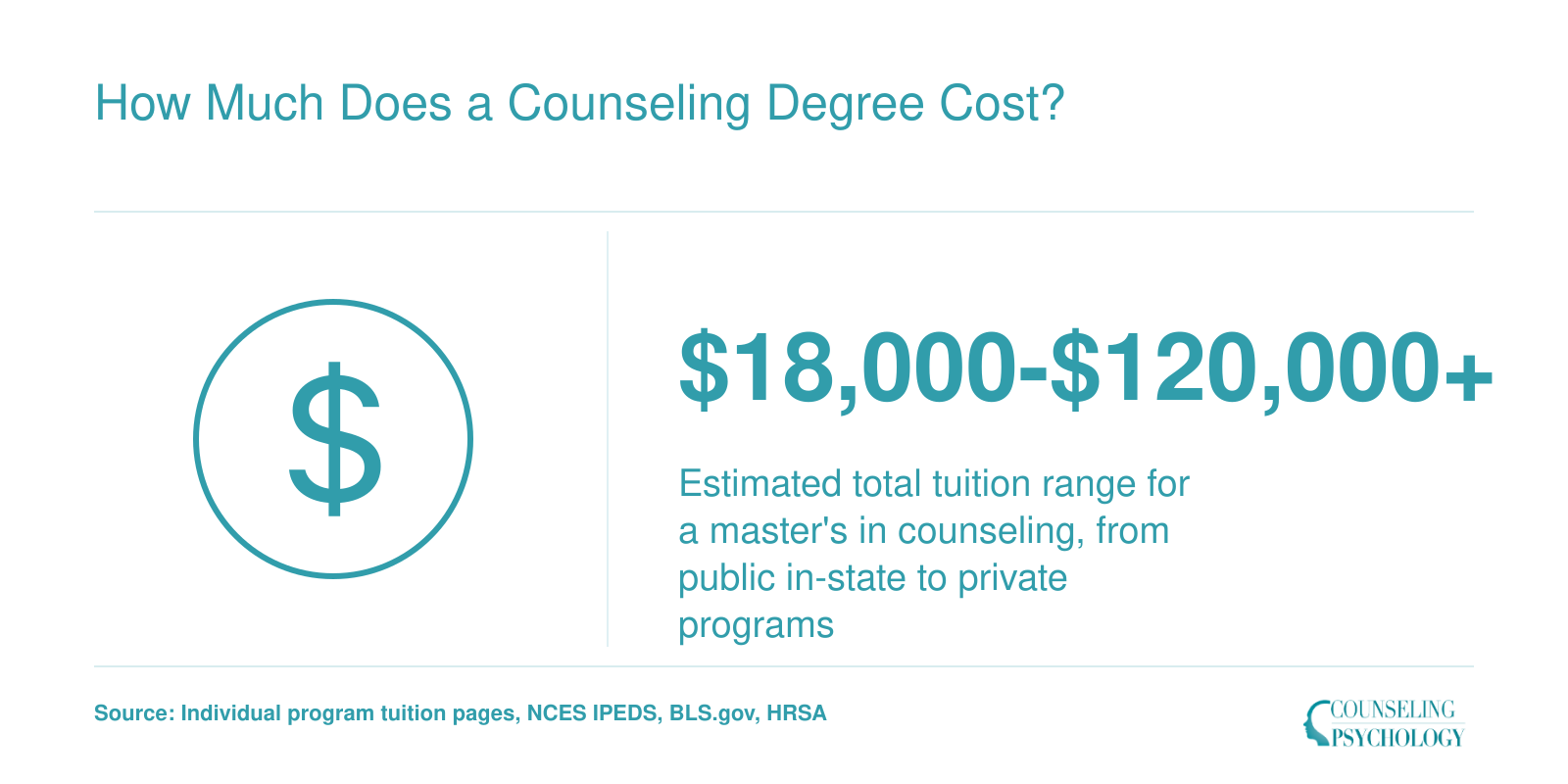
Tuition for counseling programs varies widely by degree level, institution type, and delivery format, so there is no single national average that applies to every student. Public in-state master's programs may charge $300 to $600 per credit hour, while private universities can exceed $1,000 per credit hour. The most reliable way to estimate your total investment is to compare per-credit costs directly on each program's admissions or financial aid page, then weigh that figure against median salaries for your target counseling specialty using BLS.gov data. Also check the Health Resources and Services Administration (HRSA) site for behavioral health scholarship and loan repayment programs that can substantially reduce your net cost, and contact the American Counseling Association (ACA) for member surveys on funding opportunities.
Admission Requirements and Clinical Hours
Getting into a counseling master's program is competitive, and the path from acceptance to full licensure involves far more supervised hours than most applicants expect.
What Master's Programs Look For
Most CACREP-accredited master's programs expect a minimum undergraduate GPA somewhere between 2.75 and 3.0, though many competitive programs admit students whose records trend higher. Admissions committees also look for prerequisite coursework in psychology, human development, or a related social science, so if your undergraduate degree was in an unrelated field, you may need to complete a course or two before applying.
Beyond transcripts, expect to submit a personal statement describing why you want to enter the counseling field and how your experiences have prepared you, along with two or three letters of recommendation from academic or professional contacts who can speak to your readiness. One piece of good news for applicants: the majority of counseling programs have dropped the GRE requirement over the past several years, so standardized test prep is rarely part of the equation anymore.
Practicum and Internship Hours in the Program
CACREP standards set a clear floor for supervised clinical experience during your degree. Students must complete a minimum of 100 practicum hours and 600 internship hours before graduating. These are not classroom simulations. Practicum typically places you in a real counseling setting under close supervision, often logging direct client contact hours alongside observation. Internship expands that experience, usually across two semesters, with students carrying a genuine caseload.
Common placement sites include:
- Community mental health centers: High volume, diverse client populations, and strong supervision structures make these a frequent first placement.
- School settings: Ideal for students pursuing school counseling specializations, with built-in exposure to developmental and crisis work.
- Private practice or outpatient clinics: Useful for students leaning toward clinical mental health tracks, often offering more focused therapeutic modalities.
Post-Degree Hours for Full Licensure
Finishing your degree does not mean you are fully licensed. Most states require an additional 2,000 to 4,000 supervised hours of post-degree clinical work before granting a full license such as the LPC or LMFT. That typically translates to one to three years of employment under an approved supervisor, depending on your state's rules. Students interested in the clinical mental health track can learn more about how to become a mental health counselor, including state-specific hour requirements.
Doctoral-Level Requirements
Students pursuing a Ph.D. or Ed.D. in Counselor Education take on clinical hours and layer significant additional obligations on top of them. Doctoral candidates complete dissertation research, which demands independent scholarly inquiry over several years, and most programs also require teaching practicum, meaning you will supervise or co-instruct master's-level students as part of your own training. The result is a credential built for faculty positions, supervisory roles, and research careers rather than direct clinical practice alone.
Counseling Specializations and Career Outcomes
Ongoing mental health parity efforts and school-based mandates are reshaping demand for specialized counselors, making your choice of specialty one of the most consequential decisions in your career journey. Each specialization maps to a distinct professional identity and client population, and many states tie licensure eligibility directly to your graduate program's focus.
Mapping Specializations to Career Roles
- Clinical mental health counseling prepares you to become a Licensed Professional Counselor (LPC) working in private practice, community agencies, or hospitals with clients facing depression, anxiety, or trauma. CACREP-accredited programs in this track emphasize diagnostics, treatment planning, and supervised clinical hours.
- School counseling leads to K-12 school counselor roles, where you support academic development, social-emotional learning, and college readiness. Most states require a master's in school counseling and a state-issued credential.
- Marriage and family therapy focuses on relational dynamics and systemic interventions, preparing you for licensure as a Marriage and Family Therapist (LMFT). Graduates often work in private practice, family service agencies, or integrated care settings.
- Rehabilitation counseling trains vocational rehabilitation specialists who help individuals with physical, developmental, or emotional disabilities achieve employment and independent living goals. Common employers include state vocational rehabilitation agencies and nonprofit organizations.
- Substance abuse counseling leads to roles as addiction counselors, either in residential treatment centers, outpatient clinics, or correctional facilities. Some states offer a Certified Substance Abuse Counselor (CSAC) credential that can stack with a later LPC or LMFT license.
Salary Ranges and the Factors That Influence Earnings
The Bureau of Labor Statistics reports a median wage range of approximately $49,000 to over $63,000 across core counseling occupations, depending on specialty and sector.1 For school and career counselors, the national median sits around $49,000, while substance abuse, behavioral disorder, and mental health counselors earn a median of $59,190.1 Marriage and family therapists top the typical range with a median of $63,780.1 These figures reflect May 2024 data.
- Job growth projections underscore the field's expansion. Substance abuse and mental health positions are projected to grow 17% from 2024 to 2034, much faster than the average for all occupations, adding about 48,300 openings each year.1 Marriage and family therapist roles are expected to increase by 14%, with roughly 8,700 annual openings.
- Beyond the medians, earnings can swing significantly. Private practitioners in urban markets often report income above $80,000, while early-career clinicians in rural or community settings may start below the published medians.2 Geographic location, agency versus self-employment status, and years of clinical experience routinely push salaries beyond the central benchmarks. A therapist with a well-established niche such as trauma-informed adolescent care can command premium rates.
- Setting also matters. School counselors on a 10-month contract may have lower annual pay but enjoy extended breaks, while LMFTs in group practices often build caseloads that eventually outpace agency salaries.
The Advantage of Specialty Certifications
Adding a post-master's certification can unlock niche markets and signal advanced competence to clients and insurers. A Certified Clinical Mental Health Counselor (CCMHC) credential, offered by NBCC, demonstrates expertise in clinical assessment and treatment planning. For substance abuse professionals, the CSAC or the national MAC (Master Addiction Counselor) credential can lead to clinical supervisor roles. Play therapy credentials like Registered Play Therapist (RPT) are particularly valuable for counselors working with young children; if you are drawn to younger populations, learning how to become a child counselor can help you map the right credential pathway. Professionals interested in the relational side of practice can explore how to become a couples counselor to understand the additional training and licensure steps involved. These certifications often correlate with higher reimbursement rates and more rapid career advancement, making them a strategic investment for practitioners aiming to differentiate themselves in a growing but competitive field.
A bachelor's degree in counseling or psychology can lead to roles such as behavioral health technician, case manager, or crisis hotline counselor. However, it does not qualify you for independent licensed practice; think of it as the foundation, not the finish line.
Frequently Asked Questions About Counseling Degrees
Choosing a counseling degree involves weighing program length, licensure requirements, and long-term career goals. Below are answers to the questions prospective students ask most often.
- What degree is best for counseling?
- For most people who want to practice independently as licensed counselors, a master's degree in clinical mental health counseling or a closely related field is the standard path. A master's program typically takes two to three years and satisfies the educational requirements for licensure in every U.S. state. Doctoral degrees open doors to academia and advanced clinical roles but are not required for the majority of counseling positions.
- Do you need a master's degree to become a licensed counselor?
- Yes. Every state requires at least a master's degree for independent licensure as a professional counselor (LPC, LCPC, or equivalent). The degree must usually include 48 to 60 semester hours of coursework plus a supervised clinical practicum and internship. A bachelor's degree alone does not qualify you for independent clinical licensure, though it can lead to paraprofessional support roles.
- What is the difference between a counseling degree and a counseling psychology degree?
- A counseling degree (often titled clinical mental health counseling) prepares graduates for licensure as professional counselors and emphasizes applied therapeutic skills. A counseling psychology degree is rooted in the psychology discipline and, at the doctoral level, leads to licensure as a psychologist. Both fields overlap in theory and technique, but they follow different licensure tracks and different accreditation standards (CACREP for counseling, APA for psychology).
- Is there a 2-year counseling degree?
- Associate degrees related to human services or counseling support are available as two-year programs. However, an associate degree does not qualify you for licensure as a counselor. These programs can serve as a stepping stone toward a bachelor's and then a master's degree. Some accelerated master's programs can also be completed in roughly two years of full-time study, which is the minimum for licensure eligibility.
- What pays more, LPC or LMFT?
- Nationally, salary differences between Licensed Professional Counselors and Licensed Marriage and Family Therapists are relatively modest and depend heavily on state, employer, and specialty. According to BLS data, the national median annual wage for substance abuse, behavioral disorder, and mental health counselors was approximately $53,710 as of May 2024, while the national median for marriage and family therapists was around $58,510. Geographic demand and clinical niche often influence earnings more than the license type itself.
- What can you do with a bachelor's degree in counseling?
- A bachelor's degree in counseling or a related major qualifies you for entry-level positions such as case manager, behavioral health technician, residential counselor, or community outreach coordinator. These roles involve direct client support under supervision but do not include independent psychotherapy. Many graduates use the bachelor's as a foundation for a master's program, which is required for clinical licensure.
- Are online counseling programs as respected as on-campus programs?
- Online counseling programs that hold CACREP accreditation meet the same rigorous academic standards as their on-campus counterparts. Licensing boards generally do not distinguish between delivery formats as long as the program is properly accredited and clinical hours are completed in person at approved sites. When evaluating any online program, confirm its accreditation status and verify that your state board accepts the degree.
- Why is CACREP accreditation important when choosing a counseling program?
- CACREP (Council for Accreditation of Counseling and Related Educational Programs) accreditation signals that a program meets nationally recognized standards for curriculum, faculty qualifications, and clinical training. Graduating from a CACREP-accredited program simplifies the licensure process in most states and is increasingly required for certain credentials, including the National Certified Counselor (NCC) designation. It also supports license portability if you plan to practice in more than one state.
Explore Careers
Explore Programs
- Best Christian Counseling
- Best Online Addiction Counseling Degree Programs ()
- Best Online Bachelor's in Counseling Degrees ()
- Best Online Biblical Counseling Degree Programs ()
- Best Online Clinical Mental Health Counseling
- Best Online Licensed Professional Clinical Counseling
- Best Online Master's in Counseling Programs for
- Best Online MFT Programs in
- Best Online Pastoral Counseling Programs ( Rankings)
- Best Online Ph.D. in Counseling
- Best Online School Counseling Programs for
- Best Spiritual Counseling
- Counseling vs Psychology vs Social Work
- Online Genetic Counseling
Explore Schools
Explore More
- Best Counseling Schools Near Me
- Best Online Addiction Psychology Degree Programs ()
- Best Online Graduate Certificate in Counseling
- Counseling Careers
- Counseling Licensure Acronyms
- Counseling Master's Textbooks
- Counseling Psychology Master's Degree Guide ()
- Counselor Resume Guide
- Counselor Salary
- Online Counselor
- How to Get a Counseling License
- Should I Become a Therapist? How to Know If It's Right