
What you’ll learn in this article…
- Most states require 2,000 to 4,000 supervised clinical hours after an MSW before granting independent licensure.
- BLS projects roughly 74,000 annual openings across all social work specializations through 2034, with 6% overall growth.
- National median pay for child, family, and school social workers sits near $53,000, though top metro areas exceed $75,000.
- An MSW with a child and adolescent concentration is now preferred or required by most child welfare agencies and school districts.
BSW-only roles versus MSW-track clinical practice: that single fork shapes everything that follows for a child, adolescent, and young adult (CAYA) social worker, from supervised hours to ceiling salary. CAYA practitioners serve clients from birth through roughly age 24 across child welfare, school, clinical, and community settings.
The Bureau of Labor Statistics counts more than 350,000 child, family, and school social workers nationally, and agencies still report chronic vacancies. Caseload pressure is the structural backdrop: districts and county welfare offices increasingly prefer MSW-credentialed candidates, while turnover keeps demand stubbornly ahead of the supply pipeline.
What Is a CAYA Social Worker?
A CAYA social worker is a social work professional who specializes in serving children, adolescents, and young adults, typically from birth through age 24. The term describes a practice specialization, not a separate license or credential. You earn the same state social work license as any other practitioner; what sets CAYA practitioners apart is their focused training, fieldwork, and clinical orientation toward younger populations at distinct developmental stages.
A Specialization, Not a Separate License
Because CAYA is defined by the population you serve rather than by a distinct credential, it sits alongside, and sometimes overlaps with, several other titles you will encounter:
- Child welfare social worker: Typically employed by a public agency in child protective services. The work centers on abuse and neglect investigations, family preservation, foster care, and reunification. CAYA is broader than this, but CPS work absolutely falls within it.
- School social worker: Based in an educational setting, supporting students' social, emotional, and behavioral needs within the school system. This is one of several settings where CAYA practitioners work.
- Pediatric social worker: Embedded in a hospital or healthcare system, helping young patients and families navigate illness, treatment, and discharge planning. Again, a CAYA practitioner may fill this role.
- Child and family social worker: The occupational category the Bureau of Labor Statistics uses when reporting employment and wage data. It captures a wide range of roles serving children and families across public and private sectors.
CAYA is not synonymous with any one of these titles. It is an umbrella that cuts across all of them. If you want a deeper look at how these roles branch out from a common educational foundation, explore social work degree specializations for working with children.
Where CAYA Practitioners Work
Because the specialization is defined by the population served, CAYA social workers show up in a wide range of settings: government child welfare agencies, school districts, community mental health centers, hospitals, juvenile justice programs, residential treatment facilities, and nonprofit youth-serving organizations. The employer does not define the specialization; the age group does.
Clinical, Macro, and Policy Work
Some graduate programs have formalized CAYA as a concentration. NYU Silver School of Social Work and the University of Michigan School of Social Work, for example, offer structured CAYA tracks within their MSW programs. These programs intentionally train students across three levels of practice: direct clinical work with young clients, macro-level program development and administration, and policy advocacy aimed at systems that affect youth. That breadth matters. A related but distinct path worth understanding is how to become a child psychologist, which requires a doctoral degree in psychology rather than an MSW. Becoming a CAYA social worker does not mean you are destined for casework alone. It means you are prepared to intervene at whatever level a young person's situation requires, from a one-on-one therapy session to a statewide policy campaign.
Step 1: Earn a Social Work Degree (BSW or MSW)
Specialized child and adolescent training has moved from optional to expected, with most child welfare agencies and school districts now favoring (or requiring) candidates who hold a Master of Social Work over those with only a bachelor's. That shift shapes how you should think about degree choice from day one.
The Two Main Pathways
There are two realistic routes into CAYA social work, and the one you take depends on what you studied (or plan to study) as an undergraduate.
- Pathway A (4+1 years): Earn a Bachelor of Social Work (BSW) from a CSWE-accredited program, then apply to an advanced-standing MSW that recognizes your undergraduate coursework and field hours. Advanced-standing tracks typically run 12 months full-time and skip the first-year generalist curriculum. Total time: roughly five years.
- Pathway B (4+2 years): Complete a bachelor's degree in any field (psychology, sociology, education, even unrelated majors), then enroll in a full two-year MSW program. You will cover both the generalist foundation year and a clinical or specialized concentration year. Total time: roughly six years.
A BSW alone qualifies you for some entry-level positions in case management, child protective services intake, and residential youth programs, but advancement, clinical licensure, and most therapy-oriented roles require the MSW.
CSWE Accreditation Is Non-Negotiable
Only programs accredited by the Council on Social Work Education (CSWE) lead to licensure. Graduating from an unaccredited program will disqualify you from sitting for the ASWB exam in every U.S. state, regardless of how rigorous the coursework looked on paper. Verify accreditation status directly on the CSWE website before you apply, not after you enroll.
Choosing the Right MSW Concentration and Field Placement
Not every MSW prepares you specifically for work with children and youth. Look for programs offering a concentration in children, youth, and families; child welfare; school social work; or clinical practice with adolescents. If your interest leans toward the psychological side of youth services, an educational psychology degree can complement your social work training, though it does not substitute for the MSW. Equally important is the field placement (practicum). Push for internships in child protective services, juvenile court, pediatric hospital units, school districts, foster care agencies, or community mental health clinics serving youth. Those 900-plus practicum hours are where you build the clinical instincts and professional network that determine your first job after graduation. Graduates interested in trauma-focused roles may also explore paths such as becoming a child abuse counselor, which shares significant overlap in training and placement settings.
The fastest realistic path is BSW plus advanced-standing MSW, five years total. A handful of universities also run combined BSW-to-MSW pipelines that shave additional months off, though admission is competitive and slots are limited.
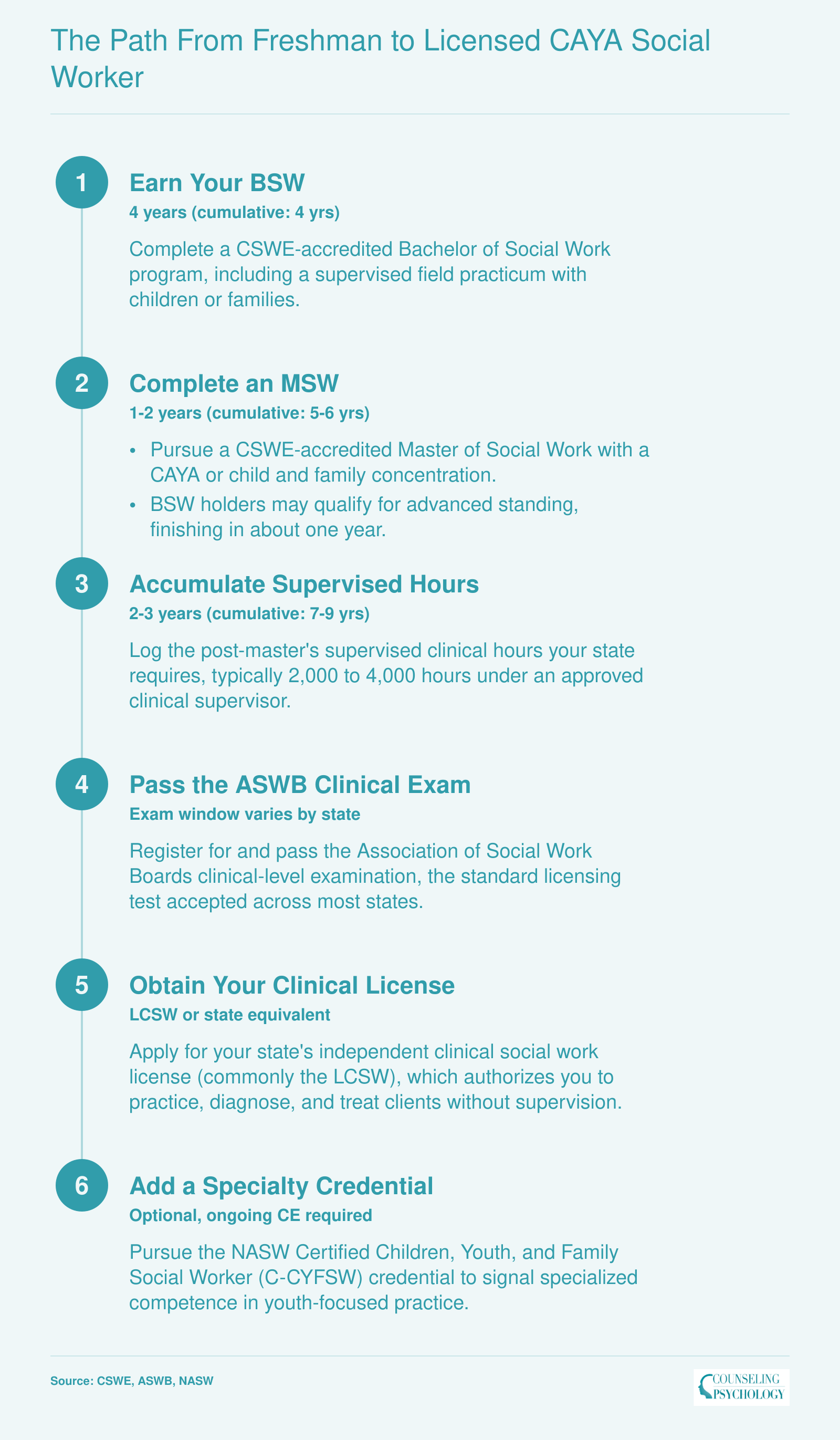
The Path From Freshman to Licensed CAYA Social Worker
Reaching full clinical independence as a CAYA social worker is a multi-year commitment. The timeline below maps each credentialing milestone so you can plan ahead, from your first undergraduate course to an optional specialty designation.
Step 2: Complete Supervised Experience
Understanding the two-tier licensing pathway
Social work licensing isn't one-size-fits-all, and the supervised experience requirement hinges on the license level you're pursuing. Most states allow bachelor's-level social workers (BSW holders) to obtain a non-clinical license, often called Licensed Social Worker (LSW) or Licensed Baccalaureate Social Worker (LBSW), soon after graduation. This credential opens the door to entry-level roles in child welfare, case management, and community advocacy, often without a post-degree supervision mandate. However, if your goal is clinical independence (diagnosing, treating mental health conditions, and providing psychotherapy to children and adolescents) you'll need the Licensed Clinical Social Worker (LCSW) or equivalent, which requires an MSW plus substantial post-graduate supervised practice.
What supervised experience entails
Every state requires LCSW candidates to accumulate a specified number of supervised clinical hours. The range generally falls between 2,000 and 4,000 hours, completed over two to three years under the oversight of a board-approved supervisor. (Exact totals vary significantly by jurisdiction; the licensing snapshot elsewhere in this guide breaks down common state requirements.) A portion of those hours must involve direct client contact with individuals, families, or groups, and many states also mandate that a minimum number of supervision sessions are one-on-one rather than group format. The supervisor, typically an LCSW with several years of post-licensure experience, signs off on your hours, provides clinical guidance, and helps you navigate ethical and diagnostic challenges specific to youth populations.
Choosing a CAYA-focused supervision setting
To build the specialized skills that child, adolescent, and young adult social work demands, aim for a supervision placement where young clients are the primary population. Settings such as child protective services, residential treatment centers, pediatric hospitals, school-based health clinics, and juvenile justice programs give you direct exposure to issues like trauma, attachment disruption, and developmental crises. Professionals in adjacent fields, such as those pursuing a path to become a marriage and family therapist, often follow a similar structure of supervised clinical hours in population-specific settings. Working in these environments while under supervision allows you to accumulate qualifying hours while simultaneously honing the assessment, intervention, and crisis-response techniques that set CAYA social workers apart. It also demonstrates to future employers that you've done more than check a box: you've intentionally cultivated expertise with youth.
Timeline from degree to independent practice
Prospective social workers often ask how long the entire journey takes. From the start of a bachelor's program to independent LCSW status, expect a total of seven to nine years: four years for a BSW, two for an MSW (or one if you qualify for advanced standing), and then two to three years of supervised practice. The post-degree phase alone typically spans two to three years for those who already hold an MSW, depending on the state's hourly requirements and whether you work full-time in a clinical setting. Part-time supervision arrangements can extend this period, so plan your schedule accordingly if you're balancing work and family obligations.
Questions to Ask Yourself
Step 3: Obtain Licensure and Specialized Certifications
Licensure transforms your education and supervised experience into legal authority to practice independently with children and families. Every state requires social workers to hold a license before offering clinical services, and the specific requirements, from exam type to supervised hours, vary considerably across jurisdictions.
State Licensure: The Non-Negotiable Foundation
The Bureau of Labor Statistics Occupational Outlook Handbook for social workers provides a reliable starting point for understanding licensure frameworks. Most states require candidates to pass the Association of Social Work Boards (ASWB) examination at the clinical level for independent practice. Beyond the exam, you will need to document your supervised hours (typically 2,000 to 4,000, depending on the state) and submit an application to your state licensing board. Fees range from around $100 to over $300 for the initial license, with renewal cycles usually spanning two years.
State licensing boards publish current requirements, renewal procedures, and continuing education mandates. University social work programs often maintain updated links to these boards and can clarify which credentials your target state recognizes. The licensure process shares structural similarities with the path to becoming a licensed professional counselor, though exam bodies and scope-of-practice rules differ.
The C-CYFSW Credential: Demonstrating Child and Family Expertise
The National Association of Social Workers (NASW) offers the Certified Children, Youth, and Family Social Worker (C-CYFSW) credential for practitioners seeking formal recognition of their specialization. Eligibility requires a BSW or MSW from a CSWE-accredited program, at least two years of post-degree supervised experience in children, youth, and family services, and a current state social work license or NASW membership.
The NASW website's credentials section details the application process. As of recent cycles, the application fee runs approximately $235 for NASW members and higher for non-members. Renewal occurs every two years and requires documentation of continuing education hours in child and family practice areas.
Registered Play Therapist Credential
For practitioners drawn to therapeutic play interventions, the Association for Play Therapy (APT) administers the Registered Play Therapist (RPT) credential. Requirements include a master's degree or higher in a mental health field, a minimum of 150 hours of play therapy instruction, and 350 hours of supervised play therapy experience under an RPT-Supervisor. Candidates must also accumulate 500 direct client contact hours using play therapy techniques. Professionals interested in the counseling side of child-focused work may also explore a child counselor degree as a complementary credential pathway.
The APT certification page outlines the full pathway, including exam information and fees. This credential signals advanced competency in a modality particularly effective with younger children who struggle to articulate trauma or emotional distress verbally.
Additional Credentials Worth Considering
Beyond C-CYFSW and RPT, several other certifications can strengthen a CAYA-focused resume:
- Certified Child Welfare Specialist: Offered through some state child welfare agencies, this credential validates competency in foster care, adoption, and protective services work.
- Trauma-Focused CBT Certification: Demonstrates proficiency in evidence-based treatment for children who have experienced abuse, neglect, or other adverse events.
- School Social Work Certification: Some states issue a separate credential or endorsement for practice within educational settings.
Start by securing your state license, then layer specialized credentials as your career focus sharpens. Each credential adds credibility when applying for supervisory roles, school district positions, or specialized clinical settings serving vulnerable youth populations.
State Licensure Snapshot: Supervised Hours and Exam Requirements
Licensure requirements for clinical social workers look remarkably uniform on paper, yet a closer look at the ten largest-employing states reveals meaningful differences in how long the supervised-experience phase actually takes. If you are planning a career in child, adolescent, and young adult social work, understanding these details early will help you pick the right state in which to train and practice.
The ASWB Clinical Exam: A Common Thread
All ten of the states profiled below require the ASWB Clinical-level examination, which tests advanced clinical knowledge and skills. That consistency is good news if you ever plan to relocate: passing the Clinical exam in one state generally satisfies the testing requirement in another. What varies is the license title each state assigns and, more significantly, the number of post-MSW supervised hours you must log before you can sit for that exam or receive your independent clinical license.
Supervised Hours at a Glance
Here is how the ten largest-employing states compare as of the 2025-2026 licensing cycle:
- Florida: 1,500 hours (the lowest threshold among these states)
- California: 3,000 hours2
- New York: 3,000 hours
- Texas: 3,000 hours
- Pennsylvania: 3,000 hours
- Illinois: 3,000 hours
- Ohio: 3,000 hours
- New Jersey: 3,000 hours
- Massachusetts: 3,500 hours
- Michigan: 4,000 hours (the highest threshold among these states)
The gap between Florida and Michigan is substantial. At a pace of roughly 20 hours of qualifying supervision per week, Florida's requirement could be met in about 18 months, while Michigan's could stretch past three and a half years. Plan your timeline accordingly.
License Titles Differ More Than You Might Expect
Most of these states issue the familiar Licensed Clinical Social Worker (LCSW) credential. A few use different titles that carry equivalent clinical authority:
- Ohio awards the Licensed Independent Social Worker (LISW).
- Michigan uses Licensed Master Social Worker (LMSW) as its advanced clinical designation.
- Massachusetts issues the Licensed Independent Clinical Social Worker (LICSW).
These title differences matter mainly for billing, employer recognition, and interstate reciprocity paperwork. Functionally, all three authorize independent clinical practice comparable to the LCSW. Professionals exploring adjacent fields, such as careers in counseling, will notice similar state-by-state variation in credential names and supervised-hour thresholds.
Child-Welfare-Specific Endorsements
None of the ten states currently offer a separate child-welfare endorsement attached to the clinical social work license. That does not mean specialization is invisible to employers. Many agencies expect CAYA-focused candidates to document youth-specific practicum hours, trauma-informed training, or credentials such as the NASW Certified Children, Youth, and Family Social Worker (C-CYFSW) designation. These voluntary credentials can set you apart even in states that do not mandate them.
Always verify requirements directly with your state licensing board, because rules can change between legislative sessions. The supervised-hours clock, in particular, is one area where states periodically update their standards.
CAYA Social Worker Salary by State
Compensation for child, family, and school social workers (BLS occupation 21-1021) varies significantly by state. The table below shows state-level median and mean annual wages, along with the 25th and 75th percentile pay ranges and total employment. Higher-cost states in the Northeast and West Coast generally lead in raw pay, though local cost of living should factor into any comparison.
| State | Total Employment | 25th Percentile | Median Salary | Mean Salary | 75th Percentile |
|---|---|---|---|---|---|
| Connecticut | 5,360 | $63,730 | $78,940 | $80,180 | $98,060 |
| District of Columbia | 2,800 | $59,280 | $78,920 | $80,040 | $95,820 |
| New Jersey | 6,410 | $59,590 | $78,150 | $79,610 | $98,920 |
| Washington | 10,570 | $58,250 | $72,290 | $73,080 | $84,180 |
| Maryland | 5,030 | $52,350 | $70,840 | $73,490 | $93,810 |
| California | 55,220 | $54,890 | $69,250 | $73,150 | $88,190 |
| Massachusetts | 9,830 | $55,510 | $67,880 | $70,620 | $87,150 |
| Rhode Island | 2,320 | $50,770 | $67,150 | $69,960 | $83,910 |
| North Dakota | 780 | $58,840 | $66,900 | $67,350 | $77,480 |
| Hawaii | 1,080 | $58,550 | $66,450 | $68,790 | $77,100 |
| New York | 27,220 | $57,950 | $65,430 | $75,270 | $82,980 |
| Vermont | 540 | $58,760 | $65,370 | $65,460 | $71,720 |
| Minnesota | 6,430 | $54,230 | $65,010 | $68,580 | $79,450 |
| New Hampshire | 1,130 | $45,790 | $64,630 | $65,880 | $76,880 |
| Colorado | 7,840 | $53,930 | $63,560 | $69,470 | $80,440 |
| Oregon | 6,260 | $52,040 | $62,770 | $66,320 | $76,480 |
| Maine | 1,910 | $56,670 | $62,620 | $64,180 | $71,410 |
| Illinois | 17,790 | $51,040 | $62,260 | $69,430 | $81,480 |
| Idaho | 1,010 | $47,830 | $62,150 | $61,560 | $72,710 |
| Nevada | 3,730 | $48,860 | $60,430 | $62,900 | $71,840 |
| Virginia | 8,160 | $49,530 | $60,280 | $65,040 | $76,450 |
| Alaska | 1,520 | $50,170 | $60,220 | $64,490 | $74,390 |
| Michigan | 15,690 | $47,840 | $59,030 | $60,580 | $73,780 |
| Wisconsin | 5,290 | $47,890 | $58,670 | $60,960 | $66,910 |
| Louisiana | 1,030 | $39,900 | $57,880 | $55,040 | $69,070 |
| North Carolina | 13,960 | $48,390 | $57,660 | $59,010 | $67,560 |
| Kentucky | 7,780 | $46,230 | $57,390 | $58,380 | $65,170 |
| Wyoming | 610 | $42,180 | $56,430 | $56,560 | $63,440 |
| Tennessee | 7,150 | $46,930 | $56,390 | $57,890 | $68,970 |
| South Dakota | 1,850 | $46,020 | $53,140 | $53,780 | $59,390 |
| Kansas | 3,380 | $47,030 | $52,690 | $55,460 | $61,120 |
| Florida | 16,160 | $45,760 | $52,350 | $56,740 | $66,260 |
| Indiana | 6,270 | $48,730 | $51,400 | $55,130 | $61,310 |
| Pennsylvania | 18,200 | $43,900 | $51,030 | $55,490 | $63,890 |
| Iowa | 3,450 | $44,950 | $50,710 | $56,840 | $68,360 |
| Ohio | 15,240 | $47,010 | $50,580 | $54,550 | $60,420 |
| Arizona | 7,770 | $45,780 | $50,140 | $52,200 | $57,540 |
| Texas | 26,490 | $42,910 | $49,940 | $51,490 | $60,110 |
| Montana | 1,250 | $42,600 | $49,630 | $52,930 | $60,690 |
| New Mexico | 2,850 | $44,010 | $49,530 | $58,650 | $69,580 |
| Utah | 1,830 | $42,840 | $49,070 | $56,410 | $64,740 |
| West Virginia | 2,370 | $43,220 | $48,220 | $49,970 | $54,960 |
| Georgia | 5,980 | $42,390 | $47,770 | $56,970 | $61,580 |
| South Carolina | 5,810 | $41,580 | $47,550 | $49,360 | $52,820 |
| Nebraska | 4,610 | $43,550 | $47,400 | $50,800 | $54,980 |
| Missouri | 7,970 | $42,360 | $47,200 | $48,660 | $53,140 |
| Alabama | 4,430 | $40,450 | $46,890 | $50,430 | $59,310 |
| Delaware | 810 | $44,820 | $46,170 | $52,350 | $54,350 |
| Puerto Rico | 3,550 | $34,340 | $45,500 | $44,790 | $51,860 |
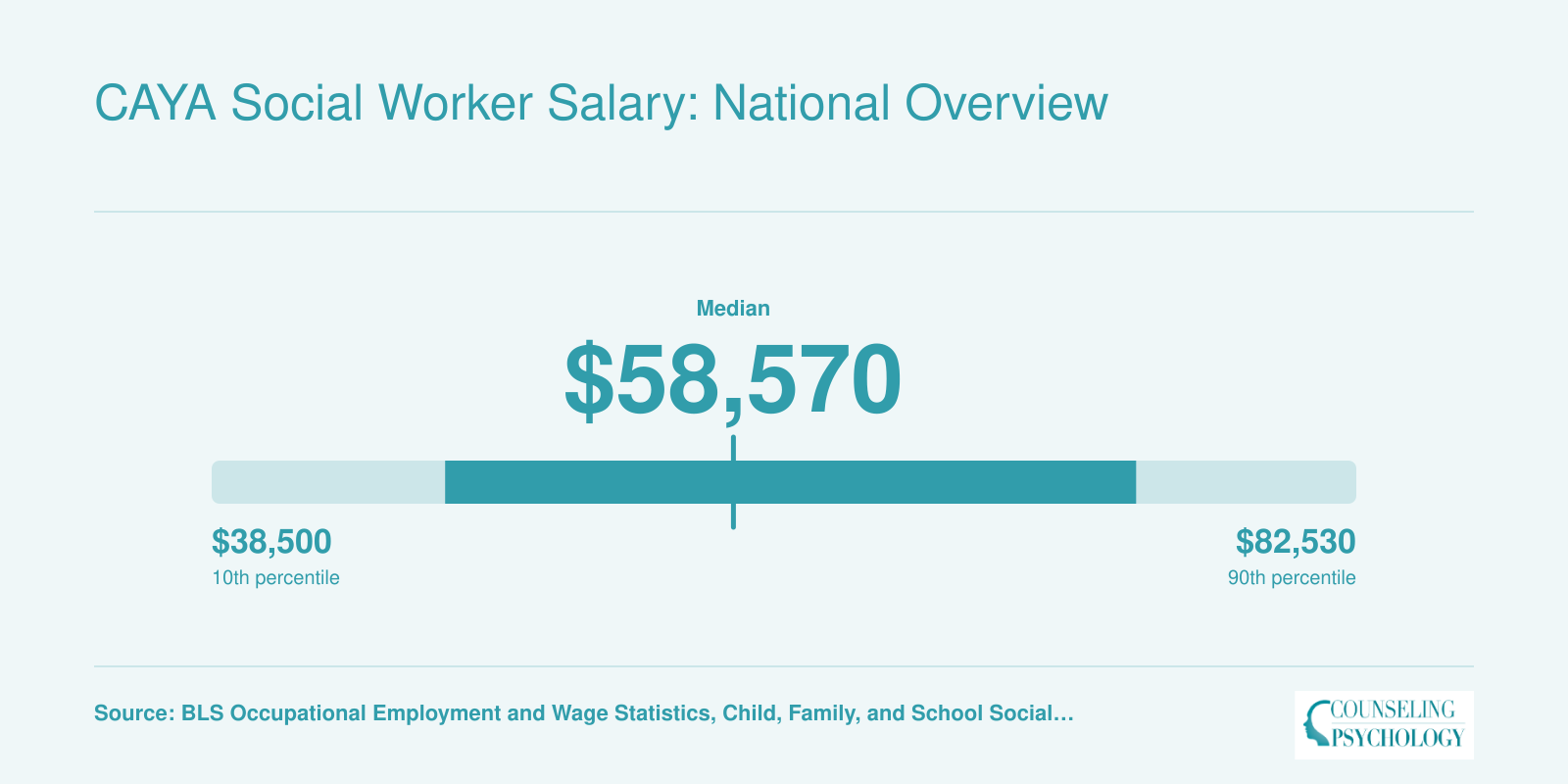
CAYA Social Worker Salary: National Overview
The gap between the 25th and 75th percentile for child, family, and school social workers spans roughly $26,500. That spread reflects the real impact of practice setting, licensure level, and geography on take-home pay. Early-career BSW holders working in rural child welfare agencies often land near the lower quartile, while MSW-licensed clinicians in metro school districts or hospital systems can push well past the 75th percentile.
Where CAYA Social Workers Work: Settings and Specializations
CAYA social workers practice in nearly every system that touches the lives of children, adolescents, and young adults, from government child welfare offices to pediatric hospital floors. The setting you choose shapes everything: your daily tasks, the populations you serve, your earning potential, and your long-term career trajectory.
Major Employment Settings
- Child protective services and child welfare agencies: These are the single largest employers of CAYA social workers. CPS workers investigate allegations of abuse and neglect, coordinate family preservation services, and manage foster care placements. Caseloads in these roles tend to run high, and turnover rates reflect the emotional weight of the work.
- Schools: Social workers embedded in K-12 settings serve on IEP teams, provide crisis intervention after traumatic events, connect families to community resources, and deliver individual or group counseling. School-based roles follow the academic calendar, which some practitioners view as a quality-of-life advantage.
- Hospitals and pediatric clinics: Medical social workers in pediatric units help families navigate diagnoses, coordinate discharge plans, and screen for social determinants of health. Hospital-based positions generally pay more than other CAYA settings, partly because they require comfort with fast-paced, interdisciplinary medical teams.
- Juvenile justice and family courts: Social workers in these settings facilitate diversion programs for youth involved in the legal system, conduct custody evaluations, and recommend treatment plans to judges. This is often where the "social worker for troubled youth" concept becomes most concrete.
- Residential treatment centers: RTCs serve young people experiencing behavioral health crises, substance use disorders, or co-occurring diagnoses. Work here is intensive and often involves shift-based scheduling, but it provides deep clinical exposure.
- Community nonprofits: Organizations focused on homelessness, immigration, domestic violence, or youth development employ CAYA social workers in case management, outreach, and program coordination roles.
Sub-Specializations Within CAYA Practice
Once you are working in the field, further specialization is common. Foster care and adoption specialists manage permanency planning for children in state custody. Juvenile justice social workers focus on rehabilitation over punishment, designing interventions that reduce recidivism. Pediatric medical social workers may concentrate on oncology, neonatal care, or emergency departments. School-based mental health practitioners deliver evidence-based therapy right on campus, removing transportation barriers for families. Adolescent substance abuse counselors work in outpatient or residential programs tailored to teens. Those interested in related helping roles, such as becoming a crisis intervention specialist, will find significant overlap with CAYA practice in emergency and school-based settings. And for those drawn to systemic change, policy and advocacy roles let you influence legislation, funding streams, and program design at the local, state, or federal level.
How Setting Affects Salary and Day-to-Day Experience
It is worth being candid: your workplace will influence your compensation as much as your degree or license does. Hospital and medical clinic roles tend to sit at the higher end of the pay scale for child, family, and school social workers, while CPS and nonprofit positions often pay less despite demanding caseloads. The salary-by-state table elsewhere in this article gives you a clearer picture of geographic variation, but within any single state, expect meaningful differences between a school-based position and a hospital-based one. Beyond pay, consider pace and emotional intensity. CPS and juvenile justice settings involve higher exposure to secondary trauma, while school and outpatient clinic roles may offer more predictable schedules and built-in support structures. Neither path is inherently better; the right fit depends on your clinical interests, your tolerance for ambiguity, and the kind of impact you want to have.
What a CAYA Social Worker Does Day-To-Day
Office-based clinical work versus field-based crisis response: the typical day for a CAYA social worker depends heavily on setting, but both paths share a common thread of high caseloads, relentless documentation demands, and emotional intensity. Understanding the rhythm and realities of the work helps prospective practitioners prepare for the challenges ahead.
A Realistic Day: Morning, Midday, and Afternoon
Mornings often start in the field. Child protective services workers conduct home visits to assess safety, observing living conditions and interviewing caregivers and children. School-based social workers begin with drop-in crisis interventions: a student in the counselor's office after a fight, a teacher referral for suspected neglect, or a quick check-in with a teen on an individualized education plan. Clinical outpatient therapists see their first scheduled clients by 9 a.m., often back-to-back 50-minute sessions focused on trauma processing, anxiety management, or family systems work.
Midday shifts to coordination and paperwork. Care coordination calls stack up: conversations with teachers about a child's attendance, pediatricians about medication adjustments, probation officers about court-ordered services, or attorneys preparing for dependency hearings. Documentation consumes hours. Every visit, phone call, and clinical session requires case notes, treatment plans, safety assessments, or court reports. Child welfare workers may juggle 15 to 25 active cases simultaneously, though national recommendations cap caseloads at 15.1 School social workers often serve entire buildings of 400 to 800 students, triaging crisis after crisis with minimal administrative support.
Afternoons bring family sessions, group therapy, or court appearances. Dependency court runs long and unpredictably. Testifying about a removal or reunification recommendation is emotionally taxing, especially when outcomes feel uncertain or when families resist interventions. Clinical therapists typically see six to eight clients per day, a volume that leaves little margin for the unexpected.
The Weight of the Work: Burnout and Turnover
The emotional demands are not abstractions. Research shows 63 percent of child welfare workers report signs of burnout, and 53 percent meet criteria for secondary traumatic stress.2 Broader studies across social work settings find burnout prevalence at 64 percent and secondary trauma at nearly 50 percent. Post-traumatic stress disorder affects more than one in four social workers.2
Turnover data underscores the toll. Child welfare agencies nationwide report annual turnover ranging from 23 to 60 percent as of 2022, with an average around 30 percent in earlier years.3 Texas loses 25 percent of new workers in the first year alone.1 Average tenure in child welfare is two years.4 High caseloads drive attrition: the national average sits at 24 to 31 cases per worker, well above the recommended maximum of 15.
Evidence-Based Strategies for Staying Well
Survival in this field requires intentional self-care and organizational support. Clinical supervision reduces burnout by 25 percent. Peer consultation groups cut burnout by 22 percent. Mentoring programs lower risk by 31 percent. Cognitive-behavioral interventions designed for burnout achieve a 42 percent reduction in clinically significant symptoms. Resilience training reduces burnout by 40 percent, and mindfulness-based programs cut emotional exhaustion by 30 percent. Flexible work hours, where agencies permit them, lower burnout risk by 28 percent.
Trauma-informed self-care frameworks, championed by organizations like the National Child Traumatic Stress Network, emphasize routine debriefing, boundary-setting, and access to personal therapy. Those interested in adjacent roles such as childhood trauma counseling will find that these same self-care principles apply broadly. Agencies that sustain manageable caseloads, protect supervision time, and support flexibility retain workers longer and produce better outcomes for children: 74 percent of cases reach permanency when only one caseworker is involved, compared to 17 percent when two workers cycle through and 5 percent with three or more.
The work is hard. The stakes are high. But with the right supports, structure, and self-awareness, CAYA social workers build sustainable careers that make a measurable difference in the lives of vulnerable youth.
Child welfare positions experience some of the highest turnover in social work, but workers with supportive supervisors, trusted colleagues, and manageable caseloads are far more likely to stay and find the work rewarding. The system’s health is just as vital as a worker’s own resilience.
Career Outlook and Advancement Paths
The Bureau of Labor Statistics projects 6% employment growth for social workers broadly through 2034, with approximately 74,000 annual openings across all social work specializations.1 While that figure spans healthcare, mental health, and community social workers, child, family, and school social workers form a large share of that demand. Historical data shows this sub-specialty outpaced the broader field in earlier decades (12% growth from 2008 to 2018, compared to single-digit growth for some other social work roles), and labor-market pressures tied to school-based mental health expansion, child welfare caseloads, and trauma-informed care adoption suggest the trend continues.2 For context, the BLS all-occupation average growth rate sits at 4%, making social work a faster-than-average field.
The Career Ladder: From Caseworker to Executive
Advancement in CAYA social work follows a predictable structure, with each rung defined by both degree and licensure level:
- Entry-level caseworker (BSW or LSW): Intake, case management, resource coordination, and documentation in child welfare agencies, schools, or nonprofits. Typical salaries cluster around $40,000 to $50,000, depending on region.
- Clinical therapist (MSW and LCSW): Direct client therapy, trauma intervention, and family systems work. Median salaries range from $55,000 to $70,000, with private practice generating higher potential.
- Clinical supervisor: Oversees a team of caseworkers or therapists, conducts trainings, and ensures compliance. Salaries start near $70,000 and climb past $85,000 in larger agencies or health systems.
- Program director: Manages entire service lines (e.g., foster care, school mental health), secures grants, and sets strategic priorities. Compensation ranges from $85,000 to $110,000, especially in large urban counties.
- Agency executive or policy roles: Chief clinical officers, state child welfare directors, or nonprofit CEOs; salaries approach or exceed $120,000, sometimes reaching $150,000 in high-cost metropolitan areas.
Each step adds managerial responsibility, strategic decision-making, and fiscal oversight, and each typically requires additional years of post-licensure experience.
Can CAYA Social Workers Earn $100K or More?
Yes. LCSWs in private practice who carry robust caseloads and accept insurance panels, hospital-based clinical social workers in pediatric or psychiatric units, and supervisory or program-director roles in high-cost-of-living states regularly exceed $100,000. BLS data shows the 75th percentile for child, family, and school social workers nationally already approaches $80,000 to $85,000, and in states like California, New York, and Massachusetts, clinical supervisors and program directors routinely cross the six-figure threshold.1 Success at this level typically requires an LCSW, five to ten years of experience, and either a clinical specialization (trauma, autism, substance-exposed infants) or a management role. For salary benchmarks in related helping professions, see our breakdown of counselor salary data.
What About $200K?
Extremely rare in traditional CAYA social work. Reaching $200,000 is possible only for those who build large group private practices with multiple associates, transition into healthcare administration (director of pediatric social services at a major hospital system), or move into adjacent executive roles such as vice president of behavioral health for a health plan. These paths represent career pivots rather than linear advancement within direct CAYA practice. Frame expectations realistically: most CAYA social workers top out between $80,000 and $130,000 even in senior roles.
Highest-Paid Paths in CAYA Social Work
Three routes consistently produce the highest compensation:
- Clinical private practice with niche specialization: LCSWs who specialize in early childhood trauma, adoption-related attachment issues, or pediatric medical social work and maintain panels with commercial insurers earn $80,000 to $110,000 annually, more in major metros.
- Hospital and VA system social work: Medical social workers in pediatric hospitals, children's psychiatric units, or Veterans Affairs facilities earn $70,000 to $95,000 as staff clinicians and $95,000 to $120,000 in supervisory roles, with robust benefits and pension plans.
- Executive leadership in large nonprofits or government agencies: Chief program officers, county child welfare directors, and statewide policy leads earn $110,000 to $150,000, though competition is fierce and the work blends clinical expertise with political acumen, budgeting, and grant management.
The common denominator: advanced credentials, years of supervised experience, and either a clinical subspecialty or willingness to step into administration.
Highest-Paying Metro Areas for Child, Family, and School Social Workers
Geography plays a major role in CAYA social worker compensation. The table below ranks the 15 highest-paying metropolitan areas by mean annual wage for child, family, and school social workers, according to the latest BLS data. Keep in mind that metros with the richest salaries often carry higher costs of living, so weigh take-home purchasing power alongside the raw numbers.
| Metro Area | Total Employment | Mean Annual Wage | 25th Percentile | Median Wage | 75th Percentile |
|---|---|---|---|---|---|
| New York, Newark, Jersey City (NY, NJ) | 21,590 | $79,960 | $59,850 | $72,750 | $96,010 |
| San Francisco, Oakland, Fremont (CA) | 5,700 | $79,860 | $58,620 | $71,810 | $99,210 |
| Washington, Arlington, Alexandria (DC, VA, MD, WV) | 6,800 | $77,700 | $58,530 | $75,780 | $93,760 |
| Los Angeles, Long Beach, Anaheim (CA) | 23,100 | $76,320 | $55,680 | $76,600 | $98,530 |
| Seattle, Tacoma, Bellevue (WA) | 5,560 | $75,050 | $59,350 | $72,950 | $87,740 |
| Denver, Aurora, Centennial (CO) | 3,820 | $74,380 | $56,900 | $65,650 | $86,350 |
| Boston, Cambridge, Newton (MA, NH) | 6,300 | $72,440 | $58,370 | $68,450 | $88,400 |
| Chicago, Naperville, Elgin (IL, IN) | 12,150 | $72,030 | $53,240 | $64,600 | $83,320 |
| Minneapolis, St. Paul, Bloomington (MN, WI) | 3,830 | $70,800 | $55,500 | $66,130 | $80,300 |
| Providence, Warwick (RI, MA) | 3,030 | $69,040 | $50,270 | $65,870 | $83,910 |
| Sacramento, Roseville, Folsom (CA) | 3,310 | $68,320 | $51,190 | $66,610 | $74,060 |
| San Diego, Chula Vista, Carlsbad (CA) | 4,330 | $68,340 | $54,420 | $61,420 | $76,960 |
| Portland, Vancouver, Hillsboro (OR, WA) | 3,790 | $67,940 | $54,890 | $64,130 | $79,060 |
| Riverside, San Bernardino, Ontario (CA) | 5,270 | $66,520 | $49,950 | $64,270 | $76,250 |
| Las Vegas, Henderson, North Las Vegas (NV) | 2,820 | $63,410 | $48,300 | $60,430 | $76,030 |
Frequently Asked Questions About Becoming a CAYA Social Worker
These are some of the most common questions prospective CAYA social workers ask when mapping out their education, licensure, and earning potential. The answers draw on current Bureau of Labor Statistics data and standard licensure requirements across states.