
What you’ll learn in this article…
- Online school counseling doctorate tuition ranges from about $3,195 to $23,446 per year depending on institution type.
- CACREP accreditation is the recognized standard for counselor education programs and directly affects licensure eligibility.
- The national median salary for school and career counselors was $65,140 in 2024, with doctoral roles paying considerably more.
- Ph.D., PsyD, and EdD degrees serve distinct career paths in research, clinical practice, and educational leadership respectively.
Demand for doctoral-level school counselors is outpacing supply, particularly in higher education faculty positions, district leadership roles, and clinical supervision, where a master's credential is simply insufficient for hiring. CACREP-accredited counselor education programs are required to employ doctorally prepared faculty, and many state licensure boards require a doctorate for supervisory credentials, creating a structural floor beneath the degree's value.
Fully online Ph.D. and PsyD programs in school counseling exist, but the field remains selective. Most doctoral programs require at least one in-person residency, and true asynchronous options are concentrated in counselor education and supervision rather than school psychology specifically. Prospective students should expect to distinguish between degree types, delivery formats, and accreditation standards before applying.
Tuition across available programs ranges from roughly $3,195 to over $23,000 annually, and completion timelines span three to seven years depending on enrollment intensity and dissertation requirements. The credential gap between a master's and a doctorate is real, consequential, and worth examining carefully before committing.
Best Online Doctorate in School Counseling Programs
The programs below represent online and hybrid doctoral options in school counseling and counselor education, ranked using a composite of institutional quality indicators rather than any single metric. Factors include graduation and retention rates, tuition affordability, student-to-faculty ratio, and graduate outcomes. Because most of these degrees are housed within broader counselor education and supervision departments, students should verify that their chosen program offers coursework or a concentration aligned with school counseling specifically.
- Institutional graduation and retention rates
- Tuition and net price affordability
- Student-to-faculty ratio
- Graduate earnings outcomes
- Program delivery flexibility
- NCES-IPEDS federal institutional data — nces.ed.gov
- Internal program database
- Independent program research
- College Scorecard graduate earnings — collegescorecard.ed.gov

Oregon State University
Oregon State University's hybrid Ph.D. in Counseling with a Counselor Education concentration is CACREP-accredited and built around a cohort model that lets students work full-time while completing their degree. Face-to-face sessions take place in Portland twice per quarter on Fridays and Saturdays, and no GRE is required. The curriculum emphasizes antiracism, social justice, and research serving BIPOC communities, with a median completion time of 48 months. The university's overall graduation rate is 70.1%.
- CACREP-accredited hybrid program, 150 credits required
- Bi-quarterly Friday/Saturday meetings in Portland, OR
- Cohort-based model with median 48-month completion
- No GRE required for admission
- Focus on antiracism, social justice, and BIPOC communities
- Master's in Counseling and 3.0 GPA required
- In-state tuition approximately $16,206; out-of-state $33,351
Doctor of Philosophy in Counseling, Counselor Education — Hybrid

University of the Cumberlands
University of the Cumberlands delivers a fully online Ph.D. in Counselor Education and Supervision that stands out for its low tuition, at roughly $3,195 per year. The 66-credit program develops advanced skills in clinical supervision, multicultural counseling, professional writing, and ethical practice. Designed for experienced counselors aiming for academic or leadership positions, the program features a comprehensive dissertation research sequence. The university's overall graduation rate is 50.4%.
- Fully online, 66 total credit hours
- Comprehensive dissertation research sequence
- Advanced clinical supervision training
- Multicultural counseling coursework integrated throughout
- Tuition approximately $3,195 per year
- Designed for licensed, experienced counselors
- Emphasis on ethical and legal counseling practice
Counselor Education and Supervision, Ph.D. — Online

Western Michigan University
Western Michigan University offers a doctoral program in counselor education that prepares graduates for mental health, school, and university-level counselor education roles. The program reports a 98% employment or continued-education rate among its graduates, making it a strong outcome-driven choice. Courses are available in both Kalamazoo and Grand Rapids. The university's overall graduation rate is 57.6%.
- School counseling concentration available
- 98% graduate employment or continued education rate
- Courses offered in Kalamazoo and Grand Rapids
- Advanced counseling, research, and leadership skills
- In-state tuition approximately $20,103; out-of-state $29,681
- 16:1 student-to-faculty ratio university-wide
- Master's degree in counseling required for entry
Counselor Education Doctoral Program, School Counseling Concentration — Online

Southern Connecticut State University
Southern Connecticut State University's Ed.D. in Counselor Education and Supervision is a hybrid program with concentrations in clinical mental health, school, and college counseling. Designed for working professionals, the three-year curriculum integrates 100 hours of practicum and 600 hours of internship. A social justice framework runs throughout the program, and the university maintains an 11:1 student-to-faculty ratio. The university's overall graduation rate is 49.9%.
- Hybrid Ed.D. with school counseling concentration
- Three-year completion timeline for working professionals
- 100-hour practicum and 600-hour internship required
- Social justice framework across the curriculum
- In-state tuition approximately $14,930; out-of-state $21,727
- 3.5 graduate GPA preferred for admission
- 11:1 student-to-faculty ratio university-wide
Counselor Education and Supervision, Ed.D., School Counseling Concentration — Hybrid

Hampton University
Hampton University, a historically Black university, offers a hybrid Ph.D. in Counselor Education and Supervision with an explicit School Counseling concentration. The program blends online coursework with campus residencies and requires approximately 64 credits beyond the master's degree. Its curriculum emphasizes practical applications in school settings and is designed to serve diverse learner populations. The university's overall graduation rate is 57.2%.
- Hybrid format with campus residencies
- School Counseling concentration, 64 credits beyond master's
- Strong research component included
- Emphasizes practical applications in P-12 settings
- Designed for diverse learner populations
- HBCU with 15:1 student-to-faculty ratio
- Tuition approximately $13,776 (same for in-state and out-of-state)
Doctor of Philosophy in Counselor Education and Supervision, School Counseling — Hybrid

Regent University
Regent University's CACREP-accredited Ph.D. in Counselor Education and Supervision is delivered online with required residencies and totals 66 credit hours. The program integrates science and faith, preparing graduates for academia, clinical practice, and research leadership. Full-time enrollment is required, and admission calls for a 60-credit master's in counseling with a 3.5 GPA. The university's overall graduation rate is 56.9%.
- CACREP-accredited, online with residencies
- 66 credit hours, full-time enrollment required
- Integrates science and Christian faith perspectives
- Advanced research methodology and dissertation required
- Multicultural competency training embedded in coursework
- Requires 60-credit master's in counseling and 3.5 GPA
- Mentorship and hands-on clinical training included
Ph.D. in Counselor Education and Supervision — Online

Mount Mary University
Mount Mary University's CACREP-accredited Ph.D. in Counselor Education and Supervision includes a School Counseling concentration and uses a hybrid format with evening classes. At 48 credit hours, it can be completed in three years full-time or five years part-time. Internship experiences take place at the university's own Counseling and Wellness Center. The university's overall graduation rate is 43%, and it maintains a 9:1 student-to-faculty ratio.
- CACREP-accredited hybrid program, 48 credit hours
- School Counseling concentration offered
- Evening classes designed for working professionals
- Internship at on-campus Counseling and Wellness Center
- Part-time (5-year) and full-time (3-year) tracks available
- 9:1 student-to-faculty ratio university-wide
- Emphasis on multicultural competence and social justice
Ph.D. in Counselor Education and Supervision, School Counseling — Hybrid

Waynesburg University
Waynesburg University's CACREP-accredited Ph.D. in Counselor Education and Supervision offers a School Counseling concentration delivered through synchronous and asynchronous online learning. The 54-credit program costs approximately $845 per credit and focuses on culturally relevant perspectives and social justice in educational leadership. The university's overall graduation rate is 65.5%.
- CACREP-accredited, fully online delivery
- School Counseling concentration, 54 credits required
- Synchronous and asynchronous coursework blended
- Approximately $845 per credit hour
- Culturally relevant and social justice curriculum
- Prepares for academic and clinical leadership
- 12:1 student-to-faculty ratio university-wide
Ph.D. in Counselor Education and Supervision, School Counseling — Online

Trevecca Nazarene University
Trevecca Nazarene University's CACREP-accredited Ph.D. in Clinical Counseling: Teaching and Supervision is a 66-credit program blending online and traditional learning through a supportive cohort model. Tuition runs roughly $799 per credit hour, and the program emphasizes compassionate service alongside rigorous research and supervision training. The university's overall graduation rate is 53.2%.
- CACREP-accredited, 66 credit hours
- Online and traditional learning blend
- Cohort model for peer support
- Approximately $799 per credit hour (about $52,734 total)
- Emphasis on compassionate service and applied research
- GRE scores required for admission
- Master's in counseling or related field prerequisite
Ph.D. in Clinical Counseling: Teaching and Supervision — Online

Prairie View A & M University
Prairie View A&M University, an HBCU in Texas, offers counseling programs aligned with CACREP core areas and Texas Education Agency standards for school counselor certification. In-state tuition is among the lowest on this list at roughly $7,993. The curriculum focuses on P-12 educational systems and blends theoretical knowledge with practical skills. The university's overall graduation rate is 43.2%.
- CACREP core areas emphasized
- Meets Texas Education Agency certification standards
- In-state tuition approximately $7,993; out-of-state $17,378
- Focus on P-12 educational counseling settings
- HBCU with 17:1 student-to-faculty ratio
- Blends theoretical and practical coursework
- Bachelor's degree required with specific GPA criteria
School Counseling Doctoral Program — Online

The Chicago School at Chicago
The Chicago School of Professional Psychology's CACREP-accredited online Ph.D. in Counselor Education and Supervision combines fully online coursework with two mandatory face-to-face residencies. The program is designed for licensed counselors and emphasizes innovative educational methodologies, technology-assisted counseling, and professional identity development. It requires 100 hours of practicum and 600 total internship hours.
- CACREP-accredited, online with two residencies
- 100 hours practicum, 600 hours total internship
- Technology-assisted counseling focus
- Designed for licensed counselors with master's degrees
- Advanced leadership and career pathway training
- 17:1 student-to-faculty ratio
- Tuition approximately $35,328 per year
Ph.D. in Counselor Education and Supervision — On-Campus

Adams State University
Adams State University offers a Ph.D. in Counselor Education and Supervision with a School Counseling concentration, delivered online at one of the lowest tuition rates among public institutions on this list. The 66-credit program emphasizes advanced research, supervision, and teaching preparation. Admission requires a master's from a CACREP-accredited program, a 3.0 GPA, and GRE scores. The university's overall graduation rate is 39.4%.
- School Counseling concentration available
- 66 semester hours, online delivery
- In-state and out-of-state tuition approximately $5,898
- CACREP-aligned curriculum
- Advanced research and leadership training
- On-campus interview required for admission
- 14:1 student-to-faculty ratio university-wide
Doctor of Philosophy in Counselor Education and Supervision, School Counseling — Online

Colorado Christian University
Colorado Christian University's Ph.D. in Counselor Education and Supervision is delivered nearly 100% online with two in-person residencies and can be completed in as few as three years. The 60-credit program takes a Christ-centered approach, integrating biblical principles with professional counseling practice. Graduates are prepared for academia, research, and leadership in mental health organizations. The university's overall graduation rate is 64.4%.
- 60 credit hours, completable in three years
- Nearly 100% online with two in-person residencies
- Christ-centered, faith-integrated approach
- CACREP standards aligned
- 600 total internship hours required
- Dissertation integrated throughout the program
- Master's in counseling required for admission
Ph.D. in Counselor Education and Supervision — Online

Marymount University
Marymount University's Ph.D. in Counselor Education and Supervision is an online program aligned with CACREP standards that accepts up to 48 transfer credits from CACREP-accredited master's programs. The curriculum develops skills in research, supervision, and clinical leadership, and global study opportunities are available. The university's overall graduation rate is 53.5%.
- Online delivery with CACREP-aligned curriculum
- 108 total credits required, up to 48 may transfer
- Focus on academic and clinical leadership roles
- Advanced research and supervision training
- Global study opportunities offered
- 14:1 student-to-faculty ratio university-wide
- Tuition approximately $23,446 per year
Ph.D. in Counselor Education and Supervision — Online

Lesley University
Lesley University's Ph.D. in Counseling and Psychology uses a weekend-intensive format, meeting one weekend per month on the Cambridge, Massachusetts campus. The 48-credit program centers on trauma-informed approaches, interpersonal neurobiology, mindfulness, and social justice leadership. It requires a master's degree and at least three years of professional experience for admission. The university's overall graduation rate is 58%.
- Weekend-intensive format, one weekend per month
- 48 credit hours, cohort model
- Trauma-informed and mindfulness-based curriculum
- Social justice and social entrepreneurship focus
- Master's degree plus three years' experience required
- 10:1 student-to-faculty ratio university-wide
- Total tuition approximately $64,800 plus fees
Ph.D. in Counseling and Psychology: Transformative Leadership, Education, and Applied Research — Hybrid
Ph.D. Vs. Psyd Vs. EDD in School Counseling: Which Is Right for You?
Doctoral programs in school counseling and school psychology come in three distinct flavors: the Ph.D. (Doctor of Philosophy), the PsyD (Doctor of Psychology), and the EdD (Doctor of Education). Each is designed for different career trajectories, and understanding the differences will help you choose the path that aligns with your professional goals.
Ph.D. in School Counseling: Research and Academia
The Ph.D. in school counseling (or counselor education) is a research-intensive degree that prepares graduates for faculty positions, program evaluation, and research roles in academic or government settings. These programs are typically accredited by CACREP (Council for Accreditation of Counseling and Related Educational Programs) and emphasize theory development, advanced statistics, and dissertation research.1 Graduates are qualified to teach in counselor education programs, conduct federally funded studies, and contribute to the evidence base that informs school counseling practice. The degree qualifies you for licensure as a professional counselor in most states, but it does not meet the requirements for psychologist licensure.1 Expect to spend four to six years in a Ph.D. program, including dissertation work. If you are exploring broader counseling doctoral programs, keep in mind that Ph.D. tracks in school counseling share much of the same foundational coursework.
PsyD in School Psychology: Clinical Practice
The PsyD in school psychology is a practice-oriented doctorate that prepares school psychologists to conduct assessments, design interventions, and provide direct services to students. These programs are accredited by the American Psychological Association (APA) and emphasize applied clinical skills, psychoeducational testing, and evidence-based intervention.2 Graduates are eligible for licensure as psychologists, not counselors, and work under a different scope of practice than school counselors.
However, fully online APA-accredited PsyD programs with a school psychology or school counseling focus do not currently exist as of 2025-2026.2 APA accreditation standards require substantial supervised clinical hours and in-person training components that are incompatible with fully online delivery. If you are interested in a PsyD, plan for hybrid or on-campus residency requirements.
EdD in School Counseling: Leadership and Administration
The EdD in school counseling is designed for practitioners who want to move into district-level leadership, policy development, or program administration. These programs are often CACREP-accredited and focus on applied research, organizational change, and systems-level intervention.1 The EdD is generally shorter and more practice-focused than the Ph.D., often requiring a capstone project rather than a traditional dissertation. Graduates pursue roles such as director of student services, district counseling coordinator, or state-level policy advisor. Like the Ph.D., the EdD qualifies you for professional counselor licensure but not psychologist licensure.
Making Your Decision
Choose a Ph.D. if you want to teach, conduct research, or shape the academic foundations of the field. Opt for a PsyD if clinical practice as a licensed psychologist is your goal, but be prepared for in-person training requirements. Select an EdD if you aim to lead counseling programs, influence district policy, or manage student services at scale.
Questions to Ask Yourself
How Much Does an Online School Counseling Doctorate Cost?
Tuition for an online doctorate in school counseling varies dramatically depending on the institution type and residency status. Among the programs listed here, annual graduate tuition ranges from roughly $3,195 at University of the Cumberlands to $23,446 at Marymount University. Keep in mind that the net price figures shown below are institution-wide averages after financial aid for all students, not guaranteed quotes for doctoral candidates specifically. Many online programs, particularly those at private universities, charge a single flat rate regardless of where you live, which can work to your advantage if you are an out-of-state student. Median graduate debt across these schools ranges from about $14,911 to $28,312, so it is worth running repayment scenarios before you commit. Public vs. private pricing differs significantly, and students at public institutions who qualify for in-state rates may pay considerably less than the listed out-of-state tuition.
| School | Sector | Annual Tuition (In-State) | Annual Tuition (Out-of-State) | Avg. Net Price (Institution-Wide) | Median Graduate Debt |
|---|---|---|---|---|---|
| University of the Cumberlands | Private | $3,195 | $3,195 | $14,107 | $14,911 |
| Adams State University | Public | $5,898 | $5,898 | $12,980 | $19,500 |
| Prairie View A&M University | Public | $7,993 | $17,378 | $13,570 | $27,000 |
| Trevecca Nazarene University | Private | $10,537 | $10,537 | $16,813 | $18,744 |
| Hampton University | Private | $13,776 | $13,776 | $25,319 | $25,442 |
| Southern Connecticut State University | Public | $14,930 | $21,727 | $20,857 | $22,250 |
| Colorado Christian University | Private | $15,394 | $15,394 | $29,500 | $28,312 |
| Mount Mary University | Private | $15,540 | $15,540 | $20,144 | $25,288 |
| Oregon State University | Public | $16,206 | $33,351 | $19,604 | $21,221 |
| Waynesburg University | Private | $16,920 | $16,920 | $18,235 | $27,000 |
| Regent University | Private | $17,869 | $17,869 | $19,923 | $24,534 |
| Lesley University | Private | $19,890 | $19,890 | $31,152 | $21,000 |
| Western Michigan University | Public | $20,103 | $29,681 | $15,273 | $26,188 |
| Marymount University | Private | $23,446 | $23,446 | $29,137 | $25,000 |
Related Articles
How Long Does an Online Ph.D. In School Counseling Take?
Full-time studies are faster but demand a heavier semester load, while part-time enrollment stretches completion but allows professionals to keep working. For online school counseling doctorates, calendar timelines shift significantly depending on degree type, transfer credits, and dissertation demands.
Typical Timeframes by Degree Type
An online Ph.D. in Counselor Education or a closely related field typically requires 4 to 6 years of full-time study, with total timelines ranging from 36 to 84 months depending on pace and program structure. Ed.D. programs in counseling or educational leadership often lean shorter, with many designed to be finished in 3 to 4 years, though some extend up to 7 years. The Psy.D. in school or counseling psychology, less frequently offered fully online, usually runs 4 to 5 years and involves heavier clinical training requirements, which can push the upper boundary toward 6 years (48 to 72 months).2
Factors That Shape Your Timeline
Several variables can accelerate or slow progress: - Enrollment intensity: Full-time students generally finish at or near the program's minimum advertised length, while part-time students, especially working school counselors, commonly take 4 to 6 years. Many online doctoral programs are structured specifically for part-time professionals, so the catalog's "4-year plan" often assumes full-time summers and no gaps. - Transfer credits: Prior graduate coursework can reduce credit requirements. Programs that accept transfer credits liberally may trim a year or more off the total. - Dissertation vs. capstone: A traditional dissertation is unpredictable; research, data collection, and writing can easily add two years beyond coursework. Some Ed.D. tracks substitute an applied capstone project, which is usually more structured and faster to complete. - Comprehensive exams: Most Ph.D. and many Ed.D. programs require a comprehensive examination after coursework, which can extend the timeline if retakes are needed.4 Continuous enrollment policies mean you keep registering for credits until all requirements are met, so delays translate directly into additional tuition and time.
Residency Requirements in Online Programs
Though coursework is remote, many online doctorates, especially those aligned with CACREP standards, include brief on-campus or virtual synchronous residencies. These intensive sessions often last a few days per year and are scheduled during summers or weekends to accommodate working students. While they do not drastically extend the overall timeline, missing or rescheduling a required residency can push graduation back by a full cycle.5 Psy.D. programs frequently add a practicum or internship component that must be completed in person, further differentiating their duration from purely coursework-based degrees.
Earning Potential With a Doctorate in School Counseling
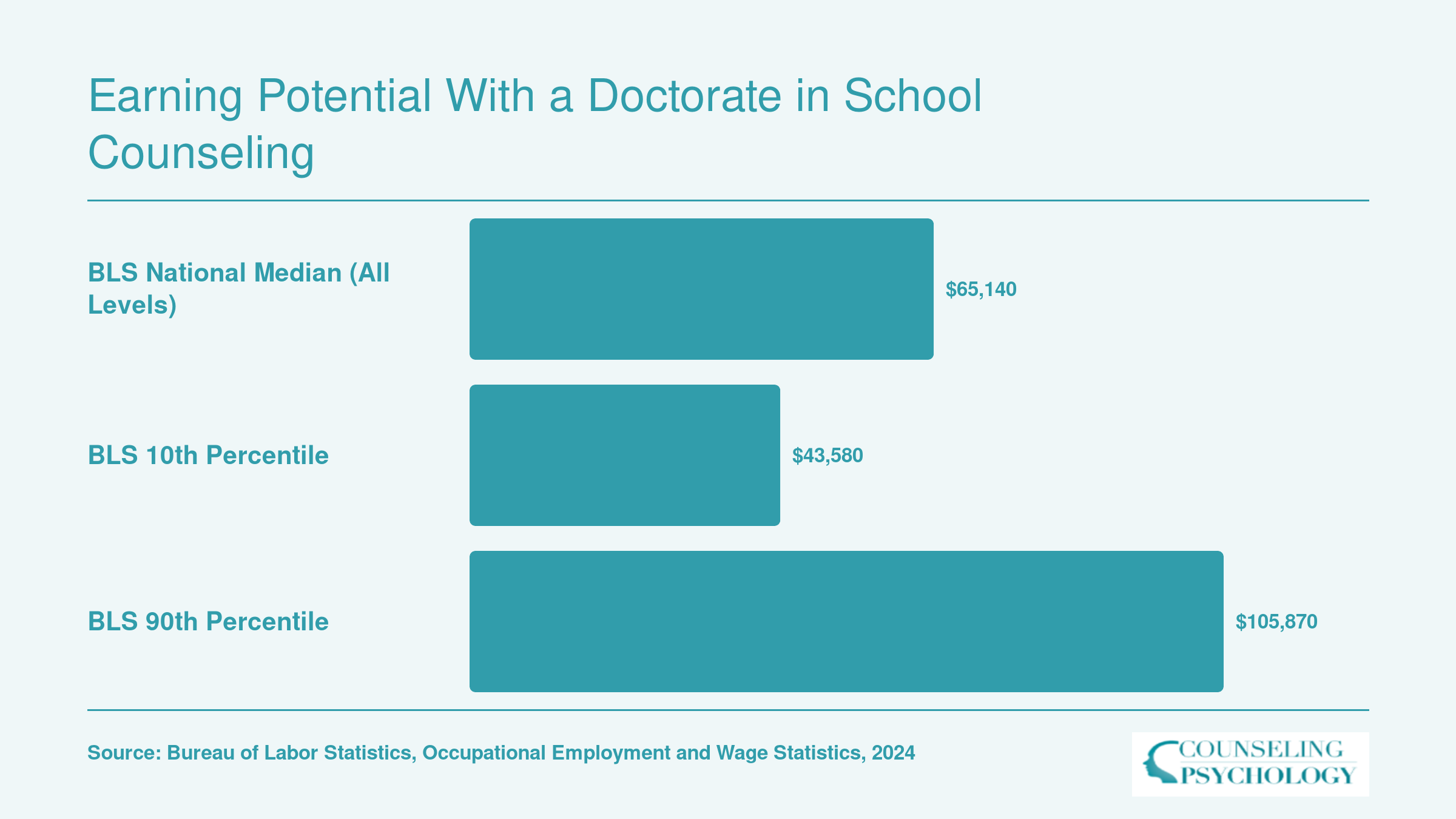
A doctorate in school counseling opens doors to higher-paying positions that master's-level practitioners simply cannot access, including counselor educator, clinical supervisor, and district-level director roles. The national median salary for school and career counselors (SOC 21-1012) was $65,140 in 2024, according to the BLS. That figure reflects the full range of experience and education levels. Doctoral graduates who move into university faculty or administrative leadership positions typically earn above this baseline, though program-level earnings data for these specific doctorates are not yet available from federal sources.
What Can You Do With a Doctorate in School Counseling?
A doctoral degree in school counseling opens career paths that simply are not available to master's-level practitioners. While a master's qualifies you to work directly with students in K-12 settings, a doctorate positions you for leadership, scholarship, and specialized clinical roles that shape the profession itself.
Doctoral-Level Career Paths
Graduates of Ph.D. and PsyD programs in school counseling pursue diverse professional trajectories:
- Counselor educator or professor: Teach graduate courses, mentor future counselors, and contribute to the research literature at universities.
- Clinical supervisor: Provide oversight and professional development for school counselors seeking licensure or continuing education.
- District counseling director: Lead counseling departments across entire school systems, setting policy and managing budgets.
- Private practice clinician: In states that permit doctoral-level counselors to practice independently, work with children, adolescents, and families outside school settings.
- Researcher or policy consultant: Advise state education agencies, advocacy organizations, or think tanks on evidence-based counseling practices.
Salary Uplift at the Doctoral Level
The pay ceiling for K-12 school counselors is constrained by district salary schedules. According to the Bureau of Labor Statistics, the national median annual wage for school counselors across all settings was $65,140 in 2024, with a range from roughly $43,580 at the 10th percentile to $105,870 at the 90th percentile.1 School counselors working specifically in K-12 environments earned a median of approximately $74,910 in 2023.2
Doctoral holders who transition into higher education faculty positions or district-level administration often exceed these figures. University counselor educators, for instance, command salaries tied to academic pay scales that can surpass what even the highest-paid school-based counselors earn. Administrative roles such as director of student services or chief wellness officer in large districts also carry compensation packages well above the classroom counselor median.
Do School Counselors Earn More Than Teachers?
This question comes up frequently, and the short answer is: it depends on the district and state, but the medians are close. BLS data shows that school counselor wages and teacher wages in elementary and secondary settings occupy similar ranges nationally. In many districts, counselors sit on the same salary schedule as teachers. The real earnings gap emerges when counselors hold advanced credentials. A doctorate qualifies you for roles outside the standard schedule entirely, widening the compensation differential substantially.
Supporting the ASCA Model at the District Level
The American School Counselor Association recommends that school counselors spend 80 percent of their time on direct and indirect student services, with the remaining 20 percent dedicated to program planning and school support activities. In practice, many counselors find themselves pulled into administrative tasks, testing coordination, or disciplinary duties that fall outside their professional scope.
Doctoral-level leaders play a critical role in helping districts implement this 80/20 standard. As counseling directors or supervisors, they advocate for appropriate caseloads, design evaluation systems aligned with ASCA benchmarks, and train building-level counselors to protect their time for student-centered work. If you are still exploring the path to this profession, our guide on how to become a school counselor covers the foundational degrees and requirements. This systemic influence is one of the most meaningful contributions a doctorate can offer to the field.
A master's degree qualifies you to practice as a school counselor. A doctorate qualifies you to train future counselors, supervise them clinically, lead district-wide programs, or conduct the research that shapes the profession itself. Both the earning ceiling and the career ceiling rise substantially, opening doors that simply remain closed at the master's level.
Admissions Requirements for School Counseling Doctoral Programs
The shift toward test-optional admissions has reshaped how school counseling doctoral programs evaluate candidates, placing greater weight on professional experience and academic preparation. While requirements vary by institution, most online Ph.D. and Ed.D. programs in counselor education follow a similar blueprint. Understanding these expectations upfront can help you assemble a competitive application.
Standard Application Materials
Doctoral programs in school counseling typically require a master's degree in counseling or a closely related field from a regionally accredited institution.1 You will submit official transcripts, letters of recommendation (usually three), a personal statement outlining your research interests and career goals, a current resume or CV documenting relevant experience, and a scholarly writing sample.2 Some programs also request an interview, either virtual or on campus, as a final step.
GPA and Testing Requirements
GPA thresholds generally fall between 3.0 and 3.5. Adams State University, for example, requires a minimum 3.0 GPA, while Sam Houston State University sets the bar at 3.5.3 Programs are increasingly waiving the GRE. Adams State does not require it at all2, and Sam Houston offers a conditional waiver based on graduate GPA.3 A strong academic record remains essential, however; admissions committees scrutinize performance in core counseling coursework.
Professional Experience and Licensure
Most doctoral programs expect applicants to have at least two years of full-time professional experience in school counseling or a related setting. The University of Vermont and Adams State both stipulate two years of relevant work.42 Many programs also require, or strongly prefer, that you hold current school counselor licensure or certification. This ensures you bring a clinical foundation to advanced study. If your master's program was not CACREP-aligned, you may need to complete additional prerequisite coursework in areas like ethics, multicultural counseling, and research methods before enrolling, as seen at the University of Vermont.4 Students who need to fill foundational gaps may also benefit from a counseling graduate certificate before applying.
How Competitive Are These Programs?
Institutional acceptance rates offer only a rough guide because they reflect university-wide admissions, not the doctoral cohort. For context, schools housing online counselor education doctorates report overall admission rates ranging from 38% (Regent University) to 99% (University of the Cumberlands). In reality, counselor education doctoral cohorts are much smaller and more selective, often admitting fewer than 10 to 15 students per cycle. Strong experience, clear research interests, and a well-defined professional narrative set successful applicants apart.
Accreditation and Licensure for Online School Counseling Doctorates
Accreditation determines whether your doctoral degree will be recognized by employers, state boards, and the institutions where you hope to teach or lead, so understanding it before you enroll is essential.
CACREP: The Standard for Counselor Education Programs
For doctoral programs in counselor education and supervision, CACREP accreditation is the benchmark that matters most. Most state licensure boards and school districts recognize CACREP-accredited programs when evaluating credentials for supervision roles, counselor educator positions, and salary advancement.1 If your goal is to move into higher education, supervise other counselors, or pursue a Licensed Professional Counselor Supervisor designation, enrolling in a CACREP-accredited doctoral program significantly strengthens your position.
Online programs are held to the same CACREP standards as campus-based ones. Accreditation reviews curriculum rigor, faculty qualifications, supervised practice requirements, and program outcomes regardless of delivery format. That said, you should still confirm with your specific state board that it accepts online doctoral degrees for any credential advancement you are pursuing, because a small number of districts and agencies maintain their own policies on delivery format.2
APA Accreditation: A Different Track Entirely
APA accreditation applies to programs in professional psychology, including school psychology PsyD programs. If you are pursuing a PsyD that leads to licensure as a psychologist or credentialing as a school psychologist, APA accreditation is the relevant standard. These programs train a different kind of practitioner and lead to different licensure outcomes than CACREP-accredited counselor education doctorates. The two tracks are not interchangeable, so be clear about which professional identity and licensure path you are targeting before you choose a program.
What the Doctorate Does and Does Not Change
Earning a doctorate in counselor education does not automatically change your school counselor certification or expand your scope of practice in K-12 settings. Initial school counselor certification in every state still requires a master's degree in school counseling or an equivalent, and a doctorate cannot substitute for that credential.1 If you are still exploring the foundational education needed to enter the field, a broader look at counseling degrees can help clarify the progression from bachelor's through doctoral levels.
What the doctorate can change is your career ceiling. It may qualify you for salary lane advancement (though some districts review how the degree was earned), open doors to counselor educator and supervisor roles, and position you for leadership in district administration or professional organizations.2 The degree is designed for already licensed and certified professionals who want to move into advanced practice, supervision, or academia, not for those seeking initial licensure.
When evaluating any program, verify two things: that the program holds CACREP accreditation if you are in the counselor education track, and that your state board and employer will recognize the degree for the specific advancement you have in mind.
FAQs About Online Doctoral Programs in School Counseling
Prospective doctoral students often have practical questions about format, timelines, and career value before committing to a program. Below are answers to the questions we hear most often about online school counseling doctorates.
Can I Complete a Doctorate in School Counseling in 2 Years?
One of the most common questions prospective doctoral students ask is whether they can finish in two years. The short answer is: it depends on the type of doctorate you pursue and how much prior graduate work you have completed. Here is what you need to know about realistic timelines for an online doctorate in school counseling.