
What you’ll learn in this article…
- Idaho requires a CACREP-accredited master's degree plus supervised experience for both LPC and LCPC licensure.
- NHSC loan repayment and PSLF can significantly reduce costs for counselors serving rural Idaho communities.
- Online programs expand access for students outside Boise, though practicum hours must still be completed locally.
- Idaho's counseling workforce is growing, with salaries climbing as demand for licensed professionals increases statewide.
Idaho currently employs fewer than 800 licensed professional counselors and licensed clinical professional counselors statewide, yet demand is rising sharply in rural counties where behavioral health infrastructure remains thin. The state's Board of Professional Counselors and Marriage and Family Therapists reports that fewer than five CACREP-accredited master's programs operate within Idaho's borders, leaving many students to weigh out-of-state online programs that qualify for licensure.
This shortage is particularly acute in counties outside the Boise metro area, where school counselors, community mental health centers, and substance abuse treatment facilities struggle to fill open positions. Idaho's two-tier licensure system requires a master's degree from a CACREP-accredited program or equivalent, followed by 3,000 supervised clinical hours for the LCPC credential.
Online programs now account for the majority of Idaho residents earning counseling master's degrees, and tuition varies widely. National median wages for substance abuse, behavioral disorder, and mental health counselors hover around $53,710, but Idaho-specific figures and rural placements can shift that range significantly.
Best Counseling Master's Programs in Idaho
Idaho offers a small but focused selection of graduate counseling programs, so this ranking is best understood as a curated list rather than an exhaustive survey. Because the state's eligible program universe is limited, each entry has been evaluated on affordability, accreditation standing, and program relevance to Idaho's counseling workforce needs. Where program-level earnings or debt figures are not yet available, we say so plainly rather than estimate.
- Tuition and net price affordability
- CACREP accreditation status
- Online or flexible delivery format
- Institutional graduation and retention rates
- Relevance to Idaho counseling workforce
- Independent program research
- NCES-IPEDS federal institutional data — nces.ed.gov
- Internal program database

Idaho State University
Idaho State University, based in Pocatello, is a public research institution with a strong health-professions focus and deep ties to Idaho's behavioral health community. Its Department of Counseling houses multiple CACREP-accredited master's programs alongside a fully online Addiction Studies Certificate, giving students a clear ladder from introductory credentials into advanced clinical training. With an institution-wide graduation rate of about 39% and a 14:1 student-to-faculty ratio, ISU serves a large population of working adults and first-generation students: roughly 68% of undergraduates receive Pell Grants. Idaho residents benefit from in-state graduate tuition of approximately $11,522 per year, while out-of-state students can expect roughly $30,632, though the university participates in Western regional tuition-exchange frameworks that may lower costs for students in neighboring states.
- Fully online format designed for working professionals across Idaho
- Covers ethical and legal issues specific to Idaho addiction practice
- Includes substance use assessment using standardized clinical tools
- Emphasizes holistic case management and group counseling skills
- Prepares graduates for work with individuals, couples, and families
- Can serve as a pathway into ISU's CACREP-accredited master's programs
- Faculty maintain strong partnerships with Idaho treatment agencies
Online Addiction Studies Certificate — Online
How Much Does a Counseling Master's Cost in Idaho?
A counseling master's degree in Idaho involves tuition, fees, and living costs that can differ sharply based on the program's format, your residency, and the institution. For many prospective counselors, understanding these numbers early helps avoid surprises and plan for licensure.
Tuition for Idaho Graduate Programs
At Idaho State University, which offers an online Addiction Studies Certificate (a graduate-level pathway), in-state tuition is roughly $11,522 per year for the 2023-2024 academic year. Out-of-state students face a steeper $30,632 per year. These are degree-aware graduate tuition figures, directly applicable to counseling-adjacent coursework. Students interested in substance use specializations may also want to explore addiction counseling degree options at the national level.
How Idaho Costs Compare Nationally
National data for online counseling master's programs shows a typical annual tuition range of $13,000 to $22,000, with some programs as low as $4,987. CACREP-accredited programs often total $27,300 to $45,362 over the entire degree. Idaho State's in-state graduate certificate pricing sits near the lower end of that national master's spectrum, making it a relatively affordable starting point, especially for residents. If you are comparing programs broadly, our overview of best online master's in counseling programs can help you benchmark costs.
What About Net Price?
The institution-wide average net price at Idaho State (after grants and scholarships) is $12,193. This figure blends costs across all graduate students, so your actual bottom line may be higher or lower. Each student's aid package, program length, and living situation will shift the final cost.
Student Debt and Monthly Payments
Graduates from Idaho State's counseling-related programs leave with a median federal loan debt of $20,039. Spreading that over a standard 10-year repayment term with typical interest rates, you are looking at roughly $220 to $230 per month. That is manageable for a new counselor in Idaho, where median earnings for master's-prepared professionals in the field hover around $45,608 ten years out, according to federal outcome data.
Variability in Real Costs
Remember that tuition is only part of the picture. Program-level earnings and employment outcomes are not yet reported for this specific certificate, so you will want to compare multiple programs and ask about internship placements, licensing exam pass rates, and job assistance when weighing the full value. For a broader view of the profession and what to expect after graduation, our guide on how to become a counselor covers the full licensure timeline.
Questions to Ask Yourself
Online Vs. On-Campus Counseling Programs in Idaho
Idaho has a small number of in-state campus-based counseling programs, which means many students, particularly those in rural areas, find that online master's programs open doors that geography would otherwise close. Both delivery formats can lead to licensure as an LPC or LCPC, but each comes with distinct trade-offs worth weighing before you commit.
Pros
- Online programs offer scheduling flexibility that lets working professionals complete coursework on evenings and weekends.
- Enrolling online gives Idaho residents access to CACREP-accredited programs nationwide, expanding choices well beyond in-state options.
- Online tuition and the elimination of commuting or relocation costs often make the total price tag lower than a comparable campus program.
- Rural Idaho residents can earn a counseling degree without uprooting their families or leaving underserved communities that need future clinicians.
- Many online programs use asynchronous formats, allowing students to balance field placements and coursework more easily.
Cons
- On-campus cohorts build peer networks organically through shared classes, study groups, and clinical training experiences.
- Campus-based programs typically arrange practicum and internship placements through established local partnerships, reducing the logistical burden on students.
- Direct, in-person faculty mentorship can deepen skill development in areas like group facilitation and crisis intervention techniques.
- Online students must independently secure supervised clinical sites in their own community, which can be challenging in less populated Idaho counties.
- Both formats require the same number of supervised clinical hours for Idaho licensure, so online learners should confirm local site availability early in their program.
Related Articles
Child Counseling Specializations and Graduate Certificates in Idaho
Specialty certificate versus general licensure: those are the two tracks Idaho counseling students typically weigh when they want to focus on children and adolescents. Understanding how each path works in Idaho will save you considerable time and money.
Idaho Does Not Offer a Child Counseling Specialty License
Before investing in a child-focused graduate certificate, note one important fact about Idaho's licensing framework. The Idaho Board of Professional Counselors and Marriage and Family Therapists does not currently offer a separate child counseling specialty license. Counselors who want to work with children in Idaho obtain the standard Licensed Professional Counselor (LPC) credential, which requires 60 graduate credits, 280 practicum hours with direct client contact, and 1,000 supervised postgraduate hours. The Licensed Clinical Professional Counselor (LCPC) designation then requires 2,000 direct client contact hours at the postgraduate level. Neither credential distinguishes a child-specific lane.
That does not mean child-focused training is irrelevant. Employers, school districts, and behavioral health agencies in Idaho routinely prefer or require candidates who have coursework in child and adolescent development, trauma, or play therapy. A graduate certificate can strengthen your resume and clinical skills even when the licensing board does not formally recognize it as a specialty tier. Students interested in working with young trauma survivors may also want to explore paths such as becoming a child abuse counselor.
Graduate Certificate Options for Idaho Residents
Because Idaho's in-state universities do not currently offer a standalone graduate certificate dedicated to child counseling, residents often look out of state to regionally accredited online programs. One example is the University of Alaska Anchorage, which offers a Children's Mental Health Certificate requiring 12 credits and delivered online.2 The program is accredited by the Northwest Commission on Colleges and Universities (NWCCU), the same regional body that oversees most Pacific Northwest institutions, and it requires applicants to hold a graduate degree in social work, psychology, special education, or a related field.2 Troy University also offers a hybrid-online certificate in Infant and Early Childhood Mental Health Counseling worth exploring.
For students still completing their master's degree, programs at schools such as Capella, Walden, and Liberty offer child and family concentration tracks within their counseling degrees. Check each institution's counseling or psychology department directly for current program details, as concentrations and certificate offerings change regularly.
It is worth noting that the University of Idaho does offer an M.S. in Child Development, though that program is not CACREP-accredited and is oriented toward child development rather than clinical counseling licensure.4 North Idaho College and the College of Idaho offer child development programming as well, but at the undergraduate or certificate level, not as graduate clinical training.56
How to Verify What Idaho Recognizes
Before enrolling in any certificate program, take these steps:
- Check the IBPCMFT website: The Idaho Board of Professional Counselors and Marriage and Family Therapists is the authoritative source on what credentials hold weight toward licensure or employer requirements in the state.
- Consult the BLS Occupational Outlook Handbook: The Bureau of Labor Statistics entry for child, family, and school counselors outlines general national requirements, but remember that specialty credential rules vary considerably by state.
- Contact professional associations: The American Counseling Association (ACA) and the Association for Play Therapy maintain lists of recognized training programs and can offer guidance specific to Idaho practitioners.
Taking these verification steps before committing tuition dollars is the most reliable way to ensure a certificate will actually serve your career goals in Idaho.
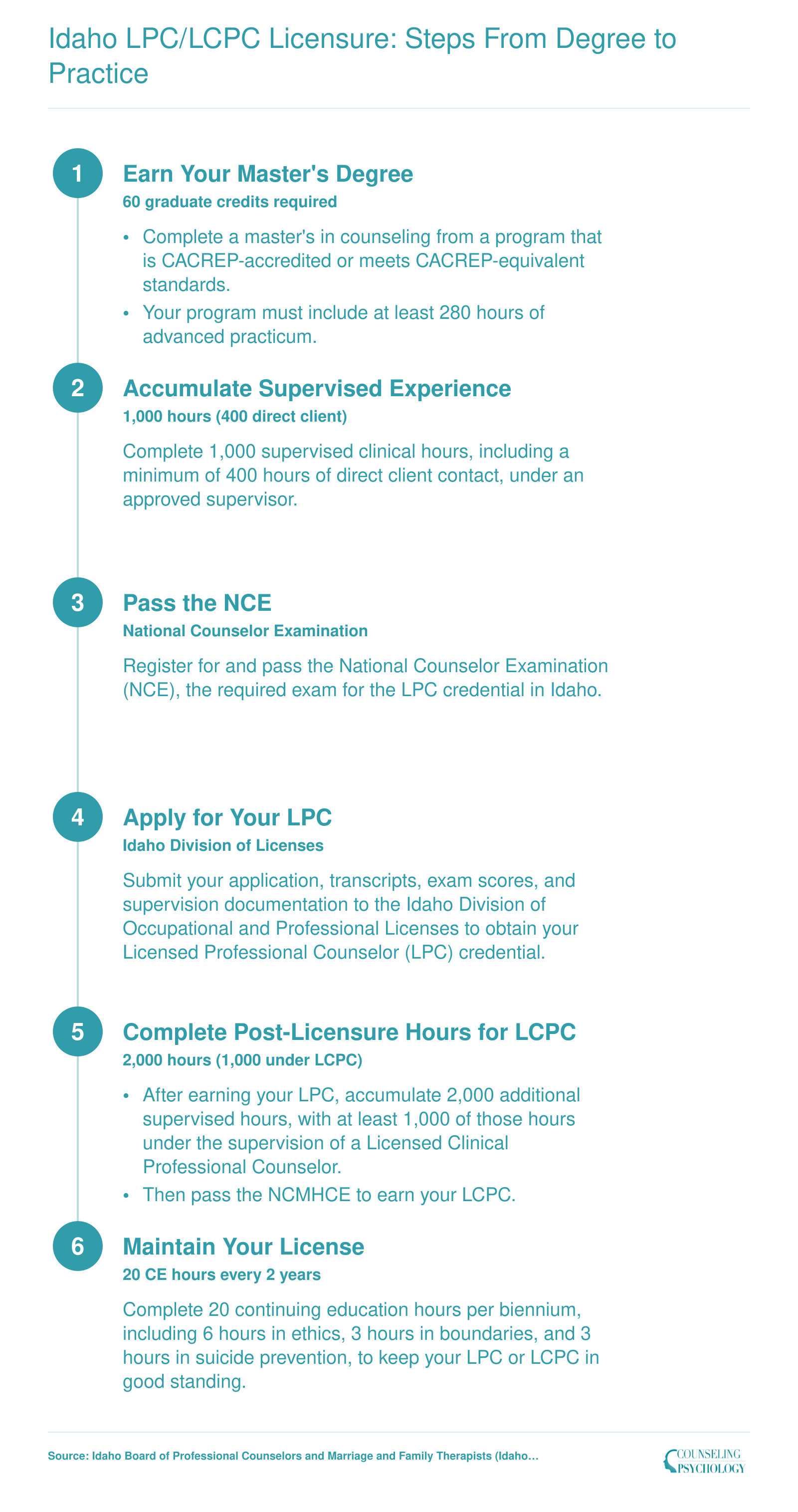
Idaho LPC/LCPC Licensure: Steps From Degree to Practice
Becoming a licensed counselor in Idaho follows a clearly defined path set by the Idaho Board of Professional Counselors and Marriage and Family Therapists. Idaho requires graduation from a CACREP-accredited program or one that meets equivalent standards, so verifying your program's alignment before enrolling is essential. Here is the step-by-step progression from enrollment to full clinical licensure.
Idaho Counseling Licensure Requirements in Detail
Understanding Idaho's two-tier counseling licensure system is essential for planning your education and career timeline, especially if you intend to practice independently or accept insurance reimbursement. Idaho issues two distinct credentials: the Licensed Professional Counselor (LPC) and the Licensed Clinical Professional Counselor (LCPC). The LPC serves as the entry-level license, while the LCPC represents advanced clinical practice and is required for many insurance panels and independent practice settings.
LPC: Entry-Level Licensure
To qualify for Idaho LPC licensure, you must complete a master's degree of at least 60 semester hours from a program accredited by CACREP or CORE.1 Idaho accepts non-CACREP degrees, but you will need to submit a detailed coursework addendum and syllabi demonstrating that your program meets Idaho's curriculum standards.3 Your graduate training must include at least 280 hours of supervised practicum experience.3
After earning your degree, you must complete 1,000 hours of supervised post-graduate experience over a minimum of two years.1 Of those 1,000 hours, at least 400 must involve direct client contact. Supervision must occur at a ratio of one hour of supervision for every 20 hours of clinical work. Qualified supervisors include LCPCs, licensed marriage and family therapists, psychologists, clinical social workers, and psychiatrists. Once you accumulate the required hours, you will sit for the National Counselor Examination (NCE). For a broader look at the credentialing process, see our guide on how to become a licensed professional counselor.
LCPC: Advanced Clinical Licensure
The LCPC requires an additional 2,000 hours of supervised clinical experience beyond the LPC, all of which must involve direct client contact.1 You must hold an active LPC before beginning LCPC supervision. The supervision ratio for LCPC candidates is one hour per 30 hours of clinical work. For the first 1,000 hours, supervision must be provided by an LCPC; the remaining 1,000 hours may be supervised by other board-approved professionals. After completing these hours, candidates take the National Clinical Mental Health Counseling Examination (NCMHCE).1 Students interested in exploring online licensed professional clinical counseling programs may want to verify that their chosen program aligns with Idaho's specific requirements.
Reciprocity and Interstate Practice
Idaho participates in the Counseling Compact, an interstate agreement that allows LCPCs licensed in member states to practice across state lines under certain conditions.1 If you earn your degree in another state, Idaho will evaluate your credentials on a case-by-case basis. Degrees from CACREP or CORE programs typically transfer smoothly, but non-accredited programs require additional documentation to verify equivalency.3 Plan ahead if you anticipate relocating, as some states impose stricter accreditation or hour requirements.
Counselor Salaries and Career Outlook in Idaho
What can you actually expect to earn as a licensed counselor in Idaho, and is the job market strong enough to justify the investment in a master's degree?
The short answer: Idaho's counseling workforce is growing, and wages are climbing alongside demand. Here is what the latest data tells us, along with where to verify the numbers yourself.
Statewide Wage Data for Mental Health Counselors
The Bureau of Labor Statistics publishes occupational employment and wage estimates by state under SOC code 21-1014 (Mental Health Counselors). For the most current Idaho-specific median and percentile wages, visit the BLS Occupational Employment and Wage Statistics page and filter for Idaho. Because published figures are updated on a lag, the most recent release available in 2026 reflects May 2023 or May 2024 survey data. Do not confuse the national median for this occupation with Idaho's median; they are separate figures, and Idaho's cost of living is lower than the national average, which typically correlates with somewhat lower nominal wages.
For Marriage and Family Therapists (SOC 21-1013), the same BLS page provides Idaho-specific estimates when sample sizes are large enough. In some years the state sample is too small to publish, so check whether data is listed or suppressed.
Boise Metro Area Wages
If you plan to practice in the Boise-Nampa metropolitan area, the BLS also publishes metro-level wage breakdowns within Idaho's state report. Boise-area wages for mental health counselors tend to sit slightly above the statewide median, reflecting higher demand and cost of living in the Treasure Valley. You can also consult the Idaho Department of Labor's local area profiles for a more granular view of hiring trends in Boise, Idaho Falls, Twin Falls, and other population centers.
Job Growth Projections
Nationally, the BLS projects employment for mental health counselors to grow roughly 16.8 percent between 2024 and 2034, expanding from about 483,500 positions to an estimated 564,600.12 That pace is considerably faster than the average for all occupations, making counseling careers a strong long-term bet.
Idaho-specific projections are maintained by the Idaho Department of Labor, which publishes long-term occupational outlook reports with growth estimates through 2030 and beyond. These reports break down expected openings by region and factor in both new positions and replacement needs as current practitioners retire. Checking this resource is essential because Idaho's population growth, particularly in the Boise metro corridor, has been outpacing national averages, which can amplify local demand for behavioral health services.
Supplementing the Numbers
Government data is a strong starting point, but it does not capture every variable that affects your take-home pay. Consider these additional resources:
- Professional association surveys: The American Counseling Association and the Idaho Association of Marriage and Family Therapy periodically publish member salary surveys that break compensation down by specialty, years of experience, and practice setting.
- University career centers: Graduate programs at institutions like Boise State University often track placement rates and starting salaries for recent alumni. Ask the program coordinator directly if this data is not posted publicly.
- Practice setting differences: Counselors in private practice, community mental health centers, schools, and hospital systems can see meaningful pay variation even within the same metro area. Agency-based roles often include benefits packages, while private practice income depends heavily on caseload and insurance panel participation.
Taken together, the data points to a favorable outlook for counseling graduates in Idaho: a growing population, expanding behavioral health infrastructure, and federal incentives for providers in underserved areas all contribute to a job market that should remain strong through the end of the decade and beyond.
Counselors working in Idaho's rural or underserved communities may qualify for federal loan repayment through the National Health Service Corps (NHSC) or Public Service Loan Forgiveness (PSLF) after 120 qualifying payments. These programs can significantly offset the cost of your master's degree, making even moderately priced programs far more affordable for graduates committed to serving high-need populations across the state.
How to Choose the Right Counseling Program in Idaho
Selecting a master's in counseling program in Idaho involves more than comparing curricula. It means identifying financial aid, loan repayment programs, and workforce incentives that align with your career goals. By exploring state-based scholarships, federal designations, program-specific funding, and professional associations, you can build a plan that supports both your education and future practice in communities that need you most.
State Resources for Financial Aid
The Idaho State Board of Education administers several scholarships for graduate students, including the Idaho Opportunity Scholarship for adults.1 This renewable scholarship requires a minimum 2.5 GPA, at least 24 credits, and a break in enrollment before applying. Applications typically open in early October. Additionally, the Idaho Department of Health & Welfare may highlight behavioral health workforce initiatives and loan repayment programs for mental health professionals serving rural areas. The Idaho Community Foundation also offers graduate-eligible scholarships, so check their site for opportunities tied to your background or region.2
At Idaho State University, the Dr. Judith Crews Counseling Scholarship specifically supports graduate counseling students; applications are usually due in early May each year.3 While not state-run, such university-specific awards are often listed alongside state resources and can significantly reduce tuition.
Federal Loan Repayment and HPSA Designations
Visit the National Health Service Corps (NHSC) website to check Health Professional Shortage Area (HPSA) designations in Idaho. These designations determine eligibility for the NHSC Loan Repayment Program, which offers substantial loan repayment for licensed professional counselors, clinical social workers, and psychologists who commit to serving in underserved areas. The growing mental health workforce shortage makes these federal programs especially relevant for students entering the field. If you plan to work in rural Idaho, this program can be a pivotal financial tool. Another federal opportunity is the NBCC Foundation Rural Scholarship, which targets master's-level counseling students dedicated to rural service.4 The next application deadline is expected in November 2026.
Program-Specific Scholarships and Assistantships
Contact the financial aid offices of prospective schools to explore department-specific funding. For example, Idaho State University uses the Bengal Online Scholarship System (BOSS) to match graduate students with internal scholarships.5 Graduate assistantships at ISU often include nonresident tuition waivers, making them a powerful option for out-of-state students. Ask about teaching, research, or administrative assistantships, as well as any regional scholarships that may not be widely advertised.
Professional Association Opportunities
Professional organizations like the Idaho Counseling Association and the American Counseling Association frequently offer member-only scholarships, grants, or guidance on funding. Joining early can give you access to exclusive opportunities. Students interested in community mental health counseling should pay particular attention, as many association grants target those committed to underserved populations. Additionally, the Pride Foundation provides financial support for LGBTQ+ students from Idaho and four other Northwest states, without requiring a counseling-specific focus.
Frequently Asked Questions About Idaho Counseling Programs
Choosing a counseling master's program involves questions about cost, accreditation, licensure, and earning potential. Below are answers to the most common questions prospective Idaho counseling students ask, grounded in current data wherever available.