
What you’ll learn in this article…
- CACREP accreditation is required for LPC licensure in Mississippi, making it the single most important program filter.
- Mississippi LPC candidates need roughly five to six years from enrollment to full licensure, including supervised practice hours.
- Several ranked programs offer online or hybrid formats, all leading to the same licensure eligibility as on-campus options.
- In-state graduate tuition varies widely across Mississippi institutions, so comparing net price is essential before committing.
Mississippi faces a persistent shortage of mental health professionals, particularly school counselors and specialists in child and adolescent therapy, a gap that makes an affordable, licensure-aligned master's in counseling a clear strategic investment. But even among the state's limited number of CACREP-accredited programs, the practical hurdles are real. All four ranked options are hybrid, combining online coursework with mandatory residencies, which forces many students to balance flexibility with travel and schedule disruptions.
Affordability is another puzzle. While in-state tuition for public programs starts under $9,000 per year, net prices after aid cluster between $13,500 and $17,600, and the cheapest sticker price is not always the best deal when location requirements and specialization tracks are factored in. For students weighing this investment, understanding how to become a counselor can help clarify whether the licensure timeline and career outcomes justify the cost. The result is that choosing a program demands a hard look at the interplay between cost, format constraints, and long-term licensure goals.
2026 Best Master's in Counseling Programs in Mississippi
Mississippi offers a focused but strong set of master's in counseling programs, with options spanning school counseling, clinical mental health counseling, and marriage and family therapy. Every program on this list delivers at least 60 credit hours of graduate coursework, and most use a hybrid or online format that accommodates working professionals across the state. Below, we highlight what sets each program apart, from CACREP accreditation and affordability to licensure alignment and regional placement networks.
- CACREP accreditation status
- Tuition and net price
- Graduation and retention rates
- Program delivery flexibility
- Licensure and career alignment
- Internal program database
- NCES-IPEDS federal institutional data — nces.ed.gov
- Independent program research
- College Scorecard graduate earnings — collegescorecard.ed.gov

Delta State University
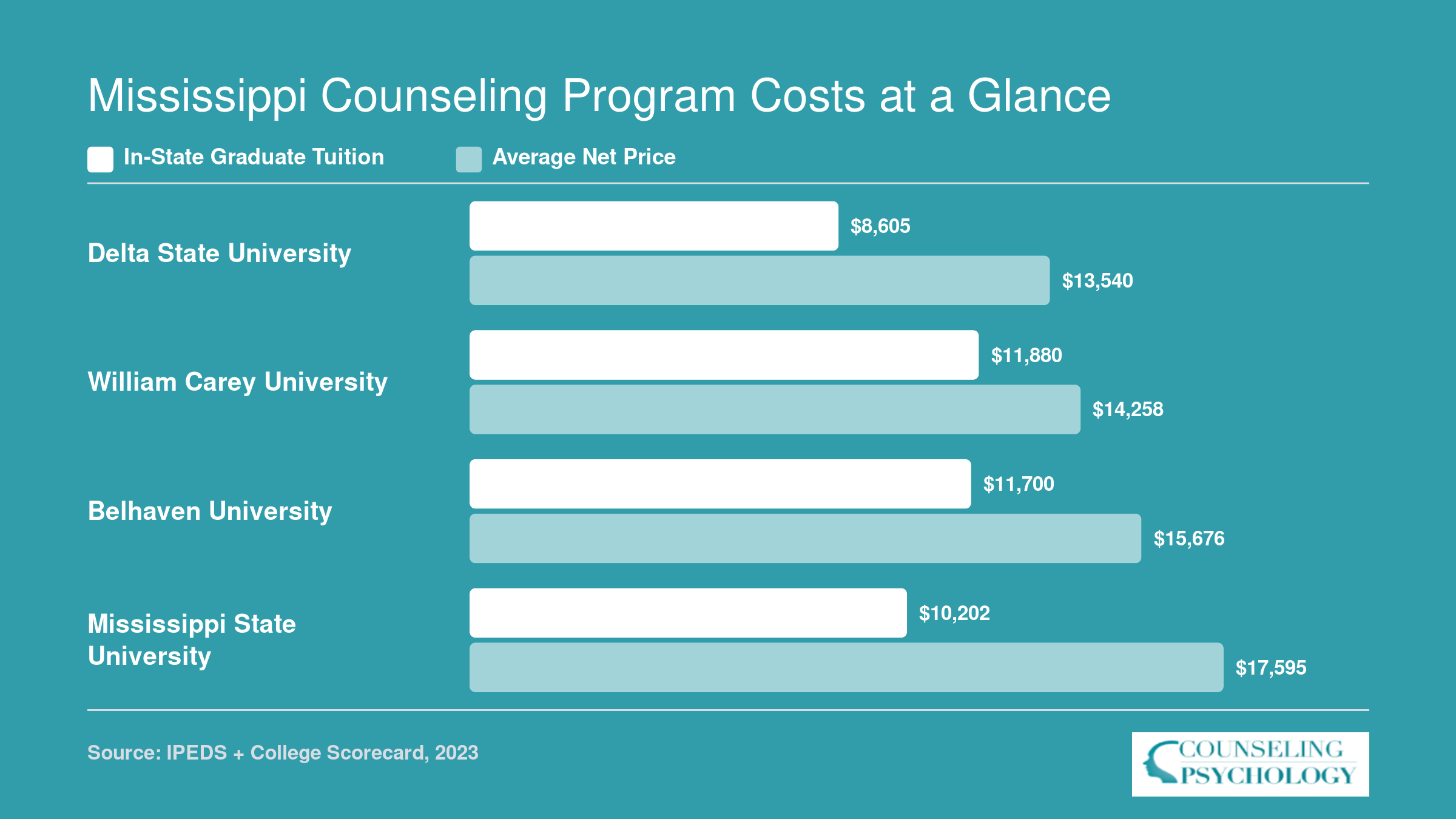
Delta State University delivers two CACREP-accredited counseling concentrations, School Counseling and Clinical Mental Health Counseling, through its M.Ed. in Counseling. The program assigns students to a hybrid or fully online track based on their distance from the Cleveland, MS campus, making it one of the most flexible public options in the state. With an annual tuition of roughly $8,605 regardless of residency and a net price near $13,540, Delta State is consistently cited among the most affordable online counseling programs in the region.
- 60-credit CACREP-accredited program (through Oct. 2028)
- Hybrid or fully online based on distance from campus
- Meets Mississippi Class AA Educator Licensure requirements
- No prerequisite courses beyond a bachelor's degree
- Capstone paper and professional presentation required
- Focus on K-12 school-aged populations
- 12:1 student-to-faculty ratio
- 60-credit CACREP-accredited CMHC track
- 700 hours of supervised field experience
- Pathway to LPC licensure in Mississippi
- Hybrid or fully online delivery available
- Requires completion of the CPCE exam
- Applications accepted year-round
- Full-time and part-time enrollment options
Master of Education in Counseling, School Counseling — Hybrid
Master of Education in Counseling, Clinical Mental Health Counseling — Hybrid

William Carey University
William Carey University's M.S. in Counselor Education with a School Counseling concentration is a 60-semester-hour hybrid program rooted in Mississippi's K-12 school system. Graduates are prepared for both the Mississippi AA educator license and national certification as Nationally Certified School Counselors. The majority of William Carey graduates accept positions in Mississippi schools, reflecting the university's strong pipeline with local districts. Annual tuition sits at roughly $11,880, with an average net price near $14,258 and an institution-wide graduation rate of about 60%.
- 60-semester-hour hybrid program
- Aligns with Mississippi DOE school counselor standards
- Prepares for National Certified School Counselor credential
- Practicum and internship in Mississippi school districts
- Emphasizes multicultural competence and ethical practice
- Curriculum blends counseling theory with applied fieldwork
- Strong graduate hiring rate in Mississippi K-12 settings
M.S. in Counselor Education, School Counseling — Hybrid

Mississippi State University
Mississippi State University's CACREP-accredited M.S. in Clinical Mental Health Counseling brings the resources of a public land-grant research university to counselor preparation. The 60-credit hybrid program includes 700 clinical hours across Mississippi community mental health centers, hospitals, and private practices. In-state tuition of approximately $10,202 makes it competitive among public options, while out-of-state students should budget roughly $27,637. The institution-wide graduation rate of about 67% is the highest among schools on this list.
- CACREP accredited through 2030
- 60 graduate credit hours with hybrid delivery
- 700 hours of supervised clinical experience
- Aligned with Mississippi LPC Board educational requirements
- Graduate assistantships and financial aid available
- Evening and online coursework for working professionals
- Practicum sites across Mississippi healthcare settings
- Requires minimum 3.0 undergraduate GPA
M.S. in Clinical Mental Health Counseling — Hybrid

Belhaven University
Belhaven University offers a fully online M.A. in Counseling with three distinct concentrations: Clinical Mental Health Counseling, Marriage and Family Therapy, and General Counseling. Based in Jackson, the program uses synchronous weekly classes and two brief on-campus residencies each year, giving students face-to-face skill-building without relocating. A flat per-credit rate of $615 applies to all students regardless of state of residence, eliminating out-of-state tuition premiums. The curriculum is described as CACREP-equivalent and is structured for Mississippi LPC licensure preparation. The institution-wide graduation rate is approximately 49%.
- 60-credit online program with brief residencies
- Curriculum aligned with CACREP standards
- Prepares graduates for Mississippi LPC licensure
- No GRE required for admission
- $615 per credit hour, same rate for all students
- Military and first-responder tuition discounts available
- Synchronous weekly online class meetings
- Christian counseling perspective integrated
- 60-credit MFT concentration within the M.A.
- Online format with two short campus residencies per year
- Prepares for LPC licensure in Mississippi
- Flexible seven-week course format
- 3.0 undergraduate GPA preferred for admission
- Practicum connections with Mississippi counseling settings
- 60-credit general counseling track
- Three specialization options within one degree
- Synchronous and asynchronous online components
- Flat per-credit tuition eliminates residency surcharges
- Licensure preparation aligned with Mississippi requirements
- Brief residencies held on Jackson campus
M.A. in Counseling, Clinical Mental Health Counseling — Hybrid
M.A. in Counseling, Marriage and Family Therapy — On-Campus
M.A. in Counseling, General Counseling — On-Campus
How We Ranked Mississippi Counseling Programs
Our rankings prioritize the factors that matter most to Mississippi students: cost, flexibility, and transparency. We applied a series of filters and metrics to identify programs that deliver strong value and real-world outcomes.
Affordability Takes Center Stage
We placed substantial weight on affordability, recognizing that graduate debt can shape a counselor's career choices for years. Our analysis considered net price (the average cost after grants and scholarships), in-state tuition rates, and the availability of financial aid. Programs that keep costs manageable rank higher because Mississippi's median counselor salaries are modest by national standards.
Online and Hybrid Delivery Only
This list excludes fully on-campus programs. We focused exclusively on online or hybrid master's in counseling options, reflecting the filter active on the data. Many Mississippi students work while earning their degree, and online flexibility is often a deciding factor. Hybrid programs that combine virtual coursework with limited in-person residencies are also included. For a broader look at nationwide options, see our guide to the best online master's in counseling programs.
Institution-Level Data Points
To gauge student outcomes, we used publicly available data from the U.S. Department of Education's College Scorecard. This includes graduation rates, the percentage of students receiving Pell Grants (a proxy for socioeconomic diversity), median earnings of former students, and median graduate debt. These metrics are institution-wide, not specific to the counseling program. We share them to offer a broader picture of the institution's performance, not to imply exact outcomes for counseling graduates.
What the Numbers Can't Tell You
Finally, we want to be upfront about limitations. Net price is an average, not a guaranteed quote. Graduation rates reflect all students, not just counseling cohorts. And earnings data may include graduates from different majors. Use our rankings as a starting point, then verify costs and outcomes directly with each program.
Mississippi Counseling Program Costs at a Glance
Graduate tuition in Mississippi varies significantly depending on the institution, but the gap between sticker price and what students actually pay can be surprising. The chart below compares published in-state graduate tuition against the average net price (the institution-wide average cost after financial aid) for each ranked program. Keep in mind that net price figures reflect averages across all students at each university and will vary based on your individual financial situation, aid eligibility, and enrollment status.
Child Counseling and School Counseling Tracks in Mississippi
Mississippi counseling programs have quietly developed some of the most specialized child-focused tracks in the Southeast, yet this is one of the least-discussed dimensions of graduate counseling education in the state.
School Counseling Concentrations Among Ranked Programs
Two programs in the rankings stand out specifically for school counseling concentrations: Delta State University and William Carey University. Delta State's M.Ed. in Counseling with a School Counseling concentration is a 60-hour hybrid program that explicitly focuses on school-aged children and meets Mississippi licensure requirements for school counselors. William Carey offers a similar 60-semester-hour Counselor Education program with a School Counseling concentration, also in a hybrid format, with preparation for both state licensure and national certification. Students considering this path should explore what it takes to become a school counselor at the national level.
Mississippi State University's Ed.S. in School Counseling goes a step further for those who already hold a master's degree. The program includes a dedicated course in Counseling Children, 100 practicum hours in K-12 school settings, and 600 internship hours, making it one of the more structured pathways for aspiring school counselors in the state.1
Play Therapy and Child-Focused Specializations
For students drawn specifically to working with younger children in clinical settings, two institutions offer notable options. The University of Mississippi provides an Ed.S. in Counselor Education with a Play Therapy Emphasis, a 25-credit post-master's program requiring one year and 1,000 hours of clinical experience, with approximately 10 hours per week of play therapy practice.2 This is a rigorous, specialized credential for clinicians who want to work with children through evidence-based, developmentally appropriate methods.
Mississippi College introduced play therapy coursework in Fall 2021, giving students a path toward the Association for Play Therapy's national certification.3 While the program details continue to develop, the addition signals growing demand for child-focused clinical training across the state.
Clinical Mental Health vs. School Counseling: Different Paths, Different Licenses
The distinction between these two tracks matters enormously for licensure and career outcomes. A school counseling track leads to a Mississippi School Counselor License, issued through the state Department of Education. Graduates typically work in K-12 schools and focus on academic, social, and career development.
A clinical mental health counseling track with a child or family emphasis, by contrast, leads to the Licensed Professional Counselor (LPC) credential, which allows graduates to work in community mental health centers, children's hospitals, outpatient therapy practices, and private settings. Those interested in the clinical route can learn more about how to become a mental health counselor. The LPC pathway requires additional post-degree supervised hours and a licensing exam beyond what school counselor licensure requires.
Practicum placements for child-focused clinical tracks in Mississippi typically include community mental health centers, pediatric outpatient clinics, and children's hospitals, in addition to school-based settings. Students pursuing a school counseling track should expect their field placements to be situated almost entirely within K-12 school districts.
If your goal is to provide therapy to children and families in a clinical environment, a clinical mental health counseling program with a child emphasis, or a post-master's play therapy credential, will generally serve you better than a school counseling degree. If your goal is to support students within a school system, the school counseling concentration is the direct and appropriate route.
Questions to Ask Yourself
Online Vs. Campus Counseling Programs in Mississippi
Choosing between online and on-campus delivery is one of the most practical decisions you will make when pursuing a master's in counseling in Mississippi. Both formats can lead to the same licensure outcome, especially when the program holds CACREP accreditation. The real question is which format fits your life, your learning style, and your clinical training goals.
Pros
- Online programs offer scheduling flexibility that lets working professionals and caregivers complete coursework on their own time.
- Students in rural Mississippi communities can access top counseling programs without relocating or enduring long commutes.
- Online delivery often carries a lower effective cost once you factor in savings on commuting, parking, and campus fees.
- CACREP accredited online programs meet the same licensure standards as campus programs, so the degree is equally respected by licensing boards.
- Asynchronous coursework allows students to balance field placements with academic requirements more easily during practicum semesters.
Cons
- On-campus and hybrid programs provide built-in cohort community and face-to-face peer support that can be harder to replicate online.
- In-person formats give students direct, regular access to on-site clinical training facilities and faculty mentorship during practicum.
- Campus-based students often benefit from stronger local networking with supervisors, agency directors, and alumni in their region.
- Nearly all Mississippi counseling programs require in-person practicum and internship hours regardless of online delivery, which limits true location independence.
- Some students find that the self-discipline required for online learning leads to feelings of isolation without structured classroom interaction.
Mississippi LPC Licensure Requirements: Steps, Hours, and Exams
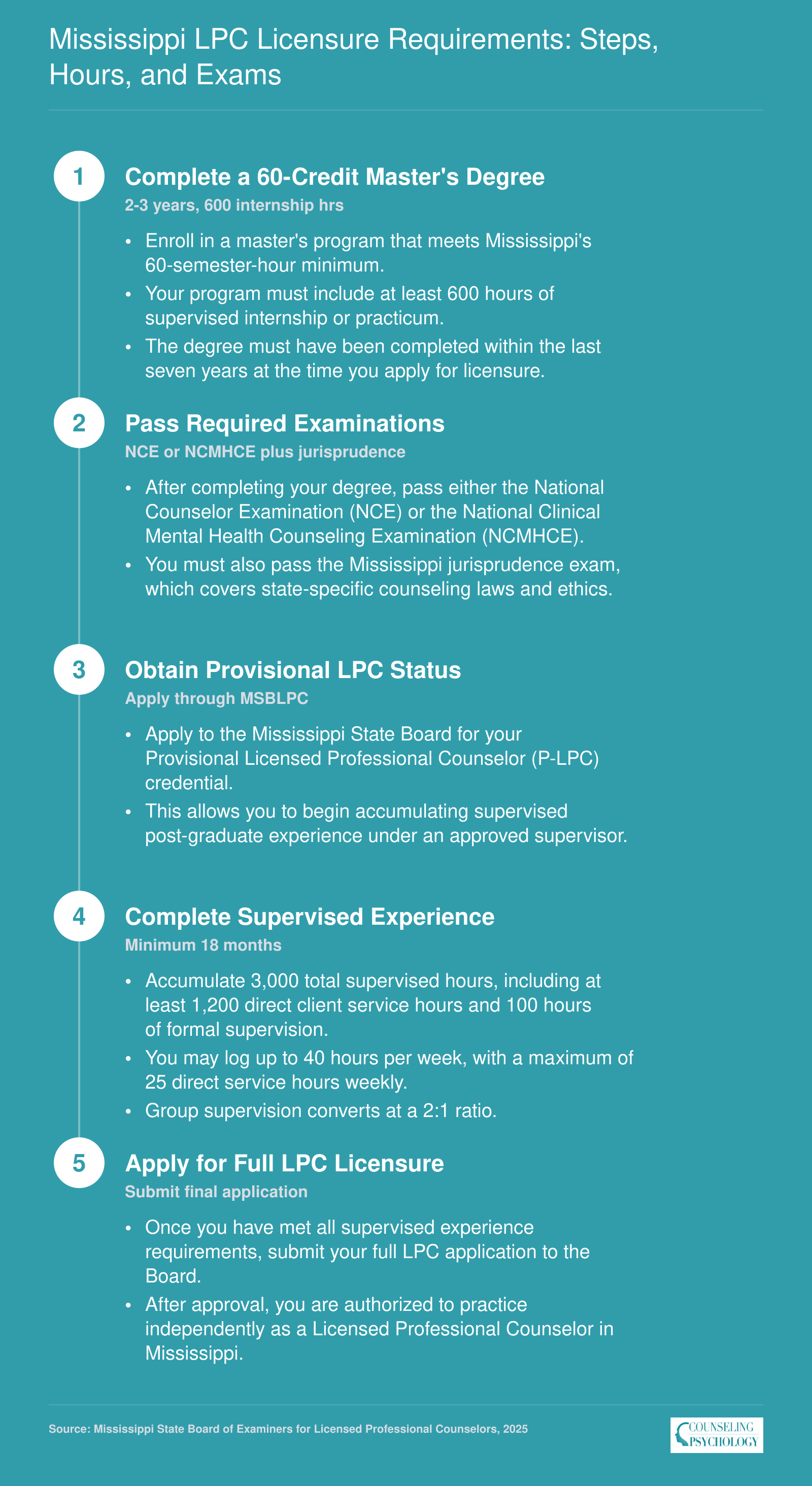
Earning your Licensed Professional Counselor (LPC) credential in Mississippi is a multi-year process that begins the day you enroll in a qualifying master's program. From start to full licensure, most candidates should plan on roughly five to six years, depending on how quickly they complete post-graduate supervised experience. As of 2025, no major legislative changes have altered these core requirements, though candidates should verify current rules with the Mississippi State Board of Examiners for Licensed Professional Counselors before applying.
LPC Vs. LMFT in Mississippi: Salary, Scope, and Career Paths
Choosing between Licensed Professional Counselor (LPC) and Licensed Marriage and Family Therapist (LMFT) credentials in Mississippi often hinges on whether you want to work with individuals across all presenting concerns or specialize in relational and family systems.
What Pays More: LPC or LMFT in Mississippi?
In Mississippi, LMFTs earn a median annual wage of $50,520, while LPCs (classified as Mental Health Counselors by the Bureau of Labor Statistics) earn $46,810 (2024 data). That $3,710 difference reflects market demand for family-systems specialists in certain clinical settings, though individual earnings vary widely based on setting, experience, and caseload. School counselors in Mississippi, another common track for master's-level clinicians, earn a median of $55,620 annually, often with better benefits and structured schedules in public-school systems.
Metro-area breakdowns within Mississippi are not published separately by BLS for these occupations due to sample size, so the statewide medians above represent the best available benchmark. Earnings in Jackson, Gulfport-Biloxi, and Hattiesburg typically track close to the state median, with private-practice and hospital-based roles occasionally exceeding it.
Scope of Practice: Who You Treat and How
LPCs are trained to assess and treat individuals across the lifespan for a broad range of mental health concerns, including anxiety, depression, trauma, substance use, and life transitions. If you are exploring the licensed professional counselor pathway, note that Mississippi licensure allows independent practice after completing 3,000 hours of supervised experience post-master's.
LMFTs, by contrast, specialize in relational dynamics, family systems theory, and couples therapy. Their training emphasizes how relationships shape mental health, making them the go-to credential for marriage counseling, family conflict, and systemic interventions. For a deeper look at this career track, our guide on how to become a marriage and family therapist covers degree and licensing steps in detail. Mississippi LMFT licensure also requires 3,000 supervised hours, but at least 1,500 must involve direct relational or family therapy.
Is MA or MS Better for Counseling?
The degree title (Master of Arts vs. Master of Science in Counseling) matters far less than CACREP accreditation and whether the program's clinical hours align with Mississippi licensure requirements. Employers, insurance panels, and the Mississippi Board of Examiners for LPCs or LMFTs evaluate your supervised experience, exam scores, and accreditation, not whether your diploma says "Arts" or "Science." Focus on choosing a CACREP-accredited program with strong practicum/internship placements rather than debating MA vs. MS distinctions.
Mississippi's licensure board requires graduation from a CACREP-accredited program (or equivalent) for LPC licensure. Choosing a non-accredited program can delay or entirely block your license, so verify accreditation early. All programs in the ranking above have been checked for current CACREP status.
Admissions Requirements and GRE Policies for Mississippi Counseling Programs
Standard Application Components
Mississippi master's in counseling programs share a common set of application requirements. You will typically need a bachelor's degree from a regionally accredited institution, a minimum cumulative undergraduate GPA in the range of 2.5 to 3.0, a personal statement outlining your career goals and fit with the program, and two to three letters of recommendation from academic or professional references.123 Most programs also require a background check as part of the admissions or enrollment process to ensure clinical placement eligibility. While these baseline items are consistent across public and private universities in the state, specific GPA thresholds and essay prompts vary, so it is wise to review each program's graduate catalog carefully.
GRE Policies: A Divided Landscape
The role of the GRE in Mississippi counseling admissions is far from uniform. As of the 2025-2026 cycle, two programs, Mississippi State University's M.S. in Counseling and William Carey University's M.S. in Counselor Education, continue to require GRE scores from all applicants.13 Neither school currently offers a waiver policy. In contrast, the University of Mississippi's M.Ed. in Counselor Education has eliminated the GRE requirement entirely; no standardized test scores are needed for admission.2 This split creates a meaningful choice for applicants: those with strong test performance may have an edge at score-requiring schools, while students seeking a test-blind pathway can turn to Ole Miss. Because GRE policies are reviewed annually, always verify the current stance with the program's admissions office before applying.
Prerequisites and Transfer Credits
Some programs expect specific undergraduate coursework. William Carey University, for instance, lists general or educational psychology, counseling theory, and statistics as prerequisites.3 Other programs commonly suggest or require an introductory psychology course and a statistics class, though the exact mix depends on the track (clinical mental health, school counseling, etc.). Students who have already completed a master's degree in psychology may find that some foundational coursework carries over. Transfer credit policies also differ: William Carey allows up to nine credits of graduate coursework to be transferred, subject to faculty approval.3 Generally, CACREP-accredited programs are cautious about accepting credits from non-CACREP programs, often limiting the number of transferable hours and requiring that courses align with CACREP standards. Prospective students with prior graduate work should contact the program coordinator early to determine which credits may apply toward degree requirements.
Frequently Asked Questions About Counseling Programs in Mississippi
Choosing a counseling program in Mississippi involves questions about accreditation, cost, licensure timelines, and career prospects. Below are answers to the questions prospective students ask most often, grounded in current program data and labor market projections.