What you’ll learn in this article…
- CACREP accredited programs offer the most portable path to LPC or LMHC licensure across all 50 states.
- Program costs range from roughly $15,000 to $50,000, and earning potential hinges on completing licensure.
- Practicum placement logistics, not coursework, are the most common reason students' timelines extend beyond two to three years.
- Clinical mental health counseling degrees align more directly with licensure, while counseling psychology programs emphasize broader research foundations.
The Bureau of Labor Statistics projects a 19% increase in substance abuse, behavioral disorder, and mental health counselor positions through 2033, far outpacing average occupational growth. That demand has pushed more CACREP-accredited and MPCAC-accredited programs to offer fully online delivery, letting working adults complete a master's without relocating or leaving their jobs.
Every program ranked here is 100% online for coursework, though practicum and internship hours still require in-person supervision at approved sites near you. The distinction matters: accreditation type affects licensure reciprocity across state lines, and practicum logistics often determine whether you finish in two years or three. Median graduate debt for these programs ranges from under $30,000 to over $80,000, making cost comparisons essential before committing.
Best Fully Online Master's in Counseling Psychology Programs
An online master's in counseling psychology prepares graduates for careers in mental health counseling, community agencies, and private practice settings. These programs blend rigorous clinical training with flexible online delivery, often including supervised practicum and internship components completed in students' local communities. We evaluated programs based on institutional reputation, accreditation status, curriculum quality, and graduate outcomes to identify the strongest fully online options available nationwide.
- Independent program research
- U.S. Department of Education College Scorecard (collegescorecard.ed.gov)
- National Center for Education Statistics (NCES-IPEDS) (nces.ed.gov)
Northwestern University
Northwestern's online counseling programs are delivered through its highly regarded School of Education and Social Policy. With a 95% graduation rate, 98% retention rate, and median alumni earnings of $89,363, Northwestern offers exceptional academic rigor paired with strong career outcomes. The university's elite reputation and deep faculty expertise in psychology and human development make this a top-tier choice for aspiring counseling professionals.
- Delivered by the School of Education and Social Policy
- Combines clinical training with evidence-based research methods
- Faculty includes nationally recognized counseling scholars
- Supervised field experiences arranged in students' communities
- Cohort-based model fosters strong peer connections
- Prepares graduates for state licensure as professional counselors
- Northwestern's 95% graduation rate reflects strong student support
MS in Counseling — Online
New York University
NYU's Steinhardt School offers an online MA in Counseling for Mental Health and Wellness that combines the prestige of a world-class research university with accessible online delivery. Graduates report median earnings of $82,509, and the program's 88% graduation rate signals strong institutional support. NYU's location in a major metropolitan hub provides access to diverse clinical placement opportunities and a vast professional network.
- Offered through NYU's prestigious Steinhardt School
- Focuses on mental health counseling and holistic wellness
- Curriculum addresses multicultural and social justice competencies
- Clinical practicum and internship completed locally
- Access to NYU's extensive alumni and professional network
- Graduates eligible to pursue state licensure as counselors
- NYU reports median alumni earnings of $82,509
Online MA in Counseling for Mental Health and Wellness — Online
William & Mary
William & Mary's online counseling program benefits from the university's long-standing academic tradition and strong graduate outcomes. With an 89% graduation rate and median alumni earnings of $73,490, the program delivers excellent value, particularly for Virginia residents. The School of Education's counseling faculty bring deep clinical expertise and a commitment to preparing ethical, culturally responsive practitioners.
- Housed in William & Mary's respected School of Education
- CACREP-accredited program meeting national standards
- Emphasis on clinical mental health and school counseling tracks
- Supervised field placements arranged in students' local areas
- Strong alumni network with 89% institutional graduation rate
- In-state tuition of approximately $25,914 per year
- Curriculum integrates research, ethics, and cultural competency
Online M.Ed. in Counseling — Online
Bay Path University
Bay Path University offers an affordable online master's in counseling psychology through its American Women's College and graduate programs. With a net price of approximately $14,271 per year and median alumni earnings of $55,383, the program provides accessible graduate education. Bay Path emphasizes experiential learning and career preparation for students seeking licensure-eligible counseling credentials.
- Affordable net price averaging around $14,271 per year
- Designed for working professionals with flexible scheduling
- Curriculum covers clinical assessment, diagnosis, and treatment
- Supervised practicum and internship requirements included
- Faculty with active clinical and research backgrounds
- Prepares graduates for state counseling licensure pathways
- Small class sizes promote individualized faculty mentorship
MS in Counseling Psychology — Online
National University
National University's MA in Counseling Psychology, offered through its JFK School of Psychology and Social Sciences, is designed for working adults seeking flexible graduate education. With a flat tuition rate of $13,284 per year regardless of residency and median alumni earnings of $67,548, the program offers strong affordability and practical career preparation. The university's four-week course format allows students to focus on one class at a time.
- Offered through the JFK School of Psychology and Social Sciences
- Unique four-week course format for focused learning
- Same tuition rate for in-state and out-of-state students
- Emphasizes practical clinical skills and theoretical foundations
- Supervised field experience in community mental health settings
- Designed specifically for working adult learners
- Median graduate earnings of $67,548 within ten years
Master of Arts in Counseling Psychology — Online
Capella University
Capella University is a well-known online institution offering CACREP-accredited counseling programs that are widely recognized for licensure preparation. The MS in Clinical Mental Health Counseling features a competency-based approach and flexible pacing options that appeal to career-focused adult learners. Capella's extensive online infrastructure and dedicated academic coaching support students throughout their graduate journey.
- CACREP-accredited program meeting national counseling standards
- Competency-based curriculum with flexible pacing options
- Virtual residency experiences supplement online coursework
- Field experience requirements completed in local communities
- Dedicated academic coaches support student progression
- Curriculum aligns with state licensure requirements nationwide
- Extensive online learning platform with robust student services
MS in Clinical Mental Health Counseling — Online
Felician University
Felician University's online Master's in Counseling Psychology provides a values-driven education rooted in the Franciscan tradition. With median alumni earnings of $57,602, the program prepares graduates for meaningful careers in mental health settings. Felician's small university environment offers personalized attention and strong faculty mentoring throughout the program.
- Grounded in Franciscan values of compassion and service
- Fully online format designed for working professionals
- Covers assessment, diagnosis, and evidence-based treatment
- Supervised clinical practicum and internship hours required
- Small cohorts allow for personalized faculty engagement
- Prepares students for professional counseling licensure exams
- Median alumni earnings of $57,602 ten years post-enrollment
MA in Counseling Psychology — Online
Campbellsville University
Campbellsville University offers an affordable online master's program in counseling that reflects its Christian liberal arts mission. The program is designed to train compassionate, skilled counselors prepared to serve diverse communities. Campbellsville's low-cost tuition and supportive online learning environment make it an attractive option for budget-conscious students pursuing counseling careers.
- Affordable tuition rooted in a Christian liberal arts tradition
- Flexible online format accommodates working professionals
- Curriculum addresses clinical counseling theory and practice
- Supervised practicum and internship experiences required
- Emphasizes ethical practice and cultural sensitivity
- Prepares graduates for state-level counseling licensure
MA in Counseling — Online
Lebanon Valley College
Lebanon Valley College provides a close-knit academic community and personalized graduate education in counseling psychology. The college's online master's program emphasizes clinical skill development and integrative approaches to mental health. Students benefit from small class sizes and faculty who are active practitioners and researchers in the counseling field.
- Small class sizes ensure individualized attention from faculty
- Curriculum integrates clinical practice and psychological theory
- Supervised field placements in community mental health settings
- Faculty include active clinicians and counseling researchers
- Flexible online delivery supports working adult students
- Prepares graduates for licensure and professional practice
MS in Counseling Psychology — Online
How We Ranked These Counseling Psychology Programs
Our ranking is a composite score that pulls four federal data points for each eligible master's program: net price (what students actually pay after grants), graduation rate, median earnings of graduates, and median student debt at completion. Those numbers come from the U.S. Department of Education's IPEDS system and the College Scorecard, the same federal sources accreditors and policy researchers use.
What Made a Program Eligible
We started with every regionally accredited institution offering a graduate program in counseling psychology, then filtered down to programs delivered 100% online. Hybrid formats that require campus residencies, low-residency models, and traditional on-campus programs were excluded from the scored pool. Practicum and internship hours completed in a student's local community do not count as a residency requirement, since fieldwork is supervised at an approved site near the student rather than on the host campus.
How the Composite Score Works
Each of the four metrics is normalized across the eligible pool, then weighted. Affordability and graduate earnings carry the heaviest weight because they speak most directly to return on investment, the question most prospective students actually want answered. Graduation rate and debt load round out the picture. Programs missing data on two or more metrics were dropped from the ranked list and routed to the additional programs section at the bottom of the article.
What This Ranking Does Not Measure
Numbers only tell part of the story. Our composite does not evaluate curriculum quality, faculty-to-student ratios, supervision quality during practicum, alumni satisfaction, or how well a specific program prepares you for licensure in your state. If you are comparing related credentials, you may also want to explore best online master's in counseling programs or best masters in mental health counseling programs to see how those options stack up. Those factors matter, often more than a one-point difference in net price, and you should weigh them through campus visits, faculty conversations, and outreach to current students.
Most ranking sites do not publish their weighting or name their data sources. We do, so you can replicate the math, challenge it, or build your own version that reflects what you actually care about.
Accreditation: CACREP Vs. MPCAC and Why It Matters for Your Career
CACREP and MPCAC represent two distinct paths to professional counselor licensure, and your choice between them can shape where you can practice and how your education is viewed by state boards. While both accreditations signal quality, their recognition varies significantly when it comes to meeting licensure requirements.
Curriculum and Clinical Training Standards
CACREP-accredited programs follow a curriculum framework that includes a minimum of 60 semester credit hours of graduate study. Students complete at least 100 hours of practicum, including 40 hours of direct client contact, followed by a 600-hour internship with at least 240 hours of direct service.2 These thresholds ensure intensive supervised experience and often align closely with the documentation state boards demand.
MPCAC accreditation, established more recently, also emphasizes competency-based training and fieldwork, though its specific hourly requirements are defined by each program and its alignment with MPCAC standards. Both accreditations require core coursework in areas like ethics, human development, and multicultural counseling, but CACREP's prescriptive model carries particular weight with licensing boards that expect clear, consistent clinical preparation.
State Licensure Board Recognition
The dominant accreditation for licensed professional counselor online programs and Licensed Mental Health Counselor (LMHC) pathways is CACREP. Most state licensing boards either require or strongly prefer a CACREP degree because it streamlines the verification of education and clinical hours. MPCAC is recognized in a growing number of states, but the list varies, and some boards do not yet accept it as an equivalent. Before you commit to a program, visit your target state's licensing board website and confirm which programmatic accreditations they accept for licensure. This single step can prevent costly delays or the need for additional coursework later.
Regional Accreditation Is the Baseline, Programmatic Is the Career Layer
Every reputable online master's program should hold regional accreditation from an agency recognized by the U.S. Department of Education, such as the Higher Learning Commission (HLC) or the Southern Association of Colleges and Schools Commission on Colleges (SACSCOC). This baseline ensures the institution meets general academic standards and allows you to access federal financial aid. However, regional accreditation alone does not guarantee that a counseling degree will satisfy licensure requirements. That is where programmatic accreditation, CACREP or MPCAC, becomes essential. It signals that the curriculum and clinical training specifically prepare you for counseling practice as defined by the profession.
Which Accreditation Should You Choose?
If your goal is licensure and you anticipate practicing in multiple states, a CACREP-accredited program offers the broadest portability and the clearest path through board verification. If you are drawn to a program with MPCAC accreditation, verify its standing with your state board and consider whether any extra steps, such as a credential evaluation or additional supervised hours, might be needed. Both accreditations uphold rigorous standards, but the practical difference boils down to how widely they are recognized for licensure. For students pursuing clinical mental health counseling online programs, checking the latest updates from your state board and the CACREP directory will give you the most current picture of what is required and where.2
Questions to Ask Yourself
Do you know which states you might want to practice in after graduation?
Are you pursuing this degree for clinical licensure or a non-clinical career?
Can you realistically complete 600+ practicum hours locally while studying online?
Counseling Psychology Vs. Mental Health Counseling: What's the Difference?
The tradeoff here is licensure certainty versus academic breadth. A clinical mental health counseling (CMHC) program is engineered to drop you straight into LPC or LMHC licensure in every state, while a counseling psychology program may give you stronger grounding in assessment, theory, and research, with a few more variables to manage on the licensure side. For most readers, the right choice depends on whether you want the fastest, cleanest path to a counseling license or whether you're weighing doctoral study or assessment-heavy roles down the line.
Where the Programs Diverge
CMHC programs are built to CACREP standards: 60 credits, applied counseling practice, and a developmental, wellness-oriented frame. They lean toward community mental health, outpatient clinics, and private practice work, with graduates entering the field as LPCs, LPCCs, or LMHCs.
Counseling psychology master's programs are typically housed in psychology departments and accredited through MPCAC (or, less commonly for terminal master's, affiliated with APA-accredited doctoral departments). They also usually require around 60 credits, but the curriculum leans harder into psychological assessment, diagnosis, and research methodology. The orientation can feel closer to clinical psychology, which is useful if you're aiming at college counseling centers, rehabilitation agencies, hospital settings, or eventual doctoral work.
Can You Get Licensed as a Counselor With a Counseling Psychology Degree?
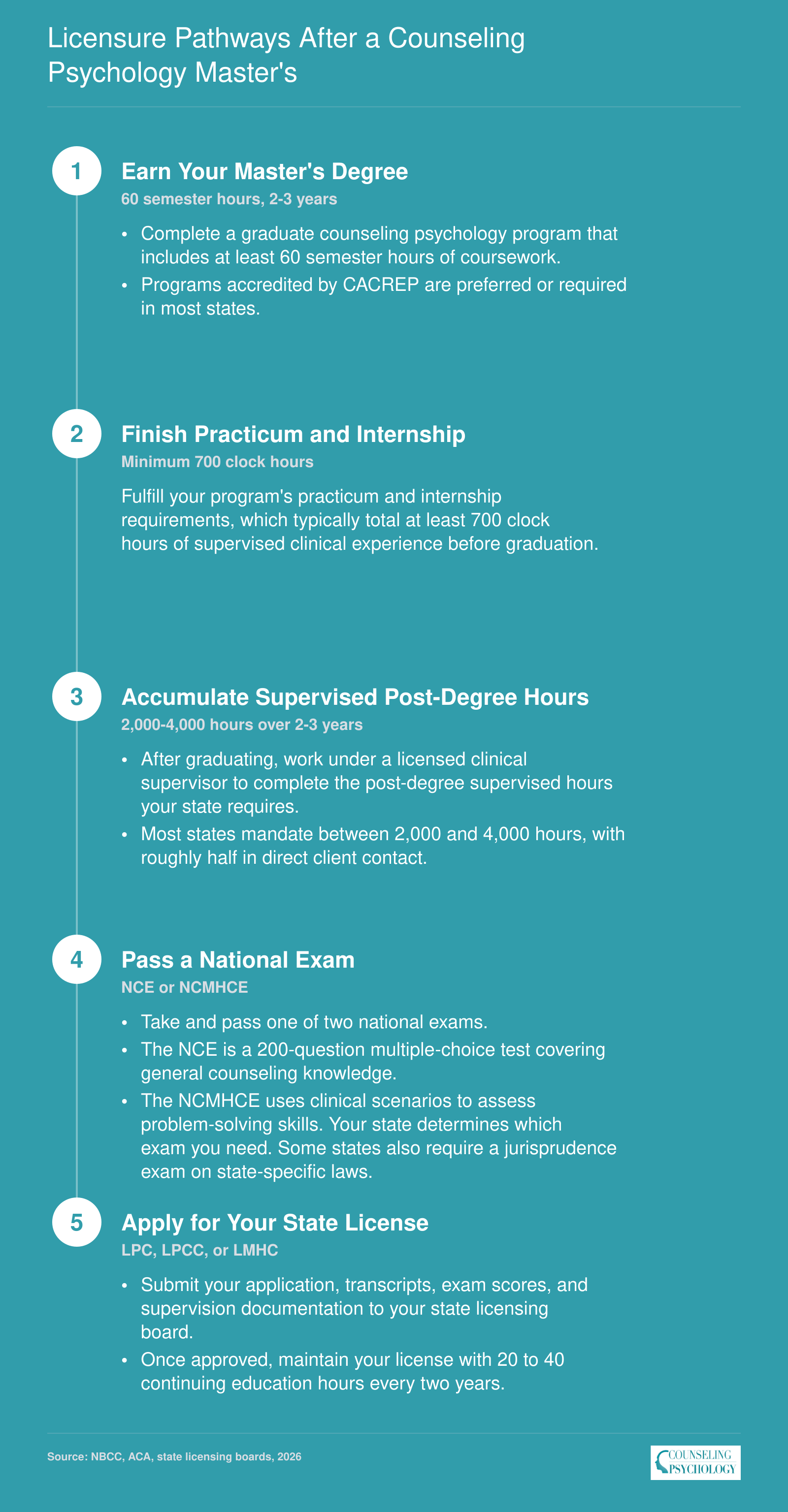
In most states, yes, provided the program is 60+ credits and includes the specific coursework state boards require (human growth and development, group counseling, career counseling, ethics, practicum, and so on). A handful of states are stricter and explicitly prefer or require a CACREP-accredited degree for LPC licensure, so check your target state's board rules before enrolling. Our guide on how to get a counseling license breaks down requirements by state. Either pathway still requires 2,000 to 4,000 hours of post-degree supervised practice and a licensure exam.
The Title Can Mislead You
Some programs labeled "counseling psychology" are functionally CACREP-accredited clinical mental health counseling programs with a different name on the diploma. Others labeled "counseling" lean heavily psychological. Ignore the title. Look at the accreditation, the course list, and whether the program publishes licensure pass rates and state-by-state eligibility. If you're unsure about the alphabet soup of credentials, a primer on counseling licensure acronyms can help.
Salary and Career Outcomes
Graduates of both programs cluster into the same job titles (LPC, LMHC, therapist, school or college counselor) with comparable earnings. Earning potential is not where these degrees separate. The real differentiator is your licensure pathway and whether you might pursue a doctorate later. For a closer look at what the day-to-day career looks like, see our overview on how to become a licensed professional counselor.
Related Articles
Licensure Pathways After a Counseling Psychology Master's
Earning your master's degree is a major milestone, but it is only one stage in the journey to independent practice. Most states require a structured sequence of education, supervised experience, and examination before granting full LPC or LMHC licensure. The total timeline from enrollment to license typically runs six to ten years depending on program format, state requirements, and how quickly you accumulate supervised hours.
Practicum and Fieldwork Hours Required by Program
Choosing between online counseling psychology masters programs often comes down to a tension between flexibility and logistics: your coursework may happen on your laptop, but your clinical hours will happen in person, at a site near you, under a licensed supervisor. How each program structures those hours, and how much help it offers in securing a placement, can shape your entire experience.
What the Standards Require
CACREP-accredited programs set the floor. The current standard calls for a minimum of 100 practicum hours plus 600 internship hours, totaling at least 700 hours of direct and indirect clinical experience. Most programs aligned with CACREP follow this structure closely, though some exceed it. Across the programs reviewed for this article, the typical range falls between 600 and 1,000 or more total clinical hours when you factor in any program-specific additions or state licensure prerequisites that may demand extra supervised contact.
Those 700 baseline hours are not interchangeable. Practicum hours usually come first and emphasize observation, skill-building, and closely supervised client interaction. Internship hours follow and require more autonomous clinical work under supervision. Mixing up the sequencing or underestimating the time commitment is one of the more common planning mistakes students make.
How Top Programs Break Down
Here is what several well-regarded online programs require:
- New York University (Online MA in Counseling): 100 practicum hours and 600 internship hours for a 700-hour total. NYU uses a network of approved clinical locations and coordinates placements directly.2
- Northwestern University (Online MA in Clinical Mental Health Counseling): 700 total clinical hours, with the program actively helping students secure placements.
- William & Mary (Online MEd in Counseling): 700 total clinical hours with structured support throughout the placement process.3
- Thomas University (Online MS in Clinical Mental Health Counseling): 100 practicum hours plus 600 internship hours, totaling 700. The program approves both sites and supervisors.
- Capella University (Online MS in Clinical Mental Health Counseling): Provides field-education support and manages site approval, though students typically take an active role in identifying potential placements.4
Placement Assistance Varies More Than You Think
This is where online students need to pay close attention. Every program listed above offers some level of placement support, but the depth of that support differs considerably. NYU maintains its own roster of approved clinical locations.2 Northwestern and William & Mary provide structured guidance that can simplify the search. Thomas University takes a hands-on role in vetting supervisors. Capella offers institutional resources but expects students to do more of the legwork.
Programs that leave placement entirely to the student do exist, even if they are not highlighted here. Before you enroll, ask pointed questions: Does the program have existing relationships with sites in your area? Will a coordinator help negotiate your placement, or will you cold-call agencies on your own? If you live in a rural area or a state where the program has fewer alumni connections, this distinction matters even more. Students weighing similar fieldwork considerations in related specialties, such as best online masters in marriage and family therapy, will find that practicum logistics follow a comparable pattern.
Plan Early, Graduate on Time
Fieldwork is not something you can compress into a final semester if you fall behind. Many students begin the placement search six months or more before their practicum starts. Account for background checks, onboarding at clinical sites, and supervisor availability. Students who treat practicum planning as an afterthought frequently find it adds semesters to their timeline, a reality explored further in the next section of this article.
Online counseling students often find that practicum placement logistics, not academic demands, are the primary reason their timeline stretches beyond expectations. This is especially true for those in rural areas or states with limited approved sites, where securing a spot can take months. Always confirm that a program offers direct placement support before enrolling.
Admissions Requirements and Prerequisites
Psychology majors have a head start, but career changers from business, education, or the sciences are admitted to most online counseling psychology master's programs every year. The admissions bar is real but not exotic, and it has loosened on one major dimension over the past five years.
The Core Application Packet
Expect roughly the same materials across programs:
- Bachelor's degree: A four-year degree from a regionally accredited institution. The major usually does not have to be psychology. Capella's online MS in Clinical Mental Health Counseling, for instance, accepts any bachelor's field.1
- Minimum GPA: Most programs set a floor between 2.5 and 3.0. Capella lists 2.5 as its minimum; the University of Houston's online M.Ed. in Counseling recommends a 3.0.3 Below the cutoff, some programs offer conditional admission tied to first-term performance.
- Letters of recommendation: Typically two or three, ideally from faculty, clinical supervisors, or employers who can speak to your judgment and interpersonal skills.
- Personal statement: Programs want to see why counseling, why now, and some self-awareness about the work. Vague essays sink otherwise strong files.
- Resume and sometimes an interview: Increasingly common, especially for cohort-based programs.
The GRE Is Mostly Gone
The biggest shift: most fully online counseling psychology programs no longer require the GRE. Capella, UMGC's Clinical Professional Counseling track4, Eastern University's MA in Counseling Psychology5, and many others are test-optional or test-free. Do not assume, though. Check each program's current admissions page, because a handful of selective programs still want scores or accept them as a tiebreaker. Students who ultimately pursue doctoral-level work, such as counseling phd programs, may encounter standardized testing requirements again at that stage.
Prerequisites for Career Changers
If your bachelor's is in nursing, marketing, or English literature, you can almost always backfill the foundational coursework. The usual list is introductory psychology, abnormal psychology, developmental psychology, and a statistics or research methods course. Many applicants complete these through community colleges or providers like Sophia and StraighterLine before applying, or during the first year of the program if the school permits.
Full-Time vs. Part-Time Pacing
Nearly every fully online program offers both tracks. Full-time students finish a 60-credit clinical mental health degree in 2 to 2.5 years. Part-time students, who are often working full jobs, typically stretch to 3 or 4 years. Practicum and internship hours, covered in the next section, are the same either way, so plan your work schedule around the fieldwork phase rather than the coursework phase.
Is a Master's in Counseling Psychology Worth It?
A master's in counseling psychology typically requires two to three years of coursework plus supervised fieldwork, costing anywhere from $15,000 to $50,000 depending on the program. Whether that investment pays off depends almost entirely on one factor: completing licensure.
The Earnings Picture
According to the Bureau of Labor Statistics, substance abuse, behavioral disorder, and mental health counselors earned a national median annual wage of $59,190 in 2024.1 Early-career counselors at the 25th percentile earned around $44,600, while experienced practitioners at the 75th percentile brought in $70,130.2 The top ten percent exceeded $89,900 annually.
These figures represent licensed, practicing professionals. Program-level earnings data for recent graduates varies by institution, and many schools do not yet report outcomes for counseling-specific tracks. What the available data confirms is that reaching that national median requires obtaining licensure and accumulating supervised clinical hours, a process that typically takes one to two years after graduation. For a deeper breakdown by degree level and specialty, see our counselor salary guide.
Counselor vs. Therapist: Who Earns More?
This question comes up constantly, but it rests on a misunderstanding. "Therapist" is a role title, not a separate credential or license. A licensed professional counselor providing therapy and a licensed marriage and family therapist both hold equivalent standing in most states. Pay differences stem from setting rather than title. Agency-based counselors often start in the mid-$40,000s. Hospital systems and integrated healthcare networks tend to pay $55,000 to $70,000. Private practice income varies widely, with established practitioners sometimes earning six figures, though that comes with overhead costs and inconsistent caseloads early on.
Cost-to-Salary Math
Among the ranked programs on this list, net prices for students range from roughly $18,000 to $45,000 for the full degree. At the national median salary of $59,190, a graduate who lands a counseling position could expect to recoup tuition costs within one to two years of full-time work. That ratio improves significantly for students who secure positions in healthcare settings or who eventually build private practices.
Compare this to fields requiring doctoral training: the upfront cost is lower, and time-to-employment is shorter. For students weighing counseling doctoral programs against master's-level counseling, the faster entry into the workforce often tips the scale.
Job Demand Supports the Investment
The BLS projects 17 percent job growth for counselors between 2024 and 2034, far outpacing the average for all occupations.1 That translates to roughly 81,000 new jobs over the decade, plus an additional 48,300 openings annually from turnover and retirement. Integrated behavioral health models, expanded insurance coverage for mental health services, and ongoing workforce shortages all fuel this demand. These trends span a wide range of counseling careers, from community agencies to private practice.
The Honest Take
This degree delivers strong returns for students who complete licensure and pursue clinical practice. The combination of manageable program costs, solid median earnings, and robust job growth creates a favorable career equation. However, the ROI weakens considerably for those who leave the field before licensure or who pursue roles that do not require graduate credentials. If you are uncertain about committing to supervised hours and state licensing exams, reconsider the investment. For everyone else, the numbers support moving forward.
Frequently Asked Questions About Counseling Psychology Master's Programs
Choosing the right counseling psychology master's program involves sorting through accreditation standards, licensure timelines, cost considerations, and career outcomes. Below are the questions prospective students ask most often, answered with specific details to help you plan confidently.
- Is it worth getting a master's in counseling psychology?
- For most graduates, yes. The Bureau of Labor Statistics projects 19% job growth for substance abuse, behavioral disorder, and mental health counselors through 2032, well above the national average. According to BLS national data, the median annual wage for mental health counselors was approximately $53,710 as of May 2024. A master's also opens the door to independent licensure and private practice, which can significantly increase long-term earning potential.
- Can I be a counselor with a master's degree in psychology?
- In most states, a master's in counseling psychology qualifies you to pursue licensure as a Licensed Professional Counselor (LPC), Licensed Mental Health Counselor (LMHC), or a similar credential. You will typically need to complete supervised post-degree clinical hours, usually between 2,000 and 4,000 depending on your state, and pass a national exam such as the NCE or NCMHCE before practicing independently.
- What is the difference between counseling psychology and mental health counseling?
- Counseling psychology tends to emphasize human development, wellness, and prevention alongside clinical skills, and it often draws more heavily from psychological theory and research. Mental health counseling programs focus primarily on diagnosing and treating clinical disorders. In practice, graduates of both types of programs frequently qualify for the same licensure categories, though curriculum emphasis, elective options, and practicum placements may differ.
- What accreditation should I look for in a counseling psychology program?
- CACREP (Council for Accreditation of Counseling and Related Educational Programs) is the gold standard for licensure portability. MPCAC (Masters in Psychology and Counseling Accreditation Council) accredits programs rooted more firmly in psychological science. Both are widely respected, but CACREP graduates benefit from streamlined licensure reciprocity in many states. Always confirm that your target program holds at least regional institutional accreditation in addition to any programmatic credential.
- How many practicum hours are required for a counseling psychology master's?
- CACREP standards mandate a minimum of 100 practicum hours (including 40 direct client contact hours) plus a 600-hour internship. MPCAC programs set their own benchmarks but commonly require similar or greater clinical exposure. Some states impose additional post-degree supervised hours for licensure, often ranging from 2,000 to 4,000. Checking your state licensing board's requirements early helps you avoid surprises after graduation.
- Who gets paid more, a counselor or a therapist?
- The titles overlap significantly, and pay depends more on licensure level, setting, and geography than on the label itself. Nationally, BLS data shows that marriage and family therapists earned a median of roughly $58,510 per year as of May 2024, while mental health counselors earned about $53,710. Clinicians in private practice or specialized settings like hospitals often earn above these medians regardless of their specific title.
- Can I complete an online counseling psychology master's on a part-time schedule?
- Most online programs offer part-time tracks designed for working professionals. Full-time students typically finish in two to three years, while part-time students should plan for three to four years. Some programs allow you to take as few as one or two courses per semester, though practicum and internship components still require dedicated blocks of clinical time that must be completed within a set window.
- How flexible are online counseling psychology programs compared to on-campus formats?
- Online programs generally deliver coursework through asynchronous lectures, discussion boards, and recorded seminars, letting you study on your own schedule. However, practicum and fieldwork hours almost always take place in person at approved clinical sites near your home. Some programs also require brief on-campus residencies or intensive weekends once or twice a year, so review each school's specific residency and fieldwork policies before enrolling.