

What you’ll learn in this article…
- Online health psychology doctorates typically take five to seven years and cost between $50,000 and $150,000 depending on degree type.
- APA accreditation remains the gold standard for licensure eligibility, and only a handful of online programs currently hold it.
- The BLS groups health psychologists under "psychologists, all other" (SOC 19-3039), with a national median salary near $106,000 as of 2024.
- PhD tracks emphasize research and often provide funding, while PsyD programs prioritize clinical practice and generally carry higher tuition.
Chronic disease now accounts for roughly 90 percent of annual U.S. healthcare spending, according to the CDC, and behavioral factors drive a significant share of that burden. That reality has pushed health psychologists into integrated care teams, hospital wellness programs, and chronic disease management settings that barely existed a decade ago.
Fully online and hybrid doctoral options in health psychology do exist, but they are genuinely limited. A handful of accredited programs offer distance-friendly formats, and many combine online coursework with required on-site practica or residencies. Students expecting a fully asynchronous path to licensure will find the options narrow.
The practical tension here is real: APA accreditation remains the clearest route to licensure in most states, and relatively few online programs carry it for health psychology specifically. Graduates from non-APA-accredited programs can face significant barriers when applying for licensure, hospital credentialing, or competitive research positions. The sections below break down accreditation requirements, program options, curriculum details, costs, and career outcomes so you can evaluate whether an online doctorate in health psychology fits your goals.
What Is a Doctorate in Health Psychology?
Health psychology is a specialized discipline that examines the intersection of psychological processes and physical well-being. While general clinical or counseling psychology primarily treats mental health conditions, health psychology focuses on how thoughts, emotions, behaviors, and social environments influence physical health outcomes, disease prevention, and recovery. This field investigates everything from stress and immune function to patient adherence to medical regimens and the psychological impact of chronic illness.
The Core of Health Psychology
At its heart, health psychology applies the biopsychosocial model, recognizing that health is shaped by biological factors (genetics, physiology), psychological factors (coping styles, beliefs), and social factors (culture, support systems). A doctoral education in this area trains you to design interventions that promote healthy behaviors, reduce risk factors, and improve patient quality of life. You might study how loneliness accelerates cognitive decline, why some smokers succeed at quitting while others do not, or how mindfulness affects cardiovascular reactivity. These are not merely academic puzzles; they are translational questions with direct implications for community wellness and healthcare policy.
PhD vs. PsyD: Two Paths to the Doctorate
Prospective students choose between two distinct terminal degrees: the Doctor of Philosophy (PhD) and the Doctor of Psychology (PsyD). A PhD in health psychology is research-intensive, culminating in a dissertation that contributes original knowledge to the field. Graduates often pursue academic appointments, research institute positions, or leadership roles in healthcare analytics. Training emphasizes grant writing, advanced statistics, and experimental design.
A PsyD, in contrast, is a professional doctorate oriented toward clinical practice. The curriculum prioritizes assessment, intervention, and supervised patient hours over empirical research. While PsyD students may complete a dissertation or scholarly project, the emphasis is on applying existing evidence to real-world settings. Both degrees can lead to licensure as a psychologist, but the PsyD track is more likely to place you in hospitals, integrated primary care, or private practice, whereas the PhD track opens doors to university teaching and funded research careers in psychology.
Health Psychology as a Specialization
It is important to understand that a pure "PhD in health psychology online" is rare. Most doctoral programs grant a degree in clinical psychology, counseling psychology, or general psychology, with a concentration or track in health psychology. You will typically enroll in an APA-accredited clinical psychology program and then select health psychology coursework, practicum placements, and a research lab aligned with your interests. Only a handful of institutions offer a standalone health psychology doctorate, and even fewer deliver that curriculum fully online due to rigorous clinical training requirements. When evaluating programs, look for faculty mentors actively publishing in journals like *Health Psychology* and for practicum sites that specialize in behavioral medicine.
Professional Home: APA Division 38
The Society for Health Psychology (APA Division 38) serves as the discipline's central professional organization. Division 38 offers a wealth of resources for aspiring health psychologists: conference networking, early career grants, a peer-reviewed journal, and detailed guidance on board certification through the American Board of Professional Psychology. Exploring the division's website and attending its annual convention can help you gauge whether this community aligns with your career vision before committing to a lengthy doctoral journey.
Online Health Psychology PHD Vs. Psyd: Key Differences
Should you pursue a PhD or a PsyD in health psychology, and how does each degree shape the career that follows?
The answer depends on whether your professional goals lean toward research and academia or toward direct clinical practice. Both degrees qualify graduates for psychologist licensure in most states, but the training philosophy, structure, and financial picture differ in important ways.1
Training Model and Emphasis
The PhD follows a scientist-practitioner model. Expect extensive research training alongside strong clinical preparation, with the ultimate goal of producing graduates who can contribute original scholarship to the field. You will complete a full empirical dissertation, often requiring you to design and conduct a multi-year study.
The PsyD, by contrast, follows a practitioner-scholar model. Clinical skills take center stage from early in the program. Instead of a traditional dissertation, most PsyD candidates complete an applied doctoral project, something closer to a program evaluation, clinical case study, or quality-improvement initiative grounded in real-world practice settings. Students weighing the PhD-versus-PsyD question in related specialties, such as clinical psychology doctorate programs, will notice the same structural divide.
Selectivity, Cohort Size, and Funding
PhD programs in health psychology tend to be highly selective, with acceptance rates in the range of 10 to 15 percent.1 Cohorts are small, and funding through assistantships, fellowships, or tuition waivers is common. PsyD programs typically accept a larger share of applicants (around 40 percent), enroll bigger cohorts, and offer less institutional funding.1 That means PsyD students often shoulder higher out-of-pocket tuition costs, a factor worth weighing carefully against expected career earnings.
Time to Completion
PhD timelines usually span five to eight years, reflecting the depth of the research requirement. PsyD programs are somewhat shorter, typically four to six years, partly because the applied doctoral project is less time-intensive than a full empirical dissertation.1
Licensure and Career Trajectories
Both the PhD and PsyD lead to licensure eligibility, but the post-graduation path often diverges. PhD graduates frequently complete postdoctoral research positions before entering faculty roles, research institutes, or policy organizations. PsyD graduates are more likely to move directly into supervised clinical practice in hospitals, integrated care settings, or community health agencies.
Neither degree is inherently "better." The right choice comes down to how you want to spend your career. If you see yourself running clinical trials or teaching at a university, the PhD aligns with that vision. If you want to work with patients managing chronic illness, pain, or health behavior change, and you want to get there faster, the PsyD may be the more efficient route.
Health Psychology PHD Vs. Clinical Psychology PHD
Choosing between a PhD in health psychology and a PhD in clinical psychology comes down to whether you see yourself primarily treating mental disorders or studying how behavior shapes physical health outcomes. The two fields share doctoral-level research training and a scientist-practitioner model, but their focal points, career pipelines, and licensure implications diverge in ways that influence where you will work and who you will serve.
Clinical Psychology: The Broader Umbrella
Clinical psychology is the foundational discipline for assessing, diagnosing, and treating mental illness. Health psychology, by contrast, is a subspecialty that often lives inside clinical psychology doctoral programs as a formal concentration or track. Many students earn a clinical PhD with a health psychology focus, taking condition-specific coursework (oncology, cardiology, pain management) and completing practicum rotations in medical settings. This embedded model is common because the American Board of Professional Psychology (ABPP) recognizes clinical health psychology as a specialty area, but the underlying doctoral degree for licensure is typically clinical or counseling psychology. If you want the broadest eligibility for state licensure and third-party reimbursement, a clinical PhD that lets you tilt toward health psychology is a pragmatic route.
Research Focus: Psychopathology vs. Biopsychosocial Health
Clinical psychology research centers on psychopathology: the origins, classification, and treatment of disorders such as depression, anxiety, schizophrenia, and personality disorders. Studies often involve randomized controlled trials of psychotherapy or investigations into neurobiological mechanisms.
Health psychology research, grounded in the biopsychosocial model, examines the interplay of psychological, social, and biological factors in physical health. Common topics include stress and immune function, adherence to medical regimens, health behavior change (smoking cessation, medication compliance), chronic illness self-management, and the psychological correlates of conditions like cancer, cardiovascular disease, or diabetes. While both disciplines use similar research methods, the outcome variables differ: clinically focused dissertations might track symptom reduction, whereas health psych dissertations often measure health behaviors, physiological biomarkers, or functional health status.
Where Graduates Work
Licensed clinical psychologists typically enter private practice, community mental health centers, psychiatric hospitals, or academic departments of psychology. Their work revolves around psychotherapy, psychological assessment, and sometimes supervision or consultation.
Health psychology PhDs (or clinical psychologists with a health specialization) gravitate toward medical and research environments. You will find them on interdisciplinary teams in hospitals, integrated primary care clinics, Veterans Affairs medical centers, public health agencies, and health policy organizations. Some work in pharmaceutical or biotech companies, designing patient support programs or studying quality-of-life outcomes. Others pursue roles that overlap with rehabilitation psychology, where the focus on functional recovery in medical populations shares common ground with health psychology. A smaller number work in independent practice, but the heavier tilt is toward institutional and academic medicine roles where collaboration with physicians and epidemiologists is the norm.
Choosing Your Path
If your primary interest lies in treating mental disorders, conducting therapy, administering personality or cognitive assessments, and addressing psychiatric crises, a clinical psychology PhD remains the better fit. If you are drawn to questions like "How does stress accelerate heart disease?" or "What interventions improve medication adherence in diabetic patients?" then health psychology is the lane to pursue. Our guide on how to become a health psychologist walks through the full career timeline in more detail.
For students who want both, a growing number of universities offer clinical psychology PhD programs with an official emphasis in health psychology. These programs prepare you for general licensure while giving you the specialized training to sit later for the ABPP board certification in clinical health psychology. That dual pathway offers maximum flexibility: you can practice as a licensed psychologist in private or institutional settings while building a niche in behavioral medicine. Check program curricula carefully; the labels "health psychology PhD" and "clinical psychology PhD with health track" can look different across schools, and not all standalone health psychology doctorates lead directly to licensure.
Questions to Ask Yourself
Do you want to conduct health behavior research, deliver direct patient care, or pursue both?
Are you prepared to complete a multi-year dissertation with virtual mentoring and remote committee access?
Does your target state license psychologists who graduated from online doctoral programs?
Can you secure a clinical or research practicum site in your local area to fulfill supervised hours?
Accreditation and Licensure for Online Health Psychology Doctorates
Choosing between a fully online doctorate and a hybrid or campus-based program is not merely a lifestyle decision. It directly determines whether you can become licensed as a psychologist in your target state. Understanding accreditation layers and state board requirements before you enroll saves years of frustration and tens of thousands of dollars.
Three Layers of Accreditation That Matter
Doctoral programs in psychology operate under a tiered accreditation system, and each layer serves a distinct purpose:
- Regional or institutional accreditation: The university itself must hold accreditation from a recognized regional body (such as the Higher Learning Commission or Southern Association of Colleges and Schools). Without this baseline, credits rarely transfer and federal financial aid is unavailable.
- APA programmatic accreditation: The American Psychological Association accredits doctoral programs in clinical, counseling, and school psychology. Critically, APA does not accredit "health psychology" as a standalone specialty. If you want an APA-accredited credential with a health focus, you must enroll in an APA-accredited clinical psychology PhD program that offers a health psychology concentration or track.
- State board recognition: Each state psychology board decides which programs qualify graduates for licensure. Many boards reference ASPPB (Association of State and Provincial Psychology Boards) guidelines, but requirements vary significantly.
As of 2026, APA does not accredit any fully online doctoral programs in health service psychology. This policy means every 100-percent-online PhD or PsyD in health psychology currently lacks APA accreditation, regardless of the institution's reputation.
Licensure Realities for Online Graduates
Most states require graduation from an APA-accredited program, or one designated by ASPPB's National Register, for licensure as a psychologist. Online graduates frequently encounter licensure obstacles because their programs fall outside these designations.2
State policies differ considerably:
- Florida requires graduation from an APA-accredited doctoral program for licensure and accepts both PhD and PsyD credentials.3
- Texas uses a "substantial equivalence" standard, comparing non-APA programs against APA benchmarks.4
- California imposes specific face-to-face instructional hour requirements and coursework mandates that many online programs cannot satisfy.5
Walden University's PhD in Clinical Psychology, for example, is not APA-accredited and lacks ASPPB/NR designation. The program currently meets licensure requirements in roughly a dozen states, including Alaska, Arizona, Colorado, Hawaii, Illinois, Kentucky, Minnesota, Nevada, New Jersey, Ohio, Texas, and West Virginia.2 Even in those states, additional face-to-face instructional hours may be required before you can sit for licensing exams.
Before enrolling in any online program, contact your target state's psychology board directly. Board policies evolve, and what qualifies today may change by the time you graduate.
The EPPP and Supervised Practice
Regardless of program format, licensure as a psychologist requires passing the Examination for Professional Practice in Psychology (EPPP). Most states also require 1,500 to 2,000 hours of supervised postdoctoral practice, though exact requirements vary.
EPPP pass rates function as a quality signal. APA-accredited programs publish first-time pass rates, and prospective students should compare these figures when evaluating programs. If an online program does not disclose EPPP outcomes, that opacity warrants caution.
Hybrid Programs as a Middle Path
Hybrid PsyD programs that blend online coursework with on-campus residencies can achieve APA accreditation. These formats preserve scheduling flexibility while meeting the face-to-face standards that licensing boards and APA require. For students committed to licensure and drawn to health psychology, a hybrid APA-accredited clinical program with a health concentration offers a more secure path than a fully online alternative.
Accredited Online PHD and Psyd Programs With Health Psychology Tracks (2026)
Choosing where to earn a health psychology doctorate comes down to a genuine tension between program rigor and practical flexibility. The programs below are frequently cited in this space, but program structures, tuition rates, and delivery formats change regularly, so treat this as a starting framework rather than a final checklist.
How to Find and Verify Accredited Programs
The American Psychological Association maintains the most authoritative list of APA-accredited doctoral programs in the country. Their online program finder lets you filter by specialty area, so searching for health psychology concentrations or related tracks is a reasonable first step. APA accreditation matters for licensure in most states, so confirm a program's status before applying rather than assuming it based on a school's marketing materials.
Beyond APA accreditation, all legitimate doctoral programs will hold regional institutional accreditation. If a program lists only regional accreditation, that does not automatically disqualify it, but it does affect licensure eligibility in many states. The BLS Occupational Outlook Handbook entry for psychologists spells out the educational requirements tied to licensure, which gives you a useful frame for evaluating whether a given program puts you on the right path. If you are also weighing broader online doctoral programs in psychology, many of the same accreditation principles apply.
Programs Worth Researching
Several schools have developed online or hybrid doctoral programs that include health psychology tracks or concentrations:
- Walden University: Offers a PhD in Psychology with a Health Psychology specialization delivered online. Credit requirements and tuition should be confirmed directly with admissions, as these figures are updated periodically.
- Capella University: Has offered doctoral tracks in health psychology through its online PhD and PsyD programs. Delivery is largely online with some residency requirements.
- Fielding Graduate University: A hybrid model that attracts working professionals. Their programs emphasize distributed learning with periodic in-person intensives.
- Alliant International University: Offers PsyD programs across multiple campuses and in some hybrid formats, with concentrations that touch on health-related areas.
- National University (formerly Northcentral): Has expanded online doctoral offerings in psychology; confirm whether a current health psychology track is available.
What to Ask Before You Apply
Contact each program's admissions office directly and ask for the current total credit requirement, per-credit tuition, whether any residency or practicum components are required in person, and the average time to completion for recent graduates. These details shift more often than school websites reflect, and the difference between a 90-credit and a 120-credit program has real consequences for both cost and timeline.
The program finder at the APA website and the BLS Handbook together give you a solid baseline for understanding which programs align with your licensure goals and long-term career direction.
What You'll Learn: Curriculum and Research Training Online
What kind of coursework, research training, and hands-on experience can you actually complete from a distance in a health psychology doctorate?
Online health psychology doctoral programs deliver a curriculum that mirrors traditional on-campus tracks in breadth and rigor, though the modalities differ. Understanding how programs structure coursework, dissertation mentoring, and applied training requirements remotely helps you evaluate whether a program can meet your professional goals.
Core Coursework in Online Health Psychology Doctorates
Most PhD and PsyD programs in health psychology require students to master a foundation in several domains:
- Psychophysiology and behavioral medicine: How stress, illness, and health behaviors interact with biological systems.
- Health behavior change theories: Models such as the Health Belief Model, Transtheoretical Model, and Social Cognitive Theory.
- Quantitative methods and biostatistics: Training in multivariate statistics, structural equation modeling, and survival analysis for health outcomes research.
- Psychopharmacology: Understanding how medications influence mental health and chronic disease management.
- Professional ethics and legal issues: Especially consent, confidentiality, and research ethics in medical settings.
- Cultural and social determinants of health: Addressing health disparities across race, ethnicity, socioeconomic status, and geography.
For example, the Walden University health psychology PhD allocates 20 credits to specialization courses and 10 credits to research methods, giving students a structured sequence in these domains.1 National University's program pairs each student with a 1:1 faculty mentor to guide elective selection and research focus.2
Dissertation and Research Mentoring from a Distance
Dissertation work is widely acknowledged as the hardest component to replicate online. Students often report that the absence of spontaneous hallway conversations and in-person lab meetings can slow progress and reduce serendipitous collaboration.
Online programs handle dissertation committees through virtual meetings (Zoom, Microsoft Teams) and asynchronous mentoring via email and shared cloud folders. Remote data collection is common: students analyze secondary datasets (NHANES, Behavioral Risk Factor Surveillance System), deploy online surveys via Qualtrics or REDCap, or partner with local health systems to collect data under supervision. Walden, for instance, includes 7 credits of dissertation support courses and 5 credits dedicated to dissertation writing to scaffold the process.1
Success hinges on self-direction, proactive communication, and the ability to troubleshoot methodological challenges without immediate face-to-face feedback.
Practicum, Internship, and Applied Training Requirements
Even fully online programs require hands-on clinical or applied experience. Most ask students to arrange practicum placements locally with hospitals, community health centers, or behavioral medicine clinics. Some programs maintain partnerships with regional health systems to streamline placement.
If a program holds APA accreditation (rare for purely online formats), it mandates a full-time, one-year predoctoral internship at an APA-accredited or APPIC-member site. For example, UTHealth Houston's clinical psychology PhD requires a one-year APA-accredited or APPIC-member internship3, and Washington State University's scientist-practitioner program begins practicum in year two.4 The University of Florida's clinical and health psychology PhD is structured as a four-year program with integrated applied training throughout.5 Students interested in substance use specializations within health psychology may also want to explore a doctorate in addiction counseling as a complementary credential.
Non-APA-accredited online programs typically do not lead to licensure as a psychologist, so they may not require internships but still encourage applied projects or consulting engagements.
Elective Tracks and Specializations
Within health psychology, many programs offer elective concentrations:
- Pediatric health psychology: Child obesity, adherence to treatment in chronic illness.
- Neuropsychology and cognitive health: Dementia prevention, traumatic brain injury rehabilitation.
- Oncology psychology: Psychosocial support for cancer patients and survivors.
- Cardiovascular behavioral medicine: Stress reduction, cardiac rehabilitation.
- Substance use and health: Harm reduction, medication-assisted treatment.
These tracks allow you to tailor coursework and dissertation topics to your career interests, even while studying online.
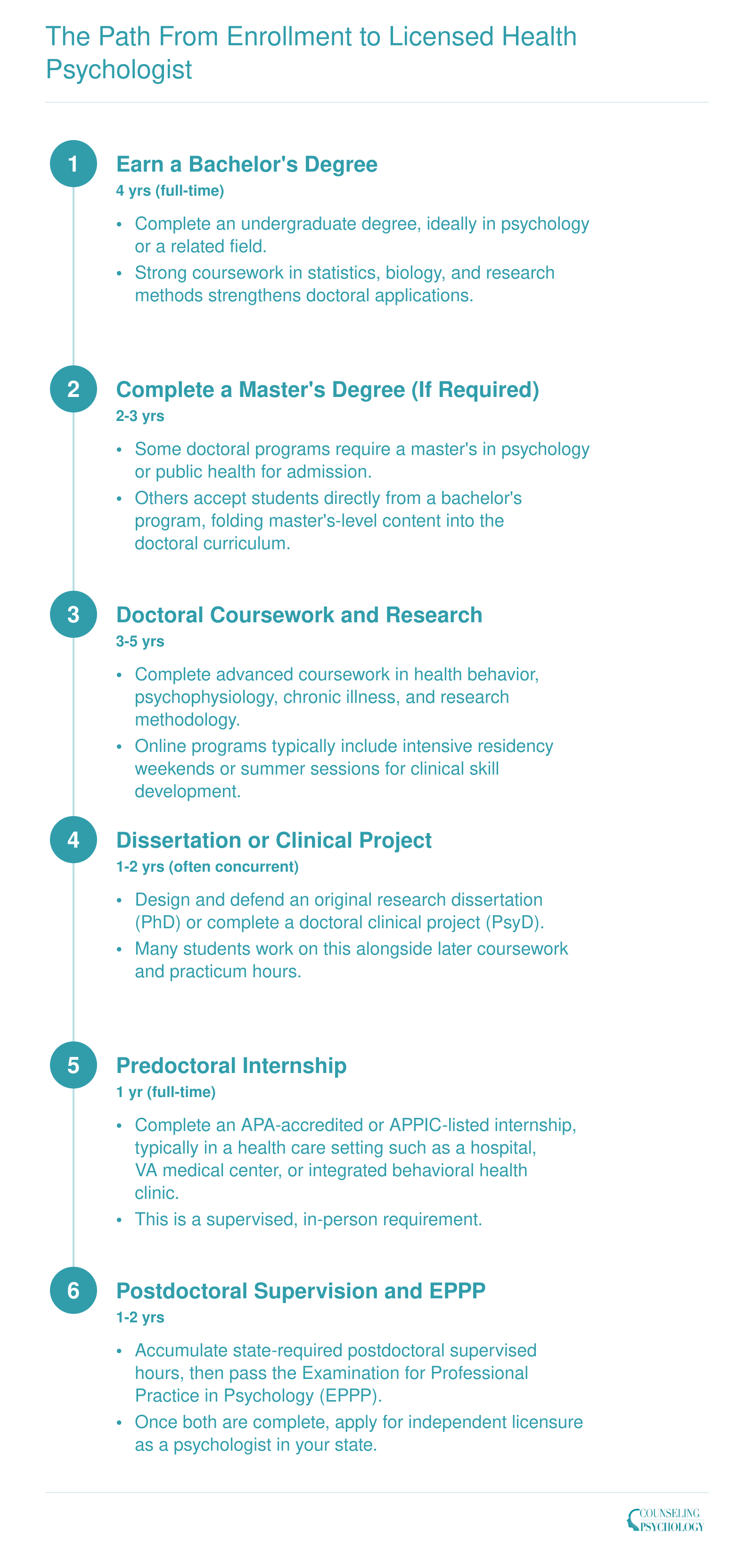
The Path From Enrollment to Licensed Health Psychologist
Becoming a licensed health psychologist is a multi-stage commitment. While exact timelines vary by program format and state requirements, the sequence below reflects the typical credentialing path for students pursuing an online doctorate in health psychology.
Admissions Requirements and Typical Student Profiles
Doctoral programs in health psychology share a common set of admissions criteria, but the weight each program places on individual components varies depending on whether the degree is a PhD or a PsyD, and whether the format is fully online or hybrid. Understanding what admissions committees look for will help you build a stronger application.
Standard Application Requirements
Most programs expect the following materials:
- Prerequisite degree: Some programs require only a bachelor's degree (Wright State University and the University of Denver, for example), while others, such as the University of Houston-Clear Lake's PsyD in Health Service Psychology, accept applicants holding a bachelor's, master's, or specialist degree.123 Programs that admit bachelor's-level students often require foundational coursework in introductory psychology, abnormal psychology, behavioral neuroscience, statistics, and research methods.
- Minimum GPA: A 3.0 cumulative GPA is a common floor, though competitive applicants typically present a 3.3 to 3.5 or higher.5
- GRE scores: The trend toward GRE waivers has accelerated. Loma Linda University and Wright State University both offer GRE waivers as of 2026, and many online programs have dropped the requirement entirely. Where the GRE is still accepted, strong quantitative scores can bolster an otherwise borderline application.
- Letters of recommendation: Two to three letters from faculty or supervisors who can speak to your research aptitude or clinical competence.
- Statement of purpose: A clear articulation of your research interests, career goals, and reasons for pursuing a doctorate in health psychology specifically.
- Writing sample: Often a master's thesis, published article, or a substantial research paper that demonstrates analytic thinking and scholarly writing.
What Separates PhD and PsyD Applicant Pools
PhD programs tend to weigh research readiness more heavily than clinical experience. Published work, a thesis, or documented involvement in a research lab can set you apart. Faculty expect incoming students to articulate a specific research question that aligns with existing lab expertise.
PsyD programs, by contrast, place greater emphasis on clinical preparation and professional fit.1 Applicants with substantial supervised clinical or healthcare hours often have an edge, even if their GPA or standardized test scores are slightly below the median. That said, PsyD applicants still benefit from demonstrating some research literacy, because doctoral-level training in any format includes a capstone or dissertation component. Prospective students interested in related practice-oriented fields, such as a doctorate in forensic psychology, will find a similar emphasis on clinical hours during the admissions process.
The Typical Online Doctoral Student
The profile of students drawn to online health psychology doctorates tends to differ from that of traditional residential cohorts. Most are mid-career professionals, often in their 30s or 40s, who are already working in healthcare systems, public health agencies, counseling settings, or behavioral health organizations. They choose online or hybrid formats because relocating for a full-time residential program is not practical, whether due to family obligations, clinical caseloads, or geographic constraints.
Competitive applicants in this group usually bring a combination of professional experience and academic preparation: several years of direct patient contact or program-level work, a master's degree in a related field, and a well-defined research interest that grew out of problems they have observed on the job. Programs value this real-world grounding because it often translates into more focused dissertation topics and faster time to completion.
If your background includes gaps, such as limited research experience or a GPA below 3.0, some programs offer conditional admission or bridge coursework. Reaching out to a program's admissions coordinator before applying can clarify whether your profile is a realistic fit.
Total tuition for an online health psychology doctorate can range from about $50,000 to over $150,000, with PsyD programs generally more expensive than research-oriented PhD tracks. Most online doctoral programs offer limited or no assistantship funding, unlike many in-person PhDs with stipends and tuition waivers, so you should expect to finance the degree primarily through personal resources or federal student loans.
Cost, Duration, and ROI of an Online Health Psychology Doctorate
Online doctoral programs in health psychology demand multi-year investments of both time and money, and prospective students need realistic benchmarks before committing. Tuition, duration, and ultimate salary potential vary widely by degree type, institution, and whether the graduate secures licensure.
Tuition Benchmarks: PhD vs. PsyD
Total tuition for an online PhD in health psychology typically ranges from $40,000 to $90,000, though public-university programs may fall below $40,000 for in-state students and private institutions occasionally exceed six figures. Online PsyD programs in health psychology generally cost more: expect $60,000 to $120,000 total, reflecting the practitioner-focused curriculum and heavier clinical training load. Per-credit rates range from $500 to $1,500, and many programs charge the same rate for online and on-campus students. A few institutions levy a small technology fee ($100 to $300 per term) for online learners, but differential pricing is the exception rather than the rule in doctoral psychology education.
Financial aid, employer tuition assistance, and graduate assistantships can significantly reduce out-of-pocket cost. PhD students often secure research or teaching assistantships that offset tuition and provide a modest stipend, though these are less common in fully online formats. PsyD students more frequently fund their programs through federal loans, scholarships, or employer benefits if they are working full-time while enrolled.
Time to Completion
Most online health psychology PhD programs advertise a four-to-five-year timeline, but actual completion spans four to seven years in practice. Coursework typically occupies the first two to three years, followed by comprehensive exams, proposal defense, dissertation research, and a final defense. Students who maintain part-time pacing, balancing work, family, or clinical training, often extend into year six or seven. Online PsyD programs likewise project four to six years, with practicum and internship placements adding scheduling complexity that delays graduation beyond the catalog minimum.
Few students finish in the advertised minimum. Delays accumulate around dissertation proposal approval, IRB review, data collection, and the scramble to secure a pre-doctoral internship match, all of which can add 12 to 24 months to the original estimate.
ROI Analysis: Salary Outcomes vs. Debt Load
The Bureau of Labor Statistics reports a national median annual wage of $94,310 for psychologists overall.1 The broader category of Psychologists, All Other, which includes health psychologists, shows a median of $117,750 and a mean of $110,300 as of May 2023.2 Health psychologists employed in scientific research and development services, the highest-paying industry segment, earned a mean annual wage of $131,220 in the same period.2 The national occupational outlook anticipates 6 percent job growth from 2024 to 2034, with approximately 12,900 annual openings.1
Weighing these salaries against $50,000 to $150,000 in tuition debt, ROI hinges on two critical factors: licensure and employer context. Licensed psychologists command significantly higher salaries and access a broader range of reimbursable clinical and consulting roles. Non-licensed PhD holders may work in academic research, corporate wellness, or policy analysis at lower pay scales, lengthening the debt-payoff horizon. Students weighing a practitioner model against a scientist-practitioner model may also want to compare clinical psychology phd programs, where similar financial dynamics apply. Graduates whose employers offer tuition reimbursement, common in hospital systems, federal agencies, and large research universities, can substantially improve their net return by reducing or eliminating loan balances before graduation.
Career Paths With a Health Psychology Doctorate
A doctorate in health psychology prepares you to work at the intersection of psychology and medicine, helping patients, populations, and organizations manage the behavioral side of physical health. Where you actually land depends on three things: whether you pursue state licensure, whether your training emphasized research or clinical practice, and whether you want to work inside a healthcare system, a university, a company, or a government agency.
Clinical and Applied Roles
Licensure as a psychologist opens the highest-paying clinical positions and is required for most patient-facing work.
- Licensed health psychologist in integrated care: Embedded in hospitals, primary care clinics, and rehabilitation centers, treating patients with chronic illness, pain, obesity, or recovery challenges. National data put the median annual wage for health psychologists at roughly $96,000 in 2023, with the top of the range reaching about $169,000.
- Behavioral medicine specialist: Works alongside cardiologists, oncologists, and endocrinologists on smoking cessation, adherence, and lifestyle change. Clinical health psychologist salaries reported by compensation trackers average around $122,000, with most falling between $108,000 and $146,000.2
- Health policy or wellness consultant: Advises hospital systems, employers, or government bodies on behavioral health strategy. Compensation varies widely by client base and seniority.
Research, Academic, and Industry Roles
Non-licensed PhD holders typically build careers around research, teaching, and program design. Salaries in these tracks tend to sit below licensed clinical bands but offer more flexibility and remote work.
- Academic researcher or professor: Runs a lab, teaches doctoral students, and competes for NIH or foundation grants. Tenure-track salaries vary by institution and discipline.
- Pharmaceutical or biotech researcher: Designs patient-reported outcome studies, adherence trials, and behavioral endpoints for drug and device companies. Industry roles often pay above academic equivalents.
- Population health program designer: Builds chronic disease management and prevention programs for insurers, ACOs, or public health agencies.
Emerging Demand Areas
The field is growing roughly 17.8% over the 2023 to 2033 decade, faster than most psychology specialties. Several areas are pulling new doctorates in:
- Telehealth-delivered behavioral interventions for depression, pain, and insomnia
- Digital therapeutics, including FDA-cleared app-based programs that need PhD-level clinical validation
- Health equity research focused on chronic disease disparities
- Self-management coaching for diabetes, cardiovascular disease, and long COVID
So what can you do with a PhD in health psychology? If you license, you can practice and bill clinically. If you stay research-focused, you can teach, consult, or work in industry. Most graduates blend two or three of these tracks across a career.
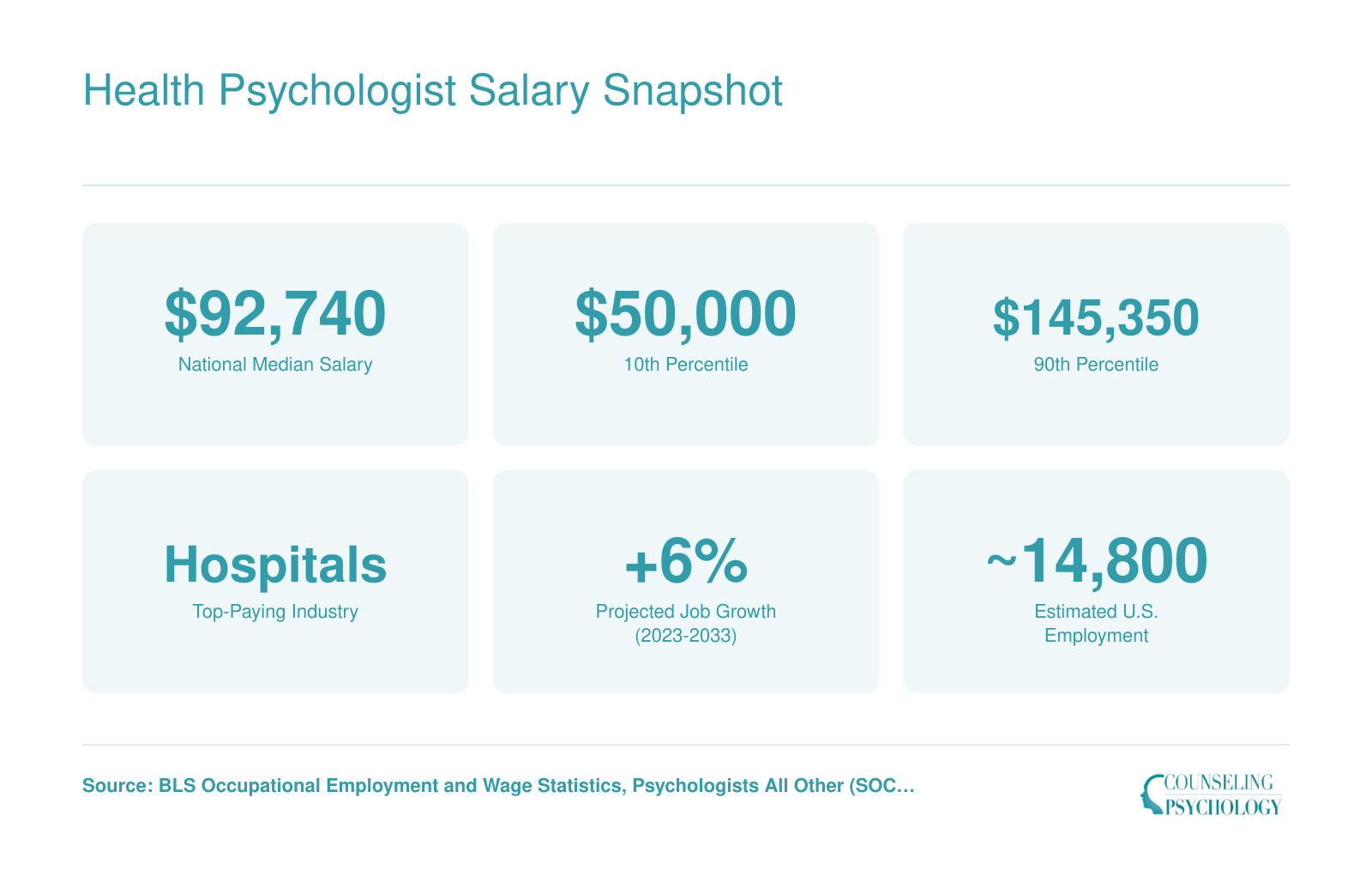
Health Psychologist Salary Snapshot
The BLS does not publish a separate category for health psychologists, so figures below reflect the broader "psychologists, all other" classification (SOC 19-3039), which is the closest available proxy. Actual earnings for doctoral-level health psychologists in hospital or research settings may trend higher.
Frequently Asked Questions About Online Health Psychology Doctorates
Prospective students researching online doctoral programs in health psychology often run into the same sticking points around accreditation, timeline, and career outcomes. The answers below address the most common questions counselingpsychology.org receives on this topic.
- Can you get a PhD in health psychology fully online?
- Most programs deliver coursework entirely online, but a fully online experience from start to finish is rare. Virtually every doctoral program requires in-person components such as residency weekends, practicum hours at approved clinical sites, and a supervised predoctoral internship. Dissertation research may also involve on-site data collection depending on your topic. Expect a hybrid format rather than a 100 percent remote path.
- Are online health psychology PhD programs accredited by the APA?
- The American Psychological Association does not currently accredit programs specifically in health psychology. APA accreditation applies to broader program categories like clinical psychology or counseling psychology, some of which offer health psychology concentrations. Regional institutional accreditation is the baseline to verify. If licensure is your goal, confirm that the program's structure meets your state licensing board's requirements for supervised hours and coursework.
- How long does it take to complete an online doctorate in health psychology?
- Timelines typically range from four to seven years. PhD programs skew longer (five to seven years) because of the original dissertation research requirement, while PsyD programs can sometimes be completed in four to six years. Part-time enrollment, which many online students choose, extends the timeline further. The predoctoral internship year is a fixed addition regardless of pace.
- Does a health psychology PhD lead to licensure as a psychologist?
- It can, but the path depends on your program type and state requirements. A doctorate from a regionally accredited institution that includes sufficient supervised clinical hours generally qualifies you to sit for the EPPP licensing exam. States vary in how many postdoctoral supervised hours they require. Programs housed within APA-accredited clinical or counseling psychology departments tend to provide the smoothest route to licensure.
- What is the difference between a PhD in health psychology and a PhD in clinical psychology?
- A health psychology PhD focuses on how psychological, behavioral, and social factors influence physical health and illness. Research often targets areas like chronic disease management, health behavior change, or public health interventions. A clinical psychology PhD trains you broadly in diagnosing and treating mental health disorders. Health psychology graduates may pursue licensure but frequently gravitate toward research, consulting, or integrated medical settings rather than traditional therapy practice.
- How much does an online health psychology doctorate cost?
- Total tuition for online doctoral programs in psychology generally falls between $50,000 and $150,000 or more, depending on whether you attend a public or private institution and whether you enroll full or part time. Some PhD programs offer graduate assistantships or tuition waivers, though these are less common in online formats. Factor in additional costs for residencies, practicum travel, and licensing exam fees when building your budget.
- Can I work full-time while completing an online health psychology PhD?
- Many online doctoral students do maintain employment, and asynchronous coursework is designed with working professionals in mind. However, practicum rotations, internship requirements, and dissertation research demand significant time commitments that can conflict with a full-time schedule. Most students find that reducing to part-time work during clinical training years is necessary. Discuss scheduling flexibility with your program advisor before committing.