
What you’ll learn in this article…
- Industrial-organizational psychologists earn the highest mean salary among all psychology specialties tracked by federal data.
- Clinical psychologist salaries vary by tens of thousands of dollars from state to state due to cost of living differences.
- PsyD graduates typically carry roughly twice the student loan debt of PhD graduates, significantly reducing real take-home pay.
- The Bureau of Labor Statistics projects psychologist employment growth will outpace most other occupations through the coming decade.
The national median salary for psychologists falls roughly between $92,000 and $106,000, depending on specialty, according to Bureau of Labor Statistics data. That range, however, only tells part of the story. A school psychologist in rural Arkansas and an industrial-organizational psychologist in Manhattan occupy very different financial realities.
Pay varies widely by state, work setting, degree type, and years of post-licensure experience. Gross salary is one number; hourly rates, after-tax income, and true take-home after practice overhead or student loan payments paint a different picture. Reaching six figures is realistic for many psychologists, but the timeline and trade-offs depend heavily on choices made during and after training.
National Psychologist Salary at a Glance
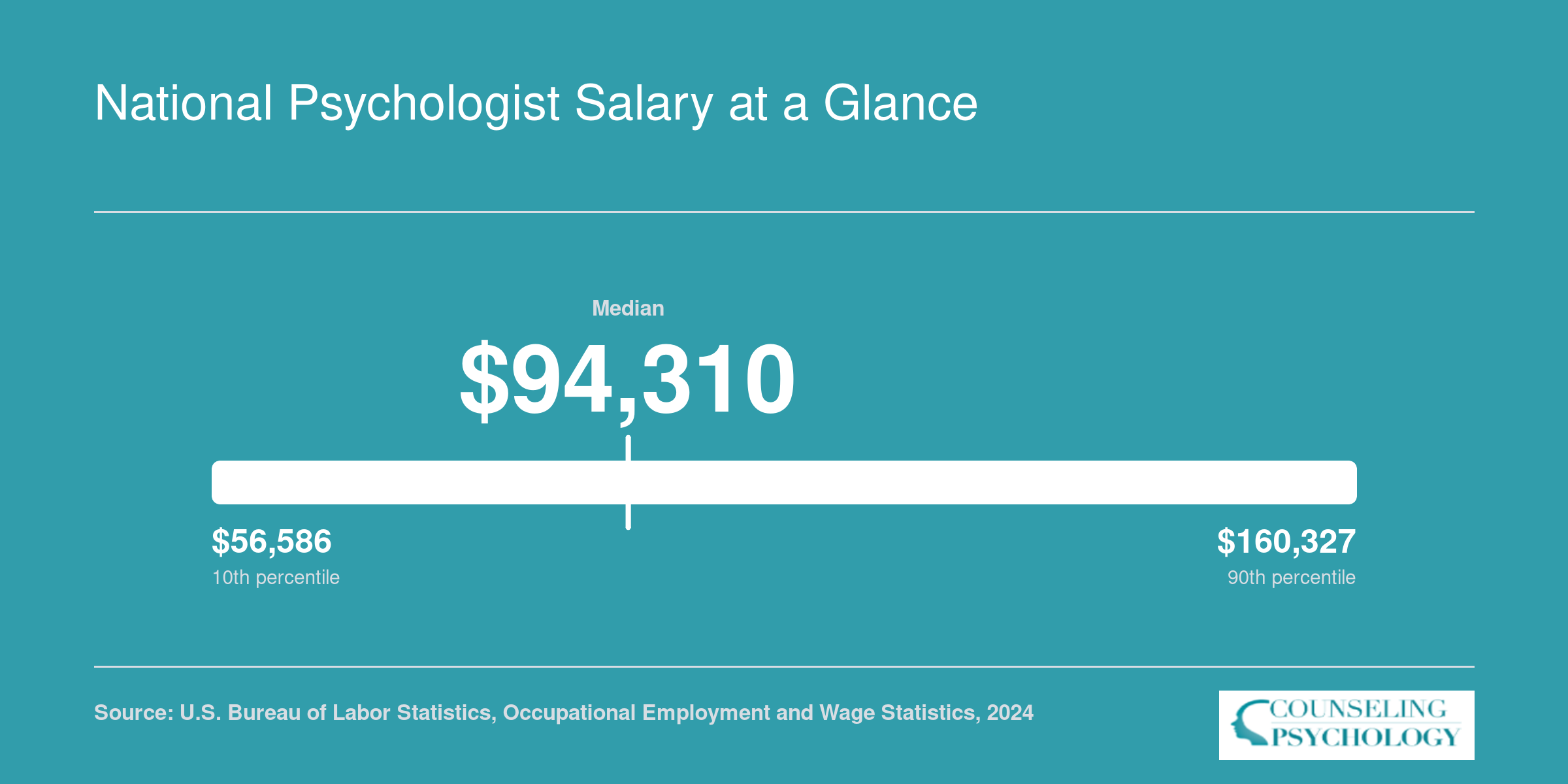
How much do psychologists make a year across the United States? The salary range below captures all psychology specialties combined, from school psychologists to clinical and counseling psychologists to industrial-organizational psychologists. With roughly 154,860 psychologists employed nationally, the field offers a wide pay distribution depending on specialty, experience, and setting.
Psychologist Salary by Specialty
Compensation in psychology varies considerably depending on the specialty you pursue. Industrial-organizational psychologists command the highest mean salary among the specialties tracked by federal labor data, while school psychologists tend to earn less but benefit from predictable schedules and strong job stability. Below is a breakdown of annual wages across the major psychology specialty categories.
| Specialty | Total Employment | 25th Percentile | Median Salary | Mean Salary | 75th Percentile |
|---|---|---|---|---|---|
| Industrial-Organizational Psychologists | 1,050 | $80,790 | $109,840 | $134,400 | $198,170 |
| Psychologists, All Other | 17,790 | $73,820 | $117,580 | $111,340 | $145,200 |
| Clinical and Counseling Psychologists | 72,190 | $67,470 | $95,830 | $106,850 | $131,510 |
| Psychologists (Broad Category) | 154,860 | $71,140 | $94,310 | $102,100 | $126,340 |
| School Psychologists | 63,830 | $73,240 | $86,930 | $93,610 | $108,210 |
What Field of Psychology Makes the Most Money?
Not all psychology specialties pay equally, and understanding which fields command the highest salaries can help you make strategic decisions about your training and career path.
Industrial-Organizational Psychology Leads the Pack
According to the Bureau of Labor Statistics, industrial-organizational (I-O) psychologists earn a median annual salary of roughly $147,000, making this the highest-paid specialty tracked by the agency. The catch? The employment base is small, with only a few thousand positions nationwide. I-O psychologists apply behavioral science to workplace challenges like employee selection, organizational culture, and productivity, and the direct return on investment they deliver to businesses justifies premium compensation. If you are drawn to the intersection of psychology and corporate strategy, this niche can be extremely lucrative, but competition for roles is steep.
Forensic and Neuropsychology: High Interest, High Reward
Two specialties that consistently attract student interest, forensic psychology and neuropsychology, also sit near the top of the pay scale, though neither is broken out in standard federal employment surveys.
Forensic psychologists evaluate defendants, provide expert testimony, and consult with legal teams. Pay varies widely by experience and setting. Entry-level forensic psychologists earn around $63,578, while early-career professionals move into the mid-$76,000s.1 The mean annual wage reaches approximately $114,5312, and median advertised salaries for experienced roles reach roughly $120,704. Demand from the court system and correctional institutions keeps this field growing, though caseloads can be heavy and emotionally taxing. If you want to learn more about what it takes to enter this specialty, review the forensic psychologist requirements.
Neuropsychologists, who assess and treat patients with brain injuries, neurological conditions, and cognitive disorders, often command salaries in the $100,000 to $130,000 range. Scarcity drives much of that premium: the specialized postdoctoral training required (typically two additional years beyond a doctoral program) limits the pipeline of qualified practitioners, giving those who complete the training significant leverage in salary negotiations. This dynamic mirrors broader trends outlined in our look at the nation's most needed psychology specialists.
Why Certain Fields Pay More
Three factors explain most of the salary variation across psychology specialties:
- Business ROI: I-O psychologists directly improve organizational performance, so employers treat compensation as an investment rather than an expense.
- Scarcity of qualified practitioners: Neuropsychology's lengthy training pipeline keeps supply low relative to clinical need, pushing salaries upward.
- Institutional demand: Forensic psychologists serve courts, law enforcement, and corrections systems that must fill positions to meet legal mandates, creating consistent demand even in economic downturns.
The Trade-Off to Consider
Higher pay almost always comes with higher barriers to entry. The most lucrative psychology fields tend to require the most specialized doctoral training, extended postdoctoral fellowships, or niche certifications. They also tend to have fewer available positions, meaning job searches may be geographically limited. Before chasing the highest salary, weigh the additional years of training, the opportunity cost of delayed earnings, and whether the day-to-day work genuinely aligns with your clinical or research interests. A well-chosen specialty that matches your strengths will almost always outperform a high-paying role that leads to burnout.
Psychologist Salary by State
Clinical psychologist salary by state varies significantly, driven by cost of living, demand, and local reimbursement rates. The table below draws from the latest available federal wage data and covers clinical and counseling psychologists, school psychologists, industrial-organizational psychologists, and other psychology specialties across selected states. Keep in mind that higher nominal pay in states like California or New York may be partially offset by elevated living costs.
| State | Specialty | Median Salary | 25th Percentile | 75th Percentile | Mean Salary |
|---|---|---|---|---|---|
| New York | Clinical & Counseling | $99,910 | $78,500 | $132,520 | $112,980 |
| Maine | Clinical & Counseling | $97,630 | $86,180 | $117,120 | $114,470 |
| Iowa | Clinical & Counseling | $98,580 | $73,520 | $124,640 | $102,560 |
| Illinois | Clinical & Counseling | $97,470 | $66,570 | $138,890 | $106,360 |
| Tennessee | Clinical & Counseling | $92,320 | $81,790 | $120,450 | $103,190 |
| Pennsylvania | Clinical & Counseling | $90,450 | $67,450 | $124,990 | $103,980 |
| North Carolina | Clinical & Counseling | $91,840 | $68,660 | $117,060 | $99,940 |
| Oklahoma | Clinical & Counseling | $91,140 | $71,810 | $119,830 | $97,350 |
| Mississippi | Clinical & Counseling | $92,390 | $64,390 | $101,360 | $95,140 |
| Utah | Clinical & Counseling | $88,990 | $68,080 | $121,980 | $94,070 |
| Florida | Clinical & Counseling | $84,020 | $49,690 | $126,460 | $92,010 |
| Missouri | Clinical & Counseling | $86,340 | $60,710 | $115,130 | $90,480 |
| New York | School | $99,310 | $78,080 | $129,370 | $103,580 |
| Massachusetts | School | $98,150 | $78,200 | $111,440 | $100,140 |
| Connecticut | School | $98,080 | $78,630 | $110,110 | $98,190 |
| Georgia | School | $96,810 | $80,890 | $109,140 | $94,240 |
| New Jersey | School | $90,900 | $75,760 | $105,020 | $94,520 |
| Ohio | School | $86,930 | $74,630 | $103,520 | $89,940 |
| Pennsylvania | School | $86,050 | $75,380 | $104,690 | $92,380 |
| Florida | School | $82,710 | $71,370 | $98,010 | $85,290 |
| Minnesota | School | $82,540 | $72,960 | $97,720 | $87,060 |
| California | All Other Psychologists | $147,650 | $78,310 | $169,330 | $130,940 |
| North Carolina | All Other Psychologists | $137,130 | $90,440 | $157,190 | $122,490 |
| Nebraska | All Other Psychologists | $137,990 | $93,790 | $163,880 | $125,420 |
| South Carolina | All Other Psychologists | $135,950 | $115,090 | $152,960 | $127,190 |
| Nevada | All Other Psychologists | $144,390 | $131,250 | $153,890 | $130,120 |
| Texas | All Other Psychologists | $81,830 | $61,740 | $133,240 | $96,040 |
| Oregon | All Other Psychologists | $82,960 | $79,380 | $130,520 | $102,460 |
| California | Industrial-Organizational | $140,540 | $106,330 | $168,510 | $137,540 |
| Oregon | Industrial-Organizational | $94,180 | $76,980 | $132,140 | $100,180 |
Top-line salaries in states like California, New York, and New Jersey can look impressive, but higher costs of living often erase the advantage. A $120,000 salary in San Francisco may leave you with less spending power than $90,000 in a lower-cost region. Before choosing where to practice, compare adjusted take-home pay, not just the number on your offer letter.
Psychologist Salary by Work Setting and Employer
Where you work as a psychologist shapes your paycheck just as much as your specialty or experience level. Compensation structures, benefits packages, and income stability vary considerably across employer types, so understanding these differences is essential when mapping out your career path.
Hospitals and Health Systems
Psychologists employed in general medical and surgical hospitals tend to earn some of the highest base salaries in the profession. According to BLS industry data, hospital-based psychologists earn a mean annual wage that often surpasses the national average for the occupation by a notable margin. These roles typically come with comprehensive benefits, including employer-sponsored health insurance, retirement contributions, paid leave, and continuing education stipends. The trade-off is that hospital positions often involve structured schedules, on-call rotations, and less autonomy over caseloads compared to independent practice.
Government Employers and the VA System
Federal, state, and local government agencies are among the most reliable high-paying employers for psychologists. The Department of Veterans Affairs (VA) health system is one of the largest single employers of psychologists in the country and offers competitive base salaries set through the federal General Schedule pay scale, with locality adjustments that can push total compensation substantially higher in metro areas. Government roles also carry strong retirement plans, loan repayment assistance programs, and generous leave policies. For early-career psychologists carrying significant student debt, VA positions can be especially attractive because of eligibility for federal loan forgiveness programs.
Schools and Universities
School psychologists and those working in higher education often operate under academic-year contracts, typically spanning nine or ten months. This contract structure is important to keep in mind when comparing salaries to twelve-month positions in clinical settings, because annualized figures may appear lower even if the per-month rate is competitive. University-based psychologists who split time between teaching, research, and clinical supervision may supplement their base salary with grant funding, summer session appointments, or consulting work. Benefits in academic settings tend to be solid, particularly at public universities, though base pay generally trails hospital and government employers.
Outpatient Care Centers
Psychologists in outpatient mental health and substance abuse treatment centers earn salaries that fall closer to the national median. These settings often involve higher patient volumes and productivity-based compensation models, where a portion of pay may be tied to the number of billable hours delivered each week. The upside is consistent referral flow and administrative support; the downside is less schedule flexibility than independent practice.
Private Practice: A Quick Note
Private practice income is highly variable, ranging from modest earnings during the startup phase to six-figure incomes for established practitioners with full caseloads. Because the financial picture for independent practice involves unique considerations like overhead costs, insurance reimbursement rates, and self-employment taxes, we address it in its own dedicated section below. Psychologists weighing whether to pursue specialization credentials to boost their earning potential may also want to consider whether board certification for psychologists is worth the investment.
Key Takeaways by Setting
- Hospitals: Higher base salaries and robust benefits; less scheduling autonomy.
- Government (including VA): Competitive pay with locality adjustments, strong retirement plans, and loan repayment options.
- Schools and universities: Academic-year contracts can skew annualized pay comparisons; solid benefits but generally lower base salaries.
- Outpatient centers: Near-median pay with productivity incentives; steady referral streams.
- Private practice: Income ceiling is high but highly variable; covered in detail in its own section.
Psychologist Salary by Experience Level
Your earning trajectory as a psychologist does not follow a straight line. A long training pipeline, a modest pre-licensure period, and wide variation across specialties and settings all shape how quickly your income grows. Here is what to expect at each stage.
The Pre-Licensure Years: Internship and Postdoc
Before you can practice independently, most states require a supervised internship and, often, one to two years of postdoctoral work. During this stretch, stipends typically fall in the range of roughly $40,000 to $60,000 per year, well below what fully licensed psychologists earn.1 This phase effectively delays full earning potential by two to three years after you finish your doctorate, a reality that every aspiring psychologist should factor into long-term financial planning.
Entry-Level (0 to 2 Years Post-Licensure)
Once licensed, early-career psychologists see a meaningful jump in pay. Available data suggest that entry-level salaries often land around $80,000 for those in salaried positions, though the figure can vary by specialty and geography.2 The Bureau of Labor Statistics reports a national mean annual wage for psychologists of about $93,590, which gives a useful benchmark, but keep in mind that figure blends professionals at all experience levels.3 Starting salaries tend to sit below that average.
Mid-Career (5 to 9 Years)
By mid-career, most psychologists have built a referral base, developed a niche, or moved into leadership roles. Salaries in this window commonly range from roughly $90,000 to $110,000 or more, depending on specialty and employer type.1 For many practitioners, the five-to-ten-year mark is when six-figure earnings become realistic. Clinical psychologists in high-demand metro areas or those with dual competencies (forensic work, neuropsychological testing) may reach that threshold sooner, while those in rural community mental health settings may take longer.
Senior and Established (15-Plus Years)
Psychologists with 15 or more years of experience, particularly those in private practice or industrial-organizational psychology, can earn well above the national median of $94,310.3 Reported figures for seasoned practitioners frequently range from $120,000 to $160,000 and higher. Growth at this stage depends heavily on setting: private practice income has more upside because you can set fees, expand services, and add supervisees, whereas institutional salaries may plateau after a certain pay band.
Where Pay Growth Is Steepest
Not all career paths reward experience equally.
- Private practice: Income tends to scale with caseload, reputation, and specialty. A solo practitioner who builds a full caseload over a decade can see earnings climb substantially beyond salaried norms.
- Industrial-organizational psychology: This specialty consistently ranks among the highest-paid areas, and experienced I-O psychologists in corporate consulting roles often command salaries or contract fees that outpace most clinical settings.2
- Salaried institutional roles: Hospitals, universities, and government agencies offer stability and benefits, but annual raises tend to be incremental, typically two to four percent per year, which limits long-term growth compared to entrepreneurial paths.
Precise salary figures at each experience level vary across sources and change over time. The ranges above draw on data reported by psychologist salary data by experience, the American Psychological Association, and the Bureau of Labor Statistics, but your individual outcome will depend on where you practice, your specialty, and the business decisions you make along the way. If maximizing lifetime earnings is a priority, choosing a high-demand specialty and considering private practice or consulting early in your career planning can make a meaningful difference.
PHD vs Psyd vs Master's: How Degree Type Affects Pay
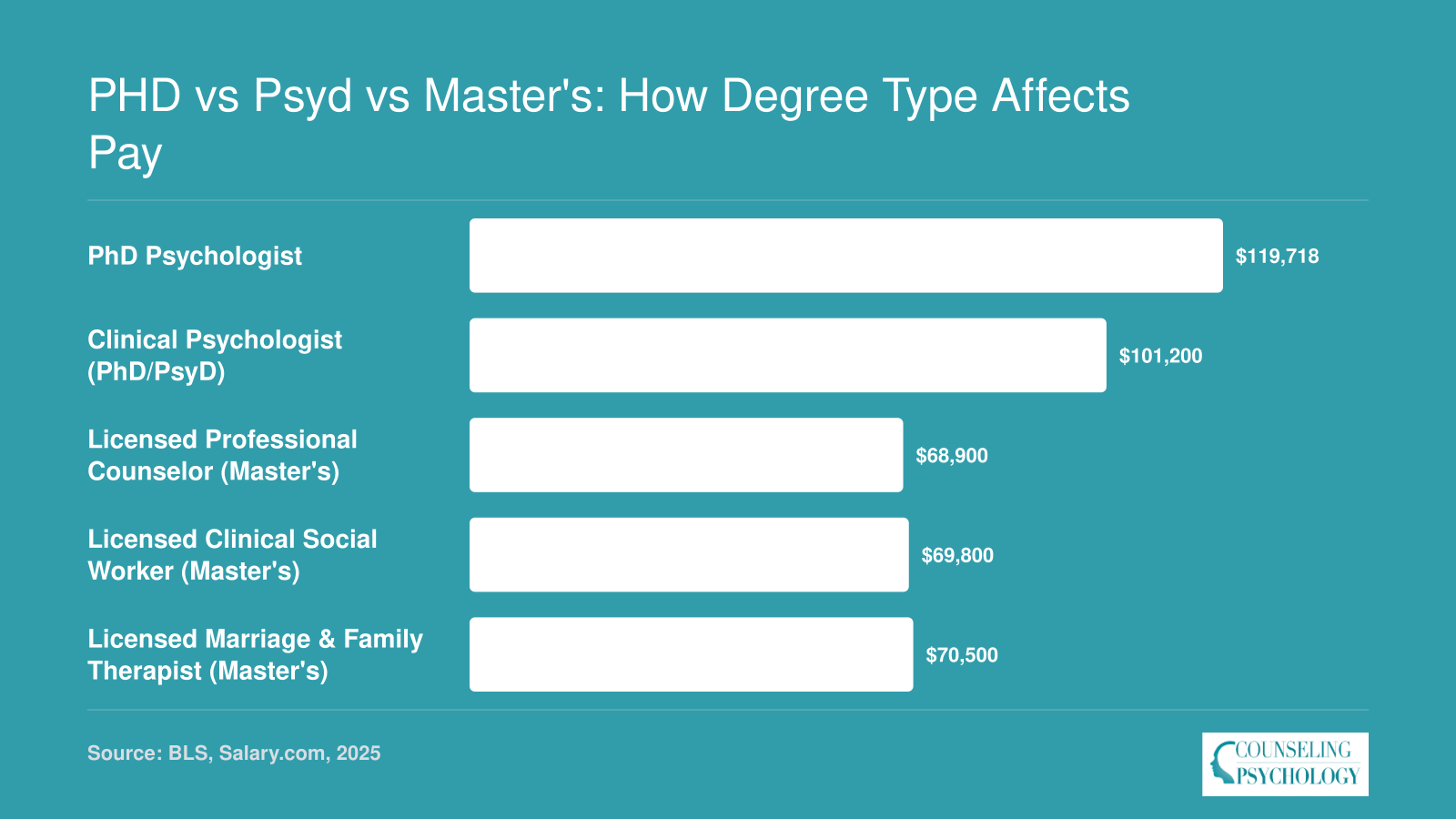
Do you need a PhD to be a psychologist? In most states, yes. Licensure as a psychologist typically requires a doctoral degree, either a PhD or a PsyD. Practitioners who hold a master's degree usually work under different titles, such as licensed professional counselor (LPC), licensed clinical social worker (LCSW), or licensed marriage and family therapist (LMFT), and their pay scales reflect that distinction. The gap between doctoral and master's-level earnings generally falls in the range of $25,000 to $35,000 per year.
Questions to Ask Yourself
Private Practice Income: What Psychologists Really Take Home
The salary figures reported by the Bureau of Labor Statistics offer a useful starting point, but they can be misleading if you are planning to hang your own shingle. A median annual wage tells you what a psychologist earns across all settings. It does not tell you what ends up in your bank account after you cover the costs of running a practice. Understanding private practice economics is essential before you commit to that path.
Gross Revenue vs. Net Income
The gap between what a private practice bills and what the practitioner actually keeps is significant. Industry surveys, including those conducted by the APA Practice Organization, consistently show that overhead expenses consume roughly 30 to 50 percent of gross revenue. Those costs include:
- Office rent or lease: Ranges widely by metro area, from around $800 per month in smaller markets to $3,000 or more in high-cost cities.
- Malpractice insurance: Typically $500 to $3,000 per year depending on the state, specialty, and coverage limits.
- Billing and administrative support: Whether you hire a biller or use practice management software, expect to allocate 5 to 10 percent of collections.
- Health insurance and retirement contributions: Unlike salaried positions, self-employed psychologists fund their own benefits, which can add $10,000 to $25,000 or more annually.
- Continuing education and licensure fees: Ongoing costs that are modest individually but add up over time.
A psychologist grossing $150,000 per year with 40 percent overhead is left with roughly $90,000 before federal and state income taxes plus self-employment tax. After taxes, that figure can drop further, sometimes into the $60,000 to $75,000 range depending on the tax jurisdiction and filing status.
Insurance Reimbursement vs. Private Pay
How you structure your fee model has an outsized effect on take-home pay. Reports from organizations that track therapist compensation, such as SimplePractice's survey data, show that insurance reimbursement rates for a standard 45- to 60-minute therapy session often fall between $80 and $150, while private pay rates in the same markets may range from $150 to $300 or higher for specialized services. Psychologists who accept a mix of insurance and self-pay clients often land somewhere in the middle, and those who move to a fully private-pay model can increase per-session revenue, though they may see fewer clients if their market is price-sensitive.
Using Program-Level Outcome Data
If you are still evaluating doctoral programs, look for career outcome reports published by the institutions you are considering. Some programs, particularly those with large clinical or counseling cohorts, report alumni earnings broken down by practice setting. These figures give you a more realistic picture than national aggregates, especially when you factor in the local cost of living and the overhead percentages discussed above. When a program reports that its graduates in private practice earn a certain median income, ask whether that number reflects gross billings or net take-home pay, because the distinction matters enormously. If you are also exploring non-clinical career paths, it is worth reviewing what you can do with a Master's in counseling psychology that isn't private practice.
A Realistic Expectation
Private practice can be financially rewarding, but it typically takes three to five years to build a full caseload and reach a stable income. Early-career practitioners often supplement with part-time agency or group practice work while growing their client base. For context on how compensation compares across related fields, you can review counselor salary by state data to benchmark against salaried counseling roles. The psychologists who thrive financially in private practice tend to be deliberate about niche specialization, geographic positioning, and business skills that most doctoral programs do not teach. If you are weighing this path, the most reliable step you can take is to build a detailed financial projection using current overhead benchmarks and realistic session counts, then compare that net figure against salaried positions in your area. That comparison will tell you far more than any national average ever could.
Student Loan Debt and Its Impact on Real Earnings
A six-figure salary looks impressive on paper, but the reality for many early-career psychologists is that a significant chunk of each paycheck goes straight to student loan servicers. Understanding the debt landscape before you commit to a doctoral program is one of the smartest financial moves you can make.
How Much Debt Do Psychology Graduates Actually Carry?
According to data from the American Psychological Association, the average student loan debt for psychology doctoral graduates sits around $103,000, with roughly 43 percent of graduates owing more than $100,000 and about 11 percent owing more than $250,000.1 Only about 27 percent of psychology doctoral graduates finish without any debt at all.1
The type of doctorate matters enormously here. PhD programs in clinical, counseling, and school psychology tend to produce substantially lower debt loads than PsyD programs, largely because PhD students are more likely to receive tuition waivers and stipends through funded positions.2 PsyD graduates, by contrast, commonly carry two to four times more debt than their PhD counterparts.3 Total costs for a PsyD program, including tuition, fees, and living expenses, can range from roughly $209,000 to $313,000.1 Some PsyD graduates from private institutions report debt levels approaching or exceeding $200,000.
What That Debt Means Month to Month
On a standard 10-year repayment plan, a graduate carrying $100,000 to $150,000 in federal loans can expect monthly payments in the range of $800 to $1,500. For an early-career psychologist earning $60,000 to $75,000 before taxes, that payment can consume 15 to 25 percent of gross income, leaving considerably less for housing, savings, and other essentials than the salary figure alone might suggest.
Repayment Strategies Worth Knowing
Two federal programs deserve attention from psychology graduates planning their finances:
- Income-Driven Repayment (IDR): These plans cap monthly payments at a percentage of discretionary income, which can provide meaningful relief during lower-earning postdoctoral and early-career years.
- Public Service Loan Forgiveness (PSLF): Psychologists employed by government agencies, VA hospitals, community mental health centers, or qualifying nonprofits may have their remaining federal loan balance forgiven after 120 qualifying monthly payments (roughly 10 years of eligible employment).
PSLF is particularly relevant for psychologists because a large share of clinical positions exist in settings that qualify, including state agencies, university counseling centers, and federally qualified health centers.
Framing the ROI Honestly
Psychology is a deeply rewarding profession, and long-term earning potential does improve with experience, specialization, and licensure. But the return on investment looks very different for a funded PhD graduate finishing with $50,000 in debt compared to a PsyD graduate starting their career under $200,000 or more.2 Neither path is inherently wrong, but each demands a different financial plan. For a complete guide to PsyD student loans and repayment modeling, it is worth running numbers specific to your situation before enrolling.
If you are weighing doctoral programs, factor in not just the sticker price but the funding package, the typical time to degree, and your likely employment setting after graduation. Realistic financial planning during the training years sets the foundation for a career you can sustain and enjoy for decades.
According to American Psychological Association data, PsyD graduates historically carry roughly twice the student loan debt of PhD graduates in psychology. While funding packages like assistantships and tuition waivers are common in PhD programs, PsyD programs typically offer far less financial support, a gap that can translate into six-figure differences in total borrowing.
Telehealth and Remote Psychologist Pay
The shift toward virtual mental health care has reshaped how many psychologists earn a living. Whether you deliver therapy through a large platform or run your own telehealth-enabled private practice, pay can vary significantly depending on the model, the state you are licensed in, and how payers reimburse remote sessions. If you are considering this path, our guide on becoming a telehealth therapist covers the education and credentialing steps in detail.
Reimbursement Parity and Insurance Rates
One of the most important factors in telehealth pay is whether your state enforces reimbursement parity, meaning insurers must pay the same rate for a virtual session as they would for an in-person visit. The APA's Practice Organization publishes periodic surveys on teletherapy reimbursement and tracks parity laws state by state. As of early 2026, most states have some form of telehealth parity statute on the books, though enforcement and scope differ. In parity states, psychologists who bill insurance for video sessions can expect roughly the same per-session revenue they would earn in the office.
Platform-Based Pay
Large teletherapy platforms such as BetterHelp and Talkspace use different compensation structures than traditional fee-for-service billing. Reported pay on these platforms generally falls in the range of roughly $30 to $50 per clinical hour, well below the median hourly rate that the Bureau of Labor Statistics reports for psychologists in traditional settings. These platforms can offer schedule flexibility and a steady flow of clients, but the trade-off in per-session income is significant. Before committing, cross-reference platform pay with aggregate salary data on sites like Indeed or Glassdoor by filtering for titles such as "online therapist" to get a realistic picture.
Independent Telehealth Practice
Psychologists who build their own telehealth practices and credential directly with insurers or charge private-pay rates tend to earn considerably more per session than platform-based clinicians. Private-pay telehealth sessions commonly range from $150 to $250 or more, depending on specialty and geography. The overhead savings from eliminating a physical office can translate into higher net income, though you still bear costs for HIPAA-compliant software, billing services, and marketing. Knowing how to evaluate online counseling or psychology programs can also help you choose a degree that prepares you for this delivery model.
How to Research Telehealth Pay
If you are evaluating telehealth as a career path or supplemental income stream, a few steps will give you a clearer view:
- BLS wage data: Search the Bureau of Labor Statistics site for psychologist occupation codes and look for industry breakdowns that may capture remote-heavy employers.
- Program websites: Many clinical psychology and school counseling programs list internship and early-career pay ranges that now include telehealth positions.
- APA surveys: The APA Practice Organization releases data on teletherapy trends, reimbursement rates, and billing best practices.
- State licensing boards: Confirm which states allow you to see clients across state lines and whether interstate practice compacts apply to your license type, as multi-state licensure can expand your client base and earning potential.
Telehealth is no longer a niche option. It is a mainstream delivery model with its own pay dynamics. Understanding where the dollars come from, and how much of each dollar you actually keep, is essential before building a practice around virtual care.
Psychologist Job Outlook and Growth Projections
If you are weighing the time and financial investment of becoming a psychologist, the employment outlook is a critical piece of the puzzle. The good news: demand for psychologists is growing at a pace that outstrips most other professions, and several indicators suggest the field remains undersupplied rather than saturated.
Projected Growth and Annual Openings
According to the Bureau of Labor Statistics, employment for psychologists is projected to grow 6 percent from 2024 to 2034.1 That rate is nearly double the 3.1 percent average projected across all occupations, placing psychology solidly in the "faster than average" category.1 Beyond net new positions, the BLS estimates roughly 5,500 annual openings each year over the projection period.1 These openings reflect a combination of new roles created by growing demand and vacancies left by professionals who retire, shift careers, or move into adjacent fields like administration or academia.
For prospective students, that consistent pipeline of openings means the labor market should remain receptive to new graduates throughout the next decade.
Where Demand Is Strongest
Not every specialty is expanding at the same pace. Two areas stand out:
- Clinical and counseling psychology: Sustained public focus on mental health, expanded insurance parity requirements, and the lingering effects of the post-pandemic mental health crisis continue to fuel demand for licensed clinicians. Community mental health centers, hospitals, and integrated primary care practices are all competing for qualified providers.
- Industrial-organizational psychology: Corporate investment in employee well-being, talent analytics, and organizational development has made I-O psychologists increasingly valuable. Employers in consulting, tech, and large human resources departments are driving much of this growth.
School psychology and neuropsychology also show healthy demand, though the volume of openings is smaller.
Is the Market Saturated?
This is one of the most common questions prospective students ask, and the short answer is no, at least not broadly. Workforce analyses consistently identify shortages of licensed psychologists, particularly in rural areas and underserved communities. The Health Resources and Services Administration has designated hundreds of counties as mental health professional shortage areas, and many states report wait times of weeks or months for new patient appointments. For a deeper look at the scope of this problem, see our coverage of the mental health workforce shortage.
That said, geographic flexibility matters. Metropolitan areas with large training programs can feel more competitive, while smaller cities and rural regions often struggle to recruit. Students who are open to relocating, working in community health settings, or building telehealth practices will find the most favorable market conditions. If you are curious how psychologist earnings compare with related roles, our counselor salary breakdown offers useful context.
The bottom line: a 6 percent growth rate, thousands of annual openings, and documented provider shortages add up to a labor market that rewards those who complete training and earn licensure. The investment is real, but the demand side of the equation remains strong heading into the next decade.
Frequently Asked Questions About Psychologist Salaries
Below are some of the most common questions prospective and current psychology students ask about compensation in the field. Where possible, each answer includes a concrete figure to help you benchmark expectations against real earnings data.