
What you’ll learn in this article…
- Indiana's clinical and counseling psychologists earned a median annual wage of $96,100 as of 2023 BLS data.
- Only Grace College and Indiana Wesleyan University hold current CACREP accreditation for counseling programs in the state.
- Online master's students can access FAFSA aid, state workforce grants, and select graduate assistantships to offset tuition.
- Choosing a non-accredited program can disqualify graduates from Indiana licensure entirely, making accreditation a top priority.
Indiana hosts more than a dozen regionally accredited institutions offering psychology degrees online, with master's-level tuition ranging from roughly $499 per credit at Indiana Wesleyan to over $600 per credit at private universities. Ten programs are ranked here, spanning general psychology, applied behavior analysis, addictions counseling, and industrial-organizational psychology.
The practical tension for most applicants is balancing cost against credential fit: a CACREP-accredited counseling master's leads to LMHC licensure, while an APA-accredited doctoral program is required for HSPP status. Picking the wrong track can add two or three years to your timeline. Students weighing a counseling doctoral program should map that decision early.
Indiana's behavioral health workforce shortage continues to push demand for licensed clinicians, particularly in rural counties where vacancy rates remain stubbornly high.
2026 Best Psychology Programs in Indiana, Ranked by Affordability and Outcomes
This ranking spotlights Indiana psychology programs that deliver strong value, weighting net price after financial aid, median graduate debt, institution-wide graduation rates, and post-graduation earnings. Every school listed offers at least one fully online psychology or behavioral-science program, making the list especially useful for working adults and distance learners across the state. Because program-level earnings data is not yet available for most of these offerings, institutional medians serve as proxy outcome indicators.
- Net price after financial aid
- Median graduate debt levels
- Institution-wide graduation rates
- Post-graduation earnings outcomes
- Online program availability
- Independent program research
- Internal program database
- College Scorecard graduate earnings — collegescorecard.ed.gov
- NCES-IPEDS federal institutional data — nces.ed.gov

Indiana University-Indianapolis
IU Indianapolis pairs a relatively low net price with a broad online psychology curriculum anchored in the IU system's research infrastructure. The fully online BS in Psychology covers behavioral neuroscience, abnormal psychology, and sensation and perception, all delivered in flexible 8- or 16-week course blocks. With a 13:1 student-to-faculty ratio and multiple start dates throughout the year, it suits Indiana residents who need an accessible entry into the discipline without relocating.
- 100% online with flexible 8- or 16-week sessions
- In-state tuition at roughly $257 per credit hour
- 120 total credits, with transfer credits accepted
- Six start dates spread across the calendar year
- Covers behavioral neuroscience, abnormal psych, and more
- Capstone course and diversity requirement included
- Personalized advising, tutoring, and peer mentorship
Bachelor of Science in Psychology — Online

Ball State University
Ball State stands out for its applied focus, anchoring its online psychology catalog around Applied Behavior Analysis with an Autism Spectrum Disorder concentration. The 36-credit ABA bachelor's track prepares graduates for the BCaBA exam, while a 15-credit online graduate certificate in autism lets working educators add a targeted credential quickly. Roughly 80% of Ball State students receive some form of financial aid, helping bring the net cost well below sticker price.
- Fully online, with part-time and full-time pacing
- 36 major credits required for the ABA focus
- Autism Spectrum Disorder concentration built in
- Prepares students for BCaBA certification exam
- Accredited by the Higher Learning Commission
- Off-campus centers in Indianapolis, Fishers, Fort Wayne
- 100% online, 15-credit graduate certificate
- No GRE required for admission
- Available in 8-week or 16-week course formats
- Federal in-state tuition rate for all students
- Integrates with existing master's programs
- Designed for educators and allied professionals
Bachelor's in Applied Behavior Analysis (ASD Concentration) — Online
Graduate Certificate in Autism Spectrum Disorder — Online

Indiana Wesleyan University-National & Global
Indiana Wesleyan University's National and Global division targets working adults who want a faith-integrated graduate psychology education entirely online. The MA in Psychology with an Industrial/Organizational concentration runs 30 credits at $499 per credit and can be finished in about 15 months, while the 48-credit MA in Addictions Counseling holds NAADAC and NASAC accreditation. Both programs lock tuition at enrollment, giving students cost predictability throughout their studies.
- Fully online, completable in 15+ months
- 30 total credit hours at $499 per credit
- No specific undergraduate prerequisite courses
- Minimum 2.5 undergraduate GPA required
- Capstone project serves as culminating experience
- Integrates biblical principles with workplace psychology
- 48-credit online program at $602 per credit
- NAADAC and NASAC accredited curriculum
- Hands-on field experience components included
- Multicultural competence woven throughout coursework
- 3.0 GPA and prerequisite psychology hours required
- Christian worldview integration across all courses
MA in Psychology, Industrial/Organizational Concentration — Online
Master of Arts in Addictions Counseling — Online

Indiana Wesleyan University
The residential arm of Indiana Wesleyan University carries an 83% first-year retention rate and a 66.7% institution-wide graduation rate, among the highest on this list. Its online Master's in Addictions Counseling (48 credits, NAADAC/NASAC accredited) prepares graduates for licensed counselor roles in treatment centers and social services. A separate 30-credit MA in Psychology with a Life Coaching and Positive Psychology track appeals to students drawn to strengths-based practice rather than clinical work.
- 48-credit online program, roughly 24-month timeline
- $602 per credit with tuition locked at enrollment
- NAADAC and NASAC accredited for certification prep
- Practicum and internship embedded in curriculum
- Six prerequisite psychology hours required
- Minimum 3.0 undergraduate GPA for admission
- 30-credit online master's, 15+ months to complete
- $499 per credit hour, tuition rate locked
- Life coaching specialization sets it apart
- No specific prerequisite courses needed
- 2.5 undergraduate GPA minimum required
- Comprehensive student support services provided
Master's in Addictions Counseling — Online
MA in Psychology, Life Coaching and Positive Psychology — Online

Trine University
Trine University regularly appears in statewide affordability rankings for online psychology, largely because its $299-per-credit rate undercuts many competitors. The online BS in Psychology spans 120 credits and lets students explore forensic psychology, abnormal psychology, and addictions counseling electives, with free textbooks bundled into tuition. A 64.4% institution-wide graduation rate and an 80% retention rate signal solid student support for a small private university.
- Fully online at $299 per credit hour
- 120 total credit hours to complete
- 200+ courses across multiple specializations
- Free textbook program included with tuition
- Optional addictions counseling coursework available
- Asynchronous format for maximum scheduling flexibility
- Career-preparation focus with research skill building
Bachelor of Science in Psychology — On-Campus

Purdue University Global
Purdue University Global offers one of the widest online psychology catalogs in Indiana, spanning bachelor's degrees in general psychology, addictions, I/O psychology, and ABA, plus master's programs in forensic psychology, educational psychology, and applied behavior analysis. Flat online tuition and no state-residency requirement make it accessible to learners throughout Indiana and beyond. The addictions track holds NAADAC Approved Education Provider status, and the ABA master's prepares students for BCBA certification.
- 180 quarter credits, fully online delivery
- Emphasis on research methods and ethical standards
- Covers major theories and cultural diversity
- Prepares students for graduate-level study
- 100% online with optional practicum track
- 34 total courses, NAADAC approved provider
- Peer Recovery Specialist credential pathway
- $371 per credit, roughly four-year completion
- 33 courses online, BCaBA certification pathway
- Business Foundations concentration available
- Average 3.5-year completion timeline
- $371 per credit with optional internship
- 180 quarter credits, fully online format
- Focus on workplace motivation and leadership
- Advanced research methods training included
- Capstone project required for completion
- 60 to 75 quarter credits depending on track
- Thesis or capstone pathway options
- Forensic, I/O, addictions, or general focus
- Does not lead to clinical licensure
- 45 quarter credits, prepares for BCBA exam
- Ethical practice and behavioral assessment emphasis
- Fully online with flexible curriculum
- Meets educational requirements in most states
- 47 quarter credits, fully online
- Focuses on educational improvement strategies
- Research design and educational technology covered
- Non-clinical, non-licensure program
Bachelor of Science in Psychology — Online
BS in Psychology, Addictions Concentration — On-Campus
BS in Psychology, Applied Behavior Analysis — Online
BS in Psychology, Industrial/Organizational — On-Campus
MS in Psychology (General, Forensic, I/O, Addictions) — On-Campus
MS in Applied Behavior Analysis — Online
MS in Educational Psychology — On-Campus

Purdue University
Purdue University's flagship campus offers one of the most outcome-oriented profiles on this list, with median alumni earnings of $72,424 ten years after enrollment and an 83.1% institution-wide graduation rate. Its online MS in Educational Studies with an ABA concentration is ABAI-approved and runs on a cohort model with synchronous sessions, preparing graduates to sit for the BCBA exam. Total program costs range from roughly $14,820 to $21,150 depending on residency, making it a premium but high-return investment.
- 33-credit online program, ABAI approved sequence
- Prepares graduates for the BCBA certification exam
- Cohort model with synchronous online sessions
- In-state and out-of-state tuition tiers available
- Blends synchronous and asynchronous learning
- Total cost roughly $14,820 to $21,150
- 21-credit online certificate, ABAI approved
- Requires an existing master's degree for admission
- Cohort-based with synchronous online classes
- In-state tuition around $494 per credit hour
- Fall semester admission only
- Minimum 3.0 GPA required for entry
MS in Educational Studies: Applied Behavior Analysis — Online
Graduate Certificate in Applied Behavior Analysis — Online

American College of Education
American College of Education, headquartered in Indianapolis, is a fully online institution built for working K-12 professionals. Its Education Specialist in Special Education with an Autism Spectrum Disorder concentration costs approximately $12,660 total for 34 semester credits and can be completed in about 18 months. The curriculum emphasizes assistive technology, differentiated instruction, and family-professional partnerships, making it a focused choice for educators who want autism expertise without pursuing a full doctoral degree.
- Fully online, 34 semester credits required
- Total program cost approximately $12,660
- Designed for educators with an existing master's
- Covers assistive technology and differentiated instruction
- Family-professional partnership strategies included
- Completion timeline around 18 months
- 9:1 student-to-faculty ratio institution-wide
Ed.S. in Special Education, Autism Spectrum Disorder — Online

Indiana Institute of Technology-College of Professional Studies
Indiana Tech's College of Professional Studies in Fort Wayne targets working adults pursuing addictions counseling careers in Indiana. The BS in Addictions Counseling is available online or on campus and meets Indiana's requirements for licensed addictions counselor positions, giving graduates a direct pathway into a high-demand field. Internship placements at treatment centers and mental health organizations provide practical experience before graduation.
- Available online and on campus
- 120 to 121 total credit hours
- Meets Indiana licensure requirements for addictions
- Internship opportunities at treatment centers
- Focus on substance use, ethics, and client rights
- Experienced instructors from the counseling field
- Prepares for substance abuse counselor and case manager roles
BS in Addictions Counseling — Online

Indiana Institute of Technology
Indiana Institute of Technology's main campus offers the same Addictions Counseling bachelor's degree with both online and on-campus delivery, giving students in the Fort Wayne area more flexibility in how they engage with coursework. The program aligns with State of Indiana undergraduate requirements for licensed addictions counselors, and graduates typically pursue roles at treatment centers, mental health organizations, and social service agencies. A 47.8% institution-wide graduation rate and higher median debt merit careful consideration, but students who use available financial aid can offset sticker price considerably.
- 120 to 121 total credit hours required
- Online and traditional campus options available
- Leads to licensed addictions counselor eligibility
- Multiple career paths in counseling and social services
- Experienced field instructors lead coursework
- Aligned with State of Indiana undergraduate standards
BS in Addictions Counseling — Online
Most Affordable Online Master's in Psychology in Indiana
Online delivery can meaningfully lower the total cost of a master's in psychology. Without room and board charges, and with the flexibility to maintain employment while studying, students often spend thousands less than their on-campus peers over the life of the degree. The table below re-sorts Indiana schools by in-state tuition so you can quickly compare sticker prices alongside the institution-wide average net price. Keep in mind that the net price figure reflects an institutional average across all aid recipients and degree levels; your actual out-of-pocket cost will depend on your financial aid package, enrollment intensity, and residency status. Among the standout values, Indiana Wesleyan University's National and Global campus advertises a per-credit rate of $499 for its MA in Psychology, and Purdue University's online MS in Applied Behavior Analysis sits at an in-state tuition of $9,992, making it one of the lowest sticker prices for a master's-level program in the state.
| School | In-State Tuition | Out-of-State Tuition | Avg. Net Price (Institution-Wide) | Median Graduate Debt | Median Earnings (10 yr) |
|---|---|---|---|---|---|
| Purdue University | $9,992 | $28,794 | $14,600 | $19,500 | $72,424 |
| Purdue University Global | $10,101 | $14,412 | $7,770 | $26,078 | $36,596 |
| Indiana Wesleyan University (National and Global) | $10,926 | $10,926 | $16,898 | $24,250 | $59,986 |
| Indiana Wesleyan University | $10,620 | $10,620 | $22,866 | $24,250 | $59,986 |
| Indiana University-Indianapolis | $10,762 | $34,891 | $11,668 | $20,000 | $55,198 |
| Ball State University | $11,082 | $29,630 | $14,940 | $23,250 | $51,833 |
| Indiana Institute of Technology (College of Professional Studies) | $9,896 | $9,896 | $20,473 | $26,391 | $47,327 |
| Indiana Institute of Technology | $31,361 | $31,361 | $23,206 | $26,391 | $47,327 |
| Trine University | $36,560 | $36,560 | $25,355 | $25,000 | $57,165 |
Questions to Ask Yourself
How to Choose the Right Psychology Program in Indiana
Two CACREP-accredited institutions currently serve Indiana master's students in counseling-track programs: Grace College (accredited through 2029) and Indiana Wesleyan University (accredited through 2030). At the master's level, Ball State University, Indiana University Bloomington, and the University of Indianapolis hold MPCAC accreditation for their counseling psychology programs, with accreditation terms extending through 2028 to 2033.2 No Indiana public university currently offers CACREP- or APA-accredited online or hybrid master's programs, limiting fully remote options for students who require specialized accreditation.
Understand the Three Accreditation Tiers That Govern Licensure Eligibility
Regional accreditation forms the baseline requirement for any psychology program. All Indiana universities listed in state rankings hold regional accreditation through the Higher Learning Commission, ensuring that credits transfer and degrees are recognized by employers and licensing boards.
CACREP accreditation matters specifically for counseling-track master's students pursuing licensed mental health counselor (LMHC) or licensed professional counselor (LPC) credentials. While Indiana's Health Service Provider in Psychology (HSPP) credential does not mandate CACREP, many states do, and licensure portability suffers if your degree lacks this seal. Grace College and Indiana Wesleyan University maintain active CACREP accreditation; students planning to practice in states with stricter requirements should prioritize these programs. For a broader look at CACREP-accredited options, explore CACREP accredited online school counseling programs at the master's level.
APA accreditation applies to doctoral-level clinical and counseling psychology programs. Master's-level students rarely encounter APA accreditation, but if you plan to advance to a PhD or PsyD, verify that your prospective doctoral program holds APA approval. Students considering that path may want to review online doctoral programs in psychology early in their planning. Indiana does not currently list APA-accredited online or hybrid master's programs in the state's public or private sectors.
Weigh Delivery Format Trade-Offs Before Enrolling
Fully online programs offer maximum scheduling flexibility and appeal to working professionals. Indiana Wesleyan University's online MA in Psychology (Industrial/Organizational concentration) and similar offerings at Indiana Institute of Technology deliver asynchronous coursework. However, all clinical and counseling master's programs require supervised practicum and internship placements, typically 600 to 1,000 hours, arranged in your local community. Online students must secure these placements independently or through program partnerships, adding logistical complexity that hybrid and on-campus formats often streamline through established training site networks.
Hybrid models split the difference: core coursework online, intensive residencies or weekly labs on campus. Ball State University and Indiana University Bloomington structure some master's cohorts this way, reducing commute burden while preserving hands-on training. If you live within two hours of campus, hybrid delivery often proves easier for fieldwork coordination.
Review Admission Requirements Across Indiana Programs
Master's programs in psychology and counseling typically expect a minimum undergraduate GPA between 2.75 and 3.0, though competitive applicants present GPAs in the 3.2 to 3.6 range. The GRE remains optional at many Indiana institutions as of 2024, but some programs still recommend or require it for merit scholarship consideration.
Prerequisite coursework varies by specialization. Counseling master's programs often require six to twelve undergraduate credit hours in psychology, statistics, or human development. Applied Behavior Analysis master's tracks may specify abnormal psychology and research methods. Indiana Wesleyan University, for example, requires a bachelor's degree and six prerequisite psychology hours for its addictions counseling MA.
Statements of purpose should articulate career goals, relevant experience (volunteer, internship, research), and fit with program philosophy. Indiana's faith-based institutions (Grace College, Indiana Wesleyan) emphasize Christian worldview integration in their essays, while public universities focus on professional readiness and diversity competence.
Cross-Check Program Credit Hours and Supervised Experience Against Indiana Licensure Requirements
Indiana's LMHC licensure requires 60 semester hours of graduate coursework and 3,000 hours of supervised clinical experience. School psychologist licensure in Indiana demands an Education Specialist degree (EdS) or equivalent, typically 60 to 70 credits, plus a supervised internship. The HSPP credential requires a doctoral degree and additional supervised hours.
Before enrolling, confirm that your target program's total credit hours, practicum structure, and supervision model align with the Indiana Behavioral Health and Human Services Licensing Board standards for your intended credential. Programs falling short by even six credits can delay licensure eligibility by months or years. Download the licensing board's education matrix and compare it line by line with the program's published requirements, asking admissions staff to clarify any gaps in writing.
Psychology Specializations Available at Indiana Schools
Indiana graduate programs offer specializations spanning clinical mental health counseling, school psychology, applied behavior analysis, substance abuse counseling, and more. Finding the right concentration requires checking multiple authoritative sources because not all specializations are uniformly accredited or widely advertised.
Check University Websites for Master's Program Listings
Start with the graduate catalogs and department pages of Indiana's major universities. Indiana University Bloomington, Purdue University, Ball State University, and Indiana State University each publish detailed descriptions of their degree tracks, elective concentrations, and practicum placements. For example, IU Bloomington's Department of Counseling and Educational Psychology lists specializations in school counseling and mental health counseling. Purdue's Department of Educational Studies offers school psychology tracks, while Ball State's Department of Counseling Psychology, Social Psychology, and Counseling has historically offered mental health counseling and school counseling options. If you are specifically exploring clinical mental health counseling masters programs indiana, compare curriculum requirements side by side. University websites also clarify whether a concentration requires additional credits, a separate application, or specific prerequisites like undergraduate coursework in behavioral science.
Use the APA Accredited Programs Database
The American Psychological Association maintains a searchable directory of accredited programs at the doctoral and internship levels. While most APA-accredited programs are PhD or PsyD tracks, the database allows filtering by state and specialty area. This step is critical if you intend to pursue licensure as a health service psychologist (HSPP). Note that master's-only programs in counseling or school psychology typically seek CACREP or NASP approval rather than APA accreditation, so cross-reference those databases as well.
Confirm ABA Master's Programs Through BACB
If you are pursuing applied behavior analysis, visit the Behavior Analyst Certification Board website and use its Verified Course Sequence search. Enter Indiana to see which schools offer BACB-approved coursework at the master's level. For a broader look at the discipline, our guide to online applied behavior analysis programs covers what to expect from ABA curricula nationwide. As of 2026, Ball State University and Purdue University Fort Wayne have published approved sequences. Completing a verified course sequence is a prerequisite for sitting for the Board Certified Behavior Analyst exam.
Contact State Licensing Boards for Substance Abuse and School Psychology Lists
For substance abuse counseling or addictions-focused tracks, reach out to the Indiana Counseling Association or the Indiana Addiction Issues Coalition for program recommendations. The Indiana Department of Education publishes a list of approved school psychology programs that satisfy state practitioner licensure requirements. State boards can also clarify whether a particular master's program meets criteria for provisional or full licensure, especially if you plan to work in public schools or community behavioral health centers.
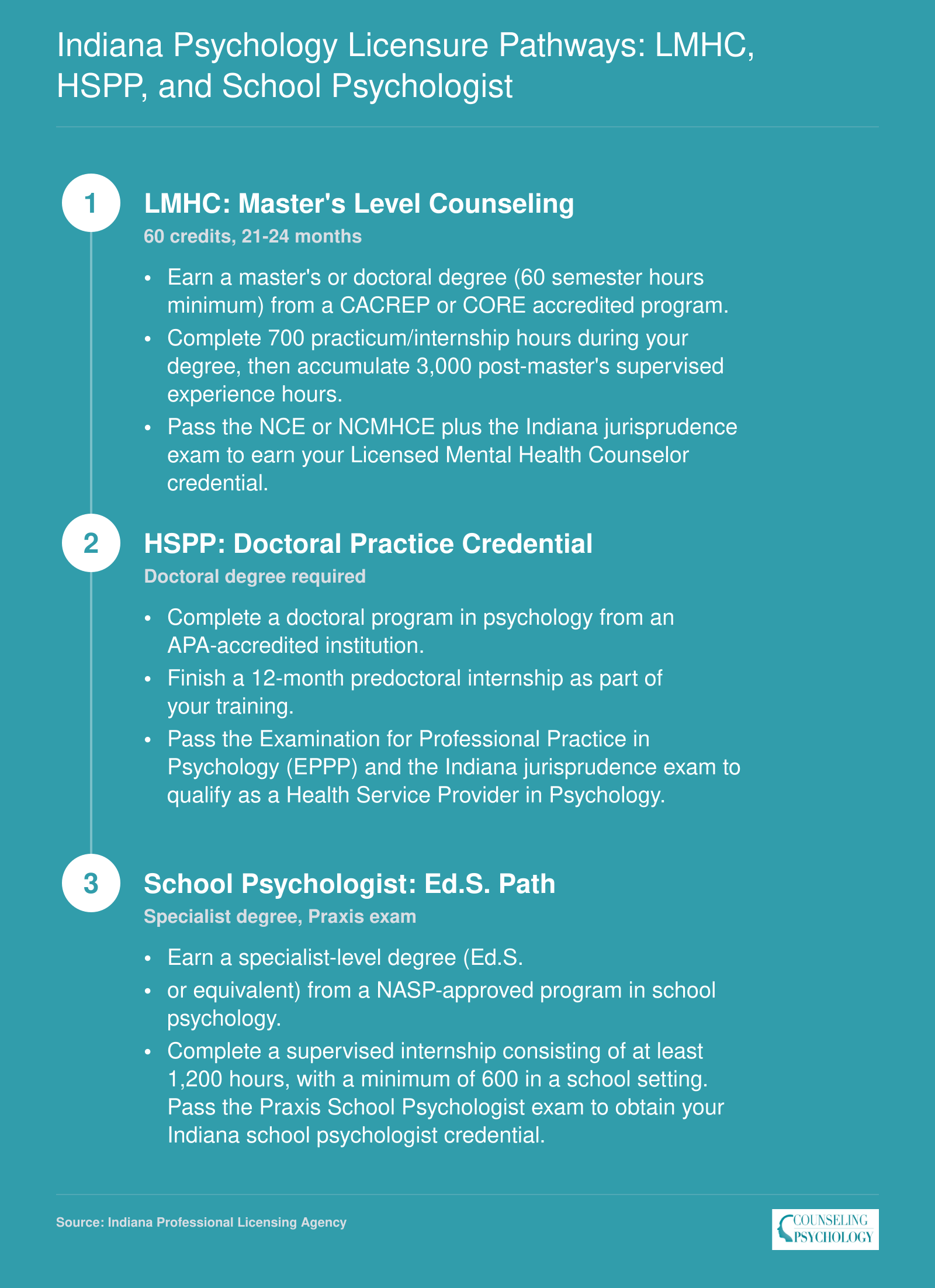
Indiana Psychology Licensure Pathways: LMHC, HSPP, and School Psychologist
Your ideal psychology program should be reverse-engineered from the credential you ultimately want. Indiana offers three primary licensure tracks, each with distinct degree levels, accreditation standards, supervised hours, and exams. Choosing the wrong program type can add years to your timeline or disqualify you from the license you need, so map your endpoint before you enroll. Below is the credentialing ladder for each pathway.
Related Articles
Career Outcomes and Salary Expectations for Indiana Psychology Graduates
Indiana's clinical and counseling psychologists earned a median annual wage of $96,100 as of 2023, with the top 10% surpassing $168,000.1 Those figures, reported by the Bureau of Labor Statistics for SOC 19-3033, offer a starting point, but salary expectations vary widely by role, setting, and location. Mental health counselors (SOC 21-1014) and industrial-organizational psychologists (SOC 19-3032) follow different pay scales, and metro areas like Indianapolis and Fort Wayne add local nuance.
Using Federal Data to Anchor Your Salary Search
The BLS Occupational Employment Statistics program is the most cited source for wage benchmarks. For Indiana-specific numbers, start at bls.gov and pull up the May 2023 estimates for each relevant SOC code. You will find not only the median but also the 10th and 90th percentile wages, which better illustrate the range. For clinical and counseling psychologists, the Indiana figures show that entry-level earners may start around $48,820, while top earners clear $168,870.1 Compare this with the national medians to see how Indiana stacks up. The BLS metro-area tables let you filter for Indianapolis-Carmel-Anderson, Fort Wayne, or other regions, highlighting pockets where demand drives wages higher.
Supplementing Government Figures with State-Level Insights
Federal data lags and aggregates broad job titles. To get a sharper picture, consult Indiana professional associations. The Indiana Psychological Association and the Indiana Counseling Association often conduct member salary surveys or share job board snapshots. These surveys capture nuances like setting (private practice, hospital, school, or correctional facility) that the BLS cannot. Association events and newsletters also provide networking opportunities where you can ask peers about realistic compensation trajectories.
Tapping Campus and Local Employer Networks
No dataset can replace real-time, on-the-ground intelligence. Reach out directly to university career centers or alumni networks at Indiana schools with strong psychology programs. Career services staff track where graduates land and what starting salaries look like by specialization. Alumni working in Indianapolis, Bloomington, or South Bend can share what local employers are offering for master's-level clinicians, doctoral-level psychologists, or school psychologists. Even a handful of informational interviews will reveal trends before they appear in published reports.
Why Combining Multiple Data Points Leads to Smarter Decisions
Wages depend on experience, employer type, and the specific license you hold. A school psychologist in a rural district will see a different number than an I-O psychologist consulting for a tech firm in Carmel. Professionals interested in niche roles should explore fields like applied psychology careers to understand how specialization shapes earning potential. Check O*NET (onetonline.org) for job outlook and skill profiles, and browse active job boards like Indeed or the Indiana state government employment page to see listed salary bands. When you cross-reference BLS percentiles, association surveys, and local employer postings, you build a composite view that no single source can provide. This layered approach gives you the confidence to negotiate offers or choose a specialization that aligns with your financial goals.
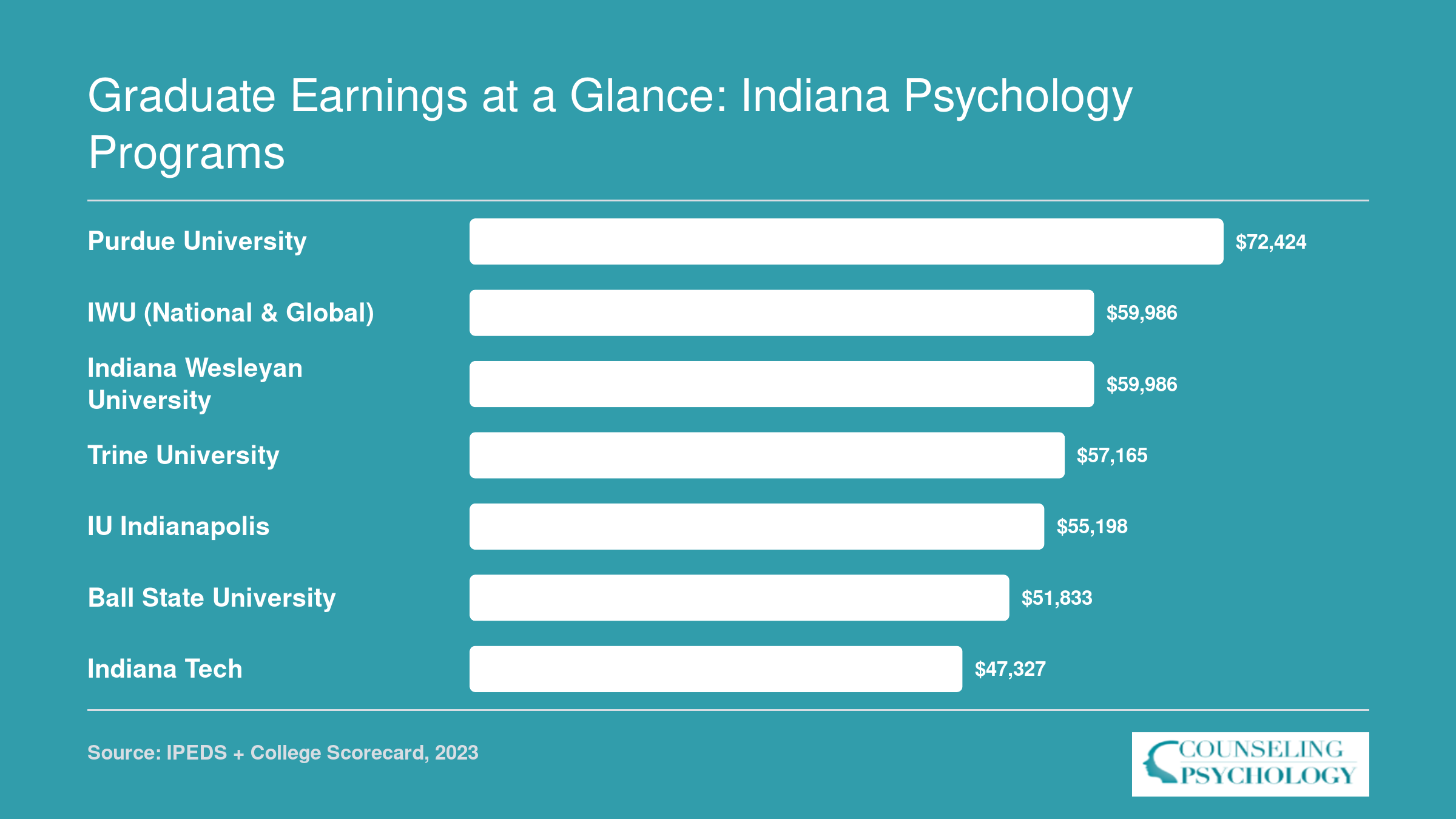
Graduate Earnings at a Glance: Indiana Psychology Programs
Program-level earnings data broken out by one-year and four-year post-completion windows are not yet available for these Indiana psychology programs. The chart below uses each institution's median earnings ten years after enrollment, drawn from College Scorecard, as a proxy for long-term graduate outcomes. These figures reflect all completers at each institution, not just those who pursued licensure in a psychology or counseling field.
Online Vs. On-Campus Psychology Programs in Indiana
Choosing between online and on-campus formats is one of the most consequential decisions you will make when selecting a psychology program. Neither option is universally better; the right fit depends on your schedule, learning style, clinical goals, and budget. It is also worth noting that many Indiana programs now use a hybrid model, combining primarily online coursework with periodic on-campus intensives for clinical skills training, which blends the strengths of both formats.
Pros
- Online programs offer scheduling flexibility that lets working professionals complete coursework around jobs and family obligations.
- Studying online can lower your total cost significantly by eliminating relocation, commuting, and on-campus housing expenses.
- Online enrollment opens access to programs statewide, so you are not limited to schools within commuting distance of your home.
- On-campus cohorts create a structured learning community with organic peer networking and direct, day-to-day faculty mentorship.
- University-affiliated clinics simplify practicum logistics for on-campus students, reducing the burden of finding and coordinating local placement sites.
- Hybrid models, increasingly common at Indiana institutions, let you build clinical skills in person while keeping the convenience of online coursework.
Cons
- Online students must still complete practicum and internship hours in person, which means coordinating local clinical sites on your own.
- The online format offers fewer spontaneous networking opportunities, making it harder to build the professional relationships that often lead to job referrals.
- Self-directed online learning does not suit every student; some learners thrive with the accountability of a set classroom schedule.
- On-campus programs typically carry higher total attendance costs once you factor in housing, transportation, and campus fees.
- Rigid on-campus schedules can be difficult to manage alongside full-time employment or caregiving responsibilities.
- Attending in person limits your program choices to schools you can realistically reach, which narrows options for students in rural parts of Indiana.
Financial Aid and Assistantships for Online Psychology Students in Indiana
Online graduate students in Indiana now have access to a broader funding landscape than even five years ago, as state agencies and federal workforce programs respond to the growing behavioral health shortage. For the 2024-2025 cycle, eligible online master's students can borrow up to $20,500 in federal Direct Unsubsidized Loans, but loans are only one piece of the puzzle. Strategic students stack institutional aid, state grants, workforce funding, and employer reimbursement.
Start With Your University's Aid Office
Indiana University, Purdue, and Ball State all post graduate funding details on their financial aid pages, but online students often have to dig deeper. Look specifically for graduate assistantships, tuition waivers, and online student funding categories. Many assistantships were historically reserved for on-campus students, but departments increasingly extend them to remote learners who can support faculty research virtually. Email the psychology or counseling department coordinator directly: posted listings are often incomplete. Students still exploring which credential to pursue may want to review the full range of degrees in psychology before committing to a funding strategy.
State Grants and Workforce Funding
The Indiana Commission for Higher Education administers several programs worth checking through the Indiana State Student Assistance Commission (SSACI).2 The Adult Student Grant offers up to $2,000 per year. Veterans and their families have stronger options: the Purple Heart Recipient program and the National Guard Tuition Supplement Grant both cover 100% of tuition at public institutions, as does the Children/Spouses of Disabled or Deceased Veterans Program (with $5,000 available at private schools).2 EARN Indiana matches 50% of wages for qualifying internships, which can offset practicum costs.
On the federal side, search HRSA.gov for Behavioral Health Workforce Education and Training (BHWET) grants, which fund counseling and psychology trainees committing to underserved areas.
Professional Associations and Employers
The Indiana Counseling Association and the American Psychological Association both list scholarships open to graduate students, including those enrolled online. Finally, check BLS.gov for high-demand Indiana employers, then ask hospitals, community mental health centers, and school districts whether they offer tuition reimbursement. Many do, but the benefit is rarely advertised externally.
Before you apply to any psychology or counseling program in Indiana, confirm that it holds the appropriate accreditation, either CACREP for counseling degrees or APA for psychology programs. Graduating from a non-accredited program can disqualify you from Indiana licensure entirely, making that investment of time and money far harder to recover from than a delayed application would have been.
Frequently Asked Questions About Indiana Psychology Programs
Prospective students often have overlapping questions about program quality, timelines, and licensure logistics. Below are the questions we hear most often, answered with current data from Indiana institutions and state licensing boards.