

What you’ll learn in this article…
- Both counselors and therapists need a master's degree, but their programs differ in credit hours, accreditors, and supervised practice requirements.
- Licensure titles such as LPC, LMHC, LMFT, and LCSW vary by state, not necessarily by differences in clinical training.
- BLS projects 18 to 22 percent job growth for mental health counselor and therapist occupations through 2032.
- Scope of practice, including the authority to diagnose, depends on license type and state law rather than the job title alone.
Most states now license mental health professionals under at least four distinct credential types, yet the public rarely distinguishes between any of them. "Therapist" and "counselor" are effectively synonyms in everyday conversation, and for someone booking a first appointment, the difference hardly matters.
Behind the scenes, the gap is real. Degree requirements range from 48 to 60 graduate semester hours depending on the discipline. Licensure titles vary state by state. Scope of practice, particularly around diagnosis and treatment planning, is governed by statute, not job title. Salary spreads between occupation categories can top $15,000 at the national median level. These structural distinctions shape career trajectories long before a clinician ever sees a client.
Are Therapists and Counselors the Same Thing?
In day-to-day conversation, "therapist" and "counselor" are used interchangeably, and most clients walk into a first session without knowing or caring which title their provider holds. Professionally, though, the words point to different things: "therapist" describes what a clinician does, while "counselor" usually points to a specific license.
Therapist Is an Umbrella Term
There is no single license called "therapist." The word describes a function, providing talk therapy, and it covers a wide range of credentialed professionals. A psychologist (PhD or PsyD), a licensed marriage and family therapist (LMFT), a licensed clinical social worker (LCSW), and a licensed professional counselor (LPC) can all accurately call themselves therapists. So can a psychiatrist who does psychotherapy in addition to medication management. The title signals what the person does in the room, not how they got there.
Counselor Usually Points to a Specific License Track
"Counselor," by contrast, more often refers to a defined credential, typically the LPC (Licensed Professional Counselor) or LMHC (Licensed Mental Health Counselor), depending on the state. These clinicians complete a master's degree in counseling, accrue roughly 2,000 to 4,000 supervised clinical hours, and pass a national exam. School counselors, rehabilitation counselors, and substance use counselors carry their own distinct credentials but follow the same general pattern: a counseling-specific degree leading to a counseling-specific license. If you find the alphabet soup of credentials confusing, a guide to counseling licensure acronyms can help you sort them out.
Where the Roles Overlap
In practice, the services look very similar. Both counselors and therapists provide talk therapy, treat anxiety, depression, grief, relationship issues, and trauma, and both require master's-level training in most cases. So are counseling and therapy similar? Yes, the work itself is largely the same. The real difference sits behind the scenes: which graduate program the clinician completed, which license they hold, and which professional board regulates their practice.
Education and Degree Requirements Compared
Counseling-track degrees prepare you to carry a 'counselor' title; clinical social work, marriage and family therapy, and psychology degrees lead to 'therapist' or 'psychologist' labels. Every path here requires graduate work, but the credit load, accreditor, and supervised practice hours diverge in ways that shape your career for years.
The Four Most Common Graduate Paths
- MA/MS in Clinical Mental Health Counseling: A 2 to 3 year master's, ideally from a CACREP-accredited program, leading to the LPC, LMHC, or LPCC credential depending on the state. Roughly 700 post-degree supervised hours are typical before full licensure, though many states require more.2
- MA/MS in Marriage and Family Therapy: A 2 to 3 year master's from a COAMFTE-accredited program (or state-approved equivalent), leading to the LMFT. The degree itself includes around 225 hours of practicum-level clinical contact, followed by a state-specified postgraduate experience period.2
- Master of Social Work (MSW): A 2 year CSWE-accredited degree leading to the LCSW after 900 to 1,200 supervised clinical hours. The MSW is the broadest of the four, covering policy and case management alongside clinical practice.
- PhD or PsyD in Clinical, Counseling, or School Psychology: A 5 to 7 year APA-accredited doctorate leading to licensure as a Psychologist. Expect a year-long predoctoral internship plus 1,500 to 2,000 postdoctoral supervised hours in most jurisdictions.
How the Degree Maps to the Title
The pattern is fairly clean: counseling degrees produce counselors, and MFT, MSW, and doctoral psychology degrees produce clinicians who typically introduce themselves as therapists or psychologists. Three of the four paths stop at the master's level. Only the psychology track requires a doctorate, which is why psychologists tend to command higher fees and take on assessment work the others cannot. If you are weighing the doctoral route, our overview of careers in psychology breaks down what that longer timeline buys you. For students drawn to the MFT path specifically, a guide on how to become a marriage and family therapist walks through accreditation and practicum details step by step. Whichever path you pick, build in time for the postgraduate supervision hours: they are non-negotiable and often the longest single phase of the timeline.
Questions to Ask Yourself
Licensure Titles Behind Each Role
One of the most confusing aspects of choosing between a counselor and a therapist is that the licensure title you earn depends largely on which state you practice in, not necessarily on differences in training or clinical skill.
A Patchwork of State Licensure Titles
There is no single national license for professional counselors. Instead, each state designates its own title and acronym. Here are the most common credentials you will encounter:
- LPC (Licensed Professional Counselor): Used in roughly 24 states plus the District of Columbia, including Texas and Pennsylvania. This is the most widely recognized counseling license in the country.1
- LMHC (Licensed Mental Health Counselor): The preferred title in about 7 states, notably New York and Florida.1
- LCPC (Licensed Clinical Professional Counselor): Found in approximately 7 states, including Illinois and Maryland.1
- LPCC (Licensed Professional Clinical Counselor): Adopted by around 6 states, such as California and Ohio.1
- LCMHC (Licensed Clinical Mental Health Counselor): Used in New Hampshire, Rhode Island, Utah, and Vermont.1
Despite the alphabet soup, every one of these licenses requires a master's degree in counseling or a closely related field, a period of supervised clinical hours, and a passing score on a standardized exam.2 The variation is in labeling, not in the caliber of preparation.
Where Do Therapist Titles Fit In?
Beyond the counseling-specific licenses above, other clinicians who routinely provide therapy carry their own designations:
- LMFT (Licensed Marriage and Family Therapist): Specializes in relational and family systems work. Holders are almost always referred to as therapists.
- LCSW (Licensed Clinical Social Worker): Trained through a social work curriculum, LCSWs frequently provide psychotherapy and are commonly called therapists in clinical settings.
- Licensed Psychologist: Holds a doctoral degree (PhD or PsyD) and can conduct psychological testing in addition to therapy. Nearly always called a therapist or psychologist, rarely a counselor.
All of these professionals deliver what the public thinks of as "therapy," yet each arrives through a distinct educational and licensure pipeline.
Can a Counselor Call Themselves a Therapist?
This question comes up constantly, and the short answer is: in most states, yes. The word "therapist" is generally not a legally protected title the way "Licensed Professional Counselor" or "Licensed Psychologist" is. Any clinician who holds a valid license and provides psychotherapy can typically describe themselves as a therapist without running afoul of state law.
The reverse, however, is not always true. Calling yourself a "counselor" or using a specific licensure abbreviation like LPC or LMHC without holding that credential can violate state practice acts. In other words, "therapist" functions more like a job description, while "counselor" is a regulated professional designation tied to a specific license.
State rules do vary, so it is always worth checking your own state's licensing board for the exact language it permits. The American Counseling Association maintains a licensure comparison chart that maps requirements across all 50 states and can help clarify what title applies where you plan to practice.
Why the Distinction Matters for Students
If you are planning a career in this field, the licensure title you pursue will affect your ability to practice across state lines, your eligibility for insurance panels, and even how clients find you online. Students exploring a licensed professional clinical counselor degree, for example, should confirm whether their target state uses the LPCC credential or an equivalent. Moving from an LPC state to an LMHC state may require additional paperwork or supervised hours, even when the underlying degree and exam are identical. Students who want a deeper look at clinical mental health counseling online programs should verify that their program meets the specific licensure standards of the state where they intend to practice. Understanding these distinctions early saves time and frustration later in your career.
Related Articles
Scope of Practice: Diagnosis, Treatment, and Prescribing
What a mental health professional is legally permitted to do, from diagnosing a condition to writing a prescription, depends more on state law and license type than on whether their title says "counselor" or "therapist." Understanding where these lines fall helps you choose the right provider and set realistic expectations for your career.
Can a Counselor or Therapist Diagnose?
The short answer is yes, in most situations. Licensed psychologists hold independent diagnostic authority in every state.1 Licensed clinical social workers and licensed marriage and family therapists have that same authority in most states, where their practice acts explicitly include diagnosis and treatment.2 The picture for licensed professional counselors is more variable: some states clearly authorize LPCs to diagnose in statute, while others restrict or simply do not address it in their administrative codes.3
A common question is whether a licensed therapist can diagnose a serious condition like schizophrenia. A licensed clinician (including an LPC, LMFT, or LCSW where state law permits) can use the DSM-5-TR to render such a diagnosis through clinical interview and assessment.4 In practice, though, a condition as complex as schizophrenia almost always involves collaboration with a psychiatrist, because medication management is central to treatment and falls outside what any master's-level counselor or therapist can provide.
The key takeaway: scope-of-practice differences between counselors and therapists often reflect state law more than credential names. An LPC in Texas may operate under different diagnostic authority than an LMFT in California, even if both completed similar graduate training.
The Prescribing Line Is Clear
No master's-level counselor or therapist, regardless of credential, can prescribe medication. That authority belongs to psychiatrists and psychiatric nurse practitioners nationally, and to psychologists in five states that have passed prescriptive authority legislation: New Mexico, Louisiana, Illinois, Iowa, and Idaho.1 If you are curious about the medical pathway, you can explore what it takes to become a psychiatrist.
Even in those states, the path is not simple. Psychologists must complete a post-doctoral master's degree in psychopharmacology plus supervised clinical experience before they can prescribe, and each state imposes its own conditions:
- New Mexico: The first state to grant prescriptive authority; requires collaboration with a physician.
- Louisiana: Grants a medical psychologist credential with a limited drug formulary.
- Illinois: Requires physician collaboration and restricts certain controlled substances.
- Iowa: Mandates advanced training, formal registration, and an ongoing collaboration arrangement.
- Idaho: Requires the psychopharmacology master's and supervised experience, consistent with the national model.
For the vast majority of counselors and therapists, the clinical toolkit is psychotherapy, assessment, and referral, not pharmacology. Knowing that boundary matters whether you are selecting a provider or planning your own career path.
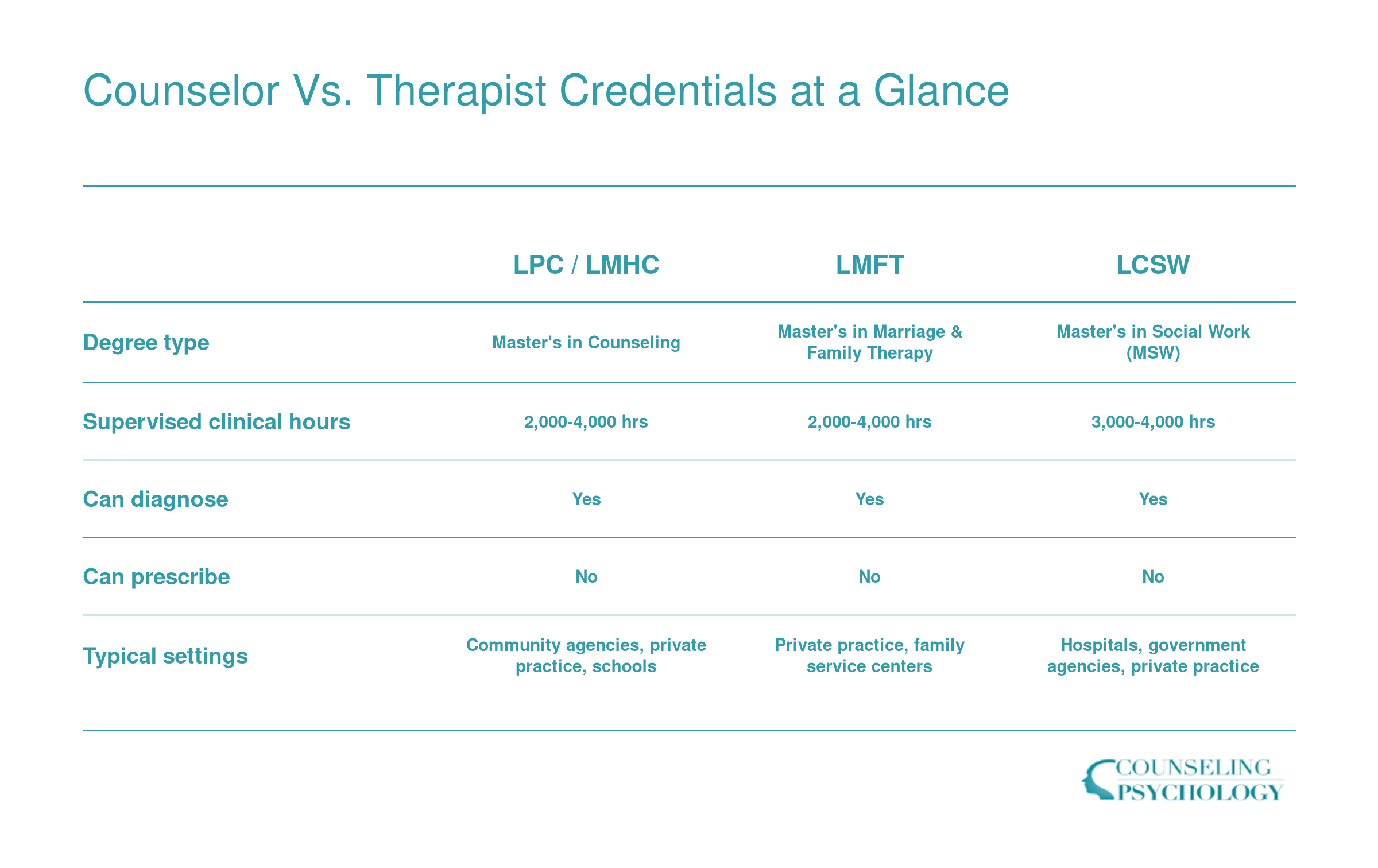
Counselor vs. Therapist Credentials at a Glance
Three of the most common clinical credential paths in mental health share core similarities but differ in degree focus, supervised experience requirements, and scope of practice. Here is a side-by-side look at the LPC/LMHC counselor track alongside two credentials often associated with the broader "therapist" umbrella.
Salary and Job Outlook for Counselors vs. Therapists
The Bureau of Labor Statistics tracks counselor and therapist earnings under two broad occupation codes that bundle multiple license types together. The figures below reflect national data, so individual salaries vary by state, employer, specialty, and years of experience. Both occupations are projected to grow faster than the average for all occupations through 2034, with mental health counselors showing especially strong demand at 17 percent projected growth and roughly 84,000 new positions expected over the decade.
| Occupation (BLS Category) | Total National Employment | National Median Salary | 25th Percentile | 75th Percentile | Projected Growth (2024 to 2034) | Projected New Positions |
|---|---|---|---|---|---|---|
| Marriage and Family Therapists (SOC 21-1013) | 65,870 | $63,780 | $48,600 | $85,020 | 13% | 6,000 |
| Substance Abuse, Behavioral Disorder, and Mental Health Counselors (SOC 21-1018) | 440,380 | $59,190 | $47,170 | $76,230 | 17% | 84,000 |
Highest-Paying States for Mental Health Counselors and Therapists
Where you practice can matter as much as what credential you hold. The tables below highlight top-paying states for two key BLS occupation categories: Marriage and Family Therapists (21-1013) and Substance Abuse, Behavioral Disorder, and Mental Health Counselors (21-1018). Keep in mind that higher median salaries in states like New Jersey, Alaska, and Oregon often reflect elevated cost of living and strong licensure demand rather than a universal pay advantage tied to one credential type over another.
| State | Occupation Category | Employment | Median Salary | 25th Percentile | 75th Percentile |
|---|---|---|---|---|---|
| New Jersey | Marriage and Family Therapists | 3,940 | $89,030 | $77,380 | $97,670 |
| Utah | Marriage and Family Therapists | 1,980 | $81,170 | $63,220 | $102,810 |
| Virginia | Marriage and Family Therapists | 910 | $80,670 | $54,010 | $95,120 |
| Oregon | Marriage and Family Therapists | 1,080 | $79,890 | $65,400 | $137,950 |
| Connecticut | Marriage and Family Therapists | 390 | $76,930 | $59,000 | $138,610 |
| Minnesota | Marriage and Family Therapists | 3,780 | $72,370 | $59,720 | $82,870 |
| Colorado | Marriage and Family Therapists | 810 | $69,990 | $54,960 | $104,990 |
| California | Marriage and Family Therapists | 32,070 | $63,780 | $47,730 | $91,660 |
| Alaska | Mental Health Counselors | 1,060 | $79,220 | $63,690 | $96,940 |
| New Mexico | Mental Health Counselors | 2,070 | $70,770 | $55,060 | $80,840 |
| Oregon | Mental Health Counselors | 6,410 | $69,660 | $56,290 | $84,970 |
| North Dakota | Mental Health Counselors | 1,180 | $66,450 | $50,810 | $75,120 |
| District of Columbia | Mental Health Counselors | 980 | $66,140 | $47,980 | $83,040 |
| Utah | Mental Health Counselors | 4,720 | $65,920 | $42,210 | $94,630 |
| Idaho | Mental Health Counselors | 2,130 | $65,240 | $48,570 | $78,100 |
| New Jersey | Mental Health Counselors | 14,640 | $64,710 | $51,170 | $84,690 |
| Washington | Mental Health Counselors | 13,150 | $64,220 | $52,070 | $80,440 |
| Arizona | Mental Health Counselors | 8,970 | $63,830 | $50,650 | $79,990 |
| Connecticut | Mental Health Counselors | 6,470 | $62,960 | $49,120 | $77,610 |
Work Settings and Specialty Areas
Where you work often matters more than whether your business card says "counselor" or "therapist." Credential type shapes the settings and specialty niches most accessible to each license, though considerable overlap exists in many environments.
Common Work Settings by Credential
School counselors are almost exclusively master's-level counselors holding school counseling licenses or endorsements (not typically LPCs in the clinical sense). Hospital-based and integrated-care clinicians frequently hold LCSW licenses, given social workers' historical foothold in medical and community settings, though counseling psychologists and psychiatric nurse practitioners also staff these roles. Private practice is open to all license types: LPCs, LMFTs, LCSWs, and psychologists all maintain independent practices, and payers credential each equally for most outpatient mental health services.
Specialty Distinctions Across Licenses
Licensed Marriage and Family Therapists concentrate on relational and systemic work. While LMFTs can and do see individuals, their graduate training emphasizes couples counselor skills, family systems, and multi-client sessions. Licensed Professional Counselors typically provide individual and group counseling across a broad range of presenting concerns: anxiety, depression, life transitions, and identity issues. Licensed Clinical Social Workers often work in medical hospitals, hospices, child welfare agencies, and other community settings where case management, discharge planning, and wraparound services intersect with psychotherapy.
Substance Abuse Counseling as a Distinct Track
Substance abuse counseling occupies a gray zone. Some states license addiction counselors separately (Licensed Alcohol and Drug Counselor, Certified Addiction Counselor), while others fold substance use disorder treatment into the LPC or LCSW scope of practice. Graduate programs in counseling or social work may offer addiction-studies concentrations, and standalone certificate or associate-degree tracks also exist. Whether a substance abuse counselor is called a "counselor" or "therapist" depends on state regulation and the credential held.
Job Titles Do Not Always Match License Type
Agency job postings labeled "therapist" may require or accept an LPC, and postings for "counselor" roles may be filled by an LCSW or LMFT. Employers use the terms interchangeably in practice, prioritizing licensure status and clinical competencies over the exact title. For a broader look at the options available, explore counseling careers across settings and specialties. Check the required credentials and scope of practice in the job description rather than relying on the position title alone.
The distinction between counselor and therapist matters most for credentialing, insurance billing, and scope of practice. For clients seeking help, the quality of the therapeutic relationship typically outweighs the specific letters after a provider's name. For those planning a career, your choice of degree and license track determines what you can legally do in practice, not the job title you use.
How to Choose Between a Counselor and a Therapist
Whether you are a prospective client trying to find the right professional or a student mapping out a career path, the counselor-versus-therapist question ultimately comes down to two practical concerns: what kind of help is needed, and what credentials make sense for the work you want to do.
If You Are Looking for Care
Start with your insurance plan before you start researching providers. Insurance companies credential mental health providers under different license categories, and coverage can vary depending on whether your plan recognizes an LPC, an LMFT, or an LCSW as an in-network provider. Some plans treat these credentials identically; others assign different reimbursement tiers or require different authorizations. Call the member services number on your card and ask specifically which license types are included in your mental health panel and whether copays differ across them. New York's mental health counselors association has documented that licensed mental health counselors are accepted by major insurance networks in that state, but the picture varies elsewhere.1 Checking your panel first saves you from a billing surprise after your first session.
If You Are Choosing a Career Path
The title matters far less than the population you want to serve and the settings where you want to work. If you are still exploring options, a good first step is learning how to become a counselor and understanding the general pathway before narrowing your focus. A quick framework:
- Individuals across the lifespan: An LPC or LMHC track gives you a broad generalist scope covering anxiety, depression, trauma, and adjustment concerns in private practice or community mental health.
- Couples and families: An LMFT credential is purpose-built for relational and systemic work. The degree curriculum and supervised hours are structured around family systems theory from the start.
- Healthcare and social services flexibility: An MSW leading to LCSW licensure opens doors in hospitals, schools, child welfare, and integrated care settings where a social work license is the expected credential.
Think about the setting first, then work backward to the degree.
The 2-Year Rule You Will Encounter Everywhere
Regardless of which credential path you choose, virtually every state requires a period of supervised post-master's clinical experience before granting full licensure.5 This is what practitioners often call the "2-year rule." In practice it means logging roughly 2,000 to 4,000 supervised hours after graduation, typically over 24 months at minimum, though some states stretch the window to 48 months depending on your pace and caseload.
The hour counts differ by state and by credential. Tennessee's LPC track, for example, requires 3,000 total hours including 1,500 hours of direct client contact and 150 hours of supervision, completed over 24 to 48 months.2 Kansas sets a similar 3,000-hour total with a 24-month minimum.3 Florida's LMHC path requires 1,500 direct-contact hours and 100 supervision hours over at least 24 months.4 California's LCSW and LMFT paths each carry a 3,000-hour requirement with a 24-month floor.6
The core structure is consistent across credential types: a master's degree, then two or more years of supervised practice, then a licensing exam. Planning your early post-graduation employment around approved supervision sites is one of the most consequential decisions you will make in this field, since the clock does not start until you are working in a qualifying role under a qualified supervisor.
Frequently Asked Questions
These are some of the most common questions students and career changers ask when weighing the counselor and therapist paths. Each answer is intentionally concise, but the distinctions matter for licensure, hiring, and client care.