
What you’ll learn in this article…
- Nebraska's top ranked 2026 psychology master's programs are hybrid Applied Behavior Analysis options within the University of Nebraska system.
- Graduate tuition at Nebraska public universities remains among the most affordable in the Midwest.
- Master's level graduates typically pursue the Licensed Mental Health Practitioner credential through the Nebraska Department of Health.
- UNL recommends a 3.5 undergraduate GPA for psychology graduate admission and does not require standardized test scores.
In-state graduate tuition at the University of Nebraska at Omaha starts around $8,300 per year, making Nebraska one of the more affordable states in the Midwest for earning a psychology master's degree. The program landscape here is small, anchored by public institutions in the University of Nebraska system alongside a handful of private colleges, each with different specialization strengths and delivery formats. For working professionals, hybrid and online options now make it possible to complete coursework remotely while fulfilling supervised clinical hours in person.
The real challenge is not access but fit. With fewer programs to choose from, understanding exactly what each school offers in terms of accreditation, licensure preparation, and cost becomes critical. Nebraska's LMHP credential, the primary clinical license for master's-level graduates, requires specific coursework and supervised hours that not every program satisfies equally. Students considering doctoral-level training may also want to compare clinical psychology doctorate programs to understand how Nebraska's offerings stack up nationally.
Best Online & Affordable Psychology Programs in Nebraska: 2026 Rankings
Nebraska's two ranked psychology programs for 2026 both focus on Applied Behavior Analysis at the master's level, delivered in hybrid formats that blend online coursework with supervised clinical experiences. Both are housed within the University of Nebraska system, giving students access to public-institution tuition rates and strong regional practicum networks. Program-level earnings and employment data are not yet available for either program, but institution-wide outcomes and affordability metrics help distinguish each option.
- Net price and financial aid
- Online or hybrid delivery format
- Institutional graduation and retention
- Graduate debt levels
- Earnings after graduation
- Internal program database
- College Scorecard graduate earnings — collegescorecard.ed.gov
- NCES-IPEDS federal institutional data — nces.ed.gov
- Independent program research

University of Nebraska at Omaha
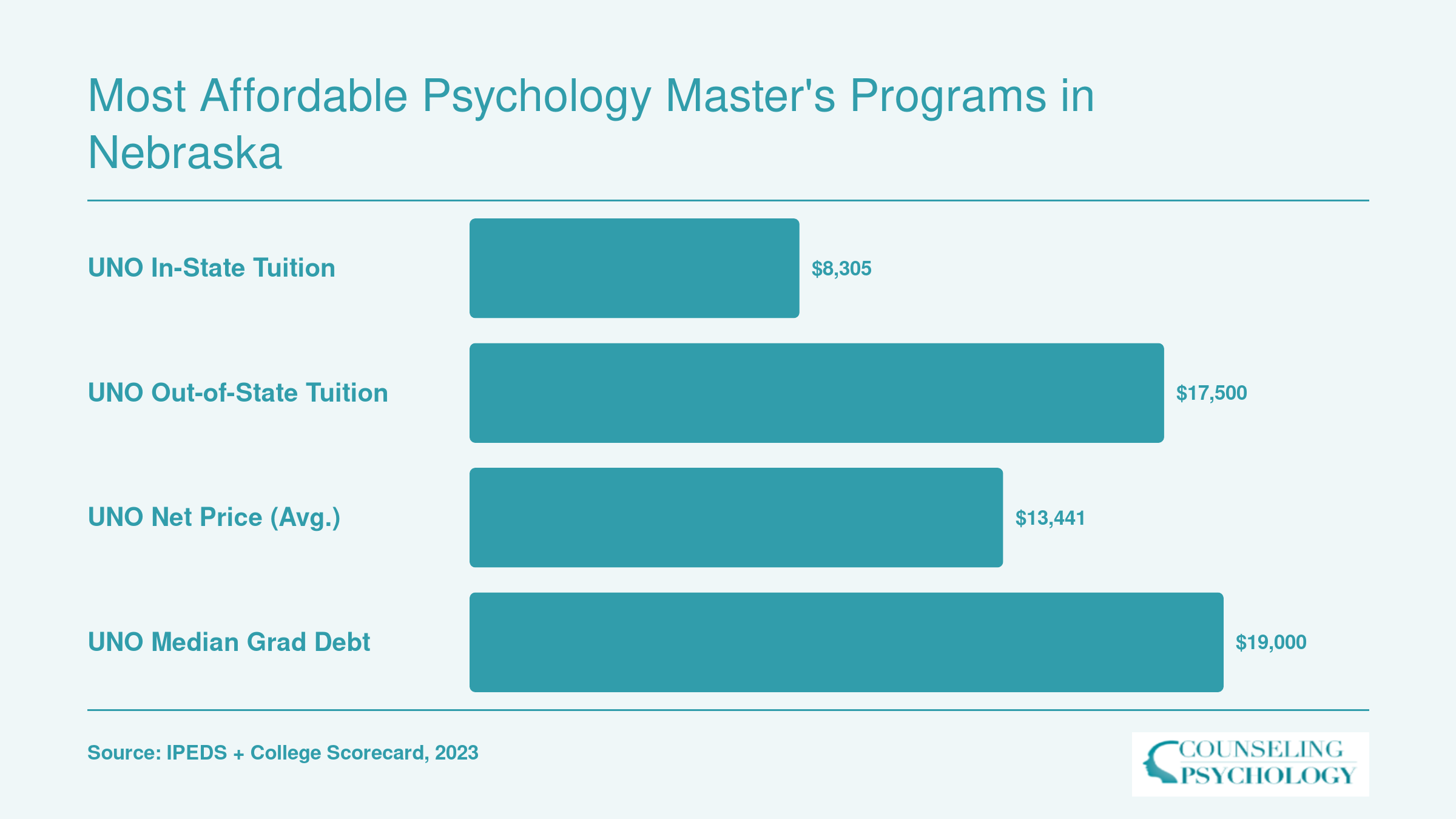
The University of Nebraska at Omaha is a large public university in Omaha with a 15:1 student-to-faculty ratio, an 87% admission rate, and robust online and hybrid infrastructure that extends access well beyond the metro area. Its institution-wide graduation rate is 47.1% (note: this is a campus-wide figure, not specific to the ABA program). In-state tuition runs approximately $8,305 per year compared to about $17,500 for out-of-state students, and the average net price after aid is $13,441. Median graduate debt sits at $19,000, with median earnings ten years after enrollment reaching roughly $53,909 across all programs.
- Hybrid format with synchronous Zoom meetings
- Prepares graduates for BCBA certification eligibility
- 51 to 54 total credit hours required
- Emphasizes person-centered, culturally responsive services
- Covers psychotherapeutic interventions and ethics coursework
- Focuses on neurodevelopmental disabilities across the lifespan
- Comprehensive examination required for completion
- Admission requires 15 undergraduate psychology credit hours
MS in Applied Behavior Analysis — Hybrid

University of Nebraska Medical Center
The University of Nebraska Medical Center is a specialized health sciences institution in Omaha with an exceptionally low 3:1 student-to-faculty ratio, reflecting its focus on intensive clinical training. In-state tuition is approximately $12,006 versus $21,696 for out-of-state students. While no institution-wide graduation rate is reported (UNMC primarily enrolls graduate and professional students), median graduate debt is a relatively low $15,000 and median earnings ten years out reach about $76,833 across all programs. The program's direct collaboration with the Munroe-Meyer Institute gives students access to one of the region's leading centers for autism and developmental disability services.
- Hybrid delivery combining online courses and in-person practica
- Up to 1,500 hours of supervised field experience required
- Collaboration with UNO and the Munroe-Meyer Institute
- Curriculum verified by the Association for Behavior Analysis International
- Designed as a two-year, full-time course of study
- Prepares graduates for the BCBA examination
- Practicum placements in clinics, schools, and community agencies
- Fall-only start date with structured cohort progression
MS in Applied Behavior Analysis — Hybrid
Nebraska's public universities offer some of the most affordable graduate tuition rates in the Midwest, and expanding online program options mean students across the state can earn a psychology degree without relocating. Smaller cohort sizes at many Nebraska schools also translate into closer faculty mentorship and more individualized support when securing practicum placements, giving graduate students a meaningful advantage as they build clinical skills.
Online Vs. On-Campus Psychology Programs in Nebraska
Choosing between online and on-campus study is one of the most consequential decisions you will make as a psychology graduate student in Nebraska. Both formats have genuine strengths, and several Nebraska institutions now offer hybrid options that blend the two. Understanding the tradeoffs in cost, flexibility, and professional development will help you pick the format that fits your life and your career goals.
Pros
- Online programs like UNK's fully online MSE in Clinical Mental Health Counseling offer asynchronous coursework, letting working professionals study on their own schedule.
- Private institutions such as Creighton University charge a single per credit rate regardless of where you live, eliminating the in state vs. out of state tuition gap entirely.
- Hybrid formats at UNO (for example, the Applied Behavior Analysis MS at roughly $8,305 in state tuition) combine online coursework with scheduled synchronous Zoom sessions, reducing commute time while preserving real time interaction.
- On campus programs provide direct access to research labs, faculty mentorship, and practicum sites, which is critical for students pursuing clinical or research intensive tracks.
- Face to face networking through campus events, cohort study groups, and professional organizations builds relationships that often translate into job referrals and collaborative research opportunities.
- Programs housed at research universities like UNL, where psychology is offered only as a campus based doctoral track with an embedded master's, give students immersive lab and clinical training that is difficult to replicate online.
Cons
- Online students at University of Nebraska system schools should not assume they will automatically receive in state tuition rates; the NU system does not guarantee universal in state pricing for all online learners.
- Campus based programs can be significantly more expensive for nonresidents: UNO's out of state graduate tuition runs around $17,500 compared to about $8,305 for Nebraska residents, a gap that adds up quickly over two or three years.
- Fully online formats may limit hands on practicum and supervised fieldwork opportunities, requiring students to arrange local clinical placements independently.
- On campus programs demand a fixed schedule and physical presence, which can be a barrier for students balancing full time employment or family responsibilities.
Most Affordable Psychology Master's Programs in Nebraska
When comparing graduate program costs, it helps to look at both published tuition and net price, which reflects the average cost after institutional aid and grants. Keep in mind that net price figures are institution-wide averages and your actual out-of-pocket cost may differ depending on your financial aid package, residency status, and enrollment intensity. Program-level earnings and debt figures for this specific master's track have not yet been published, though the institution-wide median graduate debt at the University of Nebraska at Omaha sits at $19,000.
Financial Aid, Assistantships, and Scholarships for Nebraska Psychology Students
Most Nebraska psychology applicants face the same tradeoff: chase a fully funded research-track spot that pays you to study but limits where you live and what you specialize in, or accept a flexible master's program and stitch together your own funding plan. Both paths work, but they require different timelines and different paperwork.
Departmental Assistantships and Fellowships
The University of Nebraska-Lincoln psychology department is the clearest example of the funded route. Doctoral-track students in UNL's graduate psychology program are typically offered a full tuition waiver paired with a stipend, with the exact stipend amount varying by lab, grant funding, and assistantship type.1 UNL also names several internal fellowship lines, including the Presidential Fellowship, the Fling Fellowship, and the Dean's Fellowship, which generally carry no separate work requirement beyond normal degree progress.2 Master's-only applicants should ask each program directly whether assistantships are reserved for PhD students, since at many R1 departments they are.
At the University of Nebraska at Omaha, master's options like the Applied Behavior Analysis MS lean toward part-time and hybrid enrollment, which often pairs better with employer tuition reimbursement than with a traditional 20-hour assistantship. Students exploring ABA credentials at the certificate level can also review graduate certificate in applied behavior analysis options nationwide. UNMC's ABA program, run jointly with UNO and the Munroe-Meyer Institute, sometimes attaches paid practicum or fieldwork roles to its clinical pipeline. Creighton and UNK applicants should contact the department chair directly, as funded master's slots there are limited and not always posted publicly.
State and Federal Aid
Nebraska Promise, the state's signature tuition program, covers undergraduate tuition only at University of Nebraska campuses and does not extend to graduate study. The Susan Thompson Buffett Foundation Scholarship is similarly undergraduate-only, covering tuition, fees, housing, and books for Nebraska residents at in-state institutions.3 The Davis-Chambers Scholarship ($2,000 to $4,000) also targets undergraduates.3 For master's students, the practical state-level aid picture is thin, which makes federal aid and departmental funding the real levers.
A useful proxy for how aid-friendly a campus feels: at UNO, roughly 59% of undergraduates receive Pell grants, compared to about 37% at UNMC. That figure reflects the undergraduate population, not graduate students, but it signals which campuses have built infrastructure around financially constrained learners. If you are weighing related graduate programs in the state, comparing costs across counseling master's degree options in Nebraska can also help frame the financial picture.
Three Practical Moves
- Apply early for departmental funding: Many assistantship decisions are made alongside admissions in January and February. Submitting your application by the priority deadline, not the final deadline, materially changes your odds.
- File the FAFSA by Nebraska's priority date: Graduate students qualify for federal unsubsidized loans and work-study, and some institutional aid is FAFSA-gated.
- Ask your employer before you enroll: Hospitals, school districts, and behavioral health agencies across Nebraska routinely offer tuition reimbursement for ABA, counseling, and clinical psychology coursework. Negotiate this before signing an offer, not after.
Psychology Specializations Available at Nebraska Schools
Nebraska's graduate psychology landscape is concentrated at a handful of universities, each with distinct specialization tracks. The table below reflects verified 2025-2026 program offerings. Because catalogs and department pages can lag behind real changes, contacting the program coordinator or department chair directly is the most reliable way to confirm current concentrations. You can also cross-reference accredited specializations through the American Psychological Association (APA) or the National Association of School Psychologists (NASP).
| University | Degree Level | Specialization or Concentration | Terminal Master's Available? | Notes |
|---|---|---|---|---|
| University of Nebraska, Lincoln | PhD (with MA earned en route) | Clinical Psychology | No (doctoral track only) | APA-accredited doctoral program; no standalone terminal master's in clinical psychology |
| University of Nebraska, Lincoln | PhD (with MA earned en route) | Counseling Psychology | No (doctoral track only) | Embedded MA within the PhD sequence; students do not apply separately to a master's program |
| University of Nebraska, Lincoln | PhD | Law-Psychology (Joint Concentration) | No (doctoral level only) | Interdisciplinary focus combining psychology and legal studies at the doctoral level |
| University of Nebraska, Lincoln | N/A | Industrial-Organizational Psychology | Not offered in psychology dept. | Not available through the psychology department as of 2025-2026 |
| University of Nebraska, Lincoln | N/A | Forensic Psychology (standalone) | Not offered | No dedicated forensic psychology master's; law-psychology concentration exists at the PhD level |
| University of Nebraska, Lincoln | N/A | Applied Behavior Analysis | Not offered in psychology dept. | May be available through other departments; check with the university directly |
Questions to Ask Yourself
Admission Requirements for Nebraska Psychology Master's Programs
At the University of Nebraska-Lincoln, the recommended undergraduate GPA for the psychology graduate program is 3.5 for the 2025-2026 cycle, with no standardized exam required, three letters of recommendation, and a written personal statement.1 Other Nebraska institutions set their own bars, so building your application list means comparing each program line by line rather than assuming uniformity across the state. If you are still exploring options beyond Nebraska, our guide to the best online master's in psychology programs can help you benchmark what different schools expect.
GPA Minimums and Test Score Policies
UNL sits at the higher end of the GPA range at 3.5 recommended, which is typical for research-focused doctoral feeder programs. The GRE has been dropped from UNL's psychology graduate admissions for 2025-2026, part of a broader national shift away from standardized testing in psychology that accelerated after 2020.1 Before assuming a test is or is not required at any Nebraska school, check the current admissions page directly: policies have changed year to year at several institutions, and an outdated forum post or third-party ranking site may still list GRE requirements that no longer apply.
Prerequisites and Supporting Materials
UNL expects applicants to hold a bachelor's degree in psychology or a closely related field, plus at least one undergraduate course in statistics or research methods.1 Applicants are also asked to identify two or three faculty members whose research interests align with their own, a step that matters more than people realize.2 A strong application that names no faculty fit can lose to a weaker application that does, because mentored research training is the structural core of the program.
Three letters of recommendation and a personal statement round out the UNL file. Letters from faculty who can speak to your research capacity carry more weight than letters from employers, with rare exceptions.
If Your GPA Is Below the Minimum
UNL does not offer a conditional admission pathway, so a sub-3.0 GPA is a real obstacle there.1 Practical options include:
- Post-baccalaureate coursework: Take graduate-level statistics, research methods, or advanced psychology courses as a non-degree student and earn A's to demonstrate current capacity.
- Research experience: Volunteer in a faculty lab, present at a regional conference, or co-author a poster. This often outweighs a mediocre GPA in faculty review.
- Address it directly: Use your personal statement to briefly explain the gap and point to evidence of growth. Do not ignore it and hope reviewers will not notice.
- Apply to programs with conditional pathways: Some Nebraska programs admit students provisionally with a required first-semester GPA threshold. Confirm current policies with each admissions office.
Licensure Pathways for Psychology Graduates in Nebraska
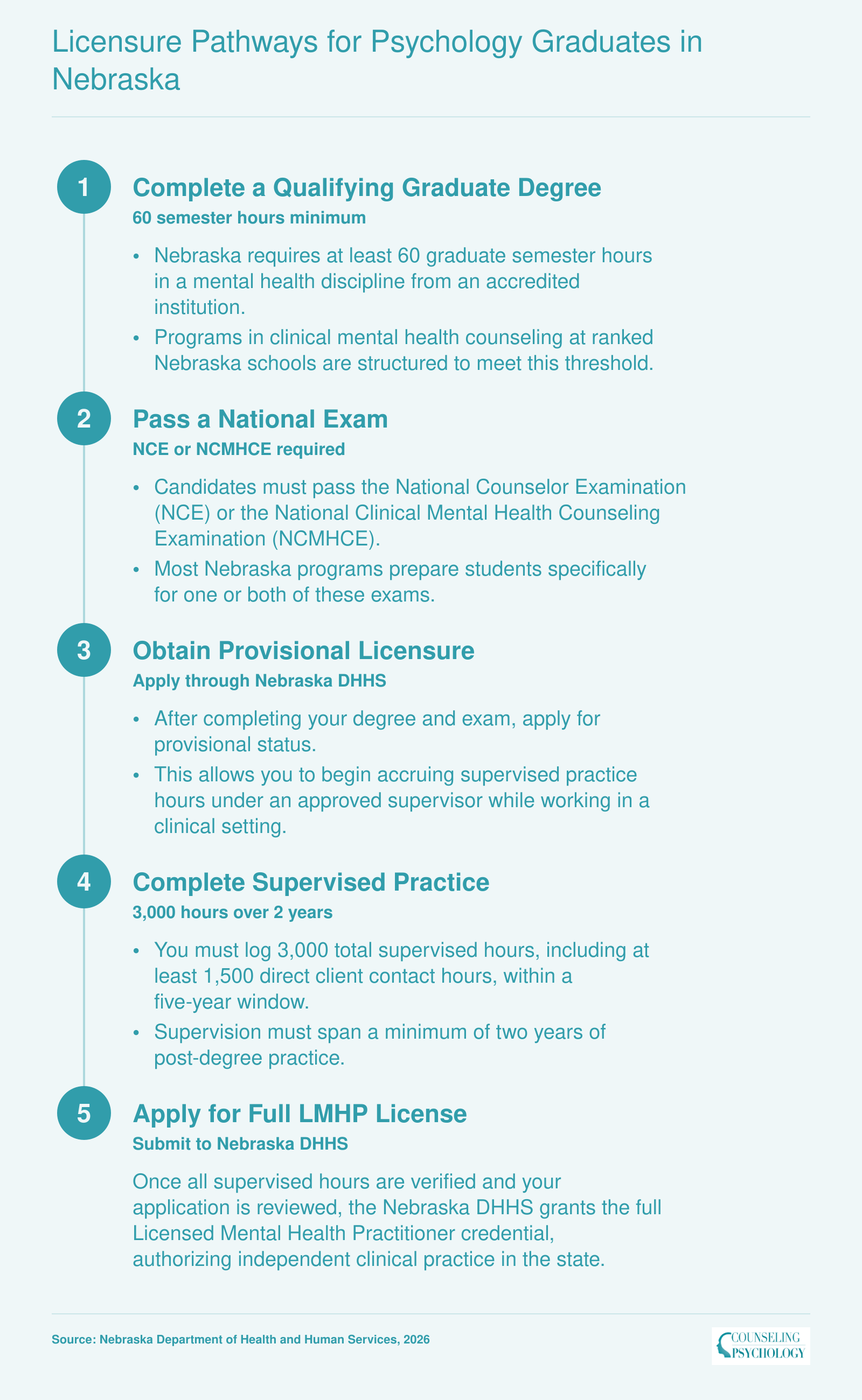
Earning a psychology degree in Nebraska is just the first milestone. The Licensed Mental Health Practitioner (LMHP) credential is the most common clinical license pursued by master's-level graduates, and the pathway is clearly defined by the Nebraska Department of Health and Human Services. Doctoral-level licensure as a Licensed Psychologist requires additional education beyond a master's, while school psychologist certification follows a separate endorsement process through the Nebraska Department of Education. Several ranked programs on this list, including those at the University of Nebraska and Chadron State College, offer curricula specifically designed to satisfy the LMHP education requirement, while specialist-level programs at UNO and UNK align with the school psychologist endorsement.
Career Outcomes and Salaries for Psychologists in Nebraska
Understanding what you can earn as a psychologist in Nebraska is essential for making an informed career decision, and the data is clearer than you might think. While national figures provide a useful baseline, real salary potential depends on your specialization, location within the state, and your level of experience.
National Salary Benchmarks
The Bureau of Labor Statistics (BLS) Occupational Employment and Wage Statistics (OEWS) program offers the most current national data. For May 2023, the median annual wage for school psychologists nationwide was $84,940, with the bottom 10% earning below $59,250 and the top 10% above $131,470.1 About 62,790 professionals were employed in this role nationally. For the broader category "psychologists, all other," a group that includes many specialized doctoral-level practitioners, the national median wage was $117,750, with a 10th percentile of $47,450 and a 90th percentile of $157,420, across roughly 14,480 jobs.2 Remember, these are national aggregates and do not reflect Nebraska-specific conditions.
Nebraska-Specific Data and Metro Area Wages
To see exactly what psychologists earn in Nebraska, go directly to the BLS OEWS website (bls.gov/oes) and filter by state and occupation. Look for the same SOC codes, including 19-3031 (clinical and counseling psychologists), 19-3032 (industrial-organizational psychologists), 19-3034 (school psychologists), and 21-1014 (mental health counselors), to pull median, 10th, and 90th percentile wages along with total employment for the state. The Nebraska Department of Labor (dol.nebraska.gov) also publishes state-level occupational projections and wage data, often with more granular breakdowns by region. Because cost of living in Nebraska is generally lower than the national average, even a wage below the national median can translate to a comfortable lifestyle. For those considering practice in urban areas, the BLS metro area data for Omaha and Lincoln may reveal different compensation trends than the state as a whole.
Job Growth Projections
The BLS Occupational Outlook Handbook (bls.gov/ooh) projects national growth for psychology occupations, typically above average, but state-specific outlooks can vary. Nebraska's labor market information office releases 10-year projections that account for local demand in schools, hospitals, and private clinics. Checking both sources gives you a clearer picture of where opportunities are expanding. Those interested in school-based roles can learn more about educational psychologist requirements to understand the pathway into that specialty.
Beyond Government Statistics
Government datasets don't always capture the full range of earnings, especially for private practice or niche roles. Professional organizations like the Nebraska Psychological Association (nebraskapsychology.org) or the Nebraska School Psychologists Association often conduct state-specific salary surveys that reflect real-world pay scales. Supplement these with employer-reported data on sites like Glassdoor or Indeed, and review university career pages (such as the University of Nebraska system) for academic or research positions. Students considering related fields may also want to explore MFT programs in Nebraska for comparison. Talking to professionals at these associations can give you insight into billing rates, benefits, and job satisfaction, which is particularly valuable when negotiating salary offers or choosing between multiple job opportunities. Comparing multiple sources helps you define a realistic salary target before you commit to a degree program.
Frequently Asked Questions About Psychology Programs in Nebraska
Nebraska's psychology landscape offers several strong programs at public universities, with options that balance affordability, flexibility, and career preparation. Below are answers to the questions prospective students ask most often.