
What you’ll learn in this article…
- Most states now require 60 graduate semester hours for LPC licensure, and the majority accept post-master's certificate credits toward that total.
- CACREP does not accredit standalone graduate certificates, so applicants should verify that certificate courses align with CACREP content standards.
- Typical online counseling certificates range from 12 to 24 credits, with tuition varying widely by institution and delivery format.
- BLS projections show strong demand for licensed counselors nationally, making the certificate a practical investment for career advancement.
Most states now require 60 semester hours of graduate counseling coursework for LPC licensure, yet the typical master's in counseling produces only 48 to 54. For counselors who already hold a master's but fall short of that threshold, or who need specific content areas like trauma or addiction for a new specialization, a credit-bearing graduate certificate closes the gap without a second degree.
The term "certificate" gets thrown around loosely. Continuing education credits, vendor-issued training badges, and regionally accredited graduate certificates are not the same credential. Only the last type generates transferable semester hours that state licensing boards consistently recognize. That distinction shapes everything from tuition investment to career return.
Best Online Graduate Certificates in Licensed Professional Clinical Counseling
The programs below are ranked using a composite that blends online delivery availability with institutional quality indicators such as net price, graduation and retention rates, student outcomes, and program depth. Because these are graduate certificates, not full degree programs, program-level earnings and completion counts are not yet reported for any of the listed offerings. Instead, we surface institution-wide cost and outcome data so you can compare value across schools. Always confirm with your state licensing board that a specific certificate satisfies your jurisdiction's LPC requirements.
- Online delivery availability
- Institutional graduation and retention rates
- Net price and affordability
- Graduate debt levels
- Program depth and credit requirements
- NCES-IPEDS federal institutional data — nces.ed.gov
- College Scorecard graduate earnings — collegescorecard.ed.gov
- Independent program research
- Internal program database

University at Buffalo
The University at Buffalo combines research-university resources with a New York State-accredited Mental Health Counseling Advanced Certificate built around multicultural competence and social justice. With an 11:1 student-to-faculty ratio and an institution-wide graduation rate of 75.2%, UB offers strong academic infrastructure for graduate learners. In-state tuition runs approximately $14,530 per year, while out-of-state students can expect around $28,210, with a net price near $20,995.
- Fully online with full-time or part-time scheduling
- 15 to 27 credit hours based on prior education
- Completable in 1 to 2 years
- New York State accredited for licensure preparation
- Curriculum centered on multicultural competence
- Emphasizes ethical practice and social justice
- Research-supported therapeutic methods
Mental Health Counseling Advanced Certificate — Online

Lamar University
Lamar University offers one of the most affordable paths on this list, with in-state tuition near $8,642 and a net price of roughly $9,366. Its 18-credit bridge certificate is purpose-built for master's-level graduates who need additional coursework to meet Texas LPC licensure standards. The institution's overall graduation rate is 37.3%, so prospective students should weigh the strong affordability against broader institutional metrics.
- Concise 18-credit bridge program, fully online
- Designed specifically for Texas LPC licensure gaps
- Covers psychopathology, ethics, and family counseling
- Requires a master's in counseling with 3.0 GPA
- Flexible online format for working professionals
- Affordable tuition supporting career changers
Program Certificate in Mental Health Counseling — Online

Troy University
Troy University fields two distinct graduate certificates in mental health counseling: a post-master's clinical track and a specialized infant and early childhood option. In-state tuition is approximately $8,550, and out-of-state tuition is about $17,100, with a net price near $16,527. The institution's overall graduation rate stands at 50.3%, and both certificates require 15 semester hours of coursework plus supervised field experience.
- 15 semester hours delivered fully online
- Includes internship and elective course options
- Focuses on advanced diagnosis and treatment planning
- Requires master's degree, references, and interview
- Tailored for experienced mental health professionals
- Evidence-based treatment strategy emphasis
- Hybrid format with two face-to-face intensive days
- 15 semester hours plus a 400-hour internship
- Covers neuroscience and reflective supervision
- Aligned with Alabama state guidelines
- Minimum 3.0 GPA required for admission
- Serves counselors, psychologists, and educators
Post-Master's Certificate in Clinical Mental Health Counseling — Online
Certificate in Infant and Early Childhood Mental Health Counseling — Hybrid

University of South Dakota
The University of South Dakota delivers a compact 12-credit online certificate built on a CACREP-approved curriculum, making it especially appealing for counselors who need to reach the 60-credit-hour threshold many states require for licensure. In-state tuition is approximately $7,118, and the net price is about $19,858. The institution's overall graduation rate is 59.9%.
- 100% online, 12 credit hours
- CACREP-approved curriculum
- Courses in clinical supervision and psychopharmacology
- Co-occurring disorder counseling training
- Offered across fall, spring, and summer terms
- Students should verify state licensure alignment
Mental Health Counseling Graduate Certificate — Online

University of Northern Iowa
The University of Northern Iowa's 18-credit Advanced Studies Certificate is tailored specifically for experienced school counselors pivoting toward Iowa's Licensed Mental Health Counselor credential. Its curriculum highlights brain-based interventions and holistic approaches with a distinctive rural-community focus. In-state tuition is roughly $11,602, and the institution posts a 67.9% overall graduation rate.
- Entirely online, 18 credit hours
- New cohort launches every summer
- CACREP-accredited program
- Requires master's in school counseling from CACREP program
- Two years of post-master's counseling experience needed
- Emphasizes rural mental health service access
- Covers psychopathology and psychopharmacology
Advanced Studies Certificate in Clinical Mental Health Counseling — Online

Colorado Christian University
Colorado Christian University integrates Christian faith perspectives with a CACREP-accredited clinical mental health counseling program offered in both online and hybrid formats. The 60-credit curriculum includes 700 practicum and internship hours, and students can specialize in Marriage and Family Therapy or Substance Use Disorders. Tuition is approximately $15,394, with a net price of about $29,500 and an institution-wide graduation rate of 64.4%.
- CACREP-accredited, 60 total credit hours
- Online and hybrid delivery options
- 700 hours of practicum and internship
- Optional emphases in MFT or substance use disorders
- Prepares for National Counselor Exam
- Approximately 30 months to completion
- Bachelor's degree with 2.5 GPA required for admission
Master of Arts in Clinical Mental Health Counseling — Online

Regent University
Regent University's 9-credit Graduate Certificate in Clinical Mental Health Counseling is among the shortest on this list, offering a focused credential at roughly $730 per credit. The program blends advanced clinical training in psychopathology, crisis intervention, and trauma-informed care with a Christian-integrated curriculum. Tuition is about $17,869, with a net price near $19,923, and the institution reports a 56.9% overall graduation rate.
- Only 9 credit hours required
- Available online and on campus
- Approximately $730 per credit
- Covers psychopathology and crisis intervention
- Trauma-informed care training included
- Christian worldview integration
- Designed as a professional endorsement credential
Certificate of Graduate Studies in Clinical Mental Health Counseling — Online

Manhattan College
Manhattan College's 27-credit Advanced Certificate is designed for clinicians who hold a master's in counseling and need to qualify for independent licensure in New York State. The program prepares graduates to work in mental health centers, hospitals, and residential treatment settings. Tuition is approximately $25,485, with a net price near $27,256, and the institution posts a 63.7% overall graduation rate with a 15:1 student-to-faculty ratio.
- 27-credit post-master's program
- Qualifies graduates for NYS mental health licensure
- Hybrid (online and blended) format available
- Advanced assessment and intervention skill development
- Master's in counseling or counseling psychology required
- Clinical training across diverse treatment settings
Advanced Certificate in Mental Health Counseling — Hybrid

University of Mary
The University of Mary offers a 15-credit hybrid certificate priced at $640 per credit, combining online coursework with interactive video conferencing and evening classes. It targets master's-level counselors aiming to fulfill clinical mental health licensure requirements, with a curriculum emphasizing ethical and legal frameworks. The institution's overall graduation rate is 66.6%, and it maintains a 14:1 student-to-faculty ratio.
- 15 credits at $640 per credit
- Hybrid format with evening class options
- Interactive video conferencing sessions
- Focuses on ethical and legal counseling issues
- Clinical skills across diverse age groups
- Designed for master's-level counselors seeking licensure
Clinical Mental Health Counseling Graduate Certificate — Hybrid

Salve Regina University
Salve Regina University's online certificate pairs mental health counseling with a rehabilitation counseling concentration, an uncommon niche among the programs on this list. It spans four courses at $2,190 each and includes internship opportunities. The institution posts the highest overall graduation rate in this ranking at 76.9%, with a 12:1 student-to-faculty ratio. Net price is approximately $36,967.
- Fully online, four-course curriculum
- $2,190 per course
- Rehabilitation counseling concentration
- Prepares for state mental health licensure
- Internship opportunities included
- Evidence-based and advocacy-focused curriculum
- Veterans benefits and tuition reimbursement options
Graduate Certificate in Mental Health (Rehabilitation Counseling) — Online

Grand View University
Grand View University's 24-credit online certificate stands out for its generous transfer policy, accepting up to 12 graduate credits, and for waiving the GRE requirement. Seven-week course blocks accommodate working professionals, and local internship placements keep field experience convenient. Tuition is approximately $9,550, with a net price near $21,774, and the institution's overall graduation rate is 54%.
- 24-credit fully online program
- No GRE required for admission
- Transfer up to 12 existing graduate credits
- Flexible seven-week course format
- Local internship placements available
- Meets Iowa licensing requirements
- Curriculum emphasizes multicultural competence and social justice
Clinical Mental Health Counseling Certificate — Online

SUNY Brockport
SUNY Brockport's 15-credit Certificate of Advanced Study serves as a bridge for counselors who already hold a master's degree and need New York State licensure. Its hybrid format blends online and in-person clinical coursework, and all courses must be passed with a B or higher. In-state tuition is about $12,486, with a net price near $16,353. The institution's overall graduation rate is 55.1%.
- 15 credit hours, hybrid delivery
- Specifically designed for NYS LMHC licensure
- Master's in counseling required for admission
- Minimum B grade required in all courses
- Graduates eligible for limited permit
- 3,000 supervised hours lead to full licensure
- Clinical Mental Health Exam passage required
Mental Health Counseling Bridge (CAS) — Hybrid
What Is a Graduate Certificate in Licensed Professional Clinical Counseling?
A graduate certificate in licensed professional clinical counseling is a credit-bearing academic credential, typically ranging from 12 to 24 semester hours, issued by a regionally accredited college or university.1 Every course you complete appears on an official university transcript as graduate-level credit. The certificate is not a full master's degree, and it is not a weekend workshop or a vendor badge. It sits in a specific niche: structured, university-housed coursework designed to fill gaps between what you already hold and what a licensing board or employer requires.
Understanding exactly what this credential is, and what it is not, matters because the word "certificate" gets used loosely across three very different tiers.
Three Tiers of Counseling Certificates
- Academic graduate certificates: These carry transcripted graduate credit from a regionally accredited institution. Courses are taught by university faculty, follow a structured curriculum, and may align with CACREP content standards even though CACREP itself accredits only master's and doctoral degree programs.2 Because the credit lives on a university transcript, it can be evaluated by state licensing boards and, in many cases, by doctoral admissions committees.
- Continuing-education certificates: Issued by NBCC-approved providers, ACA, or universities operating in a CE capacity, these are measured in contact hours or CE hours rather than academic credit.1 They serve a different purpose: helping licensed counselors meet renewal requirements. They do not add graduate credit to your transcript.
- Private or vendor training certificates: Offered by non-degree-granting organizations, these programs are not governed by CACREP program standards and carry no academic standing.1 They may build practical skills, but licensing boards generally do not recognize them as equivalent to graduate coursework.
If your goal is licensure or license portability, the first tier is the one that counts.
Who Benefits Most
Graduate certificates in clinical counseling tend to serve three audiences:
- Counselors who already hold a master's degree but need additional coursework to meet licensure requirements in a new state. Requirements vary, and a certificate can bridge specific content gaps, such as a missing diagnosis and treatment planning course, without requiring enrollment in a second master's program.
- Professionals pivoting from a related field, such as social work, school counseling, or psychology, who need targeted clinical counseling coursework to qualify for LPC-track licensure. Learning how to become a licensed professional counselor can help clarify which coursework gaps a certificate might address.
- Currently licensed LPCs who want to add a clinical specialization, such as an online graduate certificate in addiction counseling or trauma-focused practice, with documented graduate-level training.
Stackability Into Doctoral Programs
One practical advantage worth noting: at some institutions, credits earned through a graduate certificate can stack into a doctoral program. If you later decide to pursue a PhD or EdD in counselor education, those transcripted hours may transfer into your doctoral plan of study, reducing the total time and cost of the degree. Exploring counseling doctoral programs early can help you identify institutions that accept transfer credit from certificate coursework. Not every university offers this pathway, so confirm stackability policies with the specific institution before enrolling. When the option does exist, it turns a short-term credential into a longer-term academic investment.
The takeaway is straightforward. An academic graduate certificate from a regionally accredited university is the credential with real weight in the licensing and admissions process. Before committing tuition dollars, verify that the program you are considering issues transcripted graduate credit, not just a certificate of completion.
Questions to Ask Yourself
How a Counseling Certificate Supports LPC Licensure
State licensing boards nationwide have spent the past decade raising the educational floor for professional counselor licensure, and the trend accelerated sharply after 2020. The majority of states now require 60 semester hours of graduate coursework to sit for the National Counselor Examination and qualify for Licensed Professional Counselor (LPC) or Licensed Mental Health Counselor (LMHC) credentials.1 This shift has created a significant practical challenge for counselors who completed 48-credit master's programs years ago, or who earned degrees from institutions that have not yet expanded their curricula. A post-master's graduate certificate in clinical counseling has emerged as the principal pathway to close that gap.
The Core Use Case: Filling the Credit Gap
A counselor who holds a 48-credit master's degree in counseling or a related field and seeks LPC licensure in a 60-credit state typically needs 12 additional graduate semester hours in approved clinical coursework. Post-master's certificates are designed precisely for this scenario. These programs package the missing coursework into a single credential, often covering advanced topics in diagnosis, psychopharmacology, multicultural counseling, and practicum or internship hours. Completing a certificate does not confer a second degree, but it does satisfy the credit-hour requirement and, in many cases, the supervised clinical hours required by the board.
How States Differ on Certificate Coursework
Licensing boards vary widely in how they treat certificate credits.1 Three broad categories describe the landscape:
- Regionally accredited coursework accepted: Many states permit any graduate-level counseling coursework from a regionally accredited institution to count toward the 60-hour minimum. In these jurisdictions, a certificate from a reputable university is sufficient, regardless of whether the program holds specialized counseling accreditation.
- CACREP-only mandates: A growing number of states require that all coursework come from a Council for Accreditation of Counseling and Related Educational Programs (CACREP) accredited program. In these states, a post-master's certificate must itself be CACREP-accredited, or the coursework will not count toward licensure.
- Certificate coursework not accepted: A small number of states do not recognize post-master's certificate coursework at all. Mississippi, for example, requires a 60-semester-hour master's degree and does not accept certificate-only credits to satisfy the degree requirement.2 Counselors in these states must complete a second master's program or enroll in a master's degree program that accepts transfer credits from their first graduate degree.
Specific State Examples
Several states have recently updated their statutes or administrative rules:
- Mississippi: Requires a 60-semester-hour master's degree in counseling.2 The state board does not accept post-master's certificate coursework as a standalone pathway to licensure.
- Virginia: Moved to a 60-credit minimum in 2021. The board accepts coursework from any regionally accredited graduate program, including post-master's certificates, provided the content aligns with the board's core curriculum areas.
- Ohio: Requires 60 semester hours and accepts coursework from regionally accredited programs. The board does not mandate CACREP accreditation, but applicants must demonstrate that coursework covers the board's eight content areas.
- Tennessee: Requires a CACREP-accredited master's degree or a degree that meets CACREP-equivalent standards. Post-master's certificates must be CACREP-accredited to count toward licensure.
- Louisiana: Requires 60 semester hours. The board accepts coursework from regionally accredited institutions but strongly recommends CACREP-accredited programs to avoid additional documentation requirements.
Verify Before You Enroll
Because state rules change frequently, and because individual licensing boards interpret their own statutes, it is essential to contact your state's professional counselor licensing board before enrolling in any certificate program. Request written confirmation that the program you are considering will satisfy your state's education requirement. Some boards maintain pre-approved program lists; others require transcript review on a case-by-case basis.1 The Counseling Compact, an interstate licensure agreement that took effect in several states in 2024, does not standardize educational requirements, so portability remains limited even for compact-eligible counselors.
State Licensure Requirements That Accept Certificate Coursework
Most states now require 60 semester hours of graduate coursework for licensed professional counselor credentials, and the majority explicitly permit applicants to combine a master's degree with post-master's graduate certificate credits to meet that threshold.
States That Accept Certificate Credits
The table below summarizes current requirements in six states where licensing boards have published clear guidance on certificate coursework. All six accept post-master's certificate hours toward the 60-credit minimum, and none mandate CACREP accreditation for the certificate itself (though some boards give preference to CACREP-aligned programs during the application review).
| State | Required Graduate Hours | Accepts Certificate Coursework | CACREP Required |
|---|---|---|---|
| California | 60 semester hours | Yes | No |
| Texas | 60 semester hours | Yes | No |
| Florida | 60 semester hours | Yes | No |
| Virginia | 60 semester hours | Yes | No |
| North Carolina | 60 semester hours | Yes | No |
| Georgia | 60 semester hours | Yes | No |
What Acceptance Means in Practice
When a state board accepts certificate coursework, it typically reviews transcripts to confirm that the courses meet content standards outlined in statute or rule. In California, for example, the Board of Behavioral Sciences evaluates each course against specific topic areas (psychopharmacology, multicultural counseling, diagnosis, and others) rather than requiring a particular degree title.1 Texas similarly reviews syllabi and course descriptions to verify alignment with its core curriculum.2
Verify Before You Enroll
Licensure rules evolve. Several states introduced 60-hour minimums only in the past five years, and boards periodically revise their interpretations of what constitutes acceptable graduate credit. Before enrolling in any certificate program, confirm current requirements with your state licensing board and ask whether the specific program you are considering has been recognized by graduates in your jurisdiction. Many boards maintain online rosters of approved programs or offer pre-approval evaluations for a small fee.
*Requirements are subject to change. Always verify current rules with your state licensing board before enrolling in a certificate program.*
Cost, Credits, and Time to Completion Compared
The table below compares annual tuition rates and institution-level average net price after financial aid for each program featured in this guide. Keep in mind that the net price figures shown are institution-wide averages drawn from federal data; your actual out-of-pocket cost will depend on your individual aid package. Across the landscape of online graduate certificates in clinical mental health counseling, most programs require between 9 and 27 credit hours, with 12 to 18 credits being the most common range. Full-time students can typically finish in about 12 months, while part-time learners should expect 18 to 24 months.
| School | State | Annual Tuition (In-State) | Annual Tuition (Out-of-State) | Avg. Net Price After Aid | Program Credits |
|---|---|---|---|---|---|
| Lamar University | TX | $8,642 | $16,022 | $9,366 | 18 |
| University of Northern Iowa | IA | $11,602 | $23,304 | $15,901 | 18 |
| SUNY Brockport | NY | $12,486 | $14,746 | $16,353 | 15 |
| Troy University | AL | $8,550 | $17,100 | $16,527 | 15 |
| University of Mary | ND | $12,372 | $12,372 | $17,770 | 15 |
| University of South Dakota | SD | $7,118 | $12,768 | $19,858 | 12 |
| Regent University | VA | $17,869 | $17,869 | $19,923 | 9 |
| University at Buffalo | NY | $14,530 | $28,210 | $20,995 | 15 to 27 |
| Grand View University | IA | $9,550 | $9,550 | $21,774 | 24 |
| Manhattan College | NY | $25,485 | $25,485 | $27,256 | 27 |
| Colorado Christian University | CO | $15,394 | $15,394 | $29,500 | N/A |
| Salve Regina University | RI | $13,365 | $13,365 | $36,967 | 4 courses |
Related Articles
Accreditation and CACREP Alignment for Certificate Programs
CACREP currently accredits 969 programs across the United States, and every single one of them is a master's or doctoral degree program.1 That boundary matters enormously for anyone shopping for a graduate certificate in counseling: CACREP does not accredit standalone certificate programs, and no certificate can legitimately call itself CACREP-accredited. If a program's marketing uses that phrase without qualification, treat it as a red flag.
What CACREP Actually Accredits
CACREP accreditation is granted at the degree-program level. The organization evaluates a program through a self-study, a site visit, and a detailed review against its published standards, which cover eight core content areas.2 Because certificates are not degree programs, they fall outside that process entirely. The CACREP directory lists degree programs only, so you will never find a certificate entry there.3
What 'CACREP-Aligned' Really Means
When a school describes its certificate as CACREP-aligned, it is using a marketing descriptor, not an official designation.4 In practice, it typically means the certificate courses are housed within a department that holds CACREP accreditation for its master's or doctoral program, or that the curriculum maps to CACREP's standards and content areas. That distinction has real consequences in some states: licensing boards may require that qualifying coursework originate from a CACREP-accredited program. If the certificate draws coursework from a CACREP-accredited department and those courses appear on a transcript tied to that program, the coursework may satisfy those state requirements. If it does not, applicants may face additional barriers at licensure. For students weighing whether to pursue a certificate or a full degree, understanding the broader landscape of counseling degrees can help clarify where each credential fits.
Regional Accreditation as the Baseline
Regardless of any CACREP alignment, the parent institution must hold regional accreditation. Licensing boards universally require this as a baseline credential. A certificate from a regionally unaccredited school will not satisfy licensure requirements in any state, period.
Two Questions to Ask Admissions
Before enrolling, ask the admissions office two direct questions:
- CACREP origin: Is the certificate coursework taught within or drawn from a CACREP-accredited counseling program at this institution?
- Transcript notation: Will the transcript or any official documentation reflect that alignment in a way a licensing board can verify?
Getting clear, written answers to both questions before you pay a deposit is one of the most practical steps you can take to protect your path to licensure.
Admissions Requirements for Counseling Graduate Certificates
Graduate certificate programs in clinical counseling are post-master's credentials, so the admissions bar looks different from what you encountered when applying to your original graduate program. Requirements vary by institution, but a clear pattern emerges across the programs reviewed on counselingpsychology.org.
Degree and GPA Expectations
Nearly every program requires a master's degree from a regionally accredited institution. The specific discipline matters, though some schools define it more broadly than others. Governors State University, for example, accepts applicants with a master's in counseling, psychology, or a closely related field.1 Lamar University narrows the window further, requiring a 48-credit-hour master's in counseling specifically.2 St. Bonaventure University asks that the master's degree come from a CACREP-accredited counseling program completed within the past five years.5
Minimum GPA thresholds generally fall in the 2.75 to 3.0 range. Most programs set the bar at 3.0 on a 4.0 scale. The University of Mary is a notable exception, accepting applicants with a cumulative GPA as low as 2.75.4
Standardized Tests and Clinical Prerequisites
GRE and MAT scores are generally not required for certificate-level admission. These programs assume you have already demonstrated graduate-level aptitude through your completed master's degree. Instead, programs tend to focus on professional readiness. Lamar University requires 300 hours of documented field experience and two letters of recommendation.2 The University of Connecticut uses an interview-based admission process, evaluating candidates on a more individualized basis.3
Some programs also expect applicants to hold, or be eligible for, a professional license. Governors State University lists licensure eligibility as an admissions requirement, signaling that its certificate is designed to deepen existing credentials rather than serve as an entry point.1
Prerequisite Coursework and Bridge Program Considerations
If your master's degree is in a related but non-counseling field (school psychology, social work, or rehabilitation counseling, for instance), expect some programs to require specific prerequisite coursework before or during enrollment. Common prerequisites include foundational courses in counseling theories, professional ethics, and practicum or internship hours. Professionals weighing whether to pursue additional graduate work may also want to explore how to become a licensed mental health counselor for a broader look at the credentialing pathway.
A growing number of certificates are built explicitly as bridge programs. These serve counselors who completed a 48-credit master's degree and need additional coursework to meet the 60-credit-hour threshold now required for LPC licensure in many states. The UConn LPC certificate, for example, is designed to bridge coursework and clinical gaps for applicants holding a master's in school counseling, school psychology, or counselor education who want to pursue LPC-A eligibility in Connecticut.3 Lamar University's certificate similarly targets graduates of 48-hour programs.2
Before applying, verify that the certificate you are considering aligns with your specific background. A program built for CACREP-trained counselors may not accept applicants from clinical psychology or social work master's programs, and vice versa. Contacting the program's admissions coordinator to confirm eligibility before submitting materials can save you time and application fees.
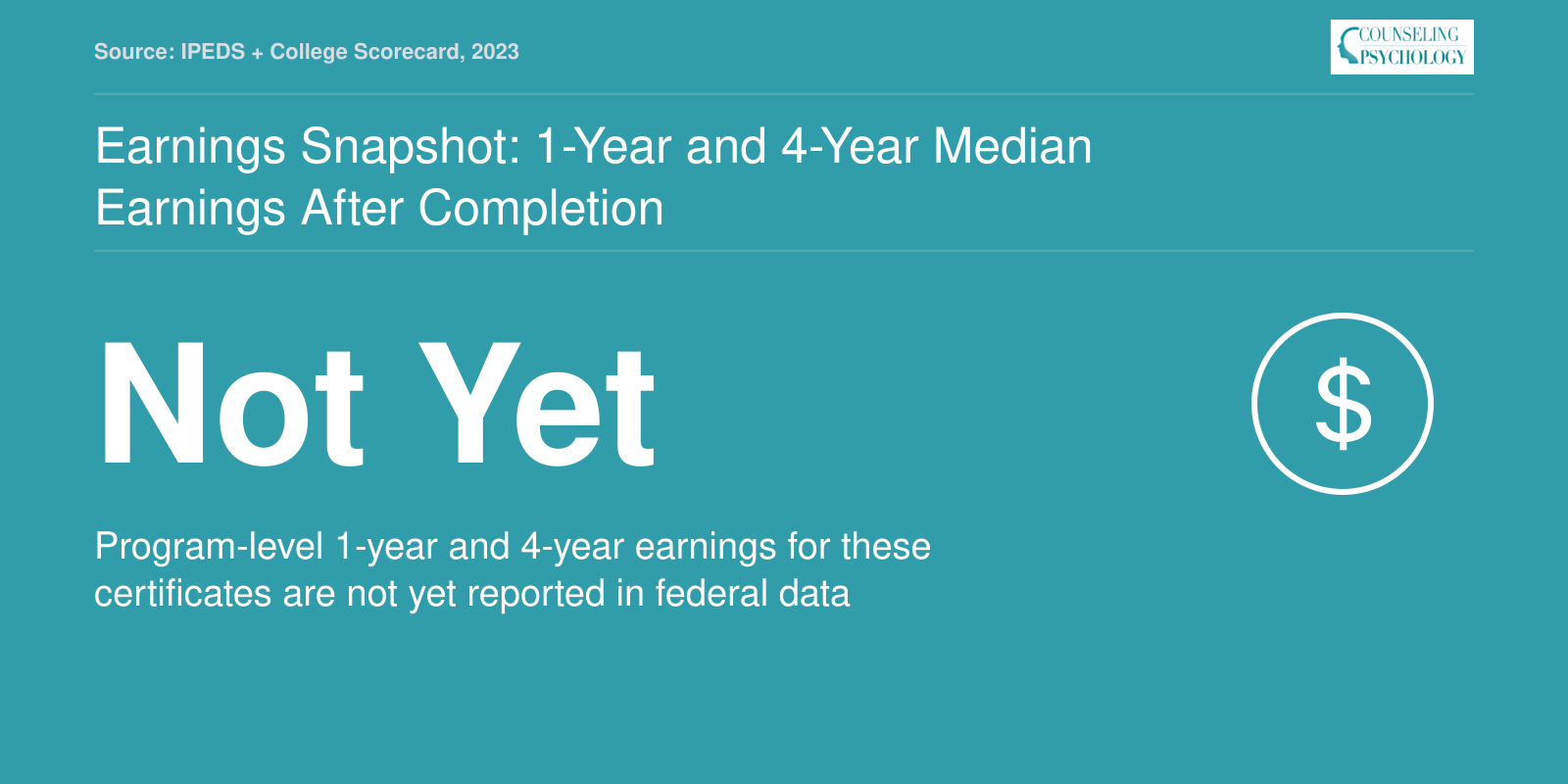
Earnings Snapshot: 1-Year and 4-Year Median Earnings After Completion
Program-level median earnings data for graduate certificate completers is considerably rarer than for degree-level programs. Among the top-ranked online counseling certificates featured in this guide, program-specific earnings at one year and four years after completion are not yet published in federal reporting. This is a common gap for certificate credentials, where small cohort sizes often prevent the release of reliable earnings figures. The institution-level median earnings shown elsewhere in this article reflect all graduates of the university, not certificate completers alone.
Career Outcomes and ROI of a Counseling Certificate
Demand for licensed professional clinical counselors continues to outpace many other professions, driven by expanding mental health parity laws and a growing recognition of behavioral health's role in overall well-being. Earning a graduate certificate positions you to enter a field where need is both acute and projected to accelerate.
Return on Investment: What the Numbers Show
A certificate's ROI hinges on increased earning potential minus total program cost. Nationally, substance abuse, behavioral disorder, and mental health counselors earned a median annual wage of $53,710 in May 2024, according to the U.S. Bureau of Labor Statistics.1 The top 10% earned more than $89,920, while the bottom 10% earned $34,580. Earnings vary significantly by work setting: those in government positions typically earn the highest median wages, followed by hospitals and individual and family services. Completing a certificate that leads to full licensure generally unlocks higher pay bands, as independent practice and supervisory roles command above-median salaries. When comparing program tuition against potential earnings, many graduates recoup their investment within two to four years, assuming steady post-licensure employment.
Job Growth and Market Demand
The BLS projects employment of substance abuse, behavioral disorder, and mental health counselors to grow 18% from 2023 to 2033, much faster than the average for all occupations.1 This translates to approximately 44,000 new openings each year, on average, largely to replace workers who transfer or exit the labor force. Key drivers include the opioid crisis, the expansion of telebehavioral health, and state-level mandates for mental health coverage. Those interested in the addiction treatment space specifically may also consider an online graduate certificate in addiction counseling. Professional associations like the American Counseling Association and the National Board for Certified Counselors consistently report strong demand for licensed professionals, especially in rural and underserved areas where counselor shortages persist.
Salary Expectations Across Settings
Earnings depend heavily on geography and practice setting. While national medians provide a baseline, you should explore state-specific BLS data or NBCC salary surveys, which outline variations by license type and years of experience. For example, counselors in private practice or those who secure National Certified Counselor (NCC) credentials often report higher incomes. Many certificate programs publish graduate employment rates and average starting salaries on their websites; review these closely to calibrate expectations. A certificate from a regionally recognized institution in a high-demand state can yield a quicker return, so always check local labor market conditions.
Maximizing Your Certificate's Value
To enhance ROI, pair your certificate with relevant fieldwork or a practicum that builds a caseload early. Seek programs that offer career services, alumni networks, or employer partnerships. Exploring broader counseling careers through professional directories can also help you identify the highest-demand niches in your area. The ACA and NBCC provide career center resources, job boards, and salary datasets that can guide your negotiation. Ultimately, the certificate's true return is not just financial: it is the ability to enter a stable, purpose-driven career at a time when the nation needs more qualified mental health professionals than ever.
FAQ: Online Counseling Graduate Certificates
Prospective students often have practical questions about how counseling graduate certificates fit into their career and licensure plans. Below are direct answers to the questions we hear most often at counselingpsychology.org.