
What you’ll learn in this article…
- Most online cognitive psychology certificates require 12 to 18 credits and can be completed in 6 to 12 months.
- Tuition varies widely, from roughly $5,000 to over $20,000, depending on residency status and institution.
- Graduates typically pursue UX research, human factors engineering, or applied research roles rather than clinical positions.
- A 3.0 undergraduate GPA is the most common admissions threshold across these programs.
UX research teams, AI product groups, and human factors engineering units now routinely list a cognitive psychology background as a preferred qualification, and the supply of candidates with formal training in attention, memory, and decision-making has not kept pace. A graduate certificate, typically 12 to 18 credits, offers a targeted way to build that vocabulary without committing two years and $40,000+ to a full master's.
The tradeoff is real: certificates rarely confer licensure or independent research credentials, and dedicated online cognitive psychology certificates remain scarce compared with applied behavior analysis or positive psychology options. Most students end up choosing between a deeply focused clinical-research credential and a broader cognitive science offering, and the right pick depends heavily on which industry you are targeting.
Top Online Graduate Certificates in Cognitive Psychology
The programs below are ordered by a quality composite that weighs online delivery availability alongside institution-wide outcomes such as graduation rate, net price, and post-graduation earnings. Because dedicated online graduate certificates in cognitive psychology remain uncommon, this list includes closely related certificates in applied behavior analysis, positive psychology, autism spectrum disorders, and cognitive sciences, all of which share substantial coursework overlap with core cognitive psychology topics like learning, memory, perception, and behavioral assessment. Graduation rates cited are institution-wide figures reported to IPEDS, not specific to any single certificate program.
- Online delivery availability
- Institution-wide graduation rate
- Net price after financial aid
- Post-graduation median earnings
- Program relevance to cognitive psychology
- Independent program research
- NCES-IPEDS federal institutional data — nces.ed.gov
- College Scorecard graduate earnings — collegescorecard.ed.gov
- Internal program database

University of Florida
The University of Florida pairs a strong research university infrastructure with a focused 18-credit online graduate certificate in addiction and recovery that draws on neuroscience and behavioral principles. With an institution-wide graduation rate above 91% and one of the lowest net prices among public flagships at $6,541, UF offers a rigorous pathway for professionals looking to deepen their understanding of the cognitive and neurological underpinnings of substance use disorders.
- 18-credit online certificate completable in one year
- Curriculum covers addiction neuroscience and treatment methods
- Meets educational requirements for addiction counselor certifications
- Non-degree sampling option lets students try courses before committing
- Designed for social workers, counselors, nurses, and physicians
- Taught by faculty specialists in psychiatry and behavioral science
Addiction and Recovery Graduate Certificate — Online

University of Central Florida
UCF stands out on this list because it offers a Cognitive Sciences Graduate Certificate alongside its applied behavior analysis track. The cognitive sciences certificate examines cognitive systems through an interdisciplinary lens, making it the closest match to a pure cognitive psychology credential among ranked programs. UCF also maintains a 78% institution-wide graduation rate and a net price of $10,411.
- 18 credit hours delivered fully online
- Meets Behavior Analyst Certification Board coursework requirements
- Covers advanced behavior analysis, ethics, and supervision
- Prepares students for National Board Certification exam
- Designed for education and psychology graduate students
- No direct certification conferred; exam eligibility only
- 12 credit hours in a fully online format
- State-approved pathway to ASD endorsement
- Includes field-based components at students' own schools
- Completable as standalone or part of a master's program
- Reduced fees for fully online students
- Emphasizes practical skills and positive behavior support
Applied Behavior Analysis Graduate Certificate — Online
Autism Spectrum Disorders Graduate Certificate — Online

Harvard University
Harvard's Extension School offers a Positive Psychology and Well-Being Graduate Certificate that applies research-based cognitive and behavioral strategies to mental and physical health. Four online courses cost a total of $13,760, and students can finish in as few as eight months or stretch over three years. Credits are stackable into Harvard master's degrees in Industrial Organizational Psychology or Psychology, an appealing option for learners who want to continue toward an advanced degree.
- Four online courses at $13,760 total tuition
- Flexible completion window from 8 months to 3 years
- No formal application required to begin coursework
- Minimum B grade required in each course
- Credits stack into select Harvard master's programs
- Summer and fall start terms available
- Full-time and part-time pacing options
Positive Psychology and Well-Being Graduate Certificate — Online

CUNY Hunter College
CUNY Hunter College offers the lowest net price on this list at $2,984, making it an accessible entry point for students in the New York City metro area and beyond. Its 27-credit Advanced Certificate in Applied Behavior Analysis includes supervised practicum experiences and prepares graduates for both BCBA certification and New York State licensure, covering cognitive and behavioral assessment methods in depth.
- 27-credit program with supervised practicum component
- Prepares graduates for BCBA certification and NY State licensure
- Nationally recognized ABA curriculum
- Covers behavioral assessment and intervention strategies
- Hybrid format combines online and in-person learning
- 14:1 student-to-faculty ratio supports individualized mentoring
Advanced Certificate in Applied Behavior Analysis — Hybrid

Florida International University
Florida International University's hybrid graduate certificate in applied behavior analysis blends online coursework with campus sessions across a 12-month timeline. The seven-course, 21-credit sequence costs $12,453 and is structured around BACB requirements, ethical codes, and behavior technologies. FIU's location in Miami and its designation as a Hispanic-Serving Institution add diversity and community engagement strengths.
- 21-credit hybrid program completed in 12 months
- Total program cost of $12,453
- Seven courses covering ABA principles, ethics, and technologies
- Requires enrollment in or completion of a graduate program
- Spring admission only with 3.0 GPA minimum
- Prepares students for Board Certified Behavior Analyst exam
Graduate Certificate in Applied Behavior Analysis — Hybrid

University of Virginia
The University of Virginia's fully online Certificate in Applied Behavioral Analysis focuses on practical competencies such as conducting behavioral assessments and writing treatment plans. Approved by the Behavior Analyst Certification Board, the program can be completed in as few as one semester or spread across seven, giving working professionals significant scheduling flexibility. No GRE is required for admission.
- Fully online with part-time study options
- Completable in 1 to 7 semesters
- Approved by the Behavior Analyst Certification Board
- No GRE required for admission
- Prepares candidates for BCBA or BCaBA exams
- Covers ethics, supervision, and behavioral assessment
- Open to bachelor's or master's degree holders
Certificate in Applied Behavioral Analysis — Online

University of Oklahoma-Norman Campus
The University of Oklahoma delivers its Applied Behavior Analysis Graduate Certificate through 100% synchronous online sessions, letting students participate in real-time lectures from anywhere. The seven-course sequence is a BACB-verified pathway with a particular emphasis on autism and developmental disabilities. Applicants must earn an A or B in the first two ABA courses before full admission.
- 100% synchronous online delivery
- Seven-course BACB-verified sequence
- Emphasis on autism and developmental disabilities
- Admission requires A or B in first two ABA courses
- Covers ABA principles, ethics, and applications
- No financial aid available for certificate-only students
- Designed for flexibility around professional schedules
Applied Behavior Analysis Graduate Certificate — Online

Vanderbilt University
Vanderbilt University's Online Post-Master's Certificate in Applied Behavior Analysis is built for professionals who already hold a master's degree and want advanced ABA training. The fully online curriculum emphasizes leadership, ethical practice, and research-based intervention strategies. Vanderbilt's 93.5% institution-wide graduation rate and 8:1 student-to-faculty ratio reflect the university's commitment to individualized graduate education.
- Fully online format designed for working professionals
- Requires a master's degree in a related field
- Focuses on leadership roles in applied behavior analysis
- Covers ethical ABA practices and intervention strategies
- Financial aid options available for eligible students
- Prepares graduates for careers in education and healthcare
Online Post-Master's Certificate in Applied Behavior Analysis — Online

Auburn University
Auburn University's Graduate Certificate in Intervention for Students with Autism and Developmental Disabilities is a 15-credit-hour program available both online and on campus. It zeroes in on evidence-based practices for improving educational outcomes, making it particularly relevant for special education teachers and human services professionals in Alabama and across the Southeast.
- 15 credit hours with online and on-campus options
- Focus on evidence-based autism intervention practices
- Designed for special education teachers and related professionals
- Addresses critical workforce needs in Alabama public schools
- Covers assessment strategies and behavioral support
- Part of Auburn's College of Education program portfolio
Graduate Certificate in Intervention for Students with Autism and Developmental Disabilities — Online

University of South Florida
The University of South Florida offers a fully online Graduate Certificate in Autism Spectrum Disorder that emphasizes assessment, diagnosis, and the integration of technology into teaching strategies. Completable in one to two years, this program is tailored for educators who want to deepen their expertise in positive behavior support and ASD-specific instruction, with credits potentially applicable toward further graduate study at USF.
- Fully online program completable in 1 to 2 years
- Focus on ASD assessment, diagnosis, and teaching strategies
- Emphasizes technology integration and positive behavior support
- Credits may transfer toward further USF graduate study
- Designed for educators seeking advanced ASD expertise
- Net price of $9,812 among the lowest on this list
Graduate Certificate in Autism Spectrum Disorder — Online
How We Ranked These Cognitive Psychology Certificate Programs
A ranking methodology is the set of rules and data points used to compare programs and sort them in order of quality, cost, and student outcomes. Our approach combines online delivery eligibility with a composite of institutional quality signals drawn from the most recent public federal datasets, then applies transparent weighting criteria to produce an ordered list.
What Makes a Program Eligible
Every certificate program included in this ranking must meet three baseline criteria. First, the program must be available entirely online or in a hybrid format that does not require campus attendance for the majority of coursework. Second, the host institution must hold regional accreditation recognized by the U.S. Department of Education. Third, the curriculum must focus explicitly on cognitive psychology, cognitive neuroscience, or closely related applied cognition topics rather than general psychology or counseling.
Data Sources and Snapshot Year
We pull institutional-level metrics from the Integrated Postsecondary Education Data System (IPEDS) and the College Scorecard, both maintained by the Department of Education. The snapshot year for graduation rates, net price, and median earnings is the most recent release available as of spring 2026, typically reflecting cohorts from two to four years prior. All Scorecard employment and earnings figures represent institution-wide aggregates, not program-specific outcomes, because the federal government does not publish certificate-level earnings data.
Limitations and What the Numbers Actually Represent
Graduation rates in our composite reflect the six-year completion percentage for first-time, full-time undergraduates at the institution, not graduate certificate students. Net price is the average annual cost after grant aid for undergraduates, not the sticker tuition for a graduate certificate. These proxies offer a directional quality signal but do not describe the certificate cohort itself. We disclose these limitations because transparency around data scope is a core component of expertise and trustworthiness.
Why This Methodology Differs
Many competitor rankings rely on surveys, reputation votes, or undisclosed weighting formulas. We use only public federal data, apply consistent scoring rules across all programs, and publish the full methodology so prospective students can understand exactly what each rank reflects. This open-data approach aligns with current standards for evidence-based educational guidance and helps readers evaluate rankings critically rather than accept them at face value.
What You'll Learn in a Cognitive Psychology Graduate Certificate
Clinical-track students dive deep into assessment and intervention, while applied-track graduates master interface design and user research. Cognitive psychology certificate curricula diverge sharply along these two paths, and understanding the difference is essential before you enroll.
Core Curriculum: The Cognitive Foundations
Most programs require 12 to 15 graduate credits, typically completed through four to five courses. The University of Kansas, for example, structures its Graduate Certificate in Mind, Brain & Education around 12 credits (three required courses plus one elective)2, while the University of Memphis Cognitive Science Graduate Certificate spans 15 credits, including a required seminar.3 Across programs, expect coursework in perception, memory, attention, and decision-making. Nearly every certificate includes neuroscience foundations, introducing students to brain anatomy, neural mechanisms, and the biological basis of cognition. This base layer applies whether you plan to conduct human factors research in tech or pursue clinical work in neuropsychology.
Applied vs. Clinical Emphasis
Curriculum emphasis varies widely. Some certificates lean clinical, preparing students for roles in assessment, cognitive rehabilitation, or health psychology. Others focus on applied cognition, with electives in human factors engineering, user-experience research, or cognitive modeling. If you are interested in tech, look for programs offering coursework in cognitive ergonomics or usability testing. If your goal is eventual clinical licensure, verify that the certificate includes abnormal psychology or cognitive assessment courses that align with your state's practicum requirements. Students pursuing a broader counseling graduate certificate may find complementary coursework that strengthens their clinical foundation.
Completion Timelines and Stackable Credits
Full-time students typically finish in 12 months, taking two courses per term. Part-time learners often stretch the program to 18 to 24 months, enrolling in one course at a time while balancing work or family obligations. Many universities allow certificate credits to stack toward a master's degree if you later decide to continue. The University of Kansas and similar institutions formally incorporate certificate coursework into their MA or MS tracks, meaning your 12 credits become the first year of a two-year degree.2 Confirm this pathway exists before you enroll, and ask admissions whether the certificate requires a separate application or automatically bridges into the master's program.
What to Look for When Comparing Programs
Evaluate whether a program includes research methods training. Strong certificates teach experimental design, data analysis, and either quantitative modeling or qualitative coding. These skills matter in both clinical and applied roles. Check course descriptions for hands-on projects: programs that require capstone assignments, simulations, or practicum hours offer better preparation than lecture-only formats. Finally, review faculty expertise. If cognitive aging is your interest, ensure at least one instructor publishes in that domain. If you want to study attention disorders, look for faculty with active labs in ADHD or executive function research.
Questions to Ask Yourself
Cognitive Psychology Certificate Vs. Cognitive Science Certificate
The choice between these two credentials usually comes down to depth versus breadth: do you want to go deeper into how the human mind works, or wider across the disciplines that study cognition from every angle? The names sound interchangeable, but the curricula, methods, and downstream career paths diverge in ways worth understanding before you enroll.1
What a Cognitive Psychology Certificate Covers
A cognitive psychology certificate sits squarely within the psychology department. Coursework centers on mental processes in humans: memory, perception, attention, language processing, and decision-making. Methods lean heavily on psychological experiments and behavioral research, which means you will spend time on experimental design, statistical analysis of human subjects data, and the empirical literature on how people think, learn, and remember.
This path makes sense if you are already trained in psychology (or plan to be) and want to specialize. It also pairs well with applied goals in clinical assessment, user research, education, or doctoral preparation. Students weighing longer-term options may want to explore cognitive psychology phd programs as a natural next step.
What a Cognitive Science Certificate Covers
A cognitive science certificate is interdisciplinary by design. Rather than living inside one department, it pulls from psychology, computer science, linguistics, philosophy, and neuroscience. Expect coursework that mixes traditional psychology with artificial intelligence, programming, formal logic, philosophy of mind, and computational modeling of cognition.
The methods reflect that breadth. You might run a behavioral study in one course, build a neural network in another, and analyze the structure of language in a third. Cognitive science suits students aiming at AI and machine learning roles, human-computer interaction, computational linguistics, or research programs that treat the mind as an information-processing system across biological and artificial substrates.
How to Choose
If your questions are about people, including how they remember, decide, and perceive, cognitive psychology is the tighter fit. If your questions are about cognition itself, wherever it shows up (human brains, machines, language systems), cognitive science gives you the wider toolkit. For students curious about what the day-to-day work looks like, learning how to become a cognitive psychologist can clarify which credential aligns with your goals. Both can feed into graduate study, but they prepare you for different conversations once you get there.
Tuition Comparison: Online Cognitive Psychology Certificate Costs
Cost is one of the first factors students weigh when choosing a graduate certificate, and the range across these programs is wider than many people expect. The table below lists annual institutional tuition rates (in-state and out-of-state) as reported to IPEDS, along with the average net price after aid, so you can compare sticker price against what students actually pay. Keep in mind that certificate-specific tuition may differ from the institution-wide figures shown here; always confirm current per-credit rates directly with each program.
| School | State | In-State Tuition | Out-of-State Tuition | Avg. Net Price | Median Graduate Debt | Student-Faculty Ratio |
|---|---|---|---|---|---|---|
| CUNY Hunter College | NY | $11,398 | $20,828 | $2,984 | $11,000 | 14:1 |
| Fort Hays State University | KS | $4,949 | $12,745 | $12,569 | $21,000 | 15:1 |
| University of Florida | FL | $12,737 | $30,130 | $6,541 | $15,000 | 16:1 |
| University of Central Florida | FL | $8,872 | $28,657 | $10,411 | $18,190 | 28:1 |
| Florida International University | FL | $11,334 | $24,439 | $9,288 | $16,500 | 24:1 |
| University of South Florida | FL | $10,428 | $21,126 | $9,812 | $17,988 | 22:1 |
| California State University, San Marcos | CA | $9,606 | $19,686 | $10,229 | $17,350 | 24:1 |
| University of Colorado Denver | CO | $9,298 | $27,154 | $11,900 | $20,500 | 17:1 |
| Northern Arizona University | AZ | $13,023 | $19,306 | $14,158 | $19,000 | 19:1 |
| University of Wisconsin, Whitewater | WI | $10,543 | $21,603 | $14,158 | $23,188 | 21:1 |
Career Outcomes: What Can You Do With a Cognitive Psychology Certificate?
A cognitive psychology graduate certificate prepares you for roles where understanding how people think, perceive, and make decisions translates directly into product design, research, and systems optimization. Unlike a clinical credential, this certificate positions you at the intersection of behavioral science and technology, opening doors in sectors that increasingly value human-centered expertise.
Where Certificate Holders Typically Land
Graduates commonly pursue roles such as:
- UX Researcher: Designs and conducts studies on how users interact with digital products, then translates findings into actionable design recommendations.
- Human Factors Engineer or Ergonomist: Applies cognitive and perceptual principles to system design in industries like aviation, healthcare technology, and defense.
- Cognitive Data Analyst: Supports AI and machine-learning teams by informing models with insights about human cognition, attention, and decision-making.
- Learning Experience Designer: Builds training programs and educational technology grounded in how memory, attention, and motivation actually work.
- Applied Research Scientist: Conducts experimental research for tech companies, government labs, or consulting firms focused on human performance.
Gauging the Job Market
Because cognitive psychology roles span multiple occupational categories, no single BLS code captures the full picture. The closest federal classifications include Psychologists, All Other (SOC 19-3039) and Human Factors Engineers and Ergonomists (SOC 17-2112). For UX-adjacent positions, the BLS groups relevant work under Market Research Analysts (SOC 13-1161) or Management Analysts (SOC 13-1111). Check the Occupational Outlook Handbook at bls.gov for the most current national median wages and projected growth rates under each of these codes, and note that growth projections cover a 10-year window.
Beyond federal data, professional organizations publish salary surveys and demand reports that zero in on cognitive psychology specializations. The Human Factors and Ergonomics Society (hfes.org) regularly releases compensation benchmarks, while the User Experience Professionals Association (uxpa.org) tracks hiring trends and skill requirements across the UX field.
Tracking Real-Time Demand
Government statistics lag the market by a year or more, so supplement them with current job postings. Search LinkedIn or Indeed for terms like "cognitive science UX," "human factors AI," or "cognitive psychology research" and note which skills employers list most often. Pay attention to salary ranges cited in those postings, as they reflect what companies are willing to pay right now, not what a lagging survey reported 18 months ago.
Google Scholar and practitioner-focused outlets such as the Nielsen Norman Group publish employer demand reports and case studies showing how cognitive psychology principles drive product and AI strategy. University career pages at research-intensive institutions also sometimes share placement data for graduates with cognitive psychology credentials.
A Practical Note on Expectations
A graduate certificate alone will not qualify you for licensure as a psychologist or place you in a senior research scientist role that requires a doctoral degree. What it does is add a documented, graduate-level competency in cognitive science that strengthens an existing resume, particularly if you already hold a bachelor's or master's degree in a related field. Many certificate holders use the credential as a stepping stone: gaining enough expertise and professional vocabulary to land an initial role, then deciding whether a full master's or doctoral program is worth pursuing based on where their career trajectory leads.
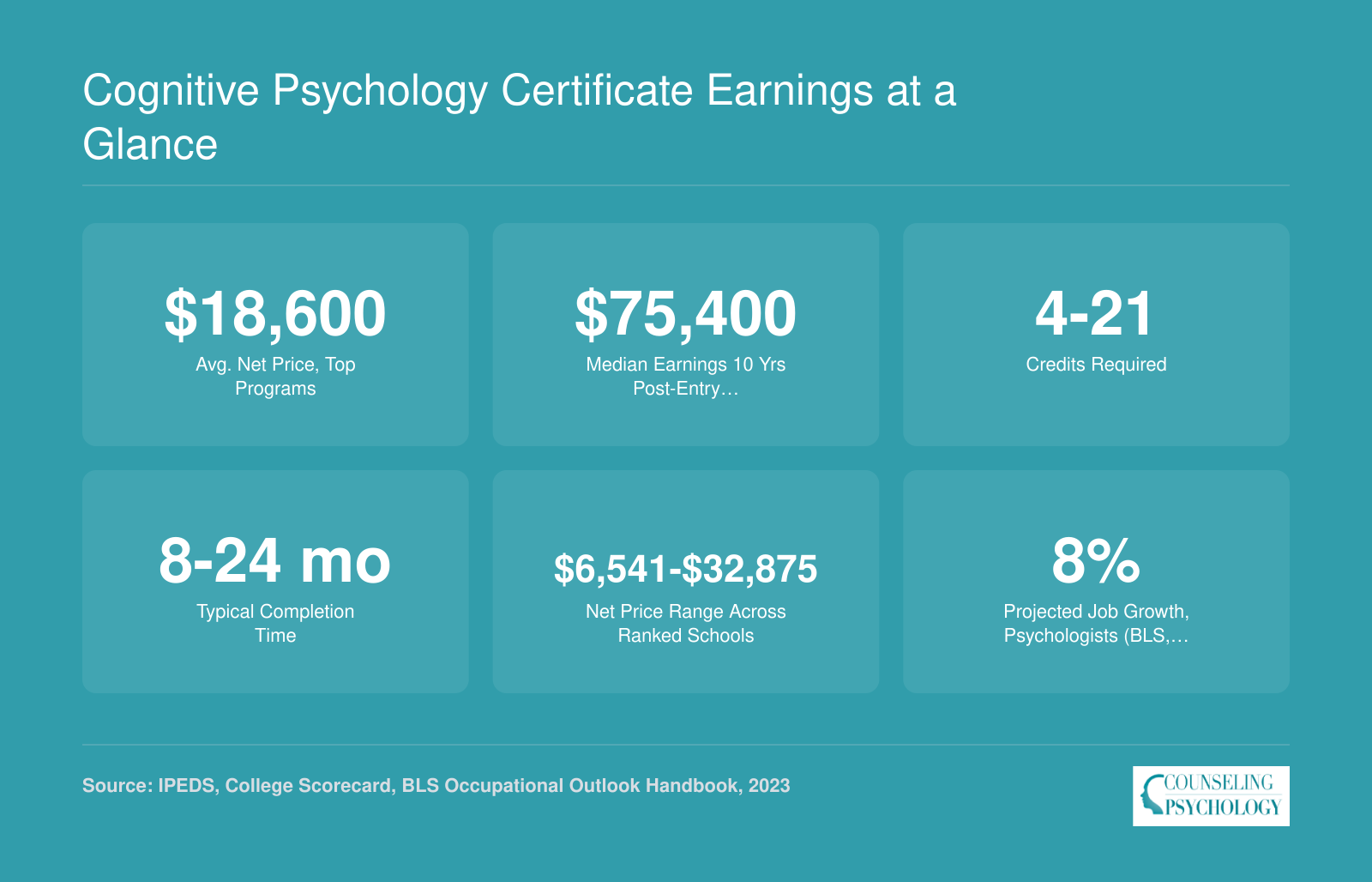
Cognitive Psychology Certificate Earnings at a Glance
Program-level earnings data for these graduate certificates are not yet published, so the figures below draw on institution-wide outcomes and published program costs to give you a quick ROI snapshot. Actual returns will vary by your prior experience, employer, and whether you stack the certificate into a full master's degree.
Admissions Requirements and How to Apply
A 3.0 undergraduate GPA is the most common minimum threshold you will encounter across online graduate certificates in cognitive psychology, though a few programs set slightly different benchmarks or evaluate applicants holistically.
Who Is Eligible
Most programs accept applicants holding any bachelor's degree, not strictly one in psychology. If your undergraduate major was in education, neuroscience, computer science, linguistics, or another related discipline, you will typically qualify. Several programs also welcome working professionals from non-psychology backgrounds who can demonstrate relevant experience in research, education, healthcare, or technology. The University of Kansas Mind, Brain and Education certificate, for example, requires a bachelor's degree in any field alongside that 3.0 GPA floor.2 If you are wondering how hard it is to get into grad school for psychology, certificate programs generally have a lower admissions bar than master's or doctoral tracks.
GRE and Standardized Tests
Graduate certificates in this space have largely moved away from standardized test requirements. None of the programs reviewed for this article, including those at USC and the University of California campuses at Riverside, Los Angeles, and Irvine, require GRE scores.3456 Some programs may ask for a statement of purpose or a professional resume in lieu of test scores, giving you the chance to contextualize your academic record and career goals.
Standard Application Materials
While exact requirements vary by institution, plan to prepare the following:
- Official transcripts: From every college or university you have attended.
- Personal statement or statement of purpose: Typically 500 to 1,000 words explaining your interest in cognitive psychology and your professional objectives.
- Letters of recommendation: One to two letters from academic or professional references.
- Resume or CV: Especially important if you are applying with a non-psychology background.
- Application fee: Usually in the $50 to $75 range, though some schools waive this for online applicants.
Prerequisite coursework in introductory psychology or statistics is requested by certain programs, but others will let you complete foundational courses concurrently or substitute professional experience.
Application Timelines
Many online certificate programs offer rolling admissions or multiple start dates throughout the year, sometimes as many as three to four entry points per calendar year. This flexibility is a genuine advantage if you are balancing work or family commitments and cannot wait for a traditional fall deadline. That said, programs with cohort models may have firmer cutoff dates, so confirm each school's specific timeline well in advance.
An online graduate certificate in cognitive psychology typically takes just 6 to 12 months to complete part-time, costs far less than a full master's degree, and positions you for growth areas like UX research and human factors engineering, making it one of the most efficient credential investments available in applied psychology today.
Frequently Asked Questions About Cognitive Psychology Certificates
Prospective students often have similar questions before committing to an online graduate certificate in cognitive psychology. The answers below draw on current program data, accreditation standards, and career research covered throughout this article.
More Online Cognitive Psychology Certificate Programs to Consider
The programs below offer additional options in cognitive psychology and related behavioral sciences. Each provides specialized training to enhance your expertise and career prospects in the field.
- Graduate Certificate in Applied Behavior Analysis
- Applied Behavior Analysis Certificate
- Applied Behavior Analysis Certificate (Autism Spectrum Disorder)
- Graduate Certificate in Applied Behavior Analysis
- Graduate Certificate in Autism Spectrum Disorder
- Graduate Certificate in Autism
- Teaching Students with Autism Spectrum Disorder Graduate Certificate
- Culturally-Centered Addictions Research Training
- Autism Spectrum Disorders Certificate
- Applied Behavior Analysis Graduate Credit Certificate Program
- Educating Individuals with Autism Postbaccalaureate Credit Certificate
- Applied Behavior Analysis Graduate Certificate
- Online Positive Psychology Graduate Certificate
- Graduate Certificate in Applied Behavior Analysis
- Graduate Certificate in Applied Behavior Analysis
- Graduate Certificate in Autism and Applied Behavior Analysis
- Graduate Certificate in Applied Behavior Analysis
- Positive Psychology
- Applied Behavior Analysis Graduate Certificate
- Autism Specialist - Online Graduate Certificate
- Applied Behavior Analysis Certificate of Advanced Study
- Graduate Certificate in Applied Behavior Analysis