
What you’ll learn in this article…
- Most online cognitive psychology programs require 30 to 42 credit hours, completable in roughly 18 to 30 months.
- Few fully online programs focus exclusively on cognitive psychology; most sit under experimental psychology umbrellas.
- This degree does not lead to clinical licensure in any U.S. state, so career paths center on research and applied roles.
- California, New York, and New Jersey rank among the highest-paying states for psychologists according to BLS data.
Unlike clinical psychology master's degrees that build toward licensure and therapy, a master's in cognitive psychology is a research degree. It trains students to investigate mental processes (memory, attention, perception, decision-making, language) using scientific methods rather than treating disorders.
Fully online options are scarce. Most graduate research training still expects on-campus collaboration, so verifying a program's delivery mode and accreditation demands scrutiny.
The degree opens doors to roles in UX research, human factors, or academic labs, but it does not qualify graduates for clinical practice. That requires a counseling master's program or clinical psychology pathway.
What You'll Learn in a Cognitive Psychology Master's Program
A cognitive psychology master's curriculum trains you to investigate how people perceive, remember, reason, and solve problems. Courses blend psychological theory with research methods, preparing you to study mental processes in laboratory, clinical, or applied settings.
Core Coursework
Most programs share a common foundation that covers the science of cognition and the skills needed to conduct original research. Expect to encounter courses such as:
- Cognitive Processes: Examines attention, perception, memory encoding, and retrieval mechanisms.
- Research Methods and Statistics: Covers experimental design, data analysis (often including ANOVA and regression), and interpretation of behavioral findings.
- Cognitive Neuroscience: Explores the neural substrates of thought, including brain imaging techniques and lesion studies.
- Learning and Memory: Investigates how knowledge is acquired, stored, and retrieved across the lifespan.
- Language and Thought: Analyzes sentence processing, speech production, and the relationship between language and cognition.
Some curricula add electives in human factors, artificial intelligence, or developmental cognition, depending on the program's research strengths.
Concentration Areas
Many online programs let you specialize. At University of North Florida, for instance, students can focus on neuroscience tracks or applied cognitive research, while Southern New Hampshire University emphasizes experimental methods and general psychological inquiry. Concentrations worth investigating include:
- Human factors and ergonomics
- Neuroscience and brain-behavior relationships
- Applied cognition for educational or workplace settings
The Bureau of Labor Statistics projects strong demand in sectors tied to human factors engineering and user experience research, so choosing a concentration aligned with industry needs can sharpen your competitiveness after graduation.
Thesis, Capstone, or Comprehensive Exam
Programs typically require a culminating experience. A thesis option suits students aiming for doctoral study or research careers; it involves designing an original study, collecting data, and defending your findings before a faculty committee. Capstone projects, by contrast, may involve applied work such as designing a cognitive assessment tool or reviewing literature for an organization. Some schools offer a comprehensive examination instead, testing breadth of knowledge across core areas.
Finding Detailed Curriculum Information
Not every program publishes its full course list online. To get accurate details, navigate to a university's official site and locate the Program Requirements or Curriculum tab. If details are sparse, reach out to program coordinators by email or phone. Comparing cognitive psychology programs alongside online master's in psychology programs can also help you gauge how curricula differ across specializations. Professional associations like the American Psychological Association and the Cognitive Science Society maintain directories and curricular guidelines that clarify what accredited programs typically include.
Accredited Online Cognitive Psychology Master's Programs
Tracking down a true cognitive psychology master's delivered entirely online is harder than finding a general experimental psychology program with a cognitive elective or two. Most universities group cognitive coursework under experimental or research psychology umbrellas, and only a handful run dedicated cognitive tracks at the master's level. The programs below reflect the 2025-2026 academic year and represent the clearest options for distance learners who want cognitive psychology as a core focus or concentration.
Regional Accreditation and Why APA Doesn't Apply Here
Every school listed here holds regional accreditation from its respective agency (Northwest Commission on Colleges and Universities, New England Commission of Higher Education, Higher Learning Commission, and so on). Regional accreditation matters for federal financial aid, transfer credit, and employer recognition. You may notice that none of these programs advertise APA accreditation. That credential applies exclusively to doctoral programs in clinical psychology, counseling psychology, and school psychology. Master's programs in cognitive, experimental, or general psychology do not seek or receive APA approval, so its absence here is expected and appropriate.
Programs Currently Offering Online or Hybrid Cognitive Psychology Master's Degrees
- University of Oregon (Online Master's in Psychology): Fully online, 49 credits, approximately $38,100 total tuition.1 The program allows students to specialize in cognitive psychology through elective selection and a thesis or capstone project. No GRE required. This is a general psychology master's with cognitive concentration options rather than a dedicated cognitive degree.
- Purdue University (Cognitive Psychology, MS): Hybrid format requiring some on-campus participation.2 Purdue's program is one of the few explicitly titled Cognitive Psychology at the master's level. Credit hours and tuition details vary by residency and enrollment term; contact the department directly for current figures. The hybrid structure typically involves intensive weekend residencies or a limited number of in-person lab sessions per semester.
- Colorado Christian University (Master of Science in Psychology): Fully online, 36 credits. No GRE required.3 This is a general psychology master's that permits cognitive concentration through elective coursework. Tuition runs approximately $700 per credit hour as of 2025-2026, placing total program cost near $25,200. The program emphasizes integration of faith and psychology, which may appeal to students seeking a Christian academic environment.
- Harvard Extension School (Master of Liberal Arts in Psychology): Hybrid format requiring some on-campus coursework in Cambridge, Massachusetts. Total requirement is 48 credits. No GRE.4 This is a general psychology ALM with options to focus on cognitive psychology through thesis and elective selection. Tuition for Extension courses is approximately $3,000 per four-credit course as of 2025-2026, bringing estimated total cost to $36,000. Harvard Extension admits students provisionally and requires successful completion of prerequisite courses before full degree candidacy.
What to Look for Beyond Delivery Format
When comparing programs, check whether the curriculum includes core cognitive courses such as cognitive neuroscience, memory and learning, perception, psycholinguistics, and computational modeling. Some programs lean heavily toward applied cognitive work (human factors, user experience research), while others emphasize experimental lab methods and theory. If your goal is a research-focused PhD in cognitive psychology afterward, prioritize programs that require a thesis, offer independent research credits, and provide faculty mentorship in active cognitive labs. If you plan to move into applied roles in UX research, instructional design, or market research, look for programs with capstone projects, data analytics training, and elective tracks in applied cognition.
Questions to Ask Yourself
Admissions Requirements and Prerequisites
Applying to a cognitive psychology master's program involves more than submitting transcripts. Admissions committees look at academic history, professional goals, and often prior exposure to research. Here is what to expect at most programs.
GPA and Test Score Expectations
A 3.0 undergraduate GPA is the standard floor at many programs, though competitive applicants frequently come in higher. The University of Florida, for example, sets a 3.0 minimum for its graduate psychology programs while noting that applicants below that threshold may be considered under special circumstances.1 At the doctoral level there, recent admitted cohorts have averaged around 3.8.1
On the GRE front, the landscape has shifted considerably. A growing number of programs have moved to GRE-optional or GRE-waiver policies, and that trend has continued into 2026. Pepperdine University's online MA in Psychology does not require the GRE at all.2 Because policies change year to year, always confirm directly with each program before you apply.
Prerequisite Coursework
Most programs expect some foundation in psychology, statistics, and research methods. The University of Florida lists prerequisites that include statistics, biological bases of behavior, developmental changes, learning and cognition, and sociocultural or individual differences.1 Programs with a cognitive or neuroscience emphasis may also want a course in biology or introductory neuroscience.
That said, not every program requires a psychology undergraduate degree. Pepperdine accepts applicants from any undergraduate field.2 Several other programs actively recruit candidates from neuroscience, computer science, and linguistics, recognizing that cognitive psychology sits at the intersection of those disciplines. If your background is in one of those areas, it is worth identifying programs that treat it as an asset rather than a gap.
Application Materials
Beyond transcripts, most programs ask for:
- Statement of purpose: Your research interests, professional goals, and reasons for pursuing this specific program
- Letters of recommendation: Usually two to three; Pepperdine requires two2
- Writing sample or research description: Some programs want evidence of prior scholarly work or a description of any research you have participated in
Research Experience: Required or Welcomed
This is one of the sharper dividing lines among programs. Research-focused programs, especially those tied to a thesis track, often expect applicants to have some hands-on research background, whether through an undergraduate lab, a capstone project, or a professional role. Other programs are explicitly designed for career-changers and working professionals with no research history.
When comparing programs, treat this distinction as a practical filter. If your background is in teaching, healthcare, or technology and you are pivoting toward applied cognitive work, look for programs that frame career-changer admissions as a feature rather than an exception.
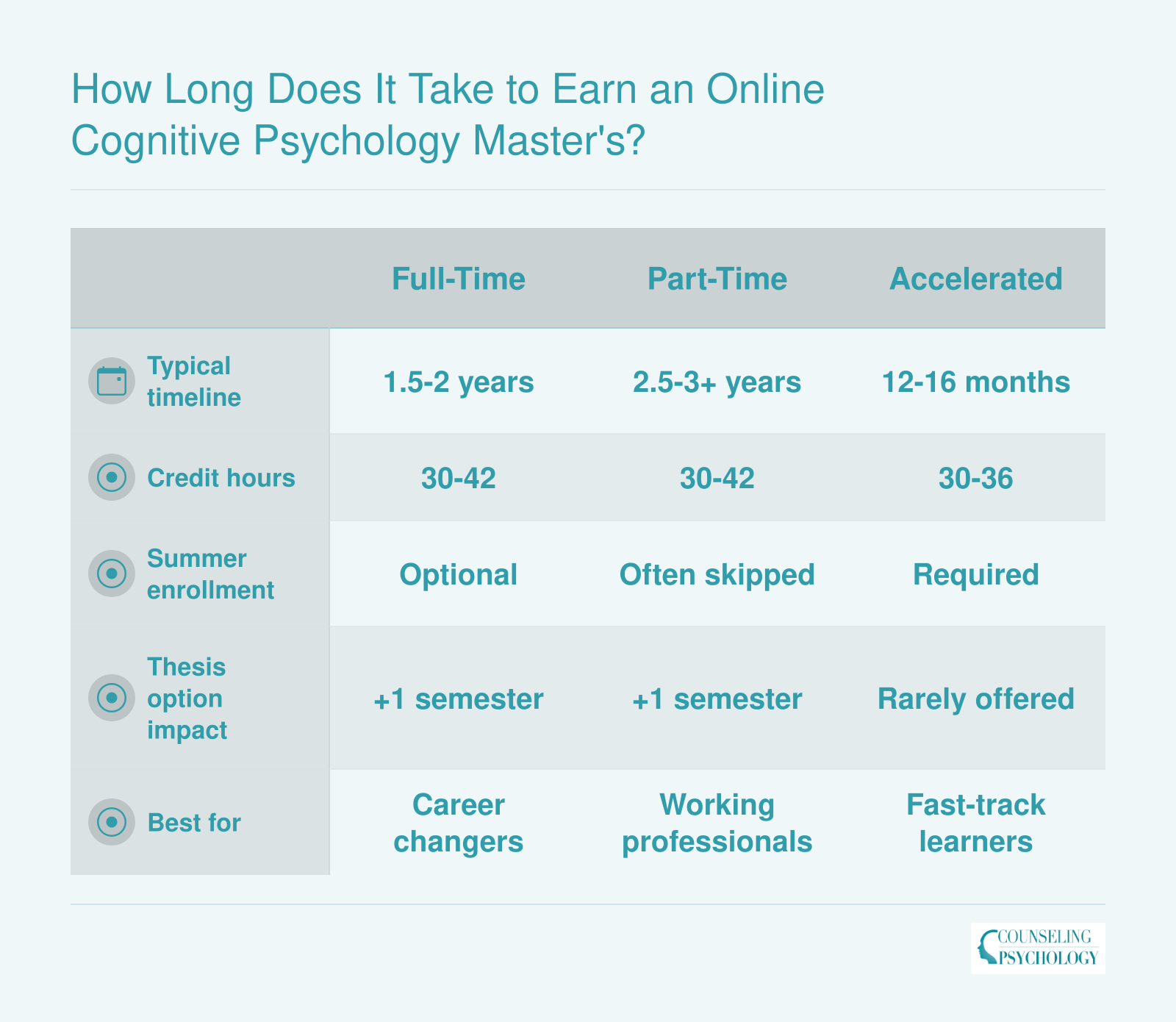
How Long Does It Take to Earn an Online Cognitive Psychology Master's?
Program length depends on your enrollment pace, whether you take summer courses, and whether your program requires a thesis. Most online cognitive psychology master's programs fall in the 30 to 42 credit-hour range, giving students real flexibility in how quickly they finish.
Cognitive Psychology Master's Vs. Cognitive Science Master's
These two degrees share overlapping territory but are built for different destinations, and choosing the wrong one can cost you time when you try to advance.
Disciplinary Focus and Home Department
A master's in cognitive psychology lives inside a psychology department. The curriculum centers on how people perceive, remember, reason, and communicate, drawing almost entirely on psychological theory and experimental research.1 A cognitive science master's, by contrast, is an explicitly interdisciplinary construction, pulling from computer science, linguistics, philosophy, neuroscience, and psychology simultaneously.1 Programs like the M.S. in Cognitive Science at Indiana University or the offerings at Johns Hopkins reflect this breadth by design, asking students to engage with computational modeling and symbolic systems alongside the behavioral research familiar to psychologists.
Coursework and Methods
The difference shows up clearly in how students spend their time:
- Cognitive psychology track: Behavioral experiments, statistical analysis, and deep dives into core cognitive domains such as memory, attention, and language processing. Programming is optional or minimal.
- Cognitive science track: Behavioral methods sit alongside computational modeling, neuroimaging, and programming-heavy coursework. Expect to engage with AI and formal language theories in ways a psychology curriculum rarely requires.
Neither approach is more rigorous than the other. They are simply calibrated for different questions.
Career Paths and the PhD Pipeline
If your goal is a psychology PhD, the cognitive psychology master's is the more direct path. Doctoral programs in psychology expect applicants who have run behavioral experiments, analyzed data with standard psychological statistics packages, and worked within a recognizable theoretical tradition in the field. Admissions committees know what they are getting.
For roles in UX research, human-computer interaction, data science, or AI-adjacent positions, either degree can work, and the cognitive science credential may actually open more doors in technology-focused hiring. The interdisciplinary framing signals comfort with computational thinking that many employers in those sectors value. If you are exploring the broader landscape, our overview of careers in psychology covers many of the paths where these degrees apply.
If you are aiming for an interdisciplinary PhD spanning linguistics, AI, or cognitive neuroscience, cognitive science is typically the stronger fit.
How to Decide
Ask two questions. First, which faculty research do you want to join? If those researchers publish in psychology journals and run behavioral labs, match their degree type. Second, what does your target PhD program or employer actually expect? A quick review of recent admits to your target programs, or job postings in your target field, will answer this faster than any program brochure.
Related Articles
Career Paths and Salary Outlook for Cognitive Psychology Graduates
The biggest misconception about a cognitive psychology master's is that it leads to clinical practice. It does not. Across all 50 states, this degree does not qualify graduates to sit for licensure as a Licensed Professional Counselor, Licensed Marriage and Family Therapist, or licensed psychologist. Those credentials require degrees in clinical or counseling psychology, social work, or counseling, along with supervised clinical hours. For example, students interested in therapeutic practice would need to pursue a path to become a clinical psychologist instead. Cognitive psychology is a research discipline focused on how people perceive, learn, remember, and decide, not a clinical one.
Roles a Master's Qualifies You For Directly
With a master's in hand, graduates typically move into applied research and analyst roles where experimental design, statistical analysis, and an understanding of human behavior carry weight:
- UX researcher: Conducts usability studies, interviews, and behavioral experiments for technology and product teams. A master's is often sufficient, though competition is heavy.
- Human factors specialist: Applies cognitive principles to interface design, aviation, healthcare devices, and defense systems. Many employers accept a master's; some prefer human factors or engineering psychology specifically.
- Research analyst or coordinator: Manages studies at universities, hospitals, think tanks, or government labs. A master's is the standard entry credential.
- Market research analyst: Uses experimental methods and survey design to study consumer decision-making.
- Academic research assistant or lab manager: A common bridge role for graduates preparing to apply to doctoral programs.
Roles That Require a Doctorate
Independent academic positions, principal scientist roles at industry labs, and the title "psychologist" itself generally require a PhD. Many cognitive psychology master's students treat the degree explicitly as PhD preparation, using it to strengthen research experience, publications, and faculty recommendations before applying to doctoral programs in cognitive, experimental, or developmental psychology.
Employment Outlook
The Bureau of Labor Statistics does not publish a standalone occupation code for cognitive psychologists; the field is folded into broader categories under SOC 19-3033 and 19-3039.1 BLS projects 6% growth for psychologists overall from 2024 to 2034, with industrial-organizational psychologist roles at 6.3% and the "psychologists, all other" category (where many research roles fall) at 4.3%.2 Clinical and counseling psychologists are projected to grow faster at 11.2%, but again, that path requires different training.2
Because graduates spread across UX, human factors, market research, and academic settings, salary data lives under several occupation categories. The table that follows breaks down what each path typically pays.
Salary by Occupation: What Cognitive Psychology Graduates Can Earn
The table below shows national salary data from the Bureau of Labor Statistics for occupational categories commonly associated with cognitive psychology training. Because BLS data maps to broad Standard Occupational Classification (SOC) codes rather than specific degree fields, these figures represent entire occupational groups, not exclusively individuals who hold a cognitive psychology degree. That said, the range is instructive: industrial-organizational psychologists report a national median well above the broader psychologist category, while school psychologists tend to cluster in a narrower, more moderate band.
| Occupation | Total Employment | 25th Percentile | Median Salary | 75th Percentile | Mean Salary |
|---|---|---|---|---|---|
| Industrial-Organizational Psychologists | 1,050 | $80,790 | $109,840 | $198,170 | $134,400 |
| Psychologists, All Other | 17,790 | $73,820 | $117,580 | $145,200 | $111,340 |
| Clinical and Counseling Psychologists | 72,190 | $67,470 | $95,830 | $131,510 | $106,850 |
| Psychologists (Broad Category) | 154,860 | $71,140 | $94,310 | $126,340 | $102,100 |
| School Psychologists | 63,830 | $73,240 | $86,930 | $108,210 | $93,610 |
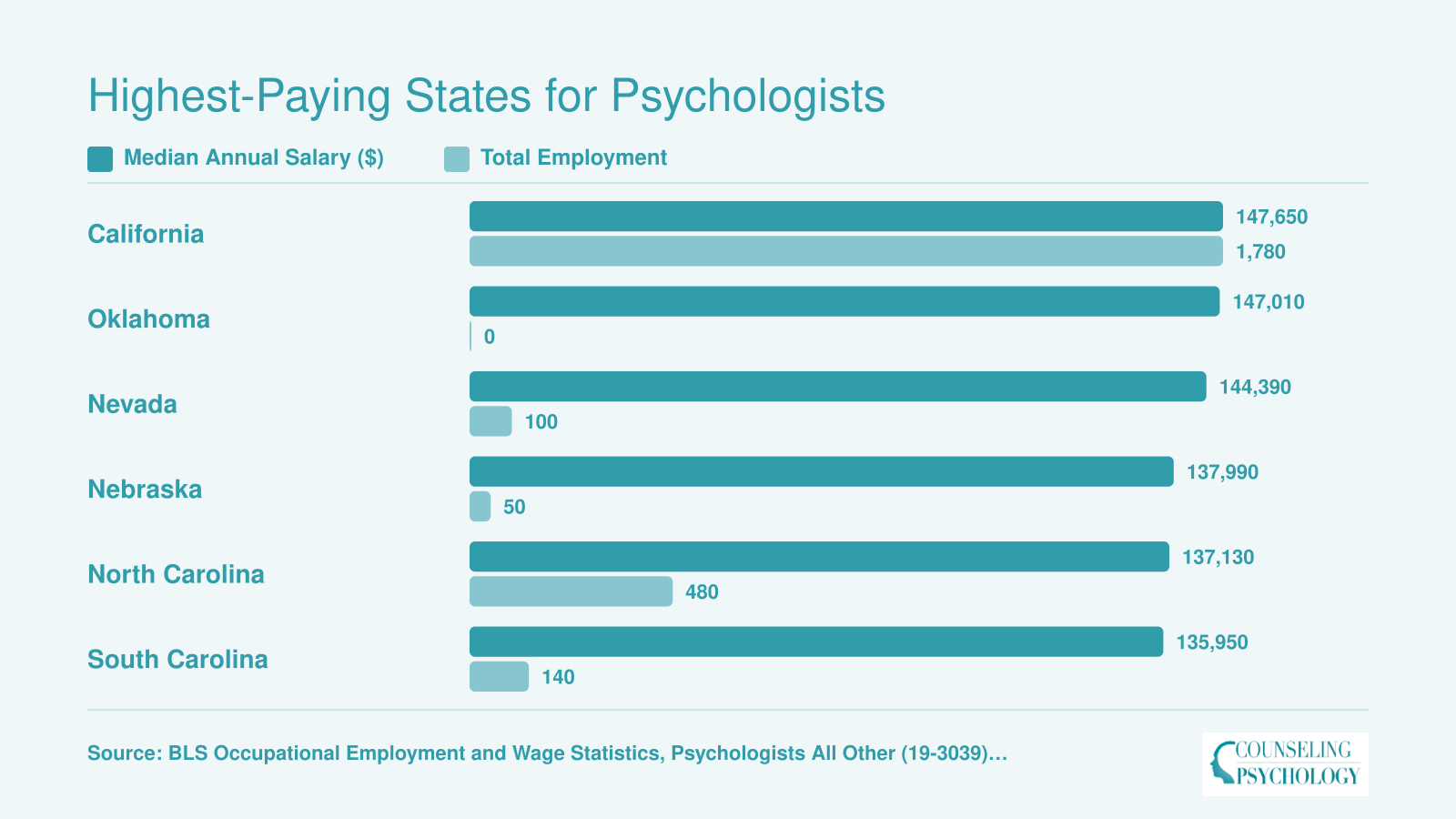
Highest-Paying States for Psychologists
Where you practice can significantly affect your earning potential. The BLS tracks state-level wages for the "Psychologists, All Other" category, which captures many of the research and applied roles cognitive psychology graduates pursue. The states below report the highest median annual salaries in this category, though keep in mind that top-paying states like California and Nevada also carry some of the nation's steepest costs of living.
Frequently Asked Questions About Cognitive Psychology Master's Degrees
Prospective students often have overlapping questions about format, outcomes, and fit when evaluating an online master's in cognitive psychology. The answers below pull together key details covered throughout this guide so you can weigh your options in one place.