
What you’ll learn in this article…
- Most online engineering psychology certificates require 12 to 18 credits and cost between $6,000 and $18,000 total.
- Only a small number of regionally accredited institutions offer fully online certificates in this specialization as of 2026.
- Engineering psychology, human factors, and I/O psychology overlap significantly but target different career paths.
- Top metro areas for related engineering roles report median salaries well above $100,000 according to BLS data.
What exactly does an engineering psychologist do, and is a graduate certificate enough to break into the field?
Engineering psychology is the scientific study of how people interact with systems, technology, and designed environments. It draws from cognitive science, human factors research, and systems engineering to reduce error, improve usability, and optimize performance in contexts ranging from aviation cockpits to hospital software interfaces. The field is narrow enough to require specialized training but broad enough to overlap with UX research, ergonomics, and human factors engineering.
A graduate certificate in engineering psychology typically runs 12 to 18 credits, making it a faster and more affordable credential than a full master's degree. The practical tension for most applicants is positioning: a certificate builds specialized expertise and signals focus to employers, but it does not substitute for a graduate degree in research-heavy or senior design roles. Supply of qualified candidates in human factors remains tighter than in general psychology, which gives this niche credential more traction than similar certificates in more saturated fields.
Engineering Psychology Vs. Human Factors Vs. I/O Psychology: What's the Difference?
Three field names, significant overlap, and one genuine source of confusion for prospective students: engineering psychology, human factors, and industrial-organizational psychology are related but not interchangeable. Understanding the distinctions shapes which certificate program actually fits your goals.
Engineering Psychology and Human Factors: Close Cousins
Engineering psychology is best understood as a psychology-focused subfield within the broader human factors umbrella. Its core concern is the cognitive side of human-system interaction: how people process information, perceive displays, manage attention, make decisions under workload, and commit errors when systems are poorly designed. Human factors (also called ergonomics internationally, and sometimes human factors engineering or human factors psychology) casts a wider net.1 It addresses not only cognitive demands but also physical ergonomics, workstation layout, equipment design, and safety-critical system architecture across industries from aviation to healthcare.
The American Psychological Association organizes both under Division 21, Applied Experimental and Engineering Psychology, defining the shared mission as improving and adapting technology, equipment, and work environments to complement human behavior and capabilities.2 The Human Factors and Ergonomics Society (HFES) serves practitioners across both labels. In day-to-day professional practice, the line between an "engineering psychologist" and a "human factors engineer" is often more historical than substantive.
Where I/O Psychology Diverges
Industrial-organizational psychology, represented by APA Division 14 (SIOP), takes a different angle entirely. Its core territory is workplace behavior and organizational performance: personnel selection, training design, performance management, leadership, motivation, and organizational culture. The human-machine interface is rarely the focal point. Where an engineering psychologist might redesign a cockpit display to reduce pilot error, an industrial organizational psychologist is more likely assessing how organizational culture affects safety reporting.
Career destinations reflect these differences. Engineering psychologists and human factors specialists tend to land in product design, defense contracting, aerospace, and consumer technology. Human factors engineers populate manufacturing and aviation. I/O psychologists gravitate toward HR functions, management consulting, and organizational development.
Why Program Names Can Mislead
Many graduate certificate programs use "engineering psychology" and "human factors" interchangeably in their titles, and some blend human factors content with I/O topics in a single curriculum, as Wright State University does with its combined Human Factors and Industrial/Organizational Psychology graduate program.3 The program name alone tells you little about what you will actually study.
Before enrolling, review the course list directly. A curriculum heavy on cognitive workload, human-computer interaction, and system safety leans toward engineering psychology and human factors. One centered on organizational behavior, talent management, and leadership development leans I/O. Many certificate programs sit somewhere in between, which may or may not suit your professional direction.
BLS wage and employment data adds another layer of complexity: these roles are grouped under broader occupational categories such as Industrial Engineers or Psychologists, making direct salary comparisons between the three fields harder than the job titles suggest. That context matters when you are weighing the return on a certificate investment.
What You'll Learn: Curriculum and Core Courses
Twelve to eighteen credits is the typical range for online graduate certificates in engineering psychology, with nine to twelve of those credits devoted to core coursework and three to six reserved for electives. That structure gives programs enough room to cover foundational theory while letting you tailor the credential toward specific career goals.
Core Courses You Can Expect
Regardless of which program you choose, certain subjects appear again and again across syllabi:
- Engineering Psychology or Human Factors Psychology: The anchor course introducing how psychological principles apply to system and product design.
- Cognition and Information Processing: Explores memory, attention, and decision-making as they relate to user performance.
- Perception and Sensation: Covers visual, auditory, and tactile processing, essential for display and alert design.
- Human-Computer Interaction: Focuses on interface design, input devices, and interaction paradigms.
- Usability Engineering or UX Research Methods: Teaches heuristic evaluation, task analysis, and user testing protocols.
- Research Methods or Applied Statistics: Provides the quantitative toolkit for analyzing human performance data.
At Embry-Riddle Aeronautical University, for instance, the 12-credit Human Factors certificate includes PSY 610 (Human Factors in Systems Design), PSY 620 (Human-Computer Interaction), PSY 630 (Cognitive Psychology and Information Processing), and PSY 640 (Research Methods in Human Factors).2 RIT's Engineering Psychology Advanced Certificate, which runs 12 to 15 credits, follows a similar pattern, covering Perception and Cognition, Ergonomics and Human Factors, and Human-Centered Computing research methods.3
Elective Options for Specialization
Electives let you sharpen the credential's focus. Common offerings include:
- Human-Automation Interaction
- Aviation Human Factors
- Safety and Risk Analysis
- Interface Design and Evaluation
- Applied Ergonomics
- Human Factors in Cybersecurity
- User Experience Design
- Assistive Technology and Inclusive Design
Tufts, for example, lists Medical Devices Human Factors, Human-Robot Interaction, and Information Visualization among its elective tracks. RIT adds Assistive Technology and Inclusive Design for students interested in accessibility.3
Capstone and Applied Projects
Most online certificates do not mandate a formal capstone thesis, but many programs incorporate an applied project within a core or elective course. You might redesign a cockpit warning system, evaluate the usability of a healthcare portal, or conduct a task analysis for a manufacturing control room. These projects translate classroom theory into portfolio-ready deliverables, a benefit that resonates whether you are pursuing applied psychology careers or moving into industry UX roles.
Choosing the Right Curricular Fit
Before enrolling, compare syllabi carefully. Some programs lean heavily toward cognitive and experimental psychology, emphasizing perception research and statistical modeling. Others prioritize applied UX and systems design, with coursework centered on prototyping tools, rapid iteration, and industry case studies. If your goal is product design at a tech firm, a UX-heavy curriculum makes sense. If you plan to pursue doctoral work or research roles in aerospace or defense, a more experimental foundation will serve you better. The credit totals may look similar on paper, but the day-to-day learning experience can differ substantially.
Questions to Ask Yourself
Am I seeking a standalone credential for immediate career pivots, or do I plan to continue toward a master's or doctorate?
Does the program's delivery format align with how I learn and when I can study?
Can I realistically commit 12 to 18 months of part-time coursework while employed?
What professional network or industry connections does this program offer?
Online Engineering Psychology Certificate Programs to Consider
Only a handful of regionally accredited institutions offer fully online graduate certificates specifically in engineering psychology or closely related human factors specializations, making careful program comparison essential for applicants. The table below presents verified options available as of 2026, including tuition structure, delivery format, and stackability into advanced degrees.
Rochester Institute of Technology (RIT): Advanced Certificate in Engineering Psychology
RIT's 15-credit Advanced Certificate in Engineering Psychology is the most established fully online option in this niche field.1 The program costs $2,370 per credit for a total estimated tuition of $35,550. RIT holds regional accreditation through the Middle States Commission on Higher Education (MSCHE), and the certificate is explicitly stackable toward the institution's Master of Science in Engineering Psychology.2 Students complete coursework entirely asynchronously with no required on-campus intensives, making the program accessible to working professionals across time zones. Core courses include human-computer interaction, cognitive psychology for design, and usability testing methods. RIT's program appears in the HFES graduate programs directory, confirming alignment with professional standards in the field.
Other Programs: Tufts University and Embry-Riddle Aeronautical University
While Tufts University's Human Factors Engineering program offers a graduate certificate option, current delivery format details indicate a hybrid structure requiring periodic on-campus attendance in Medford, Massachusetts, rather than a fully online pathway. Prospective students outside commuting distance should verify remote-participation accommodations directly with the department before applying.
Embry-Riddle Aeronautical University lists graduate coursework in human factors within its aerospace psychology offerings, but as of 2026 does not package a standalone certificate specifically marketed as engineering psychology. Students interested in aviation-focused human factors may find relevant electives within Embry-Riddle's broader Industrial-Organizational Psychology graduate programs, though these typically require master's-level admission rather than certificate enrollment.
Comparing Format and Flexibility
All verified programs require applicants to hold a bachelor's degree, typically in psychology, engineering, computer science, or a related field. Synchronous versus asynchronous delivery matters significantly for working professionals: RIT's fully asynchronous model allows students to balance full-time employment without scheduling conflicts, while hybrid programs demand real-time participation or travel. Certificate stackability varies by institution. RIT guarantees that all 15 certificate credits apply toward its master's degree if students meet graduate admission standards after certificate completion, effectively reducing the master's timeline by one semester.2 Programs without formal stackability agreements may still accept some credits on a case-by-case basis, but applicants should secure written confirmation before enrolling if they plan to pursue a master's degree later.
Cost Comparison and Financial Considerations
At $35,550 total tuition, RIT's certificate represents a significant investment, though per-credit pricing aligns with private-university graduate rates in STEM fields.1 Students should compare this cost against standalone master's programs in human factors, which typically require 30 to 36 credits at comparable per-credit rates. Certificate-only enrollment rarely qualifies for federal Title IV financial aid, but employer tuition reimbursement and private education loans remain options for most students. Some applicants enroll part-time over multiple semesters to spread costs across several budget cycles.
Related Articles
Admissions Requirements and How to Apply
Most online graduate certificates in engineering psychology share a similar admissions baseline, but the specifics, especially around prerequisite coursework, vary enough that you should read each program's checklist carefully before you start the application.
Baseline Requirements
Expect to submit the following at nearly every program:
- A completed bachelor's degree from a regionally accredited institution, typically in psychology, engineering, human factors, computer science, or a related STEM field.
- A minimum undergraduate GPA of 3.0 on a 4.0 scale. Both RIT's Advanced Certificate in Engineering Psychology and Arizona State's Graduate Certificate in Industrial and Organizational Psychology hold to this 3.0 threshold.12
- Official transcripts from every post-secondary institution attended.
- A statement of purpose explaining your career goals and why the certificate fits them. RIT and ASU both require this.12
GRE scores are generally not required. RIT explicitly lists no entrance exam, and ASU's online I/O certificate is similarly test-optional.12
Prerequisite Coursework
This is where programs diverge. RIT requires 15 semester credit hours of prerequisite work, including experimental psychology and statistics, before you can begin certificate coursework.1 If your undergraduate degree was in engineering or computer science rather than psychology, plan to take a research methods or stats course in advance, or be ready to add it early in the sequence. ASU's I/O certificate, by contrast, does not publish a formal prerequisite list, which makes it more accessible for applicants from non-psychology backgrounds.2 If you are wondering how hard is it to get into grad school for psychology, these certificate programs generally set a lower bar than full master's or doctoral admissions.
Recommendations, Resumes, and Work Experience
Letters of recommendation requirements differ. RIT asks for two letters; ASU asks for one.12 Neither program formally waives letters for experienced professionals, but both will accept supervisor letters in place of academic references, which is useful if you have been out of school for several years. A current resume or CV is standard.
Deadlines and Start Terms
RIT lists February 15 as its priority deadline but reviews applications on a rolling basis after that.1 ASU operates fully rolling admissions with multiple start dates throughout the year.2 If you need a spring or summer start, ASU is the more flexible option; RIT's certificate is most commonly entered in the fall.
Cost, Financial Aid, and Time to Completion
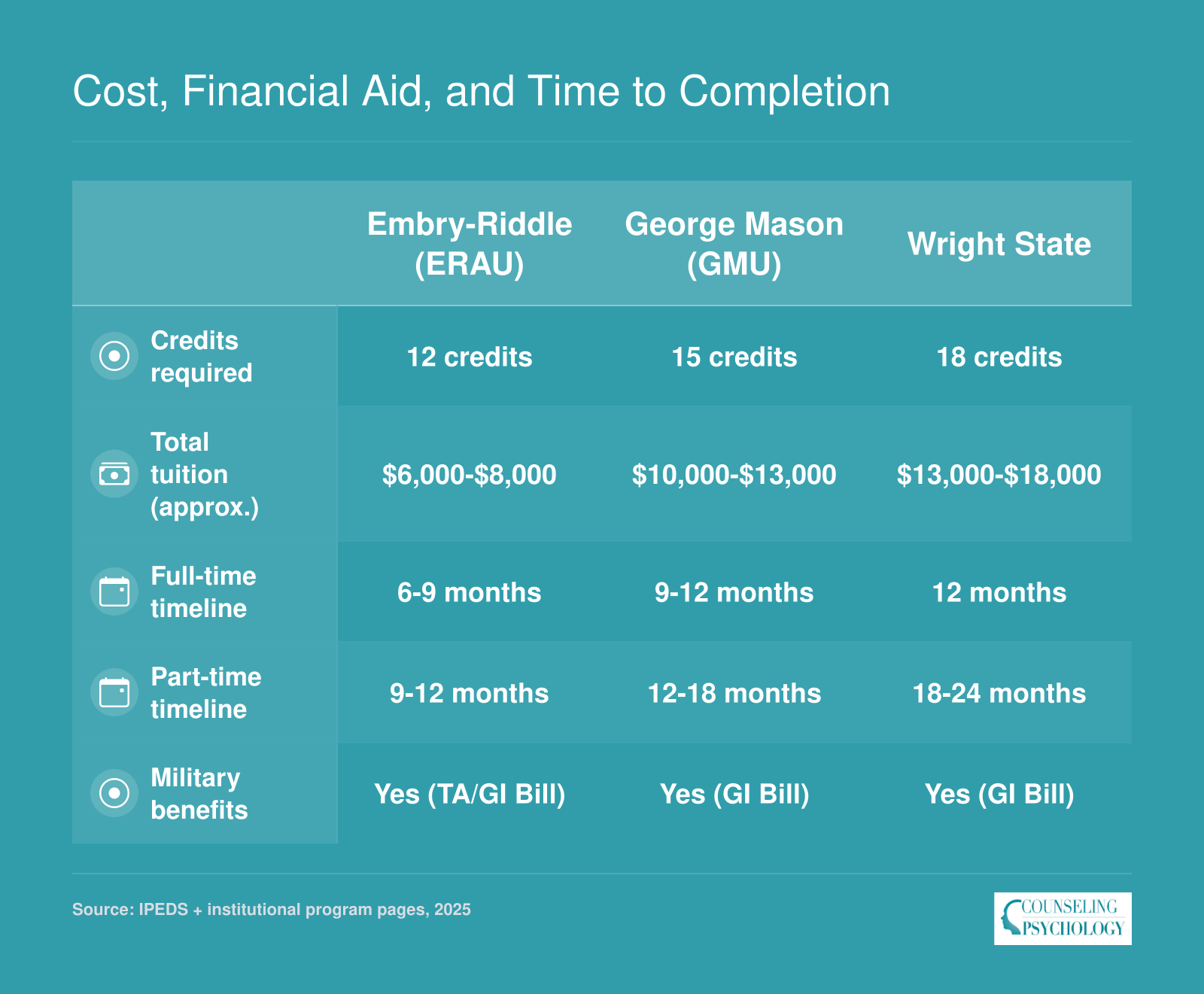
Tuition for an online graduate certificate in engineering psychology typically falls between $6,000 and $18,000 depending on the institution, credit load, and residency status. Most programs require 12 to 18 credit hours, making them completable in well under a year for full-time students. Financial aid options vary: some certificates qualify for federal student loans, though eligibility depends on whether the program is Title IV approved. Employer tuition assistance is one of the most common funding routes, especially for professionals already working in UX, defense, or tech sectors. Active-duty military and veterans should check GI Bill and Tuition Assistance eligibility, as many accredited online certificates qualify. Most schools also offer institutional payment plans that spread costs across the term without interest.
Accreditation and Credit Transferability
Regional accreditation is the single most important credential a program can hold, and it directly affects whether your certificate credits will be recognized elsewhere.
Regional vs. Specialized Accreditation
Organizations such as the New England Commission of Higher Education (NECHE), Middle States Commission on Higher Education, and other regional bodies serve as the gold standard for institutional accreditation in the United States. Credits earned at regionally accredited institutions travel far more reliably than those from nationally accredited or unaccredited schools. ABET, which accredits engineering degree programs, does not extend that oversight to psychology-side graduate certificates, so ABET status is largely irrelevant when evaluating programs in this space. What you want to confirm first is regional accreditation.
That said, regional accreditation improves portability; it does not guarantee it. Any receiving institution retains the right to accept or reject transfer credits on its own terms, regardless of where those credits were earned. Get that policy in writing before you enroll.
Stacking Credits Toward a Master's Degree
Rochester Institute of Technology offers one of the cleaner pathways available. The Engineering Psychology Advanced Certificate can serve as a stepping stone toward the Experimental Psychology MS at RIT, and students may pursue both concurrently.1 RIT's transfer credit policies require a minimum grade of C, and a C-minus is not accepted.2 That threshold matters: coursework completed during the certificate that falls below a C will not count toward the master's program, so consistent performance from the start protects your investment.
If you are considering a similar arrangement at other institutions, ask the graduate admissions office three specific questions: which courses from the certificate apply to the degree, what minimum grade is required for each, and whether there is a time limit on how old the credits can be when applied.
HFES Certification and Coursework Recognition
The Human Factors and Ergonomics Society (HFES) does not accredit academic programs, so you will not see an "HFES-accredited" certificate. What HFES does offer are professional credentials, primarily the Certified Human Factors Professional (CHFP) and the Certified Professional Ergonomist (CPE), administered through the Board of Certification in Professional Ergonomics. Relevant graduate coursework in perception, cognition, system design, and human-computer interaction can strengthen a CHFP or CPE application, but certification eligibility also depends on documented professional experience. Completing a graduate certificate does not replace that requirement; it complements it.
An engineering psychology certificate won't replace a full master's for senior research roles, but it can open doors in UX research, product design, and human factors consulting, especially for professionals who already hold a bachelor's in a related field and need a credential upgrade without a two-year commitment.
Career Outcomes and Salary Potential for Engineering Psychologists
Engineering psychology graduates typically move into roles classified under human factors engineering, ergonomics, UX research, or operations research. Because the BLS does not publish a standalone category for engineering psychologists, the closest occupational proxies are Human Factors Engineers and Ergonomists (SOC 17-2112) and related analytical roles. The table below shows projected national job growth for the most relevant occupation groups, all of which outpace the overall U.S. employment growth rate of roughly 3.1 percent for 2024 to 2034. For more granular salary and skills data, the O*NET 'My Next Move' tool lets you filter by keywords like 'human factors' or 'UX researcher,' and the Human Factors and Ergonomics Society (HFES) publishes member salary surveys that often capture compensation details not found in generic government databases. Many university program websites for engineering psychology or human factors also publish annual placement reports listing starting salaries, employer types, and common job titles for recent graduates.
| Occupation Group | Projected National Job Growth (2024 to 2034) | Growth Relative to All U.S. Occupations | Primary Source |
|---|---|---|---|
| Industrial Engineers | 11% | Approximately 3.5 times the national average | Bureau of Labor Statistics, Industry and Occupational Employment Projections |
| Operations Research Analysts | 21% | Approximately 7 times the national average | Bureau of Labor Statistics, Industry and Occupational Employment Projections |
| All U.S. Occupations (Baseline) | 3.1% | N/A | Bureau of Labor Statistics, Industry and Occupational Employment Projections |
Highest-Paying Metro Areas for Related Engineering Roles
Because the Bureau of Labor Statistics does not track engineering psychologists as a standalone occupation, Industrial Engineers (SOC 17-2112) serve as a useful salary proxy. Many engineering psychology certificate holders work alongside or in roles classified under this category. The table below ranks the top 15 metros by median annual salary. Notice that tech hubs, defense contractor corridors, and major manufacturing centers dominate the list, and these are the same industries that employ the most engineering psychologists.
| Metro Area | Median Annual Salary | Mean Annual Salary | Total Employment |
|---|---|---|---|
| San Jose, Sunnyvale, Santa Clara, CA | $136,290 | $145,460 | 3,850 |
| San Francisco, Oakland, Fremont, CA | $133,790 | $140,470 | 4,630 |
| Portland, Vancouver, Hillsboro, OR/WA | $126,530 | $133,600 | 5,440 |
| Seattle, Tacoma, Bellevue, WA | $126,310 | $126,550 | 5,350 |
| Houston, Pasadena, The Woodlands, TX | $116,170 | $122,230 | 8,210 |
| San Diego, Chula Vista, Carlsbad, CA | $114,400 | $122,050 | 3,110 |
| Phoenix, Mesa, Chandler, AZ | $110,100 | $124,090 | 5,400 |
| Boston, Cambridge, Newton, MA/NH | $109,960 | $118,590 | 8,450 |
| Los Angeles, Long Beach, Anaheim, CA | $108,300 | $120,710 | 8,900 |
| Miami, Fort Lauderdale, West Palm Beach, FL | $107,400 | $114,520 | 3,490 |
| New York, Newark, Jersey City, NY/NJ | $107,000 | $113,340 | 7,910 |
| Denver, Aurora, Centennial, CO | $106,800 | $114,330 | 2,410 |
| Dallas, Fort Worth, Arlington, TX | $105,070 | $112,350 | 10,150 |
| Minneapolis, St. Paul, Bloomington, MN/WI | $102,440 | $109,130 | 14,250 |
| Detroit, Warren, Dearborn, MI | $100,940 | $107,800 | 17,080 |
Frequently Asked Questions About Engineering Psychology Certificates
Prospective students often have practical questions before committing to a graduate certificate in engineering psychology. Below are answers to the most common concerns, from career applications to credit transfer and program eligibility.
- What can you do with an engineering psychology certificate?
- Graduates typically pursue roles in user experience (UX) research, usability testing, human factors analysis, and product design evaluation. Industries that hire for these skills include aerospace, defense, healthcare technology, automotive, and consumer electronics. The certificate can also strengthen an existing psychology or engineering career by adding a specialized human factors credential that employers value in safety-critical design environments.
- How long does it take to get an engineering psychology graduate certificate?
- Most online graduate certificates in engineering psychology require four to six courses, which translates to roughly 12 to 18 credit hours. Full-time students can typically finish in two to three semesters, while part-time students may need three to four semesters. Accelerated formats or summer enrollment options at some institutions can compress the timeline to under one year.
- Can engineering psychology certificate credits transfer to a master's program?
- In many cases, yes. Several programs are designed so that certificate coursework applies directly toward a master's in human factors, engineering psychology, or a related field at the same institution. If you plan to transfer credits elsewhere, verify the receiving program's transfer policies in advance. Regionally accredited certificates generally have the best transferability.
- What is the difference between engineering psychology and human factors?
- The two fields overlap significantly and are sometimes used interchangeably. Engineering psychology emphasizes the cognitive and perceptual processes people use when interacting with systems, drawing heavily on experimental psychology methods. Human factors is a broader umbrella that also incorporates ergonomics, physical design, and workplace safety. In practice, professionals in both areas often hold similar roles and collaborate closely.
- Do I need a psychology degree to enroll in an engineering psychology certificate program?
- Not necessarily. Many programs accept applicants with bachelor's degrees in engineering, computer science, design, or other technical fields. Some require prerequisite coursework in introductory psychology, statistics, or research methods, but these can often be completed before or alongside certificate courses. Review each program's admissions page for specific prerequisite expectations.
- Is an engineering psychology certificate worth it for career changers?
- For professionals transitioning from general psychology, software development, industrial design, or related fields, the certificate offers a focused credential without the time and cost of a full master's degree. It signals specialized competence to employers in UX, product safety, and systems design. Career changers should weigh whether their target roles require a full graduate degree or whether the certificate meets employer expectations in their industry.