

What you’ll learn in this article…
- Engineering psychologists typically need 6 to 10 years of education from bachelor's degree through doctorate.
- Most accredited graduate programs use a hybrid format combining online coursework with on-site lab components.
- BLS data for Industrial-Organizational Psychologists, the closest proxy, shows a national median salary above $150,000.
- Defense, aerospace, tech, and healthcare rank among the top employment sectors for engineering psychology graduates.
Engineering psychology applies psychological principles to the design of systems, products, and interfaces so they align with how people actually think, perceive, and behave. As artificial intelligence, autonomous systems, and complex interfaces proliferate across industries, demand is rising for professionals who understand both human cognition and technology design. Most positions require a master's degree, though doctoral training opens research and senior consulting roles.
The core tension for prospective students is time versus opportunity. A master's degree takes two to three years and qualifies you for applied practitioner roles at competitive salaries. A PhD adds another three to five years but positions you for faculty appointments, advanced research positions, and leadership in product strategy.
Online and hybrid formats remain rare because the field depends on lab access, usability testing, and simulation environments. Most accredited programs anchor their coursework online but require periodic campus residencies for hands-on methods training. Graduates enter sectors ranging from aerospace and defense to consumer technology, medical devices, and transportation systems.
What Is Engineering Psychology?
What does an engineering psychologist actually study, and how does their work impact the tools you use every day?
Engineering psychology is the scientific study of how people perceive, think, and act when they interact with technology, systems, and environments. It sits at the intersection of cognitive psychology, industrial engineering, and computer science, translating research on human capabilities and limitations into safer, more intuitive designs. Practitioners aim to reduce errors, improve efficiency, and enhance user satisfaction across a wide range of contexts, from the layout of a cockpit instrument panel to the interface of a mobile health app.
Core Focus Areas
The field organizes its research around several core psychological processes:
- Perception: How people see, hear, and feel the world around them. An engineering psychologist might study how pilots interpret visual alerts in a darkened cockpit or how drivers detect pedestrians while using a semi-autonomous vehicle.
- Cognition: The mental processes behind attention, memory, problem-solving, and decision-making. Designing a medical device that minimizes the chance of a nurse entering the wrong dosage is a classic application.
- Human Error: Why mistakes happen, whether due to fatigue, poor interface design, or information overload, and how systems can be made more resilient. This includes analyzing accident scenarios and building safeguards into high-risk industries.
- Decision-Making: How people evaluate options under time pressure, uncertainty, or stress. Work in this area informs everything from emergency response training to the layout of trading terminals in finance.
These fundamentals feed directly into real-world design problems. For autonomous vehicles, researchers examine how quickly a driver can retake control when the car encounters an ambiguous situation. In hospital operating rooms, they might test how lighting, alarm sounds, and screen placement affect a surgeon's performance during long procedures.
Where the Field Sits in Higher Education
In university catalogs, engineering psychology often appears under two different names. Many programs label it "human factors and ergonomics," a broader term that encompasses physical ergonomics (body mechanics) and organizational psychology alongside cognitive engineering. Some departments house the specialty within applied psychology, while others place it in industrial engineering or computer science. The upcoming section untangles these labels so you can identify the right program fit, but the core mission stays the same: use rigorous behavioral science to make technology work with people, not against them.
A Cross-Disciplinary Foundation
Because engineering psychology tackles problems that span hardware, software, and human behavior, it draws on multiple disciplines. Cognitive science provides models of how the brain processes information. Industrial engineering contributes methods for workflow analysis and system optimization. Computer science offers tools for creating simulations, testing user interfaces, and analyzing large datasets. This blend means that professionals in the field develop skills that are both deeply analytical and broadly practical, ready to move from a laboratory study on attention to a usability test of a new surgical robot.
Engineering Psychology Vs. Human Factors, UX, and Related Fields
Engineering psychology, human factors engineering, UX research, and human-computer interaction (HCI) are frequently confused or treated as interchangeable. While they share a common foundation in understanding how people interact with systems, each field has evolved distinct emphases, degree pathways, and employer expectations. Prospective students should understand these differences to align their graduate training with the career path they envision.
Degree Pathways and Research Orientation
Engineering psychology and human factors engineering typically require MS or PhD training in engineering psychology, human factors psychology, or human factors engineering.1 Some programs reside in psychology departments with a cognitive or experimental focus, while others are housed in industrial and systems engineering or dedicated human factors departments.2 These fields emphasize experimental rigor, quantitative research methods, and controlled studies of human performance in safety-critical contexts. Graduates are expected to design and execute empirical studies, analyze large datasets, and apply statistical modeling to complex systems.
UX research draws from a broader set of backgrounds. While many UX researchers hold advanced degrees in human factors, HCI, or experimental psychology, others come from anthropology, sociology, information science, or design research.3 The orientation is more product-focused and iterative, with rapid qualitative and mixed-methods studies that feed directly into design sprints. UX roles place less emphasis on publication in academic journals and more on communicating actionable insights to cross-functional teams.
HCI occupies a middle ground. MS and PhD programs in human-computer interaction combine computer science, cognitive science, and design, preparing graduates for both research and applied roles.4 HCI work is experimentally grounded but often explores emerging interaction paradigms (voice, AR/VR, multimodal interfaces) rather than optimizing existing safety-critical systems.
Job Titles and Employer Sectors
The same individual might be called a human factors engineer at Boeing, an engineering psychologist at the FDA, and a UX researcher at Meta, depending on industry norms. Defense and aerospace employers favor human factors engineer or engineering psychologist titles and expect candidates to understand regulatory frameworks, certification processes, and formal usability testing protocols.5 Medical device companies use similar titles and often require knowledge of FDA human factors guidance.
Tech companies, by contrast, post UX researcher or user researcher roles. These positions focus on consumer and enterprise software, e-commerce platforms, fintech applications, and social media products. The work is faster-paced and less constrained by regulatory requirements, though the underlying cognitive principles remain constant. Professionals in these roles often draw on skills that overlap with those of an industrial organizational psychologist, particularly when optimizing workplace tools and enterprise platforms.
HCI roles appear most frequently at companies with dedicated research labs or those building novel interfaces. Job titles include HCI researcher, interaction designer, and UX engineer. These roles often bridge research and implementation, requiring both experimental skills and technical fluency.
Professional Society Affiliations
Engineering psychologists and human factors practitioners typically join the Human Factors and Ergonomics Society (HFES) and may also belong to APA Division 21 (Applied Experimental and Engineering Psychology).5 UX researchers are more likely to join the User Experience Professionals Association (UXPA) or ACM SIGCHI, the special interest group on computer-human interaction. HCI researchers frequently participate in SIGCHI conferences and publish in venues like CHI, UIST, and ACM Transactions on Computer-Human Interaction.
Understanding these professional ecosystems helps students identify relevant conferences, networking opportunities, and publication venues during and after graduate training.
Questions to Ask Yourself
How to Become an Engineering Psychologist
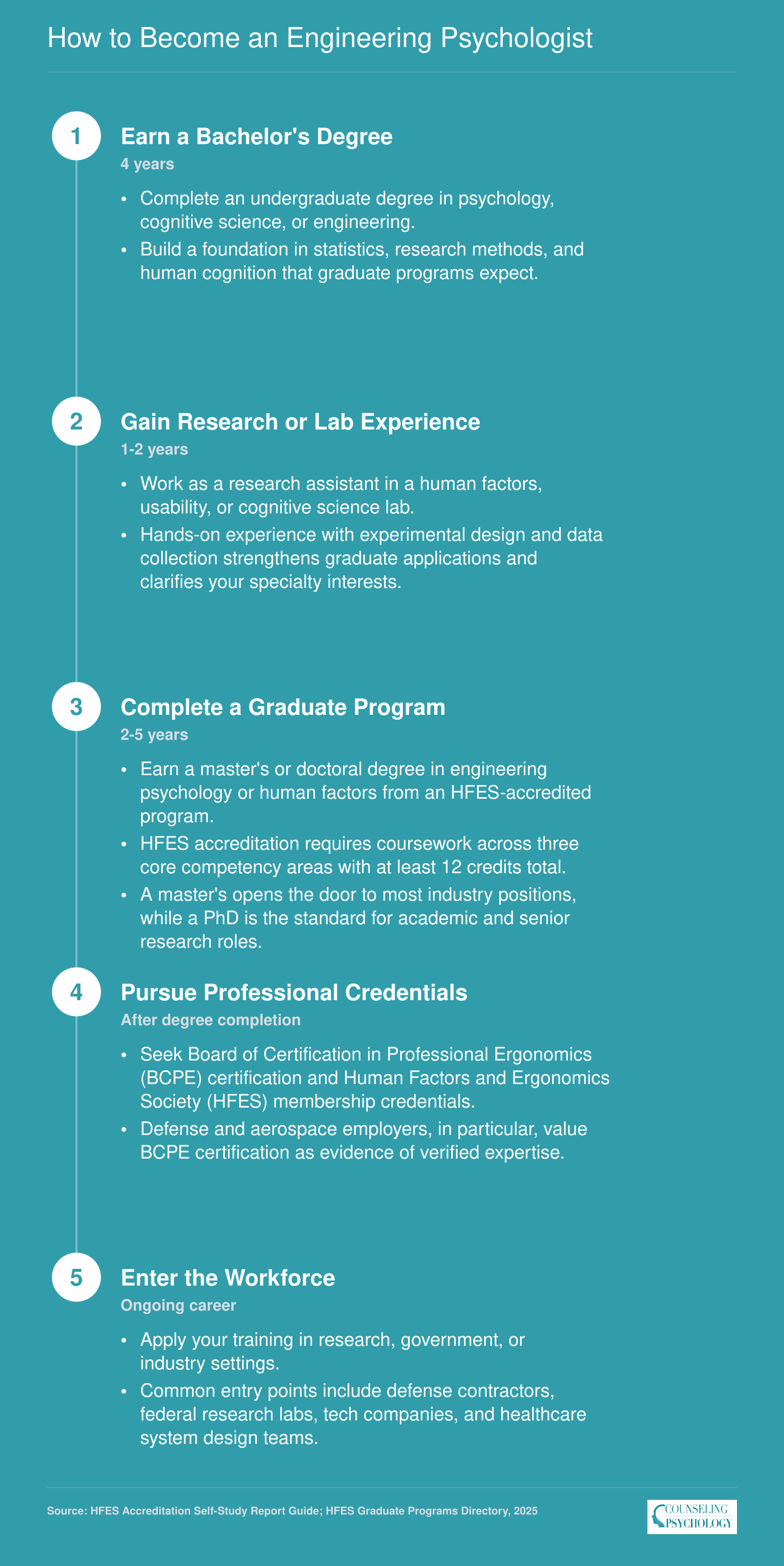
The path to becoming an engineering psychologist typically spans 6 to 10 years from the start of your bachelor's degree through completion of a doctorate. A master's degree qualifies you for most practitioner and applied roles, but a PhD is generally expected for academic positions and senior research appointments in defense, aerospace, and technology sectors.
Engineering Psychology Degree Levels and Programs
Engineering psychology credentials follow a four-tier structure, with the master's degree serving as the standard entry point for most practitioner roles. Unlike clinical psychology, where doctoral training is mandatory, engineering psychology values applied skills and research capacity at the graduate level, making it accessible to working professionals who balance career advancement with credential building.
Bachelor's Degrees: Foundation Rather Than Specialty
Few universities offer a standalone undergraduate major in engineering psychology. Most students prepare through a bachelor's in psychology, cognitive science, or an engineering discipline such as industrial, systems, or mechanical engineering. Relevant electives matter more than the major's title. Look for coursework in experimental methods, human cognition, statistics, programming, and biomechanics. This foundation positions graduates for master's admission but rarely for direct entry into engineering psychology roles.
Master's Programs: The Primary Credential
The majority of practicing engineering psychologists hold a master's degree, typically completed in two years of full-time study. Programs appear under varied catalog titles such as human factors and engineering psychology, applied experimental psychology, or human factors engineering. The label matters less than the curriculum. Verify that core content includes perception and cognition, human-machine interaction, research design, usability testing, and applied statistics. Master's holders move into usability research, systems design, safety analysis, and product development roles across technology, defense, healthcare, and consumer goods sectors.
Graduate Certificates: Credential Stacking for Mid-Career Pivots
Graduate certificates in human factors or engineering psychology, usually 12 to 18 credit hours, serve professionals adding specialized skills to an existing degree. Engineers seeking user-centered design expertise or psychologists transitioning into applied research often pursue certificates alongside or after a master's in a related field. These programs condense the essentials of human factors methods without requiring a full degree timeline.
Doctoral Degrees: Research Leadership and Advanced Practice
PhD programs train researchers for academic, government laboratory, and corporate R&D positions. Expect four to six years of coursework, comprehensive exams, and original dissertation research. A smaller number of applied science doctorates (such as the Doctor of Engineering or applied psychology doctorates) prepare practitioners for senior consulting and leadership roles without the research publication demands of a PhD. Students weighing doctoral paths across the discipline can explore broader careers in psychology to compare timelines and outcomes.
Admission Prerequisites and Competitive Profiles
Most master's programs require a bachelor's degree in psychology, engineering, computer science, or a closely related field. Minimum GPA thresholds typically sit at 3.0, though competitive programs review applicants starting at 2.5 and favor those well above the floor. Cal Poly's MS Psychology program, for instance, sets a 3.0 minimum but reviews candidates as low as 2.53, while doctoral programs at Northwestern and the University of Florida report cohort averages near 3.6 to 3.8.12
Prerequisite coursework varies by program emphasis. Psychology-anchored tracks expect statistics, research methods, and foundational courses in cognition, perception, or experimental psychology. Engineering-anchored programs such as Tufts' Human Factors Engineering MS require a Bachelor of Science in engineering or a natural science.4 The University of Florida's psychology PhD lists statistics, biological bases of behavior, developmental psychology, learning or cognition, and courses in social, personality, abnormal, or individual differences as prerequisites.2
GRE requirements have softened across the field. Northwestern's psychology PhD became GRE-optional for Fall 2026, though recent cohorts averaged 160 quantitative and 165 verbal.1 The University of Florida and Cal Poly also dropped mandatory GRE submission.23 When scores remain part of the application, admissions committees weigh quantitative performance heavily due to the field's reliance on statistics and modeling.
Research experience strengthens applications significantly. Competitive candidates present undergraduate research assistantships, independent studies, honors theses, or published conference abstracts. Three letters of recommendation are standard14, with the strongest coming from faculty or supervisors who can speak to analytical ability, methodological rigor, and collaborative research skills.
The next section surveys online and hybrid program formats that accommodate working professionals pursuing these credentials without relocating or pausing employment.
Related Articles
Online and Hybrid Engineering Psychology Graduate Programs
Fully online engineering psychology programs are genuinely rare. The field relies heavily on lab-based research methods, usability testing, and simulation environments that are difficult to replicate through asynchronous coursework alone. Most accredited options have settled on a hybrid model: online lectures and seminars for the bulk of the curriculum, combined with periodic on-campus intensives (often one or two weeks during summer sessions) where students complete hands-on lab work. Prospective students should go in with that expectation rather than anticipating a fully remote experience.
Programs Worth Knowing About
The Human Factors and Ergonomics Society (HFES) maintains a graduate programs directory, and cross-referencing it with available enrollment information surfaces a handful of programs relevant to distance learners as of 2025-2026.1
- Embry-Riddle Aeronautical University Worldwide, MS in Human Factors Engineering: Listed as online and carries HFES accreditation through July 2027. Embry-Riddle also offers a separate hybrid MS in Human Factors at its residential campus, accredited through July 2031. The Worldwide division is the distance-accessible option.
- San Jose State University, MS in Human Factors/Ergonomics: A hybrid program with HFES accreditation through March 2027. SJSU has a long track record in the field and draws students from the broader California tech industry.
- California State University Long Beach, MS in Psychology with an Option in Human Factors: Hybrid format, HFES-accredited through November 2029. One of the longer accreditation windows among programs currently enrolling students.
- George Mason University, MS and PhD in Human Factors and Applied Cognition: Both degrees are hybrid and carry HFES accreditation through February 2029. The doctoral program is notable because accredited PhD options in this field are limited.
- Florida Institute of Technology, MS in Human Factors in Aeronautics: Listed as an online offering, though it does not currently hold HFES accreditation.1 Still a credible program for students focused on aviation contexts, but applicants should weigh the accreditation gap.
Why HFES Accreditation Matters
Accreditation from HFES is not just a quality signal. It has a direct practical consequence: eligibility for the Board of Certification in Professional Ergonomics (BCPE) credential is tied to graduating from an accredited program. Many employers in aerospace, defense, and human-systems integration specifically look for BCPE eligibility or certification when hiring. Choosing a non-accredited program does not close every door, but it may require additional documented work experience to qualify for certification pathways later.
Georgia Tech's PhD in Engineering Psychology is worth mentioning as a historical reference point. It held HFES accreditation for many years, but that accreditation lapsed in 2024.1 Students considering doctoral study should confirm a program's current accreditation status directly with HFES before applying, since standings change at renewal cycles.
Part-Time Options and Completion Timelines
Several of these programs accommodate working professionals through part-time enrollment, a meaningful consideration given that many students entering graduate engineering psychology programs are already employed in technical roles. Part-time completion typically runs three to four years for a master's degree. Programs vary in how they structure the lab intensives for part-time students, so it is worth asking admissions coordinators specifically how residency requirements are scheduled around a full-time work schedule.
Regardless of format, verify before enrolling that any program you are considering includes genuine hands-on research methods training. Remote-accessible usability labs, virtual simulation platforms, and supervised independent research are all reasonable substitutes for some in-person components, but a program with no lab exposure of any kind will leave graduates underprepared for roles that require applied research skills.
Engineering Psychology Salary and Job Outlook
Because engineering psychology sits at the intersection of psychology and systems design, the Bureau of Labor Statistics does not track it as a standalone occupation. The closest proxy is Industrial-Organizational Psychologists (SOC 19-3032), a category that captures many engineering psychology graduates alongside related human factors roles. The figures below reflect approximate 2024 national data from BLS; keep in mind that the salary range represents the broader I-O psychology occupation, not exclusively engineering psychology degree holders. Human factors engineers, another common career path for EP graduates, lack a dedicated SOC code and are typically grouped with industrial engineers or related engineering categories, so direct salary comparisons are limited. On the growth side, I-O psychology carries a bright outlook designation from O*NET, with projected employment growth characterized as faster than average for 2024 to 2034, well above the 3.1% baseline projected for all occupations over the same period.
| Metric | Industrial-Organizational Psychologists (National, 2024) |
|---|---|
| BLS SOC Code | 19-3032 |
| Total National Employment | 1,050 |
| Median Annual Salary | $109,840 |
| 25th Percentile Annual Salary | $80,790 |
| Mean Annual Salary | $134,400 |
| 75th Percentile Annual Salary | $198,170 |
| Projected Job Growth (2024 to 2034) | Faster than average |
| Bright Outlook Designation | Yes |
Engineering Psychology Salary by Experience Level
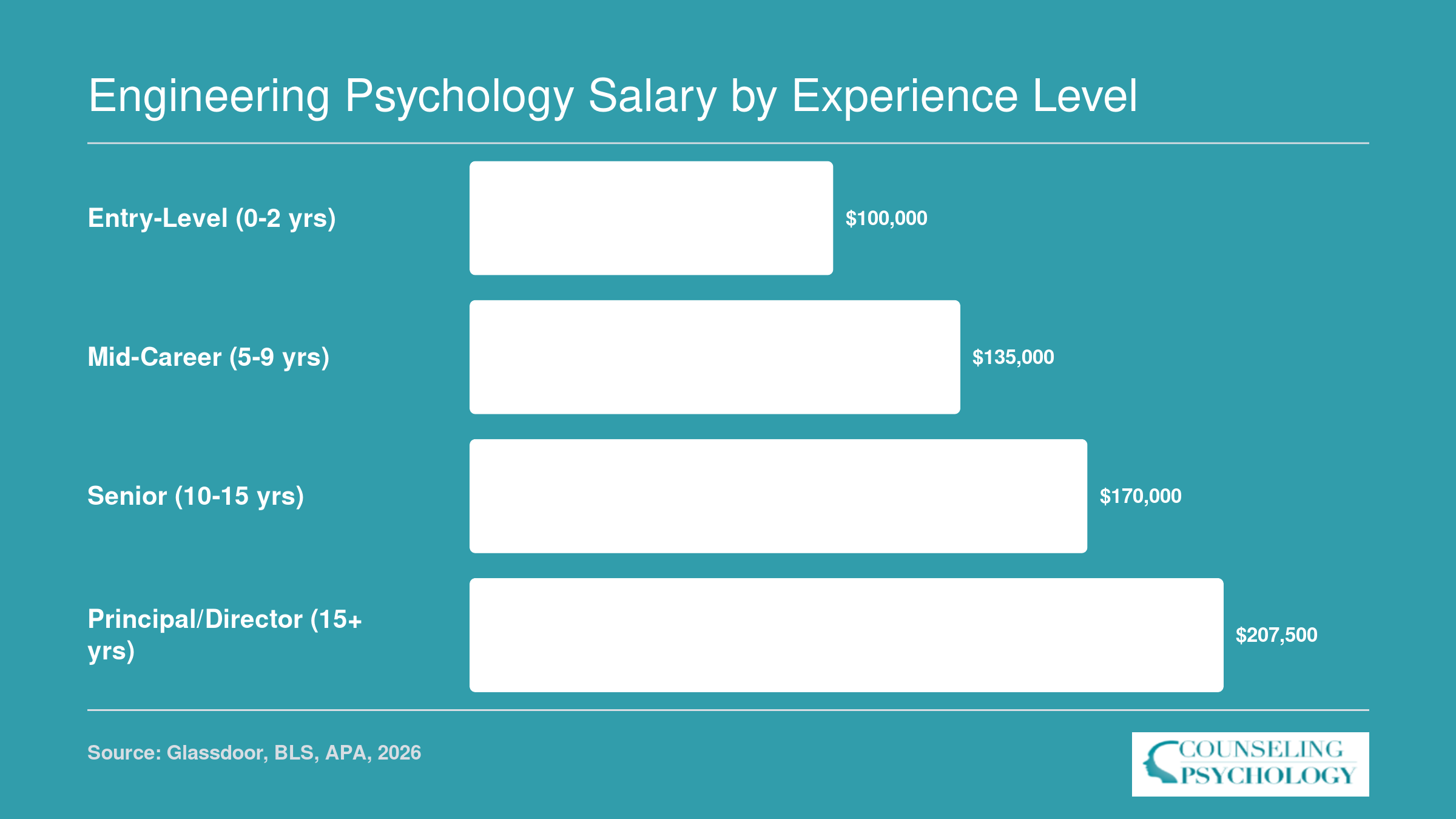
Earning potential in engineering psychology climbs steadily with experience, and professionals who hold a doctoral degree typically enter at higher salary bands and advance to senior roles faster. The ranges below reflect national estimates for engineering psychologists across industries in 2026.
Most engineering psychologists enter graduate programs after earning a bachelor's degree in psychology, engineering, or a related field, and many continue working while they study. Online and hybrid formats allow these professionals to add graduate credentials without relocating or stepping away from their careers, making advanced training accessible to those already established in the workforce.
Engineering Psychology Curriculum and Key Skills
The rapid integration of AI-driven interfaces into everyday products has pushed engineering psychology programs to evolve their curricula faster than at any point in the field's history. What once centered on cockpit displays and control panels now spans autonomous vehicles, surgical robotics, augmented reality, and consumer software, and graduate coursework reflects that expanded scope.
Core Graduate Courses
Most engineering psychology master's and doctoral programs share a common curricular backbone, though exact course titles vary by institution. Expect to encounter some version of these:
- Research Methods: Experimental design tailored to human performance studies, including within-subjects and between-subjects paradigms common in usability research.
- Cognitive Psychology: Covers attention, memory, decision-making, and mental workload, the theoretical foundation for nearly every applied project in the field.
- Human-Computer Interaction (HCI): Principles of interface design, interaction modeling, and iterative user-centered design processes.
- Usability Testing and Evaluation: Hands-on methods for heuristic evaluation, think-aloud protocols, and A/B testing at scale.
- Sensation and Perception: Visual, auditory, and haptic processing as they relate to display design and environmental factors.
- Statistics and Data Analysis: Goes well beyond introductory stats; programs typically require multivariate analysis, signal detection theory, and Bayesian approaches.
- Systems Engineering Principles: Introduces students to large-scale system lifecycles, requirements analysis, and how human factors integrate into engineering project management.
Technical Tools Employers Expect
Coursework alone will not make you competitive. Hiring managers across defense, tech, and healthcare sectors look for demonstrated proficiency with specific tools and frameworks:
- Eye-tracking hardware and analysis software (Tobii Pro, EyeLink)
- Task analysis methods such as hierarchical task analysis (HTA) and cognitive task analysis (CTA)
- Statistical packages, particularly R and SPSS, with growing demand for Python-based data pipelines
- Prototyping platforms like Figma, Axure, or Sketch for rapid design iteration
- Simulation environments used in aerospace or automotive domains (e.g., MATLAB/Simulink)
- Familiarity with design standards relevant to your target industry, such as MIL-STD-1472 for defense human factors work or ISO 9241 for ergonomic software design
If a program does not give you structured exposure to at least several of these, you will likely need to build that skill set independently before entering the job market.
The Capstone or Thesis Advantage
The single most differentiating element on a new graduate's resume is a thesis or capstone project with real-world application. Strong programs require one or the other, and the best candidates treat it as a portfolio centerpiece. A project that solves an actual design problem for an industry partner, whether it involves redesigning a medical device interface or optimizing a cockpit warning system, signals to employers that you can move from theory to deliverable. If a program offers only a comprehensive exam with no applied project option, think carefully about how you will demonstrate practical capability.
Interdisciplinary Electives
Engineering psychology sits at a crossroads of multiple disciplines, and smart students take advantage of that. Electives drawn from industrial engineering, computer science, or neuroscience departments can round out your expertise in ways that make you more versatile. A course in machine learning gives you the vocabulary to collaborate with AI teams. A neuroscience elective in brain imaging methods opens doors in neuroergonomics research, a growing subfield that overlaps with the work of a cognitive neuroscientist. Programs housed within larger universities tend to offer the most flexibility here, so when evaluating schools, look at what is available across departments and not just within your home program.
Top Employment Sectors for Engineering Psychologists
Engineering psychologists work wherever human beings interact with systems, tools, or technology that can be designed better. That covers a wide range of industries, each with its own job titles, project types, and hiring culture.
Defense and Aerospace
This is the field's longest-standing employer, and the work is consequential. Engineering psychologists in defense and aerospace design cockpit displays that allow pilots to process critical information under extreme cognitive load, or they develop mission-planning interfaces that reduce error during high-stakes operations. Contractors and agencies alike draw heavily on human factors expertise. One practical note: most defense and government roles require a security clearance, and the adjudication process can take months or longer, so candidates should expect longer hiring timelines than they would encounter in the private sector. Professionals interested in military-adjacent psychology roles may also want to explore the path to becoming an air force psychologist.
Government Agencies
Federal agencies including the FAA, NASA, and DoD human systems integration labs employ engineering psychologists to shape policy, evaluate equipment, and conduct applied research. A practitioner at the FAA might analyze near-miss incident data to redesign air traffic control interfaces. Job titles in this sector tend toward labels like "human systems integration specialist" or "human factors researcher," so searching federal job boards requires casting a wide net.
Technology
Major tech firms run large UX research teams that function as in-house engineering psychology practices. Someone in this role might run usability studies to determine how users navigate a new operating system feature, then translate those findings into design recommendations. The title here is almost always "UX researcher" or "user researcher," rarely anything with "psychology" in it.
Automotive
The shift toward autonomous and semi-autonomous vehicles has made this sector a significant growth area. Engineering psychologists evaluate how drivers respond to handoff moments when automation disengages, or they design dashboard alerts that communicate urgency without causing panic. Driver safety systems and in-vehicle interfaces both rely on human factors input.
Healthcare
Hospitals, device manufacturers, and health IT companies need practitioners who can make complex tools usable under pressure. Engineering psychologists in this space might assess why nurses misread an infusion pump display, then work with engineers to redesign the interface before a product ships.
Consulting
Many practitioners work for consulting firms that serve clients across all the sectors above. This path offers variety, but it also demands flexibility, since projects and clients change frequently.
Across every sector, job titles vary widely. Searching only for "engineering psychologist" will surface a fraction of relevant openings. Broader searches using terms like "human factors engineer," "UX researcher," "human systems integration," or "cognitive systems analyst" will reveal the fuller picture.
Frequently Asked Questions About Engineering Psychology Programs
Engineering psychology sits at an interesting crossroads of behavioral science and systems design, which naturally raises a lot of questions from prospective students. Below are the most common ones we hear, answered with current data and practical context.
Explore Programs
Related Programs
- Best Climate Psychology
- Best Online Applied Behavior Analysis
- Best Online Applied Psychology Degree
- Best Online Associate Degrees in Psychology for
- Best Online Autism Spectrum Disorders
- Best Online Bachelor's in Psychology
- Best Online Child Psychology Degree
- Best Online Clinical Psychology Programs for
- Best Online Cognitive Psychology Degree
- Best Online Counseling Psychology Programs for
- Best Online Developmental Psychology
- Best Online Educational Psychology Degrees
- Best Online Forensic Psychology Degree
- Best Online Graduate Certificate in Psychology
- Best Online Health Psychology Programs for
- Best Online I/O Psychology
- Best Online International Psychology
- Best Online Master's in Psychology Programs for
- Best Online Neuropsychology Programs for
- Best Online Ph.D. in Psychology
- Best Online Positive Psychology Programs for
- Best Online Psychopharmacology Programs for
- Best Online PsyD Programs for
- Best Online School Psychology
- Best Online Social Psychology Programs for
- Best Online Sports Psychology Programs in
- Online Geropsychology