
What you’ll learn in this article…
- Standalone online social psychology bachelor's degrees are rare; most programs structure the focus as a concentration within a general psychology major.
- Median graduate debt across ranked programs is roughly $20,500, compared to median earnings of about $57,400 ten years after enrollment.
- Entry-level roles span HR, marketing, and UX research, but practicing as a social psychologist requires a PhD or related doctoral degree.
- Strong research experience and GRE scores matter most when applying to competitive doctoral programs in social psychology.
Social psychology examines how individuals think, feel, and act under the influence of real or imagined others. For employers in HR, UX research, and marketing, that translates into a directly hireable skill set: understanding group behavior, persuasion, and decision-making. At the bachelor's level, the degree typically lives inside a broader psychology major with a social psychology concentration.
Across the U.S., 29 accredited online programs now include a social psychology focus, and the ranking below emphasizes graduation rates, net cost, and alumni earnings. While the label signals applied behavioral science, the course mix varies widely: some programs lean heavily on experimental methods, others on applied social research.
Because psychologist licensure requires a doctorate, the immediate bachelor's payoff is the data literacy and research training that employers in people-facing roles increasingly demand.
Best Online Social Psychology Bachelor's Programs
The programs below were selected from a pool of online-delivery-eligible bachelor's degrees and ranked using a composite quality score that weighs graduation rate, net price after aid, post-graduation earnings, and student outcomes. Because standalone social psychology bachelor's degrees are rare, most of these programs are general psychology degrees whose curricula include substantial social psychology coursework, giving you the foundational training you need. Program-level earnings data is not yet available for these listings, so the institution-wide figures cited reflect ten-year median earnings for all graduates.
Details
- Independent program research
- NCES-IPEDS federal institutional data — nces.ed.gov
- Internal program database
- College Scorecard graduate earnings — collegescorecard.ed.gov

Florida International University
Florida International University's BA in Psychology lets students explore six subdisciplines, including social and industrial-organizational psychology, through a fully online format. Located in Miami and designated as a Hispanic-Serving Institution, FIU draws a highly diverse student body, and its 92% retention rate signals strong student satisfaction. With an institution-wide graduation rate of 74.4% and a net price of roughly $9,288 after aid, the program pairs affordability with solid outcomes (the ten-year institution-wide median earnings sit at $60,249).
- Six subdisciplines including social and I-O psychology
- Fully online delivery with no campus visits required
- Hands-on research opportunities for undergraduates
- Requires an AA degree or University Common Core
- Prerequisites in psychology, biology, and statistics
- Institution-wide graduation rate of 74.4%
- Net price approximately $9,288 after aid
- 92% first-year retention rate
Bachelor of Arts in Psychology — Online

Texas A&M University-Central Texas
Texas A&M University-Central Texas stands out for its remarkably low net price of about $1,300 after aid, making it one of the most affordable paths to a psychology bachelor's degree. The hybrid BS in Psychology blends online and on-campus learning across 120 credit hours, covering clinical work, research methods, and psychological theory. Open admissions and robust advising support make it accessible to working adults and transfer students alike.
- Hybrid format with online and on-campus courses
- 120 credit hours with career-focused curriculum
- Research symposiums for undergraduate participation
- Open admissions with financial aid options available
- 16:1 student-to-faculty ratio
- Net price approximately $1,300 after aid
- Designed for both traditional and working adult students
Psychology, BS — Hybrid

George Mason University
George Mason University, situated just outside Washington, D.C., connects psychology students to opportunities in public policy, national research organizations, and government agencies. The program offers multiple concentrations, including options in clinical, cognitive neuroscience, and forensic psychology, and awards both BA and BS credentials. An institution-wide graduation rate of 67.8% and ten-year median earnings of $76,343 reflect the school's strong regional job market advantages.
- Multiple concentrations including clinical and forensic
- Online and campus delivery options available
- Strong quantitative and research methods training
- 120 total credits required for completion
- Honors program pathway for high achievers
- Proximity to D.C. policy and research institutions
- Institution-wide ten-year median earnings of $76,343
- Net price approximately $17,915 after aid
Bachelor of Psychology (BS/BA) — Online

University of Arizona
The University of Arizona's online BA in Psychology is STEM-designated, which strengthens the quantitative and research credentials graduates carry into the job market. Social psychology is explicitly embedded in the curriculum, making this program especially relevant for students targeting that subfield. With no on-campus requirements and a flat online rate of $525 per credit, the program provides genuine geographic flexibility. The institution-wide graduation rate stands at 67.5%, and ten-year median earnings reach about $59,979.
- STEM-designated online bachelor's degree
- Social psychology content built into the curriculum
- $525 per credit with no out-of-state surcharge
- 120 credits required, fully online delivery
- World-class faculty with active research programs
- No on-campus visits required
- Requires completion of a declared minor
- Next start date is July 1, 2026
B.A. Psychology — Online

University of West Florida
The University of West Florida offers a fully online BA in Psychology that can be completed in as few as 24 months, making it a practical choice for transfer students or those with prior credits. The curriculum emphasizes scientific thinking and covers research methods alongside social psychology. At a net price of approximately $9,364 after aid, UWF is one of the more affordable options on this list, and its 89% retention rate points to strong student support.
- Fully online with 120 credit hours required
- Completable in 24 to 48 months
- Curriculum covers research methods and social psychology
- Emphasizes scientific thinking and problem-solving
- Requires C or better in prerequisite courses
- Net price approximately $9,364 after aid
- Tailored learning paths for individual career goals
Psychology, BA — Online

Oregon State University
Oregon State University delivers its psychology bachelor's entirely online through OSU Ecampus, with four start terms per year and the same diploma awarded to on-campus graduates. The program blends scientific and humanistic perspectives on human behavior and trains students in empirical research methodology. The net price is higher at roughly $19,604, but the institution-wide graduation rate of 70.1% and ten-year median earnings of $64,010 reflect strong academic quality.
- 100% online through OSU Ecampus
- Four start terms each academic year
- $366 per credit, no nonresident surcharge
- 180 quarter credits required for graduation
- Same diploma as on-campus graduates receive
- Comprehensive student support services
- Scientific methodology and empirical problem-solving focus
Psychology, BS — Online

Washington State University
Washington State University's fully online BS in Psychology covers core psychological principles, research methods, and electives in areas like clinical psychology and social behavior. A 15:1 student-to-faculty ratio gives online learners more direct access to experienced faculty than many larger programs. Institution-wide ten-year median earnings of $68,905 are among the highest in this ranking, and the university uses open educational resources to keep textbook costs down.
- Fully online bachelor of science format
- 35 credits in psychology coursework required
- Open educational resources reduce textbook costs
- 15:1 student-to-faculty ratio
- Electives in clinical psychology and social behavior
- Psychology Club and Honor Society access
- 120 total credits required for graduation
- Institution-wide ten-year median earnings of $68,905
Psychology, BS — Online

University at Albany
The University at Albany (SUNY) pairs a research-intensive BA in Psychology with flexible online and on-campus delivery. Students complete 36 psychology credits, with 24 at the 300-level or above, gaining depth in cognitive, clinical, social, and biological psychology. Accelerated pathways into graduate programs are available, which is a meaningful advantage for students planning to pursue an advanced degree in social psychology or a related discipline.
- Online and on-campus delivery options
- 36 psychology credits, 24 at the 300+ level
- Research-intensive curriculum with mentorship
- Accelerated graduate degree pathways available
- Covers cognitive, clinical, social, and biological psych
- Institution-wide graduation rate of 61.4%
- Net price approximately $17,167 after aid
Bachelor of Arts in Psychology — Online

Oklahoma State University
Oklahoma State University's online BS in Psychology is a 120-hour program that covers topics from personality and pediatric psychology to forensic psychology. The fully online format is designed for students balancing work and family, and active-duty military students may qualify for resident tuition rates. At a net price of about $17,447 after aid, it falls in the mid-range, with an institution-wide graduation rate of 68.2%.
- Fully online, 120-hour bachelor's program
- Coursework in personality and forensic psychology
- Flexible scheduling for working students
- Active-duty military may receive resident tuition
- Scholarships and financial aid options available
- Institution-wide graduation rate of 68.2%
- Builds communication and research skills
Psychology, BS — Online

University of Kansas
The University of Kansas offers a 100% online bachelor's in psychology that functions as a degree-completion program, requiring prior college credit for admission. A flat-rate tuition of $445 per credit hour applies to all domestic students regardless of state residency, eliminating the out-of-state surcharge that inflates costs at many public universities. The institution-wide graduation rate is 68.8%, and ten-year median earnings reach approximately $61,945.
- 100% online degree-completion program
- $445 per credit, no out-of-state tuition
- Requires prior college credit for admission
- Rolling application deadlines
- Same degree as on-campus graduates
- Taught by University of Kansas faculty
- Curriculum covers research methodology and critical analysis
- Institution-wide ten-year median earnings of $61,945
Online Bachelor's in Psychology — Online
What Is a Social Psychology Degree?
A social psychology degree trains you to study how individuals think, feel, and behave in the presence of others, drawing on experimental research, group dynamics, attitude formation, persuasion, and prejudice. At the bachelor's level, it almost always lives inside a broader psychology major, either as a named concentration, an applied emphasis, or a cluster of upper-division electives. Knowing which model a school uses matters more than the program's marketing language, because the difference shapes your transcript, your graduate school readiness, and how employers read your credential.
Start With Labor Market Data, Not Brochures
Before you compare programs, pull up the U.S. Bureau of Labor Statistics at BLS.gov and read the Occupational Outlook Handbook entries for psychologists, market research analysts, human resources specialists, and social and community service managers. BLS publishes social psychology specifically under the broader psychologist category, and entry-level roles for bachelor's holders typically sit in research, HR, sales, and public-sector analyst tracks. Anchoring your program search to actual job titles, not course catalog poetry, keeps the decision grounded. Students drawn to hands-on research roles may also want to explore an applied psychology degree online to compare curriculum overlap.
Verify Programmatic Recognition
The American Psychological Association (APA) does not accredit bachelor's programs (its accreditation begins at the doctoral level), but the APA website and the Society for Personality and Social Psychology (SPSP) both publish directories of psychology departments with social psychology research strength. Use those listings alongside regional institutional accreditation, the bare minimum for credit transfer and federal aid eligibility, to filter out programs that won't carry weight if you apply to graduate school later. If you already know a master's degree is in your future, reviewing online master's in psychology programs now can help you reverse-engineer the undergraduate coursework you'll need.
Read the Curriculum Page Carefully
Go directly to each college's psychology department page and filter by terms like social psychology, applied social psychology, or social and behavioral sciences. Look at whether the school lists a formal concentration on the degree audit, or whether social psych appears only as three or four electives buried in a general BA or BS. Both models can work, but only one will show up on your diploma.
Talk to an Admissions Advisor
Finally, email or call an admissions advisor and ask plainly: Is social psychology a declared track on the transcript, or a cluster of electives? Which faculty teach the social psych courses, and do they advise undergraduate research? Those two answers tell you more than any rankings page.
Social Psychology Vs. General Psychology: Key Differences
Employer demand for psychology graduates has been shifting toward candidates who can demonstrate specialized, applied skills rather than broad theoretical knowledge alone.1 Understanding how a social psychology degree differs from a general psychology degree can help you choose the path that best aligns with your career goals.
Scope and Focus
General psychology is a broad discipline covering the full spectrum of mind and behavior, from cognitive processes and developmental stages to abnormal psychology and neuroscience.2 Social psychology is a subfield that narrows the lens to how social context shapes individual thoughts, feelings, and actions. If you are drawn to topics like group dynamics, persuasion, prejudice, or conformity, the social psychology track gives you a more targeted curriculum. If you prefer to keep your options wide open across clinical, experimental, or developmental directions, a general psychology degree preserves that flexibility.
Career Paths and Occupation Overlap
There is substantial overlap between the two tracks at the bachelor's level. Both can lead to roles in human resources, market research, community services, and nonprofit program coordination. However, the Bureau of Labor Statistics categorizes working professionals differently depending on the direction they take after graduation. Searching BLS.gov for "psychologists" versus "social scientists" reveals distinct median salary ranges, projected job growth rates, and typical education thresholds for each cluster. Social psychology graduates who continue to graduate school often land in research or applied psychology careers, while general psychology graduates spread across a wider range of roles.
Enrollment Trends and Employer Perception
General psychology remains one of the highest-volume undergraduate majors in the country, which means the talent pool is large and competition can be stiff.2 Social psychology programs tend to attract smaller cohorts seeking specialization, a distinction that can work in your favor when employers review resumes.1 Data from the National Association of Colleges and Employers and LinkedIn Workforce Reports frequently highlight growing demand for skills in data literacy, behavioral analysis, and cross-cultural communication, all areas where social psychology coursework provides direct preparation.
Professional associations offer useful benchmarking here. The American Psychological Association publishes salary surveys and career-path reports for psychology subfields, and the Society for Personality and Social Psychology tracks outcomes specific to social psychologists. If you want a closer look at what social psychologists actually do day to day, reviewing those reports alongside university career services data is a practical step.
Which Track Fits You?
Neither degree is objectively better. A general psychology degree offers breadth and the freedom to pivot across specializations later. A social psychology degree signals to employers and graduate admissions committees that you already have focused analytical skills in human social behavior. If you know you want to work in research, policy, organizational development, or any role where understanding group behavior is central, the social psychology concentration gives you a head start.
Social Psychology Vs. Applied Social Science: Which Bachelor's Fits Your Goals?
These two degrees sound similar but prepare you for different careers and different graduate paths. A social psychology bachelor's is rooted in psychological theory and experimental research, while an applied social science degree is intentionally interdisciplinary, blending sociology, political science, economics, and psychology around real-world practice. Both are widely available online as of 2026, and both tend to be transfer-friendly, though credit caps and residency rules vary by institution.
Social Psychology Bachelor's
Grounded in psychological theory: courses in social cognition, group dynamics, persuasion, and personality within a psychology department framework Quantitative and experimental: statistics (including multivariate analysis), experimental design, and data analytics Market research analyst, human resources specialist, data analyst, research assistant Psychology programs (clinical, counseling, social, I/O): aligns closely with APA undergraduate guidelines and builds the quantitative research skills admissions committees expect Widely available through psychology departments at many accredited universities Generally transfer-friendly; psychology prerequisite sequences (statistics, research methods) must typically match the receiving program's requirements
Applied Social Science Bachelor's
Interdisciplinary and practice-oriented: coursework spans social policy, community development, ethics, and applied problem-solving across multiple social science disciplines Qualitative and policy-driven: interviews, case studies, program evaluation, and policy analysis, often paired with a fieldwork or practicum component Case worker, community outreach coordinator, policy officer, nonprofit program manager Social work (MSW) and public policy programs: strong grounding in social welfare, community practice, and qualitative inquiry; may require supplemental coursework if pivoting to a psychology doctorate Widely available, including programs at institutions such as the University of Wisconsin at Stout and the University of Maryland Global Campus Generally transfer-friendly; broad liberal arts and social science credits often apply, though fieldwork or practicum hours may not transfer
Related Articles
What Will You Learn in an Online Social Psychology Program?
Most online bachelor's programs in psychology offer a social psychology concentration built on a mix of general psychology requirements and upper-division specialty courses. The exact titles vary by school, but the overall architecture is consistent enough that you can anticipate the core experience before you ever apply.
The Foundation Courses
Every program starts with a base layer covering general psychology, research methods, and statistics. These are not optional detours. Social psychology is a research-intensive discipline, and faculty at most programs expect students to arrive at upper-division coursework already comfortable reading empirical studies, interpreting data, and designing basic research. Look for courses like:
- Research Methods in Psychology: Covers experimental design, surveys, observational methods, and how to evaluate published studies.
- Statistics for Behavioral Sciences: Descriptive and inferential statistics, often with lab or software components.
- Biological Bases of Behavior: Connects neurological function to social behavior.
- Abnormal Psychology: Foundational for students who go on to graduate study or helping professions.
The Social Psychology Core
Upper-division coursework is where the concentration takes shape. Across several program pages reviewed for this article, commonly appearing courses include:
- Social Psychology: The flagship course. Covers attitude formation, persuasion, group dynamics, conformity, prejudice, and interpersonal attraction.
- Psychology of Prejudice and Discrimination: Examines implicit bias, stereotype formation, and systemic inequality through a psychological lens.
- Group Dynamics and Organizational Behavior: Explores how people function within teams, institutions, and authority structures.
- Cross-Cultural Psychology: Looks at how cultural context shapes perception, identity, and behavior. Students drawn to this area may eventually explore how to become a cultural psychologist.
- Psychology of Persuasion and Influence: Popular in programs designed for students heading into marketing, communication, or public policy.
- Community and Applied Social Psychology: Bridges theory and real-world application in health, education, and civic settings.
How to Verify What a Specific Program Actually Teaches
Curriculum listings on program pages are the most direct source. Look for a "Courses" or "Curriculum" tab on any university's program page, and compare it against the skills and knowledge areas listed in BLS occupational descriptions for roles you are targeting. If a program page is vague, request a sample four-year plan from the admissions office directly. College Navigator also lets you cross-reference schools and sometimes surfaces academic program details worth following up on.
The American Psychological Association publishes guidelines for undergraduate psychology programs. Reviewing those guidelines alongside a school's course list is one of the most efficient ways to judge whether a curriculum reflects current disciplinary standards.
Questions to Ask Yourself
Do you find yourself more curious about why people conform in groups than about treating individual mental health conditions?
Are you drawn to understanding bias and persuasion rather than providing one-on-one counseling?
Do you want a research-heavy curriculum that positions you for graduate school or applied analytics roles?
Would you rather study how systems and environments shape behavior than how to support individuals through personal crises?
Cost, Financial Aid, and ROI for Online Social Psychology Programs
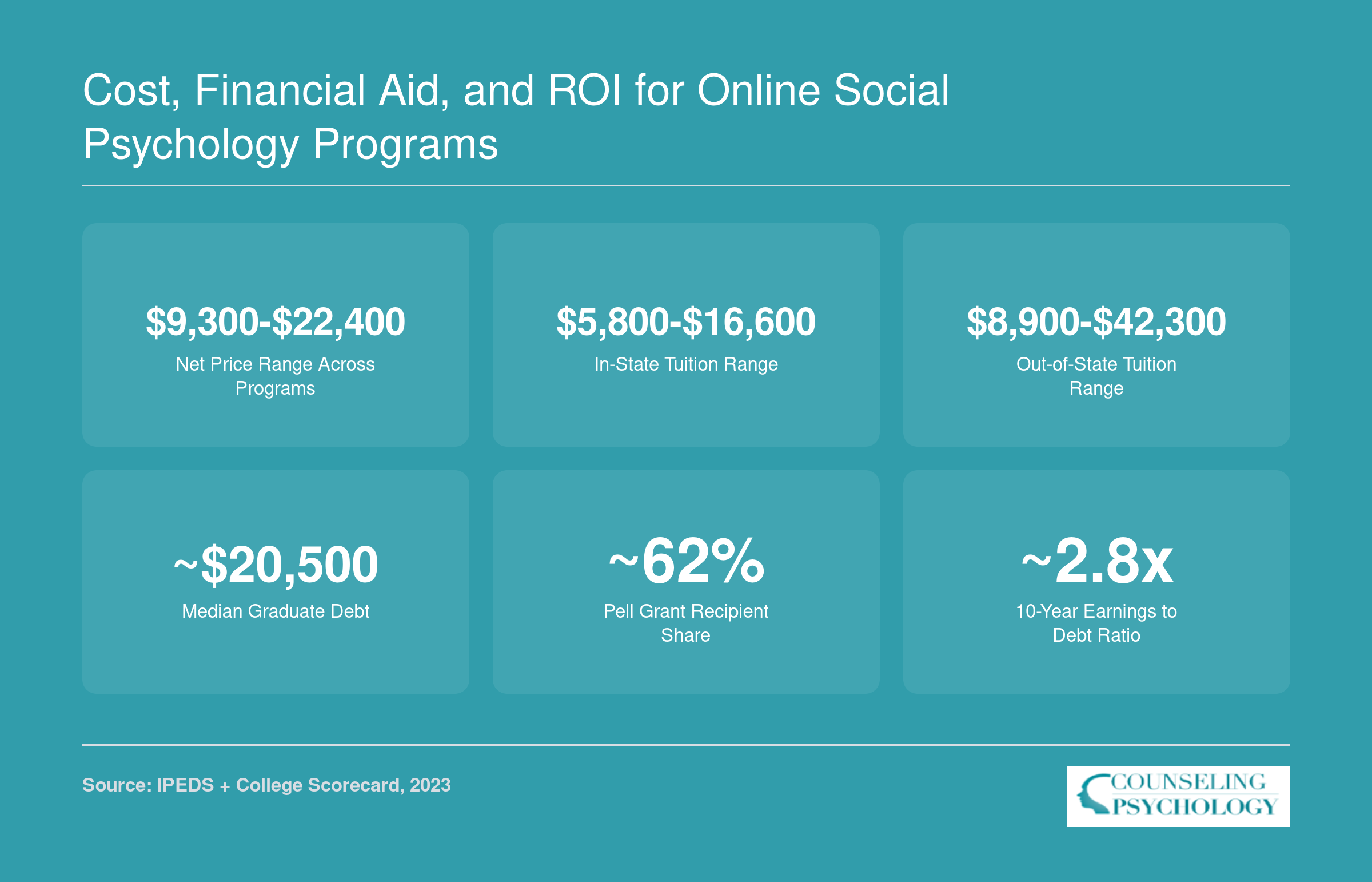
Across the programs in our ranked list, the financial picture is encouraging for online psychology students. The median graduate debt of roughly $20,500 is modest compared to institution-wide median earnings of about $57,400 ten years after enrollment, meaning graduates can expect to recoup their investment relatively quickly. Net price varies widely depending on residency status and institutional aid, so treat the figures below as approximate institution-wide averages rather than guaranteed costs for every student. Over 60% of students at these schools receive Pell Grants, signaling that substantial federal aid flows to this population.
Admissions Requirements and Transfer Policies
What GPA do you actually need to get into an online social psychology program, and how many transfer credits can you bring with you?
The answer varies more than you might expect. GPA floors, prerequisite coursework, and transfer limits differ significantly from one school to the next, so understanding the landscape will help you target programs that match your academic profile.
GPA Thresholds
Minimum GPA requirements for online bachelor's programs in psychology span a wide range. More open-access institutions may accept applicants with a cumulative GPA as low as 2.0; Texas State University's online BA in Psychology, for instance, sets its floor right at that mark.1 Georgia State University's online psychology completion program requires a 2.32, while the University of Florida asks for a 2.75.3 At the more selective end, Arizona State University's online BA in Psychology lists a 3.0 minimum.4 As a general rule, expect programs at larger public research universities to land in the 2.5 to 3.0 range, while broader-access schools may sit closer to 2.0.
Keep in mind that institution-wide admissions rates (which you will sometimes see published in federal data) reflect the entire university, not the psychology department specifically. Treat those figures as a general selectivity signal rather than a precise indicator of your chances in a social psychology track.
Prerequisite Courses
Most programs expect you to arrive with a handful of foundational courses already completed. Common prerequisites include:
- Introductory Psychology: Nearly universal across programs.
- English Composition: Required at most institutions to ensure writing readiness.
- College-Level Math or Statistics: UF Online, for example, requires both Pre-Calculus and Introduction to Statistics 1, along with a Biological Sciences course.3
Some schools bundle prerequisites into their general education block, so completing them at a community college before transferring is a practical way to save on tuition.
Transfer Credit Policies
If you are coming from a community college or another four-year institution, transfer-friendly policies can shave a year or more off your timeline. The University of Florida accepts 60 to 64 transfer credits toward its online BA in Psychology.3 Georgia State University's completion program is designed specifically for students who hold an associate degree in psychology or have already earned at least 60 credits.2 Many online programs in this space follow a similar model, accepting anywhere from 60 to 90 credits from regionally accredited institutions.
Before you apply, request an unofficial credit evaluation. Policies on which courses count toward the psychology major versus general education requirements can differ, and knowing early prevents surprises.
Standardized Tests and Additional Materials
Standardized test requirements have faded significantly across online programs. ASU Online does not require entrance exams4, and Texas State University has adopted a test-optional policy.1 This trend holds broadly in the online psychology space.
That said, programs with competitive concentrations or limited cohort sizes sometimes ask for a personal statement or letters of recommendation. These supplemental materials give admissions committees a sense of your research interests and professional goals, which matters more at schools that funnel students into focused social psychology tracks. If you are already thinking about graduate study, understanding how hard it is to get into grad school for psychology can help you frame those materials strategically. Even when these items are listed as optional, submitting them can strengthen a borderline application.
What Can You Do With a Bachelor's in Social Psychology?
The biggest question most students weigh is whether a specialized degree will open enough doors to justify the investment, or whether a broader psychology major offers more flexibility. A bachelor's in social psychology actually lands in a productive middle ground: it is specific enough to give you marketable research and behavioral-analysis skills, yet broad enough to apply across industries that depend on understanding how people think, decide, and interact in groups.
Career Tracks Worth Exploring
Social psychology graduates move into a surprisingly wide range of applied roles. Six career paths align especially well with the degree's core competencies:
- Market Research Analyst: Design surveys, run focus groups, and interpret consumer behavior data. The national median annual wage was $76,950 in 2024, according to the Bureau of Labor Statistics, with a projected job growth rate of 7% through 2034.1
- Human Resources Specialist: Apply knowledge of group dynamics, motivation, and bias to hiring, onboarding, and employee relations. BLS data show the national median salary for HR specialists near $67,650 as of recent reporting.
- UX Researcher: Conduct usability studies, A/B tests, and behavioral interviews to shape digital products. Though the BLS does not track UX researcher as a standalone occupation, many practitioners fall under the broader market research or social science research assistant categories.
- Community Health Worker: Use persuasion science and community-engagement strategies to promote public health initiatives at the local level.
- Survey Researcher: Build, test, and administer instruments that gather reliable data on attitudes and behaviors for government agencies, think tanks, or polling firms.
- Social Services Coordinator: Manage outreach programs, coordinate referrals, and evaluate program effectiveness for nonprofits or municipal agencies.
Why Employers Value This Skill Set
Companies in marketing, organizational behavior, and product design specifically seek candidates who can translate group-dynamics theory into actionable insights. If you are drawn to the corporate side of people science, learning more about the path to becoming an industrial organizational psychologist can help you see where a bachelor's in social psychology fits within the broader field. Social psychology coursework in experimental design, statistical analysis, and attitude measurement maps directly onto the day-to-day responsibilities of market research teams, HR analytics units, and UX labs. Hiring managers in these fields frequently note that candidates who understand concepts like social proof, cognitive bias, and conformity pressure can contribute faster than those with only a general psychology background.
Students interested in the consumer-facing side of this work may also explore the growing niche of consumer psychology, which applies many of the same behavioral principles to branding, advertising, and purchasing decisions.
Internships and Fieldwork
Many online programs partner with local organizations, nonprofits, or corporate offices to arrange practicum placements, though availability varies by program and region. These placements let you apply classroom theory in real settings and build a portfolio of work samples that strengthen your resume. If your program does not include a required internship, seek one independently; hands-on experience is often the differentiator in competitive job markets.
Is a Bachelor's in Social Psychology Worth It?
For applied roles in research, human resources, marketing, and community services, the answer is yes. The degree equips you with analytical and interpersonal skills employers actively seek, and the salary data for related occupations reflect solid earning potential right out of school. That said, clinical practice and tenure-track research faculty positions require graduate education, typically a master's or doctoral degree. If those are your long-term goals, treat the bachelor's as a strong foundation rather than a final destination. The salary breakdown in the next section offers a closer look at earning potential across these career tracks.
Social Psychology Career Salaries at a Glance
A bachelor's in social psychology prepares you for several research and analytics roles right out of school, with additional growth potential as you gain experience. The table below presents national median annual wages and total employment figures from the Bureau of Labor Statistics. These figures reflect entry and mid-career positions that align closely with the skills developed in a social psychology program, including research design, data analysis, and understanding human behavior in group settings. Market research analysts represent the largest employment pool by far, while survey researchers and social science research assistants offer more specialized paths. Keep in mind that salaries can vary significantly by industry, region, and years of experience.
| Occupation | National Median Salary | 25th Percentile | 75th Percentile | Total U.S. Employment |
|---|---|---|---|---|
| Social Science Research Assistants | $58,040 | $46,190 | $73,060 | 32,940 |
| Survey Researchers | $63,380 | $46,110 | $85,370 | 7,720 |
| Market Research Analysts and Marketing Specialists | $76,950 | $56,220 | $104,870 | 861,140 |
Preparing for Graduate School in Social Psychology
Direct-to-PhD versus a master's-first pathway: the route you choose after earning your bachelor's in social psychology depends largely on the research experience you bring to the table and how competitive your application profile is.
What Top PhD Programs Expect
Admissions committees at leading social psychology doctoral programs look for a consistent set of qualifications. NYU's social psychology PhD, for example, places particular emphasis on research involvement and expects applicants to have completed roughly six quantitative or methods courses at the undergraduate level.1 The University of Virginia eliminated its GRE requirement back in 2021, shifting focus to research experience, faculty fit, and genuine intellectual passion.3 Wayne State lists the GRE as optional and requires at least 12 semester hours of psychology coursework, including experimental psychology with a lab component and statistics.2
Across top programs more broadly, competitive applicants typically bring one to two years of dedicated research experience, and many successful candidates have completed a senior thesis, presented posters at conferences, or worked in a post-baccalaureate research position for one to three years before applying.4 Strong letters of recommendation from research mentors carry significant weight.
Can an Online Bachelor's Get You Into a PhD Program?
Yes, but you will need to be intentional about closing the research gap. Accredited online degrees are generally treated as equivalent by admissions committees in the mid-2020s, so the format of your coursework is less of a concern than what you did beyond coursework.4 Online students should actively pursue opportunities such as:
- Remote RA positions: Many university labs now hire remote research assistants, a shift that accelerated during the pandemic and has persisted.
- Independent study or honors thesis: Some online programs offer capstone research tracks or independent study credits that let you design and execute a study under faculty supervision.
- Post-graduation lab work: Spending a year or two as a full-time research assistant or lab coordinator at a university after graduating is one of the most common paths into top doctoral programs.
Make sure your statistics preparation extends at least through multivariate methods. Programs that list six quantitative courses as a benchmark are not unusual, and arriving at a PhD program without that foundation puts you at a disadvantage from day one.
The Master's-First Pathway
If your research profile is thinner than you would like, or if your undergraduate institution did not offer robust thesis options, a terminal master's in social or experimental psychology can serve as a bridge. A master's program gives you two years to build mentored research experience, publish, and develop the kind of application that top PhD programs expect. This route is especially common among graduates of online bachelor's programs who did not have easy access to brick-and-mortar lab environments during their undergraduate years.
A Note on Licensure
A bachelor's in social psychology alone does not qualify you to practice as a licensed psychologist. The title of psychologist, including social psychologist in a clinical or applied context, requires a doctoral degree and state licensure. If independent practice or the psychologist title is your goal, exploring broader careers in psychology can help you map out the doctoral path that fits your interests, whether that is a PhD or PsyD beyond the bachelor's level.
A bachelor's in social psychology equips you with research methods and behavioral science training that employers in HR, marketing, and UX actively seek. If your long-term goal is to practice as a social psychologist, though, plan on pursuing a PhD, because independent practice and academic research roles in this field require doctoral-level credentials.
Frequently Asked Questions About Social Psychology Degrees
Choosing a degree path raises plenty of practical questions, from daily coursework to long-term career payoff. Below are straightforward answers to the questions prospective social psychology students ask most often.
- What can I do with a bachelor's in social psychology?
- A bachelor's in social psychology qualifies you for roles in market research, human resources, community outreach, survey research, and nonprofit program coordination. Many graduates also move into advertising, public relations, or social services. The BLS reports that, nationally, survey researchers earned a median salary of about $60,000 as of recent data, while human resources specialists earned roughly $67,650. Some graduates pursue additional credentials to enter counseling or applied behavior fields.
- Is social psychology a hard major?
- Difficulty depends on your comfort with research methods and statistics, which are core components of most social psychology programs. You will analyze data sets, design studies, and interpret results alongside theory courses. Students who enjoy understanding group behavior and are willing to build quantitative skills typically find the major manageable. Time management matters, too: expect regular writing assignments, group projects, and at least one research methods sequence.
- What degree do I need to be a social psychologist?
- Practicing as a social psychologist usually requires a doctoral degree, either a Ph.D. or a Psy.D., with a concentration in social psychology. A bachelor's degree is the first step, followed by a master's or direct entry into a doctoral program. Licensure requirements vary by state but generally include supervised clinical or research hours and passing the Examination for Professional Practice in Psychology (EPPP).
- Can I get a BS in psychology online?
- Yes. Numerous regionally accredited universities offer fully online Bachelor of Science and Bachelor of Arts programs in psychology, including concentrations in social psychology. Online programs cover the same curriculum as on-campus versions, with coursework in research methods, statistics, social cognition, and group dynamics. Look for regional accreditation from bodies recognized by the U.S. Department of Education to ensure your credits transfer and employers recognize your degree.
- How is a social psychology degree different from a general psychology degree?
- A general psychology degree surveys broad topics such as developmental, clinical, cognitive, and abnormal psychology. A social psychology concentration narrows the focus to how individuals think, feel, and behave in social contexts, covering persuasion, prejudice, group decision-making, and conformity. Social psychology students typically take more coursework in research design and statistical analysis applied to social phenomena, which builds a strong foundation for careers in research, policy, or marketing.
- Is a bachelor's in social psychology worth it?
- For many students, yes. The degree develops research, analytical, and communication skills valued across industries. Graduates enter fields like market research, human resources, and community services, where median salaries often range from the mid-$40,000s to the upper-$60,000s nationally, depending on the role. The degree also positions you well for graduate study. Maximizing ROI means choosing an accredited, affordable program and gaining internship experience before graduation.
More Online Social Psychology Programs to Consider
Beyond our top 10, these programs offer additional pathways to a bachelor's in social psychology or general psychology online. Each entry below includes key details such as net price, format, and distinguishing features.
- Psychology
- Bachelor of Arts (B.A.) in Psychology
- Bachelor of Arts in Psychology
- BA in Psychology
- Psychology
- Bachelor of Science in Psychology
- Bachelor of Arts in Psychology
- Psychology
- Bachelor of Arts in Psychology
- Liberal and Interdisciplinary Studies, B.A. General Psychology Concentration
- Bachelor of Arts in Psychology
- Bachelor of Science in Psychology
- Bachelor of Science in Psychology
- Psychology
- Psychology