
What you’ll learn in this article…
- Online social psychology master's tuition ranges from roughly $18,000 to over $60,000 across accredited programs.
- Most programs require a 3.0 GPA and introductory psychology coursework, but many have dropped the GRE.
- Graduates enter careers in market research, UX research, organizational consulting, and community development.
- Regional accreditation, not APA accreditation, is the critical quality marker for these master's programs.
Employers in UX research, behavioral policy, and organizational development increasingly seek candidates who understand group dynamics, persuasion, and decision-making at a level deeper than a bachelor's degree provides. That demand has pushed more universities to offer a master's in social psychology online, though fully accredited options remain relatively scarce compared to clinical or counseling tracks.
The scarcity itself creates a sorting problem. Prospective students must weigh program quality against format flexibility, often comparing degrees housed in different departments or labeled under broader "applied psychology" umbrellas. Tuition across current online options ranges from roughly $18,000 to over $60,000, and salary outcomes vary just as sharply depending on industry and role.
Best Online Master's in Social Psychology Programs
Online master's programs in social psychology prepare students to understand how individuals think, feel, and behave within social contexts. These programs blend psychological theory with research methods, equipping graduates for careers in organizational consulting, community development, market research, and applied behavioral science. The following schools offer well-regarded online or hybrid graduate programs in social psychology or closely related concentrations, ranked by program quality, institutional reputation, and student outcomes.
- Independent program research
- U.S. Department of Education College Scorecard (collegescorecard.ed.gov)
- National Center for Education Statistics (NCES-IPEDS) (nces.ed.gov)
Arizona State University
Arizona State University offers a highly regarded online Master of Science in Psychology that allows students to explore social and behavioral science topics within a rigorous research framework. ASU's global reputation and innovation-driven approach provide access to leading faculty and expansive research opportunities. With a 68% graduation rate and median alumni earnings of $62,668, ASU consistently delivers strong student outcomes.
- Covers social cognition, group dynamics, and behavioral research
- Taught by faculty from ASU's nationally ranked psychology department
- Flexible online format designed for working professionals
- Emphasis on applied research methods and data analysis
- Access to ASU's extensive digital library and research tools
- No GRE required for admission consideration
- Capstone or thesis options available for culminating experience
Master of Science in Psychology — Online
Pepperdine University
Pepperdine University's Graduate School of Education and Psychology offers an online master's in psychology with coursework applicable to social psychology topics. Known for its high academic standards and an 83% graduation rate, Pepperdine graduates report median earnings of $82,939, the highest among schools on this list. The program's emphasis on ethical practice and human behavior in social settings makes it a premium choice.
- Explores social influence, attitudes, and interpersonal behavior
- Grounded in Pepperdine's values-driven educational philosophy
- Faculty with extensive applied and research expertise
- Strong alumni network across psychology and business sectors
- Median graduate earnings of $82,939 ten years post-enrollment
- 83% institutional graduation rate reflects strong support systems
- Coursework includes research design and statistical analysis
Master of Arts in Psychology — Online
CUNY School of Professional Studies
CUNY School of Professional Studies delivers an affordable online Master of Arts in Psychology that integrates social psychology theory with practical applications. As part of the City University of New York system, the program benefits from diverse faculty perspectives and an urban research orientation. CUNY SPS is known for making quality graduate education accessible to a wide range of learners.
- Covers social psychology, group behavior, and cultural influences
- Highly affordable tuition within the CUNY public system
- Asynchronous coursework designed for working adults
- Faculty drawn from CUNY's extensive psychology network
- Emphasizes research methodology and critical analysis skills
- Located within a diverse, globally connected university system
- Prepares students for doctoral study or applied psychology careers
Master of Arts in Psychology — Online
National University
National University offers online graduate psychology programs with flexible scheduling and a unique four-week course model ideal for busy professionals. With a flat tuition rate of $13,284 for all students regardless of residency, National University provides cost transparency. Graduates report median earnings of $67,548, reflecting strong workforce preparation in applied psychology fields.
- Accelerated four-week course format for faster completion
- Flat tuition rate regardless of state of residency
- Covers social behavior, cognition, and applied research methods
- Monthly start dates offer maximum enrollment flexibility
- Median alumni earnings of $67,548 ten years after enrollment
- Military-friendly institution with dedicated veteran support
- No GRE requirement for most applicants
Master of Arts in Psychology — Online
Nova Southeastern University
Nova Southeastern University provides online graduate psychology programs through its College of Psychology, one of the largest and most established in the nation. Students gain access to faculty specializing in social and community psychology research. With a 63% graduation rate and median earnings of $59,209, NSU balances academic rigor with practical career preparation.
- Housed within one of the nation's largest psychology colleges
- Concentrations available in social and community psychology areas
- Emphasizes applied research and evidence-based practices
- Online coursework with optional campus-based intensives
- Faculty actively engaged in social psychology research
- Prepares graduates for doctoral programs or applied careers
- 63% institutional graduation rate with strong student support
Master of Science in Psychology — Online
Southern New Hampshire University
Southern New Hampshire University is known for its accessible and affordable online programs, including graduate offerings in psychology with social psychology coursework. SNHU's online infrastructure is among the most developed in the country, providing robust academic support and career services. With competitive tuition and rolling admissions, it is well suited for students balancing work and study.
- Concentration in social psychology within the MS Psychology program
- Affordable online tuition with no hidden fees
- Six start dates per year for maximum scheduling flexibility
- Covers social influence, persuasion, and group dynamics
- 24/7 online academic and technical support available
- No standardized test scores required for admission
- Median alumni earnings of $50,318 ten years after enrollment
Master of Science in Psychology – Social Psychology Concentration — Online
Capella University
Capella University specializes in online education and offers master's-level psychology programs with social psychology foundations. The competency-based FlexPath option allows students to progress at their own pace, potentially reducing both time-to-degree and cost. With a net price of $14,400 per year and low median debt of $14,968, Capella is one of the most affordable options available.
- FlexPath self-paced option allows competency-based progression
- Social psychology coursework embedded in the core curriculum
- Low median graduate debt of $14,968 compared to peers
- Designed specifically for the online adult learner experience
- Quarterly start dates with year-round enrollment options
- Dedicated academic coaching and career planning resources
- Accredited by the Higher Learning Commission
Master of Science in Psychology — Online
Liberty University
Liberty University offers one of the largest online graduate programs in the country, including master's-level psychology with coursework in social behavior and applied psychology. The program integrates a Christian worldview with academic study, appealing to students seeking faith-based education. Liberty maintains a 65% graduation rate and provides extensive online student support services.
- Integrates social psychology concepts with a Christian worldview
- 100% online with eight-week course terms for flexibility
- Covers social cognition, attitudes, and group behavior
- Transfer-friendly policy accepting up to 50% of credits
- 65% institutional graduation rate with strong retention support
- Financial aid and military tuition discounts available
- No GRE or GMAT required for admission
Master of Arts in Psychology — Online
Walden University
Walden University is a pioneer in online higher education and offers a robust Master of Science in Psychology with a social psychology specialization. The program emphasizes applying psychological principles to real-world social issues, aligning with Walden's mission of positive social change. Flexible pacing and year-round enrollment make it accessible to working professionals.
- Dedicated social psychology specialization within the MS program
- Mission centered on driving positive social change
- Covers persuasion, prejudice, social identity, and group processes
- Coursework aligned with APA guidelines for psychology education
- Multiple start dates throughout the year for flexibility
- Extensive virtual library and research database access
- Capstone project focused on applied social psychology research
MS in Psychology – Social Psychology Specialization — Online
Roosevelt University
Roosevelt University offers graduate psychology programs rooted in its longstanding commitment to social justice and equity. Located in downtown Chicago, the university provides online and hybrid options that allow students to study social behavior in diverse urban contexts. With a median debt of $22,000 and median earnings of $48,712, Roosevelt appeals to students prioritizing mission-driven education.
- Strong social justice orientation embedded throughout the curriculum
- Explores social psychology within diverse urban communities
- Online and hybrid delivery options available for flexibility
- Faculty expertise in community and applied social psychology
- Small class sizes support individualized mentoring relationships
- Located in Chicago with access to diverse research populations
- Prepares graduates for applied careers or doctoral-level study
Master of Arts in Psychology — Online
How We Ranked These Social Psychology Programs
Our ranking begins with a clear filter: only programs that deliver their curriculum primarily or fully online make the initial cut. We look for asynchronous, synchronous, or hybrid structures that do not require regular in-person residencies beyond brief orientations. This ensures every school you see here is genuinely accessible to distance learners.
How We Built the List
We started with the U.S. Department of Education's Integrated Postsecondary Education Data System (IPEDS) and the College Scorecard, pulling all institutions reporting online graduate programs in psychology. We then cross-referenced institutional websites to verify current online delivery and to identify program tracks, whether the degree was explicitly in social psychology, applied social psychology, or a general psychology master's with a robust social psychology concentration. Because the federal Classification of Instructional Programs (CIP) code for "social psychology" is used by only a handful of schools, our list also includes programs labeled "general psychology" or "applied psychology" that offer at least 12 credit hours of social psychology coursework and faculty actively researching in the field.
The Metrics That Matter
After establishing the eligibility pool, we ordered programs using a weighted composite of outcomes data. The composite prioritizes four factors: - Earnings: Median earnings of graduates one year after completion, sourced from College Scorecard. - Cost: Net price and average debt load for graduate students, adjusted for completion. - Completion rates: The proportion of full-time, first-time students who graduate within 150% of normal time. - Debt outcomes: Median debt and cohort default rates, signaling how manageable the investment is. We applied a smoothing model to reduce noise from small sample sizes, so programs with very few graduates did not unfairly skew high or low.
What the Rankings Don't Measure
We deliberately exclude subjective measures like faculty reputation, peer assessment surveys, and student satisfaction polls. While those factors can matter for some learners, they introduce bias and are not uniformly measurable across disparate program types. Our focus remains on quantifiable, publicly verifiable student outcomes: what graduates earn, how much they owe, and whether they finish the program. We also do not consider accreditation status as a ranking metric, though every program listed holds regional accreditation, and most have additional programmatic accreditation, because that is a baseline requirement, not a differentiator.
Addressing the Program Universe
Because very few universities offer a dedicated online master's in social psychology, the list may appear shorter than rankings for broader fields. We prefer a smaller, carefully curated set over inflating the count with unrelated programs. The inclusion of strong general or applied psychology tracks with substantial social psychology content reflects the reality of the graduate education landscape and provides a more useful starting point for students specifically interested in social psychological methods and theory.
Side-By-Side Tuition Comparison for Online Social Psychology Programs
Tuition for online master's programs in social psychology and related psychology concentrations varies widely, from roughly $18,000 to well over $60,000 depending on the institution. The figures below reflect published 2025-2026 rates where available. Most of these programs offer federal financial aid, and many provide institutional scholarships or employer tuition-reimbursement partnerships, so out-of-pocket costs may be lower than the sticker price suggests.
| Program | Per-Credit Rate | Total Credits | Estimated Total Cost | Notes |
|---|---|---|---|---|
| University of Louisiana at Monroe, Online MS in Psychology | $500 | 36 | ~$18,000 | Flat rate for in-state and out-of-state students |
| Southern New Hampshire University, Online MA in Psychology | $530 | 36 | ~$19,080 | Flat rate; no in-state vs. out-of-state differential typically applies |
| Purdue University Global, Online MS in Psychology | N/A | N/A | ~$11,414/year | Annual tuition and fees listed; total cost depends on enrollment pace |
| Pepperdine University, Online MA in Psychology | $2,030 | N/A | Varies by credit total | No in-state vs. out-of-state difference; private university pricing |
Related Articles
What Can You Do With a Master's in Social Psychology?
A master's in social psychology opens doors across several well-defined occupational categories, many of which treat the degree as a direct entry-level credential rather than a stepping stone to a doctorate.
Market Research and Consumer Insights
Market research analysts (SOC 13-1161) represent one of the largest employment categories for social psychology graduates. The BLS Occupational Outlook Handbook notes that a bachelor's degree is the typical entry requirement, but employers in competitive markets and research-intensive firms increasingly prefer candidates with graduate training in social behavior, research design, and statistical analysis. Social psychology coursework maps cleanly onto this work: understanding attitude formation, persuasion, group dynamics, and survey methodology is precisely what consumer insights teams need.
Survey researchers (SOC 19-3022) occupy a narrower but related space. The BLS lists a master's degree as the standard entry requirement for this role, making it one of the clearest direct-hire targets for graduates. Survey researchers design questionnaires, analyze response bias, and interpret behavioral data for clients ranging from federal agencies to political campaigns.
Applied Research and Academia-Adjacent Roles
Sociologists (SOC 19-3041) typically require a master's or doctorate depending on the setting. Government agencies and policy organizations often hire at the master's level for research and analyst positions. Social psychology training overlaps substantially with sociological methods, particularly in areas like social influence, collective behavior, and community-level research. Graduates interested in broader applied psychology careers will find that this overlap creates useful flexibility.
Industrial-organizational psychologists (SOC 19-3032) command strong salaries and work in corporate consulting, human resources, and organizational development. The BLS notes that graduate-level education is required for most positions. If you want to understand how to become an industrial organizational psychologist, look for programs that include I-O-oriented coursework; the Society for Industrial and Organizational Psychology (SIOP) publishes salary surveys and job market data that give a clearer picture of compensation than general wage statistics alone.
Where to Dig Deeper
For reliable, occupation-specific data, visit BLS.gov and look up each SOC code directly. If you are still exploring whether this field is the right fit, our guide on how to become a social psychologist covers the full career trajectory in detail. University career pages for the programs you are considering often publish graduate employment outcomes, and alumni networks are among the most candid sources of information about where a degree actually leads. Professional associations like SIOP and the American Psychological Association conduct periodic salary surveys worth reviewing before you commit to a program or a career direction.
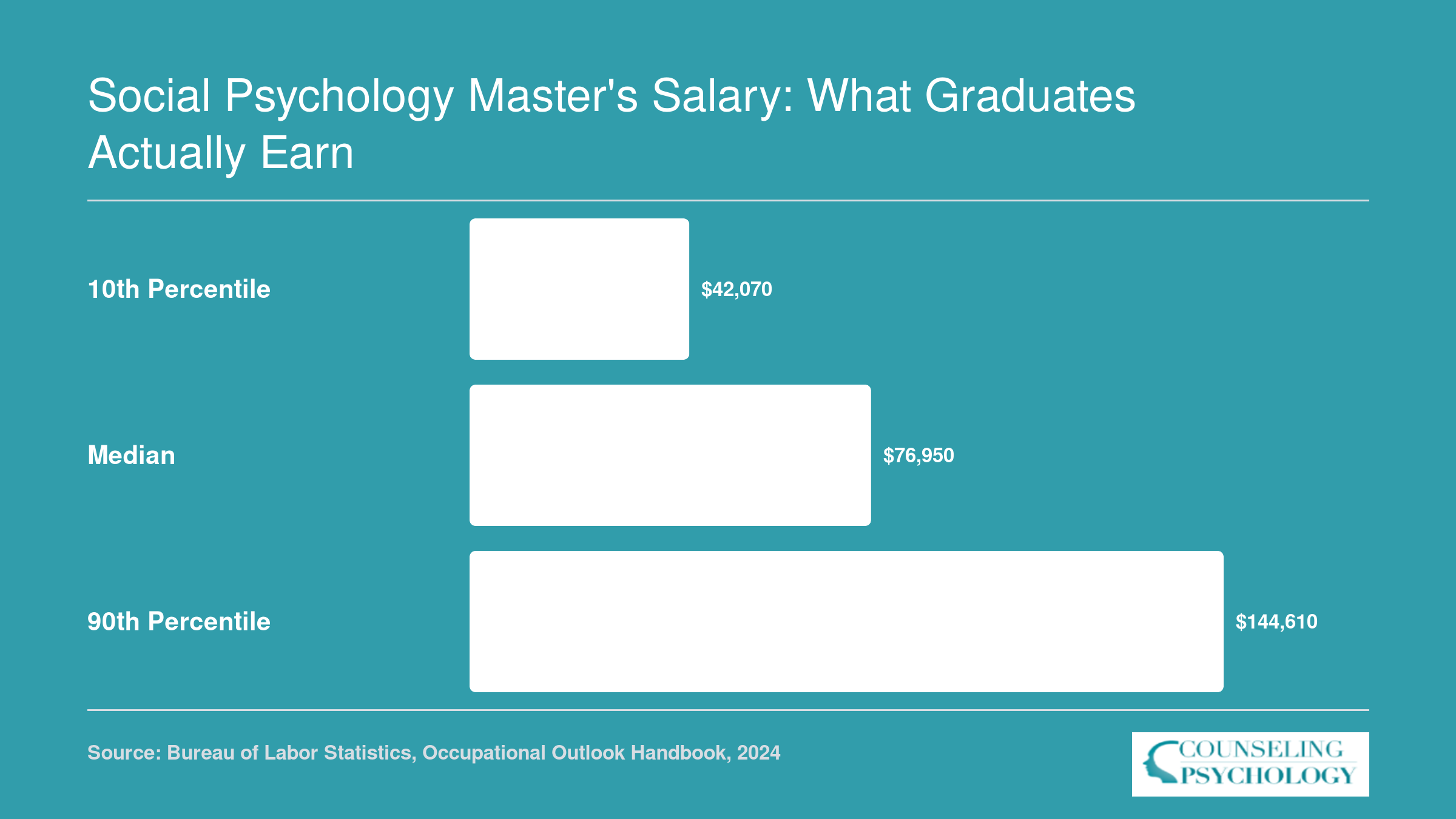
Social Psychology Master's Salary: What Graduates Actually Earn
Can you reach six figures with a master's in social psychology? The answer depends heavily on your career path, the industry you enter, and where you live. A UX researcher at a major tech firm in San Francisco will out-earn a nonprofit program evaluator in a rural metro by a wide margin. The national BLS figures below show how the realistic salary spread looks across the most common occupation tied to social psychology graduates for which verified data is available.
Questions to Ask Yourself
Is a Master's in Social Psychology Worth It?
The honest answer depends on what you plan to do with the degree, how much you pay for it, and what you would be doing instead. Here is a framework for thinking through the return on investment in concrete terms.
The Financial Payback Timeline
Tuition for the online programs profiled on this page generally falls between roughly $15,000 and $50,000 for the full degree. Program-level earnings data shows that graduates of many social psychology and related behavioral-science master's programs report median earnings in the mid-$40,000s to low-$60,000s within one to two years of completion, with figures climbing into the $55,000 to $75,000 range by the three- to four-year mark. If your all-in cost lands around $25,000 and you see a $10,000 to $15,000 annual salary bump over what you earned with a bachelor's alone, the degree can pay for itself in roughly two to three years. Programs at the higher tuition end stretch that timeline, so shopping on cost per credit genuinely matters.
Be Honest About the Salary Ceiling
Six-figure salaries are realistic in specific lanes: industrial-organizational psychology roles, UX research positions, and data-driven strategy jobs in the tech sector. But many social-psych-adjacent positions in nonprofits, education, government, and community organizations start in the $55,000 to $80,000 range and climb modestly from there. If maximizing lifetime earnings is your primary goal, make sure the program you choose builds quantitative and applied research skills that open doors to those higher-paying tracks.
Comparing Your Alternatives
Two paths students frequently weigh against a social psychology master's deserve a candid look:
- Entering the workforce with a bachelor's in psychology: You avoid tuition debt entirely, but median earnings for bachelor's-level psychology graduates tend to plateau in the $40,000 to $55,000 band. Advancement into research, management, or specialized roles often stalls without a graduate credential.
- Pursuing an MSW instead: A Master of Social Work opens a direct path to clinical licensure and reimbursable practice, which a social psychology degree does not. However, MSW programs are typically more expensive, and the starting salaries for licensed social workers overlap heavily with social-psych master's holders. The MSW makes more sense if you want to provide therapy; the social psychology degree makes more sense if you want to do research, program design, or organizational work.
If you are still exploring which graduate credential fits your goals, our overview of different types of psychology degrees can help you compare options side by side.
Beyond the Paycheck
Financial ROI is only part of the picture. A social psychology master's offers real career-pivoting power because the skill set (survey design, behavioral analysis, program evaluation, persuasion science) transfers across industries from healthcare to marketing to public policy. The degree also provides serious intellectual depth in understanding group behavior and social influence, which is increasingly valued by employers navigating DEI strategy, consumer insights, and public communication challenges. For students considering a PhD, this master's serves as a low-risk proving ground: you build research experience, refine your interests, and strengthen doctoral applications without committing to a five- to seven-year program upfront. Those drawn to clinical work might also explore clinical psychology doctorate programs as a longer-term option.
The bottom line: a social psychology master's is worth it when the program is affordable, the curriculum aligns with a specific career direction, and you enter with realistic expectations about where the degree does and does not lead.
Curriculum and Specialization Tracks to Compare
Ball State University offers students a choice between a traditional thesis and an internship-based culminating experience in its MA in Social Psychology, illustrating the applied-versus-research divide that shapes program design across the field.1 Understanding how programs structure their curricula helps you match your career goals to the right track.
Applied vs Research Orientations
Programs fall along a spectrum. Research-oriented tracks emphasize thesis completion, advanced statistical methods, and experimental design. Ball State's thesis option and Harvard Extension School's requirement that students complete either a thesis or capstone project exemplify this model.2 Core coursework in these programs centers on social psychology theory, statistics, and research methods, preparing students for doctoral candidacy or roles in university research labs.
Applied programs prioritize immediate workforce readiness. The University of Oregon's online Master's in Psychology delivers core courses in community needs assessment, intervention science, and program evaluation, with capstone research integrated each term rather than a single thesis.3 Ball State's internship track and certificate options in criminal justice, health, or institutional research mirror this applied focus.1 ASU's online MS in Psychology spans cognitive, developmental, physiological, and social psychology, allowing elective customization without a specified thesis requirement.4 Students drawn to this model may also want to explore applied psychology masters programs for additional options.
Emerging Specialization Tracks
Beyond the generic applied-versus-research split, newer tracks address niche demand:
- Political psychology: Examines voter behavior, ideology formation, and social influence in political contexts.
- Behavioral economics: Blends psychology and economic decision-making, increasingly relevant in policy and marketing roles.
- Health behavior: Focuses on adherence, patient communication, and public health intervention design.
- Organizational social psychology: Applies group dynamics and social cognition to workplace culture, team performance, and leadership.
The University of Oregon offers special-topics electives in neuroscience, diversity and equity, and substance use, while Ball State's sociology and criminal justice tracks overlap with political and organizational themes.31
Practicum and Fieldwork Requirements
Practicum availability varies sharply. Ball State's internship option provides supervised applied experience.1 Harvard Extension School requires two on-campus weekends or one three-week summer course but does not mandate fieldwork.2 The University of Oregon and ASU programs do not list practicum components, signaling a classroom or capstone-focused model.34 Those interested in organizational and workplace applications of social psychology can learn more in our personnel psychologist career guide.
Self-Sorting: Which Track Fits You?
Research-oriented programs suit PhD-bound students who need methodological depth, thesis experience, and faculty mentorship for doctoral applications. Applied programs serve those entering the workforce immediately in user-experience research, organizational consulting, public health, or market analysis. If you plan to pursue licensure as a clinical or counseling professional, verify that the program does not carry the social psychology label alone. Most state boards require practicum hours and counseling-specific coursework that general social psychology tracks omit.
When evaluating programs, focus first on whether the university holds regional accreditation (from a recognized body such as HLC, SACSCOC, or WSCUC), not on APA accreditation. APA accredits doctoral clinical and counseling programs, not master's degrees in social psychology, so searching for APA-accredited social psych master's programs will lead you nowhere. Regional accreditation is the credential that matters for licensure, employer recognition, and graduate school admission.
Admissions Requirements and Tips for Online Programs
Most online master's programs in social psychology set a minimum undergraduate GPA of 3.0, require foundational coursework in psychology, and have eliminated the GRE as a barrier to entry.12 Arizona State University Online, CUNY School of Professional Studies, and American Public University System all waive standardized test requirements and welcome applicants who can demonstrate readiness through academic transcripts and professional experience.3 This test-optional shift reflects the field's recognition that strong research skills and intellectual curiosity matter more than entrance exam scores, particularly for working professionals and career-changers who form the core audience for online programs.
GPA and Prerequisite Coursework
The 3.0 GPA threshold is standard but not absolute. CUNY SPS and ASU both offer holistic review processes that weigh research methods coursework, professional accomplishments, and personal statements alongside undergraduate grades.12 All three programs require completion of introductory psychology, statistics, and research methods before matriculation. ASU recommends social science statistics specifically.1 If you lack these courses, many schools offer bridge coursework or conditional admission pathways that let you complete prerequisites during your first semester.
Non-Psychology Majors Welcome
Every program reviewed accepts applicants without psychology undergraduate degrees. CUNY SPS explicitly notes conditional admission for career-changers, and American Public University lists the same three prerequisite courses required of all applicants.23 If your bachelor's is in sociology, education, business, or any field where you engaged with behavioral research, online social psychology programs are designed to accommodate your transition. Plan to take two to three foundational courses before or during your first term. Students exploring adjacent graduate pathways, such as cognitive psychology masters programs, will find similar prerequisite expectations.
Three Concrete Application Tips
First, tailor your statement of purpose to social psychology by naming the subfields or research questions that drive your interest (intergroup conflict, persuasion, social cognition), not just "I want to understand human behavior." Second, highlight any research experience, even if informal: undergraduate honors projects, workplace data analysis, volunteer program evaluation, or independent literature reviews all demonstrate analytical rigor. Third, secure at least one academic reference who can speak to your capacity for critical thinking and quantitative reasoning; a professor who supervised your statistics coursework carries more weight than a supervisor who can only vouch for your punctuality.
Program Length and Pacing
Typical online social psychology master's programs require 30 to 42 credits. Full-time students finish in 1.5 to 2 years, while part-time learners spread coursework over 2 to 3 years. Most programs offer asynchronous schedules that let working professionals balance job, family, and study without relocating or quitting their jobs.
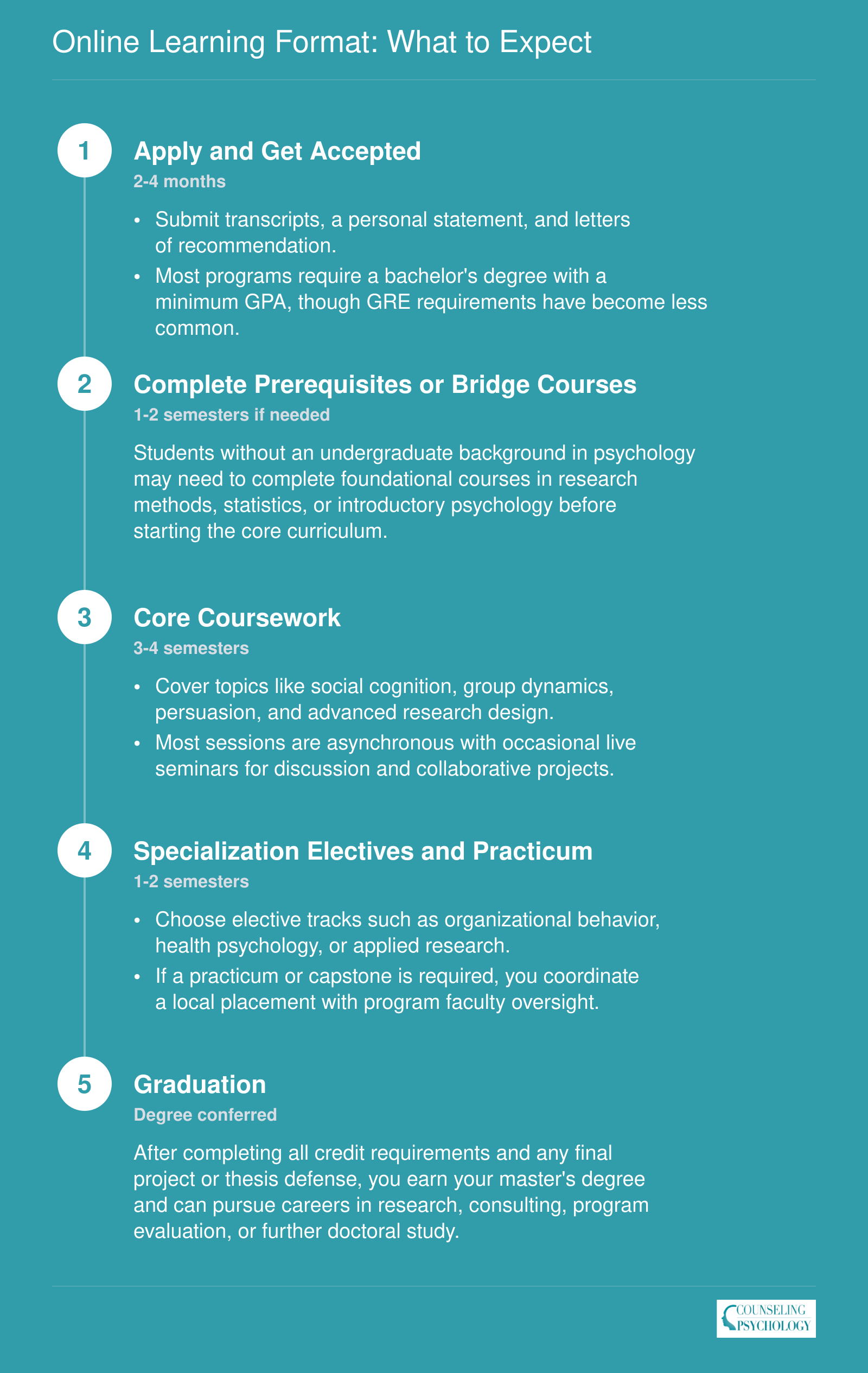
Online Learning Format: What to Expect
Most online social psychology master's programs follow a structured sequence that takes roughly two to three years. Coursework is primarily asynchronous, meaning you watch lectures and complete assignments on your own schedule, though many programs include periodic synchronous seminars or group discussions via video conference. Some schools use a cohort model where you progress through courses with the same group of students, while others offer self-paced enrollment with more flexible start dates. If your program requires a practicum or capstone internship, you will typically arrange the placement in your local area with faculty approval.
Licensure, Further Education, and Next Steps
Licensure for social psychology master's graduates is not a single path but a set of state-specific rules that determine what professional credentials you can hold and what services you can offer. Unlike clinical or counseling psychology programs that lead directly to a license, a master's in social psychology often sits at the intersection of research and applied work, meaning the licensure landscape is patchy and requires careful navigation.
Start with your state's licensing board
The first stop is always your state's psychology licensing board. A directory is available through the Association of State and Provincial Psychology Boards (ASPPB). These offices publish the exact requirements for any psychology-related credential, including master's-level titles. Some states issue a Licensed Psychological Associate or similar designation, which may allow you to practice under supervision, conduct assessments, or provide therapy in certain settings. Pay close attention to supervised experience hours (often 1,000 to 4,000 post-degree) and whether the Examination for Professional Practice in Psychology (EPPP) at the master's level or a state-specific exam is required.
Understand the 'psychologist' title
The American Psychological Association (APA) is unambiguous: the title "psychologist" requires a doctoral degree. No state will license a master's-level graduate as a psychologist. However, other professional paths exist. The National Association of School Psychologists (NASP) credentials school psychologists at the specialist level, and some states license master's-level psychological examiners or associates. The U.S. Bureau of Labor Statistics (BLS) website includes a state-by-state tool that shows typical education levels and licensure requirements for psychology occupations, a quick way to compare options across states.
Explore further education and career ladders
For many, a master's in social psychology serves as a stepping stone. If your goal is independent practice as a psychologist, you will need to pursue a doctoral program (PhD or PsyD) in a licensable specialty like clinical, counseling, or school psychology. Even if you stay at the master's level, you may find roles in research coordination, program evaluation, marketing, or user experience research that do not require a license. Exploring the broader landscape of careers in psychology can help you identify which of these paths align with your interests. Check whether your program's curriculum includes practicum experiences that can strengthen a doctoral application or provide direct client contact if your state permits it.
Get personalized guidance
Generic advice only goes so far. Contact your state psychological association, which often maintains a list of approved supervisors and current rule changes. University career services and program faculty are also valuable, especially if they have alumni working with similar credentials. Some professional organizations, like the Society for Personality and Social Psychology, offer mentoring programs or career resources that can clarify nontraditional routes. Always verify what you hear against official state board publications, since rules shift and online information can be outdated.
Frequently Asked Questions About Online Social Psychology Master's Programs
Below are answers to some of the most common questions prospective students ask before committing to an online master's in social psychology. Where possible, each answer points back to data and discussions covered earlier in this article.