What you’ll learn in this article…
- New Hampshire has no fully online doctoral psychology program that meets state licensure requirements as of 2026.
- In-state bachelor's tuition starts at $7,724 at the University of New Hampshire system, while private options cost significantly more.
- Licensure as a psychologist in New Hampshire typically requires seven to ten years from doctoral enrollment to independent practice.
- APA accreditation affects license portability, federal hiring eligibility, and insurance panel access for New Hampshire graduates.
Seven institutions offer psychology programs in New Hampshire, and none provides a fully online doctorate that meets state licensure requirements. That concentrated landscape forces prospective psychologists to weigh cost, format, and career trajectory early in the search.
The rankings below prioritize affordability and accessible online pathways. Later sections compare PsyD versus PhD options, unpack licensure steps, and map specializations to local job demand. Students exploring online doctoral programs in psychology will find that no APA-accredited option exists in a fully online format as of 2026.
Graduates of New Hampshire programs earn median wages near the national average, roughly $66,000 ten years after starting college, making cost-conscious program selection a long-term financial lever.
2026 Best Psychology Programs in New Hampshire: Rankings
New Hampshire offers a compact but varied landscape for psychology education, with options ranging from low-cost online bachelor's degrees to APA-accredited doctoral programs. The schools below were evaluated with a strong emphasis on affordability and online accessibility, making this list especially useful for students balancing work, family, or geographic constraints. Program-level earnings data is not yet available for most of these offerings, so we focus on institution-wide outcomes and net price to help you compare value.
- Net price and financial aid
- Online and hybrid availability
- Graduation and retention rates
- Program breadth and specializations
- Graduate earnings outcomes
- Internal program database
- College Scorecard graduate earnings — collegescorecard.ed.gov
- NCES-IPEDS federal institutional data — nces.ed.gov
- Independent program research

University of New Hampshire
The University of New Hampshire anchors the state's psychology training pipeline with multiple online Applied Psychology concentrations, from Addictions Studies to Applied Behavior Analysis and Counseling Foundations. In-state tuition of $19,202 and a net price of $23,805 make it one of the stronger value propositions among four-year institutions in the state. The school's overall graduation rate is 76.1%, the highest on this list, and median earnings ten years after enrollment reach $66,479. UNH is widely regarded as a key contributor to New Hampshire's behavioral health workforce.
- Fully online bachelor's requiring 120 credit hours
- Covers addiction biology, counseling foundations, and prevention
- Integrative capstone ties theory to real-world practice
- Up to 90 transfer credits accepted
- Prepares graduates for roles in behavioral health services
- No GRE required for admission
- Online format with flexible scheduling for working adults
- Builds skills in counseling theory and human development
- 120 credits required, with generous transfer policy
- Career-focused curriculum guided by expert faculty
- Serves as a stepping stone to graduate counseling programs
- Personalized academic advising throughout the program
- Evidence-based ABA curriculum delivered entirely online
- Emphasizes ethical practice and behavioral intervention skills
- Prepares students for careers with autism and developmental populations
- 120 total credits with up to 90 transferable
- Accredited through NECHE regional accreditation
- Designed for working professionals and career changers
- Explores health behaviors and sociocultural wellness factors
- Interdisciplinary behavioral science coursework
- Designed as a pathway into bachelor's-level study
- Affordable tuition relative to private alternatives
- Focus on prevention strategies across diverse populations
- Flexible online delivery suits place-bound learners
Applied Psychology, Addictions Studies Option (B.S.) — Online
Applied Psychology, Counseling Foundations Option (B.S.) — Online
Applied Psychology, Applied Behavior Analysis Option (B.S.) — Online
Applied Psychology, Wellness and Prevention Option — Online

New England College
New England College pairs a small student-to-faculty ratio of 8:1 with a fully online Psychology B.A. that includes an Applied Behavioral Analysis concentration aligned with Behavior Analysis Certification Board requirements. The net price of $26,972 reflects substantial institutional aid, and the program is structured to prepare graduates for the national board exam. The school's overall graduation rate is 34.5%, a figure prospective students should weigh carefully, though the intimate class sizes and career-focused curriculum appeal to learners who thrive with close faculty interaction.
- Online program aligned with BACB coursework requirements
- Prepares students to sit for the national certification exam
- Covers behaviorist theory, research methods, and ethical assessment
- Develops skills in behavior plan creation and implementation
- Flexible format accommodates students at various career stages
- Career paths include mental health, school counseling, and human services
Psychology, Applied Behavioral Analysis Concentration (B.A.) — Online

Rivier University
Rivier University stands out in New Hampshire for offering both an online B.A. in Psychology and one of the state's few APA-accredited doctoral programs, the Psy.D. in Counseling and School Psychology. That doctoral offering is explicitly structured to meet New Hampshire licensure requirements, including a 2,000-hour internship. At the undergraduate level, a Mental Health and Addiction Studies track can prepare students for LADC licensure. The school's overall graduation rate is 51.7%, and its net price of $28,082 reflects private-institution costs offset by institutional aid.
- Fully online, 120 to 121 credit hours at $402 per credit
- 7-week accelerated course format with multiple start dates
- Up to 90 transfer credits accepted
- Strong research methodology and analytical skills training
- Positions graduates for social services and graduate study
- Flexible scheduling for students balancing work and academics
- Concentration prepares students for LADC licensure pathway
- Online delivery with the same 7-week course structure
- Covers addiction, counseling, and mental health fundamentals
- Builds competency in culturally responsive practice
- Up to 90 transfer credits honored
- Multiple career paths in treatment and prevention
- APA-accredited practitioner-scholar doctoral program
- Minimum five-year timeline, 60 to 130 credit hours
- Weekday evening courses support working professionals
- 2,000-hour supervised internship required
- Meets all New Hampshire psychology licensing requirements
- Multiple practicum placements build clinical competence
- $1,275 per credit at the doctoral level
B.A. in Psychology — Online
B.A. in Psychology, Mental Health and Addiction Studies — Online
Psy.D. in Counseling and School Psychology — Hybrid

University of New Hampshire at Manchester
UNH Manchester provides the same Applied Psychology degree options as its Durham parent campus but at a lower in-state tuition of $15,838 and a net price of just $9,992, making it the most affordable four-year option on this list. Online concentrations in Organizational Psychology, Counseling Foundations, and Applied Behavior Analysis give students workforce-ready pathways. The campus maintains an 8:1 student-to-faculty ratio, and the school's overall graduation rate is 50%.
- Fully online, 120 credits with up to 90 transferable
- Focuses on workplace behavior, HR, and consulting readiness
- Expert faculty with real-world organizational experience
- Regionally accredited through NECHE
- Personalized academic advising available
- Affordable in-state tuition under $16,000
- Online bachelor's exploring counseling theory and practice
- 120 credit hours with generous transfer credit policy
- Serves as a foundation for graduate counseling study
- Career advising helps students map post-graduation paths
- Designed for flexibility around work and family
- Regionally accredited institution
- Evidence-based ABA curriculum delivered fully online
- Emphasizes ethical behavioral intervention strategies
- Up to 90 transfer credits reduce time to completion
- Comprehensive behavioral science training
- Tailored for working professionals and adult learners
- Flexible course scheduling across multiple terms
Applied Psychology, Organizational Psychology Option (B.S.) — Online
Applied Psychology, Counseling Foundations Option (B.S.) — Online
Applied Psychology, Applied Behavior Analysis Option (B.S.) — Online

University of New Hampshire College of Professional Studies Online
UNH's College of Professional Studies Online is purpose-built for adult and nontraditional learners, offering some of the lowest listed tuition in the state at $7,724 in-state and $9,284 out-of-state. The net price of $10,864 and a generous transfer policy (up to 90 credits) make it especially compelling for career changers. Online concentrations span Addictions Studies, Applied Behavior Analysis, and Organizational Psychology. The school's overall graduation rate is 29.5%, which reflects the part-time, adult-learner population it primarily serves.
- Fully online with internship or capstone project
- 120 total credits, up to 90 transferable
- Specialized coursework in addiction and behavioral health
- NECHE-accredited institution
- Career advising and flexible learning pathways
- Prepares for entry-level roles in counseling and social work
- Scientific behavior modification approach delivered online
- Focus on autism, developmental disabilities, and intervention
- 120 credit hours with high transfer-credit ceiling
- Evidence-based ABA techniques in every core course
- Versatile career opportunities across clinical settings
- Individualized strategies for behavior change
- Online bachelor's exploring workplace psychological principles
- Potential careers in HR, consulting, and management
- Up to 90 transfer credits accepted
- Expert faculty with practitioner backgrounds
- NECHE-accredited, affordable tuition rates
- Flexible course scheduling for working adults
Applied Psychology, Addictions Studies Option (B.S.) — Online
Applied Psychology, Applied Behavior Analysis Option (B.S.) — Online
Applied Psychology, Organizational Psychology Option (B.S.) — Online

Southern New Hampshire University
Southern New Hampshire University is one of the nation's largest online educators and offers psychology pathways from bachelor's through master's level, including concentrations in Forensic Psychology, Child and Adolescent Development, and Industrial-Organizational Psychology. Online bachelor's tuition runs $330 per credit, a figure that has earned national "Best Buy" recognition for affordability. The net price of $36,708 reflects on-campus figures and is higher than most competitors here; online-only students typically pay less. The school's overall graduation rate is 42.8%, and it maintains a 24:1 student-to-faculty ratio.
- Online, $330 per credit with 8-week terms
- Covers criminal behavior, legal psychology, and ethics
- No application fee and no GRE required
- 24/7 student support and flexible scheduling
- Transfer up to 90 credits toward the 120-credit degree
- Prepares for diverse careers in criminal justice settings
- Focuses on developmental stages and intervention strategies
- Online delivery with the same $330 per-credit rate
- 8-week course terms allow accelerated completion
- No entrance exam required for admission
- Career paths in education, social services, and advocacy
- Access to a 400,000-plus alumni network
- Online program with culturally responsive counseling focus
- Evidence-based techniques for addiction intervention
- 40 courses, each in an 8-week accelerated format
- Capstone course integrates classroom and field learning
- Transfer up to 90 credits
- $330 per credit with no application fee
- Blends business administration with behavioral science
- Online, career-focused curriculum at $330 per credit
- 40 courses across 8-week terms
- Prepares for roles in HR and organizational development
- Transfer-friendly, up to 90 prior credits accepted
- Flexible online learning for working professionals
- Fully online master's at $637 per credit, 12 courses
- Three concentration tracks available
- No GRE required, 10-week terms
- Foundation courses available for non-psychology majors
- Does not lead to clinical licensure
- Flexible scheduling for working graduates
- Applies psychological theory to criminal justice contexts
- Online, $637 per credit with flexible term scheduling
- Covers legal considerations and ethical practices
- Bachelor's degree required for admission
- Foundation courses bridge non-psychology backgrounds
- Prepares for roles in corrections, courts, and research
- Online master's focusing on youth development and intervention
- 36 credits at $637 per credit
- No test scores required for admission
- 24/7 online support and academic advising
- Prepares graduates for doctoral study or applied roles
- Research methods and assessment training included
B.A. in Psychology, Forensic Psychology Concentration — Online
B.A. in Psychology, Child and Adolescent Development — On-Campus
B.A. in Human Services, Substance Abuse Concentration — Online
B.S. in Business Administration, I-O Psychology Concentration — On-Campus
M.S. in Psychology — On-Campus
M.S. in Psychology, Forensic Psychology Concentration — Online
M.S. in Psychology, Child and Adolescent Psychology — On-Campus

Franklin Pierce University
Franklin Pierce University rounds out the list with a hybrid Master's in Clinical Mental Health Counseling, a 60-credit program that combines online coursework with on-campus intensives in Rindge. At roughly $39,900 total, it is positioned as a licensure-aligned pathway designed to address New Hampshire's shortage of licensed counselors. The program requires 700 hours of supervised field experience, and the school's overall graduation rate is 53.5%. Franklin Pierce is a practical choice for students already working in or near the state who want to earn a counseling credential without fully pausing their careers.
- 60-credit hybrid program blending online and campus sessions
- 700 hours of supervised field experience required
- Total estimated cost of approximately $39,900
- Covers ethics, multicultural counseling, and diagnosis
- Admission requires 3.0 GPA, essay, and three references
- Designed to prepare graduates for NH counselor licensure
- On-campus intensives held in Rindge, NH
Master's in Clinical Mental Health Counseling — Hybrid
Online Vs. On-Campus Psychology Programs in New Hampshire
Seven New Hampshire institutions deliver psychology programs in online, hybrid, or campus-only formats, but none currently offer a fully online doctorate in psychology that leads to state licensure. For students weighing their options, understanding which schools deliver which degrees, and in what format, is essential to mapping an affordable, flexible, and career-viable path.
Bachelor's Degrees: Fully Online Across Multiple Institutions
New Hampshire's online bachelor's landscape is robust. Southern New Hampshire University (SNHU) operates one of the largest online psychology programs in the country, with fully asynchronous bachelor's degree tracks in general psychology, forensic psychology, and related applied fields.2 The University of New Hampshire College of Professional Studies also offers a B.S. in Applied Psychology entirely online, with concentrations in organizational psychology and applied behavior analysis.3 New England College delivers an online B.A. in Psychology with an applied behavioral analysis concentration, and Rivier University provides an online B.A. in Psychology with a mental health and addiction studies track. All four programs allow students to complete core coursework from anywhere, with no campus residencies required at the bachelor's level.
Master's Degrees: Limited Online, Hybrid Options Emerging
Master's-level psychology programs in New Hampshire are scarce online. Franklin Pierce University offers a hybrid Master's in Clinical Mental Health Counseling that blends online coursework with on-campus intensives and 700 hours of supervised field experience. SNHU does deliver a fully online master's degree in psychology, though it does not qualify graduates for independent licensure as a psychologist.2 Students interested in marriage and family therapy may also want to explore MFT programs in New Hampshire as an alternative licensure pathway. Students seeking a master's pathway to licensure as a licensed psychologist or clinical psychologist will need to confirm that any program meets New Hampshire's supervised practice and academic requirements, which typically include in-person practica.
Doctoral Programs: No Fully Online Options in New Hampshire
Can you earn a psychology doctorate online in New Hampshire? The short answer is no, not from a New Hampshire-based institution, and not in a format that leads to state licensure. Antioch University New England operates the state's only APA-accredited PsyD program, and it is delivered entirely in person. No other New Hampshire school currently offers a doctoral program in psychology. For a broader look at what is available nationally, our guide to clinical psychology doctorate programs covers APA-accredited options across the country. Online doctoral programs in psychology, regardless of where they are housed, do not hold APA accreditation as of 2025, and APA accreditation remains the gold standard for licensure eligibility. New Hampshire also requires in-person supervised clinical hours for licensure, which fully online programs cannot satisfy. Students seeking a doctoral credential must either attend Antioch's on-campus program or consider APA-accredited programs in nearby states that may offer hybrid or low-residency formats with in-person practicum placements.
Practical Advice: Match Format to Your Career Goal
Flexibility matters, but so does career viability. If your goal is to become a licensed psychologist in New Hampshire, plan for in-person doctoral training and supervised practica. If you are pursuing a bachelor's or sub-master's credential for roles in human services, organizational psychology, or research support, New Hampshire's fully online options deliver strong, asynchronous coursework that accommodates working adults. Hybrid programs like Franklin Pierce's counseling master's strike a middle ground, requiring periodic campus visits but preserving weekday flexibility. Before enrolling, verify that any program's delivery mode aligns with your state's licensure requirements and your own scheduling constraints.
Questions to Ask Yourself
Doctoral Psychology Programs in New Hampshire: Psyd Vs. PHD Compared
New Hampshire offers a limited but distinct set of doctoral psychology pathways, and the PsyD vs. PhD distinction matters more here than in larger states with dozens of options. The PsyD is practitioner focused: expect heavy clinical training, structured cohorts, and a doctoral project rather than a traditional dissertation. The PhD emphasizes original research, typically comes with stronger funding packages (teaching or research assistantships), and prepares graduates for both clinical work and academic careers. Below is a side-by-side look at the primary doctoral programs available in or closely serving the state as of 2026.
| Feature | Antioch University New England PsyD (Keene) | UNH PhD in Psychology (Durham) |
|---|---|---|
| Degree Type | PsyD (Doctor of Psychology) | PhD (Doctor of Philosophy) |
| Primary Orientation | Practitioner-scholar model with emphasis on clinical practice | Research-oriented with clinical training components |
| APA Accreditation | Yes, APA accredited | The doctoral program in psychology at UNH is not a clinical psychology program and does not hold APA accreditation in clinical psychology |
| Total Credits Required | 108 to 120 credits | Varies by concentration; typically around 72+ course credits plus dissertation research |
| Typical Program Length | 5 years (includes internship year) | 5 to 7 years, depending on dissertation timeline |
| Cohort Size | Approximately 21 students per entering cohort | Small cohorts, generally fewer than 10 per concentration |
| Admission Rate | Roughly 60% | Highly selective at the doctoral level; overall university undergraduate admission rate is about 88%, but PhD cohorts are far more competitive |
| GRE Requirement | GRE not required for admission as of recent cycles | Policies vary by concentration; check with the department directly |
| Dissertation or Doctoral Project | Clinical dissertation (applied project rather than traditional experimental dissertation) | Traditional research dissertation required |
| Funding and Assistantships | Limited institutional funding; most students finance through loans or employer support | PhD students commonly receive teaching or research assistantships with tuition remission |
| EPPP Pass Rate | Program-specific EPPP pass rates are not consistently published for recent cohorts; prospective students should request this data directly from the program | Not applicable (UNH PhD is not a licensed-practice clinical program) |
| Best Fit For | Students committed to clinical practice who want structured, cohort-based training | Students drawn to psychological research, academia, or research-intensive clinical careers |
Related Articles
What a Psychology Degree Costs in New Hampshire, and What Graduates Earn
Tuition and Net Price: Public vs. Private Perspectives
The sticker price of a psychology degree in New Hampshire varies widely between public and private institutions. At public universities, in-state tuition for bachelor's programs ranges from $7,724 at the University of New Hampshire College of Professional Studies Online to $19,202 at the Durham campus. Out-of-state students face higher charges, typically $36,000 to $40,000. Private college tuition falls between $17,200 at Southern New Hampshire University and $46,442 at Franklin Pierce University. The net price, what the average student actually pays after grants and scholarships, is often lower. For public schools, effective net prices range from $9,992 at UNH Manchester to $23,805 at the main UNH campus. Private net prices are generally higher, clustering between $27,000 and $37,000. Keep in mind these figures are institution-wide averages and not a guaranteed quote; your own cost will depend on financial aid eligibility and program-specific fees. Online and hybrid formats can also influence total outlay, particularly when they eliminate relocation or commuting expenses.
Debt at Graduation: What Borrowers Owe
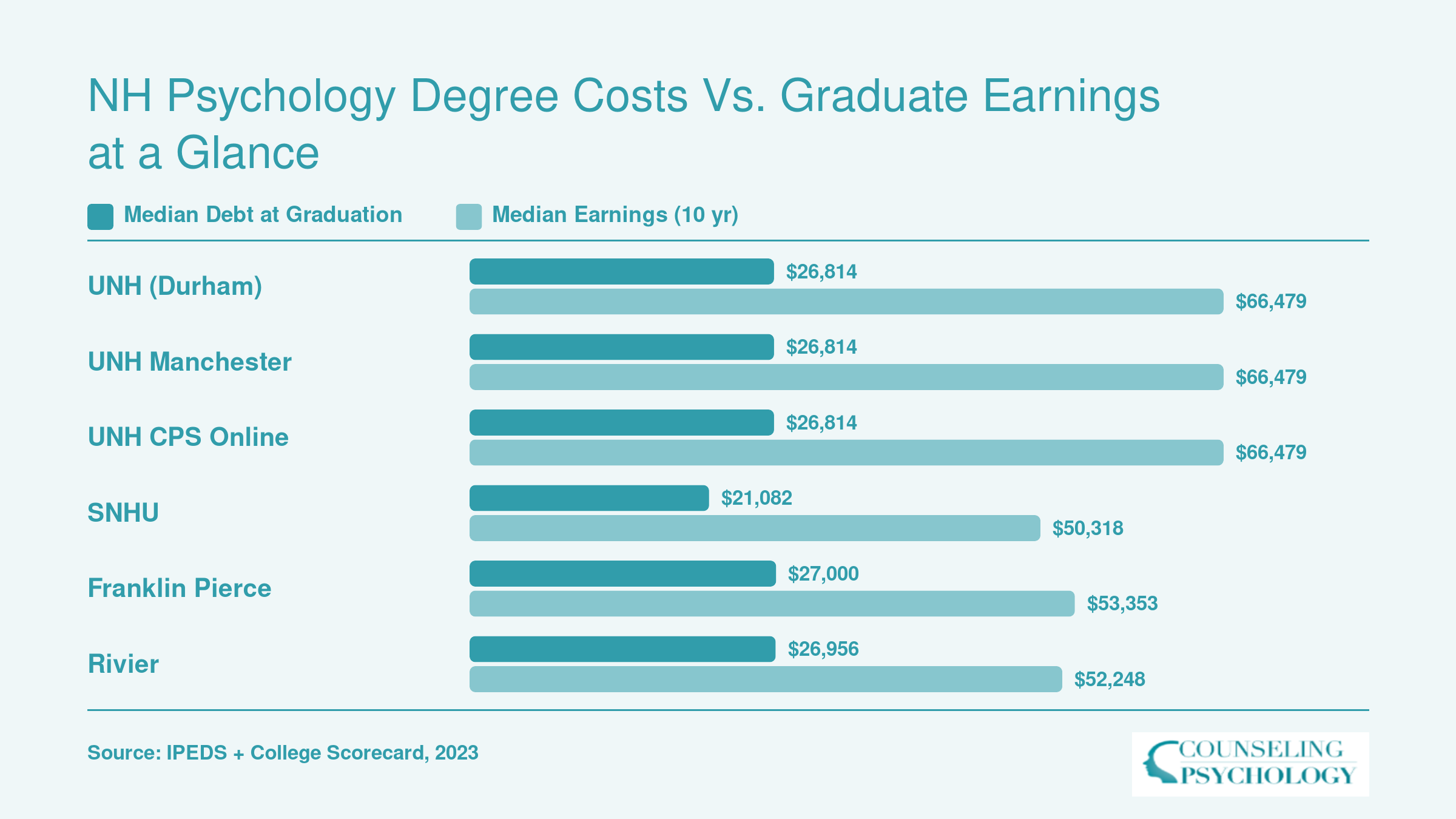
Median debt for graduates of New Hampshire's psychology programs is not reported at the program level, but institutional medians give a ballpark. At the private colleges on our list, median debt ranges from about $21,000 at SNHU to $27,000 at Franklin Pierce. Public university graduates from the UNH system carry a median of around $26,800. Translated to a standard 10-year repayment plan, a $27,000 loan at current federal interest rates would mean monthly payments roughly between $280 and $310. While these figures are manageable compared to national averages, they underscore the importance of borrowing strategically, especially if you plan to pursue graduate education later, where additional loans often accumulate.
Earnings Potential for New Hampshire Psychologists
Short-term program-level earnings data are not yet available for these specific psychology degrees, but statewide labor market data offers a clear picture of what licensed psychologists earn. According to the May 2025 State Occupational Employment and Wage Estimates from the Bureau of Labor Statistics, clinical and counseling psychologists in New Hampshire earn a median annual wage of $99,200, with the top 10 percent making more than $128,000.1 School psychologists have a median of $80,500, and psychologists overall (across all specialties) reach a median of $105,300.1 These figures reflect licensed professionals with doctoral or specialist-level credentials. Students interested in the undergraduate pathway can explore a bachelor's degree in clinical psychology as a first step, though bachelor's-level psychology graduates can expect considerably lower starting pay, often in the $40,000 to $60,000 range nationally, which makes advanced training a near-necessity for those targeting a psychologist's salary.
Weighing the Investment
A clinical psychology PhD program can easily cost over $100,000 in tuition alone, and combined with lost earnings during years of supervised experience, the upfront burden is substantial. However, New Hampshire's psychologist salaries offer a strong return on that investment over a long career. Even accounting for debt repayment, a licensed psychologist in the state can out-earn many other professional fields within a decade of licensure. The key is to keep total borrowing in check: choosing an affordable master's or doctoral program, maximizing employer-funded training, and pursuing specializations with high demand can tip the balance further in your favor. Use the BLS data and institutional net-price benchmarks here as a starting point to calculate your own break-even timeline before taking on significant debt.
NH Psychology Degree Costs Vs. Graduate Earnings at a Glance
How does median graduate debt stack up against long-term earnings at New Hampshire's psychology programs? The chart below compares median debt at graduation with median earnings ten years after enrollment for six institutions. Program-level earnings shortly after graduation are not yet available for these schools, so the institution-wide ten-year figure from College Scorecard serves as the best current benchmark.
How to Become a Licensed Psychologist in New Hampshire: Step-By-Step
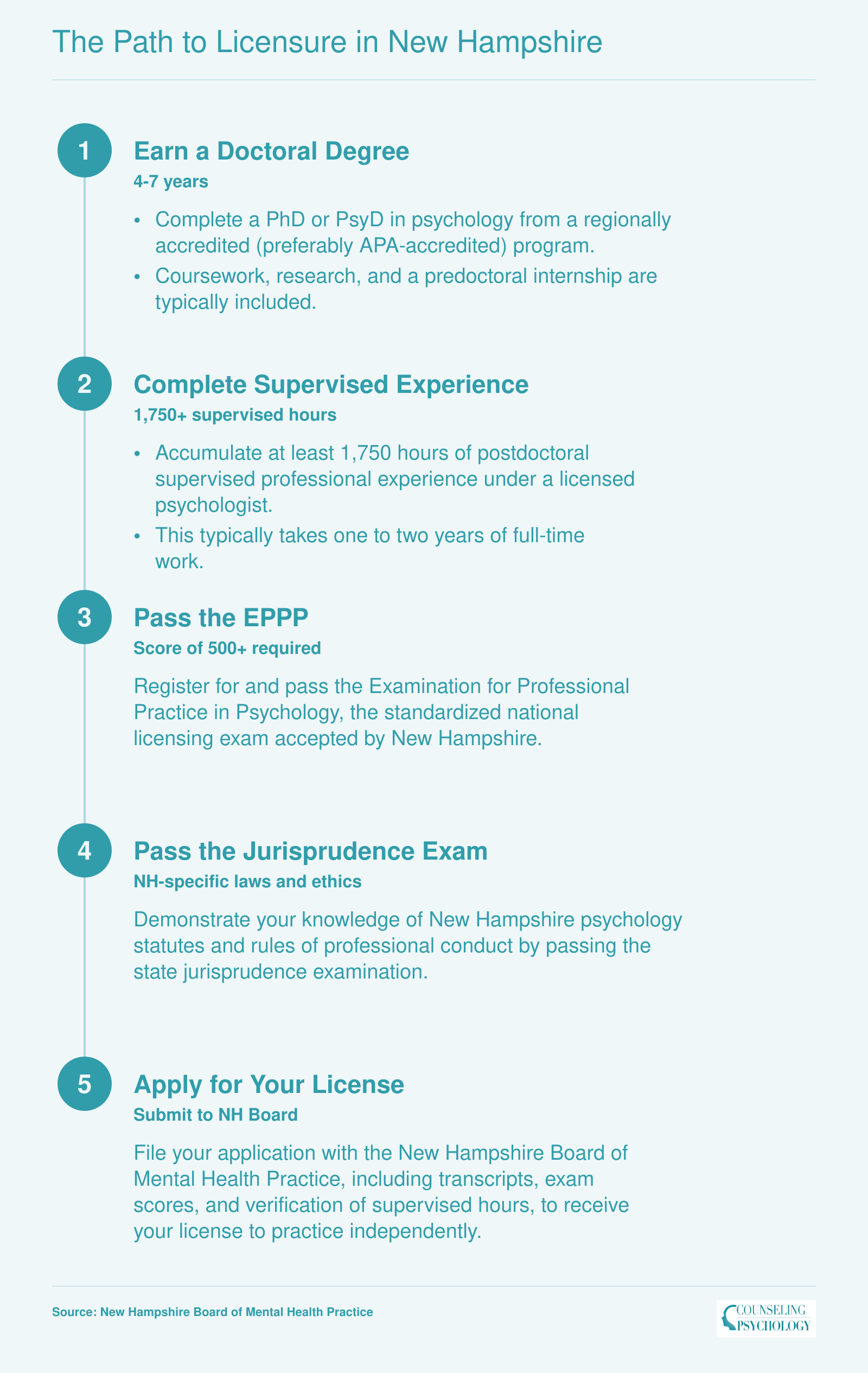
Becoming a licensed psychologist in New Hampshire follows a structured sequence that typically takes seven to ten years from the start of a doctoral program to independent practice. Each stage builds on the last, so understanding the full pathway before you enroll makes it easier to choose the right program and plan your timeline. For a broader look at the general process, see our guide on how to become a psychologist.
The Degree Requirement
New Hampshire requires a doctoral degree in psychology, either a PhD or a PsyD, from a regionally accredited institution. APA-accredited programs are automatically accepted, and that distinction carries real weight: APA accreditation is the clearest signal that a program meets national training standards, and it tends to smooth the process if you later seek licensure in another state.2 Programs that lack APA accreditation are not automatically disqualified in New Hampshire, but candidates should verify regional accreditation carefully before enrolling.
Supervised Experience Hours
New Hampshire requires a total of 3,000 supervised hours, split across two stages.2
- Predoctoral hours: 1,500 hours completed before graduation, typically through practicum placements and internship.
- Postdoctoral hours: An additional 1,500 hours completed after the doctoral degree is conferred.
During the postdoctoral phase, you must receive at least two hours of supervision per week. At least 375 of your total hours must involve direct client contact. Supervision must be provided by a licensed psychologist who meets the board's qualifications.
Examinations
Two exams stand between your postdoctoral experience and a full license.
First, the Examination for Professional Practice in Psychology (EPPP). New Hampshire requires a passing scaled score of 500, which aligns with the national standard used by most states. The EPPP fee is $600, paid directly to the testing vendor.3
Second, a state-specific jurisprudence exam that covers New Hampshire statutes, rules, and ethical standards governing psychological practice.3 Passing this exam demonstrates that you understand the legal framework you will operate within as a licensed psychologist in the state.
Application to the Board
Once your degree, supervised hours, and exam scores are in order, you apply to the New Hampshire Board of Psychologists. The application requires a background check and payment of fees: the initial license fee is $135, in addition to the application fee of $316. Factor these costs into your planning, as they come at the end of a lengthy training period when many candidates are transitioning out of supervised positions.
A Note on the Master's-Level Track
Not every graduate student is aiming for doctoral-level licensure. If you complete a master's degree in counseling or a related field, a different license applies: the Licensed Clinical Mental Health Counselor (LCMHC) credential, overseen by the New Hampshire Board of Mental Health Practice. The LCMHC track has its own supervised hours requirement and examinations and is a well-established pathway into clinical practice. Those interested in the counseling route can explore counseling master's programs online to compare options. It is worth knowing early which track aligns with your goals, since the doctoral and master's pathways diverge significantly in cost, time, and scope of practice.
The Path to Licensure in New Hampshire
Becoming a licensed psychologist in New Hampshire follows a defined sequence. From your first day of doctoral coursework to independent practice, expect a timeline of roughly 8 to 12 years depending on your program format and how quickly you accumulate supervised hours.
Psychology Specializations Available in New Hampshire
New Hampshire's psychology programs span several specializations, each with distinct career trajectories. Understanding which concentrations exist at different degree levels helps you align your education with your professional goals.
Bachelor's-Level Concentrations
Undergraduate programs in New Hampshire offer more variety than you might expect:
- Applied Behavior Analysis: Both the University of New Hampshire at Manchester and New England College offer ABA concentrations. These programs align with Behavior Analyst Certification Board requirements, preparing graduates for careers working with individuals with autism spectrum disorder or developmental disabilities.
- Addiction Psychology: The University of New Hampshire offers an addictions studies option through its applied psychology major, covering addiction biology, counseling approaches, and intervention strategies.
- Forensic Psychology: Southern New Hampshire University's bachelor's program includes a forensic psychology concentration examining criminal behavior, legal psychology, and offender assessment.
- Organizational Psychology: The UNH College of Professional Studies offers this concentration for students interested in workplace behavior, human resources, and consulting careers.
- General Psychology: Rivier University's bachelor's program includes a mental health and addiction studies track that prepares graduates for Licensed Alcohol and Drug Counselor certification.
These undergraduate concentrations provide entry points into human services, case management, or behavioral technician roles. They also serve as strong preparation for graduate study.
Master's and Doctoral Specializations
Graduate-level programs narrow toward professional practice:
- Clinical Mental Health Counseling: Franklin Pierce University's 60-credit master's program includes 700 hours of field experience and prepares graduates for counselor licensure, not psychologist licensure. You can explore best counseling programs in New Hampshire for a closer look at these options.
- Clinical Psychology (Doctoral): Antioch University New England offers a PsyD program with a practitioner focus, training students for clinical practice leading to licensure as a psychologist.
- Research-Oriented PhD: The University of New Hampshire's doctoral program emphasizes research methodology and academic preparation, better suited for those pursuing faculty positions or research careers.
Career Implications by Specialization
Your specialization determines your licensure pathway. Clinical and counseling psychology doctoral programs lead to licensure as a psychologist in New Hampshire, while ABA tracks prepare you for board certification as a behavior analyst. Mental health counseling master's programs lead to counselor licensure, a separate credential. School psychology programs, when available, lead to state certification for work in educational settings. Research tracks typically lead to academic positions or roles in applied research organizations rather than direct clinical practice. For a broader view of where each path can take you, our guide to careers in psychology outlines salary expectations and entry points across specializations. Students interested in criminal behavior and legal settings should also review the forensic psychologist requirements to understand what additional training is needed beyond a bachelor's concentration.
APA accreditation is more than a quality badge: it determines whether you can transfer your license to another state, qualify for psychologist roles at VA hospitals or federal agencies, and join insurance panels. New Hampshire doctoral students planning clinical practice should treat APA accreditation as essential, not optional, when choosing a program.
Frequently Asked Questions About Psychology Programs in New Hampshire
Choosing a psychology program in New Hampshire raises practical questions about accreditation, cost, and licensure. Below are answers to the questions prospective students ask most often, grounded in current 2026 program data and state requirements.