

What you’ll learn in this article…
- Psychology BA holders earn a median starting salary around $38,000 to $40,000, trailing business and nursing graduates by a significant margin.
- BLS projects 6% to 11% job growth through 2034 for roles commonly filled by psychology graduates, depending on the specific occupation.
- Roughly 40% to 45% of psychology BA holders eventually pursue graduate school, and a strategic graduate degree can double lifetime earnings.
- Pairing the degree with internships, research experience, and a complementary minor significantly improves both job prospects and starting pay.
Psychology is the fourth most popular undergraduate major in the United States, yet it consistently records some of the lowest early-career median earnings among all fields. Its appeal lies in the broad lens it offers on human behavior: a foundation for careers in counseling, research, business, and social services. But the degree's open-ended nature creates a persistent gap between student expectations and labor-market realities.
Employers prize the critical thinking and interpersonal skills psychology majors develop, but without additional credentials or targeted internships, graduates often find themselves in roles that underutilize their training. The outcome hinges less on the major itself than on whether a student pairs it with a deliberate career strategy, whether that means getting into grad school for psychology, pursuing data analysis coursework, or building hands-on experience before graduation.
What Can You Actually Do With a Bachelor's in Psychology?
A bachelor's in psychology qualifies you for a wider range of jobs than most people assume, but the realistic picture is more nuanced than "become a therapist" (which typically requires a graduate degree and license). Understanding where BA and BS psychology graduates actually land helps you plan your career path with eyes open.
Common Job Titles and Settings
The Bureau of Labor Statistics Occupational Outlook Handbook lists several occupations that routinely accept a bachelor's in psychology as a qualifying credential. Two of the most accessible are social and human service assistant and psychiatric technician. Social and human service assistants help clients navigate benefits, coordinate care, and connect with community resources. Psychiatric technicians work in inpatient facilities supporting patients with mental illness or developmental disabilities.
Beyond those roles, bachelor's-level psychology graduates commonly work as:
- Case managers: Coordinating services for clients in social service agencies, hospitals, or nonprofits.
- Behavioral health technicians: Supporting treatment plans in residential or outpatient mental health settings.
- Human resources specialists: Applying knowledge of motivation, group dynamics, and assessment in corporate HR departments.
- Market research analysts: Leveraging research methods training to study consumer behavior.
- Probation officers and correctional treatment specialists: Working within criminal justice systems (some states require additional certification).
- School paraprofessionals and education coordinators: Supporting student services in K-12 or higher education environments.
Employers hiring psychology graduates span mental health clinics, school districts, corporate HR departments, nonprofit organizations, government agencies, and healthcare systems. Filtering job boards like LinkedIn or Indeed by "bachelor's in psychology" will surface these employers quickly, and doing so in your target city gives you a realistic snapshot of local demand.
What the APA Data Actually Shows
The American Psychological Association tracks outcomes through its periodic surveys of psychology baccalaureate graduates. These reports reveal that most graduates do find employment, but a meaningful share ends up in positions that do not strictly require a psychology degree or, in some cases, any four-year degree at all. The APA's research has consistently shown that within the first year or two after graduation, a notable percentage of psychology bachelor's holders report working in roles that feel only loosely connected to their training. Over time, many transition into more aligned positions, particularly if they gain field experience or pursue graduate education.
The takeaway is not that the degree is useless. It is that the bachelor's alone often functions as a general-purpose credential rather than a direct professional license. Graduates who pair the degree with internships, targeted electives (data analysis, applied behavior analysis, organizational psychology), or entry-level field experience tend to land in roles that use their training more directly. Those drawn to research or practice-oriented tracks may also want to explore applied psychology careers to see how the field translates beyond clinical work.
How to Research Your Own Outcomes
Rather than relying on national averages alone, dig into the specifics:
- Check your university's psychology department for alumni employment reports. Many programs now publish placement data or link to APA survey results.
- Search the APA website for its "Psychology Baccalaureate" reports, which track long-term career trajectories, earnings, and the percentage of graduates in jobs that may not require a degree.
- Use job board filters to see which roles in your area list a bachelor's in psychology as sufficient. Pay attention to whether postings also require certifications, specific coursework, or supervised experience hours.
- Look at BLS profiles for occupations you are considering. Each profile includes median pay, projected growth rate, and typical entry-level education, giving you a concrete baseline for planning.
The bottom line: a psychology bachelor's opens real doors, but the doors you walk through depend heavily on how intentionally you build experience alongside the degree.
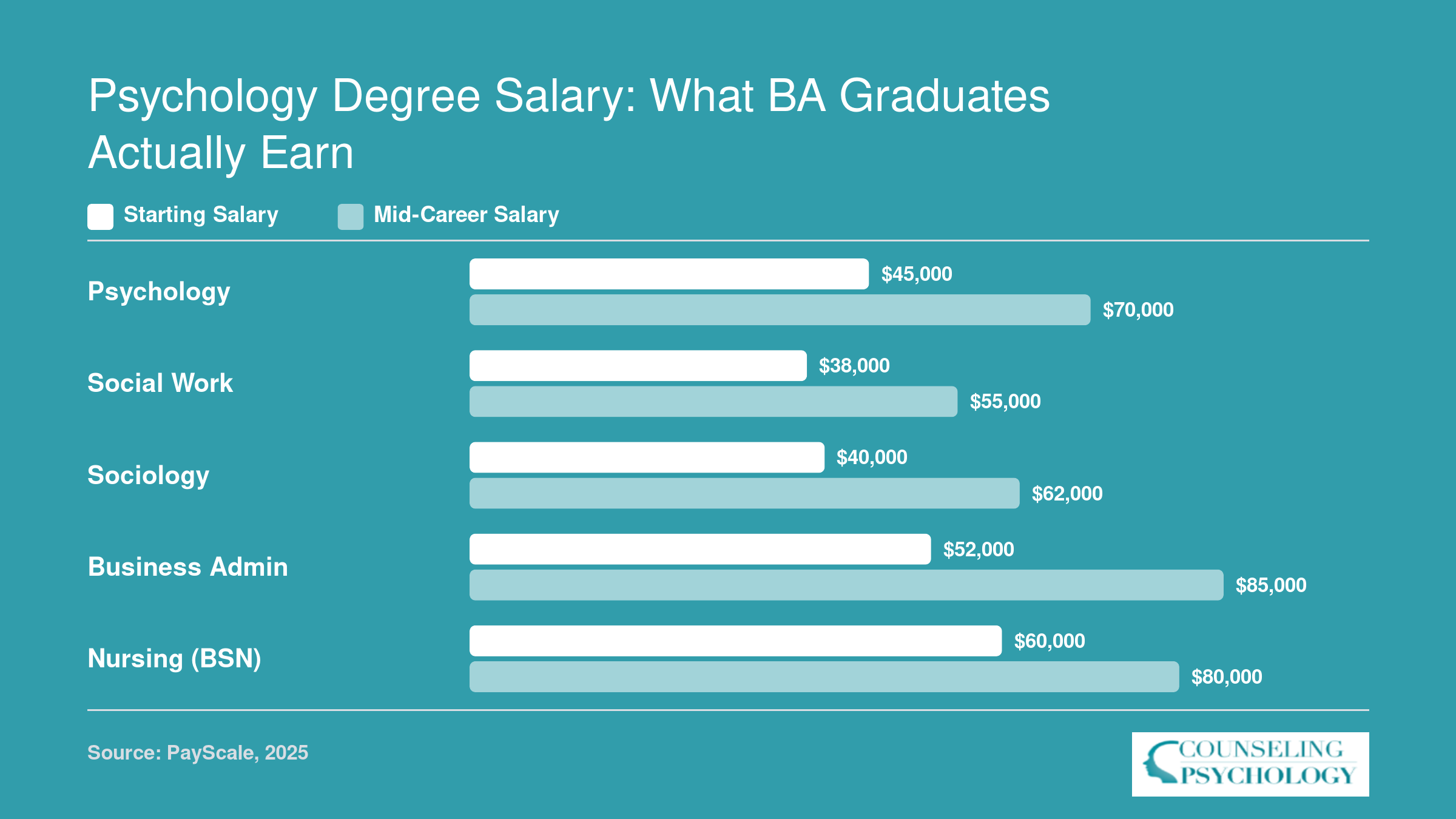
Psychology Degree Salary: What BA Graduates Actually Earn
A bachelor's in psychology opens doors, but the salary trajectory looks different depending on your major and whether you pursue graduate education. Here is how psychology stacks up against comparable bachelor's degrees at the early-career and mid-career stages.
Questions to Ask Yourself
Is your interest in psychology rooted in genuine curiosity about human behavior, or is it a default because you haven't settled on another major?
Are you willing and financially able to commit to two to six more years of graduate education if your target career requires licensure?
Would you feel fulfilled in a psychology-adjacent role such as HR, case management, or research coordination if you stop at the bachelor's level?
Job Outlook and Demand for Psychology Graduates
The job outlook for psychology graduates depends heavily on which career path you pursue and whether you stop at the bachelor's level or continue to graduate school. Here is what the Bureau of Labor Statistics projects for 2024 to 2034 across the roles psychology majors most commonly enter.1
Growth Rates That Outpace the Economy
The BLS projects overall employment growth of about 3.1% for all occupations over the decade.2 Most of the fields that attract psychology graduates are growing significantly faster:
- Substance abuse, behavioral disorder, and mental health counselors: 23% projected growth, with roughly 45,000 to 50,000 annual openings nationwide. This is one of the fastest-growing occupations in the country, though it typically requires a master's degree for clinical roles.
- Market research analysts and marketing specialists: 15% growth, with 109,000 to 112,000 annual openings. Psychology majors with strong research and data skills can compete here.
- Social and human service assistants: 13% growth, with 63,000 to 65,000 annual openings. This is one of the most accessible roles for BA holders, often serving as a stepping stone into the broader mental health and social services pipeline.
- Psychologists (all types): 9% growth, with about 16,000 to 17,000 annual openings. Nearly all psychologist positions require a doctoral degree.
- Human resources specialists: 4% growth, with 78,000 to 80,000 openings per year. Moderate growth, but the sheer size of this field (over 822,000 employed nationally in 2024) means steady hiring volume.
The broader health care and social assistance sector is projected to grow at 8.4%, reinforcing the trend that mental health and human services roles will remain in demand.2
The Mental Health Workforce Shortage
A nationwide shortage of mental health professionals is reshaping the job market. The most urgent need is for licensed clinicians, which means master's-level counselors and doctoral-level psychologists. But that shortage creates a ripple effect. Community mental health agencies, hospitals, and nonprofits increasingly rely on bachelor's-level staff to fill case management, intake coordination, peer support, and behavioral health technician positions. If you are considering counseling careers, the bachelor's degree opens real doors in these settings, even before graduate training.
The Competition Problem
Here is the honest counterweight: psychology is one of the top five most-conferred bachelor's degrees in the United States, with well over 120,000 awarded each year according to federal data. That means a large supply of graduates competing for the BA-level positions listed above. Social and human service assistant roles, for example, employed about 481,000 people nationally in 2024.1 The openings are there, but so are the applicants.
This supply-and-demand imbalance is less severe in underserved rural areas and community mental health settings, where turnover is high and qualified applicants are harder to recruit. Graduates willing to relocate or work in these environments often find shorter job searches and faster advancement. For those drawn to addiction treatment, learning how to become a substance abuse counselor can further sharpen your competitive edge.
What This Means for Your Decision
The job outlook for psychology-adjacent careers is genuinely strong, especially if you are open to the human services, research, or HR tracks. But a bachelor's in psychology alone does not guarantee easy placement in the specific clinical or counseling roles many students envision when they choose the major. Understanding where demand actually exists, and being strategic about internships, geography, and skill development, matters as much as the degree itself.
Cost, Student Debt, and ROI of a Psychology Bachelor's
The median student loan debt for psychology bachelor's graduates sits at roughly $27,000, according to the Federal Reserve's latest Report on the Economic Well-Being of U.S. Households. This figure is slightly below the $30,000 median for all bachelor's degree holders, but the real question is whether earnings after graduation justify the cost. Below, we break down the numbers and show you how to run your own analysis using publicly available data.
Understanding Tuition Costs
Where you enroll dramatically changes the price tag. The National Center for Education Statistics (NCES) College Navigator provides school-level tuition and net price data. As of the most recent academic year:
- Public in-state: Average annual tuition hovers near $11,000.
- Public out-of-state: Expect to pay roughly $28,000 per year.
- Private nonprofit: Sticker prices average around $40,000, though financial aid often reduces the net cost.
Because psychology is a common major offered at nearly every four-year institution, you can compare costs across dozens of schools in minutes. The net price, what students actually pay after grants and scholarships, is often far lower than the published tuition, so always use that figure for planning.
Student Debt Loads for Psychology Majors
Beyond the topline median, the Federal Reserve's data highlights variations by demographic and institution type. For instance, graduates of public universities tend to borrow less than their peers at private colleges. The College Board's annual Trends in Student Aid report reinforces this: about 55% of bachelor's recipients overall carry education debt, and the average amount has crept up slowly but remains manageable for most psychology graduates pursuing entry-level roles.
Notably, psychology majors are not among the highest-debt fields, but they also do not command the highest starting salaries. This makes it critical to estimate what your payments will look like relative to projected income. For a clearer picture of what different roles pay, check our breakdown of counselor salary data across degree levels and specialties.
Estimating Your Return on Investment
The Bureau of Labor Statistics (BLS) Occupational Outlook Handbook is your go-to for salary benchmarks. Common career paths for psychology BA holders include human resources specialist (median pay $64,000), social and community service manager ($74,000), and market research analyst ($68,000). While these figures are national medians, they offer a starting point. Professional associations like the American Psychological Association publish more granular salary surveys, often sliced by education level and region.
To gauge whether the debt is worth it, try this quick math: subtract annual loan payments from expected after-tax income. If your debt-to-income ratio stays below 10 to 15%, the financial strain is usually minimal. For a graduate with $27,000 in loans on a standard 10-year repayment plan at 5% interest, monthly payments would be about $286. Against a $50,000 salary, that represents roughly 7% of gross monthly income, well within a comfortable range.
Tools for a Personalized ROI Estimate
Generic averages only go so far. For a more precise picture:
- Use each school's net price calculator, found on its financial aid website, to estimate your actual cost.
- Look up the institution's published career outcome reports. Many now post first-destination surveys showing employment rates and median salaries for psychology graduates specifically.
- Plug your numbers into an online payback-period template: divide total debt by the expected annual earnings boost attributable to the degree. If the calculation yields a payback period under five years, the investment is generally considered sound.
You can also explore program-level earnings data on the U.S. Department of Education's College Scorecard, though this information is not yet available for every program. When it is, it provides a direct link between the cost of a specific psychology program and the wages its alumni actually earn.
Related Articles
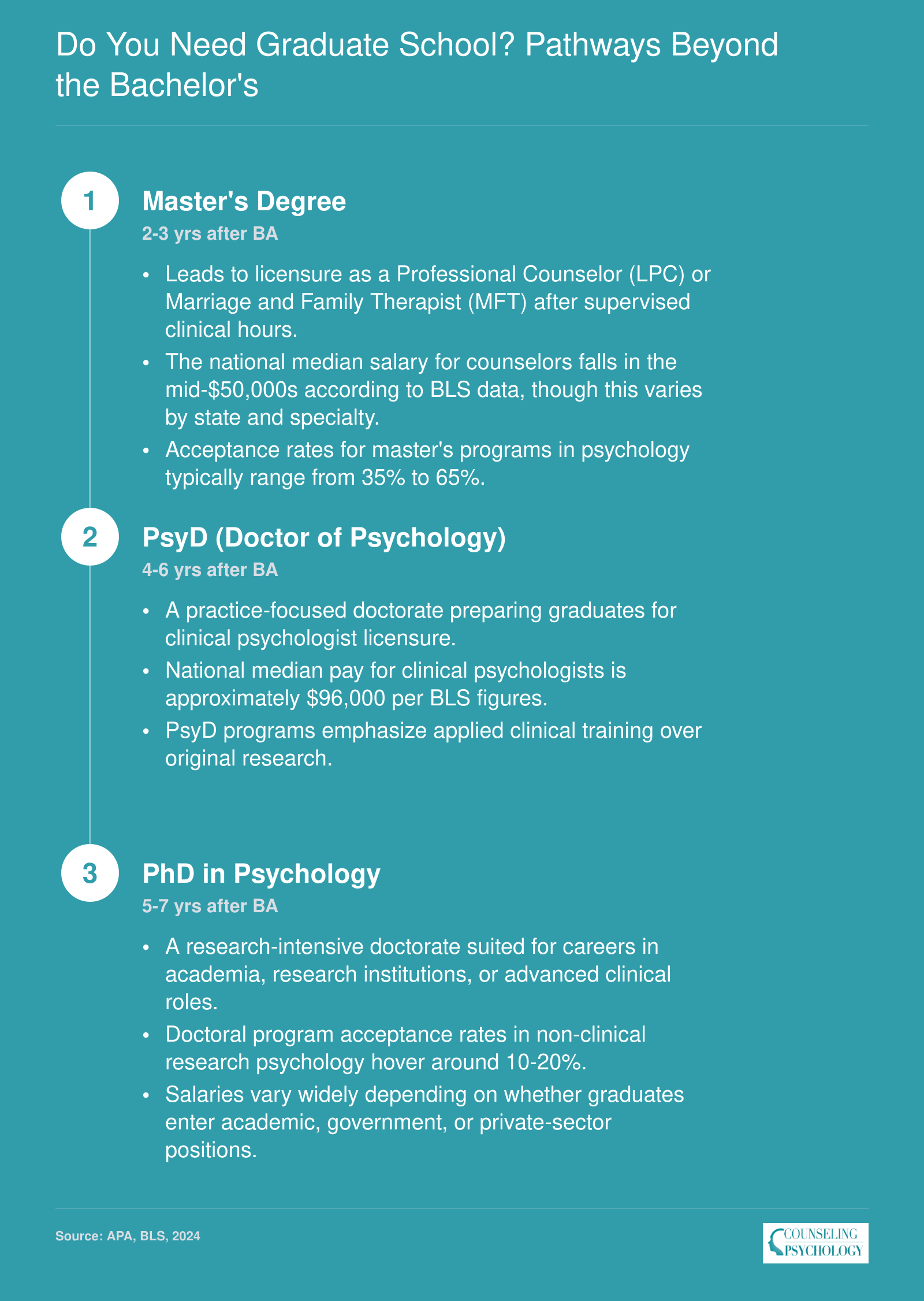
Do You Need Graduate School? Pathways Beyond the Bachelor's
Roughly 40-45% of psychology BA holders eventually pursue a graduate degree, though APA data shows many wait up to a decade before enrolling. Only about 14% earn a graduate degree specifically in psychology. Here are the three primary pathways for those who do continue.
Psychology Vs. Other Majors: How It Compares
How does a psychology bachelor's degree compare to other popular majors like business, social work, or sociology, and which one actually positions you for the career you want?
Median Salaries at the Bachelor's Level
Salary is often the first benchmark students consider. According to the National Association of Colleges and Employers, the average starting salary projection for 2026 business administration graduates sits between $60,000 and $70,000.1 By contrast, social work majors with a bachelor's typically launch their careers earning between $40,000 and $45,000.2 Sociology graduates fall into a similar band, with reported early-career earnings ranging from $38,000 to $55,000, and mid-career figures reaching $65,000 to $90,000 depending on industry and location.3
Psychology bachelor's degree holders often start in a range comparable to sociology and social work, commonly between $35,000 and $45,000, before graduate education or specialized roles lift earnings. The immediate disparity with business is real, and students weighing purely financial returns may find psychology less lucrative early on. However, the salary gap narrows substantially for those who combine a psychology background with data skills, certifications, or a targeted master's degree.
Career Flexibility and Job Applications
One area where psychology consistently outperforms majors like social work or sociology is raw versatility at the bachelor's level. A psychology degree maps easily to roles in human resources, marketing, sales, user experience research, case management, and behavioral health support, none of which require a graduate degree to start. Social work and sociology, while valuable, lock graduates into more bounded pathways: social work majors are heavily channeled into social services and casework, and sociology graduates often need to work harder to signal their analytical training to employers outside of research or nonprofit sectors.
Communications majors share some of this flexibility, moving into public relations, corporate communications, and media. But psychology's grounding in data analysis and human behavior can differentiate graduates in tech-adjacent fields like UX and consumer psychology, giving them a real edge in emerging roles.
When Helping People Is the Goal: Psychology vs. Social Work
If your core motivation is helping others, the comparison between psychology and social work at the bachelor's level can feel especially abstract. Here is the practical distinction: a BA in psychology gives you a broad understanding of human development, cognition, and abnormal behavior, ideal preparation for eventual clinical training, but it does not qualify you to provide therapy. A BSW, while also generalist, opens a direct (if limited) path into frontline human service roles. Some states allow BSW-holders to perform non-clinical case management, but clinical licensure (LCSW) requires a master's degree.4
Psychology's advantage here is the breadth of graduate options: from clinical and counseling psychology to marriage and family therapy, school psychology, or even pivoting into a dual degree MSW program. Sociology offers less direct scaffolding into therapeutic professions.
The Graduate School Factor
Both psychology and sociology are frequently described as "pre-graduate" majors, and the data bears that out. A psychology bachelor's is the most common stepping stone into master's and doctoral programs across multiple disciplines (education, law, business, health sciences). Social work's graduate trajectory is more linear: most BSW holders progress to an MSW. Business and communications majors, by contrast, lean less heavily on graduate school for career advancement, though MBAs and specialized master's are common at mid-career.
If you value keeping your options open at age 22, psychology and sociology offer wide graduate-level pathways. If speed to a direct license matters more, social work's BSW-to-MSW ladder can be efficient. But if you want a profession that does not require extra schooling to earn a competitive wage, business administration frequently wins that calculation.
A psychology bachelor's is most worth it when you treat it as a foundation rather than a finish line. Pair the degree with relevant internships, a strategic minor, or a concrete graduate school plan, because the degree alone is unlikely to open clinical or high-salary doors without those added steps.
Who Should (And Shouldn't) Major in Psychology
Psychology can be one of the most rewarding undergraduate majors, or one of the most frustrating, depending on how well it aligns with your goals and how intentionally you plan your path. Think of this as a decision tool rather than a verdict. Some students will thrive in psychology with the right strategy, while others may find a stronger fit in social work, public health, or business.
- You have a genuine curiosity about human behavior, motivation, and mental health that drives your academic engagement.
- You are drawn to helping professions such as counseling, therapy, education, or community health and see psychology as a launchpad.
- You are willing and financially able to pursue graduate school, where psychology careers truly open up.
- You value a versatile liberal arts foundation that builds strong writing, research design, and critical thinking skills.
- You want a broad degree that can complement careers in HR, marketing, UX research, nonprofit management, or data analysis.
- You expect a high salary immediately after graduation; entry level roles for BA holders in psychology tend to pay modestly.
- You are unwilling to pursue additional certifications, licensure, or graduate education to advance in clinical or counseling roles.
- You want a clear, direct career pipeline similar to nursing, engineering, or accounting with defined post-graduation employment.
- You are choosing psychology as a default major because it seems easy or because you have not explored alternatives with a plan.
- You have not researched how your specific career goals map to the degree; without a strategy, the ROI can disappoint.
Tips to Maximize the Value of Your Psychology Degree
Some psychology majors graduate with a polished resume of internships, research credits, and data skills that land them competitive jobs or funded graduate offers. Others finish with only coursework and wonder why the bachelor's alone opens so few doors. The difference is rarely talent. It is strategy, executed early.
Pursue Research Experience Early and Often
Research assistant roles, even unpaid, are the single strongest predictor of admission to graduate psychology programs. Faculty look for students who understand the scientific process, can navigate IRB protocols, recruit participants, code data, and write clearly. Start asking professors about lab openings by sophomore year. If your campus lacks research opportunities, look for summer REU (Research Experiences for Undergraduates) programs funded by the National Science Foundation. These typically include stipends and housing, and they carry substantial weight on a CV. Students drawn to lab-based work may want to explore what it takes to become an experimental psychologist.
Add a Strategic Minor or Double Major
A psychology degree paired with a complementary credential dramatically expands entry-level job options. Consider:
- Data science or statistics: Employers hiring for research coordinator, market analyst, and user experience roles actively seek psychology backgrounds with quantitative fluency.
- Business or marketing: Consumer insights, human resources, and organizational development positions value this combination.
- Public health: Opens pathways into community health work, program evaluation, and epidemiology support roles.
- Spanish or another high-demand language: Bilingual bachelor's-level clinicians, case managers, and outreach coordinators earn more and have wider placement.
Double majors take planning, but minors are manageable for most students without extending time to degree. Those interested in workplace dynamics should look into an industrial organizational psychology bachelor degree as a complementary path.
Complete At Least Two Supervised Field Experiences
Internships and practica give you supervised hours, professional references, and proof that you can apply theory in real settings. Aim for diversity: one clinical or counseling placement and one in research, HR, or community services. Many employers will not interview bachelor's-level candidates without prior fieldwork. Start tracking opportunities through your department, campus career center, and local nonprofits by junior year.
Build Quantitative and Software Skills
Psychology graduates who list SPSS, R, Python, or advanced Excel on their resumes earn measurably more and compete for analyst and coordinator roles that others cannot access. Take at least one course beyond introductory statistics. If your program offers psychometrics, experimental psychology electives, or data visualization courses, prioritize them. Many departments also offer independent study credit for learning R or building a portfolio project.
Network Through Psi Chi and APA Student Affiliates
Psi Chi, the international honor society in psychology, costs around $50 for lifetime membership and offers conference travel grants, exclusive job boards, and chapter networking events. APA student affiliate membership (currently about $35 per year) provides access to career webinars, mentorship programs, and discounted conference registration. Both are concrete, low-cost steps that signal professional seriousness to graduate programs and employers.
Frequently Asked Questions About Psychology Degrees
Below are answers to the most common questions students ask when weighing whether a psychology bachelor's degree is the right investment. Each response draws on current labor data and licensure requirements so you can plan with confidence.
- Is it worth it to get a bachelor's degree in psychology?
- For many students, yes, provided you pair the degree with internships, relevant skills, and a clear career plan. A bachelor's in psychology qualifies you for support roles in human services, research, HR, and community organizations. If your goal is independent clinical practice, understand upfront that you will need graduate education. The degree's value depends heavily on how intentionally you use it.
- What can you do with just a bachelor's in psychology?
- Common roles include case manager, behavioral health technician, human resources specialist, research assistant, and substance abuse counselor. The BLS notes that substance abuse and behavioral disorder counselor positions typically require a bachelor's degree. You can also move into marketing, education, or nonprofit management, where skills in human behavior and data analysis translate well.
- How much do psychology majors make with a bachelor's degree?
- Entry-level earnings vary widely by role and region. Substance abuse, behavioral disorder, and mental health counselors earned a national median of $59,190 per year according to 2024 BLS data, though many bachelor's-level positions start below that figure. Roles in HR, market research, or corporate training can push starting salaries higher depending on the employer and location.
- Do you need a master's degree to work in psychology?
- For most psychology-titled positions, yes. The BLS lists a master's or doctoral degree as the typical prerequisite for psychologist roles. Mental health counselor positions also generally require a master's. However, bachelor's holders can work in substance abuse counseling, psychiatric technician roles, and other support positions without a graduate degree.
- Who gets paid more, a therapist or a psychologist?
- Psychologists earn considerably more on average. The 2024 national median for clinical and counseling psychologists was $95,830, while substance abuse, behavioral disorder, and mental health counselors earned a national median of $59,190. That gap of roughly $35,000 reflects the additional doctoral training psychologists complete. Licensed therapists with a master's degree fall between those two benchmarks in many settings.
- Is a psychology degree worth it compared to other majors?
- Psychology graduates tend to start at lower salaries than peers in engineering, computer science, or nursing. However, psychology builds transferable skills (critical thinking, communication, research literacy) that perform well across industries over time. Students who add a minor in data science, business, or health administration often close the early-career earnings gap significantly.
- Can you become a counselor with just a bachelor's in psychology?
- In a limited capacity. You can qualify for substance abuse and behavioral disorder counselor roles with a bachelor's degree, according to the BLS. Some states also permit bachelor's-level registered counselors to work under supervision. However, independent licensure as a professional counselor (LPC) or marriage and family therapist (LMFT) requires a master's degree in virtually every state.