What you’ll learn in this article…
- North Carolina's public MSW programs charge in-state tuition from roughly $6,800 to $8,600 per year.
- Advanced standing tracks let BSW holders finish an MSW in about half the time and cost.
- LCSW licensure in North Carolina typically requires two to six years of supervised practice after the MSW.
- Title IV-E child welfare stipends can cover full or partial tuition at participating NC schools.
North Carolina's public universities operate 13 CSWE-accredited or candidacy MSW programs, and the effective net price spread is wide: roughly $7,900 per year at Fayetteville State University on the low end to north of $20,000 at private campuses like Johnson C. Smith and Wingate. That gap, more than program prestige, often dictates how much debt you carry into your first post-MSW job.
Demand for licensed social workers continues to climb across Charlotte, Raleigh, Greensboro, and the Triangle's hospital systems, school districts, and behavioral health agencies. The catch is that starting MSW salaries in the state cluster well below clinical psychology or masters in counseling pay, so net price and time-to-licensure matter more than rankings. Advanced standing, online flexibility, and Title IV-E stipends are the three levers that meaningfully change the math.
Best MSW Programs in North Carolina: Our Rankings
North Carolina is home to more than a dozen CSWE-accredited or candidacy MSW programs, and the cost differences are significant. We sorted these programs by net price first because what you actually pay, after grants and institutional aid, determines how much debt you carry into a career that often starts in the $40,000-to-$55,000 salary range. Schools that also deliver coursework online earn extra weight for students juggling jobs or family obligations across the state. Program-level earnings data is not yet available for most of these MSW programs, so we rely on institution-wide figures and independent research where noted.
- Net price after financial aid
- Online or hybrid availability
- CSWE accreditation status
- Institutional graduation and retention rates
- Field practicum structure and hours
- NCES-IPEDS federal institutional data — nces.ed.gov
- College Scorecard graduate earnings — collegescorecard.ed.gov
- Independent program research
- Internal program database

Fayetteville State University
Fayetteville State University pairs one of the lowest net prices in the UNC System with a fully online, CSWE-accredited MSW. The program offers two concentrations (Children and Family Services, Mental Health and Substance Abuse) plus graduate certificates in military behavioral health, substance abuse studies, and advanced clinical practice. Its proximity to Fort Liberty makes it especially well-suited for military-connected students and working professionals in the Sandhills region. FSU is a historically Black university, and roughly 82% of undergraduates receive Pell Grants, reflecting the institution's deep commitment to access.
- Fully online delivery with full-time, part-time, and advanced standing tracks
- 61 credit hours with 960 field practicum hours required
- Children and Family Services concentration available
- Mental Health and Substance Abuse concentration available
- Graduate certificates in military behavioral health and substance abuse
- CSWE-accredited with a social justice and multicultural focus
- January 15 application deadline; no GRE required for most applicants
Master of Social Work — Online

University of North Carolina at Pembroke
UNC Pembroke delivers its CSWE-accredited MSW online with a distinctive School Social Work licensure pathway approved by the NC Department of Public Instruction. Students can earn M-Level licensure to practice in K-12 public schools while completing field practicums under licensed school social workers. With a net price of $10,260 and a 14:1 student-to-faculty ratio, UNCP offers a more personalized experience than many larger UNC campuses. The program accepts applications on a rolling basis across summer and fall terms.
- Online format with School Social Work licensure pathway
- Approved by NC Department of Public Instruction for M-Level licensure
- Field practicums completed in NC public schools
- Advanced Generalist Practicum courses with integrated seminar
- Flexible summer and fall admission cycles
- CSWE-accredited; C or better required in all coursework
- 14:1 student-to-faculty ratio across the institution
Master of Social Work — Online

University of North Carolina at Greensboro
UNC Greensboro runs a Joint Master of Social Work with North Carolina A&T State University, combining the resources and faculty of two major Greensboro institutions. The campus-based program centers on multicultural clinical practice and offers concentrations in families/youth at risk and health/mental health. Students can choose a two-year full-time track or a one-year advanced standing option, and the GRE is not required. Study abroad opportunities and more than $5 million in departmental funding distinguish the program from smaller alternatives.
- Campus-based joint program with NC A&T State University
- Concentration: families and youth at risk
- Concentration: people affected by health and mental health issues
- Two-year full-time or one-year advanced standing tracks
- No GRE required; study abroad opportunities available
- Over $5 million in external research and program funding
- CSWE-accredited since 2000; one annual application cycle
Joint Master of Social Work — On-Campus

North Carolina A & T State University
North Carolina A&T State University, a historically Black university in Greensboro, partners with UNC Greensboro on the same Joint MSW program but delivers it through a hybrid format that blends on-campus and online components. Students benefit from access to libraries, faculty, and field networks at both campuses. The hybrid structure can be a practical middle ground for NC residents who want some face-to-face interaction without committing to a fully on-campus schedule. A&T's selective admissions (roughly 50% acceptance rate) and HBCU mission add a distinctive dimension.
- Hybrid delivery through joint program with UNC Greensboro
- CSWE-accredited since 2000; multicultural clinical practice focus
- Access to resources and faculty across two universities
- Students attend classes on both Greensboro campuses
- HBCU with a strong institutional commitment to access
- Net price of $10,846; in-state tuition around $8,368
Master of Social Work — Hybrid

Western Carolina University
Western Carolina University's MSW is a hybrid program taught at sites in Cullowhee and Asheville, making it one of the few options for students in western North Carolina. The 62-credit-hour curriculum includes concentrations in Substance Abuse Studies and School Social Work, plus an optional NC School Social Work certification. Stipends of $10,000 are available for students in integrated healthcare and substance abuse tracks, and graduate assistantships help offset costs further. Full-time, part-time, and advanced standing pathways give BSW holders and career changers alike a workable timeline.
- Hybrid classes in Cullowhee and Asheville; 62 credit hours
- Substance Abuse Studies and School Social Work concentrations
- $10,000 stipends for integrated healthcare and substance abuse tracks
- Advanced standing available for BSW graduates (within 7 years)
- NC School Social Work certification pathway included
- No GRE required; 3.0 GPA for last 60 credit hours
- Graduate assistantships and transfer of up to 12 credits
Master of Social Work — Hybrid

University of North Carolina at Charlotte
UNC Charlotte offers a fully online, CSWE-accredited MSW built for working professionals in the Charlotte metro and beyond. NC residents pay $309.59 per credit hour (plus a $30 college fee), placing the total cost of the 39-to-60-credit program well below many private alternatives. Students select from one-, two-, or three-year completion plans, with synchronous and asynchronous coursework and a 16-hour weekly field internship. Demand has been high: summer 2026 admission closed early, so prospective students should plan for 2027 start dates.
- Fully online with synchronous and asynchronous coursework
- NC resident tuition: $309.59 per credit; nonresident: $1,186.59
- 39 credit hours (advanced standing) to 60 credit hours (traditional)
- One-, two-, or three-year completion plans available
- 16-hour weekly internship requirement during field semesters
- Priority application deadline January 15; summer admission only
- Summer 2026 cohort closed early; 2027 applications reopen April 2026
Master of Social Work — Online

Appalachian State University
Appalachian State University's CSWE-accredited MSW features concentrations in Individuals and Families or Community and Organizational Practice, with a crossover design that lets students sample both. The regular program is campus-based in Boone, while the advanced standing track is available online, making it a solid option for NC BSW holders who want to stay in western North Carolina without relocating. A 74.5% institution-wide graduation rate (among the highest on this list) signals strong student support systems. Full-time students finish in two years; part-time students have up to four.
- Online delivery available for advanced standing (BSW graduates)
- Campus-based regular pathway in Boone, NC
- Concentrations: Individuals and Families; Community and Organizational Practice
- Crossover design allows coursework across both concentrations
- Full-time (2-year) and part-time (4-year) schedules
- Practicum placements required; GRE may be waived
- CSWE-accredited; December 1 application deadline
Master of Social Work — Online

North Carolina State University at Raleigh
NC State's MSW sits within one of the state's flagship research universities and follows an advanced generalist practice model. The campus-based program in Raleigh requires 60 credit hours for its traditional two-year track or 39 for advanced standing (BSW graduates with a 3.5 GPA). Field internships involve 24 hours of weekly placement with professional organizations. NC State's institution-wide graduation rate of nearly 85% and median ten-year earnings of $68,758 reflect broad institutional strength, though these figures span all majors and are not MSW-specific.
- Campus-based in Raleigh; advanced generalist practice model
- 60 credit hours (traditional) or 39 (advanced standing)
- 3.0 GPA for traditional track; 3.5 GPA for advanced standing
- 24-hour weekly field internship at partner organizations
- Social justice, policy analysis, and leadership coursework
- CSWE-accredited; capstone project required
- Biology and statistics prerequisites for traditional pathway
Master of Social Work — On-Campus

University of North Carolina Wilmington
UNC Wilmington delivers its MSW through a hybrid format that combines online coursework with required field placements, making it accessible to students across eastern North Carolina and the coastal region. Concentrations span Clinical Practice, Macro Practice, and an Advanced Standing pathway for BSW graduates. The 62-credit-hour program includes 900 hours of field placement (600 for advanced standing), and graduates qualify for NC licensure as LCSWs, Certified Master Social Workers, or Certified Social Work Managers. UNCW is frequently recognized as military-friendly, a plus for students near Camp Lejeune.
- Online-hybrid delivery; suited for NC residents statewide
- Clinical Practice and Macro Practice concentrations
- 62 credit hours with 900 field placement hours (regular track)
- Advanced standing: 39 credits and 600 internship hours
- No GRE required; 3.0 undergraduate GPA minimum
- Qualifies graduates for LCSW, CMSW, and manager certification
- Military-friendly institution near Camp Lejeune
Master of Social Work — Hybrid

East Carolina University
East Carolina University's MSW stands out for offering both a full-time on-campus pathway in Greenville and a 100% online part-time pathway completed over three years. The program concentrates on Clinical-Community Social Work Practice and requires 1,032 field hours for the regular track (672 for advanced standing), exceeding minimums at several peer programs. ECU's CSWE accreditation meets licensure requirements in all continental U.S. states, a significant advantage for graduates who may eventually practice outside North Carolina. Students may be able to complete field hours at their current employer when criteria are met.
- 100% online part-time track or full-time on-campus in Greenville
- Clinical-Community Social Work Practice concentration
- 60 credit hours (regular); advanced standing for BSW graduates
- 1,032 field hours regular; 672 advanced standing
- Meets licensure requirements in all continental U.S. states
- Field hours at current employer may be permitted
- January 15 priority deadline; no credit for life experience
Master of Social Work — Hybrid

North Carolina Central University
North Carolina Central University, an HBCU in Durham, offers a hybrid MSW focused on advanced generalist practice from micro through macro levels. Evening and Saturday classes, supplemented by some online sessions, are designed for students who work during traditional business hours. The traditional two-year and one-year advanced standing pathways both include substantial field practicums (16 hours weekly in the first year, 24 in the second). NCCU's location in the Research Triangle gives students access to a broad network of hospitals, nonprofits, and government agencies for field placements.
- Hybrid format: evening, Saturday, and some online classes
- Traditional two-year or one-year advanced standing pathways
- Field practicum: 16 hours weekly (year one), 24 (year two)
- Advanced standing requires BSW, 3.0 cumulative GPA, 3.25 major GPA
- HBCU with a social justice and cultural competence emphasis
- No GRE required; $50 application fee
- Durham location provides Research Triangle field placement network
Social Work, M.S.W. — Hybrid

Johnson C Smith University
Johnson C. Smith University, a private HBCU in Charlotte, designed its MSW for working adults with evening and weekend scheduling. The Advanced Generalist concentration and flexible pathways (one-year advanced standing or two-year traditional) let students tailor their timeline. Field experience totals 400 hours in the first year and 500 in the second, and weekend internships are an option. The 12:1 student-to-faculty ratio is the smallest on this list, providing more direct mentorship. As a private institution, the net price of roughly $20,894 is higher than most public options but includes a no-GRE admissions policy.
- Campus-based in Charlotte with evening and weekend classes
- Advanced Generalist concentration; CSWE-accredited
- One-year advanced standing or two-year traditional pathway
- 400 field hours (year one) plus 500 (year two)
- Weekend internship placements available
- No GRE required; 12:1 student-to-faculty ratio
- HBCU with cultural competence integrated throughout curriculum
Master of Social Work — On-Campus

Wingate University
Wingate University offers a fully online, asynchronous MSW that lets students complete coursework on their own schedule while working full-time. The 48-credit-hour curriculum, including 12 practicum credits, can be finished in two years (full-time) or one year (advanced standing). Wingate frames its program around a "beloved community" model emphasizing transformative practice at micro, mezzo, and macro levels. The program holds CSWE candidacy status rather than full accreditation, an important distinction: candidacy programs are in the accreditation pipeline, and graduates may receive retroactive accreditation recognition once the process concludes.
- Fully online and asynchronous; designed for working professionals
- 48 credit hours including 12 practicum credit hours
- Two-year full-time or one-year advanced standing completion
- CSWE candidacy status (not yet fully accredited)
- Graduates may receive retroactive accreditation recognition
- Transformative social work within a beloved community framework
- Bachelor's degree required; no GRE needed
Master of Social Work — Online
How We Ranked These NC MSW Programs
A ranking of MSW programs is only useful if it reflects what actually shapes your day-to-day experience and long-term prospects: how much you will pay, how likely you are to finish, and what you can reasonably expect to earn afterward. Our rankings prioritize affordability first, then layer in graduation rates, post-completion earnings, and return on investment.
Affordability as the Primary Filter
We weight cost metrics heavily because tuition and net price determine accessibility for most students. Specifically, we consider:
- Net price: the average annual cost after grants and scholarships, drawn from federal College Scorecard data
- Tuition: published per-credit or per-year rates for MSW programs
- Pell grant share: the percentage of undergraduates receiving Pell grants, a proxy for an institution's commitment to serving lower-income students
- Median debt at completion: what graduates typically owe when they finish
These four factors form the backbone of our rankings. A program that costs $15,000 less than a peer, all else equal, rises in our list.
Graduation Rates, Earnings, and Return on Investment
Affordability alone does not tell the whole story. We also examine:
- Graduation rate: the institution-wide six-year completion rate reported to IPEDS. These are not MSW-specific figures; graduate program completion data are rarely disaggregated publicly. A higher overall graduation rate suggests better academic support infrastructure.
- Median earnings after completion: what graduates across all programs at the institution earn one year after finishing, per College Scorecard. Again, this is institution-wide, not MSW-only.
- ROI ratio: the relationship between median earnings and median debt, expressed as a simple ratio. Higher earnings relative to debt signal better economic outcomes.
CSWE Accreditation: The Baseline Standard
Every program on our list holds accreditation from the Council on Social Work Education (CSWE). This is non-negotiable. CSWE accreditation is the only path to clinical licensure (LCSW) in North Carolina and every other state. We apply a similar accreditation-first approach when evaluating related fields, such as best MFT programs in North Carolina. Programs without CSWE accreditation do not appear in our rankings, regardless of cost or convenience.
Data Sources and Limitations
We rely on the U.S. Department of Education's College Scorecard and the Integrated Postsecondary Education Data System (IPEDS) for financial, enrollment, and outcome metrics. Both datasets reflect completers from prior cohorts, typically two to four years before the current catalog year. Your individual net price will vary based on residency status, financial aid eligibility, transfer credits, and whether you attend full- or part-time. Treat these rankings as a starting point, not a final answer.
Questions to Ask Yourself
Online Vs. On-Campus MSW Programs in North Carolina
Choosing between an online and on-campus MSW is one of the biggest decisions you will make during your graduate school search. Both formats lead to the same CSWE-accredited degree, and both satisfy the educational requirements for LCSW licensure in North Carolina. The right choice depends on your schedule, location, and how you learn best. Several NC schools now offer hybrid options that blend online coursework with periodic in-person intensives, giving you a practical middle ground.
Pros
- Online MSW programs offer scheduling flexibility that working professionals and parents need to stay on track.
- You can access top CSWE-accredited programs statewide or nationally without relocating from your current community.
- Many online programs charge a flat tuition rate regardless of residency, which can lower costs for out-of-area students.
- On-campus cohorts foster strong peer relationships and professional networking that carry forward into your career.
- In-person formats give you direct access to clinical training labs, faculty mentorship, and on-site field placement coordination.
- Structured on-campus schedules help students who thrive with routine and face-to-face accountability from classmates.
Cons
- Online students must arrange local field placements independently, which can be especially challenging in rural parts of NC.
- Without a physical cohort, online learners may miss spontaneous peer support and the informal mentoring that happens between classes.
- On-campus programs require commuting or relocating, adding housing and transportation costs that online students avoid.
- Rigid on-campus class schedules make it harder to hold a full-time job while completing your MSW at the traditional pace.
- Some on-campus programs charge higher tuition for out-of-state or out-of-district residents, limiting affordability.
Related Articles
Section content unavailable.
MSW Programs in Charlotte: A Closer Look
Campus-rooted networks versus fully online flexibility: that choice defines the MSW landscape in Charlotte. UNC Charlotte runs a flexible online MSW with synchronous and asynchronous classes, while Johnson C. Smith University offers an evening-and-weekend on-campus Advanced Generalist track tailored for working adults. Both hold CSWE accreditation, but their delivery, tuition, and field placement ecosystems differ sharply.
UNC Charlotte: Online Reach with Charlotte Resources
UNC Charlotte's online MSW enrolls students across North Carolina and beyond, charging in-state students roughly $8,037 per year and non-residents $23,072. The program offers one-year advanced standing (39 credits), two-year traditional (60 credits), and three-year part-time plans. Although classes meet online, field placements often land in Charlotte-area agencies: Atrium Health hospital systems, Mecklenburg County Department of Social Services, and a dense network of nonprofits addressing housing insecurity, behavioral health, and child welfare. Charlotte's size means interns can choose micro clinical rotations in integrated-care clinics or macro community-organizing roles in advocacy coalitions. The 16-hour weekly internship requirement aligns with work schedules, and students outside Charlotte can arrange placements closer to home while still benefiting from faculty connections to metro-area supervisors.
Johnson C. Smith University: Evening On-Campus Cohort
JCSU's on-campus MSW, housed at a historically Black university in northwest Charlotte, runs classes evenings and weekends to accommodate full-time employment. Tuition sits at approximately $20,770 annually for all students (private institution, no in-state discount). The Advanced Generalist curriculum requires 400 field hours in year one and 500 in year two; weekend and daytime internship slots are both available, giving students access to the same Atrium Health, county DSS, and nonprofit placements that UNC Charlotte interns use. JCSU's smaller cohort size and cultural-competence emphasis appeal to students seeking a tight-knit, justice-focused learning community within Charlotte city limits.
Choosing the Best Fit for You
Which Charlotte MSW is best? If cost is paramount and you already hold North Carolina residency, UNC Charlotte's in-state online tuition is roughly one-third of JCSU's. If you value face-to-face cohort connection, evening structure, and an HBCU mission, JCSU may justify the higher price. If you live outside Charlotte but want access to metro field sites, UNC Charlotte's online format lets you commute for internships without relocating for classes. Both programs prepare graduates for North Carolina LCSW licensure; neither requires Charlotte residency to enroll or complete field hours, so students in Asheville, Wilmington, or the Triangle can tap into Charlotte program resources remotely.
Advanced Standing Vs. Traditional MSW Tracks in NC
If you already hold a BSW from a CSWE-accredited program, advanced standing can cut your MSW timeline and tuition roughly in half. Eligibility rules differ by school, but the core requirement is the same: a CSWE-accredited BSW earned within a set number of years and a competitive GPA. Below is a side-by-side look at how the two tracks compare across North Carolina programs.
| Feature | Advanced Standing Track | Traditional Track |
|---|---|---|
| Typical credit hours | 30 to 39 credits | 58 to 60 credits |
| Time to completion | About 12 months (full time) | About 24 months (full time) |
| Entry requirements | BSW from a CSWE-accredited program, earned within 5 to 7 years; minimum GPA of 3.0 to 3.5 depending on school | Bachelor's degree in any field; minimum GPA of 3.0 at most programs |
| Estimated cost savings (in-state tuition) | Roughly 35% to 40% less than traditional, since fewer credits are required | Full tuition for all 58 to 60 credits |
| NC State University | 39 credits, 12 months; requires 3.5 GPA and BSW within 7 years | 60 credits, 2 years; 3.0 GPA minimum |
| North Carolina Central University | 35 credits, 12 months; requires 3.0 GPA and BSW within 7 years | 58 credits, 2 years |
| Other NC schools with advanced standing | UNC Charlotte, UNC Greensboro/NC A&T (joint program), East Carolina University, UNC Wilmington, Appalachian State, Western Carolina, Fayetteville State, Johnson C Smith, Wingate University | All of these schools also offer the full traditional pathway |
MSW Tuition and Affordability in North Carolina
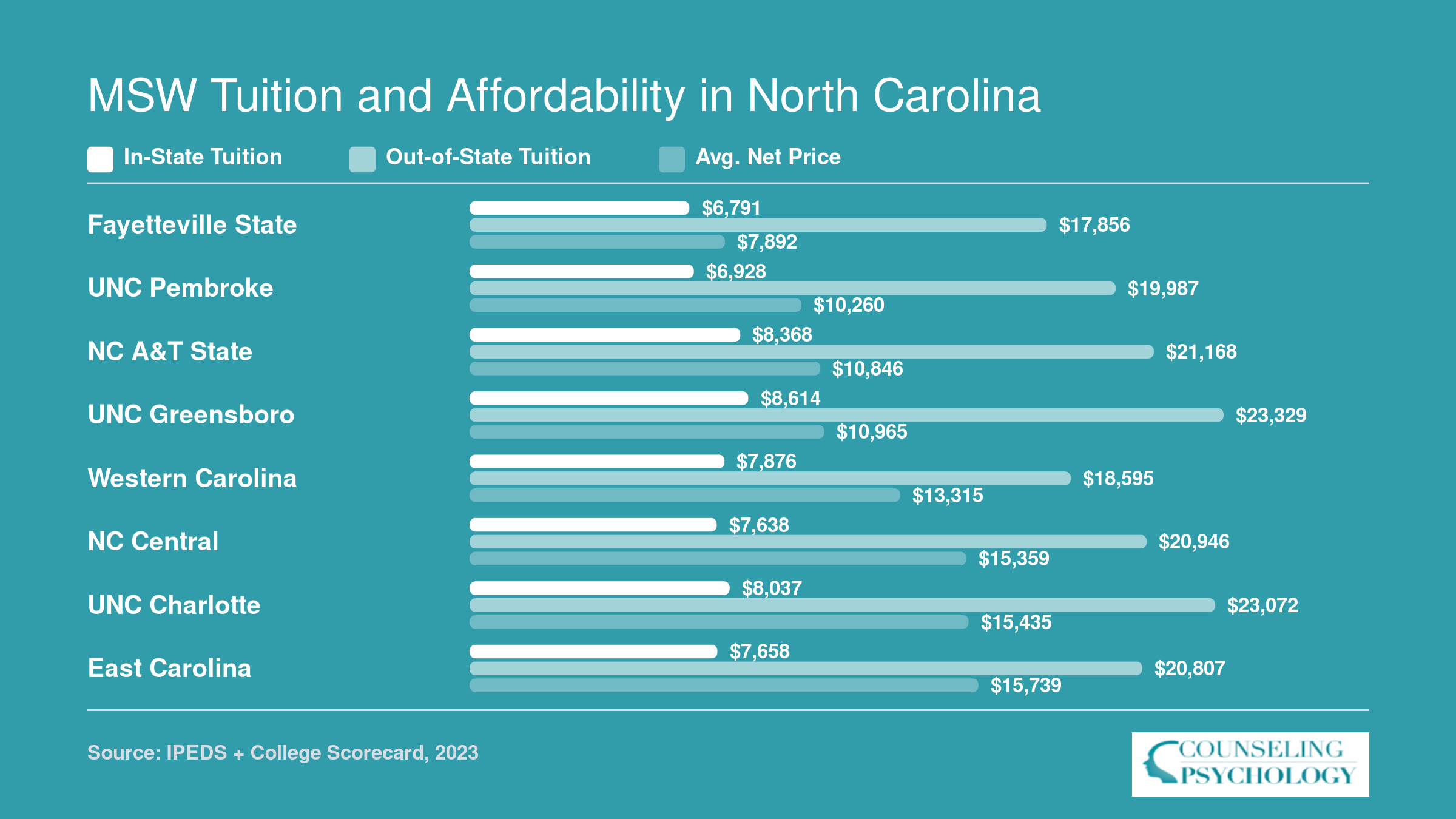
Every school on this list is a public university within the UNC system, yet annual tuition still ranges considerably. In-state rates span from roughly $6,800 at Fayetteville State to about $8,600 at UNC Greensboro, while out-of-state rates jump as high as $23,329. The net price figures shown below are institution-wide averages reported to IPEDS; your actual MSW cost will differ based on graduate-level aid, assistantships, and individual financial packages.
NC Social Work Scholarships, Stipends, and Loan Forgiveness
The North Carolina Division of Social Services administers Title IV-E child welfare stipend programs that can cover full or partial MSW tuition in exchange for a service commitment in public child welfare after graduation. These federally funded stipends are available through several North Carolina universities, including UNC Chapel Hill, NC State, East Carolina University, and Appalachian State University. Stipend amounts vary by program and year but typically range from $10,000 to $20,000 annually, often covering tuition plus a modest monthly living allowance. In return, recipients commit to one year of employment in public child welfare for each year of funding received. Each participating MSW program lists specific stipend details, application deadlines, and service obligation terms on its financial aid or child welfare specialization page. Check the NCDSS website for the current list of participating universities and contact your program directly to confirm eligibility and application procedures.
State and National Scholarships for Social Work Students
Beyond Title IV-E stipends, North Carolina social work students should explore general state scholarship opportunities through the NC State Education Assistance Authority (NCSEAA), which administers several need-based and merit-based aid programs for graduate students. The National Association of Social Workers North Carolina Chapter (NASW-NC) maintains a resource list of social work scholarships, including awards from private foundations and professional organizations. Individual MSW programs may also offer assistantships, tuition remission, or work-study positions that reduce the net cost of attendance. Review each school's financial aid office website and contact the director of MSW admissions to learn about institutional scholarships specific to social work students.
Loan Forgiveness and Repayment Programs
All social workers employed by government agencies or qualifying nonprofit organizations should consider federal Public Service Loan Forgiveness (PSLF), which forgives remaining federal student loan balances after 120 qualifying monthly payments under an income-driven repayment plan. Social workers in public child welfare, schools, hospitals, and community mental health centers often meet PSLF eligibility criteria. Use the PSLF Help Tool on studentaid.gov to verify that your employer qualifies and to submit the required Employment Certification Form annually. North Carolina also offers the NC State Loan Repayment Program for Health Care Practitioners, administered by the NC Office of Rural Health, which provides up to $50,000 in loan repayment for licensed clinical social workers who commit to working in underserved areas. This program has specific eligibility requirements, including a full-time commitment to a designated shortage area and a two-year or four-year service obligation. Visit the NC Office of Rural Health website for application cycles and eligible practice sites.
Planning for Repayment
Before accepting loans, review salary and employment data from the Bureau of Labor Statistics Occupational Outlook Handbook for social workers to inform your repayment strategy. The NC Board of Licensed Social Workers website provides state-specific licensure requirements, including the clinical hours and supervision needed to pursue LCSW licensure, which typically commands higher salaries than unlicensed social work roles. Understanding the timeline from MSW graduation to full licensure can help you plan for income-driven repayment or PSLF during the supervised practice period.
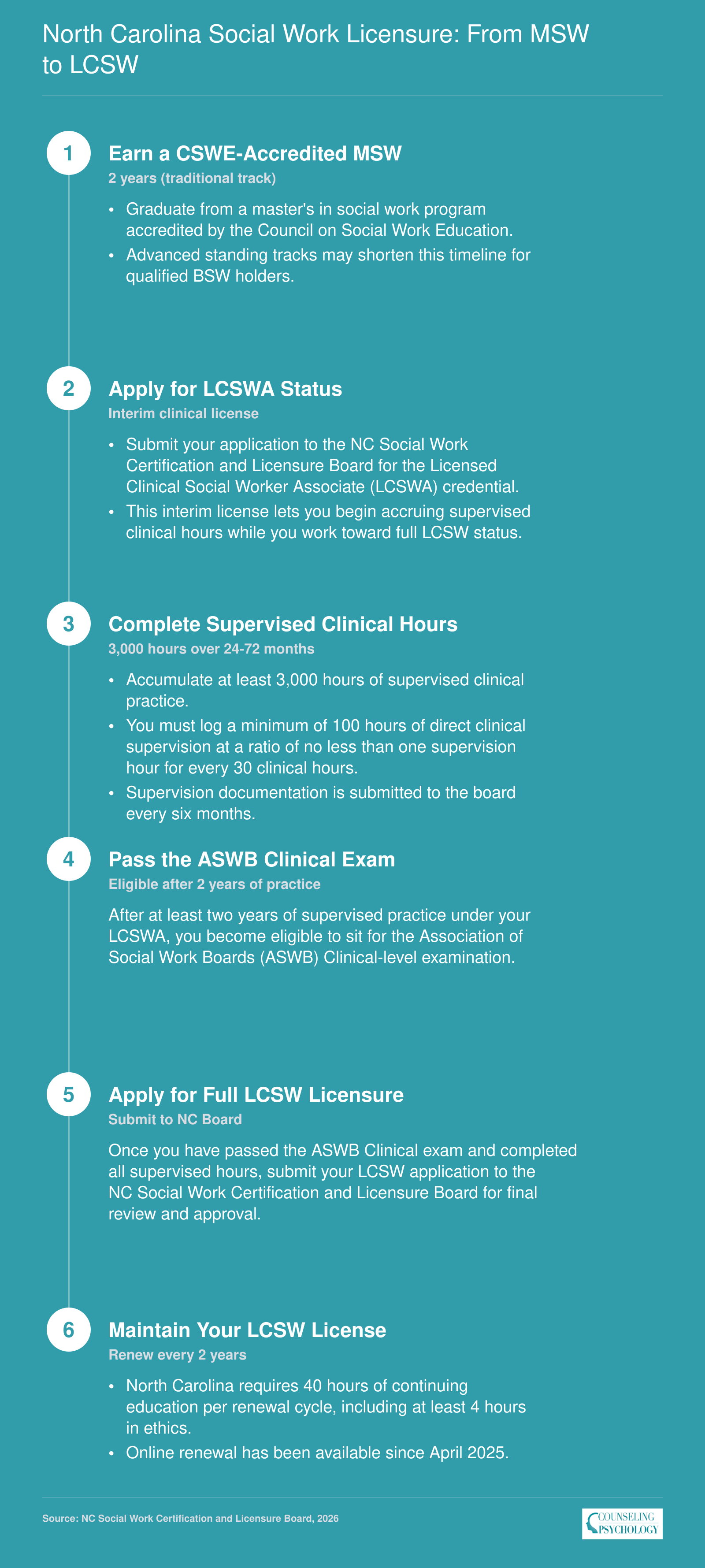
North Carolina Social Work Licensure: From MSW to LCSW
Earning your LCSW in North Carolina is a structured process that typically takes two to six years after you finish your MSW. Here is the step-by-step credentialing ladder, based on current requirements from the NC Social Work Certification and Licensure Board.
What MSW Graduates Earn in North Carolina
Social work salaries in North Carolina vary significantly by practice setting and metro area, making program choice and career direction meaningful financial decisions. While an MSW is not a high-salary credential compared to other professional degrees, clinical licensure and specialization can substantially increase your earning potential over time.
Program-Level Earnings Data
Federal scorecard data on specific MSW program earnings (such as median wages one or two years after completion) is not yet published for most North Carolina programs. This gap makes it difficult to compare exact post-graduation salary figures across schools. When this data becomes available, it will offer clearer insight into which programs deliver the strongest early-career outcomes.
Metro-Area Wages by Social Work Specialty
BLS wage data from 2023 shows how location and specialty shape your paycheck in North Carolina:1
- Charlotte-Concord-Gastonia: Child, family, and school social workers earn a median of $60,670 annually, with the top 10% reaching $84,680. Healthcare social workers in this metro average $65,720 per year, while mental health and substance abuse social workers average $52,420.
- Raleigh-Cary: Child, family, and school social workers earn a median of $62,540, with the highest earners at $82,180.
- Greensboro-High Point: The same category of social workers earns a median of $54,980, with top earners reaching $72,590.
Healthcare settings consistently pay more than school-based or community agency roles. If maximizing salary is a priority, targeting hospital systems or integrated health clinics in Charlotte or Raleigh makes sense. For a broader look at how these figures compare to related helping professions, see our breakdown of counselor salary with masters degrees.
Return on Investment Considerations
Tuition and debt data is available for most ranked programs, though detailed ROI metrics (like debt-to-earnings ratios from the federal scorecard) are not yet published at the program level. What we do know: in-state tuition at public universities like UNC Charlotte, East Carolina, or Western Carolina remains far lower than private options, typically ranging from $7,000 to $9,000 per year. Lower debt loads help offset the profession's moderate salaries.
The LCSW Earnings Trajectory
Entry-level MSW wages often sit in the $45,000 to $55,000 range statewide. The path to higher earnings runs through clinical licensure. Earning your LCSW after completing supervised practice hours opens access to clinical positions in hospitals, private practice, and specialty clinics where salaries trend higher. Over a 10- to 15-year career, the difference between a non-clinical MSW role and an LCSW in healthcare or private practice can exceed $20,000 annually.
According to the Bureau of Labor Statistics, employment of social workers is projected to grow 6 percent from 2024 to 2034, faster than the average for all occupations.
Common Questions About NC MSW Programs
Prospective MSW students in North Carolina tend to ask many of the same questions about program quality, cost, and licensure. Below are straightforward answers drawn from the data and analysis elsewhere in this article.