

Key Takeaways
- Portland State University leads local options, but online programs from accredited schools nationwide also serve Oregon students affordably.
- Total tuition for most graduate social work certificates in Oregon falls between roughly $5,000 and $15,000.
- George Fox University lets students stack 15 certificate credits directly into its 62-credit MSW program.
- A graduate certificate cannot qualify you for LCSW clinical licensure in Oregon, which requires a full MSW.
Can a graduate certificate fill the credential gap for Portland social services roles without the two-year commitment of an MSW? In as few as two semesters and at a cost of $5,000 to $15,000, these focused programs deliver graduate-level training that employers in the region's dense nonprofit and healthcare sectors recognize.
Oregon's aging population and mental health workforce shortage are pushing demand for credentialed professionals well beyond what the current labor pool supplies. A certificate signals specialized competence in school social work, trauma practice, or gerontology that can make an application stand out.
But certificates carry hard limits: they won't qualify you for clinical licensure, and their value hinges on choosing a program that aligns with local employer expectations.
Best Affordable Graduate Certificates in Social Work Near Portland
Oregon students exploring graduate-level social work credentials have several affordable options both in-state and online from accredited institutions across the country. Portland State University anchors the local landscape with CSWE-accredited programming, while nearby schools in Oregon and the Pacific Northwest offer convenient access. For those willing to study online, several out-of-state universities extend competitive tuition rates, and Oregon participates in regional reciprocity agreements that can reduce costs at partner institutions.
- Independent program research
- U.S. Department of Education College Scorecard (collegescorecard.ed.gov)
- National Center for Education Statistics (NCES-IPEDS) (nces.ed.gov)
Portland State University
Located in the heart of Portland, PSU is the most geographically convenient option for local students pursuing advanced social work credentials. The School of Social Work holds CSWE accreditation and offers graduate-level coursework in clinical practice, community-based social work, and policy advocacy. With a net price around $9,552 per year and median alumni earnings of $57,906, PSU delivers strong value for in-state learners. Students benefit from deep ties to Portland's extensive network of social service agencies and community organizations.
- CSWE-accredited program in downtown Portland
- Advanced concentrations in clinical or community practice
- Field placement partnerships across the metro area
- In-state tuition approximately $11,679/yr
- Median graduate earnings of $57,906 at 10 years
- Part-time and full-time enrollment options available
- Strong alumni network throughout Oregon social services
Master of Social Work (MSW) — On-Campus
Eastern Oregon University
Eastern Oregon University provides an accessible online MSW pathway for Oregon residents who want an in-state option without relocating. As a public university, EOU offers competitive in-state tuition of approximately $11,076 per year, making it one of the more affordable routes to a graduate social work credential in the state. The online format is particularly well-suited for working professionals in the Portland area who need scheduling flexibility. EOU's open-admissions approach (98% acceptance rate) makes it an inclusive option for career changers.
- Fully online MSW from an Oregon public university
- In-state tuition around $11,076/yr for OR residents
- Designed for working professionals with flexible scheduling
- Field placements can be arranged near Portland
- No relocation required for Oregon-based students
- 98% acceptance rate supports accessible enrollment
- Focus on rural and underserved community practice
Master of Social Work (MSW) – Online — Online
Boise State University
Boise State University sits just across the Oregon border in Idaho and participates in Western Regional Graduate Program (WRGP) agreements that can benefit Oregon students with reduced tuition rates. The School of Social Work offers graduate-level programming with a focus on clinical and community practice. With a 60% graduation rate and median earnings of $51,658, Boise State provides a solid Pacific Northwest credential. Its proximity to Portland (roughly a six-hour drive) also makes hybrid or intensive formats more feasible than distant out-of-state schools.
- WRGP reciprocity may lower tuition for Oregon residents
- Located in the Pacific Northwest for regional relevance
- In-state tuition approximately $9,048/yr
- Clinical and community-based practice concentrations
- 60% graduation rate with strong student support
- Median alumni earnings of $51,658 at 10 years
- Field placement opportunities across Idaho and beyond
Master of Social Work (MSW) — Hybrid
University of Kentucky
The University of Kentucky offers a fully online Clinical Social Work Certificate designed for MSW holders seeking advanced clinical specialization. UK's online social work programs are CSWE-accredited and accessible to students nationwide, including Oregon residents. With median alumni earnings of $59,025 and a 71% graduation rate, UK brings strong outcomes. The clinical certificate specifically targets practitioners looking to deepen assessment, diagnosis, and intervention skills without pursuing a full doctoral degree.
- Standalone graduate certificate in clinical social work
- Fully online format accessible from Portland
- Designed for MSW holders seeking advanced clinical skills
- CSWE-accredited social work program
- Focus on clinical assessment, diagnosis, and treatment
- Median alumni earnings of $59,025 at 10 years
- 71% institutional graduation rate
Clinical Social Work Certificate – Online — Online
California State University-Sacramento
Sacramento State offers one of the most affordable graduate social work programs on the West Coast, with in-state tuition at just $8,018 per year. While out-of-state tuition rises to around $20,618, Oregon students may find this competitive compared to many private alternatives. CSU Sacramento's Division of Social Work holds CSWE accreditation and serves a diverse urban population. With a 94% acceptance rate and median earnings of $64,876, it delivers impressive outcomes relative to cost.
- Among the most affordable MSW programs on the West Coast
- In-state tuition only $8,018/yr; out-of-state $20,618/yr
- CSWE-accredited with strong clinical training
- Median alumni earnings of $64,876 at 10 years
- 94% acceptance rate for accessible admissions
- Urban setting with diverse field placement options
- Net price approximately $9,338/yr for qualifying students
Master of Social Work (MSW) — On-Campus
Valdosta State University
Valdosta State University offers one of the lowest-cost social work graduate programs in the country, with in-state tuition at $6,124 per year and out-of-state tuition at $17,836. The university's online MSW program makes it accessible to Oregon students seeking maximum affordability. While median earnings sit at $49,361, the low debt burden and competitive pricing make VSU a strong budget option for students willing to study fully online from the Portland area.
- Among the lowest-tuition MSW programs nationally
- Out-of-state tuition approximately $17,836/yr
- Fully online delivery for Oregon-based students
- CSWE-accredited social work curriculum
- Net price around $10,945/yr for qualifying students
- Flexible scheduling for working professionals
- Accessible admissions with 72% acceptance rate
Master of Social Work (MSW) – Online — Online
University of Central Florida
UCF's School of Social Work offers graduate programming with a strong online presence, making it available to out-of-state students in Oregon. With a 78% graduation rate and median earnings of $58,308, UCF delivers solid outcomes. The university's 40% acceptance rate signals selectivity, and its net price of approximately $10,411 per year makes it competitively priced. UCF's research-active faculty and large student body provide extensive networking opportunities even for distance learners.
- Strong online MSW accessible to Oregon residents
- 78% graduation rate signals strong student support
- Median alumni earnings of $58,308 at 10 years
- Out-of-state tuition approximately $22,467/yr
- Selective admissions with 40% acceptance rate
- Research-active faculty in clinical and macro practice
- Large alumni network across social services
Master of Social Work (MSW) — Online
Rutgers University-New Brunswick
Rutgers offers a 100% online MSW program through its highly regarded School of Social Work, one of the oldest and most respected in the nation. While out-of-state tuition reaches $37,441, the program's prestige and median alumni earnings of $74,479, the highest among schools on this list, may justify the investment. The 84% graduation rate and 93% retention rate reflect excellent academic support. Oregon students benefit from the fully online format and Rutgers' national reputation.
- 100% online MSW from a top-ranked research university
- Highest median alumni earnings on this list at $74,479
- 84% graduation rate with 93% retention
- CSWE-accredited with multiple specialization tracks
- Nationally recognized School of Social Work
- Field placements can be arranged locally in Oregon
- Out-of-state tuition approximately $37,441/yr
Master of Social Work (MSW) – 100% Online — Online
George Fox University
George Fox University in Newberg sits just 25 miles southwest of Portland, offering local students a faith-based approach to graduate social work education. The university integrates Christian values with professional social work training. With tuition at $42,750 per year, George Fox is the most expensive Oregon option on this list, though its 72% graduation rate and median earnings of $59,761 reflect quality outcomes. It suits students seeking a values-driven education in close proximity to Portland.
- Located just 25 miles from downtown Portland
- Faith-integrated approach to social work education
- 72% graduation rate with strong mentorship
- Median alumni earnings of $59,761 at 10 years
- Small class sizes for personalized instruction
- Field placements available across the Portland metro
- Tuition approximately $42,750/yr
Master of Social Work (MSW) — On-Campus
What Is a Graduate Certificate in Social Work?
Graduate certificates in social work typically range from 12 to 18 credit hours and can be completed in two to four semesters of part-time study. These focused credentials sit between an undergraduate degree and a full master's program, offering a targeted pathway for professionals who want to test the field, deepen expertise, or pivot careers without committing to a two-year MSW.
How Certificates Differ from MSW Degrees
The most important distinction is scope. A Master of Social Work requires 30 to 60 credits (depending on whether you hold a BSW), supervised field placements totaling 900 or more hours, and typically two years of full-time enrollment. If you are weighing the full degree route, our guide to advanced standing MSW programs in Portland, Oregon covers accelerated options for BSW holders. A certificate condenses that timeline dramatically, focusing on coursework in a single specialty area rather than broad generalist training.
Cost follows a similar pattern. Where MSW tuition in Oregon can exceed $40,000 for the full degree, certificate programs often fall between $6,000 and $15,000. Time and money savings come with a trade-off, however: certificates alone do not qualify graduates for Licensed Clinical Social Worker (LCSW) status in Oregon. State licensure requires a CSWE-accredited MSW plus supervised post-graduate hours, so a certificate cannot substitute for that foundational degree.
Who Benefits Most
Two audiences find graduate certificates especially useful:
- Career changers and pre-MSW explorers: Professionals with bachelor's degrees in unrelated fields can sample social work coursework before committing to a full master's program. Strong performance in a certificate can strengthen an MSW application and, in some cases, transfer as elective credit.
- Post-MSW practitioners seeking specialization: Licensed social workers already holding an MSW may add certificates in trauma-informed care, substance use counseling, gerontology, or school social work to qualify for niche roles or meet continuing education requirements.
For those interested in the substance use specialty track, graduate certificate in addictions counseling programs offer a focused credential that pairs well with social work practice.
The Accreditation Question
The Council on Social Work Education (CSWE) accredits BSW and MSW programs, not standalone certificates. This means most graduate certificates carry no independent CSWE seal. That said, certificates housed within CSWE-accredited schools benefit from institutional credibility, faculty expertise, and curriculum aligned with accreditation standards. When evaluating programs near Portland, check whether the certificate is offered by a department that also holds CSWE accreditation for its MSW; employers often view these credentials more favorably than certificates from institutions without accredited social work programs.
Understanding these distinctions helps you set realistic expectations: a certificate can accelerate your career or confirm your interest in the field, but it is not a shortcut to clinical licensure.
Questions to Ask Yourself
How Much Does a Social Work Certificate Cost in Oregon?
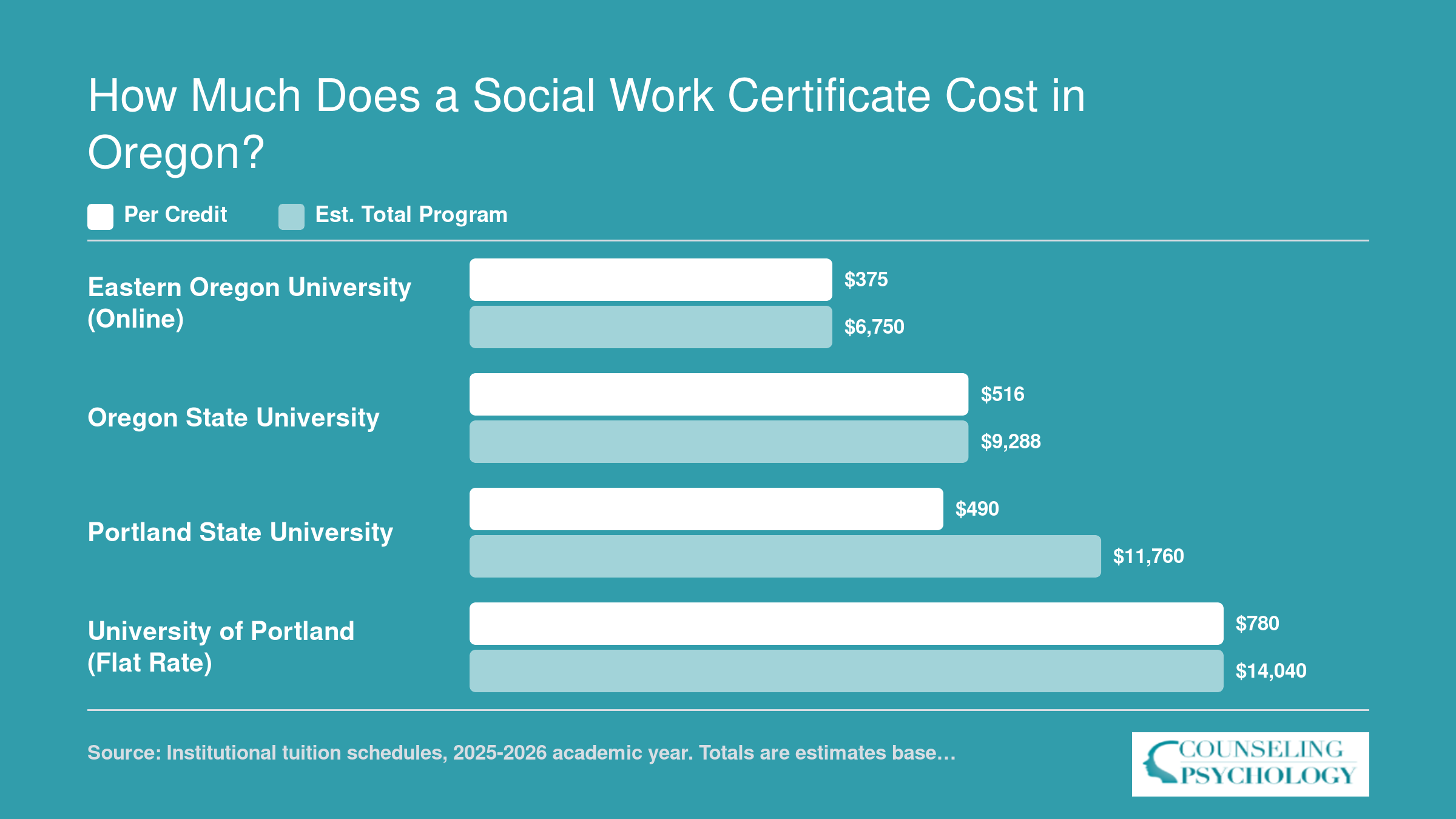
Graduate certificate tuition in Oregon varies widely depending on the institution, delivery format, and whether in-state rates apply. Most public universities charge per credit, with total program costs typically ranging from roughly $5,000 to $15,000 for 15 to 24 credits. A few programs offer flat-rate tuition regardless of residency, which can be a significant advantage for out-of-state online learners. Portland-area students should also explore Oregon-specific funding: the Oregon Health Authority's Health Care Workforce Grant awarded up to $6,260 per student in 2025-2026 for behavioral health fields, and Title IV-E child welfare stipends may cover tuition for students committed to public child welfare careers. Note that the Oregon Opportunity Grant does not extend to graduate certificate students. Some institutions, such as Oregon State University, have secured federal financial aid approval for select certificate programs, so always confirm aid eligibility with the school's financial aid office before enrolling.
Related Articles
Online vs. On-Campus Certificate Options for Portland Students
Many Portland-area professionals already work in social services, community agencies, or healthcare settings while pursuing advanced credentials. Choosing between online and on-campus certificate formats involves weighing several practical factors against your current commitments and career goals.
Schedule Flexibility and Time to Completion
Online certificate programs generally offer the greatest scheduling freedom, and online certificate enrollments have grown faster than degree programs over the last decade.1 Asynchronous coursework allows you to complete readings, discussions, and assignments on your own timeline, fitting study around shifts at a crisis center or case management duties. Programs through institutions like Portland State University's flexible online programs and Oregon State Ecampus deliver coursework entirely online, letting students progress without commuting to campus.2 On-campus or hybrid programs, by contrast, typically require set meeting times, which can conflict with unpredictable work schedules common in social services roles.
Time to completion varies, but online programs often allow accelerated pacing for motivated learners who can dedicate extra hours during slower work periods.
Field Placement Requirements
Regardless of format, many graduate certificates in social work include supervised field experience. Online students should confirm whether programs accept placements at their current employer or require arrangements at approved sites in the Portland metro area. On-campus programs sometimes offer more direct placement coordination through existing agency partnerships, which can simplify logistics.
Networking and Professional Connections
On-campus cohorts provide face-to-face interaction with peers and faculty, which some students find valuable for building professional relationships. Online learners can still connect through virtual discussion boards, group projects, and synchronous video sessions when offered. Portland-area students in online programs may also seek local professional associations or workshops to supplement remote coursework.
Tuition and Cost Considerations
Tuition differences between online and on-campus certificates are often modest, though online students typically save on commuting, parking, and related expenses. Some institutions charge identical per-credit rates regardless of delivery mode, while others set separate fee structures. Always compare total program costs, including technology fees for online learners.
Employer Perception
National surveys of hiring managers indicate that credentials from reputable online programs are generally viewed as comparable in quality to traditional on-campus certificates.3 What matters most to employers in Oregon's social services sector is accreditation status, relevant field experience, and demonstrated competencies, not delivery format.
Stackable Pathways: Can a Certificate Count Toward an MSW?
Fifteen credits earned through George Fox University's stand-alone School Social Work certificate can apply directly toward the university's 62-credit MSW program, making it one of the cleaner examples of a stackable credential pathway in the Portland region.1
What "Stackable" Actually Means
A stackable credential is one where the coursework completed at a lower credential level carries forward into a higher-level program, reducing the total credits a student must complete later. In social work education, this typically means certificate credits count toward the MSW rather than sitting unused on a transcript. The appeal is straightforward: if 12 to 15 credits stack into a 60- to 64-credit MSW, a student effectively bypasses 20 to 25 percent of the degree's total tuition.
Oregon State University offers a comparable model outside social work, where a 9-credit microcredential feeds into an 18-credit certificate that then applies toward a Master of Public Policy.2 That structure illustrates how institutions build deliberate on-ramps from short credentials to full degrees.
What Oregon Programs Actually Offer
Formal, published articulation agreements specifically linking a stand-alone social work certificate to an MSW program are not common across Oregon institutions as of 2024. George Fox's integrated structure is the regional standout, partly because the certificate and MSW share the same program design from the start rather than relying on a transfer agreement added after the fact.
Pacific University's MSW does offer advanced standing for students who hold a BSW, reducing the required coursework from 64 credits to 32, with a five-year limit on when the undergraduate degree was awarded.4 That is a different mechanism than certificate stacking, but the underlying logic is similar: prior relevant coursework shortens the degree path. For a deeper look at how advanced standing works at area schools, see our guide to Oregon MSW programs with that option.
For programs that do accept transfer credits more generally, Oregon MSW programs typically cap transfers at 9 to 12 credits, require a minimum grade of B in each course, and enforce a five- to seven-year time limit on credit age. These are general patterns, not guaranteed policies at any single school.
Confirm Everything Before You Enroll
Stacking policies change. A program that accepted certificate credits last year may have updated its curriculum requirements this year, making those credits ineligible. Before enrolling in any certificate with the intent to stack, ask the graduate admissions office two direct questions: does this certificate formally articulate with your MSW, and what GPA must I maintain to remain eligible? Then get the answer in writing, whether that is an email confirmation or a formal letter of intent.
George Fox requires a minimum 3.0 GPA for its MSW program, which serves as a practical floor for students planning to use the certificate as an entry point.1 Falling below that threshold mid-certificate could disrupt the entire stacking plan. The financial math only works when the pathway holds together from start to finish.
Certificate vs. MSW: Career Outcomes and Salary in Oregon
Credential level is the single biggest factor shaping which social work roles you can pursue and what you can expect to earn. In Oregon, clinical and licensed social worker positions overwhelmingly require an MSW plus supervised practice hours, while a graduate certificate in social work typically qualifies holders for case management, housing coordination, community outreach, and behavioral health support roles. Portland metro wages tend to run above the statewide median for most social work occupations, so the figures below offer useful context, but your actual earnings will depend on employer, setting, and experience. BLS salary figures represent statewide Oregon data; Portland area hourly ranges are drawn from 2025 employer postings and should be treated as approximate.
| Occupation | Typical Credential Required | Oregon Statewide Median Salary (BLS) | Portland Area Hourly Range (2025 Estimates) | Common Employers in Portland |
|---|---|---|---|---|
| Case Manager / Social Services Specialist | Graduate certificate or bachelor's degree | N/A | $23 to $35/hr | Central City Concern, Transition Projects, community mental health clinics, youth services agencies |
| Child, Family, and School Social Workers | MSW preferred; some positions accept bachelor's plus experience | $62,770 | N/A | Oregon DHS, school districts, nonprofit family service agencies |
| Mental Health and Substance Abuse Social Workers | MSW plus licensure (LCSW or CSWA) | $71,830 | N/A | Kaiser Permanente, community mental health organizations, behavioral health clinics |
| Healthcare Social Workers | MSW plus licensure (LCSW) | $85,150 | $35 to $55/hr | Providence Health, OHSU, Legacy Health, hospital systems |
| Community Outreach / Housing Coordinator | Graduate certificate or related degree | N/A | $23 to $35/hr | Transition Projects, Central City Concern, agencies with state or federal funding |
A graduate certificate gets you into social services roles faster and cheaper than an MSW, but it will not qualify you for clinical licensure (LCSW) in Oregon. If clinical practice is your goal, treat the certificate as a stepping stone and choose a program with stackable credits that apply toward a full master's degree.
How to Choose the Right Social Work Certificate Program
Picking a certificate is less about brand prestige and more about whether the credits, credential, and schedule will actually move your career forward. Work through these four criteria before submitting an application.
Verify Accreditation and Institutional Standing
CSWE accredits MSW and BSW degrees, not standalone certificates. That said, certificates housed within a CSWE-accredited social work department carry far more weight than those offered through continuing education arms or unaffiliated providers. Confirm the certificate is taught by the same faculty who teach the MSW, and that the host program holds current CSWE accreditation. Portland State University, for example, is the regional benchmark Oregon employers recognize.
Confirm Employer Alignment
A credential only matters if hiring managers value it. Before enrolling, contact two or three agencies where you'd actually want to work (a community mental health center, a hospital social work department, a child welfare nonprofit) and ask directly: would this certificate qualify me for the role I'm targeting, or do you require an MSW? Five minutes on the phone can save two years of tuition.
Check Stackability and Credit Transfer
If there's any chance you'll pursue an MSW later, get the credit transfer policy in writing. Some programs accept up to 12 certificate credits toward the MSW; others accept none. Policies vary even within the same university system.
Match Format to Your Life
Online asynchronous works for full-time employees with unpredictable hours. Hybrid suits learners who want cohort connection. On-campus evenings fit Portland-based workers with steady 9-to-5 schedules. If you're weighing related credentials, exploring counseling graduate certificate options can help you compare format flexibility across programs.
A Note on Oregon Licensure
No certificate leads directly to LCSW licensure in Oregon; that path requires the MSW plus supervised clinical hours. However, certificate coursework combined with supervised experience can qualify you for the Qualified Mental Health Associate (QMHA) designation through MHACBO, which opens doors at community mental health agencies across the Portland metro. Students interested in broader counseling programs in Oregon should also review state-specific licensure pathways before committing to a program.
Frequently Asked Questions About Social Work Certificates in Portland
Graduate certificates in social work raise practical questions about cost, career value, and how they relate to Oregon licensure. The answers below draw on current Oregon Board of Licensed Social Workers requirements and general program data to help you sort through the details.