

What you’ll learn in this article…
- ASU offers the strongest CSWE-accredited MSW in Arizona with fully online, on-campus, and advanced-standing tracks.
- Arizona LCSW licensure requires passing the ASWB exam plus completing at least 3,200 supervised clinical hours post-MSW.
- Service-commitment stipends and open scholarships are the two primary funding paths for Arizona MSW students.
- Most MSW candidates in Arizona complete field placements totaling 900 or more hours across multiple semesters.
Arizona's social work job market is expanding faster than the national average, driven by acute demand in child welfare, behavioral health integration, and rural healthcare gaps. But the state's MSW pipeline is compact: just two CSWE-accredited programs operate here, both at public universities and both offering fully online pathways alongside on-campus tracks.
Arizona State University and Northern Arizona University anchor the landscape. ASU delivers the largest enrollment, multiple concentration options, and an advanced-standing route for BSW holders. NAU offers a smaller cohort model with a clinical focus. Both programs prepare graduates for Arizona's multi-tiered licensure ladder, which requires 3,200 supervised clinical hours after graduation for full LCSW credentialing.
Tuition runs lower than many coastal markets, but program-level cost transparency remains limited in public datasets. Most Arizona MSW students weigh service-commitment scholarships that exchange tuition coverage for a contracted post-graduation job against open aid with no employment strings. The return on investment depends heavily on whether you aim for independent clinical practice, which commands a higher wage ceiling, or salaried agency roles in schools, hospitals, or state systems. Students drawn to substance use treatment should also consider how online addiction counseling degrees can complement an MSW skill set.
Best MSW Programs in Arizona: Rankings & Highlights
Arizona's MSW landscape is anchored by one powerhouse public university that delivers multiple concentration tracks entirely online. Arizona State University's CSWE-accredited Master of Social Work stands out for its flexible scheduling, statewide field placement coordination, and an advanced-standing pathway that lets qualified BSW graduates finish in as little as one year. Below is a closer look at the program options, costs, and outcome data that matter most when choosing an affordable MSW in Arizona.
- Tuition and net cost
- Graduate earnings outcomes
- Program delivery flexibility
- Accreditation and licensure alignment
- Admissions selectivity
- NCES-IPEDS federal institutional data — nces.ed.gov
- Internal program database
- College Scorecard graduate earnings — collegescorecard.ed.gov
- Independent program research

Arizona State University
Arizona State University delivers its entire MSW through ASU Online, giving students across Arizona (and beyond) access to a CSWE-accredited program without relocating. The curriculum spans micro, mezzo, and macro practice levels, preparing graduates for clinical roles, community organizing, and policy work in a state with pronounced rural, tribal, and health-equity challenges. In-state and online tuition is listed at roughly $10,843 per year, and the university's median graduate debt of $19,500 is moderate for a 60-credit-hour master's degree. Ten years after enrollment, College Scorecard data shows the institution-wide median earnings reach $62,668, a useful benchmark even though program-specific earnings figures are not yet available for the MSW.
- Fully online, CSWE-accredited 60-credit-hour program
- Classes run in 7.5-week sessions for scheduling flexibility
- 960 hours of supervised practicum arranged in your region
- Advanced standing track available for BSW holders (finish in ~1 year)
- Requires 240 hours of documented social work experience
- 3.0 GPA minimum with essay, resume, and three references
- Diploma and transcript carry no online designation
- Online concentration preparing students for clinical licensure pathways
- 51 to 60 credit hours with two- or three-year completion options
- Foundation and specialization practicums totaling 960 hours
- CSWE accreditation supports Arizona LCSW eligibility
- No prior BSW required; applicants from varied backgrounds welcome
- Multiple enrollment sessions with a next start date in August 2026
- Macro-focused concentration for nonprofit, government, and advocacy careers
- Online delivery through ASU with the same accreditation standing
- 51 to 60 credit hours including foundation and specialization practicums
- Concurrent degree options available for broader credential stacking
- Prepares graduates for professional social work licensure in Arizona
- Transfer credit accepted under specific conditions
Master of Social Work, Advanced Generalist — Online
Master of Social Work, Advanced Direct Practice — Online
Master of Social Work, Policy, Administration and Community Practice — Online
Arizona MSW Program Cost Comparison: Tuition, Debt & Net Price
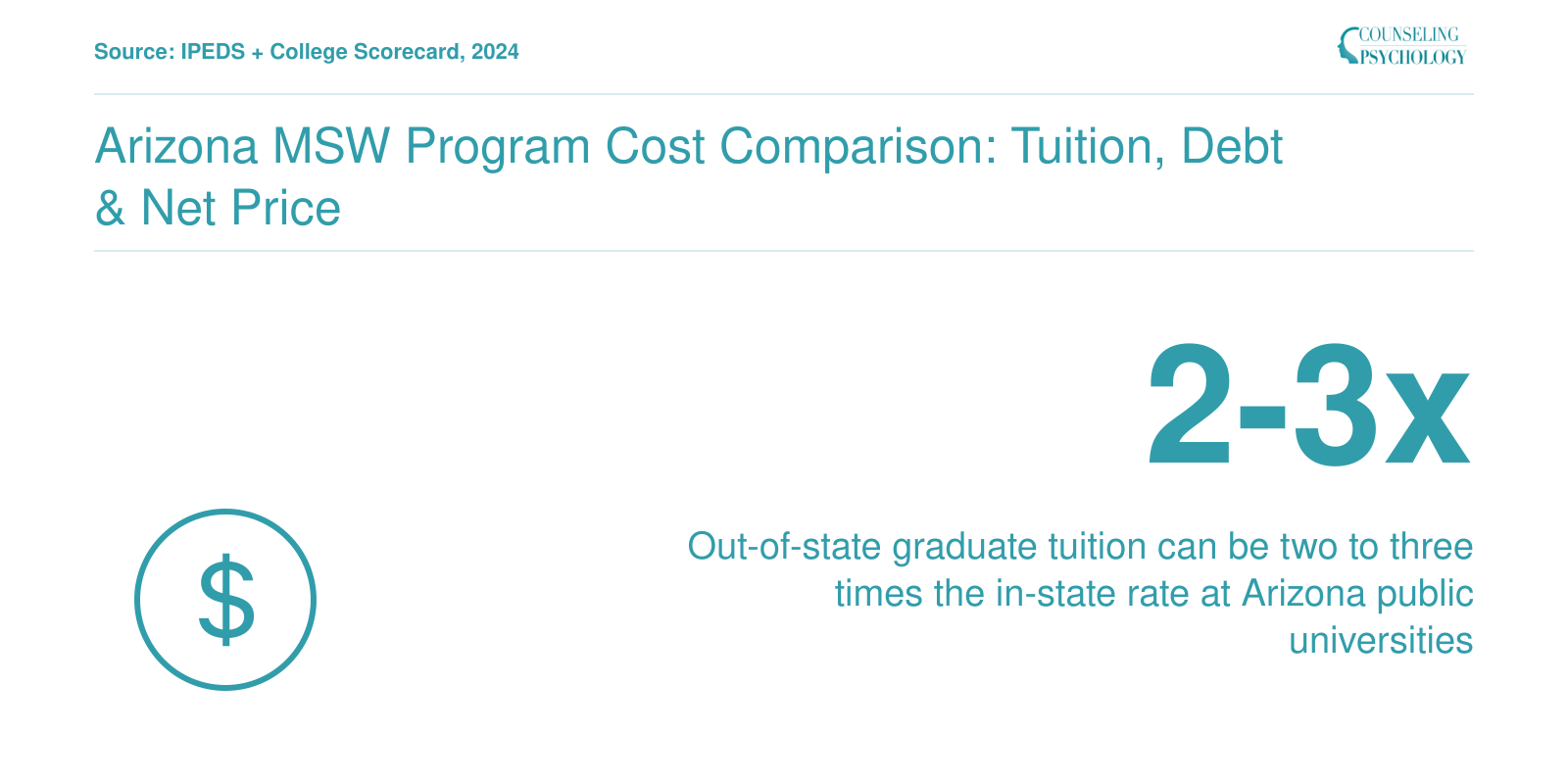
Program-level tuition, net price, and median graduate debt figures for individual Arizona MSW programs are not yet available in the current dataset. Nationally, the average annual graduate tuition at public universities runs roughly $12,000 to $13,000 for in-state students, while out-of-state rates can be two to three times higher. For online MSW seekers, residency classification is a critical cost lever: some Arizona institutions extend in-state pricing to all online learners regardless of where they live, potentially saving tens of thousands of dollars over the life of the degree.
MSW-Specific Scholarships & Funding in Arizona
Service-commitment stipends versus open scholarships: these are the two main funding tracks Arizona MSW students weigh. The first trades tuition coverage for a contracted job after graduation; the second hands you money with no employment strings attached. Most Arizona students end up combining both with federal loans.
Title IV-E Child Welfare Stipends at ASU and NAU
The Arizona Department of Child Safety (DCS) partners with Arizona State University and Northern Arizona University to fund students through the federal Title IV-E Child Welfare Program.1 The stipend covers tuition and mandatory fees (application, graduation, and late fees are excluded) for students enrolled in the two-year MSW Academic track, MSW Advanced Standing, or, for current DCS employees, the Part-Time MSW.2 BSW juniors and seniors are also eligible.
To qualify, you need to be in good academic standing, declare the child welfare concentration, and complete a child welfare practicum.1 You sign a contract before funding starts. After graduation, you work for DCS for the contracted service period as a regular employee with standard pay and benefits, not as a temporary hire.2 Specific stipend dollar amounts for the 2026 cycle have not been publicly posted; check directly with the ASU Child Welfare Education Program or the DCS Title IV-E office for current figures.
HRSA Behavioral Health and NHSC Loan Repayment
MSW graduates who move into clinical roles in underserved areas can pursue federal loan repayment through the National Health Service Corps (NHSC). Licensed clinical social workers (LCSWs) qualify, and Arizona has designated Health Professional Shortage Areas across rural counties and parts of Phoenix and Tucson. HRSA's Behavioral Health Workforce Education and Training (BHWET) program also funds traineeships at some accredited schools, including stipends for students placed in integrated behavioral health settings.
University Awards, Federal Aid, and Employer Help
ASU and NAU both run their own graduate scholarships and a limited number of graduate assistantships through their schools of social work, though MSW-dedicated awards are less common than departmental need-based aid. Most students fill the remaining gap with federal Direct Unsubsidized (Stafford) loans up to $20,500 per year and Grad PLUS loans for any balance. If you are already working in human services, ask your employer about tuition reimbursement; Arizona behavioral health agencies and hospital systems increasingly offer it as a retention benefit.
Related Articles
Online Vs. On-Campus MSW Options in Arizona
Arizona students weighing MSW delivery formats have more choices than most states. ASU alone offers three distinct tracks, each with different scheduling models, tuition structures, and available concentrations, while NAU adds another fully online option. The comparison below captures the practical differences that shape your day-to-day experience and total cost.
| Feature | ASU Online (Asynchronous) | ASU Sync (Live Online) | ASU Downtown Phoenix (On-Campus) | NAU Online |
|---|---|---|---|---|
| Delivery Format | Fully asynchronous; coursework completed on your own schedule in 7.5-week sessions | Live, synchronous class sessions held at scheduled times via video conferencing | Traditional in-person classes at the Downtown Phoenix campus (a Tucson location is also available for select cohorts) | Fully online; check NAU's current schedule for synchronous vs. asynchronous session details |
| Total Credits | 60 | 60 | 60 | 60 (typical for CSWE-accredited programs) |
| Typical Duration | 24 to 36 months | 24 months | 24 to 36 months (full-time or extended plan) | Varies; consult NAU for current cohort timelines |
| Concentrations Available | Advanced Generalist | Advanced Direct Practice | Planning, Administration, and Community Practice (PAC) and Advanced Direct Practice | Contact NAU for the latest concentration offerings |
| Tuition Model | Flat per-credit rate regardless of residency (IPEDS reports approximately $10,843 per year) | Resident and nonresident tuition tiers apply | Resident and nonresident tuition tiers apply | Typically a flat online rate; verify current pricing with NAU directly |
| Out-of-State Students | Pay the same flat rate as Arizona residents, making this the most predictable option for nonresidents | Nonresident surcharge applies; confirm current differential with ASU | Nonresident surcharge applies; establishing Arizona residency can lower costs after the first year | NAU online programs generally use a single rate, but confirm with the admissions office |
| Field Placement Hours | 960 hours arranged near your location | 960 hours arranged near your location | 960 hours, typically at agencies in the Phoenix metro or Tucson area | Comparable to CSWE requirements (typically 900+ hours); placements coordinated in your community |
| Scheduling Flexibility | Highest flexibility; ideal for working professionals or those in rural areas | Set class times but no commute; suits students who want real-time interaction from home | Fixed class schedule with face-to-face interaction and on-site networking opportunities | Generally flexible; scheduling details depend on the current program structure |
Questions to Ask Yourself
Specializations & Concentrations at Arizona MSW Programs
A concentration is the focused track you choose within your MSW that shapes your coursework, field placement, and, ultimately, the roles you qualify for after graduation. In Arizona, the concentration options vary by school and delivery format, so matching your career goals to the right program matters from day one.
Clinical vs. Macro: Two Distinct Paths
Most MSW programs nationwide divide into clinical and macro tracks, and Arizona is no exception in recognizing both workforce needs.
- Clinical (Advanced Direct Practice): Arizona State University offers an Advanced Direct Practice concentration on its Tempe campus.1 This track prepares you for one-on-one and group therapeutic work, and it is the natural fit if you plan to pursue Licensed Clinical Social Worker (LCSW) status. Arizona's behavioral health sector has been expanding steadily, and clinically trained social workers are in high demand across community mental health centers, hospitals, and private practice settings.
- Macro (Community and Policy Practice): While macro-level concentrations focus on program development, nonprofit leadership, advocacy, and systems-level change, not every Arizona school labels this track identically. Graduates on macro paths often land roles in child welfare agencies such as the Arizona Department of Child Safety (DCS), policy organizations, or large nonprofit networks. If direct therapy is not your calling but you want to drive change at scale, this is the direction to explore.
Advanced Generalist: ASU's Online Track
ASU's online MSW, delivered asynchronously through ASU Online, offers an Advanced Generalist concentration rather than the Advanced Direct Practice track available on campus.2 The Advanced Generalist model blends clinical and macro skills, which can be appealing if you want flexibility across settings. The program requires 60 credits and 960 hours of practicum, mirroring the on-campus credit load.3 One practical note: the diploma does not distinguish between on-campus and online completion, so the degree carries the same institutional weight regardless of format.
Do Advanced-Standing Students Get the Same Choices?
Advanced-standing plans, designed for students who already hold a BSW from a CSWE-accredited program, typically compress the credit load by waiving foundation courses. Whether the same concentration menu is available in the shortened plan depends on the institution. At ASU, prospective advanced-standing students should confirm directly with the School of Social Work whether both the Advanced Direct Practice and Advanced Generalist options remain accessible, because curriculum adjustments can shift from year to year.
Connecting Specializations to Arizona's Job Market
Arizona faces persistent workforce gaps in three areas where MSW graduates are especially needed:
- Behavioral health: The state has designated multiple counties as Health Professional Shortage Areas for mental health, making clinically trained social workers essential for expanding access to care.
- Child welfare: DCS and contracted agencies consistently recruit MSW holders for case management, supervisory, and program evaluation roles. A macro or generalist concentration pairs well here.
- Healthcare social work: Hospitals and integrated care systems across the Phoenix and Tucson metros seek social workers who can coordinate care for complex patient populations, a role that draws on both clinical assessment skills and systems-level thinking.
Choosing a concentration is not purely academic. It determines the type of field placement you complete, the supervision hours that count toward licensure, and the professional network you build before you graduate. Reviewing each program's concentration details early, ideally before you apply, helps you avoid switching tracks mid-program and the extra time that can add.
MSW Admissions Requirements & Acceptance Rates in Arizona
Arizona's MSW programs maintain clear admissions standards, but a holistic review process means your full profile matters more than any single number.
Standard Admission Requirements
Arizona State University's Master of Social Work program, available on campus and fully online, asks for a minimum 3.0 cumulative GPA from a regionally accredited bachelor's degree.1 Three letters of recommendation are required, ideally from academic and professional references who can speak to your readiness for graduate-level social work education.2 You must also submit a current resume or curriculum vitae, along with a four- to six-page personal statement that outlines your motivation, relevant experience, and understanding of the profession.1 Additionally, ASU requires documentation of at least 240 hours of paid or volunteer social work experience, a concrete way to demonstrate your commitment before you enroll.1 The GRE is not required for the 2025-2026 admission cycle; it is entirely waived.1 Other programs in the state, such as Northern Arizona University, follow a comparable framework with a 3.0 GPA baseline and similar supporting materials, though specific experience-hour requirements may differ.
Advanced Standing: A Shorter Route for BSW Graduates
If you already hold a Bachelor of Social Work from a CSWE-accredited program earned within the last six years, you may qualify for the Advanced Standing track.1 This pathway recognizes your foundational coursework and field experience, allowing you to complete the MSW in roughly 30 credits instead of the traditional 60. The trade-off is a higher GPA threshold (3.20 at ASU) and an earlier application deadline: February 1 for fall enrollment, compared to June 1 for the standard track.1 Advanced Standing is an accelerated ladder for BSW holders who are ready to dive into advanced practice courses and specialized field placements with less repetition.
What Acceptance Rates Really Mean for MSW Applicants
University-wide acceptance figures can be misleading. ASU's overall acceptance rate sits around 67%, but that number spans all graduate programs and does not reflect the selectivity of a specific MSW cohort. MSW programs typically admit smaller, cohort-based classes, and competition for those seats can be steeper than the institutional figure suggests. No program-specific acceptance rate is published, but the combination of a 3.0 GPA floor, required experience hours, and a multi-part application naturally filters for prepared, committed candidates. If you meet or exceed the baseline qualifications and submit a strong narrative package, your odds are solid.
Your Application: Where Experience and Essays Can Make the Difference
Admissions committees at Arizona MSW programs practice holistic review, which means a GPA that falls a few tenths short of the 3.0 minimum does not automatically disqualify you.1 Demonstrated social work experience, whether through employment, internships, or sustained volunteer work, can offset a lower GPA. The personal statement is your most powerful tool: use it to connect your background to the program's mission, explain any academic bumps, and show self-awareness about your growth. Letters of recommendation should come from people who can attest to your interpersonal skills and work ethic, not just your classroom performance. If you have questions about eligibility, reach out to the program's admissions office; many offer pre-evaluation conversations to help you assess your competitiveness before you apply.
Arizona MSW Field Placement: What to Expect
Field education is the signature pedagogy of social work, and in Arizona that means a substantial time commitment in the field alongside your coursework, structured to meet CSWE standards across multiple semesters.
Hours and Structure
CSWE-accredited MSW programs require a minimum of 900 field hours for traditional (two-year) students, typically split across a foundation-year generalist placement and a specialization-year concentration placement. Advanced-standing students, who already hold a BSW, complete only the specialization placement, usually 500 to 600 hours. At ASU, students follow a published practicum calendar (the MSW Fall 2026 Practicum Education Calendar lays out start dates, hour-logging deadlines, and seminar meetings), and online students face firm document deadlines, such as the Spring 2026 Internship Required Documents window, well before the semester begins.1
Where Arizona Students Are Placed
Field sites across the state span a wide range of practice settings:
- Healthcare systems: Banner Health hospitals and clinics, VA medical centers in Phoenix and Tucson, and pediatric and behavioral health units
- Public child welfare: Arizona Department of Child Safety (DCS) regional offices
- Community mental health: agencies contracted through the regional behavioral health authorities
- Schools: K-12 districts placing interns as school social workers
- Tribal communities: agencies serving the Navajo Nation, Tohono O'odham, Gila River, and other sovereign nations, often through formal affiliation agreements
At ASU, placements are coordinated through the Sonia Internship Database with support from a practicum team and faculty liaison, though the process is student-led: you identify sites of interest, and the program facilitates the affiliation agreement.2 ASU does not guarantee placement at a specific agency. Students interested in child welfare settings, such as DCS, may also find value in exploring child abuse counselor education pathways that complement field experience.
Rural and Online Considerations
Urban students in Phoenix and Tucson have the deepest pool of sites. Students in Flagstaff, Yuma, or on tribal lands generally have fewer options but can often place locally, particularly with DCS, IHS-affiliated clinics, or rural behavioral health providers. Online MSW students at ASU can typically arrange placements in their home communities provided the agency signs a New Agency Affiliation Agreement Packet, meaning relocation is rarely required, though students in very remote areas should start the site-search conversation early.1
How to Get Licensed as a Social Worker in Arizona
Earning your MSW is the first milestone, but practicing independently in Arizona requires navigating a defined credentialing ladder overseen by the Arizona Board of Behavioral Health Examiners. Budget roughly $440 in state fees across the process (application, fingerprinting, and license issuance), and plan for at least two years of post-degree supervised practice before you can apply for full clinical licensure. Arizona has signed on to the interstate social work licensure compact, though the compact is not yet active, so for now each license is state-specific.
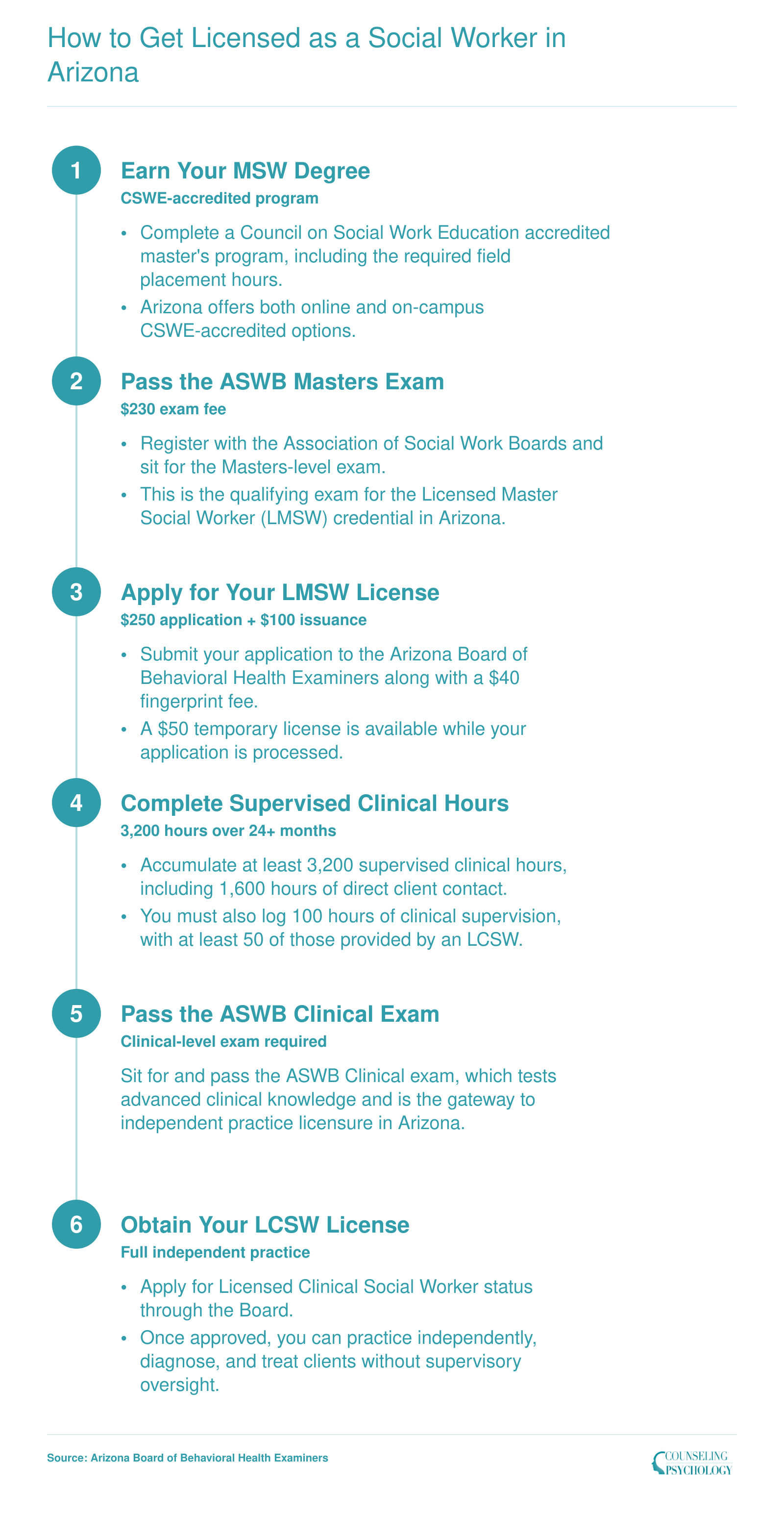
After earning your MSW and passing the ASWB exam, you can obtain your LMSW and begin practicing under supervision right away. Full clinical licensure (LCSW) requires at least 3,200 hours of supervised clinical experience, which most candidates complete over two to three years. Plan for this post-degree commitment as you map out your career timeline.
Is an MSW Worth It? Salary & Career Outcomes in Arizona
Is an MSW in Arizona a financially sound investment? For most aspiring clinicians, the answer hinges on careful calculation: the cost of the degree against how much you can realistically earn afterward, plus the doors that licensure unlocks. For a concrete local benchmark, graduates of Arizona State University's online MSW program report a median income of $62,668 a decade after starting, with a median student debt of $19,500. That translates to a debt-to-income ratio of just 31%, meaning future earnings handily cover loan repayment. To understand the full picture, though, you need to weigh salary premiums, specialty demand, and the non-monetary returns of clinical practice.
MSW Salary Premium Over a Bachelor's Degree
Breaking into social work with a BSW typically lands you in case management or support roles where Arizona salaries often sit in the mid-$40,000s to low $50,000s. An MSW expands your scope and your earning potential. Clinical and administrative positions that require a master's generally start $10,000 to $20,000 higher, and the gap widens with experience and independent licensure. Licensed clinical social workers in the state routinely exceed $70,000, particularly in urban hubs like Phoenix and Tucson. For context on how these figures compare to related helping professions, see our breakdown of counselor salary with masters data.
Arizona Social Worker Earnings by Specialty and Setting
Job setting heavily influences pay. Drawing on the latest BLS data, national median wages provide a useful yardstick:1 - Child, family, and school social workers: $59,190 - Mental health and substance abuse social workers: $63,870 - Healthcare social workers: $67,430
Arizona's market aligns closely with these national figures, with Phoenix-Mesa-Chandler and Tucson metros often pulling slightly above the statewide average.2 Within the Grand Canyon State, behavioral health agencies, hospital systems, and child welfare departments are among the top employers. Healthcare social workers in Arizona, frequently placed in integrated health settings, can anticipate medians in the upper $60,000s to mid-$70,000s, while substance abuse and mental health roles cluster in the $55,000 to $70,000 band.3
Debt-to-Earnings Ratio and Payback Timeline
Return on investment isn't just about raw salary; it's about how long you carry the loan. With the ASU program's median debt of $19,500 and earnings of $62,668, the math is favorable. On a standard 10-year repayment plan, monthly payments would be about $200, leaving ample room for living expenses. Even if you borrow the maximum typical amount for an MSW (some students take on $30,000 to $40,000), a social worker's income comfortably supports repayment. Moreover, Arizona MSW graduates can position themselves for Public Service Loan Forgiveness by working in qualifying nonprofits or government agencies, a common route in child welfare and community mental health.
Beyond the Paycheck: The Value of Licensure and Clinical Roles
The financial case alone makes an MSW worthwhile for many, but the credential also opens the door to clinical licensure. Arizona requires a master's degree to pursue the Licensed Clinical Social Worker (LCSW) credential, which is non-negotiable for independent practice, psychotherapy, and supervisory positions. Many Arizona social workers find that the combination of higher pay, greater autonomy, and the ability to bill insurance directly for therapy services transforms an MSW from a line-item expense into a long-term career asset. In a state where behavioral health needs remain high and integrated care models are expanding, clinical social work is not just a job: it is a resilient and impactful profession.
Frequently Asked Questions About MSW Programs in Arizona
These are some of the most common questions prospective students ask about earning a Master of Social Work in Arizona. Each answer draws on program data, cost figures, and licensure details covered throughout this guide.