
What you’ll learn in this article…
- The 2024 national first-time BCBA exam pass rate was 54 percent, making program-specific pass rates a critical comparison point.
- Online ABA master's tuition ranges widely, so comparing after-aid cost rather than sticker price prevents costly surprises.
- Most states now require separate behavior analyst licensure beyond BCBA certification, and rules vary significantly by state.
- Over 81,000 BCBAs hold active credentials in the United States, reflecting rapid field growth and strong job demand.
Demand for Board Certified Behavior Analysts has roughly quadrupled over the past decade, and online delivery has become the default format for working clinicians who cannot relocate to a residential program. The 29 programs ranked here span bachelor's tracks, master's degrees, graduate certificates, and post-master's credentials, with delivery formats ranging from fully asynchronous to synchronous hybrid cohorts.
The practical tension for most applicants is cost against credentialing fit. Tuition across the ranked list runs from under $7,000 per year in-state at public universities to over $67,000 at private institutions, and not every program's coursework is verified by the Behavior Analyst Certification Board. That verification, along with supervised fieldwork access, determines whether a degree actually leads to BCBA eligibility.
Best Online Applied Behavior Analysis Programs
The programs below were selected for their combination of online accessibility, institutional strength, and alignment with BCBA or BCaBA exam preparation. Each offers a distinct path into applied behavior analysis, whether you are pursuing a bachelor's degree, a master's, or a post-master's certificate. Program-level earnings data are not yet available for these ABA offerings, so the institutional metrics listed reflect each university as a whole rather than any single program.
- Online delivery and accessibility
- Institutional graduation and retention rates
- Net price and tuition affordability
- Program-level outcomes when available
- BACB curriculum verification
- NCES-IPEDS federal institutional data — nces.ed.gov
- College Scorecard graduate earnings — collegescorecard.ed.gov
- Independent program research
- Internal program database

University of Washington-Seattle Campus
The University of Washington pairs a strong research university reputation with an online M.Ed. in ABA that charges a flat per-credit rate regardless of residency, removing the usual out-of-state tuition penalty. The program holds ABAI Tier 2A recognition and delivers all coursework live via synchronous Zoom sessions in cohorts of roughly 50 students, striking a balance between community feel and schedule flexibility. An optional full supervision package lets students complete BCBA fieldwork requirements under one institutional umbrella, and an embedded course satisfies Washington State's School Behavior Analyst ESA credential.
- Online synchronous delivery via live Zoom sessions
- 56 to 62 total credits with 2 to 3 year flexible completion
- $589 per credit for all students regardless of residency
- ABAI Tier 2A recognized verified course sequence
- Optional supervision package for BCBA fieldwork hours
- Capstone project required for degree completion
- Scholarships available up to $8,000
- Includes Washington State ESA certification coursework
Master of Education in Applied Behavior Analysis — Online

Florida State University
Florida State University's hybrid M.S. in Applied Behavior Analysis consistently reports strong BCBA exam pass rates and structures its five-semester curriculum around small class sizes and hands-on clinical practica. Tuition waivers and paid assistantships are available, which can substantially reduce the effective cost. The program does not require the GRE for admission, and courses are delivered across two campus options, giving students some geographic flexibility within the hybrid format.
- Hybrid format across two Florida campus locations
- Five-semester structured curriculum with clinical practicum
- No GRE required for admission
- Tuition waiver and paid assistantship opportunities
- BACB verified course sequence with top exam pass rates
- Small class sizes for individualized faculty mentorship
Master of Science in Applied Behavior Analysis — Hybrid

University of South Florida
The University of South Florida stands out for offering in-state tuition to every online student regardless of where they live, making its fully online M.A. in ABA one of the more cost-accessible master's options on this list. The program is structured for completion in five semesters and integrates 1,500 supervised fieldwork hours coordinated in each student's local community. Doctoral-level faculty teach every course, and dedicated scholarship opportunities are available for ABA students specifically.
- Fully online with in-state tuition for all students
- Five-semester completion timeline
- 1,500 supervised fieldwork hours in local communities
- No GRE required for admission
- Scholarship opportunities for ABA students
- Doctoral-level behavior analyst instructors
- Board certification exam preparation embedded in coursework
Master of Arts in Applied Behavior Analysis — Online

Florida International University
Florida International University is the only school on this list that offers ABA pathways at three credential levels: a fully online bachelor's ABA track preparing students for the BCaBA exam, a hybrid master's in behavior analysis geared toward BCBA certification, and a 12-month hybrid graduate certificate for those who already hold an advanced degree. The institution-wide net price of $9,288 and tuition starting at $6,565 for in-state students make FIU one of the more affordable entry points into the field. Faculty across all three programs are practicing BCBAs, and the Miami campus provides access to a large and diverse clinical population for practicum placements.
- Fully online format with multiple start dates annually
- 120 total credits with BCaBA certificate pathway
- Tuition from $235.57 to $648.87 per credit hour
- Success coach support throughout the program
- Research-based curriculum in behavior analysis
- Flexible scheduling for working students
- Hybrid program completable in 18 months
- 45 credit hours with BCBA credential preparation
- Fall and spring admission cycles
- Practical experience with BCBA faculty supervision
- Ethics coursework and professional development focus
- Diverse clinical learning environment in Miami
- 12-month hybrid program with seven courses
- Total cost of approximately $12,453
- Requires an existing graduate degree and 3.0 GPA
- Spring admission only
- Covers behavior technologies and ethical codes
- Prepares for BCBA board certification exam
Bachelor of Arts in Psychology, Applied Behavior Analysis Track — Online
Master of Science in Psychology, Behavior Analysis — Hybrid
Graduate Certificate in Applied Behavior Analysis — Hybrid

University of Virginia
The University of Virginia offers multiple online ABA pathways housed within its nationally ranked special education program. Students can pursue a fully online M.Ed. with an ABA concentration, a separate M.Ed. with a special education leadership or general curriculum focus, or a standalone ABA certificate that prepares holders for either the BCBA or BCaBA exam depending on prior degree level. All courses are delivered synchronously, no GRE is required, and the certificate's 1-to-7-semester pacing is designed for working educators across the country. The institution-wide graduation rate of 95.6% reflects UVA's broad academic strength.
- Fully online synchronous delivery
- Prepares for BCBA exam with ABA-focused coursework
- Core special education courses support state endorsement
- No GRE required for admission
- 1 to 2 year completion timeline
- Ideal for educators blending ABA with special ed practice
- Fully online synchronous program ranked #7 in special education
- Multiple emphasis areas including optional BCBA preparation
- Bachelor's degree prerequisite with no GRE
- Experienced faculty instruction across all courses
- State endorsement options available
- 1 to 2 year flexible completion
- Three concentration options within one degree framework
- Leadership and BCBA pathways available concurrently
- Fully online synchronous format
- No GRE required for admission
- Guaranteed admission pathway for UVA undergraduates
- Ranked nationally in special education
- Fully online, BACB-approved program
- Completable in 1 to 7 semesters at part-time pace
- Prepares for BCBA or BCaBA exam based on prior degree
- No GRE required
- Covers ethics, supervision, and practical ABA skills
- Open to bachelor's or master's degree holders
Master of Education in Special Education, ABA Concentration — Online
Master of Education in Special Education, General Curriculum — Online
Master of Education in Special Education, Leadership — Online
Certificate in Applied Behavioral Analysis — Online

CUNY Hunter College
CUNY Hunter College provides a hybrid M.S. in Applied Behavior Analysis and a 27-credit Advanced Certificate, both structured to align with New York State licensure requirements for behavior analysts. The institution-wide net price of $2,984 is the lowest on this list, reflecting CUNY's mission to serve a broadly accessible student population. Courses blend online and on-campus components, and supervised practicum experiences are built into the certificate track. For students already holding a bachelor's degree and eyeing New York practice, Hunter's programs offer a direct pathway to both BCBA certification and state licensure.
- Hybrid format combining online and campus sessions
- Covers assessment, intervention, and ethical practices
- Financial aid options available
- Bachelor's degree and prerequisites required
- Practical skills emphasis throughout curriculum
- Suited to recent graduates and career changers
- 27-credit hybrid certificate with supervised practicum
- BCBA certification preparation pathway
- Nationally recognized curriculum design
- Pathway to New York State behavior analyst licensure
- Supervised practicum experiences included
- Focused on practical, field-ready ABA competencies
Master of Science in Applied Behavior Analysis — Hybrid
Advanced Certificate in Applied Behavior Analysis — Hybrid

University of Central Florida
The University of Central Florida offers an 18-credit online graduate certificate in ABA that fulfills the Behavior Analyst Certification Board's coursework requirements. Housed within UCF's special education program, the certificate covers advanced behavior analysis, ethics, and supervision. It is designed for students already in education or psychology graduate programs who want to add ABA board certification eligibility to their credentials. UCF's in-state tuition of $8,872 and net price of $10,411 keep costs moderate, though the certificate itself does not confer certification directly.
- Fully online, 18 credit hours
- Meets BACB coursework requirements
- Covers advanced behavior analysis and ethics
- Supervision and personnel management coursework
- Designed for education and psychology graduate students
- Does not directly confer certification
- Part of UCF's Special Education program
Applied Behavior Analysis Graduate Certificate — Online

University of Houston
The University of Houston's M.Ed. in Special Populations with an ABA concentration uses a hybrid model to prepare students for BCBA certification while keeping them connected to Houston's diverse clinical landscape. The program emphasizes ethical guidelines, data-driven decision making, and professional collaboration, with a GRE waiver available for applicants with relevant experience. Graduates find roles in schools, clinics, and community-based organizations across Texas and beyond.
- Hybrid learning format blending online and campus
- Prepares graduates for BCBA certification
- GRE waiver available for qualified applicants
- Emphasis on ethical guidelines and data-driven practice
- Professional collaboration skills integrated throughout
- Career pathways in schools, clinics, and communities
Master of Education in Special Populations, Applied Behavior Analysis — Hybrid

University of Oklahoma-Norman Campus
The University of Oklahoma's online ABA graduate certificate is a BACB-verified seven-course sequence delivered entirely through synchronous distance learning. Its performance-based progression policy requires students to earn an A or B in the first two courses before continuing, which helps ensure that completers are well prepared for the BCBA exam. The curriculum focuses specifically on autism and developmental disabilities. Certificate-only students should note that financial aid is not available for this credential.
- 100% synchronous online delivery
- BACB verified seven-course sequence
- Performance-based progression: A or B required in first two courses
- Focused on autism and developmental disabilities
- Prepares for BCBA examination
- No financial aid for certificate-only students
- Flexible scheduling for working professionals
Applied Behavior Analysis Graduate Certificate — Online

Vanderbilt University
Vanderbilt University's online post-master's certificate in ABA is built for professionals who already hold a master's degree and want advanced, research-informed training. Delivered through Peabody College of Education, one of the top-ranked special education programs in the country, the certificate covers ABA principles, ethical practices, and intervention strategies in a flexible online format. Vanderbilt's institution-wide graduation rate of 93.5% and 8:1 student-to-faculty ratio signal the level of academic support students can expect.
- Fully online format designed for working professionals
- Requires a related master's degree for admission
- Research-based ABA curriculum through Peabody College
- Covers ethical practices and intervention strategies
- Prepares for leadership roles in ABA settings
- Financial aid options available
- 8:1 student-to-faculty ratio institution wide
Online Post-Master's Certificate in Applied Behavior Analysis — Online
How We Ranked These Online ABA Programs
Transparent criteria versus a mystery black box: that contrast defines the difference between a ranking students can actually use and one they have to take on faith. Many competitor lists present a curated set of programs without explaining what landed a school on the list or why one program outranked another. This ranking works differently.
The Core Methodology
Each program in this list was evaluated using a composite score that combines multiple quality indicators. Online delivery is treated as a meaningful program feature, so schools offering fully asynchronous or synchronous-online ABA pathways receive a methodological boost that reflects the practical value of remote access for working adults and students in underserved regions.
Baseline quality factors layered into the composite include:
- Graduation rate: Drawn from institution-wide data, not ABA-program-specific completion figures. Program-level graduation rates are rarely published in a standardized way, so the institution-wide figure serves as a reasonable proxy for the academic support environment a student can expect.
- Net price: A sector-conditional average that accounts for whether a school is public or private, since sticker prices mean different things across those contexts.
- Program-level earnings and debt: Where available, we drew on College Scorecard data to surface what graduates actually earn and borrow, giving a more grounded picture of return on investment than tuition alone.
Data Sources
The underlying data comes from three primary sources: the U.S. Department of Education's College Scorecard, the Integrated Postsecondary Education Data System (IPEDS), and an internal ranking composite that weights and normalizes these inputs into a single score.
What This Means for You
No ranking captures every dimension of program quality. Scorecard earnings data reflects all graduates of a credential type at an institution, not exclusively ABA students, and institution-wide graduation rates can mask variation at the program level. If you are also exploring broader options such as online master's in psychology programs, the same principle applies: cross-reference any ranking with discipline-specific details. Use this list as a starting point, then verify BACB-approved course sequence status, faculty credentials, and the fieldwork placement support each program provides before making a final decision.
Questions to Ask Yourself
Types of Online ABA Degrees and Certificates
Choosing the right credential level determines both the timeline to employment and the scope of practice you will hold. A bachelor's degree opens entry-level doors, while a master's unlocks independent clinical work and BCBA certification. Applied behavior analysis credentials exist across four tiers, each mapped to specific Behavior Analyst Certification Board certifications and career roles.
Bachelor's Degree in ABA
A bachelor's degree in applied behavior analysis or a related field serves as the foundation for entry-level positions and two pathways: Registered Behavior Technician (RBT) certification and Board Certified Assistant Behavior Analyst (BCaBA) certification. RBT requirements include a high school diploma or equivalent, 40 hours of training using the RBT 2026 curriculum outline, and supervision by a BCaBA or BCBA; certification must be renewed every two years with 12 professional development units.1 BCaBA certification requires a bachelor's degree, completion of BACB-approved coursework, and coursework attestation using the BCaBA Pathway 2 Coursework Attestation form effective January 2026.2 Bachelor's programs are less common in online formats, with most institutions focusing their distance offerings on master's and certificate programs.
Master's Degree in ABA
Master's programs dominate the online ABA landscape and represent the most direct route to Board Certified Behavior Analyst (BCBA) certification. The BACB now requires a master's degree from a qualifying program for BCBA eligibility; bachelor's-level pathways to BCBA were phased out in prior standards updates. Master's students complete BACB-approved coursework, submit a BCBA Pathway 2 Coursework Attestation form effective January 2026, and accumulate supervised fieldwork hours before sitting for the certification exam. The majority of ranked programs in this guide award master's degrees, reflecting both market demand and the BACB's current standards. Note that Ontario residents became ineligible for BCBA certification starting July 1, 2026, due to provincial regulatory changes.4
Graduate Certificate in ABA
Graduate certificates target professionals who already hold a master's degree in psychology, education, special education, or a related field and need only the BACB-required coursework to qualify for the BCBA exam. These programs typically include five to eight courses covering the BACB's verified course sequence and require fewer total credits than a full master's degree. Certificates offer a faster, more affordable pathway for career changers or clinicians adding ABA specialization to an existing credential.
Doctoral Programs
Doctoral programs in ABA prepare graduates for research, university teaching, clinical leadership, and advanced practice roles. The BCBA-D designation recognizes doctoral-level training but does not confer additional practice privileges beyond the BCBA. Doctoral programs are less common online due to the intensive research and dissertation requirements, though some institutions offer hybrid formats that blend distance coursework with periodic on-campus residencies.
Related Articles
What to Look for in an Online ABA Program
Choosing an online applied behavior analysis program requires attention to specific accreditation standards, fieldwork logistics, and delivery formats that directly affect whether you can sit for the Board Certified Behavior Analyst (BCBA) exam and practice in your state. Not every program marketed as an ABA master's degree meets the Behavior Analyst Certification Board's verification requirements, and missteps early in your search can cost years of time and tuition.
BACB-Approved Course Sequence
The BACB maintains strict standards for which graduate coursework qualifies toward certification eligibility. A program must offer a BACB-approved course sequence or hold verification from the Association for Behavior Analysis International (ABAI). Many universities list ABA in the degree title but do not meet these standards, leaving graduates unable to sit for the BCBA exam. Before you enroll, confirm that the program explicitly states BACB approval or ABAI verification on its website or in program materials. Contact the department directly if this information is unclear, and cross-reference the program against the BACB's online directory of approved course sequences.2
Practicum and Supervision Logistics
Online ABA programs require substantial supervised fieldwork completed in person, typically in your local community. Current BACB standards mandate either 2,000 hours of supervised fieldwork or 1,500 hours of concentrated supervised fieldwork, both completed under a qualified supervisor with specific activity requirements.1 Concentrated fieldwork involves more intensive oversight and may shorten your timeline, but not all students have access to settings that support the concentrated track.
Most online programs use an integrated practicum model, pairing coursework with concurrent fieldwork that unfolds over 18 to 24 months. Some universities, including St. Cloud State, include supervision within the program structure and help students connect with qualified supervisors.2 Other programs expect you to identify and secure your own fieldwork site and supervisor, which can be challenging if you live in a rural area or lack connections in the field. Fieldwork hours can accrue starting on the first day of your qualifying coursework, but the BACB caps monthly hours at 130, so cramming fieldwork into a short window is not feasible.1 Many programs charge additional practicum fees beyond standard tuition, so budget accordingly.
Synchronous vs. Asynchronous Formats
Online ABA programs vary in how they deliver instruction. Asynchronous formats let you watch lectures and complete assignments on your own schedule, a significant advantage for working professionals juggling jobs, family, and coursework. Synchronous formats require you to attend live virtual sessions at set times, which can strengthen peer connections and provide real-time practice of complex skills like functional behavior assessment. Some programs blend both approaches, offering asynchronous lectures with occasional synchronous labs or case discussions.
Completion Timelines
Part-time enrollment, common among working behavior technicians and educators, typically extends program length to 2.5 to 3 years. Full-time students can finish coursework in 1.5 to 2 years, though fieldwork requirements often determine the actual graduation date regardless of credit completion. Your timeline also depends on how quickly you accumulate supervised hours and whether you pursue the standard or concentrated fieldwork pathway.1
State Authorization and Licensure
Online programs must hold authorization to enroll students in your state of residence, a requirement tied to federal and state distance-education regulations. Some states impose additional behavior analyst licensure requirements beyond BCBA certification, including jurisprudence exams, background checks, or supervised post-certification hours. Verify that your target program is authorized in your state and research your state's specific licensure rules before you commit.
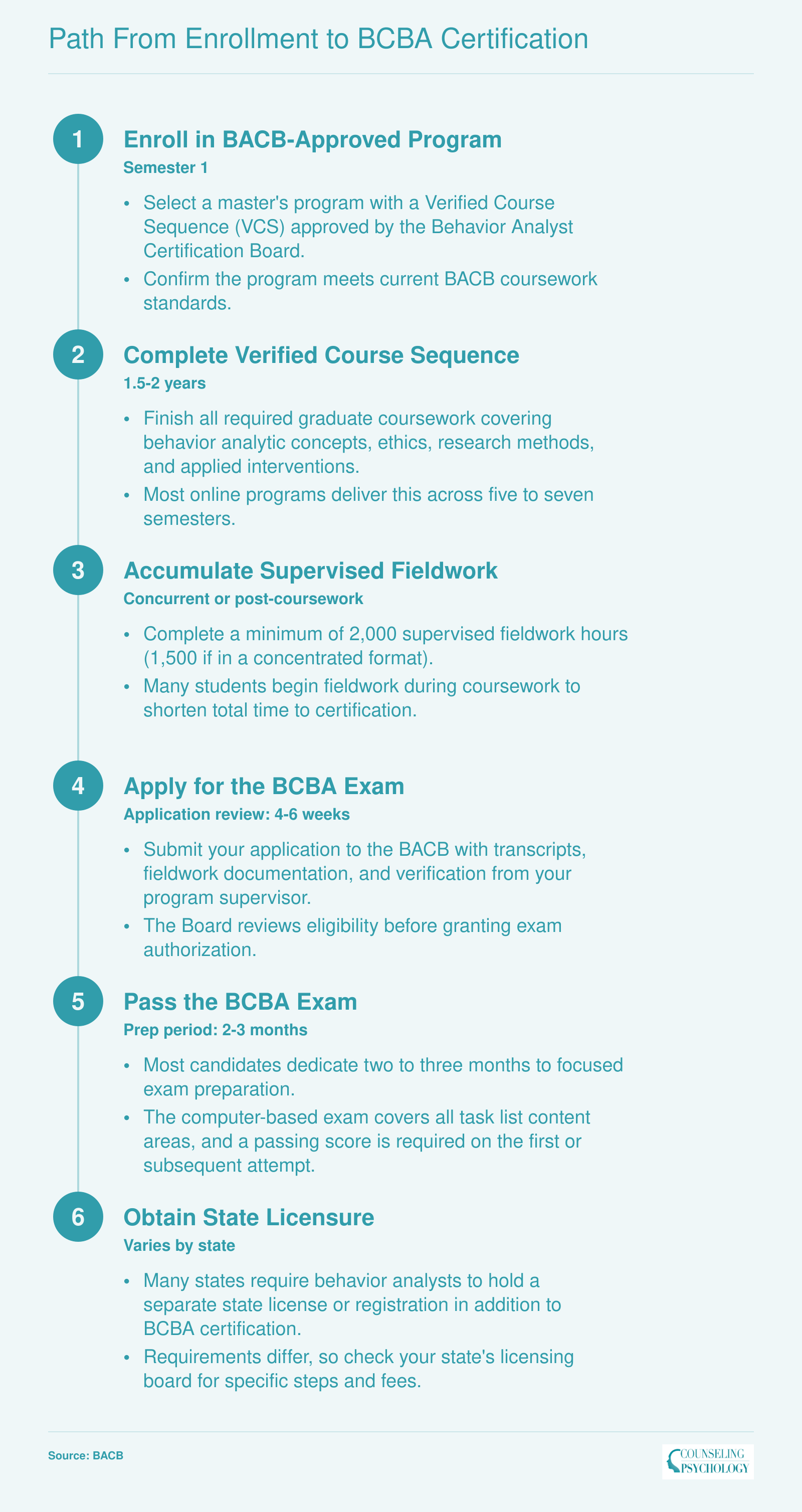
Path From Enrollment to BCBA Certification
Becoming a Board Certified Behavior Analyst follows a structured sequence. While timelines vary by program format and fieldwork scheduling, most candidates move from enrollment to certification in roughly two to three years.
BCBA Exam Preparation and Pass Rates for Online Programs
The BCBA exam is a genuine filter, and where you train matters for how well you clear it.
The National Benchmark
In 2024, the national first-time pass rate for the BCBA exam was 54 percent, across nearly 10,000 examinees from 192 programs.1 That figure is lower than many prospective students expect, and it underscores why exam preparation deserves as much scrutiny as tuition or course format when you are comparing programs.
How the BACB Reports Pass-Rate Data
The Behavior Analyst Certification Board publishes university examination pass rates by institution each year. A few mechanics are worth understanding before you use this data to make decisions.
First, the BACB only includes programs with at least six candidates in the reporting window. Programs smaller than that threshold are excluded, so a school's absence from the list does not necessarily mean its graduates performed poorly. It may simply mean the cohort was too small to appear.
Second, the BACB does not currently separate pass rates by delivery format. If a university offers both a campus-based and an online track under the same program umbrella, their results are combined into one figure. You cannot always tell whether online-only graduates drove the rate up or pulled it down.
Pass Rates at Online-Serving Programs
Several programs with online or online-inclusive delivery posted notably strong results in 2024:2
- Florida Institute of Technology: 100 percent first-time pass rate
- University of Alabama in Huntsville: 100 percent first-time pass rate
- University of Kansas: 93 percent first-time pass rate
- St. Cloud State University: 90 percent first-time pass rate
- University of South Florida: 89 percent first-time pass rate
- University of Washington, Seattle: 88 percent first-time pass rate
Each of these programs significantly outpaced the national average, which is meaningful context for applicants trying to gauge exam readiness support.
Treating Pass Rates as One Signal Among Many
A program with a small graduating cohort can swing from 100 percent to 60 percent in a single year with just a few additional failures. When you see an extraordinary rate attached to a program that graduates 10 to 15 students annually, treat it as a promising sign rather than a guarantee. Pair pass-rate data with what you learn about faculty support, mock exams, supervision quality, and whether the curriculum maps tightly to the current BCBA Task List. Those structural features predict performance more reliably than any single year's percentage.
Cost of Online ABA Programs and Financial Aid
Federal student loan limits for graduate students have not changed since 2012, even as graduate program costs have climbed steadily. For online ABA master's programs, understanding both sticker price and realistic after-aid cost helps you plan before you commit.
Tuition Range and Net Price Across Programs
Tuition for online ABA master's programs varies widely depending on whether you attend a public university as an in-state student, pay out-of-state rates, or enroll at a private institution. Among the programs featured in our ranking, in-state graduate tuition ranges from approximately $6,700 to $20,800 per year, while out-of-state rates climb from roughly $15,300 to $38,500. Private programs often fall in the upper half of that range or higher.
Net price offers a more realistic snapshot. Institution-wide average net price after institutional aid (not ABA-specific, but a useful benchmark) ranges from around $3,000 to $12,000 annually at the public universities in our dataset. Keep in mind that graduate students receive less institutional grant aid than undergraduates, so your personal net cost will depend on federal loans, employer support, and outside scholarships.
Three Most Affordable Online ABA Programs
If cost is your primary concern, these three programs stand out for in-state or standard tuition:
- Florida Atlantic University: In-state tuition approximately $6,700, out-of-state around $18,500; institution-wide net price approximately $8,800. The program is fully online and ABAI-verified.
- CUNY Hunter College: In-state tuition approximately $11,400, out-of-state around $20,800; institution-wide net price approximately $3,000. Hybrid format with practical skill emphasis.
- Northern Kentucky University: In-state tuition approximately $10,800, out-of-state around $16,400; institution-wide net price approximately $8,200. Thirty-three credit hours, as few as eighteen months to complete.
These figures reflect graduate-level tuition published by the institutions; verify current rates and residency policies directly.
Hidden Costs Beyond Tuition
Tuition is only part of the picture. Plan for practicum-related expenses such as travel to client sites, liability insurance, and background checks. The BCBA exam application fee is approximately $245, and most candidates invest $200 to $600 in study materials or exam-prep courses.1 Once certified, state licensure fees range from $50 to $300 depending on jurisdiction.
ABA-Specific Financial Aid and Scholarships
Several organizations offer targeted funding for behavior analysis students. The Society for the Advancement of Behavior Analysis awards the Sidney W. & Janet R. Bijou Grant, providing up to $12,000 for graduate students pursuing master's or doctoral degrees. Applications for the 2026 cycle opened in September 2025, with a January 14, 2026 deadline.3 SABA also offers a Senior Student Presenter Grant that covers complimentary registration for student presenters at ABAI conferences.3
Additional awards include Jacob's Touch, Autism Care Today, and United Healthcare Children's Foundation, each offering up to $5,000 annually.4 While the Association of Professional Behavior Analysts does not maintain a widely advertised standalone scholarship program with fixed amounts, directories such as Fastweb's scholarships for ABA majors list dozens of smaller awards for behavior analysis students.
Many ABA agencies and school districts offer tuition reimbursement to employees pursuing BCBA certification, sometimes covering 50 to 100 percent of program costs in exchange for a service commitment.
Federal Student Loans and Graduate Debt Outlook
Graduate students may borrow up to $20,500 per year in federal Direct Unsubsidized Loans, plus additional Direct PLUS (Grad PLUS) loans up to the full cost of attendance minus other aid. Interest accrues while you are enrolled.
Median graduate debt among completers at the institutions in our dataset ranges from approximately $11,000 to $23,000. Because many ABA students enter with prior work experience or employer support, actual borrowing often falls below the federal maximum. Compare median debt at your shortlist schools against starting salaries in your intended market to gauge affordability.
As of 2025, more than 81,000 Board Certified Behavior Analysts hold active credentials in the United States, reflecting explosive growth in a field that barely existed two decades ago. This surge tracks rising demand for evidence-based autism interventions and behavioral health services across schools, clinics, and home settings nationwide.
Career Paths and Salary Outlook for ABA Graduates
Graduates of online applied behavior analysis programs typically pursue roles as Board Certified Behavior Analysts (BCBAs), assistant behavior analysts, or behavior technicians. The career outlook for these professionals remains strong, driven by growing demand for autism services, special education support, and behavioral intervention across clinical, school, and community settings.
National Salary Data and Job Growth
The U.S. Bureau of Labor Statistics categorizes many BCBAs under SOC 21-1019, Counselors, All Other. As of May 2023 (the most recent published data), this occupational group reported a median annual wage of $48,510 nationally. The 10th percentile earned $32,690, while the 90th percentile reached $79,310. These figures reflect a broad category that includes many counseling careers, so BCBA salaries often exceed the median, particularly for those holding advanced credentials and working in top-paying states or private practice.
Employment of counselors, all other, is projected to grow 11 percent from 2022 to 2032, much faster than the average for all occupations. The expansion of autism diagnosis rates, increased insurance coverage for ABA therapy, and school-based behavioral support programs continue to fuel demand.
Top-Paying States and Industries
BLS Occupational Employment and Wage Statistics (OEWS) data show significant geographic variation. States with the highest median wages for counselors, all other, in May 2023 included California, New Jersey, and Connecticut, where median wages ranged from $58,000 to $68,000. Behavior analysts in outpatient care centers and individual and family services typically earn above the national median, while those in elementary and secondary schools may see lower but still competitive pay.
For more granular BCBA salary data, the Behavior Analyst Certification Board publishes periodic salary surveys at BACB.com. The most recent BACB survey indicated that BCBAs with one to five years of experience earned a median of approximately $70,000 annually, while those with more than ten years averaged closer to $85,000. The Association for Behavior Analysis International also releases regional compensation reports that break down earnings by setting, such as home-based services, clinics, and consulting roles.
Program-Specific Alumni Outcomes
Many university career services offices publish alumni outcome data for their ABA master's programs. These reports often list average starting salaries, employer names, and placement rates by state or industry. Prospective students should review these pages to gauge real-world outcomes and compare them across programs. Some institutions report BCBA exam pass rates and first-year employment rates, which serve as additional benchmarks for program quality.
Beyond the BCBA: Alternative Career Paths
Not every graduate immediately pursues BCBA certification. Some work as Registered Behavior Technicians (RBTs) or assistant behavior analysts, roles that require fewer supervised hours and offer median wages in the $35,000 to $50,000 range. Others transition into program management, research, or policy roles within public health agencies or advocacy organizations, where salaries vary widely based on sector and location.
State Licensure Requirements for Online ABA Graduates
Will my BCBA certification be enough to practice in the state where I want to work? The honest answer: it depends on where you live, and the regulatory map has shifted noticeably since 2020. Most states now require behavior analysts to hold a state-issued license in addition to BCBA certification, but a handful still rely on the national credential alone, and a few have no behavior-analyst-specific regulation at all.1
States That Require Separate Licensure
More than 35 states have enacted some form of behavior analyst licensure law.1 A representative sample:
- Texas: State license required through the Department of Licensing and Regulation. BCBA alone is not sufficient. Applicants submit a state application and pass a background check, but no separate state exam.2
- Indiana: Requires a state license issued through the Professional Licensing Agency, with active BACB certification as a prerequisite.3
- New Jersey: Operates its own licensure board with separate credentials for behavior analysts and assistant behavior analysts.4
- Illinois: Requires state licensure and is transitioning to a new application system in 2025.5
- Minnesota: Licensure is administered through the Board of Psychology rather than a standalone ABA board.1
- Arkansas: Newly regulated as of 2025, with licensure now mandatory.1
- New York, Washington, Virginia, Wyoming: All require state licensure beyond BCBA certification, with specific procedural requirements set by each board.1
States That Accept BCBA Alone (or Have No Law)
A smaller group, including California and Pennsylvania, has no separate ABA licensure statute.67 Practitioners typically work under their BCBA credential, sometimes alongside title-protection rules that restrict who can call themselves a behavior analyst. A few states have no regulation at all, which can affect insurance reimbursement even when practice is legally permitted.
Verify Program Authorization Before You Enroll
One detail online students often miss: a program's participation in the State Authorization Reciprocity Agreement (SARA) does not guarantee that the degree leads to licensure in your state. SARA covers distance education delivery, not professional licensure approval. The process of navigating state-level requirements can feel similar to what students face when pursuing counseling licensure in other behavioral health fields. Before you pay a deposit, contact your state's licensing board directly and ask whether graduates of the specific program you are considering are eligible to sit for licensure. Reputable programs publish state-by-state authorization disclosures; if you cannot find one, ask for it in writing.
Frequently Asked Questions About Online ABA Programs
Prospective students often have similar questions about online applied behavior analysis programs, certification timelines, and costs. Below are straightforward answers drawn from the details covered throughout this article.
More Online ABA Programs to Consider
Looking for more options beyond our top 10? The following schools also offer online ABA programs at various degree levels, from bachelor's to graduate certificates. Each entry includes program highlights, format, and tuition range to help you compare.
- M.Ed. in Special Education with emphasis in ABA
- Special Education and Child Development (Applied Behavior Analysis)
- Graduate Certificate in Applied Behavior Analysis
- Applied Behavior Analysis Certificate
- Master of Arts in Applied Behavioral Science
- Graduate Certificate in Applied Behavior Analysis
- Master of Education in Special Education (Applied Behavior Analysis)
- Master of Education in Special Education (Applied Behavior Analysis)
- Master's in Special Education (Applied Behavior Analysis)
- Applied Behavior Analysis Graduate Credit Certificate Program
- Applied Behavior Analysis Graduate Certificate
- Applied Behavior Analysis
- General Studies in Education (Applied Behavior Analysis)
- Master of Arts in Applied Behavior Analysis and Autism Spectrum Disorders
- Master of Science in Applied Behavior Analysis and Autism Studies
- Graduate Certificate in Applied Behavior Analysis
- Master of Education in Special Education with a Concentration in Autism Spectrum Disorder and Applied Behavior Analysis
- Graduate Certificate in Applied Behavior Analysis
- Master of Education in Special Education with a Concentration in Applied Behavior Analysis
- Graduate Certificate in Applied Behavior Analysis
Explore Programs
Explore Programs
- Best Online Applied Psychology Degree
- Best Online Associate Degrees in Psychology
- Best Online Autism Spectrum Disorders
- Best Online Bachelor's in Psychology
- Best Online Child Psychology Degree
- Best Online Clinical Psychology
- Best Online Cognitive Psychology Degree
- Best Online Counseling Psychology
- Best Online Developmental Psychology
- Best Online Educational Psychology Degrees
- Best Online Forensic Psychology Degree
- Best Online Graduate Certificate in Psychology
- Best Online Health Psychology
- Best Online I/O Psychology
- Best Online International Psychology
- Best Online Master's in Psychology
- Best Online Neuropsychology
- Best Online Ph.D. in Psychology
- Best Online Positive Psychology
- Best Online Psychopharmacology Programs for
- Best Online PsyD
- Best Online School Psychology
- Best Online Social Psychology
- Best Online Sports Psychology
- Engineering Psychology Degrees
- Online Geropsychology