
Key Takeaways
- Wisconsin has no in-state PsyD program, so residents must choose from nationally available online or hybrid options.
- APA accreditation and confirmed Wisconsin state authorization are essential before enrolling in any out-of-state program.
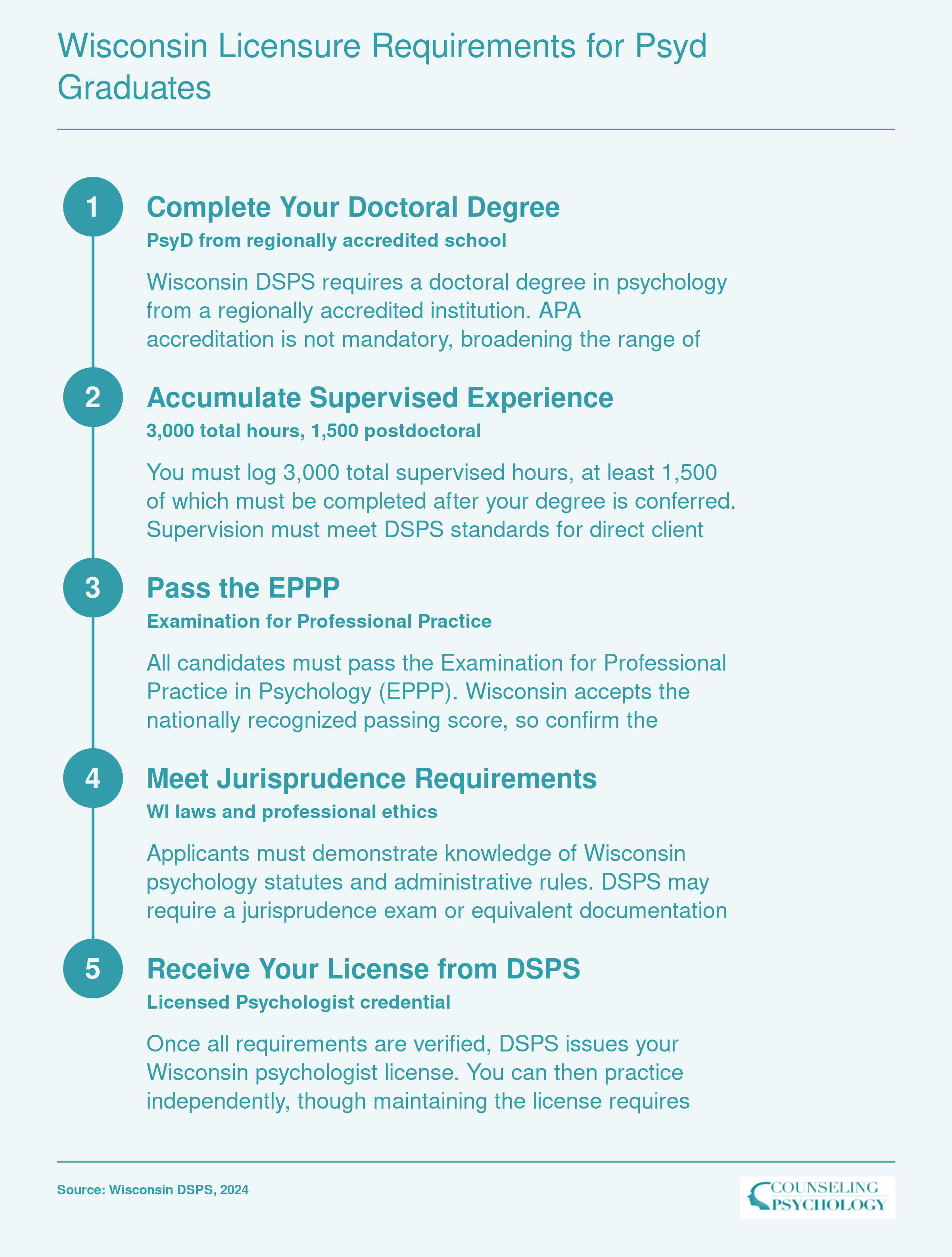
- Wisconsin licensure requires supervised postdoctoral hours and the EPPP, administered through the DSPS.
- Milwaukee metro psychologist salaries tend to track slightly above the statewide median according to BLS data.
Are there any APA-accredited PsyD programs in Milwaukee? No. Wisconsin currently has no in-state Doctor of Psychology programs, and the Milwaukee area is no exception. That means residents pursuing a practitioner-focused doctorate in psychology must look to programs based outside the state.
The practical route for most Wisconsin students is a hybrid or online PsyD from an APA-accredited institution that holds authorization to enroll state residents. Several nationally recognized programs meet these conditions and have verified that their curriculum and internship placements satisfy Wisconsin's licensure requirements administered by the Department of Safety and Professional Services.
For Wisconsin applicants, the most important factor is not a program's location. It's confirming that any online PsyD holds both APA accreditation and explicit state authorization. That detail directly affects eligibility for the psychologist license and access to federal financial aid. Students exploring related helping professions in the state may also want to review accredited masters in counseling in Wisconsin as a complementary career path.
Best Online PsyD Programs for Wisconsin Students
Wisconsin does not currently have an in-state PsyD program, which means residents looking to earn a Doctor of Psychology must look beyond state lines. The good news: several nationally available hybrid and online programs accept Wisconsin students, letting you complete most coursework remotely while traveling for brief residencies or practicum placements. The programs below are ordered by a quality composite that weighs institutional outcomes, program rigor, and online accessibility. Because every school on this list sits outside Wisconsin, tuition figures reflect out-of-state rates where applicable. APA accreditation status can change between review cycles, so always confirm a program's current standing directly with the APA before you apply.
- Institutional graduation and retention rates
- Graduate debt and earnings outcomes
- Program rigor and clinical hours
- Online or hybrid delivery accessibility
- Accreditation and licensure alignment
- College Scorecard graduate earnings — collegescorecard.ed.gov
- NCES-IPEDS federal institutional data — nces.ed.gov
- Independent program research
- Internal program database

Northern Arizona University
Northern Arizona University delivers a Doctor of Psychology in Clinical Psychology through a hybrid format anchored at its North Valley, Phoenix campus. The program requires 107 credit units and 2,000 hours of supervised clinical practice, giving students extensive hands-on training alongside flexible online coursework. NAU's institution-wide graduation rate is 61.3%, and its student-to-faculty ratio of 19:1 reflects the resources of a large public research university. For Wisconsin residents, out-of-state tuition runs approximately $19,306 per year (net price around $14,158 after aid), making it one of the more affordable doctorate options on this list.
- Hybrid format blends online coursework with on-site intensives
- 107 total credit units required for completion
- 2,000 hours of supervised clinical practice included
- Individualized research component builds scholarly skills
- Minimum 3.0 undergraduate GPA required for admission
- Three letters of recommendation needed
- Diverse clinical training across populations and settings
Doctor of Psychology in Clinical Psychology — Hybrid

Georgian Court University
Georgian Court University, a private institution in Lakewood, New Jersey, offers a Psy.D. in School Psychology with two entry tracks: a five-year path for bachelor's holders and a three-year advanced-standing route for certified school psychologists. The hybrid, evening-class schedule is built for working professionals, and the GRE is not required. With an 11:1 student-to-faculty ratio and a strong social justice emphasis, the program prepares graduates for roles in schools, hospitals, clinics, and private practice. Out-of-state tuition is $15,850 per year, with a net price of roughly $19,285; the institution's overall graduation rate is 53.6%.
- Hybrid evening delivery designed for working professionals
- Two entry pathways: five-year and three-year advanced standing
- 420 practicum hours plus 1,500 to 1,750 hour internship
- No GRE required for admission
- 47 to 112 total credits depending on entry track
- Emphasis on social justice and evidence-based practices
- Faculty with diverse clinical and research expertise
- Reported high job placement rate for graduates
Psy.D. in School Psychology — Hybrid

University of Southern Maine
The University of Southern Maine houses a School Psychology Psy.D. that blends rigorous doctoral coursework with 600 practicum hours and a 1,500-hour predoctoral internship. Its hybrid format allows Wisconsin students to complete much of their academic work remotely. USM is a public university, so Wisconsin residents should plan on the out-of-state tuition rate of approximately $26,676 per year (net price around $13,596). The institution's overall graduation rate is 40.3%, and its 14:1 student-to-faculty ratio supports closer mentorship at the graduate level.
- 111 total graduate credits required
- 600 practicum hours with supervised field placements
- 1,500-hour predoctoral internship caps clinical training
- Meets both national and state certification standards
- Optional M.S. in Educational Psychology along the way
- Dissertation research required for degree completion
- Professional ethics training integrated into curriculum
School Psychology Psy.D. — Hybrid

Rivier University
Rivier University in Nashua, New Hampshire, offers a Psy.D. in Counseling and School Psychology that uniquely integrates both disciplines into a single practitioner-scholar curriculum. The program holds APA accreditation (verify current status before applying) and spans a minimum of five years, with 60 to 130 credit hours depending on prior coursework. Weekday evening classes and a hybrid model accommodate professionals who cannot leave the workforce during training. Out-of-state tuition is $13,375 per year, though the net price rises to approximately $28,082; the institution's overall graduation rate is 51.7%.
- APA-accredited program (confirm current status before applying)
- Practitioner-scholar model emphasizing evidence-based services
- Minimum five-year doctoral timeline
- 60 to 130 total credit hours based on prior education
- 2,000-hour internship required
- Weekday evening course schedule supports working students
- Multiple practicum experiences across settings
- Approximately $1,275 per credit
Psy.D. in Counseling and School Psychology — Hybrid

Fielding Graduate University
Fielding Graduate University in Santa Barbara, California, pioneered a distributed learning model that blends online sessions with brief residential intensives, making it a strong fit for Wisconsin residents who need maximum schedule flexibility. The university's APA-accredited PhD in Clinical Psychology (verify current status before applying) offers concentrations in Forensic Psychology, Neuropsychology, and Health Psychology. Tuition is approximately $24,689 per year ($10,385 per term), and the program typically takes five to six years to complete. No GRE is required, and the curriculum emphasizes social justice alongside clinical competency. Note that institutional graduation rate and net price data are not currently published for Fielding.
- APA-accredited program (confirm current status before applying)
- Distributed learning model with online and residential components
- No GRE required for admission
- Tuition approximately $10,385 per term
- Five to six year expected completion timeline
- Forensic psychology specialization coursework
- Social justice values woven throughout curriculum
- Same APA-accredited distributed learning platform
- Neuropsychology-focused electives and training
- No GRE requirement for admission
- Designed for working professionals and adult learners
- Faculty are active clinical practitioners
- Flexible online and residential format
- Health psychology track within APA-accredited program
- Supports diverse student populations including military families
- No GRE required
- Tuition approximately $10,385 per term
- Five to six year completion window
- Social justice-focused curriculum and training
PhD in Clinical Psychology, Forensic Psychology Concentration — Hybrid
PhD in Clinical Psychology, Neuropsychology Concentration — Hybrid
PhD in Clinical Psychology, Health Psychology Concentration — Hybrid

Union Institute & University
Union Institute & University, based in Cincinnati, Ohio, offers a hybrid Doctor of Psychology with a concentration in Clinical Psychology. The program targets working professionals who already hold a master's degree in psychology or a related field, making it a potential fit for mid-career Wisconsin clinicians seeking a doctoral credential. The curriculum prioritizes evidence-based practice and clinical diversity. Tuition, net price, and institutional outcome data are not currently published for this school, so prospective applicants should request detailed cost and outcomes information directly from the admissions office.
- Hybrid format combines online learning with campus sessions
- Requires a master's degree in psychology or related field
- Clinical psychology concentration included
- Financial aid options available
- Emphasis on evidence-based clinical practice
- Designed for working professionals advancing their careers
Doctor of Psychology, Clinical Psychology Concentration — Hybrid
How We Ranked These PsyD Programs
Our ranking draws on College Scorecard outcomes data and institutional metrics to create a quality composite score, with an online-delivery boost applied to programs accessible to Wisconsin students from any location. The methodology emphasizes measurable graduate outcomes, including earnings after degree completion, typical debt loads, and program completion rates, alongside institution-wide indicators like overall graduation rate and net price. Programs offering fully online or hybrid formats receive additional weight because they remove geographic barriers for students balancing work, family, or clinical placements across the state.
What This Ranking Does Not Measure
This list does not assess clinical training quality, faculty research productivity, or the strength of practicum partnerships. It also does not verify APA accreditation status. Wisconsin requires a doctoral degree from an APA-accredited program for independent licensure as a psychologist, so you must confirm accreditation directly with the American Psychological Association before enrolling. If you are exploring broader clinical psychology doctorate programs, keep in mind that accreditation standards apply equally to PhD and PsyD tracks. The ranking is designed to surface programs with strong completion and employment outcomes, not to substitute for your own due diligence on training model or licensure eligibility.
Tuition and Net Price Notes
Tuition figures in the comparison table reflect degree-aware graduate rates where available. Net price, however, is an institution-wide average that includes undergraduate aid packages and does not predict your individual cost. Graduate students typically receive less grant aid than undergraduates, and doctoral students in PsyD programs often rely on loans or employer tuition assistance. Request a personalized financial aid estimate from each program before comparing total cost of attendance.
Online and Hybrid Access
All ranked programs offer online or hybrid delivery, meaning Wisconsin residents in Milwaukee, Madison, Green Bay, or rural counties can complete coursework without relocating. Practicum and internship requirements still demand in-person clinical hours, but the academic component remains flexible for students who need to stay employed or near family during their doctoral training.
PsyD Program Cost and ROI Comparison
Understanding the financial picture before committing to a doctoral program is critical, especially for Wisconsin students weighing online options from out-of-state institutions. The table below sorts each ranked program by its earnings-to-debt ratio (ROI ratio), which compares median earnings ten years after enrollment against median graduate debt. Northern Arizona University and the University of Southern Maine stand out with the lowest median graduate debt figures, both hovering near $19,000, while delivering strong median earnings that push their ROI ratios above 2.6. Rivier University carries the highest median debt at nearly $27,000 and the highest institution-wide average net price at $28,082, which translates to noticeably steeper monthly loan obligations for graduates. Keep in mind that every net price figure shown is an institution-wide average across all students and degree levels; actual PsyD program costs can differ significantly depending on credit requirements, residency fees, and clinical training expenses. Contact each school's financial aid office directly to get a program-specific cost estimate before making your decision. Program-level earnings data (one-year and four-year post-completion) and monthly loan payment figures are not yet available for these programs, so the ROI comparison here relies on the broader institutional metrics reported by the College Scorecard.
| School | Program | Format | Median Graduate Debt | Median Earnings (10 yr) | Net Price (Institutional Avg) | ROI Ratio |
|---|---|---|---|---|---|---|
| Northern Arizona University | Doctor of Psychology in Clinical Psychology | Hybrid | $19,000 | $54,384 | $14,158 | 2.86 |
| University of Southern Maine | School Psychology, Psy.D. | Hybrid | $19,060 | $49,958 | $13,596 | 2.62 |
| Georgian Court University | School Psychology, Psy.D. | Hybrid | $21,816 | $53,096 | $19,285 | 2.43 |
| Rivier University | Psy.D. in Counseling and School Psychology | Hybrid | $26,956 | $52,248 | $28,082 | 1.94 |
Questions to Ask Yourself
Wisconsin Licensure Requirements for PsyD Graduates
Earning a PsyD is just the first milestone. Wisconsin's licensure pathway, administered by the Department of Safety and Professional Services (DSPS), requires a defined sequence of supervised experience and examinations before you can practice independently. Notably, Wisconsin does not mandate APA accreditation for your doctoral program; a degree from a regionally accredited institution satisfies the educational requirement, which means both APA-accredited and non-APA-accredited programs listed in this ranking can qualify. If you're interested in school-based practice, a separate DPI School Psychologist certification is available to PsyD holders who complete 1,200 internship hours (including 600 in a school setting), pass the Praxis School Psychologist exam, and meet a 3.0 GPA minimum with institutional endorsement.
How Much Does a PsyD Make in Wisconsin?
Salary is one of the most practical factors to weigh before investing in a doctoral program. While Wisconsin-specific wage data for clinical and counseling psychologists is not published separately in the most recent BLS release, the national figures offer a useful benchmark, and the Milwaukee metro area tends to track close to national medians for healthcare occupations.
National Wage Snapshot for Clinical and Counseling Psychologists
According to May 2023 data from the Bureau of Labor Statistics Occupational Employment and Wage Statistics, clinical and counseling psychologists earned the following annual wages nationwide:1
- 10th percentile: $48,820
- 25th percentile: $66,050
- Median (50th percentile): $96,100
- 75th percentile: $129,020
- 90th percentile: $168,870
The mean annual wage came in at $106,600 across roughly 71,730 employed professionals. These are national figures; Wisconsin-specific and Milwaukee-Waukesha-West Allis MSA-specific breakdowns were not separately reported in the most recent release, so treat the numbers above as a directional guide rather than a precise local estimate.
School Psychologist Earnings
If your PsyD track leads toward school psychology, the pay range shifts. School psychologists earned a national median of $84,940 in the same 2023 data, with the 10th-to-90th percentile spread running from $59,250 to $131,470.2 School districts in the Milwaukee metro area commonly offer additional stipends or salary schedule bumps for doctorate-holding psychologists, though exact amounts vary by district. Students interested in the academic side of school psychology may also want to explore doctorate programs in educational psychology, which can open additional career paths.
How Program-Level Earnings Data Differs
You may notice that individual program profiles sometimes report what graduates actually earned one or more years after completion. Those figures reflect the specific mix of graduates from a given program, including those who may be in early-career roles, postdoctoral positions, or part-time practice. Program-level earnings data is not yet available for the PsyD programs ranked in this article, so the BLS occupation-wide wage statistics remain the best reference point for setting salary expectations.
Job Outlook and Demand Drivers
The Bureau of Labor Statistics projects 6 percent employment growth for psychologists nationally through the current decade, with roughly 11,800 to 12,900 openings anticipated each year.3 That growth is modest compared to some healthcare fields, but the real story for Wisconsin students is the persistent shortage of licensed psychologists in both clinical and school settings. Rural and underserved communities across the state face particularly acute gaps, and school districts throughout Wisconsin have reported difficulty filling school psychologist vacancies for several consecutive years. Mental health workforce shortages, expanded insurance parity requirements, and increased public awareness of behavioral health needs all contribute to sustained demand. For a broader look at how compensation compares across the helping professions, see our guide to counselor salary by degree and specialty.
For Wisconsin students completing an online PsyD from an APA-accredited program, these market conditions translate into strong hiring prospects, especially if you are open to working outside the Milwaukee metro or serving populations with limited access to psychological services.
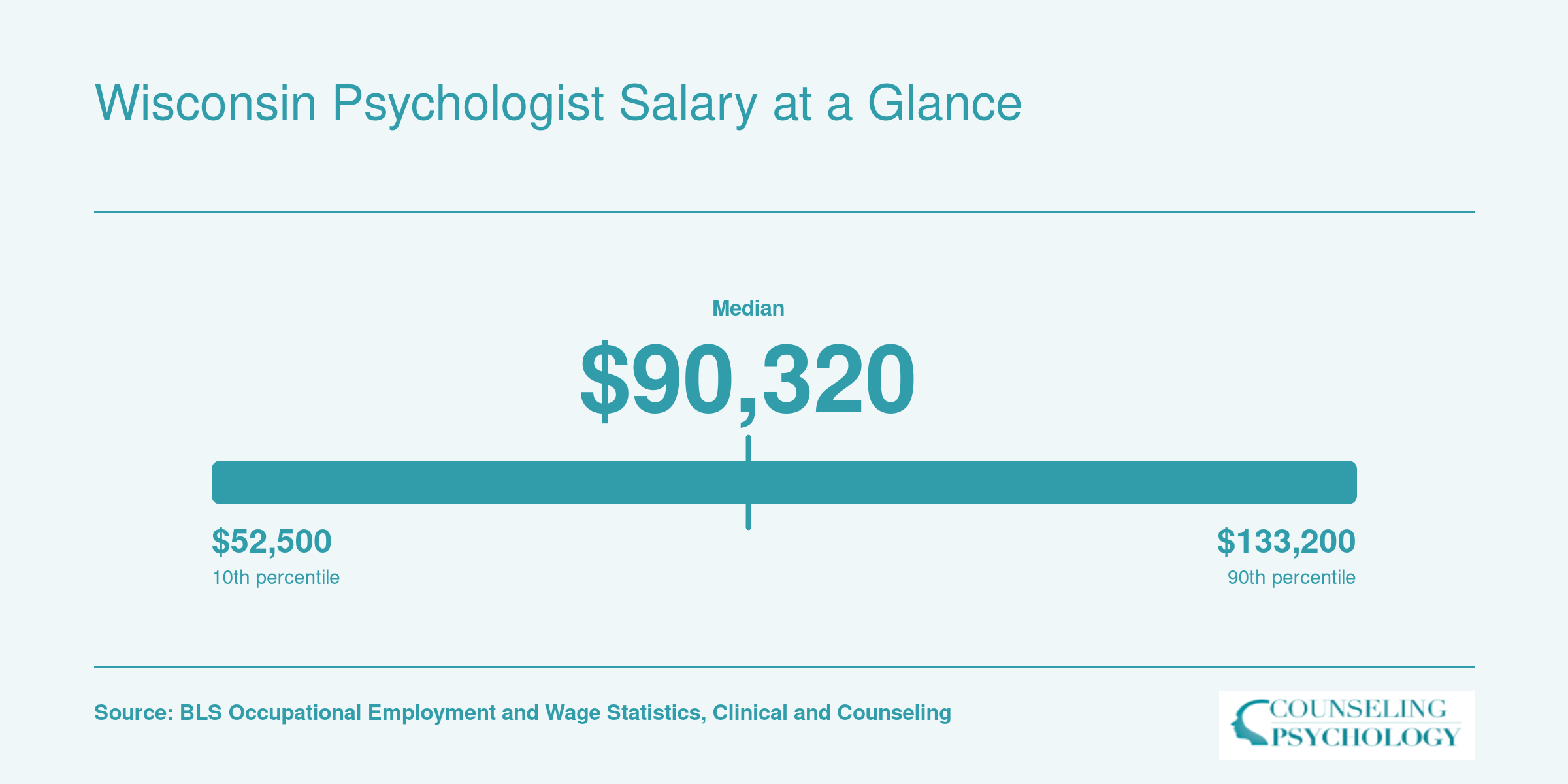
Wisconsin Psychologist Salary at a Glance
The wage spread for psychologists in Wisconsin is substantial, reflecting differences in specialty, experience, and setting. According to BLS data, the Milwaukee metro area median tends to track slightly above the statewide median, and both fall modestly below the national median for clinical and counseling psychologists.
PsyD vs PhD in Psychology: Which Doctorate Is Right for You?
Both the PsyD and the PhD in psychology qualify you for the same Wisconsin psychologist license issued by the Department of Safety and Professional Services. The real question is how you want to spend your career. If your goal is full-time clinical practice, a PsyD is purpose-built for that path. If you see yourself splitting time between research and patient care, or pursuing academic positions, a PhD is the more traditional route. Here is how the two degrees compare across the dimensions that matter most.
| Dimension | PsyD | PhD |
|---|---|---|
| Primary Career Focus | Clinical practice and applied settings | Research, academia, and clinical work |
| Typical Program Length | 4 to 6 years | 5 to 7 years |
| Capstone Requirement | Clinical dissertation or doctoral project emphasizing applied practice | Traditional research dissertation with original empirical contribution |
| Acceptance Rates | Less selective; programs generally admit larger cohorts | Highly selective; most programs accept a small percentage of applicants |
| Funding and Assistantships | A minority of students receive full tuition coverage; expect more out of pocket cost | A majority of students receive tuition waivers and stipends through assistantships or grants |
| Predoctoral Internship | 1 year of supervised clinical experience required | 1 year of supervised clinical experience required |
| Wisconsin Licensure Equivalence | Fully qualifies for WI psychologist licensure | Fully qualifies for WI psychologist licensure |
Wisconsin applicants to online PsyD programs must confirm that the program holds state authorization to operate in Wisconsin. Not all online programs are approved in every state, and lack of authorization can disqualify you from Wisconsin licensure and federal financial aid, even if you complete the degree.
Admissions and Application Tips for PsyD Programs
PsyD admissions have grown notably more competitive over the past several years, and programs are actively revising their requirements to reflect new testing norms, shifting accreditation expectations, and growing applicant pools.
Know What Each Program Actually Requires
The single most important thing you can do is visit each program's official admissions page directly. GPA thresholds, GRE policies, and prerequisite course requirements change from cycle to cycle. A program that required the GRE two years ago may have moved to a test-optional or GRE-free model by now. Many programs currently consider applicants with an undergraduate GPA in the 3.0 to 3.5 range competitive, but some selective programs set their informal floor higher. If you are wondering how hard is it to get into grad school for psychology, the answer depends heavily on the specific program and format. Do not rely on third-party summaries or forum posts for these specifics.
Prerequisite coursework typically includes introductory psychology, statistics, and at least one course in research methods or abnormal psychology. Some programs require prior clinical or research experience before you apply, not after admission. Confirm these details directly with admissions staff, especially for online PsyD programs, where policies vary more widely than in traditional residential cohorts.
Application Timelines and Deadlines
Fall cohort deadlines for PsyD programs generally fall between November and February, though some programs accept rolling applications into spring. The Association of Psychology Postdoctoral and Internship Centers (APPIC) and APA Division 12, the Society of Clinical Psychology, both maintain resources that reflect current application cycles and training timelines. These are worth bookmarking alongside any program-specific portal.
For questions about accreditation standing, the American Psychological Association and the Council of Chairs of Training Councils (CCTC) are the authoritative sources. Always confirm that a program holds or is in the process of receiving APA accreditation before you apply, since licensure in Wisconsin and most other states depends on it.
Acceptance Rates and Cohort Size
Acceptance rates for PsyD programs are rarely published in a centralized way. Online programs especially tend not to report these numbers publicly. The most direct route is a phone call or email to the admissions office. Ask specifically about cohort size, average entering GPA, and whether the program uses a rolling or fixed-deadline review process. Programs respect applicants who come prepared with specific questions.
For those exploring the broader path to this career, understanding psychologist education requirements at each stage can help you plan ahead. For general career outlook data on psychologists, BLS.gov provides a useful macro-level picture, but for granular application strategy and internship placement rates, professional associations are a better resource than any government database.
Frequently Asked Questions About PsyD Programs for Wisconsin Students
Choosing the right doctoral program is a major decision, and Wisconsin students often have specific questions about local options, accreditation, and career outcomes. Below are answers to the most common questions we hear from prospective PsyD candidates in the state.