What you’ll learn in this article…
- Several ABAI-verified ABA programs near Columbus offer total estimated costs well under $40,000 for Ohio residents.
- Ohio requires both the national BACB credential and a separate Certified Ohio Behavior Analyst license through the Board of Psychology.
- Graduate assistantships, employer tuition reimbursement, and targeted scholarships can cut real out-of-pocket costs significantly.
- Online ABA programs still require in-person supervised fieldwork hours, giving Columbus-area students a local clinical advantage.
Ohio ranks among the top ten states for BCBA demand, yet in-state tuition for ABA coursework ranges from roughly $10,000 to over $26,000 depending on program type and residency status. That spread matters: the difference between Cleveland State's 21-credit graduate certificate and the University of Cincinnati's full master's degree can shape both your debt load and your timeline to licensure.
Columbus sits within commuting or online range of at least six accredited ABA options, including Ohio State's campus-based M.A. and several hybrid or fully online alternatives. Most require BACB-verified coursework plus supervised fieldwork hours, and Ohio's Certified Ohio Behavior Analyst (COBA) license adds a state-specific layer on top of national certification.
Best Affordable ABA Programs Near Columbus, Ohio
Ohio is home to a strong cluster of ABA programs at public and private universities, several of which sit within easy reach of Columbus or deliver coursework entirely online. We ranked these options by net price, institutional outcomes, and program relevance so you can zero in on the path that fits your budget and career goals. Program-level earnings data is not yet available for these specific ABA offerings, so we include institution-wide median earnings at ten years as a broader reference point.
- Net price and tuition affordability
- Institution-wide graduation rate
- Program format and flexibility
- BCBA exam preparation alignment
- Fieldwork and specialization options
- NCES-IPEDS federal institutional data — nces.ed.gov
- College Scorecard graduate earnings — collegescorecard.ed.gov
- Internal program database
- Independent program research

Cleveland State University
Cleveland State University delivers a fully online Graduate Certificate in Behavior Analysis built around 21 credit hours and seven courses mapped to the BACB 5th Edition Task List. The program is ABAI-approved and emphasizes practical skill building for autism spectrum and disability services settings. With a net price of roughly $14,764 and in-state tuition near $11,297, it ranks as the most budget-friendly option on this list. The institution-wide graduation rate sits at about 50.6%, so prospective students should weigh the low sticker price against broader retention trends.
- Fully online, 21-credit-hour curriculum
- Aligned with BACB 5th Edition Task List
- ABAI-approved course sequence
- Covers ethics, consultation, and supervision
- Focus on autism and developmental disabilities
- In-state tuition approximately $11,297
- Requires a bachelor's degree with 2.75 GPA
Graduate Certificate in Behavior Analysis — Online

University of Cincinnati
The University of Cincinnati offers two fully online ABA pathways: a Master of Education in Foundations in Behavior Analysis and a Graduate Certificate in Behavior Analysis. Both carry ABAI-verified course sequences and prepare graduates for the BCBA exam. The M.Ed. can be completed in as few as five semesters, and students receive support from dedicated Student Success Coordinators. The institution posts a 75% graduation rate and median earnings of roughly $54,810 at ten years across all graduates.
- 100% online with no in-person visits required
- ABAI-verified course sequence
- Completable in five semesters
- Part-time curriculum option available
- Prepares for BCBA exam eligibility
- 59% reported BCBA exam pass rate
- Student Success Coordinator support included
- Fully online delivery
- ABAI-verified coursework
- Designed for career changers and working clinicians
- Focuses on autism and learning disabilities
- Financial aid available for eligible students
- Prepares candidates for BCBA certification
Master of Education in Foundations in Behavior Analysis — Online
Graduate Certificate in Behavior Analysis — Online

Bowling Green State University
Bowling Green State University pairs a 100% online M.Ed. in Special Education with an ABA specialization alongside a standalone ABA Graduate Certificate. Courses run in accelerated seven-week blocks with multiple start dates, making either track practical for working professionals. The M.Ed. path also prepares graduates for the Certified Ohio Behavior Analyst (COBA) credential. Institution-wide, BGSU reports a 63.7% graduation rate and median earnings near $47,896 at ten years.
- 100% online with seven-week course blocks
- Prepares for both BCBA and COBA credentials
- BCBA-verified course sequence
- Ethics and compliance training embedded
- Multiple annual start dates
- In-state tuition approximately $10,291
- Career-focused curriculum for clinical and school settings
- Fully online, completable in about one year
- Six required courses
- Multiple start dates for flexible enrollment
- Designed to enhance existing professional credentials
- Prepares for BCBA exam eligibility
- Accelerated seven-week course format
Master of Education in Special Education, Applied Behavior Analysis — Online
Graduate Certificate in Applied Behavior Analysis — Online

University of Dayton
The University of Dayton's 21-credit Graduate Certificate in Applied Behavior Analysis is an on-campus program that includes a comprehensive 500-hour supervised field experience, typically finished in 12 to 15 months. The curriculum stresses scientific behavioral assessment, intervention design, and measuring treatment outcomes. Dayton's institution-wide graduation rate of 80.2% and median earnings around $75,537 at ten years reflect strong institutional outcomes, though the net price of approximately $29,533 is higher than the public university options on this list.
- 21-credit on-campus graduate certificate
- 500 hours of supervised fieldwork included
- Meets BACB certification coursework requirements
- Completable in 12 to 15 months across three to four terms
- Scientific approach to behavioral assessment
- Prepares graduates for school, healthcare, and agency roles
Certificate in Applied Behavior Analysis — On-Campus

John Carroll University
John Carroll University, a private Jesuit institution near Cleveland, offers a 39-credit M.S. in Applied Behavior Analysis delivered in a hybrid format that blends online and in-person instruction. Rolling admissions and no GRE requirement lower the barrier to entry, while all required fieldwork hours can be completed under faculty supervision. The program prepares students for both BCBA certification and the COBA credential. JCU's 13:1 student-to-faculty ratio and 78.6% institution-wide graduation rate point to a supportive academic environment.
- 39-credit hybrid program (online and in-person)
- Prepares for both BCBA and COBA certification
- No GRE required for admission
- Rolling admissions throughout the year
- All fieldwork hours supervised on site
- Emphasis on ethical practice across diverse settings
- 13:1 student-to-faculty ratio
- Careers span healthcare, education, and business
M.S. in Applied Behavior Analysis — Hybrid

Ohio State University
Ohio State University is the only program on this list based directly in Columbus, offering a Master of Arts in Special Education with an ABA Specialization. The hybrid format mixes online coursework with on-campus components, and both full-time and part-time schedules are available. Scholarships and graduate assistantships may offset the roughly $13,901 in-state tuition, and the university's military-friendly policies and on-campus medical center create unique applied training contexts. OSU's 87.7% institution-wide graduation rate is the highest among these six schools, and median earnings reach about $60,409 at ten years.
- Hybrid format with online and campus components
- Full-time and part-time scheduling options
- Meets BCBA certification coursework requirements
- Scholarships and assistantships may be available
- Columbus location with access to on-campus hospital
- Military-friendly campus policies
- 87.7% institution-wide graduation rate
Master of Arts in Special Education, ABA Specialization — On-Campus
How We Ranked These Programs
Most program rankings start with reputation; this one starts with your budget. We built an affordability-first list because for many aspiring BCBAs, the immediate question is not which school looks best on a resume, but which school leaves you the smallest loan balance.
What Matters Most in This Ranking
Our scoring prioritized what you pay, and what you earn after, not just the sticker price.
- Degree-aware tuition: The published cost for the exact ABA program you would enroll in, not a broader university average.
- Net price after aid: The estimated amount you would actually pay once federal, state, and institutional grants are factored in, drawn from IPEDS.
- Institutional graduation rate: A signal of student support and completion resources, which can protect your investment.
- Program-level earnings: Median earnings of graduates from comparable instructional programs, pulled from the College Scorecard's field-of-study data.
- Delivery format: Whether the program is online, on-campus, or hybrid, because flexibility often translates into savings on relocation, commuting, and opportunity cost.
What the List Doesn't Tell You
We intentionally left out several quality metrics because they deserve their own deep dives, which you'll find in later sections.
- BCBA exam pass rates reported separately for each school.
- Curriculum specifics or faculty research the ranking treats cost as the first filter, not the final word.
- Practicum placement strength critical for fieldwork, but outside a pure cost analysis.
If you are also comparing programs nationally, our broader guide to online applied behavior analysis programs can help you benchmark Columbus-area options against schools elsewhere. All cost and earnings figures reflect the 2024-2025 academic year snapshot, the most recent complete federal dataset available from IPEDS and the College Scorecard as of 2026. Where a program lacked field-specific earnings data, we used the institution's overall median for graduate-level programs, always flagged in the school profile so you can dig deeper.
Total Cost Breakdown: Tuition, Fees, and Hidden Expenses
The table below compares annual tuition rates and estimated net price after aid for each ranked program. Keep in mind that these figures reflect institution-level data from IPEDS and College Scorecard, so your actual graduate program costs may differ. Beyond the sticker price, every aspiring BCBA should budget for expenses that rarely appear on a tuition calculator. Textbooks typically run $600 to $1,200 over the course of a program, and exam prep materials can add another $500 to $2,000 depending on the review course you choose. Technology and proctoring fees (common in online formats) may add $20 to $75 per course or $15 to $40 per proctored exam. If your program does not bundle supervision, private supervision for fieldwork hours can cost $75 to $150 per hour. Liability insurance for fieldwork placements is relatively modest at $20 to $100 per year, but it is required. Finally, the BACB itself charges a $245 application fee plus a $125 exam appointment fee, totaling $370 for your first certification attempt. Retakes cost $265. The spread between the least and most expensive options on this list is roughly $9,300 in annual tuition for Ohio residents and more than $26,000 for out-of-state students, so choosing strategically can save you a significant sum before you even factor in hidden costs.
| School | Credential | In-State Tuition | Out-of-State Tuition | Net Price After Aid |
|---|---|---|---|---|
| Bowling Green State University | Master's (ABA) | $10,291 | $16,283 | $24,022 |
| Cleveland State University | Graduate Certificate (ABA) | $11,297 | $21,107 | $14,764 |
| Ohio State University | Master's (ABA Specialization) | $13,901 | $42,740 | $17,339 |
| University of Cincinnati | Master's (Behavior Analysis) | $14,902 | $26,674 | $25,648 |
| John Carroll University | M.S. in ABA | $15,782 | $15,782 | $28,746 |
| University of Dayton | Graduate Certificate (ABA) | $19,580 | $19,580 | $29,533 |
Questions to Ask Yourself
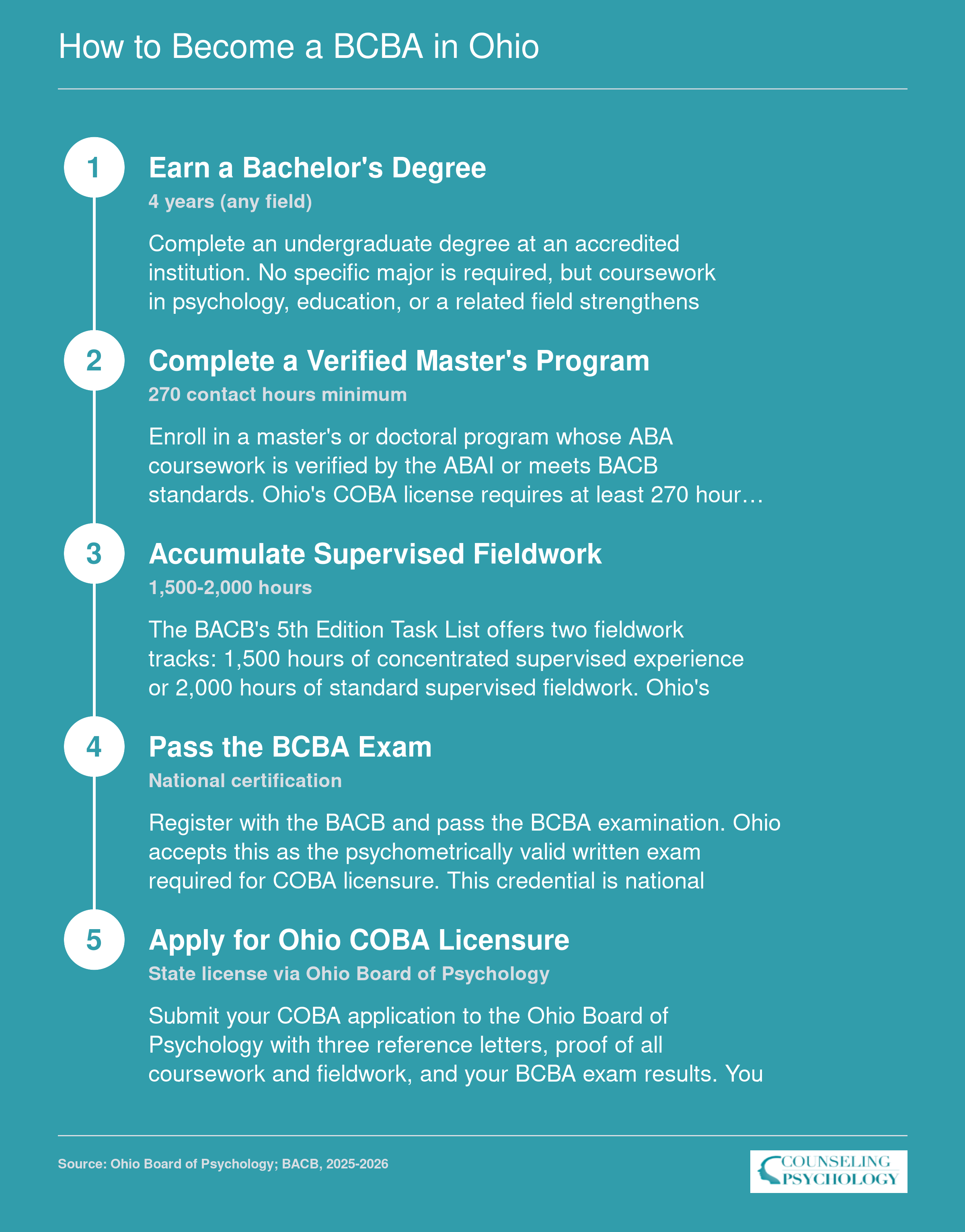
How to Become a BCBA in Ohio
Practicing as a Board Certified Behavior Analyst in Ohio requires both a national BACB credential and a separate state license. The Certified Ohio Behavior Analyst (COBA) credential is governed by the Ohio Board of Psychology, and the requirements layer on top of what the BACB itself demands. Here is the step-by-step path from your first degree through active Ohio practice.
BCBA Pass Rates and Career Outcomes for Ohio Graduates
What are the actual BCBA exam pass rates for ABA programs in Ohio, and do more affordable programs still produce strong results?
This is one of the most practical questions you can ask before committing tuition dollars, yet program-level pass rate data is surprisingly hard to find in one place. The Behavior Analyst Certification Board publishes first-time candidate pass rates by university each year, and the 2024 figures reveal meaningful differences across Ohio programs.1
Ohio Program Pass Rates vs. the National Benchmark
The national first-time BCBA exam pass rate for 2024 was 54%, with retake candidates passing at just 25%.2 Against that backdrop, Ohio programs show a wide spread:
- University of Cincinnati: 59% first-time pass rate, above the national average. UC's fully online M.Ed. in Foundations in Behavior Analysis holds an ABAI-verified course sequence, and the pass rate suggests strong exam preparation relative to cost.
- Ohio State University: 38% first-time pass rate, well below the national average. OSU's ABAI-accredited M.A. program carries prestige and research depth, but candidates have struggled on the certification exam in recent reporting cycles.2
First-time pass rates for several other Ohio programs on our list, including Bowling Green State University, University of Dayton, John Carroll University, and Cleveland State University, were either not separately reported in the 2024 BACB data or fell below the reporting threshold. That does not necessarily signal a weak program; it may reflect smaller cohort sizes that the BACB does not disaggregate.3
What About Earnings and Employment After Graduation?
Program-level earnings and employment outcomes for these ABA programs are not yet available through federal reporting channels. That means we cannot currently compare median salaries one or two years post-completion on a school-by-school basis for the programs ranked here. When these data are published, counselingpsychology.org will incorporate them into the program profiles.
In the meantime, institution-wide median earnings ten years after enrollment offer a rough proxy for the caliber of graduates each school produces. Among the Ohio schools on our list, University of Dayton graduates report the highest institution-level median at roughly $75,500, followed by John Carroll University near $62,900 and Ohio State University around $60,400. These figures reflect all programs at each university, not ABA specifically, so treat them as context rather than a direct salary forecast for behavior analysts.
The Takeaway on Cost vs. Quality
The pass rate data challenges a common assumption: paying more does not automatically buy a higher exam pass rate. The University of Cincinnati, one of the more affordable options on this list for in-state students, outperformed higher-tuition competitors on the 2024 BCBA exam.2 Meanwhile, Ohio State's lower pass rate came despite ABAI accreditation and a well-resourced research university setting.
None of this means you should pick a program on pass rate alone. Cohort size, faculty mentorship, fieldwork quality, and your own study habits all factor in. If you are exploring options beyond Ohio, our directory of online applied behavior analysis programs can help you compare ABAI-verified course sequences nationwide. But when you are comparing programs that differ by thousands of dollars in tuition, knowing that a less expensive option can still deliver above-average certification outcomes is a meaningful data point. Watch for updated BACB reports each year and weigh them alongside total cost, fieldwork support, and how well a program's schedule fits your life.
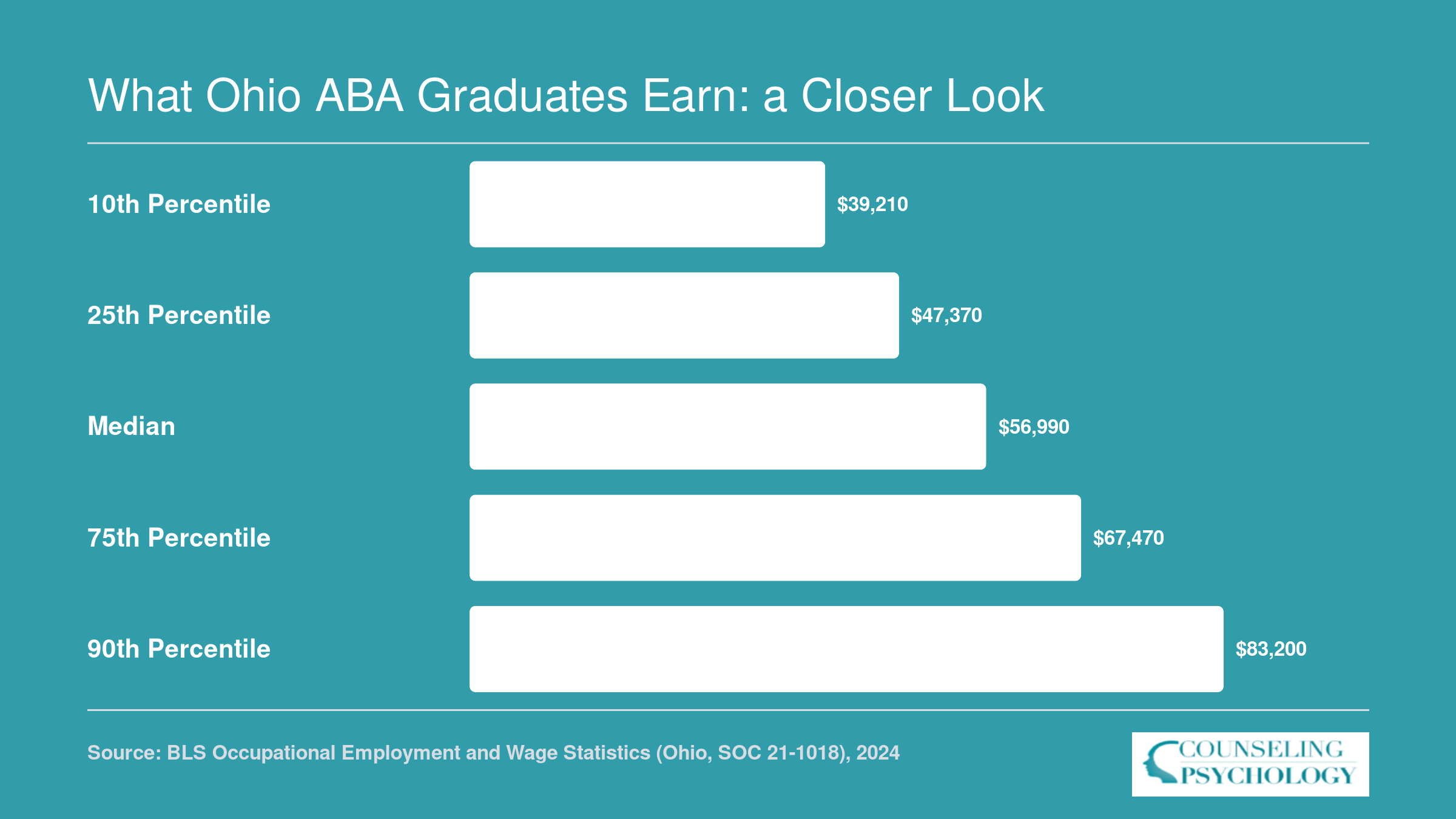
What Ohio ABA Graduates Earn: A Closer Look
Program-level graduate earnings data is not yet published for the ABA programs ranked in this article, so we turn to the best available wage benchmarks. The BLS tracks wages for behavior analysts and related behavioral health counselors, and Ohio-specific figures offer useful context for what you can expect after earning your BCBA credential. Keep in mind that BCBAs with board certification typically earn more than the broader counselor category shown here, with one Columbus-area employer reporting a mean hourly rate near $46.
Scholarships, Assistantships, and Tuition Reimbursement for Ohio ABA Students
Graduate students pursuing BCBA certification in Ohio have access to several funding streams that can meaningfully reduce total program cost. Unlike undergraduate aid, graduate scholarships and assistantships often require active negotiation and early application, and many of the most generous awards come from sources students overlook entirely.
University Graduate Assistantships and Departmental Aid
Many Ohio ABA programs offer graduate assistantships that cover tuition and provide a stipend in exchange for teaching, research, or clinical supervision duties. Ohio State, University of Cincinnati, and Bowling Green State University all employ graduate assistants within their special education and psychology departments. These positions typically waive in-state tuition and may provide a modest monthly stipend. Some programs cap the number of covered credits at 15 per semester, so confirm the exact scope before accepting a position.1 Assistantship availability fluctuates year to year; contact department coordinators directly in the fall before your intended start date.
Bowling Green State University and Ohio State also maintain smaller, named scholarships for behavior analysis students. These awards are often announced through departmental newsletters or graduate program websites rather than centralized financial aid portals, so students who monitor only the general scholarship database may miss them.
Employer Tuition Reimbursement: The Most Overlooked Funding Source
Columbus-area ABA employers, including Nationwide Children's Hospital and large service providers like Hopebridge and Behavioral Innovations, routinely offer tuition reimbursement to employees pursuing BCBA credentials. These programs can cover $5,000 to $10,000 per year, sometimes more for employees willing to commit to post-graduation service agreements. Many students work part-time as behavior technicians or registered behavior technicians while completing their master's coursework and use employer tuition benefits to fund the degree entirely.
Nationwide Children's Hospital, for example, reimburses employees for graduate coursework aligned with clinical roles. If your practicum or fieldwork site employs BCBAs, ask your supervisor whether the organization supports tuition benefits for current staff. Students who want to advance beyond the master's level may also consider ABA doctoral programs online as a longer-term investment.
National Scholarships and Diversity Grants
Several national organizations award scholarships to ABA students. The Society for the Advancement of Behavior Analysis (SABA) offers the Innovative Student Research Grant, the Sidney W. & Janet R. Bijou Grant, and the Senior Student Presenter Grant. These typically fund travel, research expenses, and occasionally tuition. SABA also administers the Innovative Student Research Grant in Diversity, Equity, and Inclusion, which prioritizes applicants from underrepresented groups. The Autism Recovery Foundation Behavior Analysis Scholarship targets graduate students pursuing BCBA or BCaBA certification and awards several thousand dollars annually.
The BACB itself maintains a list of diversity scholarships updated each spring. While individual award amounts vary, stacking two or three smaller scholarships can offset a full semester of tuition.
Pell Grant Context and Aid Eligibility
Graduate students are not eligible for Pell Grants, but the percentage of undergraduates receiving Pell at a given institution can signal the school's broader commitment to affordability and aid. Among Ohio ABA programs, Cleveland State University enrolls the highest share of Pell recipients at the undergraduate level (61.1%), followed by University of Cincinnati (50.2%) and Bowling Green State University (48.5%). While these figures do not directly predict graduate aid generosity, schools serving more lower-income undergraduates often maintain robust financial aid offices and may offer more flexible payment plans or emergency aid funds.
Three Actionable Funding Strategies
- Negotiate assistantship scope early: When offered a graduate assistantship, clarify how many credits are covered, whether summer tuition is included, and whether the stipend continues during practicum semesters. Some departments will expand coverage for strong candidates.
- Ask practicum sites about tuition programs: Before committing to a fieldwork placement, inquire whether the site offers tuition reimbursement or will hire you part-time. Many ABA agencies prefer to train their own BCBAs and will invest in students who show commitment.
- Apply to BACB and SABA diversity scholarships in the fall: Most national ABA scholarships have December or January deadlines. Set a reminder in October to gather transcripts, letters of recommendation, and a brief personal statement. Even a $1,000 award covers textbooks and exam fees.
Online vs. On-Campus ABA Programs: Cost and Flexibility Compared
Choosing between online, on-campus, and hybrid ABA programs involves more than just tuition numbers. Even fully online programs require in-person supervised fieldwork hours, so where you live matters regardless of how your coursework is delivered. Columbus-area students have a distinct advantage here: the region's concentration of autism service providers, school districts, and organizations like Advanced Behavioral Therapy in Reynoldsburg means practicum placements are more accessible than in many parts of the state.
| Factor | Online Programs | On-Campus Programs | Hybrid Programs |
|---|---|---|---|
| Example Ohio Programs | University of Cincinnati (M.Ed.), Bowling Green State University (M.S.), Cleveland State University (Certificate) | Ohio State University (M.A.), University of Dayton (Certificate) | John Carroll University (M.S.) |
| In-State Tuition Range | $10,291 to $14,902 per year | $13,901 to $19,580 per year | $15,782 per year (flat rate, in-state and out-of-state) |
| Out-of-State Tuition Range | $16,283 to $26,674 per year | $19,580 to $42,740 per year | $15,782 per year |
| Coursework Flexibility | Fully asynchronous or flexible scheduling; complete coursework from anywhere | Fixed class schedules; requires commuting to campus | Some courses online, some on campus; moderate flexibility |
| Supervised Fieldwork | Required locally, not included in online delivery; students must secure practicum sites independently or with program support | Often arranged through university partnerships and local clinics | Typically coordinated through program; fieldwork integrated into curriculum |
| Columbus Practicum Access | Columbus residents can tap into Nationwide Children's Hospital, local school districts, and ABA agencies for fieldwork, even while taking courses from a distant university | Ohio State students benefit from direct campus proximity to Columbus practicum sites | Students at John Carroll (Cleveland area) would need to arrange Columbus-area placements separately if living near Columbus |
| Best Suited For | Working professionals or students who need schedule control and already have practicum connections in the Columbus area | Full-time students who want structured cohort experiences and university-facilitated placements | Students who want a blend of in-person mentorship and remote coursework flexibility |
The sticker price of a program is only one piece of the puzzle. Your true cost hinges on residency status, whether your employer offers tuition reimbursement, whether you choose an online or on-campus format, and how quickly you finish. Scroll back to the ranked list and cost table above to compare these factors side by side before making your decision.
Frequently Asked Questions About ABA Programs in Columbus
Choosing the right ABA program involves understanding certification pathways, costs, and career distinctions. Below are answers to the questions prospective students ask most often when exploring options near Columbus, Ohio.