

Key Takeaways
- Louisville offers two accredited DSW programs: the University of Louisville's Kent School and Spalding University, both fully online.
- DSW programs emphasize applied practice leadership, while a PhD centers on research, making each degree fit different career paths.
- Neither Kentucky DSW program typically provides full tuition waivers, so KHEAA aid and employer tuition benefits are critical funding sources.
- A DSW yields the strongest salary gains in Louisville when graduates move into administrative, faculty, or policy roles.
Kentucky's social work doctoral market has shifted toward part-time online DSW programs designed for working clinicians who want to move into leadership, policy, or faculty roles without leaving their practice. Louisville itself anchors two fully online DSW options: the University of Louisville's 44-credit program and Spalding University's accelerated 50-credit track, both structured around cohort models and capstone projects rather than traditional dissertations. Neither requires on-campus residency, but they differ sharply in pace, cost, and concentration focus.
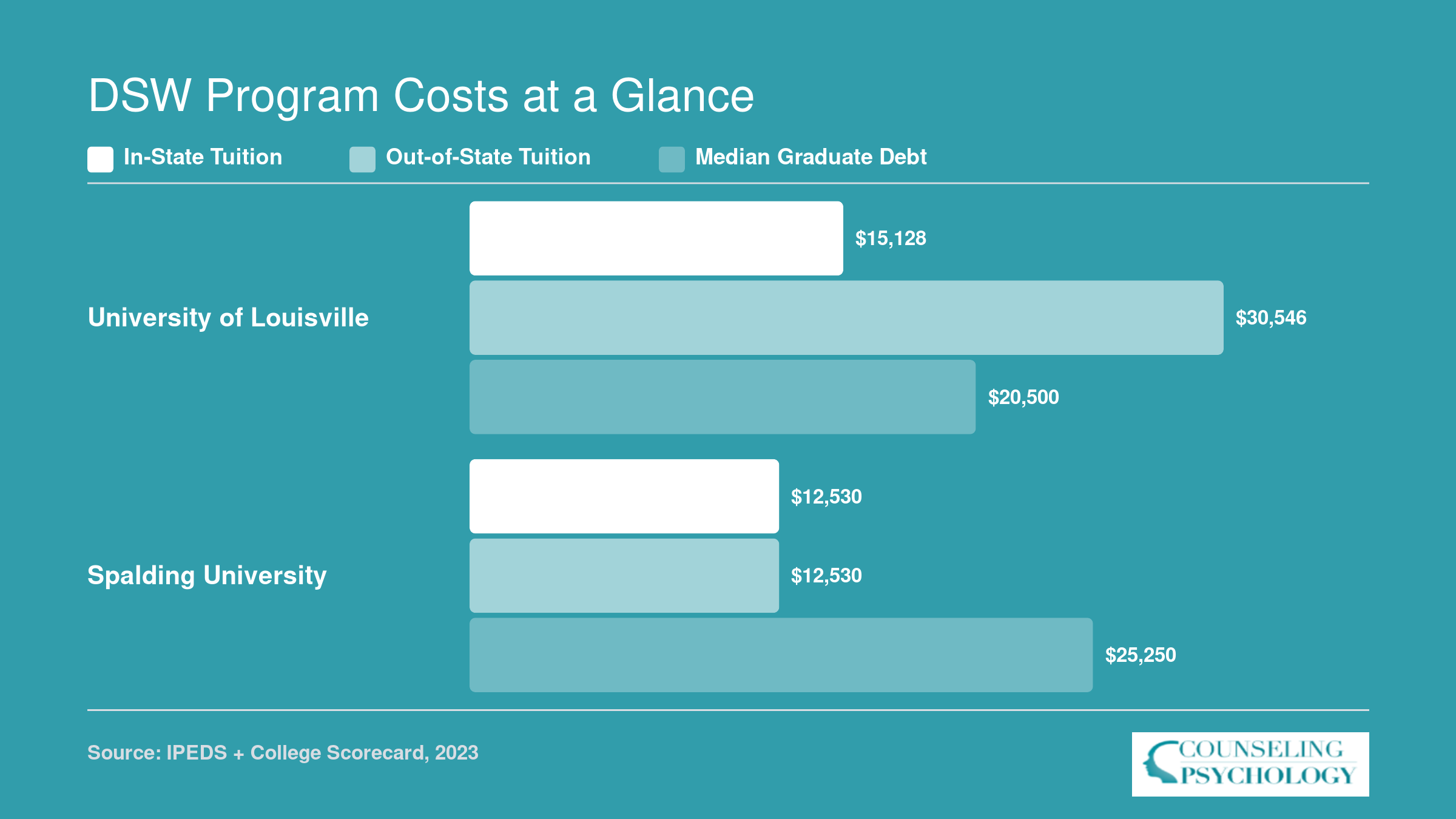
Practicing LCSWs in Kentucky face a practical tension: the DSW carries no licensure premium (the state board does not recognize it as a separate credential level), yet it increasingly appears in job postings for senior clinical directors, macro-level policy analysts, and tenure-track academic positions. Both Louisville programs cost substantially less than comparable out-of-state DSW degrees, with tuition ranging from around $12,500 to $30,500 depending on residency status and school, but funding is largely self-pay or employer-supported. Few doctoral social work programs offer assistantships.
The Louisville market sits within a broader regional shift: DSW enrollment nationwide has grown faster than PhD enrollment since 2020, reflecting demand for applied doctoral training that complements, rather than replaces, clinical expertise.
Best DSW Programs Near Louisville, KY: Ranked List
Louisville is home to two accredited universities offering Doctor of Social Work programs, each with a distinct emphasis and format designed for working professionals. Both are fully online, making them accessible to practitioners across Kentucky and surrounding states. Below, we break down what sets each program apart so you can weigh fit, cost, and career alignment before applying.
- Program relevance and concentration options
- Institutional graduation and retention rates
- Tuition affordability and financial value
- Faculty ratio and cohort structure
- Post-graduation earnings and debt levels
- Independent program research
- Internal program database
- NCES-IPEDS federal institutional data — nces.ed.gov
- College Scorecard graduate earnings — collegescorecard.ed.gov

University of Louisville
The University of Louisville's Raymond A. Kent School of Social Work and Family Science delivers a fully online DSW built for experienced practitioners who want to move into teaching or organizational leadership. As an R1 research institution, UofL pairs rigorous scholarship with deep ties to Kentucky social service agencies, and its first DSW cohort has already graduated 19 practitioner-scholars now working in regional leadership and academic roles. Schools offering this program have a graduation rate of 61.2%, and the institution-wide median earnings ten years after enrollment sit at $53,899, with a median graduate debt of $20,500.
- 100% online with synchronous monthly seminars and asynchronous coursework
- 44 credit hours completed part-time over approximately 3 years
- Small cohorts of roughly 20 students per entering class
- Teaching and leadership practicums, often completable at current employer
- Capstone project replaces traditional dissertation requirement
- Tuition listed at $775 per credit hour; military rate available
- No on-campus residency required at any point in the program
Doctor of Social Work — Online

Spalding University
Spalding University, a private institution rooted in downtown Louisville's urban core, offers a two-year online DSW with two concentration tracks: Advanced Clinical Practice and Leadership and Administration. Its social justice mission and small cohort model appeal to practitioners seeking either deeper clinical expertise or executive-level preparation within Kentucky agencies and nonprofits. Schools offering this program have a graduation rate of 51.7%, with institution-wide median earnings of $49,438 at ten years and a median graduate debt of $25,250. A 10% alumni tuition discount rewards those who completed earlier degrees at Spalding.
- Fully online with synchronous Saturday sessions and asynchronous work
- 50 credit hours designed for completion in two years
- Concentration deepens clinical assessment and intervention skills
- Student-directed capstone tailored to individual practice interests
- Small cohort model fosters peer mentorship and accountability
- Research and publication opportunities integrated into coursework
- Fully online format with synchronous and asynchronous components
- 50 credit hours over a two-year timeline
- Concentration prepares graduates for executive and program director roles
- Saturday class schedule accommodates weekday clinical caseloads
- Graduate assistantships available for qualifying students
- Social justice and equity framework embedded across curriculum
Doctor of Social Work, Advanced Clinical Practice — Online
Doctor of Social Work, Leadership and Administration — Online
Louisville vs. UK: Side-by-Side DSW Program Comparison
Two Louisville-area institutions currently offer DSW programs that working professionals in Kentucky should evaluate carefully. The University of Louisville's Kent School of Social Work delivers a well-established online doctorate, while Spalding University, also located in downtown Louisville, offers a faster-paced alternative with a clinical practice focus. Because the University of Kentucky does not currently offer a standalone DSW degree, this comparison places the two Louisville-based programs side by side so candidates can weigh the factors that matter most to their careers.
| Feature | University of Louisville DSW | Spalding University DSW |
|---|---|---|
| Total Credits | 44 credit hours | 50 credit hours |
| Delivery Format | 100% online (synchronous and asynchronous components) | Online (synchronous and asynchronous components) |
| Time to Completion | 3 years (36 months), must finish within 4 years of qualifying assessment | Approximately 2 years |
| Cohort Size | Approximately 20 students per cohort | Small cohort model (exact size varies by year) |
| Concentration Options | Leadership and teaching practicums; no named clinical concentration | Advanced Clinical Practice |
| Capstone or Dissertation | Capstone project (no traditional dissertation required) | Capstone project tailored to student interests |
| Per-Credit Tuition (2025-2026) | Approximately $775 per credit hour | Contact Spalding for current per-credit rates; alumni discount available |
| Estimated Total Program Cost | Roughly $34,100 (44 credits at $775) | Published as 50 credits; contact admissions for full cost estimate |
| Residency or Immersion Requirement | No residency required; monthly virtual seminar sessions | No published residency requirement |
| Military or Special Tuition Rates | Military tuition rate available | Not publicly listed |
| Institutional Classification | R1 research university (public) | Private university |
| Institution-Wide Student-to-Faculty Ratio | 14:1 | 9:1 |
Questions to Ask Yourself
DSW vs. PhD in Social Work: Which Fits Your Kentucky Career Goals?
Choosing between a DSW and a PhD means deciding whether you want to lead practice or lead research. In Kentucky's social work job market, that choice shapes which doors open first.
Practice Leadership vs. Research Scholarship
The DSW is a practice doctorate designed for clinical leaders, agency executives, and advanced practitioners who want to solve real-world problems.1 Graduates typically move into roles like hospital social work directors, nonprofit CEOs, clinical faculty at schools of social work, or policy advisors in state and regional agencies. The curriculum emphasizes applied knowledge, program evaluation, evidence-based practice implementation, and organizational leadership. Both the University of Kentucky and University of Louisville design their DSW programs for scholar-practitioners who want to bridge the gap between research and frontline service delivery.23
The PhD, by contrast, trains researchers and scholars. PhD programs focus on quantitative and qualitative methods, theory development, grant writing, and producing original empirical work.1 Graduates pursue tenure-track faculty appointments at research universities, principal investigator roles on federal grants, and policy-research positions at think tanks or government agencies. PhD candidates often work as research or teaching assistants during their studies, and most programs expect full-time enrollment for four to six years.
How Kentucky Employers and Universities View the Credentials
In 2026, Kentucky employers and academic departments increasingly recognize the DSW as suitable, and sometimes preferred, for clinical faculty roles, particularly at practice-oriented MSW programs.1 Schools value DSW holders who bring recent agency experience, deep clinical expertise, and connections to community partners. Research-intensive universities and tenure-track lines still favor the PhD, but the gap has narrowed for teaching-focused and clinical-track appointments.
In health systems, behavioral health agencies, and nonprofit settings around Louisville, the DSW signals advanced competence in leadership and program design. Hospital social work departments, regional mental health centers, and state agencies hire DSW graduates for director and senior leadership roles where practice expertise matters more than methodological training.
Licensure and Post-Degree Credentialing
Neither credential changes your LCSW status in Kentucky. Both the DSW and PhD are post-licensure degrees for career advancement, not licensure requirements. You will still hold the same clinical license after graduation; the doctoral degree opens pathways into administration, teaching, and policy roles that lie beyond direct practice.
Program Design and Time Commitment
DSW programs are typically built for working professionals. Both UK and Louisville offer part-time, hybrid, or online formats that allow students to maintain employment while completing coursework over three to four years.23 PhD programs usually require full-time study, on-campus residency, and research assistantships that provide tuition remission and a stipend but constrain outside work. If you need to keep your salary and clinical position, the DSW structure fits that reality; if you can dedicate several years to full-time study and want to build a research career, the PhD makes sense.
Related Articles
Accreditation, CSWE Standards, and Kentucky Licensure Implications
Accreditation in social work education works differently at the doctoral level than most prospective students expect. Understanding how it applies to DSW programs, and how Kentucky's licensure board treats the degree, can save you from costly surprises.
How CSWE Accreditation Applies to DSW Programs
The Council on Social Work Education (CSWE) accredits BSW and MSW programs, not doctoral programs. No DSW carries CSWE program-level accreditation because CSWE does not extend its standards to that tier. What you will see instead is a DSW program housed within a CSWE-accredited school or department of social work. That institutional affiliation is a meaningful quality signal: it means the faculty, curriculum development processes, and ethical standards already meet CSWE benchmarks at the master's level. Still, it is not the same thing as the program itself holding accreditation, and you should not let marketing language blur that distinction.
Before enrolling in any DSW program, confirm that the university holds current institutional accreditation from a recognized regional accreditor such as the Higher Learning Commission (HLC) or the Southern Association of Colleges and Schools Commission on Colleges (SACSCOC). Regional institutional accreditation is the baseline that protects credit transferability, financial aid eligibility, and employer recognition of your degree.
Kentucky Licensure: What the DSW Does and Does Not Replace
The Kentucky Board of Social Work issues three license types: LSW, CSW, and LCSW.1 To earn the LCSW, the state's highest clinical license, you need a qualifying MSW (from a CSWE-accredited program), completion of the ASWB Clinical Exam, and post-master's supervised experience.1 That experience requirement breaks down as follows:
- Duration: Two years of full-time practice or three years of part-time practice.
- Total supervision: 150 hours, split into at least 100 individual hours and 50 group hours, with individual sessions occurring at minimum every two weeks.
- Direct client contact: At least 60% of your work hours must involve direct client contact.
- Supervisor qualifications: Your supervisor must hold an LCSW for at least two years and have completed a six-hour supervisor training.
A DSW does not waive or shorten any of these requirements. The Kentucky Board treats the DSW as equivalent to the MSW for licensure eligibility, meaning it satisfies the degree requirement but does not unlock a separate doctoral-level license.1 Kentucky has no DSW-specific credential, title protection, or license category.
Does a DSW Affect Pay or Advancement in Kentucky?
Kentucky state agencies and university systems sometimes tie salary schedules to education level. In those contexts, a doctoral degree can place you in a higher pay band than a master's-level colleague holding the same license. However, this varies by employer and position classification; it is not guaranteed by the state board. The DSW's practical payoff in Kentucky tends to show up in leadership eligibility, faculty appointments, and competitive positioning for administrative roles rather than in a formal statewide pay differential.
Continuing education obligations remain the same regardless of degree level. Kentucky LCSW holders must complete 30 hours per renewal cycle, including specified hours in ethics, suicide assessment, domestic violence and elder abuse, and pediatric abusive head trauma.1 The DSW does not reduce or modify those requirements.
The bottom line: earning a DSW builds expertise and can open doors, but it operates alongside Kentucky's existing licensure framework rather than replacing any part of it. Verify both institutional accreditation and the program's relationship to a CSWE-accredited school before committing tuition dollars.
Curriculum, Concentrations, and Capstone Expectations
Applied practice versus original scholarship: that distinction shapes every decision in DSW curriculum design. Unlike a PhD, which centers on generating new theoretical knowledge through a dissertation, the Doctor of Social Work builds advanced practitioners who translate research into direct impact within their organizations and communities.
Core Curriculum Structure
The University of Louisville's DSW program requires 41 credit hours organized around three pillars: advanced clinical practice, leadership and policy, and applied research methods.1 Courses run in eight-week sessions, with students typically completing one course at a time. This pacing reflects the program's design for working professionals, many of whom hold active LCSW roles in healthcare, child welfare, or community mental health settings.3
Expect coursework to cover advanced assessment and intervention techniques, organizational leadership theory, social policy analysis, and quantitative and qualitative research design. Two practicum experiences round out the curriculum: one focused on leadership development, the other on teaching and pedagogy.4 These practicums distinguish the DSW from purely coursework-based doctorates and prepare graduates for supervisory, administrative, or academic roles. Students weighing a research-focused path instead may want to compare counseling doctoral programs before committing to an applied degree.
Capstone Project: Applied, Not Theoretical
The capstone is the DSW's defining academic milestone. Unlike a PhD dissertation that contributes original theory to the scholarly literature, a DSW capstone addresses a real-world practice problem using existing evidence. Louisville requires two dedicated capstone courses culminating in a formal defense.
For candidates in the Louisville metro area, capstone projects might unfold at major healthcare systems like Norton Healthcare or UofL Health, behavioral health providers such as Centerstone (formerly Seven Counties Services), or state agencies including the Kentucky Cabinet for Health and Family Services. These settings offer access to meaningful data, organizational stakeholders, and populations that benefit directly from practice improvements.
Time Commitment for Working Professionals
Most DSW candidates maintain full-time employment throughout the program. Realistically, plan for 15 to 20 hours per week across coursework, readings, discussion participation, and capstone development. The asynchronous and synchronous online delivery provides flexibility, but the workload remains substantial over a typical three-year part-time timeline.
Concentration Options
Concentration availability varies by program and cohort year. Some DSW programs offer tracks in clinical practice, organizational leadership, or social work education. Prospective students should confirm current concentration offerings directly with admissions, as curriculum structures evolve. The Kent School's program emphasizes both leadership and teaching practicums, suggesting a dual focus that prepares graduates for administrative advancement or adjunct and full-time faculty positions.4
DSW Program Costs at a Glance
Tuition is one of the biggest factors in choosing a DSW program, and the two Louisville-area options differ significantly depending on residency status. Unlike many PhD programs in social work, DSW programs rarely offer full tuition waivers or funded assistantships, so understanding the sticker price matters.
Cost, Financial Aid, and Employer Tuition Benefits in Kentucky
Doctoral tuition can feel daunting, but Louisville-area DSW candidates have several funding channels worth investigating. The key is knowing exactly where to look and whom to contact.
State-Level Aid Through KHEAA
The Kentucky Higher Education Assistance Authority (KHEAA) administers the state's primary grant and loan programs, including the Kentucky Tuition Grant (KTG) and College Access Program (CAP) Grant. However, eligibility for these awards varies by degree level and institution type, and not all doctoral students will qualify. Visit kheaa.com or call KHEAA directly to confirm whether your DSW program and enrollment status make you eligible. Even if the headline grants do not apply at the doctoral level, KHEAA staff can point you toward lesser-known state loan programs and repayment assistance options.
Federal Behavioral Health Workforce Funding
The Health Resources and Services Administration (HRSA) funds the Behavioral Health Workforce Education and Training (BHWET) program, which channels stipend and training dollars to graduate social work students preparing for careers in underserved communities. BHWET awards are typically administered through participating universities, so your first step is asking your program director whether the school holds an active BHWET grant. If it does not, check hrsa.gov for the latest funding announcements; new grant cycles open periodically and your school may apply in the future.
Employer Tuition Reimbursement in the Louisville Market
Several major Louisville employers offer tuition assistance that can offset a significant portion of DSW costs:
- Norton Healthcare: Provides annual tuition reimbursement for eligible employees; contact HR for the current cap and qualifying degree programs.
- Humana: Offers an education assistance benefit; reimbursement limits and program eligibility requirements are available through the company's benefits portal.
- UofL Health: Employees should check with their department's HR representative, as reimbursement policies can differ across system entities.
- Kentucky state employees: The Kentucky Personnel Cabinet administers a tuition assistance program outlined at personnel.ky.gov, though individual agency policies may set additional conditions or priorities.
Because reimbursement caps and eligible-program definitions change from year to year, always verify details with the employer's benefits department before relying on a specific dollar figure in your financial plan.
Additional Scholarship and Planning Resources
Your university's financial aid office remains one of the most underused resources at the doctoral level. Staff can help you identify institutional fellowships, graduate assistantships, and external scholarships you might otherwise miss. The NASW Kentucky Chapter (naswky.org) also maintains a list of social work scholarships and can connect you with practitioners who have navigated the same financial decisions. For broader financial planning, salary benchmarks like those found in a counselor salary overview can help you model loan repayment timelines realistically. Combining these tools gives you a clearer picture of what a DSW investment looks like against your projected earnings in the Louisville area.
Career Outcomes and Salary Expectations for Louisville DSW Graduates
A DSW pays off in Louisville when it moves you into leadership, faculty, or policy work, not when it duplicates what an LCSW already credentials you to do. The honest read on earnings starts with what graduates of these specific programs actually report, then compares that to what doctoral-level roles in the local market pay.
What Program Graduates Earn
The two ranked Louisville-area DSW programs sit at the doctoral level, where federal program-level earnings tracking is still thin. Graduate earnings specific to the University of Louisville and Spalding DSW cohorts are not yet published in federal outcome datasets, which is common for newer doctoral programs with small annual graduating classes. Institution-wide earnings for alumni ten years after entry land around $53,900 at UofL and $49,400 at Spalding, but those figures blend all degrees and undersell what a doctoral social worker can command.
Louisville MSA Wage Benchmarks
For a more accurate floor, look at what the Louisville-Jefferson County KY-IN metro pays in roles a DSW typically targets. Bureau of Labor Statistics data for Social and Community Service Managers (SOC 11-9151) in the Louisville MSA shows a median annual wage of $47,403, with the 75th percentile at $60,115 and the 90th percentile reaching $75,377.1 Healthcare social workers (21-1022) and child, family, and school social workers (21-1021) track somewhat lower at the median, but doctoral-trained clinicians who move into supervisory or program-director slots routinely cluster in the upper quartiles. Note that these wage figures reflect the most recent published OEWS reference period, and the BLS updates Louisville MSA data annually.2
Where the Degree Adds Real Value
Louisville employers who reward doctoral credentials include Norton Healthcare and UofL Health for hospital social work leadership, Seven Counties Services and Centerstone for clinical director roles in behavioral health, and the Kentucky Cabinet for Health and Family Services for policy and program-evaluation positions. UofL's Kent School of Social Work and Spalding's School of Social Work both hire DSW-credentialed faculty for clinical instructor and practice-track positions. These roles overlap with broader counseling careers that benefit from advanced credentials and leadership experience.
Realistically, expect a $10,000 to $20,000 bump when the DSW unlocks a director, associate dean, or senior policy title. If you stay in direct clinical practice, the LCSW already does most of that work, and the doctorate's payoff shifts toward teaching eligibility, consulting credibility, and long-term career mobility rather than an immediate salary jump.
Louisville professionals weighing a DSW have two solid in-state options and several accredited online programs worth considering. The right choice comes down to your cost tolerance, whether you prefer hybrid or fully online coursework, and whether your employer offers tuition assistance. Clarifying those three factors early will sharpen your decision and save you time.
Frequently Asked Questions About DSW Programs in Kentucky
Choosing a doctoral program is a significant commitment, and prospective DSW students in the Louisville area often have overlapping questions about logistics, cost, and career value. Below are answers to the most common questions, grounded in what is currently available for Kentucky-based social workers.