What you’ll learn in this article…
- Richmond lacks a local DSW or Ph.D. in social work, but VCU and Norfolk State serve Virginia residents nearby.
- Virginia in-state tuition gives public university doctoral students a significant cost advantage over out-of-state and private options.
- For Virginia licensure, CSWE accreditation and the ASWB exam matter far more than whether the degree reads DSW or Ph.D.
- Doctoral social workers in Virginia who reach clinical director or faculty roles typically earn at the 75th percentile or above nationally.
Richmond has exactly one doctoral social work program within reasonable commuting distance: the Ph.D. in Social Work at Norfolk State University, roughly 90 miles southeast in Norfolk. That scarcity is not a minor inconvenience. When a metro has a single ranked option, every factor, from concentration fit to tuition to delivery format, carries more weight than it would in a saturated market.
As a result, most Richmond-area students cast a wider net. Virginia Commonwealth University's Ph.D. program in Richmond proper accepts applications but is housed within a different academic structure, and many working clinicians turn to online and hybrid DSW programs offered by out-of-state institutions with established Virginia student populations.
The practical tension shaping this decision is not prestige. It is the gap between what a research-focused Ph.D. and a practice-focused DSW each prepare you to do, and whether either credential accelerates the specific role you are targeting in Virginia's public health and social services sector.
Ranked: Best Doctorate of Social Work Programs in Richmond, VA
Richmond itself does not currently host a doctoral social work program, so the ranked universe for this list is necessarily small. Norfolk State University, located roughly 90 miles southeast in Norfolk, offers the closest Virginia-based Ph.D. in Social Work, and its online delivery option makes it a realistic path for Richmond-area professionals. Later sections of this article explore additional Virginia-accessible doctoral programs, including hybrid and fully online options, that widen the field for students based in and around the capital.
- Institutional graduation and retention rates
- Net price and financial aid availability
- Program concentration and mission alignment
- Delivery format accessibility
- Faculty-to-student ratio
- Independent program research
- Internal program database
- NCES-IPEDS federal institutional data — nces.ed.gov
- College Scorecard graduate earnings — collegescorecard.ed.gov

Norfolk State University
Norfolk State University is a historically Black university whose Ethelyn R. Strong School of Social Work houses one of the few HBCU-based doctoral social work programs in the country. Its Ph.D. in Social Work centers on underserved populations and African American families, a mission that resonates strongly with the communities and policy landscape across Virginia, including Richmond. The program is available both in person and online, and financial aid along with assistantships help offset costs at an institution-wide average net price of $15,282.
- Concentration in family-centered social work practice
- Unique focus on underserved populations and African American families
- Available full-time or part-time with online delivery option
- Requires an MSW degree and minimum 3.0 GPA for admission
- GRE scores required as part of the application
- Curriculum includes advanced research methods and policy analysis
- Dissertation required; all requirements due within seven years
- Assistantships and financial aid available to admitted students
Ph.D. in Social Work, Family-Centered Social Work Practice — On-Campus
DSW vs. Ph.D. in Social Work: Which Is Right for Virginia Students?
The central tension here is practical versus academic: do you want to lead clinical programs and shape direct practice, or do you want to generate new knowledge and teach at the university level? Both degrees carry doctoral standing, but they send graduates down different paths. In Virginia, that distinction has real consequences for how you spend the next three to five years and where your career goes afterward.
What the DSW Is Designed For
The Doctor of Social Work is built around applied scholarship. Students focus on clinical leadership, supervision, program development, and translating research into practice settings.1 The degree typically takes 24 to 36 months to complete, making it the faster route to the doctoral credential.2 The culminating requirement is a capstone project rather than a traditional dissertation, which means the final product tends to center on a concrete problem in practice rather than an original contribution to social work theory.3
For Virginia practitioners who already hold an LCSW and want to move into director, department head, or senior clinical roles, the DSW is often the more direct fit. Hospitals, community mental health centers, and social services agencies in the Richmond area generally treat the DSW and the Ph.D. as equivalent for hiring purposes when the position emphasizes leadership over research productivity.
What the Ph.D. in Social Work Is Designed For
The Ph.D. is the research degree. Programs run 36 to 60 months and require a dissertation grounded in original inquiry, theory development, or advanced research methods.2 Graduates are trained to produce the peer-reviewed work that fills academic journals and informs policy at the state and federal level.4
If tenure-track faculty positions, federally funded research grants, or policy-institute roles are the goal, the Ph.D. is the expected credential. Virginia universities with research-intensive social work programs, including Virginia Commonwealth University, hire primarily Ph.D.-prepared faculty for those tracks. Given the ongoing mental health workforce shortage, demand for doctoral-level social work educators and researchers continues to grow.
Virginia Licensure and Employer Preferences
Neither the DSW nor the Ph.D. automatically confers LCSW licensure in Virginia. Licensure continues to depend on supervised clinical hours and examination, not the degree title. That said, both credentials satisfy the doctoral-level education requirement for any Virginia licensure tier that requires post-master's education. Employers in the Richmond area who prefer a doctoral credential for senior clinical or administrative positions generally do not distinguish between the two degree types in their job postings.
The clearest guide: if your goals center on practice, administration, or clinical training, the DSW delivers those outcomes faster. If your goals center on research, publishing, and the professoriate, the Ph.D. is the appropriate preparation.
Questions to Ask Yourself
Online, Hybrid, and On-Campus Doctoral Social Work Programs Near Richmond
On-campus doctoral study offers immersive mentorship and a tight-knit scholarly community, while online and hybrid formats open the door for mid-career social workers who cannot relocate. Richmond-area students benefit from both: a flagship campus-based Ph.D. program and access to a growing number of remote practice doctorates that welcome Virginia residents.
The On-Campus Anchor: VCU's Ph.D. in Social Work
The Ph.D. in Social Work at Virginia Commonwealth University is the cornerstone of doctoral education in Central Virginia. Students work closely with research-active faculty on projects addressing health disparities, behavioral health, and social policy.1 The program is designed for those with a Master's in Social Work or a closely related field, and no GRE is required for admission.2 Both full-time and part-time enrollment options are available, though most students commit to four to five years of full-time study to complete the dissertation.3 The degree carries a strong emphasis on preparing graduates for academic and research leadership roles.
Online DSW Programs: Flexibility for Working Professionals
For social workers aiming to stay in practice while earning a practice doctorate, online DSW programs from CSWE-accredited institutions provide a practical route. These programs rarely require relocation. Instead, they deliver advanced coursework in clinical leadership, program evaluation, and organizational management through a fully online platform. Many are structured as three-year, part-time degrees that let students keep their clinical jobs. Although Virginia has limited in-state DSW options, residents can apply to out-of-state online programs designed for a national cohort, often with no distinction in tuition rates for non-residents.
Hybrid Formats: The Best of Both Worlds?
Some doctoral social work programs use a hybrid model that blends online semesters with short, in-person residencies. These intensives may be held once a year or over select weekends, allowing students to build relationships with peers and faculty without leaving their jobs for an entire term. The format appeals to clinicians and agency managers who value face-to-face networking but need geographic flexibility. For Richmond-area candidates, hybrid programs based in the mid-Atlantic or Southeast are often within driving distance of a residency site, further reducing travel strain.
Richmond's Practicum Advantage: A Wealth of Field Sites
Whether students attend a local Ph.D. or an online DSW with a field component, the Richmond region offers a dense network of placement opportunities. VCU Health, the Hunter Holmes McGuire VA Medical Center, the Richmond Behavioral Health Authority, and area Department of Social Services offices serve as real-world laboratories for advanced practice and research. Doctoral students pursuing clinical licensure or leadership tracks can often arrange practica in settings aligned with their career goals. This concentration of large health systems and public agencies gives Richmond-based doctoral candidates a distinct edge in securing meaningful field experiences.
Related Articles
Program Cost and In-State Tuition for Doctoral Social Work in Virginia
How much will a doctoral social work degree actually cost Virginia residents, and is staying in-state worth the savings?
Public In-State Tuition: The Virginia Advantage
Virginia residents considering doctoral social work programs have a significant financial edge when choosing public universities. Norfolk State University's Ph.D. in Social Work lists in-state tuition at approximately $13,412 per year, compared to $25,826 for out-of-state students. The institution-wide average net price sits around $15,282, though actual doctoral program costs vary based on credit loads and fee structures. VCU's Ph.D. in Social Work, requiring 48 credits and delivered on campus, typically runs between $25,000 and $40,000 total for in-state students across the full program.1
These figures represent substantial savings compared to many online DSW alternatives that attract Virginia residents.
Online DSW Programs: Convenience at a Premium
Online DSW programs vary widely in total cost. Programs at the lower end, often requiring 39 to 60 credits at $900 to $1,600 per credit hour, total between $36,000 and $45,000.2 However, several popular options carry higher price tags:
- Tulane University DSW: $70,000 to $90,000 over 36 months2
- University of St. Thomas (Minnesota) DSW: $60,000 to $80,000 total2
- Rutgers University DSW: $45,000 to $65,000 over 36 months2
- St. Thomas University (Florida) DSW: $40,000 to $55,000 total3
Virginia residents can enroll in SARA-approved online programs from institutions across the country, but this flexibility comes with a real trade-off: you forfeit Virginia's in-state tuition rates. A Virginia resident paying full tuition at Tulane's DSW program could spend double or triple what a VCU Ph.D. would cost.
Borrowing Realities for Doctoral Social Work Students
Program-level debt data for doctoral social work programs is not yet published for most Virginia institutions. However, institution-wide figures provide context: Norfolk State reports a median graduate debt of $29,000 across all programs. Doctoral students often borrow less than this median when assistantships, fellowships, or employer tuition assistance offset direct costs.
Before committing to any program, request a detailed cost breakdown including fees, required residencies for online programs, and realistic completion timelines. A three-year DSW that stretches to four years due to work obligations changes the total investment considerably.
Doctoral Social Worker Earnings in Virginia
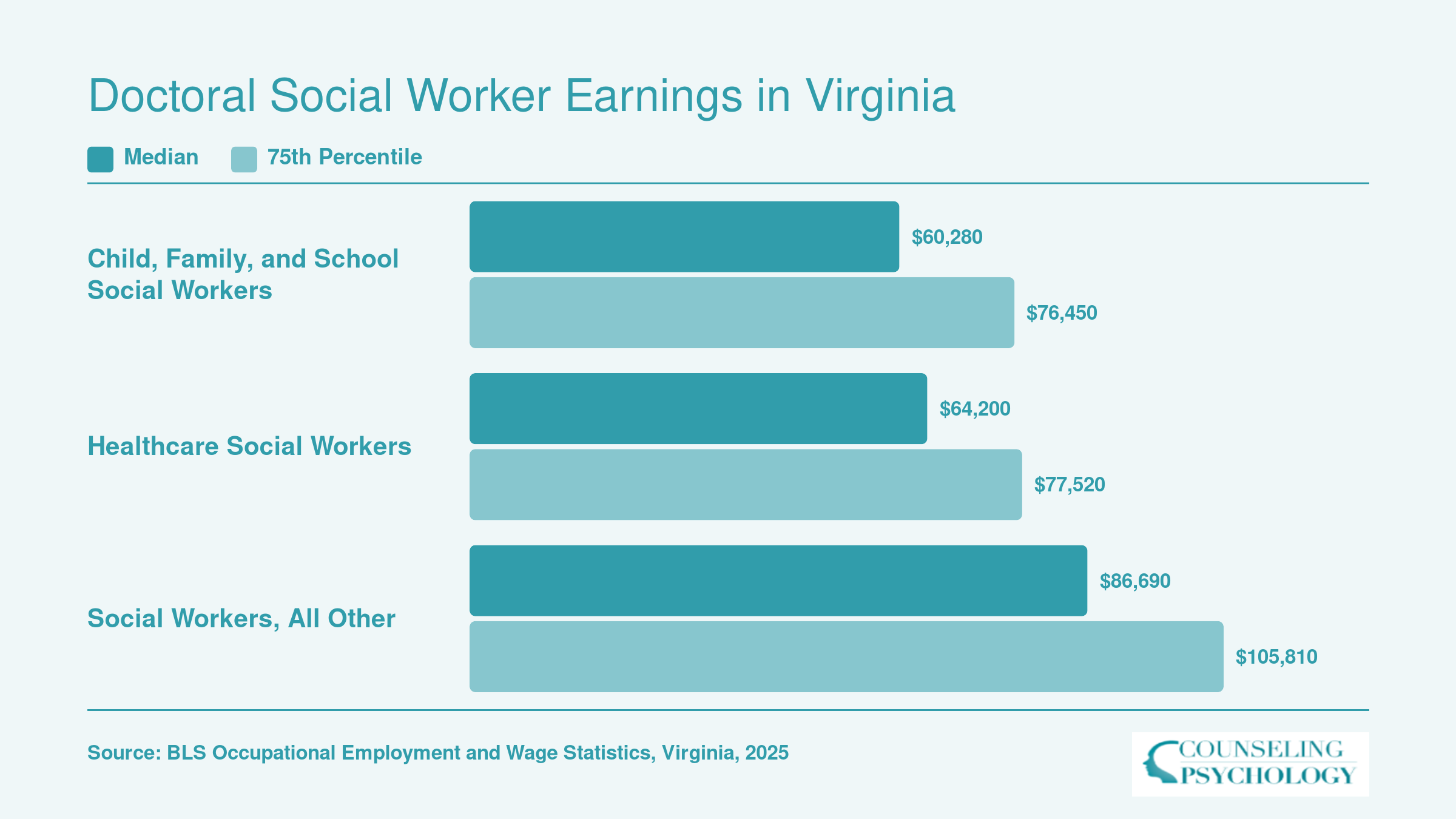
Doctoral-level social workers in Virginia who move into clinical director, program administrator, or faculty roles typically earn salaries at the 75th percentile and above. The chart below shows how Virginia wages stack up at the median and 75th percentile across three BLS social work categories, giving you a clear picture of the earnings ceiling a doctorate can help you reach.
Career Outcomes and Earnings for Doctoral Social Workers in Virginia
Demand for senior social work leadership is growing faster than the pipeline of qualified doctoral graduates, which means the credential carries real leverage in Virginia's job market right now.
What the National Numbers Say
The Bureau of Labor Statistics reports 2024 national median wages across social work specialties: healthcare social workers earn a national median of $68,090 per year, mental health and substance abuse social workers earn $60,060, and child, family, and school social workers earn $58,570.1 These are national figures and do not reflect Virginia-specific or Richmond-metro conditions directly, but they establish a useful floor.
Licensed clinical social workers in private practice occupy a different tier. National data suggests average annual earnings in the $90,000 to $94,000 range, with some practitioners reaching $120,000 or more depending on caseload, specialty, and setting.2 A doctorate does not automatically confer licensure, but it does position graduates for the highest-paying roles within the profession.
Postsecondary social work teachers, the academic career track tied most directly to a Ph.D., earn a national median of $83,980 according to 2024 BLS data.3
The Doctoral Premium
Framing the doctorate as a salary accelerator helps answer the question of whether advanced education pays off financially. Research consistently points to a premium of roughly $20,000 to $25,000 per year for doctoral holders compared to MSW-only practitioners when measured across similar roles.2 That gap widens further at the senior end: clinical directors, agency executives, and tenured faculty routinely command salaries that an MSW alone rarely reaches. For a broader look at how education level shapes compensation across helping professions, see our breakdown of counselor salary data by degree and specialty.
The MSW itself already delivers a meaningful return, adding approximately $13,000 annually over a BSW-level salary on a national basis.2 The doctorate layers another step of earnings acceleration on top of that foundation, particularly for roles that require research credentials or institutional authority.
Career Paths and Which Degree Fits
The role you want shapes which doctoral path makes sense:
- Clinical director or agency executive: Either degree works, but a DSW's practice focus aligns more naturally with organizational leadership in service settings.
- University faculty: A Ph.D. is the standard expectation for tenure-track appointments and research-intensive roles.
- Policy analyst or government advisor: Both degrees open doors, though the Ph.D.'s research training carries more weight in evidence-based policy contexts.
- Advanced private practice: A DSW combined with LCSW licensure is a practical combination for clinicians who want to specialize and lead.
For context, Norfolk State University's Ph.D. in Social Work, the only doctoral social work program in the ranked data for Virginia's programs closest to Richmond, does not yet have published program-level graduate earnings data. Prospective students should ask programs directly about where recent graduates are employed and at what salary range, since those conversations often reveal more than aggregate figures alone.
Virginia's public universities and state agencies are active employers of doctoral social workers, and Richmond's concentration of nonprofits, health systems, and policy organizations creates a realistic local market for graduates who want to stay in the region.
Admissions Requirements and GRE Policies for Virginia Doctoral Social Work Programs
The GRE is largely on its way out for doctoral social work admissions in Virginia, but it has not disappeared entirely. The single most important data point for Richmond-area applicants is that VCU's PhD in Social Work does not require the GRE for the 2025-2026 cycle.1 Norfolk State University's PhD program, by contrast, still lists GRE scores as a required component of the application packet. Most online DSW programs marketed to working clinicians have followed VCU's lead and dropped standardized testing altogether.
What Virginia Doctoral Programs Actually Require
Across both DSW and PhD tracks, the core admissions package looks similar:
- Master's degree: An MSW from a CSWE-accredited program is the standard prerequisite. VCU requires an MSW or closely related master's, and Norfolk State requires the MSW outright. Neither accepts applicants with only a BSW.2
- Practice experience: Most DSW programs expect two to three years of post-MSW clinical or leadership experience. PhD programs are less rigid on this point but still favor applicants with field experience that informs a clear research agenda.
- Writing sample: VCU requires a 5 to 8 page academic writing sample. This is non-negotiable for research-oriented PhDs.1
- Letters of recommendation: VCU asks for three letters, at least two from academic sources. Plan ahead if you have been out of school for a decade.1
- Personal statement: Programs want to see fit with faculty research interests (PhD) or a defined practice problem you intend to tackle (DSW).
- English proficiency: International applicants to VCU need a TOEFL iBT of 100 or higher, or IELTS of 6.5 or higher.1
VCU's PhD application deadline falls in early January for fall admission, so the timeline runs roughly nine months ahead of matriculation.1
Selectivity and Rolling Admissions
Program-level admit rates for doctoral social work cohorts are not published in federal data; the figures you see on college profiles (Norfolk State's institution-wide rate of about 88%, for example) reflect undergraduate admissions and tell you nothing about doctoral selectivity. PhD cohorts are typically small, funded, and competitive. Many online DSW programs, by contrast, operate on rolling or multi-term admissions and admit larger cohorts, which generally lowers the barrier to entry for qualified MSW holders with practice experience. Applicants exploring other doctoral paths in the helping professions, such as doctorate in marriage and family therapy programs, will find a similar emphasis on prior clinical experience and a personal statement that demonstrates scholarly focus.
CSWE Accreditation and Virginia Licensure for Doctoral Social Workers
Earning a doctorate in social work deepens your expertise, but the credential alone does not determine your ability to practice clinically or supervise others in Virginia. State licensure rules and program accreditation are the gatekeepers, so understanding both before you enroll saves time and money. The Virginia Board of Social Work regulates all practice titles, and the Council on Social Work Education (CSWE) sets the educational standards that most states, including Virginia, rely on when evaluating license applications.
Accreditation Matters: Verify Through CSWE
CSWE accreditation is the baseline for any doctoral program you consider. It signals that the curriculum, faculty, and student outcomes meet national quality standards. For doctoral programs, accreditation applies to the overall institution or school of social work, not always to each individual degree track. That nuance matters when you later apply for licensure or academic positions.
- Check the CSWE Accreditation Directory: Use the searchable database on the CSWE website to confirm a program is listed. Look for the specific campus and delivery mode (online, hybrid, or face-to-face) because an off-campus or online program must still fall under the accredited unit.
- State-by-state guidance: CSWE also publishes notes on how each state handles doctoral-level licensure or advanced standing. This is a starting point, not a substitute for verifying details with the Virginia board directly.
Virginia LCSW Requirements and Doctoral Distinctions
Virginia does not issue a separate, distinct license for doctoral-level social workers. The highest practice license is the Licensed Clinical Social Worker (LCSW), which requires a master's degree from a CSWE-accredited program, two years of post-master's supervised clinical experience, and a passing score on the ASWB clinical exam. A DSW or PhD does not waive the supervised experience requirement, though some doctoral programs build in advanced clinical training that may make the post-degree supervision process more efficient.
- Doctoral advantages: Holding a doctorate can qualify you for certain roles, such as teaching at the university level or leading research teams. In private practice, an LCSW with a doctorate may be eligible for insurance panel reimbursement at a higher rate or could position themselves for supervisory roles more quickly after meeting the post-licensure experience threshold.
- Supervisory privileges: To provide clinical supervision in Virginia, you must hold an LCSW and complete additional training. The Board does not grant automatic supervisory authority based on a doctoral degree alone. If your goal is to supervise, check the Board's current regulations, as rules around qualifying supervisors can update from year to year.
- ASWB exam policies: Virginia uses the ASWB clinical exam for LCSW candidates. Doctoral graduates take the same exam as master's-level applicants. Contact the Virginia Board of Social Work or visit their website for the latest exam policies, including any changes to test delivery or continuing education requirements that might affect your licensure timeline.
Licensing Exam Pass Rates and Program Outcomes
Program quality often shows in student outcomes. When you research individual DSW and PhD programs in the Richmond area, look for pages that publish alumni job placement rates or ASWB exam pass rates. A program that tracks and shares this data demonstrates transparency and a commitment to student success.
- What to ask: Does the program report the percentage of graduates who pass the ASWB clinical exam on their first attempt? Are graduates employed in clinical, academic, or administrative roles within six months of finishing? Some programs post these numbers on their website; for others, you may need to request the data from the admissions office.
- Virginia-specific context: A program located in Virginia or one that serves a high number of in-state students may have stronger networks with local agencies and licensing board staff, which can smooth your path to supervision hours and employment.
Additional Resources for Virginia Candidates
- National Association of Social Workers (NASW) Virginia Chapter: The state chapter often hosts licensure workshops, maintains a list of approved supervisors, and can clarify how doctoral training aligns with practice rights.
- Association of Social Work Boards (ASWB): For questions about exam content, scoring, or registration, the ASWB is the authoritative source. Their website includes exam guides and state-specific regulations.
- Virginia Board of Social Work website: Bookmark this page and check it periodically during your doctoral program. Regulations can shift, and the Board is the only source for binding information on LCSW requirements, supervision rules, and any future credential for doctoral practitioners.
For Virginia licensure, what carries weight is graduating from a program housed in a CSWE-accredited school and passing the ASWB exam. Whether your degree reads DSW or Ph.D. does not change your eligibility to practice: that distinction shapes your career direction, not your license.
Frequently Asked Questions About Doctoral Social Work Programs in Richmond, VA
Prospective doctoral students in the Richmond area often have overlapping questions about program types, admissions policies, and return on investment. Below are answers grounded in current program data and Virginia licensure requirements.
Tips for Choosing the Right Doctoral Social Work Program
Which doctoral social work program actually fits your career goals, your budget, and your life in Virginia right now? That question is worth sitting with before you submit a single application.
Match the Degree to the Destination
The DSW and the Ph.D. are built for different endpoints. If your goal is to deepen clinical expertise, lead a behavioral health organization, or advance direct practice in a setting like a Richmond hospital or state agency, the DSW is designed for that trajectory. If you want to produce original research, pursue a tenure-track faculty position, or shape national policy through scholarship, the Ph.D. is the appropriate path. Choosing the wrong type is not just inconvenient; it can mean years of coursework that does not align with how you actually want to spend your career. Professionals weighing related advanced degrees, such as counseling doctoral programs, face the same kind of alignment question.
Look Hard at Field Placement Networks
Richmond is genuinely well-positioned for social work doctoral students. The concentration of VCU Health facilities, VA medical centers, state government offices, and nonprofit behavioral health organizations means strong programs here can offer field placements and practicum connections that rural or fully remote programs simply cannot replicate. Ask programs directly: where do your current students complete their field hours, and what standing relationships do you have with agencies in the region?
Compare True Cost, Not Just Tuition
In-state tuition at a public university Ph.D. program in Virginia will often come in significantly below the total cost of an online DSW from a private institution, even after you factor in commuting or part-time enrollment. Calculate the full picture: fees, required residencies, technology costs, and lost income if the program is not flexible enough to work around your current job.
Verify Accreditation and State Authorization
Before enrolling in any out-of-state online program, confirm two things. First, that the program holds CSWE accreditation, the credential your future licensing board and employers will look for. Second, that the institution is authorized to enroll Virginia residents in distance education. State authorization is a separate requirement from accreditation, and gaps there can create complications when you apply for licensure.
Talk to People Already in the Program
Websites and admissions staff present programs at their best. Current students and recent graduates tell you what advising actually looks like at 9 p.m. before a deadline, whether dissertation committees are accessible, and how program culture shapes the experience. Ask the admissions office to connect you with alumni. If a program hesitates to do that, take note.