
What you’ll learn in this article…
- Tuition ranges from roughly $6,000 to $18,000 per year, making program cost comparisons essential before enrolling.
- ACBC certification requires three sequential phases and complements, but does not replace, a master's degree.
- Not every program qualifies graduates for state licensure as an LPC or LMHC, so verify tracks before applying.
- Most programs use asynchronous online delivery, though residency and practicum requirements vary by school.
Faith-integrated counseling credentials have moved decisively online, and the options now range from 30-credit ministry-focused degrees to 60-credit clinical programs that satisfy state licensure requirements. That spread matters. A student choosing a non-licensure biblical counseling master's at under $9,000 in total tuition faces a fundamentally different career calculus than one entering a 60-hour hybrid program with 900 required client-contact hours and a path to an LPC.
Across 27 programs reviewed here, tuition runs from roughly $6,000 to $26,000 per year, and the divide between licensure-track and ministry-only pathways shapes everything from course load to long-term earning potential. Not every program prepares you for ACBC certification, and fewer still meet clinical mental health counseling standards in all 50 states. For students still weighing broader options across counseling degree levels, understanding where biblical counseling fits in the larger landscape is a practical first step.
Top Online Master's in Biblical Counseling Programs
The following programs are ordered by a quality composite that weights institutional outcomes, affordability, and online accessibility. Each school listed offers at least one master's-level program in biblical or Christian counseling that can be completed primarily online or in a hybrid format. These are not ranked as cheapest or highest-earning; instead, the composite reflects a blended picture of value, flexibility, and program fit for students pursuing faith-integrated counseling training in 2026.
Details
- College Scorecard graduate earnings — collegescorecard.ed.gov
- NCES-IPEDS federal institutional data — nces.ed.gov
- Internal program database
- Independent program research

Cedarville University
Cedarville University is a private Christian institution in Ohio with a 72.5% institution-wide graduation rate and a 14:1 student-to-faculty ratio. Its online Master of Theological Studies in Biblical Counseling can be completed in as little as one year, and the university explicitly positions the degree as a foundation for voluntary biblical counseling certification. Cedarville continues to expand its biblical counseling training pathway, adding a graduate certificate option alongside the MTS track.
- 36-credit-hour program completable in as few as 12 months
- Fully online with limited optional in-class sessions
- Covers marriage counseling, crisis counseling, and methodology
- Builds foundation for ACBC-style voluntary certification
- Multiple start dates each year for scheduling flexibility
- Financial aid available; graduate tuition listed at $11,015
- No state licensure preparation; designed for church settings
Master of Theological Studies in Biblical Counseling — Online

Moody Bible Institute
Moody Bible Institute, based in Chicago, is one of the most recognized names in evangelical education. Its hybrid counseling programs blend clinical rigor with biblical integration, and the Clinical Mental Health Counseling track boasts a reported 99% job placement rate and 96% pass rate on the National Counselor Examination. On-campus components in Chicago make it especially practical for students in Illinois and surrounding Midwestern states.
- Hybrid format with required on-campus sessions in Chicago
- Reports 99% job placement and 96% NCE pass rate
- $539 per credit hour; tuition listed at $9,702 (IPEDS)
- Structured to meet Illinois professional counseling licensure
- Integrates faith-based principles with clinical training
- Group interview required as part of admissions process
- Hybrid delivery at $539 per credit hour
- Prepares graduates for professional licensure pathways
- Requires 12 to 15 months of supervised clinical experience
- Integrates biblical worldview with psychological practice
- Flexible scheduling for working professionals
- Clinical and pastoral skill development combined
MA in Clinical Mental Health Counseling — Hybrid
MA in Counseling Psychology — Hybrid

Ottawa University-Kansas City
Ottawa University's Kansas City campus offers a counseling master's degree with a Christian and Spiritual Counseling concentration that is explicitly designed for licensure. The program requires 60 to 63 credit hours and 900 client contact hours through practicum and internship, and it is structured to meet educational requirements in Arizona, Kansas, and Wisconsin. A 6:1 student-to-faculty ratio supports close mentorship throughout the clinical training process.
- 60 to 63 credit hours in a hybrid delivery format
- 900 client contact hours via practicum and internship
- Meets licensure requirements in AZ, KS, and WI
- 6:1 student-to-faculty ratio for individualized guidance
- Core foundation courses, electives, and field placement
- Bachelor's degree in any field accepted for admission
- Regional field placements available in Kansas City area
Master of Arts in Counseling, Christian and Spiritual Counseling Concentration — Hybrid

The Southern Baptist Theological Seminary
The Southern Baptist Theological Seminary in Louisville is a flagship institution for confessional evangelical training. Its MA in Biblical Counseling and Practical Theology is a 60-credit-hour hybrid program priced at roughly $322 per credit hour, with an explicit pathway to ACBC certification. The degree is tailored for students called to counsel within local churches, counseling centers, and missions organizations rather than pursue state clinical licensure.
- 60 credit hours; designed for completion in about two years
- Hybrid delivery with online coursework and Louisville intensives
- Tuition approximately $322 per credit hour ($8,996 annual, IPEDS)
- Explicit ACBC certification pathway built into curriculum
- Practicum courses included for supervised counseling experience
- No specific undergraduate major required for admission
- Focused on church, missions, and parachurch counseling contexts
Master of Arts in Biblical Counseling and Practical Theology — Hybrid

Liberty University
Liberty University is one of the largest providers of online Christian higher education in the country. Its fully online MA in Pastoral Counseling integrates theology with psychotherapy for church, hospital, and nonprofit settings, while a Theology concentration variant offers deeper doctrinal focus. Courses run in 8-week sessions, and the university accepts up to 50% transfer credits, making it especially flexible for mid-career ministry professionals and military-connected students.
- Fully online with 8-week course sessions
- Non-licensure program; prepares for pastoral care roles
- Supervised 150-hour internship required
- Accredited by the Association of Theological Schools
- Tuition listed at $8,730 (IPEDS); military discounts available
- Transfer up to 50% of credits from prior graduate work
- Covers crisis intervention and multicultural counseling
- No standardized test scores required for admission
- 36 credit hours with deeper systematic theology focus
- Fully online 8-week courses for working adults
- Covers doctrine of God and broader theological foundations
- ATS-accredited; no standardized testing for admission
- Military tuition discounts and transfer credit accepted
- Designed for confessional church and chaplaincy contexts
MA in Pastoral Counseling — Online
MA in Pastoral Counseling, Theology Concentration — Online

Regent University
Regent University in Virginia Beach delivers a fully online MA in Human Services with a Christian Counseling focus in just 30 credit hours. The program blends real-time virtual interaction, small-group projects, and podcast-style lectures. It is a non-licensure degree designed for para-professional and ministry roles, and admission does not require GRE scores or official transcripts at the application stage, lowering barriers for mid-career applicants nationwide.
- Fully online; 30 credit hours total
- $615 per credit hour; net price $19,923 (IPEDS)
- No GRE required; unofficial transcripts accepted initially
- Prepares for human services manager and pastoral counselor roles
- Blends real-time sessions, group projects, and podcast lectures
- Non-licensure track for church and nonprofit settings
M.A. in Human Services, Christian Counseling — Online

Bethany Lutheran College
Bethany Lutheran College in Mankato, Minnesota, offers a 60-credit Clinical Mental Health Counseling program grounded in a Christian worldview. The hybrid format pairs online coursework with on-campus residencies, and graduates are eligible for both national certification and state licensure, including in Minnesota. Students can choose a two- or three-year completion plan, and no specific undergraduate major is required for admission.
- 60 credit hours in a hybrid online-plus-residency format
- Eligible for national certification and state licensure
- Christian worldview integrated throughout the curriculum
- Choice of 2-year or 3-year completion timeline
- On-campus residencies held in Mankato, Minnesota
- Accepts undergraduate degrees in any field
- Net price $20,148 (IPEDS); 12:1 student-to-faculty ratio
Clinical Mental Health Counseling — Hybrid

Dallas Baptist University
Dallas Baptist University offers a 36-hour MA in Christian Counseling that blends biblical principles with psychological theory in a hybrid delivery model. The program is a non-licensure track designed for service in churches, denominational agencies, and ministry-based organizations throughout Texas and the broader Southwest. Experienced faculty with real-world ministry backgrounds anchor the curriculum, and the flexible scheduling accommodates working professionals.
- 36-hour non-licensure graduate program
- Hybrid format with online and Dallas campus sessions
- Integrates theology, psychology, and biblical principles
- Designed for church, parachurch, and denominational roles
- Flexible scheduling for working professionals and pastors
- Faculty bring active ministry and counseling experience
- Institution-wide graduation rate of 57% (IPEDS)
Master of Arts in Christian Counseling — Hybrid

Southern Adventist University
Southern Adventist University in Collegedale, Tennessee, offers a Master of Ministry with a Biblical Counseling concentration, the first program of its kind among Adventist institutions. The hybrid curriculum blends religious studies with psychological insights to prepare church leaders for initial counseling guidance and referrals. Pastors and denominational workers in the Southern Union may qualify for free tuition through conference sponsorship, making it an exceptionally affordable option for Adventist ministry professionals.
- Hybrid format with campus components in Tennessee
- First biblical counseling concentration in Adventist education
- Free tuition possible for Southern Union church employees
- Combines religion and psychology for pastoral care
- Prepares leaders for initial guidance and referral counseling
- Annual tuition listed at $13,760 (IPEDS); net price $24,345
Master of Ministry, Biblical Counseling Concentration — Hybrid

Campbellsville University
Campbellsville University is a Baptist-rooted institution in Kentucky offering a fully online Master of Theology at $324 per credit hour. While the M.Th. is a broad theology degree rather than a clinical counseling credential, it serves pastors and ministry leaders who want deeper theological foundations to undergird their preaching, teaching, and pastoral counseling work. The 30-credit-hour program requires no GRE or GMAT and accepts up to 12 transfer credits.
- Fully online; 30 credit hours at $324 per credit
- Three emphasis areas: biblical studies, pastoral leadership, theological studies
- No GRE or GMAT required for admission
- Accepts up to 12 transfer credits from other programs
- Accredited by SACSCOC for regional credibility
- Net price $19,341 (IPEDS); median graduate debt $17,156
- Designed for advanced ministry and pastoral counseling contexts
Master of Theology — Online
How We Ranked These Programs
Every ranking on this page reflects a composite quality score built from four measurable dimensions: institutional graduation rates, net price, program-level earnings outcomes, and online-delivery eligibility. We draw data from the U.S. Department of Education's College Scorecard, the Integrated Postsecondary Education Data System (IPEDS), and direct institutional reporting to ensure every number is verifiable and current.
What the Composite Score Measures
Graduation rate reflects the six-year completion rate for first-time, full-time undergraduates at the institution. This is an institution-wide metric, not specific to the biblical counseling master's program itself, because the federal government does not yet publish program-level completion rates for graduate degrees. Net price represents the average annual cost after grants and institutional aid, calculated for full-time students in the program's sector (private nonprofit or public). Because most biblical counseling programs sit within private nonprofit seminaries, the figure reflects that sector's conditional average. Earnings outcomes come from Title IV data linking graduates to IRS and SSA wage records; when available, we use the median earnings of graduates one year after completing the specific program. Online-delivery eligibility confirms that the program offers a fully remote pathway with no required campus visits or intensive residencies.
Why Transparency Matters
Many ranking sites publish lists without stating what they measured or where the numbers came from. We believe students deserve to know the criteria, the limitations, and the trade-offs. Graduation rates tell you about institutional infrastructure and student support, not about theological depth or counseling pedagogy. Net price averages mask individual financial-aid awards, which vary widely by household income and enrollment status. Earnings data lag by one to two years and exclude graduates who do not work in Title IV-reportable jobs. These are honest constraints, and we name them plainly so you can weigh rankings alongside your own priorities: denominational alignment, faculty credentials, accreditation status, and whether the program prepares you for state licensure or church-based ministry.
Biblical Counseling Vs. Christian Counseling Vs. Pastoral Counseling: Key Differences
Two students with similar faith convictions can end up in very different careers depending on which counseling path they choose. One may sit across from clients in a private practice office billing insurance under a state license; another may meet with church members in a Sunday school room after the service. The label on the master's degree matters because it determines theological method, credentialing route, and where you can legally practice.
Theological Method and Scope
The three paths diverge first on how they treat Scripture in relation to psychology.
- Biblical counseling: Operates from a sufficiency-of-Scripture model, where the Bible is treated as the primary authoritative source for diagnosing and addressing problems of the heart.1 Scope is church-based discipleship, and practitioners generally do not use DSM categories. This work often overlaps with church discipline and member care.2
- Christian counseling: Uses an integration model, drawing on both psychological research and Christian theology.3 Scope is clinical mental health, including assessment, DSM-informed diagnosis, and treatment planning. It is kept separate from church discipline.
- Pastoral counseling: Rooted in a biblical and theological orientation but framed as pastoral care and shepherding.4 Pastors typically do not formally diagnose, and counseling happens within the broader work of congregational ministry.
Credentials and Licensure
The credential a program prepares you for is the clearest signal of where you will work.
- Biblical counseling: Certification through ACBC, IABC, or CCEF. Does not lead to state licensure. Primary setting is the local church or a church-affiliated counseling center.1
- Christian counseling: State licensure as an LPC, LMHC, LMFT, or similar, often paired with AACC or CAPS membership.3 Primary setting is clinical or private practice, sometimes integrated with a church referral network. Students interested in the clinical licensure track can learn more about how to become a licensed professional counselor.
- Pastoral counseling: Typically requires an MDiv and ordination, with optional clinical pastoral education (CPE) through ACPE or historical certification through AAPC. Not a licensure track by default. Primary settings include the church and chaplaincy roles in hospitals, prisons, or the military.4
For a broader look at how these paths compare to other faith-oriented roles, see our overview of biblical counseling degree online options. Knowing which lane you want before you enroll prevents the common mistake of finishing a degree that does not qualify you for the work you imagined doing.
Questions to Ask Yourself
Do you want to counsel within a church or ministry setting, or do you envision working in a licensed clinical practice?
Is state licensure (LPC/LMHC) important to your career goals, or will certification through ACBC or IABC meet your needs?
How much clinical supervision and practicum hours are you willing to complete beyond your degree?
Licensure Vs. Non-Licensure: What Each Program Qualifies You For
The central tension here is a practical one: a master's in biblical counseling can open ministry doors immediately, but it may or may not put you on the path to a state-issued counseling license. Which outcome you need depends on where you plan to work and whom you plan to serve.
What Non-Licensure Programs Typically Qualify You For
Many biblical counseling master's programs are designed for church-based, parachurch, or faith community roles rather than clinical or mental health agency settings. Graduates of these programs often pursue certification through bodies like the Association of Certified Biblical Counselors (ACBC) or the International Association of Biblical Counselors (IABC), which carry real credibility in religious ministry contexts. In those settings, state licensure is frequently not required. Some graduates also explore adjacent paths such as spiritual counseling certification, which shares a similar faith-oriented focus.
Some states also maintain pastoral or religious counselor exemptions that allow clergy and faith-based counselors to provide counsel within their congregational role without holding a Licensed Professional Counselor (LPC) or Licensed Mental Health Counselor (LMHC) credential. The scope and limits of these exemptions vary considerably from state to state. A handful of states are fairly permissive; others restrict the exemption narrowly to ordained ministers counseling their own congregants. Reviewing your specific state's counseling board website is the most reliable way to understand what non-licensed practice looks like where you live.
When Licensure Matters and What It Takes
If your goal includes working in a hospital, community mental health center, private practice billing insurance, or any setting that requires a state license, most standalone biblical counseling degrees will not satisfy the prerequisites. Those interested in this route can learn more about how to become a licensed professional counselor, since LPC and LMHC licensure typically require a counseling master's program accredited by CACREP or a comparable body, a defined set of clinical practicum and internship hours (often 600 to 1,000 supervised hours during the degree), and a passing score on a licensing exam such as the NCE or NCMHCE.
Some graduate programs in Christian or biblical counseling do offer licensure-eligible tracks that weave clinical coursework into a faith-integrated curriculum. If licensure is your goal, ask programs directly whether their degree satisfies the academic prerequisites in your state, and request contact with a licensure advisor before enrolling.
Where to Research Further
Several resources can sharpen your understanding before you commit to a program:
- BLS.gov: The U.S. Bureau of Labor Statistics publishes state-by-state occupational and licensing information for counselors, including notes on exemptions in some states.
- State counseling boards: Search for your state's LPC or LMHC board website to read the actual statutory language on exemptions and requirements.
- Program licensure advisors: Admissions staff at graduate programs can tell you whether their curriculum aligns with your state's requirements, but always verify with the board directly.
- Professional associations: The American Counseling Association (ACA) and the American Association of Christian Counselors (AACC) both offer member resources and guidance on navigating licensure pathways, including in states with religious counselor provisions.
The bottom line: know your intended work setting before you choose a program. For ministry roles, a non-licensure biblical counseling degree paired with ACBC or IABC certification is a coherent and legitimate path. For clinical settings, verify that your chosen program meets your state's specific academic and clinical hour requirements before you enroll.
ACBC and IABC Certification Pathways by Program
Earning a master's degree in biblical counseling versus pursuing professional certification through a credentialing body like ACBC or IABC represents two distinct but often complementary pathways into ministry-based counseling. Many students pursue both concurrently, while others complete their degree first and add certification later to strengthen their credentials within faith communities.
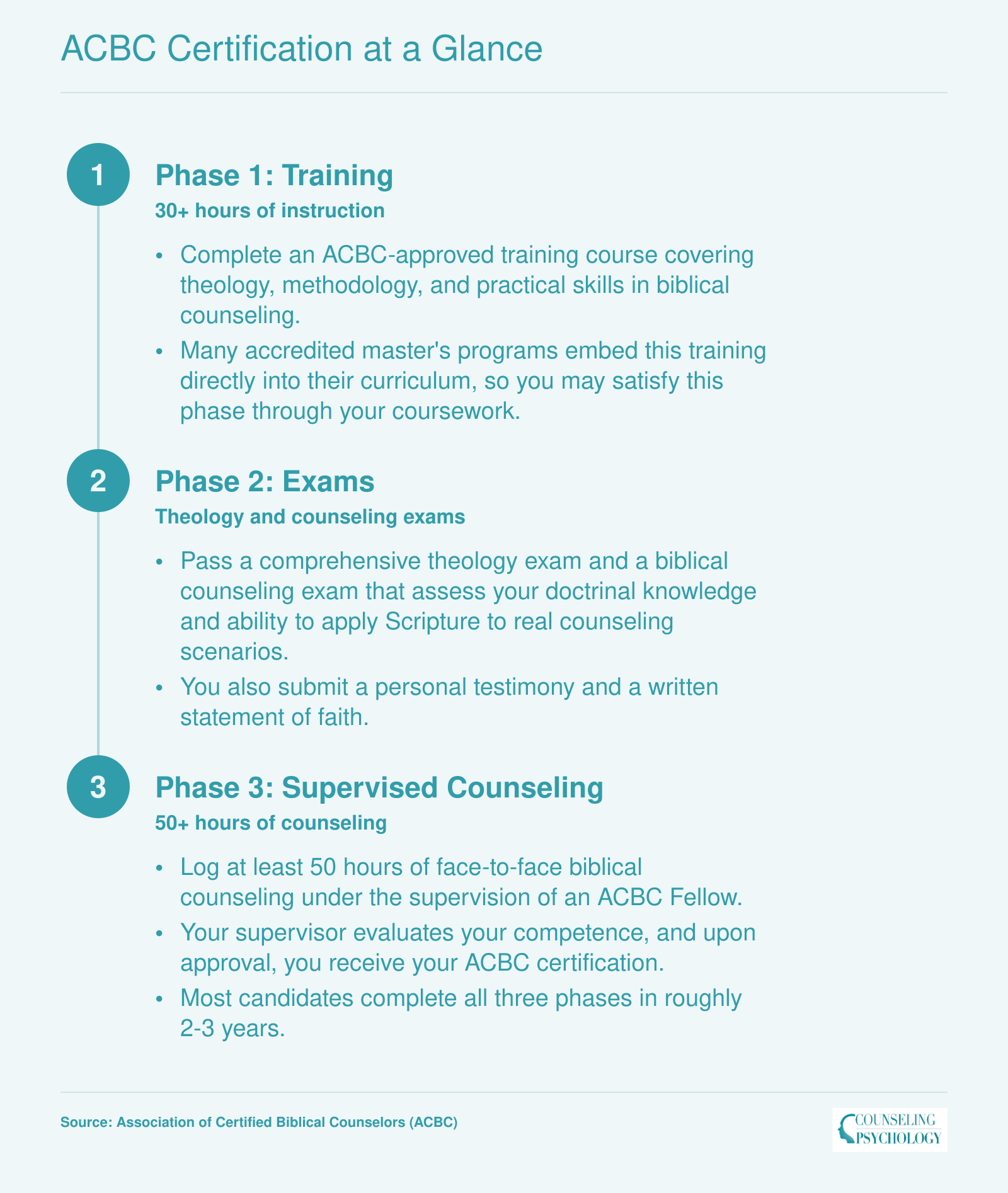
ACBC Certification: A Three-Phase Journey
The Association of Certified Biblical Counselors structures certification as a progressive, three-phase process designed to ensure theological fidelity and counseling competence.1 Phase 1 centers on learning and training: candidates must complete at least 30 hours of instruction in biblical counseling theology and methodology, observe a minimum of 10 counseling sessions conducted by a certified counselor, and read at least 1,000 pages of approved biblical counseling literature (including a minimum of 300 pages on theology).2 Candidates have up to four years to complete Phases 1 and 2 combined.1
Phase 2 requires passing a rigorous written examination. The exam consists of 44 essay questions, each requiring one to one-and-a-half pages of written response, covering both theology and counseling methodology. This phase tests not just knowledge but the ability to apply biblical principles to real counseling scenarios.
Phase 3 demands hands-on supervised counseling experience: candidates must log 50 counseling sessions under the oversight of an ACBC-certified counselor.4 At least 10 of those sessions must be with the same counselee to demonstrate sustained care, and at least five sessions must be audio-recorded for review. Candidates have one year to complete Phase 3 after passing Phase 2.4
IABC Certification and Alternative Pathways
The International Association of Biblical Counselors offers a parallel certification track, though specific requirements differ and are generally less widely documented in public sources. IABC certification tends to emphasize theological alignment and practical ministry readiness, but does not follow the same three-phase structure as ACBC. Students interested in IABC should contact the organization directly to confirm current requirements and whether their chosen program qualifies.
Which Programs Align with ACBC or IABC?
Not all accredited online master's programs in biblical counseling hold formal ACBC training-center status or explicit IABC alignment. Among the ranked programs, some institutions design their curricula to cover ACBC Phase 1 content, including the 30 hours of fundamentals instruction and assigned reading thresholds. For example, IBCD's Care & Discipleship courses cover 30 hours of fundamentals and 640 pages of reading, aligning closely with ACBC Phase 1 requirements.5 However, students should verify directly with both the program and ACBC whether the school holds official training-center status, as this can streamline Phase 1 completion.
Even if a program lacks formal ACBC or IABC affiliation, graduates can still pursue certification independently by completing the required phases outside their degree. Many students choose this route, leveraging their master's coursework to satisfy theological and counseling knowledge requirements while independently arranging observation hours and supervised counseling sessions through local churches or certified counselors in their area.
ACBC Certification at a Glance
The Association of Certified Biblical Counselors (ACBC) credential is the most widely recognized certification in the biblical counseling field. Earning it requires completing three sequential phases, each with distinct requirements. Here is how the process unfolds from start to finish.
Cost Comparison: Tuition, Fees, and Total Program Estimates
Costs across these online master's in biblical counseling programs vary significantly. Published graduate tuition rates range from about $6,000 per year (Baptist University of Florida) to nearly $18,000 per year (Regent University). The institution-wide average net price after financial aid, drawn from federal data, spans roughly $10,000 to $28,000. Keep in mind that the net price figure shown below is an approximate, institution-wide average reflecting all undergraduate and graduate students who received aid. Your actual out-of-pocket cost will depend on the specific program, your aid package, and your enrollment status.
| School | State | Annual Tuition | Avg. Net Price After Aid (Institution-Wide) |
|---|---|---|---|
| Baptist University of Florida | FL | $6,000 | $10,372 |
| Hobe Sound Bible College | FL | Not published at program level | $12,074 |
| Campbellsville University | KY | $9,920 | $19,341 |
| Regent University | VA | $17,869 | $19,923 |
| Bethany Lutheran College | MN | $10,815 | $20,148 |
| Life Pacific University | CA | $12,728 | $20,898 |
| Mission University | MO | $8,250 | $21,383 |
| Faulkner University | AL | $16,050 | $22,085 |
| Moody Bible Institute | IL | $9,702 | $22,221 |
| Southern Adventist University | TN | $13,760 | $24,345 |
| Cedarville University | OH | $11,015 | $24,468 |
| Messiah University | PA | $14,040 | $26,502 |
| Crown College | MN | $11,740 | $26,672 |
| Montreat College | NC | $11,820 | $27,061 |
| Cairn University | PA | $10,530 | $27,642 |
Graduates pursue roles such as church counselor, pastoral care director, parachurch ministry counselor, Christian school counselor, chaplain, or private biblical counseling practice without state licensure. Those who complete licensure track programs can also qualify for LPC or LMHC credentials, opening doors to clinical mental health settings alongside faith integrated care.
Career Outcomes and Salary Expectations for Biblical Counseling Graduates
Licensure-track graduates and ministry-focused graduates occupy very different earning landscapes, and understanding both is essential before you commit to a program. Here is what the available data tells us, along with honest acknowledgments of what it does not.
Program-Level Earnings Data: What We Know (and Don't)
Program-specific earnings figures for biblical and Christian counseling master's degrees are not yet available through federal reporting for the programs featured in this guide. None of the ranked schools have published median earnings at one year or four years after completion for these specific programs. That gap is common for newer or smaller graduate programs and does not reflect poorly on the institutions themselves. It simply means prospective students need to look at broader benchmarks for context.
Institution-Wide Earnings as a Rough Benchmark
One way to approximate earning potential is to look at the median earnings of all graduates from a given institution, measured ten years after enrollment. Across the schools featured in our rankings, those institution-wide figures range from roughly $46,000 to $57,000 per year. Dallas Baptist University sits near the top of that range at about $56,800, while schools like Southeastern University and Bethany Lutheran College fall closer to $46,000. Keep in mind that these numbers reflect graduates from every program at the university, not just counseling. They are a general indicator of the economic outcomes associated with each school's student population, not a precise forecast for biblical counseling graduates specifically.
BLS Data for the Closest Clinical Comparison
The Bureau of Labor Statistics tracks substance abuse, behavioral disorder, and mental health counselors (SOC 21-1018), which is the closest federal occupational category for counseling graduates who pursue clinical roles. Nationally, the median annual wage for this group was $59,190 as of 2024.1 The field is growing considerably faster than average, with a projected job growth rate of 17% from 2024 to 2034 and approximately 48,300 openings expected each year during that period.1 Graduates who complete a licensure-eligible program, such as those offered at Messiah University, Crown College, or Bethany Lutheran College, are positioned to enter this job market directly. For a closer look at one of the largest occupational segments in this category, see our guide on how to become a substance abuse counselor.
The Ministry and Church Employment Factor
Many biblical counseling graduates, however, do not pursue state licensure at all. They serve in church-based counseling ministries, parachurch organizations, missions agencies, or denominational support roles. Compensation in these settings varies widely and is generally not captured by BLS data. Church-based counseling positions may offer salaries below the clinical counseling median, sometimes significantly so, depending on congregation size, denomination, and geographic region. Some roles are part-time or come with non-cash benefits such as housing allowances. Prospective students should research compensation norms within their specific denominational context rather than relying solely on federal wage statistics.
Putting It All Together
If your goal is clinical practice with state licensure, programs designed to meet CACREP or state-specific requirements give you the clearest path to the $59,190 national median and beyond. Those interested in a broader view of the profession can explore various counseling careers to compare salary ranges and growth projections across specializations. If you are called to ministry-centered counseling, your earning trajectory will depend more on your specific ministry context than on any federal wage benchmark. Either way, asking each program directly about graduate placement and employer types is one of the most practical steps you can take during your search.
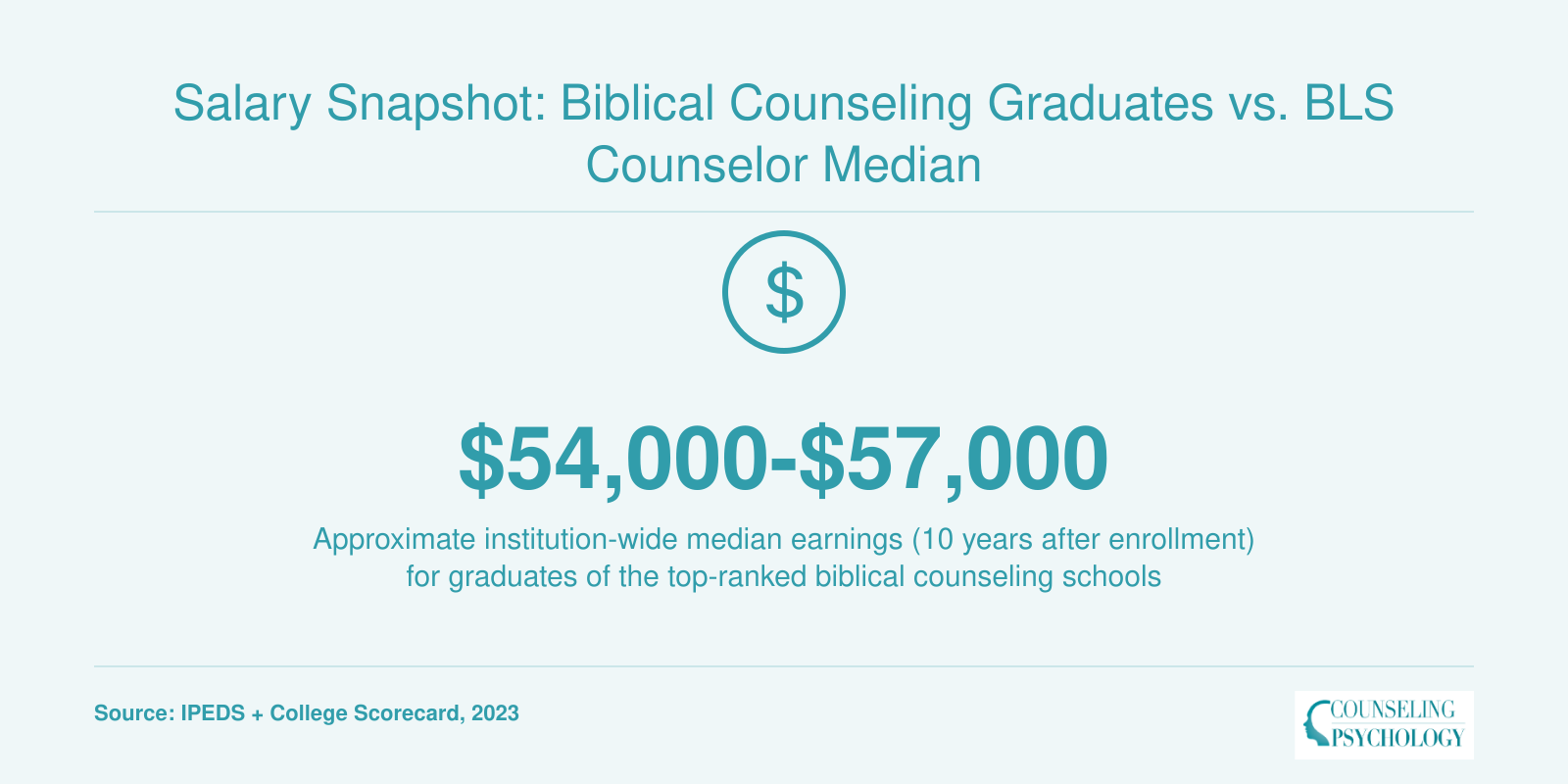
Salary Snapshot: Biblical Counseling Graduates Vs. BLS Counselor Median
Program-level earnings data (such as median salary one year or four years after graduation) are not yet available for the biblical counseling master's programs in our rankings. Without verified program-specific figures, a side-by-side bar comparison would be misleading. What we can share is the institution-wide median earnings reported for graduates of these top-ranked schools, which cluster in the mid-$50,000s, roughly in line with the national BLS median for educational, guidance, and career counselors (SOC 21-1012). As program-level outcome data are published, counselingpsychology.org will update this section.
Online Learning Formats: What to Expect Day-To-Day
Online biblical counseling programs have largely consolidated around asynchronous delivery, but the day-to-day experience still varies more than the marketing copy suggests. Knowing the differences between delivery models, scheduling structures, and residency requirements will save you from surprises after you enroll.
Common Delivery Models
Most accredited online biblical counseling master's programs fall into one of four delivery patterns, and many blend two or more:
- Asynchronous coursework: Lectures, readings, and discussion boards are posted on a weekly schedule, and you complete work on your own clock. Mission University, Luther Rice College & Seminary, and Midwestern Baptist Theological Seminary all use this model for their MA in Biblical Counseling programs.123
- Synchronous video sessions: Live class meetings on Zoom or a similar platform at fixed times each week. These are more common in counseling practica than in lecture courses.
- Cohort-based scheduling: Students move through the curriculum together in a fixed sequence. The three programs cited above are non-cohort, meaning you can start in most terms and progress at your own pace.123
- On-campus intensives (residencies): One- or two-week immersive sessions for supervised counseling practice. Mission, Luther Rice, and Midwestern do not require these, but several other biblical counseling programs do, especially for clinically oriented tracks.123
Verify Before You Enroll
"100% online" does not always mean what students assume. Some programs marketed as online require travel for practica, oral exams, or counseling observations. Read the academic catalog (not just the program landing page), and ask admissions directly: Is any portion of this degree delivered in person, and if so, when and where?
Plan for 9 to 20 hours per week per course. Luther Rice and Midwestern estimate 9 to 12 hours weekly per course, while Mission's compressed 6-week format runs closer to 15 to 20 hours.123 If you are exploring broader Online Biblical Counseling Degree Programs, understanding these time commitments upfront will help you compare options realistically.
Are Online Master's Degrees in Counseling Respected?
Yes. When the program holds regional accreditation (or recognized national accreditation such as ATS for seminary degrees), the diploma carries the same credential weight as an on-campus version. Employers, certifying bodies like ACBC and IABC, and state licensure boards evaluate the institution and curriculum, not the delivery format. The transcript typically does not distinguish online from residential coursework.
Frequently Asked Questions About Online Biblical Counseling Master's Programs
Choosing an online master's in biblical counseling raises practical questions about career paths, credentials, and program logistics. Below are answers to the questions prospective students ask most often, drawn from current program data and certification requirements.
- What can I do with a Master's in biblical counseling?
- Graduates typically serve as church-based counselors, ministry leaders, chaplains, or pastoral care directors. Some work in parachurch organizations, rescue missions, or nonprofit counseling centers. Because these programs emphasize Scripture-centered care rather than clinical training, most roles are within faith-based settings. A master's degree also positions you to pursue ACBC certification, which is widely recognized in evangelical churches and ministries.
- What degree do I need to be a biblical counselor?
- There is no single required degree, but a master's in biblical counseling is the standard credential for professional ministry roles. Programs range from 36 to 60 credits depending on the school. For example, Luther Rice College and Seminary offers a 36-credit M.A., while Southern Baptist Theological Seminary requires 60 credits. ACBC certification, the most recognized credential in the field, requires graduate-level coursework along with supervised counseling hours and an oral exam.
- Are online master's degrees in counseling respected?
- For church and ministry positions, regionally or nationally accredited online biblical counseling degrees are generally viewed as equivalent to on-campus programs. Certification bodies like ACBC accept coursework completed online. That said, if your goal is state licensure as a professional counselor, a standalone biblical counseling degree typically will not qualify. Employers in clinical or state-regulated settings may require a degree specifically designed to meet licensure standards.
- How much money do biblical counselors make?
- Earnings vary widely based on setting, geography, and whether the role is full-time or part-time. Many church-based counseling positions pay modestly compared to licensed clinical roles. According to the Bureau of Labor Statistics, the national median salary for substance abuse, behavioral disorder, and mental health counselors was approximately $53,710 as of 2024, but biblical counselors working in ministry settings often earn below that figure because compensation structures differ significantly from clinical practice.
- Do biblical counseling degrees lead to state licensure?
- In most cases, no. Online master's programs in biblical counseling are not designed to meet state licensure requirements for professional counseling (such as LPC or LMHC). Programs at schools like Southern Baptist Theological Seminary and Midwestern Baptist Theological Seminary explicitly note that their degrees do not prepare graduates for state licensure. If licensure is your goal, look for programs specifically structured around your state's clinical hour and coursework requirements.
- What is the difference between ACBC and IABC certification?
- ACBC (Association of Certified Biblical Counselors) is the more widely recognized credential, requiring graduate-level training, supervised counseling experience, a written exam, and an oral evaluation. IABC (International Association of Biblical Counselors) has lower recognition within the broader biblical counseling community and different certification standards. Some schools, such as Mission University, prepare students for both certifications, while most ACBC-aligned programs focus exclusively on that pathway.
- How long does an online master's in biblical counseling take to complete?
- Most programs take 18 to 36 months depending on credit requirements and enrollment pace. A 36-credit program like Luther Rice's M.A. can be finished in as few as 16 months at an accelerated pace. Larger programs requiring 60 credits, such as those at Southern Baptist Theological Seminary or Midwestern Baptist Theological Seminary, typically take 24 to 36 months. Many online formats offer flexible scheduling so students can balance coursework with ministry or employment.
More Online Biblical Counseling Programs to Consider
Beyond our top 10, many other schools offer online master's programs in biblical counseling or related fields. This directory lists additional programs across the country, providing options for students who want to explore further opportunities.
- Master of Arts in Counseling
- M.S. in Christian Counseling - Philadelphia (Marriage and Family Counseling, Professional Counseling, Electives)
- Master of Arts in Biblical Counseling
- MS in Pastoral Care & Counseling
- Master of Arts in Counseling (Christian and Spiritual Counseling)
- M.A. in Counseling (Christian Counseling)
- M.A. in Pastoral Counseling
- Master of Arts in Clinical Mental Health Counseling
- Master of Arts in Christian Counseling and Family Ministry
- Master of Counseling (Christian Counseling)
- Master of Arts in Counseling (Clinical Mental Health Counseling, Couple and Family Counseling, School Counseling)
- Master of Arts in Christian Counseling
- Master of Pastoral Theology (Pastoral Counseling)
- Master of Arts in Christian Counseling
- MS Family Studies | Christian Counseling Specialization
- Master of Arts in Pastoral Care and Counseling (Chaplaincy and Spiritual Care, Clinical Track)