
What you’ll learn in this article…
- CACREP accreditation is the single most important factor when choosing a counseling program in Washington.
- Washington counselors earn meaningfully above the national median wage for the occupation.
- Tuition at public institutions can fall under $5,000 per year, while private programs may exceed $24,000.
- The LMHC licensure process in Washington requires supervised postgraduate clinical hours overseen by the Department of Health.
In Washington, earning a Licensed Mental Health Counselor credential means completing a 60-credit master's that meets CACREP standards, logging 3,000 supervised hours, and passing the NCMHCE. The programs below are filtered for online or hybrid delivery and ranked with an emphasis on affordability, reflecting the reality that cost is a top barrier for graduate students in the behavioral health fields.
The state's demand for clinical mental health and school counselors continues to climb, and hiring announcements now routinely outpace the number of new licensees entering the workforce each year. That supply-demand gap makes program choice a strategic decision: the right master's balances flexibility, cost, and a clear path to Washington licensure.
2026 Best Master's in Counseling Programs in Washington
The programs below were selected for Washington students who need flexible delivery, manageable tuition, and curricula aligned with state licensure requirements. Rankings weight affordability and online or hybrid availability, then layer in graduation outcomes, accreditation standing, and program depth. Every school on this list offers at least one counseling-related credential that can be completed partly or entirely online, making each a realistic option for working adults across the state.
- Tuition and net price affordability
- Online or hybrid delivery options
- Institutional graduation outcomes
- Accreditation and licensure alignment
- Program breadth and specialization depth
- NCES-IPEDS federal institutional data — nces.ed.gov
- College Scorecard graduate earnings — collegescorecard.ed.gov
- Independent program research
- Internal program database

City University of Seattle
City University of Seattle is a private, nonprofit institution built around working professionals. Its counseling programs follow a practitioner-scholar model with a social justice and multicultural emphasis, and all three master's concentrations hold CACREP accreditation. With a 5-to-1 student-faculty ratio and hybrid scheduling, students receive close mentorship while managing jobs and family obligations. Graduates report strong mid-career earnings relative to peer programs in the state.
- CACREP-accredited, 90-credit master's program
- Hybrid format blends online and in-person sessions
- Meets Washington LMHC licensure requirements
- Social justice and multicultural counseling emphasis
- Multiple supervised internship placements available
- Practitioner-scholar model with clinical skill focus
- CACREP-accredited K-12 school counseling track
- Hybrid delivery at approximately $710 per credit
- Prepares students for Washington State ESA credential
- Multicultural and anti-racist curriculum framework
- 90 total credits with multiple internship sites
- Practitioner-scholar approach to evidence-based practice
- Prepares graduates for marriage and family therapy licensure
- Online coursework with supervised practicum experiences
- Culturally attuned, ethically grounded curriculum
- Emphasizes personal growth alongside clinical expertise
- Hands-on training in couple and family interventions
- Flexible scheduling designed for working adults
M.A. in Counseling, Clinical Mental Health Counseling — Hybrid
M.A. in Counseling, Professional School Counseling — Hybrid
M.A. in Counseling, Marriage, Couple, and Family Counseling — Hybrid

Eastern Washington University
Eastern Washington University offers some of the lowest graduate tuition in the state, with in-state rates around $14,106 and a net price near $13,886. Its CACREP-accredited counseling tracks span clinical mental health, school counseling, and a family and child life concentration. EWU also provides an online Addiction Studies Graduate Certificate that meets Washington DOH requirements for Substance Use Disorder Professional certification, making it a practical add-on for licensed clinicians looking to expand their scope of practice.
- Fully online, 20-credit graduate certificate
- Meets Washington State DOH SUD Professional requirements
- Covers counseling theories and group counseling techniques
- Includes pharmacological actions of substances coursework
- Case management training for diverse populations
- Emphasizes ethics and confidentiality in addiction care
Addiction Studies Licensed Professionals Graduate Certificate — Online

Seattle University
Seattle University pairs Jesuit educational values with CACREP-accredited online counseling degrees that explicitly target Washington licensure. Both the school counseling and clinical mental health tracks run 90 credits over three years, featuring asynchronous coursework, brief summer campus residencies, and a year-long practicum completed in each student's own community. Graduates are uniquely eligible for Washington's Substance Use Disorder certification upon completion, a differentiator few peer programs offer. The institution's 75.5% graduation rate and 10-to-1 student-faculty ratio reflect strong academic support.
- CACREP-accredited, fully online with summer residency
- 90 credits completed over three years
- Meets Washington Residency ESA certification requirements
- Embedded Substance Use Disorder certification eligibility
- Multicultural, anti-racist counseling curriculum
- Year-long practicum in student's local school community
- Asynchronous format suits full-time educators
- CACREP-accredited with Washington LMHC licensure focus
- Two years asynchronous online, third year hybrid
- Four-day summer campus residencies after years one and two
- SUD certification eligibility included in curriculum
- Weekly online synchronous group supervision in year three
- Practicum at approved sites anywhere in Washington
- Social justice and equity integrated throughout coursework
Online Master's in School Counseling — Online
Clinical Mental Health Counseling, Online MAEd — Online

Northwest University
Northwest University in Kirkland delivers a 60-credit Master of Arts in Clinical Mental Health Counseling through a primarily online, cohort-based format with three required on-campus residency experiences. The program holds CACREP accreditation, integrates a Christian worldview with evidence-based counseling practices, and prepares graduates for Washington state licensure. At roughly $720 per credit, with no GRE requirement and a 32-month timeline, it is structured to move career changers into the field efficiently. The main campus reports a 70.8% institution-wide graduation rate.
- CACREP-accredited, 60-credit online master's degree
- Cohort-based model completed in 32 months
- Approximately $720 per credit, no GRE required
- Three on-campus residency experiences in Kirkland
- Flexible asynchronous format for working adults
- Prepares graduates for Washington state licensure
- Holistic approach covering biological, psychological, and cultural dimensions
M.A. in Clinical Mental Health Counseling — Online

Northwest University-Center for Online and Extended Education
Northwest University's Center for Online and Extended Education offers the same CMHC curriculum through a distance-focused branch, giving students across Washington and other SARA-member states access to the 60-credit, 32-month program with local practicum and internship placements. Tuition runs about $15,364 per year, and students complete fieldwork in their own communities, removing relocation barriers for those in underserved or rural parts of the state.
- 60-credit online degree meeting WA licensure requirements
- Three brief on-campus residency experiences required
- Practicum and internship completed in student's community
- Flexible asynchronous coursework with no GRE requirement
- Christian worldview integrated with evidence-based practice
- Culturally responsive counseling training emphasized
- 32-month program length for efficient completion
M.A. in Clinical Mental Health Counseling (Online and Extended Education) — Online

Edmonds College
Edmonds College in Lynnwood is included here as an affordable on-ramp for students not yet ready for a master's program. Its Bachelor of Applied Science in Behavioral Health Support Specialist prepares graduates for entry-level roles in Washington mental health and SUD agencies, with tuition positioned at roughly half the national average for comparable four-year degrees. Two supervised internships totaling 300 hours leverage partnerships with Snohomish County behavioral health providers, and the program's cohort structure accepts transfer credits from Washington community college pathways.
- Applied bachelor's degree, not a master's program
- Hybrid: classes every other Saturday plus flexible formats
- Two supervised internships totaling 300 hours
- Tuition about half the national average for comparable degrees
- Cohort-based, maximum 25 students per cohort
- Designed for WA community college transfer students
- Prepares graduates for behavioral health agency roles
Behavioral Health Support Specialist, BAS — Hybrid
How to Choose a Counseling Program in Washington
The single most consequential decision you will make when selecting a master's in counseling in Washington is whether the program holds CACREP accreditation, because that choice ripples through every stage of your career that follows.
Why CACREP Accreditation Should Be Your Starting Filter
Washington's Department of Health recognizes CACREP-accredited programs as meeting the educational requirements for Licensed Mental Health Counselor (LMHC) and Licensed Marriage and Family Therapist (LMFT) credentials. Graduates of non-CACREP programs can still pursue licensure, but they may face additional course-by-course transcript reviews, supplementary coursework, or delays in the application process. Accreditation also matters if you ever plan to practice in another state or pursue national certification through the National Board for Certified Counselors. Employers, clinical supervisors, and insurance panels increasingly treat CACREP status as a baseline expectation rather than a bonus.
Matching Specializations to Washington Licenses
Counseling master's programs in Washington generally offer several concentration tracks, and each one maps to a different credential or career path:
- Clinical Mental Health Counseling: Prepares you for the LMHC license, the most common independent-practice credential in the state.
- School Counseling: Leads to an Educational Staff Associate (ESA) certificate through OSPI, required for K-12 school counselor roles.
- Marriage and Family Therapy: Aligns with the LMFT license, which has its own supervised-experience requirements distinct from the LMHC.
- Child and Adolescent Counseling: Often structured as an emphasis within a clinical mental health track or as a standalone graduate certificate, useful for careers in pediatric behavioral health settings.
Choose the track that matches the license you intend to hold, not simply the one that sounds most interesting. Switching tracks after enrollment can add semesters and cost. If you are weighing clinical mental health counseling against marriage and family therapy, reviewing best online clinical mental health counseling programs and accredited MFT programs online can help you understand how curricula differ at the national level.
Practicum and Internship Placement Support
Washington requires supervised clinical hours before you can sit for licensure, so the quality of a program's field placement network is not a minor detail. Ask admissions offices direct questions: Does the program place students at approved sites, or are you responsible for finding your own? How many clinical sites does the program have agreements with in your region? If you live in a rural part of the state, placement logistics become even more critical. A program based in Seattle may have dozens of partner sites in the Puget Sound area but very few east of the Cascades.
Format, Location, and the True Cost
Fully online programs offer scheduling flexibility, but most still require in-person practicum and internship hours at a site near you. Hybrid programs that include periodic campus residencies add travel costs that can surprise students who budgeted only for tuition. When comparing programs, build a realistic total cost estimate that includes tuition, fees, liability insurance, background checks, practicum travel, and any required on-campus intensives. A program with lower per-credit tuition may cost more overall if it requires multiple trips across the state or out of state for residencies. For a broader look at how counseling degrees are structured across education levels, our general guide breaks down costs and career paths. Rural students in particular should weigh whether a program's clinical placement infrastructure can support them locally before committing.
Questions to Ask Yourself
Online Vs. On-Campus Counseling Programs in Washington
Choosing between online and on-campus formats is one of the most practical decisions you will face when pursuing a master's in counseling in Washington. Both paths can lead to the same licensure outcome, but they differ in daily experience, cost, and flexibility. Hybrid models, which are increasingly common across Washington programs, often combine the scheduling advantages of online learning with the relationship building of in-person cohorts.
Pros
- Online programs offer schedule flexibility that is especially valuable for working professionals and career changers balancing jobs or family responsibilities.
- Students in rural areas of Washington can access accredited counseling programs without relocating to Seattle, Spokane, or other metro hubs.
- Online programs often carry a lower total cost when you factor in savings on housing, commuting, and campus fees.
- On-campus programs typically provide built-in practicum site networks, making it easier to secure required clinical placements in the local area.
- The cohort community of an on-campus program creates natural peer support, study groups, and professional networking from day one.
- A structured on-campus schedule helps students maintain consistent progress, which can benefit those who thrive with external accountability.
Cons
- Even fully online counseling students must complete roughly 600 to 700 or more supervised in-person practicum and internship hours, which requires local site coordination.
- Online learners may find it harder to build professional relationships with peers and faculty compared to those in face-to-face cohorts.
- Self-discipline and strong time management skills are essential for online students who lack the routine of a set class schedule.
- On-campus programs generally cost more overall once you account for housing, transportation, parking, and related expenses.
- Traditional on-campus schedules offer less flexibility, which can be a barrier for students who are working full time or managing other commitments.
Related Articles
Child Counseling Specializations and Graduate Certificates in Washington
Washington's mental health workforce is increasingly recognizing the need for clinicians with specialized training in child and adolescent therapy, but formal graduate certificate options remain concentrated in a few targeted programs. For counseling professionals in the state, understanding the difference between a full master's degree and a post-master's certificate is critical for both career growth and meeting licensing requirements.
Washington-Based Child Counseling Certificates
The most prominent university-based academic certificate in Washington designed specifically for child-focused clinical work is the Certificate in Play Therapy at Antioch University Seattle.1 This post-master's program is open to practitioners who already hold a master's degree in a mental health field, and its curriculum aligns with the academic requirements for the Registered Play Therapist (RPT) credential. While the certificate equips clinicians with specialized skills in child-centered play therapy and expressive techniques, it is not a stand-alone path to initial Washington licensure as a Licensed Mental Health Counselor (LMHC).
Beyond Antioch's play therapy certificate, aspiring child specialists will find limited institutional options within state borders. The PlayStrong Institute offers a Play Therapy Certificate in Child-Centered Play Therapy, but this program is framed as a continuing education experience rather than an academic graduate certificate.2 It does not carry university credit and is best viewed as professional development for those already licensed.
Online and Out-of-State Options
Washington residents can also consider online offerings from accredited universities outside the state. George Washington University's Post-Master's Certificate in Counseling is a 12-credit program that includes coursework in child and family counseling, though it is not exclusively child-focused.3 The certificate requires a prior master's degree in counseling and can provide additional expertise, but like all post-master's certificates, it does not fulfill the core educational requirements for initial Washington licensure. For a broader look at similar credentials across disciplines, see our guide to the best graduate certificate in mental health counseling programs.
Certificates vs. Full Master's Degrees: Key Differences
A graduate certificate in child counseling is fundamentally a specialization tool, not a replacement for a qualifying master's degree. In Washington, becoming an LMHC demands a 60-semester-credit master's in counseling or a related field, along with supervised experience and a passing exam. A full master's program with a child or adolescent concentration, such as Antioch University Seattle's M.A. in Child, Couple, and Family Therapy or an M.Ed. in School Counseling from a Washington university, builds that licensure-eligible foundation.4 By contrast, a certificate typically adds 12 to 24 credits of advanced coursework in areas like play therapy, family systems, or trauma-informed care, and is intended for those who already have a qualifying degree. Students still exploring their options may want to review best online master's in counseling programs to compare full degree pathways.
Who Should Pursue a Child Counseling Certificate
These certificates are most valuable for professionals who are already licensed or license-eligible and want to branch into child or adolescent therapy without completing a second full master's. Common candidates include:
- Licensed mental health counselors (LMHCs) seeking to add a play therapy specialization or pursue RPT credentialing.
- School counselors who want deeper clinical skills for individual and group work with children.
- Clinical social workers expanding their scope to include child-focused mental health services.
In all cases, the certificate enhances expertise but does not independently authorize practice or confer a new license. For those starting their counseling career and aiming to work with children, a full master's program with a child, adolescent, or school counseling track remains the required first step.
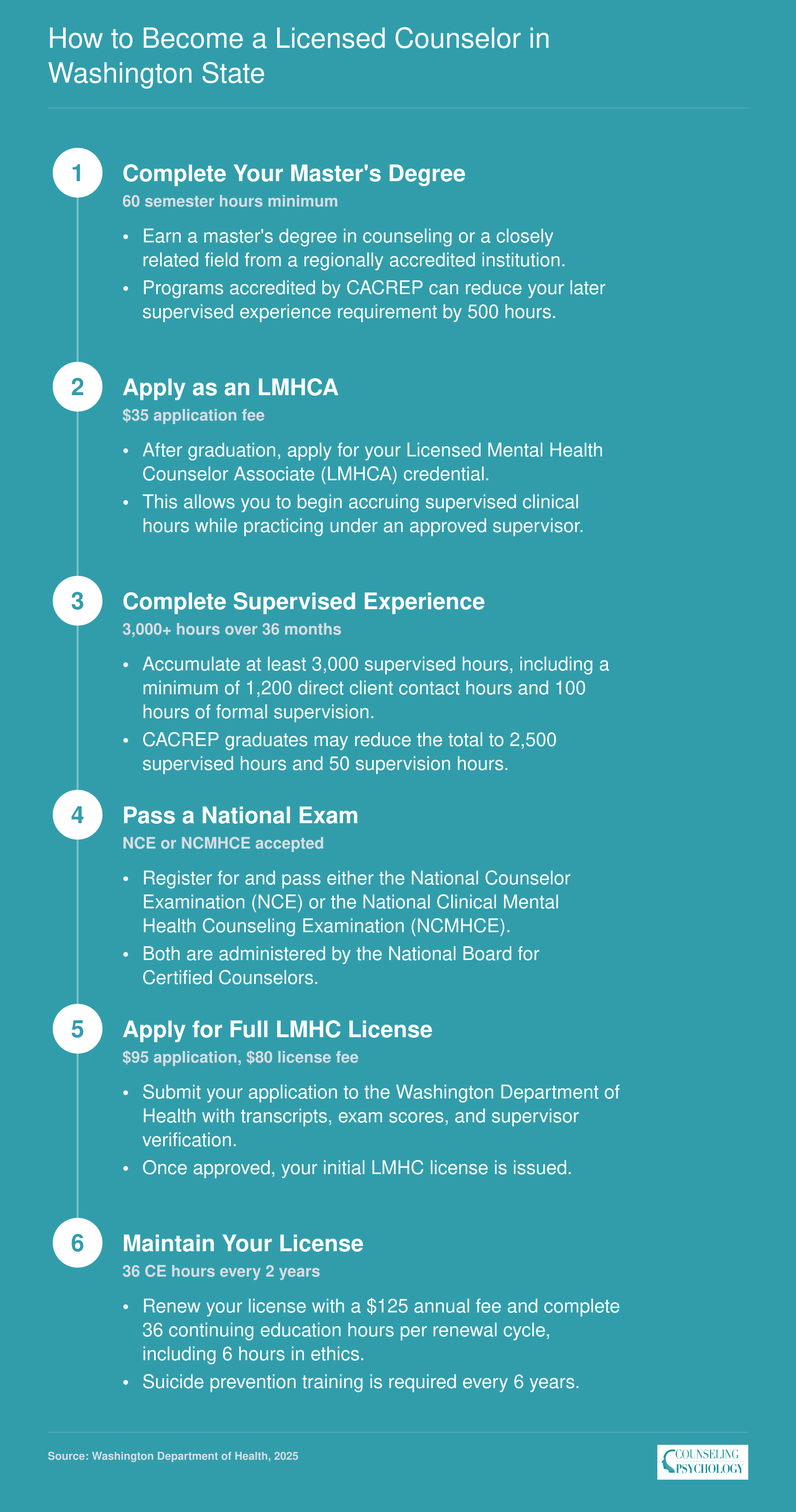
How to Become a Licensed Counselor in Washington State
Earning your Licensed Mental Health Counselor (LMHC) credential in Washington is a structured, multi-stage process overseen by the Department of Health. Note that school counselor certification follows a separate pathway through the Office of Superintendent of Public Instruction (OSPI) and does not require DOH licensure.
Tuition and Financial Aid for Washington Counseling Programs
Tuition for Washington counseling programs ranges widely, from under $5,000 per year at public institutions to more than $24,000 at private universities. However, sticker price rarely tells the full story. Net price, which reflects the average cost after grants and scholarships are applied, is a far more meaningful comparison metric. A school with high published tuition may actually cost less out of pocket once institutional and federal aid are factored in. Also worth noting: the share of students receiving Pell Grants at a given school can signal how accessible that institution is for lower income students. Schools with higher Pell Grant shares tend to have stronger aid packages and more experience supporting students with financial need.
| School | In-State Tuition | Out-of-State Tuition | Net Price (After Aid) | Median Graduate Debt | Pell Grant Recipients |
|---|---|---|---|---|---|
| Edmonds College | $4,810 | $10,875 | $11,010 | $11,855 | 82.2% |
| Eastern Washington University | $14,106 | $29,892 | $13,886 | $19,500 | 63.3% |
| Northwest University (Online and Extended Education) | $15,364 | $15,364 | $35,671 | $20,891 | 58.4% |
| Northwest University | $20,332 | $20,332 | $22,288 | $20,891 | 58.4% |
| Seattle University | $24,216 | $24,216 | $34,662 | $19,883 | 36.9% |
What Counseling Graduates Earn in Washington
What counseling graduates earn after completing their master's degree depends on their license, practice setting, and location within the state. While starting salaries vary, the long-term outlook for mental health professionals in Washington is strong, with demand growing across urban and rural communities. This section breaks down the earnings data available for program completers and compares it to typical debt levels.
Program Earnings Benchmarks
Program-specific earnings data is not yet published for many Washington counseling degrees, but institutional earnings metrics provide a reliable benchmark. Among the ranked schools, median earnings for former students 10 years after entering range from approximately $55,000 at Northwest University to over $75,000 at Seattle University. City University of Seattle alumni see a median around $69,000, and Eastern Washington University grads report about $58,000. While these figures cover all graduates, not just counseling majors, they illustrate the earning potential of institutions with respected counseling programs. As more specialized outcome data becomes available, it will offer a clearer picture, but for now, these numbers align with statewide counseling salaries.
Statewide Salary Data for Counselors
According to the latest Bureau of Labor Statistics data, mental health counselors in Washington earned a median annual wage of $64,220 in 2024.1 In the Seattle-Tacoma-Bellevue metro area, which has a higher cost of living and strong demand, counselors classified as "Counselors, All Other" earned a median of $70,100. These figures represent experienced professionals; entry-level earners typically start lower, while seasoned practitioners and those in private practice can earn well above the median. The state's growing focus on behavioral health and substance use treatment continues to drive salary growth, particularly in community agencies and hospital systems.
LMHC vs. LMFT: Earning Potential
Prospective students often ask whether licensed mental health counselors or licensed marriage and family therapists earn more in Washington. While precise state-specific breakdowns are limited, national patterns hold true locally: LMFTs often command slightly higher fees for couples and family therapy, which is a specialized billing code. Students weighing the MFT route can learn more about how to become a marriage and family therapist before committing. However, licensed mental health counselors have broader eligibility to work in a wider variety of settings, from schools and substance use clinics to employee assistance programs, giving them more diverse employment opportunities and often steadier demand. In practice, the salary difference is modest, and both paths can lead to six-figure incomes with experience and private practice volume.
Debt and Return on Investment
For most Washington counseling programs, median federal student loan debt at graduation falls between $19,000 and $25,000. Seattle University's school counseling program shows a median debt of about $19,883, while CityU's MFT program sits at $25,000. When compared to mid-career earnings that are two to three times higher than annual debt, the return on investment is clear. For example, CityU's debt-to-earnings ratio results in a roughly 2.78x multiplier, meaning that typical earnings quickly outweigh borrowing. Even with modest starting salaries, most graduates can comfortably manage loan payments while building a career in a field with long-term salary growth. Those still exploring their options may want to review the best masters in mental health counseling programs to compare accreditation, outcomes, and cost. Choosing an accredited, high-quality program that aligns with your licensure goals remains the most important factor in maximizing both earnings and personal satisfaction.
Washington counselors earn meaningfully above the national median wage for the occupation, and the state's demand for licensed mental health professionals continues to grow faster than average. If you complete an accredited program and meet licensure requirements, you are entering one of the stronger behavioral health job markets in the country.
Frequently Asked Questions About Counseling Programs in Washington
Prospective counseling students in Washington often have similar questions about cost, accreditation, and licensure. Below are answers to the most common ones, drawing on the program details and career data discussed earlier in this guide.