

What you’ll learn in this article…
- ACGC-accredited genetic counseling master's programs require in-person clinical hours, so no program is fully online.
- Total program costs typically range from $60,000 to $65,000, though in-state tuition can drop below $20,000.
- The national median annual wage for genetic counselors reached $98,910 according to 2024 BLS data.
- About 5,500 board-certified genetic counselors practice in the U.S., with demand rising in precision medicine.
Can you earn a genetic counseling degree mostly online? The Bureau of Labor Statistics projects 18 percent job growth for genetic counselors through 2033, one of the fastest rates in healthcare, and demand for flexible program formats has grown alongside that expansion. Yet a core tension shapes every applicant's search: ACGC accreditation requires supervised clinical fieldwork, so no program is fully remote.
What that means in practice is a hybrid reality. Most programs deliver didactic coursework online while requiring students to complete in-person clinical rotations, often self-arranged, at approved sites near their home. The proportion of online versus on-campus instruction varies considerably from one program to the next.
With roughly 5,500 board-certified genetic counselors currently practicing in the United States, the field remains small and the credentialing pathway is tightly controlled. Graduates must pass the ABGC board exam to enter clinical practice, making program accreditation and clinical preparation non-negotiable factors in any enrollment decision.
Best Online Genetic Counseling Programs
Online and hybrid genetic counseling master's programs have expanded significantly in recent years, making this growing healthcare field more accessible to students nationwide. Programs accredited by the Accreditation Council for Genetic Counseling (ACGC) prepare graduates for board certification through the American Board of Genetic Counseling. The following programs offer flexible online or hybrid delivery formats, combining rigorous didactic coursework with supervised clinical fieldwork placements to meet professional standards.
- Independent program research
- U.S. Department of Education College Scorecard (collegescorecard.ed.gov)
- National Center for Education Statistics (NCES-IPEDS) (nces.ed.gov)
University of Wisconsin-Madison
The University of Wisconsin-Madison brings exceptional academic prestige to its genetic counseling program, housed within one of the nation's leading research universities. With a 90% graduation rate and median earnings of $73,792, UW-Madison consistently produces well-prepared professionals. The program leverages the university's strong genetics research infrastructure and clinical partnerships across Wisconsin's healthcare systems.
- ACGC-accredited master's program with hybrid delivery format
- Access to UW-Madison's world-class genetics research facilities
- Clinical rotations at major academic medical centers
- Strong alumni network in genetic counseling nationwide
- Comprehensive training in prenatal, cancer, and pediatric genetics
- Faculty actively engaged in cutting-edge genomics research
- 90% institutional graduation rate reflects strong student support
MS in Genetic Counseling — Hybrid
University of Connecticut
UConn's genetic counseling program is well-regarded for its rigorous curriculum and strong clinical training opportunities across New England. The university boasts an 83% graduation rate and median alumni earnings of $73,997, among the highest in this ranking. Its selective 52% acceptance rate reflects the quality and competitiveness of the student body.
- ACGC-accredited program with hybrid online and in-person format
- Clinical placements at top New England healthcare facilities
- Integrated coursework in genomics, ethics, and psychosocial counseling
- Faculty with diverse clinical and research specializations
- Training in prenatal, pediatric, cancer, and adult genetics
- Median alumni earnings of $73,997 reflect strong career outcomes
- Access to UConn Health's genetic medicine resources
MS in Genetic Counseling — Hybrid
Arizona State University
Arizona State University's MS in Genetic Counseling offers an innovative hybrid format well-suited to working professionals and distance learners. With in-state tuition of $12,223 and a generous net price averaging around $15,000, ASU provides strong value. The program benefits from ASU's expansive online learning infrastructure and partnerships with healthcare systems throughout the Southwest.
- ACGC-accredited hybrid MS program with online coursework
- In-state tuition of $12,223/yr offers excellent affordability
- Supervised clinical fieldwork at partnered healthcare sites
- Curriculum covers molecular genetics, counseling theory, and ethics
- ASU's robust online platform supports flexible learning schedules
- Training in cancer, prenatal, pediatric, and neurogenetics
- Median institutional debt of $19,500 reflects manageable borrowing
MS in Genetic Counseling — Hybrid
University of South Carolina-Columbia
The University of South Carolina offers a hybrid genetic counseling program that combines distance coursework with required on-campus intensives and clinical placements. With a 79% graduation rate and competitive in-state tuition of $12,688, USC delivers solid value for Southeast residents. The program provides training across a range of clinical specialties within the Prisma Health system and other regional partners.
- ACGC-accredited hybrid program with online didactic components
- Clinical rotations across major South Carolina health systems
- In-state tuition of $12,688/yr provides affordability for SC residents
- Curriculum integrates psychosocial counseling and genomic science
- Training in prenatal, cancer, cardiovascular, and pediatric genetics
- 79% graduation rate demonstrates strong program completion support
- Median alumni earnings of $62,177 reflect competitive outcomes
MS in Genetic Counseling — Hybrid
Boise State University
Boise State University offers an online MS in Genetic Counseling designed for accessibility across geographic boundaries. Its in-state tuition of $9,048 makes it one of the most affordable options on this list. The program emphasizes distance-friendly delivery while coordinating clinical fieldwork placements in students' home regions when possible.
- Online delivery model expands access for students in rural areas
- Among the lowest in-state tuition at $9,048/yr
- ACGC-accredited program meeting national certification standards
- Clinical fieldwork coordinated in students' home communities
- Curriculum covers genetic testing, counseling skills, and ethics
- Prepares graduates for ABGC board certification examination
- Flexible scheduling designed for working professionals
MS in Genetic Counseling (Online) — Online
University of Cincinnati
The University of Cincinnati's genetic counseling program benefits from its location within a major academic medical center and extensive clinical partnerships. UC offers a hybrid format that pairs online learning with clinical rotations at Cincinnati Children's Hospital and UC Health. A 75% graduation rate and reasonable in-state tuition of $13,976 add to the program's appeal.
- ACGC-accredited hybrid program with online coursework options
- Clinical training at Cincinnati Children's Hospital Medical Center
- In-state tuition of $13,976/yr offers strong Midwest value
- Access to UC Health's comprehensive genetic medicine services
- Training spans prenatal, pediatric, cancer, and adult genetics
- 75% graduation rate reflects effective student completion support
- Faculty with active clinical and research portfolios
MS in Genetic Counseling — Hybrid
Kean University
Kean University's MS in Genetic Counseling provides an affordable pathway into the profession, particularly for New Jersey residents with in-state tuition of $14,299. The program uses a hybrid model combining online instruction with clinical experiences at major healthcare facilities throughout the New York metropolitan area. Its location provides access to a dense network of clinical genetics sites.
- ACGC-accredited hybrid program with online didactic coursework
- Clinical rotations at major NYC metro area healthcare systems
- Net price of approximately $12,447/yr enhances affordability
- Comprehensive curriculum in clinical genetics and counseling skills
- Emphasis on diverse and underserved patient populations
- Prepares students for American Board of Genetic Counseling exam
- Growing alumni network in the Northeast region
MS in Genetic Counseling — Hybrid
Southern California University of Health Sciences
SCU Health Sciences offers a focused MS in Genetic Counseling as part of its health sciences mission. With a flat tuition rate of $10,476 regardless of residency, it presents an accessible option for out-of-state students. The program leverages Southern California's extensive healthcare network for diverse clinical placement opportunities.
- Flat tuition of $10,476/yr regardless of in-state or out-of-state status
- Clinical placements across Southern California healthcare systems
- Curriculum integrates genomic medicine and psychosocial counseling
- Health sciences-focused institution with interprofessional opportunities
- Training in prenatal, cancer, pediatric, and pharmacogenomics
- Median alumni debt of $11,400 among the lowest in this ranking
- Small cohort sizes enable personalized faculty mentorship
MS in Genetic Counseling — Hybrid
Indiana State University
Indiana State University offers one of the most affordable genetic counseling programs in the country, with a net price averaging around $10,873. The hybrid program combines online coursework with clinical fieldwork, making it accessible for students throughout the Midwest. ISU's smaller program size allows for close faculty mentorship throughout the training experience.
- Among the most affordable programs with net price around $10,873/yr
- Hybrid delivery combines online learning and clinical rotations
- Small cohort model provides individualized faculty attention
- ACGC-accredited program preparing students for ABGC certification
- Clinical placements arranged across Indiana healthcare systems
- In-state tuition of $10,258/yr supports budget-conscious students
- Comprehensive training in genetic risk assessment and counseling
MS in Genetic Counseling — Hybrid
Bay Path University
Bay Path University offers an MS in Genetic Counseling through a hybrid format that leverages the institution's strong tradition in health sciences education. While tuition runs higher at $40,530, Bay Path alumni report impressive median earnings of $125,557, suggesting strong career return on investment. The program provides clinical training through partnerships with major New England medical centers.
- ACGC-accredited hybrid program with flexible online coursework
- Alumni report median earnings of $125,557 reflecting strong ROI
- Clinical rotations at major New England healthcare institutions
- Curriculum emphasizes genomics, counseling theory, and research
- Small class sizes foster close peer and faculty relationships
- Training across prenatal, cancer, and pediatric genetics specialties
- Prepares graduates for ABGC board certification examination
MS in Genetic Counseling — Hybrid
What Is Genetic Counseling?
The American Board of Genetic Counseling recognizes approximately 5,500 board-certified genetic counselors in the United States, a workforce growing rapidly to meet demand in precision medicine. Genetic counseling is a health profession that helps individuals and families understand their inherited disease risks, interpret genetic test results, and make informed decisions about screening, prevention, and treatment. Genetic counselors translate complex genomic information into actionable guidance, supporting patients through emotionally charged diagnoses and helping them navigate options tailored to their values and medical histories.
Genetic Counselors vs. Geneticists
Genetic counselors are not physicians or laboratory researchers. They hold master's degrees and work directly with patients, often collaborating with medical geneticists who are MDs or PhDs specializing in diagnosis and research. While a medical geneticist might identify the underlying mutation causing a rare disorder, the genetic counselor sits with the family to explain what that mutation means, discuss recurrence risk, and connect them with support resources. This patient-facing role requires deep scientific literacy combined with counseling skills, not bench science or clinical prescribing authority.
Where Genetic Counselors Work
Genetic counselors practice in diverse settings. Hospitals employ counselors in prenatal and pediatric genetics clinics, where they assess risks for chromosomal abnormalities and inherited conditions. Cancer centers rely on counselors to evaluate hereditary cancer syndromes and guide decisions about prophylactic surgery or targeted therapies. Cardiology and neurology departments increasingly integrate genetic counseling for conditions like familial hypercholesterolemia and Huntington disease. Telehealth has opened access to underserved regions, and some counselors work in direct-to-consumer testing companies or pharmaceutical firms developing gene therapies.
A Field in Rapid Evolution
The scope of genetic counseling is expanding beyond traditional prenatal and cancer genetics. Pharmacogenomics, which tailors medication choice and dosing to a patient's genetic profile, is becoming routine in psychiatry and cardiology. Direct-to-consumer test results from companies like 23andMe often prompt referrals to genetic counselors for interpretation. Precision medicine initiatives are embedding genomic data into routine care, and genetic counselors increasingly serve as the bridge between raw sequencing output and meaningful clinical action. This evolution demands counselors stay current with emerging science while maintaining the empathetic, patient-centered focus that defines the profession.
Can You Earn a Genetic Counseling Degree Online?
The short answer is yes, but with an important caveat: no Accreditation Council for Genetic Counseling (ACGC)-accredited program is entirely online. All genetic counseling master's programs require completion of supervised clinical fieldwork hours, which must be done in person. However, several programs now offer online or hybrid coursework, allowing students to complete the majority of their didactic learning remotely.
What Online and Hybrid Formats Look Like
Genetic counseling programs fall into three general delivery categories:
- Fully in-person: All classes and clinical rotations take place on campus. This remains the most common model.
- Hybrid (didactic online, clinicals in person): Coursework is delivered online, but students complete required clinical rotations at affiliated healthcare facilities. Some programs help arrange placements; others expect students to secure their own local sites.
- Distance-friendly hybrid: Similar to hybrid, but designed specifically for students who live far from the main campus. Students typically arrange clinical experiences in their own geographic area, with program approval.
Programs Offering Online and Hybrid Options
As of 2026, a growing number of ACGC-accredited programs have launched online or hybrid tracks.1 Examples include:
- Southern California University of Health Sciences (100% online coursework)2
- University of Connecticut (competency-based, online didactic model)3
- Boise State University (distance-delivered master's)1
- Medical University of South Carolina1
- Bay Path University (distance-education model)1
- Augustana University (hybrid format)1
This list is not exhaustive, and program formats continue to evolve. Always verify the current delivery method and accreditation status on the ACGC program directory before applying.
The Clinical Hour Reality
Even in programs labeled "online," students must complete at least 500 supervised clinical hours.1 This means you'll need to be physically present at approved clinical sites, often located in a variety of healthcare settings such as prenatal, pediatric, cancer, or specialty genetics clinics. If you enroll in a distance-friendly hybrid program, you'll typically work with the program to identify qualified supervisors near your home, but availability is not guaranteed. Proximity to a major medical center with genetic counseling services will greatly improve your chances of fulfilling this requirement.
So while you can earn your genetic counseling degree largely online, the hands-on clinical component is not optional. It's a cornerstone of the profession, mandated by accreditation standards and necessary for board certification eligibility.
Online Vs. Hybrid Vs. In-Person Genetic Counseling Programs
No fully asynchronous online genetic counseling program exists today, and that is unlikely to change as long as hands-on clinical training remains central to accreditation.1 Understanding the real differences among the three delivery formats will help you choose the path that fits your life without sacrificing the credentials you need.
Fully In-Person Programs
Traditional on-campus programs concentrate all coursework, lab sessions, and clinical rotations in and around the university's home city. Students benefit from daily face-to-face interaction with faculty and cohort members, and clinical placements are typically arranged through established institutional partnerships. This format suits applicants who can relocate and prefer a structured campus experience. Most in-person programs run 21 to 24 months.
Hybrid Programs
Hybrid programs split the curriculum between online didactic coursework and required on-campus intensives, which may occur several times per semester or in concentrated weekend blocks. Clinical rotations still take place in person, often at sites near the university. Cohort interaction blends virtual discussion with periodic face-to-face residencies. This format works well for students who live within reasonable travel distance of the institution but need some scheduling flexibility.
Distance-Friendly Hybrid Programs
These programs deliver the largest share of coursework online while requiring students to complete clinical hours at approved sites, sometimes in or near their home communities.2 This model represents the ceiling for online accessibility in genetic counseling education. For students in rural or underserved areas, the ability to arrange local clinical placements can be transformative: it removes the need to relocate and often introduces genetic counseling services to communities that lack them. Program length typically mirrors the standard 21-to-24-month timeline, though some students take slightly longer to secure and complete clinical rotations in less densely served regions.
How to Compare Formats
Across all three delivery modes, programs hold accreditation from the Accreditation Council for Genetic Counseling and prepare graduates for the same American Board of Genetic Counseling certification exam.1 There is no evidence that salary or employment outcomes differ based on format. When evaluating your options, weigh these dimensions:
- Flexibility: Distance-friendly hybrids offer the most scheduling latitude; in-person programs offer the least.
- Clinical logistics: In-person and standard hybrid programs typically pre-arrange placements, while distance-friendly hybrids may ask you to help identify local sites.
- Cohort connection: In-person cohorts bond daily; hybrid and distance cohorts rely more on virtual collaboration, supplemented by intensive residency weekends.
- Best fit: In-person suits relocators and campus-oriented learners. Standard hybrid fits regional students who want partial flexibility. Distance-friendly hybrid serves working professionals, military-connected students, and those committed to practicing in underserved areas.
The bottom line: your format choice should be driven by geography, life circumstances, and clinical-site access, not by concerns about credential quality.
All ACGC-accredited genetic counseling programs mandate supervised clinical hours, meaning hands-on patient interaction cannot be bypassed, even if most courses are online. Before applying to any hybrid program, verify that clinical placement sites are accessible and approved in your location. Without a local site, completion of degree requirements may be jeopardized.
Accreditation: Why ACGC Approval Matters
If there is one factor that can make or break your genetic counseling career before it even starts, it is programmatic accreditation. The Accreditation Council for Genetic Counseling (ACGC) is the sole recognized accrediting body for genetic counseling master's programs in the United States and Canada.1 Graduating from a program that does not hold ACGC accreditation disqualifies you from sitting for the American Board of Genetic Counseling (ABGC) certification exam, the credential most employers require and most states reference in their licensure laws. There is no workaround for this requirement.
How Many Programs Are ACGC-Accredited?
As of 2026, the number of ACGC-accredited genetic counseling programs has grown to roughly 60 or more across the U.S. and Canada, and that number continues to climb as new programs launch to meet surging demand for genetic counselors.2 Programs like those at Indiana University's Genetic Counseling Graduate Program, Kean University, and the University of Utah Genetic Counseling Program hold full ACGC accreditation, meaning their graduates are eligible to pursue board certification immediately upon completing degree requirements.
However, not every program listed in an ACGC directory is at the same stage. The ACGC recognizes several status categories:1
- Accredited: Fully approved programs whose graduates qualify for the ABGC exam.
- Accredited New Program/Provisional: Programs that have received initial accreditation but are still establishing a track record. Graduates of provisionally accredited programs are generally eligible for the board exam, but you should confirm this directly.
- Developing Status: Programs that are working toward accreditation but have not yet achieved it. Graduates of developing programs typically cannot sit for the ABGC exam.
The distinction between provisional and developing status matters enormously. A program in developing status may look polished on its website and accept tuition dollars, yet its graduates could find themselves unable to obtain the certification needed for employment.
Always Verify Directly
Before committing to any genetic counseling program, verify its current accreditation status on the ACGC website.2 Program status can change between application cycles, and marketing materials do not always reflect the most recent designation. The ACGC maintains a searchable directory of all programs and their current standing.
Regional Accreditation Still Counts
Programmatic accreditation through the ACGC is the non-negotiable gatekeeper, but the university itself should also hold regional (now called institutional) accreditation. Institutional accreditation is what makes you eligible for federal financial aid, ensures your credits can transfer, and signals that the university meets baseline academic standards. A program housed at a school without institutional accreditation could jeopardize both your funding and your ability to use that degree elsewhere. Think of it as two layers of quality assurance: institutional accreditation covers the university, and ACGC accreditation covers the specific genetic counseling program. You need both.
Genetic Counseling Program Costs, Financial Aid, and ROI
Total program costs for accredited genetic counseling master's programs typically fall between $60,000 and $65,000, but vary widely by institution and residency status.1 For example, the University of South Florida charges about $19,400 for in-state students and $41,500 for out-of-state students2, while the University of Connecticut ranges from roughly $49,000 in-state to over $87,000 out-of-state.3 Indiana University's 2025, 2026 tuition sits at $22,956 in-state and $58,476 out-of-state4, and UNC Greensboro (2023, 2024) totals $26,013 in-state versus $58,148 out-of-state.5 These figures show that public in-state options can cut total costs by half or more compared to out-of-state or private alternatives.
Financial Aid and Scholarships
Multiple funding sources exist specifically for genetic counseling students. Institutional aid includes merit scholarships like Indiana University's $5,000 annual award or UConn's program-level $2,000 scholarship and the Crandall Fellowship worth $20,000.34 Nationally, the National Society of Genetic Counselors (NSGC) offers competitive scholarships, and the Jane Engelberg Memorial Fellowship provides research or project funding. Graduate assistantships, though not guaranteed, can offset tuition through stipends and fee waivers at many campuses. Most students also rely on federal Direct Unsubsidized Loans, with an annual limit of $20,500 for graduate students and a $100,000 aggregate cap.1 Genetic counseling falls under standard graduate loan limits rather than the higher professional school caps, so careful borrowing is essential. Students exploring other counseling degrees should note that loan limits apply similarly across most master's-level counseling fields.
Return on Investment and Loan Repayment
The investment compares favorably to starting salaries in the field. The U.S. Bureau of Labor Statistics reports a national median annual wage for genetic counselors above $95,000, with early-career earnings often exceeding $75,000. Even if a student finances the entire $60,000 to $65,000 typical program cost, standard 10-year repayment installments would absorb a manageable share of monthly income. Many graduates report debt loads lower than total tuition thanks to scholarships, and the strong job market keeps unemployment for the profession extremely low. The NSGC's Cost of Entry analysis reinforces that while upfront costs are significant, genetic counseling offers a steady path to financial stability.1
Reducing Costs Through Program Choice
Shorter program formats can lower both direct and opportunity costs. Some accelerated tracks run 21 months instead of 24, allowing graduates to enter the workforce sooner. Hybrid or online components also let students maintain part-time employment during didactic phases, reducing lost income. Choosing a public, in-state program remains the single most powerful cost-reduction strategy, but students should also weigh the total expense against potential regional salary differences when planning their career.
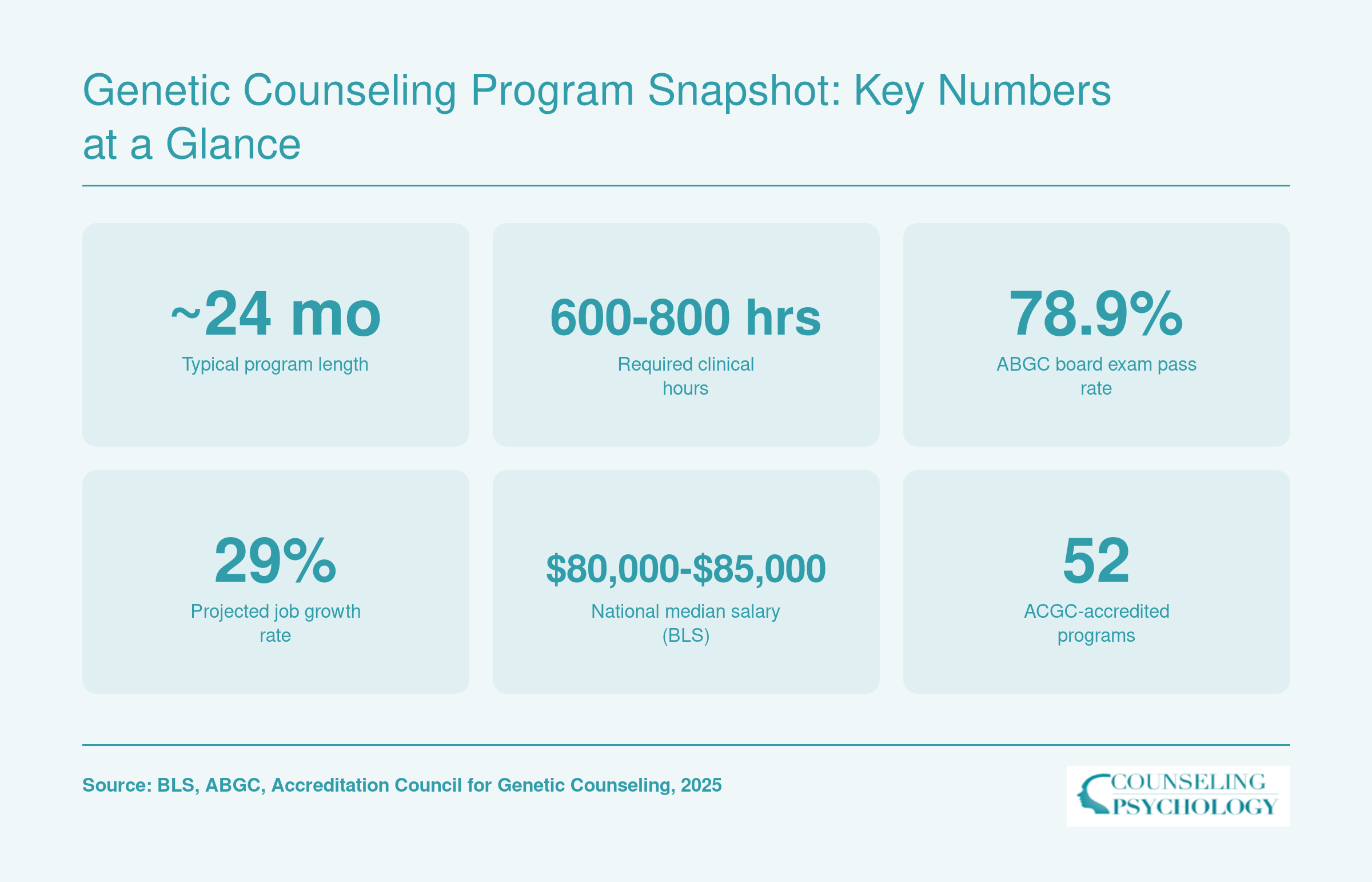
Genetic Counseling Program Snapshot: Key Numbers at a Glance
Before you commit to a genetic counseling master's program, these benchmarks can help you evaluate cost, timeline, and career payoff. All figures reflect the most recent data available from federal agencies and credentialing bodies.
How to Choose the Right Genetic Counseling Program
A program that offers maximum scheduling flexibility may provide minimal clinical placement support, while one with a rigid cohort model might hand you a fully arranged rotation calendar. Understanding these trade-offs is the first step toward making a smart decision. With roughly half of ranked applicants matching to a program in the national match process and an overall admission rate near 30%, every application slot matters.1 Narrowing your list with clear criteria saves time and strengthens each submission.
Five Criteria That Should Drive Your Decision
Organize your research around these pillars:
- Format and flexibility: Determine whether you need a fully online, hybrid, or in-person structure and confirm the program can accommodate your location and schedule.
- Clinical placement support: This is a major differentiator. Some programs arrange every clinical rotation for you at affiliated hospitals and clinics. Others, especially those designed for distance learners, expect students to identify and secure local sites on their own. Ask each program exactly how placements work before you apply.
- Cost and financial aid: Tuition varies widely. Inquire about assistantships, stipends, and scholarships earmarked for genetic counseling students, because even small funding differences compound over a two-year program.
- Specialization tracks: If you already know you want to focus on prenatal, cancer, pediatric, or laboratory and industry genetics, look for programs that offer dedicated coursework or rotations in those areas.
- Outcomes: Board pass rates, graduation rates, and job placement percentages tell you how well a program prepares its graduates. For context, the University of Utah reports a 97% job placement rate, a 100% graduation rate, and an 89% ABGC board exam pass rate, with an average class size of about 10 students.2
Clinical Placements Deserve Extra Scrutiny
Clinical hours are the backbone of genetic counseling education, and how a program manages them can shape your entire experience. Programs affiliated with academic medical centers often rotate students through multiple specialty clinics under one roof. Distance-friendly programs may require you to cultivate relationships with local genetics providers, which adds logistical effort but can also let you train closer to home. Either model can work well; the key is knowing which one you are signing up for.
What Admissions Committees Actually Value
Programs typically require a minimum GPA around 3.0 and prerequisite courses in genetics, biochemistry, psychology, and statistics.3 Both the University of Washington and UCSF list similar foundational requirements.4 However, GPA alone rarely determines admission. Programs consistently emphasize patient-facing experience, including crisis counseling, patient advocacy, disability services, teaching, and genetic counseling shadowing hours, as the experiences that set competitive applicants apart.
Ask for the Data Programs Are Required to Share
Accredited programs must publish outcome data, including ABGC board exam pass rates and employment statistics. Not all programs display this information prominently on their websites, so request it directly from each admissions office. Comparing these numbers side by side gives you an objective benchmark that cuts through marketing language and helps you evaluate whether a program truly delivers on its promises.
Questions to Ask Yourself
Genetic Counseling Program Curriculum and Clinical Requirements
Balancing rigorous academic coursework with hands-on clinical training is the central challenge of any genetic counseling program, and how you navigate both components will shape your readiness for board certification and professional practice.
Core Curriculum Structure
Most ACGC-accredited programs follow a structured curriculum spanning 20 to 24 months. Core coursework typically covers:
- Molecular and Clinical Genetics: Foundational science courses exploring chromosomal abnormalities, inheritance patterns, and emerging genomic technologies.
- Psychosocial Counseling: Training in communication techniques, grief counseling, and patient-centered care that prepares you to support families navigating difficult diagnoses.
- Ethics and Professional Practice: Case-based exploration of informed consent, genetic discrimination, privacy regulations, and the evolving legal landscape.
- Research Methods and Statistics: Coursework in study design, data interpretation, and evidence-based practice, which proves especially valuable if you pursue research or academic roles.
Beyond core requirements, many programs offer elective specialization tracks. You might focus on cancer genetics, cardiovascular genomics, or neurogenetics depending on your career goals and the program's faculty expertise.
Clinical Training Requirements
Clinical rotations form the backbone of your professional preparation. Most programs require a minimum of 500 direct patient-contact hours, though many students accumulate 700 to 1,000 hours before graduation. These rotations typically begin in the second year and rotate through multiple specialty areas:
- Prenatal and reproductive genetics
- Pediatric genetics and metabolic disorders
- Cancer risk assessment and hereditary syndromes
- General adult genetics and specialty clinics
You will work alongside certified genetic counselors, medical geneticists, and interdisciplinary care teams in hospitals, outpatient clinics, and telehealth settings. This variety ensures you graduate with broad competencies across patient populations. Students interested in adjacent helping professions, such as those exploring how to become a counselor, will recognize the same emphasis on supervised clinical hours as a pathway to licensure.
Prerequisite Variability
Admission prerequisites vary significantly by program. Some require completed coursework in biochemistry, statistics, psychology, and genetics before matriculation. Others accept related science backgrounds or permit co-requisite enrollment during your first semester. Review each program's specific requirements carefully, as missing prerequisites can delay your start date by a full academic year.
Capstone and Thesis Options
Many programs require a culminating research project, thesis, or capstone experience. This component builds credentials for students interested in laboratory-based industry roles, academic positions, or doctoral study. Even if you plan to enter clinical practice directly, completing original research strengthens your evidence-appraisal skills and distinguishes you in a competitive job market.
Certification, Licensure, and Career Outcomes for Genetic Counselors
The Certified Genetic Counselor (CGC) credential, awarded by the American Board of Genetic Counseling (ABGC), is the single most important professional milestone after completing your degree. Without it, most employers will not consider you for clinical positions, and an increasing number of states now require it as a prerequisite for licensure.
The Credentialing Pathway
The route from student to practicing genetic counselor follows a clear sequence:
- Graduate from an ACGC-accredited program: Only graduates of programs accredited by the Accreditation Council for Genetic Counseling are eligible to sit for the board exam.
- Pass the ABGC certification exam: This comprehensive exam tests clinical knowledge, psychosocial counseling skills, and case management competencies. Most graduates take it within a few months of completing their degree.
- Earn the CGC designation: Passing the exam grants you the Certified Genetic Counselor credential, which must be maintained through continuing education.
- Obtain state licensure where required: As of 2025, more than 30 states require genetic counselors to hold a state license. Some states accept ABGC certification as sufficient evidence of competence, while others impose additional application steps, fees, or supervised practice hours. Always verify requirements in the state where you plan to work.
This credentialing sequence shares structural similarities with other counseling careers, where graduation from an accredited program, a national exam, and state licensure form the standard path to practice.
Career Paths and Where the Growth Is
Genetic counselors work across a surprisingly broad range of settings, and the field continues to diversify.
- Clinical roles: Hospitals, academic medical centers, prenatal clinics, and oncology programs remain the traditional home base. You might specialize in cancer genetics, pediatric genetics, cardiovascular genetics, or reproductive counseling.
- Industry positions: Pharmaceutical companies, biotech firms, and genetic testing laboratories are hiring genetic counselors at a growing pace. These roles often center on variant interpretation, medical affairs, product development, or clinical trial design. Industry positions frequently offer higher compensation than clinical settings.
- Research and education: Some counselors contribute to genomics research or move into faculty roles at training programs, helping educate the next generation.
Industry roles have been expanding fastest over the past several years, driven by the surge in direct-to-consumer genetic testing and precision medicine initiatives. If you are drawn to the intersection of science and business, this is a career path worth watching closely.
Salary and Job Placement
Compensation for genetic counselors is strong and continues to trend upward. According to BLS data, the national median annual wage for genetic counselors was approximately $98,910 as of 2024, with a median hourly wage of $47.55.1 The range is wide depending on experience, specialty, and setting:
- 10th percentile: roughly $72,530
- 25th percentile: roughly $83,380
- 75th percentile: roughly $108,090
- 90th percentile: roughly $132,190
These percentile figures are drawn from the BLS Occupational Employment and Wage Statistics for May 2023 and will vary by state and employer type.2 Entry-level genetic counselors can expect a mean starting salary of about $81,373, according to 2024 survey data.3 Industry roles, particularly at large biotech or pharmaceutical companies, often push compensation well above the 75th percentile.
Job placement rates add further confidence. NSGC Professional Status Survey data consistently shows that the vast majority of genetic counseling graduates, typically 90% or more, secure employment within a year of finishing their program. The field is also projected to grow at about 9% over the 2024 to 2034 period, which is faster than average for all occupations.1
Taken together, the credentialing pathway is straightforward, compensation is competitive from day one, and demand shows no signs of slowing. If you complete an accredited program and pass the board exam, you are entering a profession with unusually strong career security.
Genetic Counselor Salary by State
Where you practice has a major impact on what you earn as a genetic counselor. The Bureau of Labor Statistics reports a national median annual wage of $98,910 for genetic counselors (2024), but state-level mean wages range widely, with the top-paying states clustering on the coasts and in the Northeast.1
Top 10 Highest-Paying States for Genetic Counselors
The figures below come from the BLS Occupational Employment and Wage Statistics program (2023, the most recent state-level release). Wages shown are mean annual figures, not medians, and employment counts reflect total genetic counselors employed in each state.1
- California: $138,540 mean annual wage, 370 genetic counselors employed
- Connecticut: $112,060 mean annual wage, 50 employed
- Vermont: $107,220 mean annual wage, 40 employed
- Colorado: $105,500 mean annual wage, 50 employed
- New Jersey: $101,970 mean annual wage, 70 employed
- Massachusetts: $99,810 mean annual wage, 200 employed
- Minnesota: $93,500 mean annual wage, 160 employed
- District of Columbia: $93,230 mean annual wage, 40 employed
- New York: $93,050 mean annual wage, 330 employed
- Pennsylvania: $86,100 mean annual wage, 330 employed
Pay vs. Job Concentration
Notice the gap between where pay is highest and where jobs are concentrated. California leads on both fronts, but Vermont, Colorado, and DC pay well while supporting only 40 to 50 positions each. Larger employment hubs like New York, Pennsylvania, Minnesota, and Massachusetts offer more openings but sit in the middle of the pay range. If you want flexibility to job-hop or specialize, the higher-employment states give you more room to maneuver. For a broader look at compensation trends across the profession, see our counselor salary by state breakdown.
Cost of Living Changes the Picture
A $138,540 salary in California stretches very differently than a $107,220 salary in Vermont. Housing, state income taxes, and commuting costs can erase nominal pay advantages quickly. Before weighing a job offer in a high-wage state, run the numbers against a cost-of-living calculator and factor in your loan repayment timeline. In several lower-ranked states, the real purchasing power of a counselor's salary actually exceeds what you'd net in the top-paying metros.
Frequently Asked Questions About Genetic Counseling Programs
Prospective students often have similar questions about the path to becoming a genetic counselor. Below are direct, practical answers to the most common concerns about program format, cost, admissions, and career preparation.
Explore Programs
Explore Programs
- Best Online Addiction Counseling Degree
- Best Online Bachelor's in Counseling Degrees
- Best Online Biblical Counseling Degree
- Best Online Clinical Mental Health Counseling
- Best Online Licensed Professional Clinical Counseling
- Best Online Master's in Counseling
- Best Online MFT
- Best Online Pastoral Counseling
- Best Online Ph.D. in Counseling
- Best Online School Counseling
- Counseling vs Psychology vs Social Work