
What you’ll learn in this article…
- At least five different abbreviations (LPC, LPCC, LMHC, LCPC, LCMHC) can all refer to the same licensed professional counselor role depending on your state.
- Credentials follow a strict listing order: highest degree first, then licenses, then national certifications, then exams passed.
- School counselors hold education department certificates (LSC, CSC) that are separate from clinical mental health licenses like the LPC or LMHC.
- National certifications such as the NCC are voluntary and portable, while state issued licenses are mandatory for independent clinical practice.
Across the United States, a licensed professional counselor practicing in Virginia uses the acronym LPC, while the same credential in Massachusetts carries the title LMHC and in Illinois becomes LCPC. Add national certifications like NCC and CCMHC, qualifying exams like the NCE and NCMHCE, and specialty designations layered on top, and the total number of active counseling abbreviations easily exceeds two dozen.
The confusion is not a beginner's problem. Seasoned clinicians regularly misread job postings, list credentials in the wrong order, or assume a national certification substitutes for a state license. The practical stakes are real: using an incorrect title on a billing form or a clinical record can trigger a licensing board complaint.
State legislatures name their own licenses independently, credentialing bodies operate on separate renewal cycles, and qualifying exams serve different purposes depending on jurisdiction. No single authoritative list covers every variation, which is why practitioners and students alike consistently find the credential system harder to parse than the clinical training itself.
Quick-Reference Table of Counseling Acronyms
Counseling credentials are the official letters that appear after a practitioner's name, and each one signals a specific level of training, a licensing authority, or an examination requirement. Understanding what those letters actually mean helps you choose the right educational path, communicate your qualifications accurately, and make sense of what clients, employers, and licensing boards expect.
State Licenses: The Credentials That Authorize Practice
State licenses are the most consequential credentials because they legally permit a counselor to practice independently. These vary by state, which is why the same job can carry different initials depending on where a clinician works.1
- LPC (Licensed Professional Counselor): A master's-level mental health professional licensed by a state board to provide counseling and psychotherapy to individuals, couples, families, and groups. Awarded after completing supervised experience and passing a qualifying exam such as the NCE.2
- LPCC (Licensed Professional Clinical Counselor): Used in states including California, Minnesota, Kentucky, Ohio, and New Mexico, this credential authorizes independent clinical practice, including diagnosis and treatment of mental and emotional disorders, and often permits supervision of other counselors.2
- LMHC (Licensed Mental Health Counselor): The standard license in states such as Florida, Indiana, Massachusetts, New York, and Washington, granted to counselors with a master's degree who provide assessment and treatment across a wide range of mental and emotional conditions.1
- LCSW (Licensed Clinical Social Worker): A master's-level social worker who has completed clinical supervision hours and a state examination, authorized to provide psychotherapy and diagnose mental disorders.1
- LMFT (Licensed Marriage and Family Therapist): A master's- or doctoral-level clinician licensed to assess, diagnose, and treat mental and relational disorders with a primary focus on couples and family systems.1 If you are pursuing this credential, it helps to understand LMFT supervision hours requirements early in your planning.
National Certifications and Qualifying Exams
Not every acronym represents a state license. Some reflect voluntary national certifications that demonstrate advanced competency, while others name the examinations counselors must pass to earn a license or certification.
- NCC (National Certified Counselor): A voluntary, nationally recognized certification from the National Board for Certified Counselors (NBCC), awarded to counselors who meet graduate education, supervised experience, and examination requirements and agree to NBCC's code of ethics.3
- NCE (National Counselor Examination for Licensure and Certification): A standardized multiple-choice exam developed by NBCC that many states accept for initial counselor licensure and that also serves as the primary examination for the NCC credential.4
Why the Same Role Can Have Different Letters
Because licensure is regulated at the state level, there is no single national license for professional counselors. A counselor in New York holds an LMHC, while an equally qualified colleague in Texas holds an LPC, and one in California may hold an LPCC. The underlying training requirements are often similar, but the credential names differ. If you are still deciding between counseling, psychology, or social work, sorting out these acronyms early can save significant confusion. Keeping a reference like this table handy prevents mix-ups when you are comparing programs, reading job postings, or verifying supervision requirements in a new state.
Licenses Vs. Certifications Vs. Exams: Why the Category Matters
Job seekers scrolling through counseling openings often see a string of acronyms in the requirements line and assume all credentials work the same way. They do not. Understanding whether a given abbreviation refers to a license, a certification, or an exam changes how you plan your career timeline, where you can work, and which credential you actually need to accept an offer.
Three Categories, Three Functions
A license is a state-issued authorization that legally permits you to practice as a counselor within that state's borders. Without it, you cannot bill insurance, hold yourself out as a licensed professional, or use the protected title (such as Licensed Professional Counselor). Examples include LPC, LMHC, LCPC, and LMFT. Each state sets its own requirements for coursework, supervised hours, and examination.
A certification is a voluntary credential issued by a national organization, most commonly the National Board for Certified Counselors (NBCC). The flagship example is the NCC (National Certified Counselor). Earning an NCC demonstrates that you meet a standardized national benchmark, but it does not authorize independent practice or replace a state license. Certifications enhance your resume and may satisfy certain job or reimbursement requirements, but they carry no legal authority to practice.
An exam is neither a license nor a certification. It is the test you must pass to earn one of those credentials. The NCE (National Counselor Examination) is an exam. Passing it is typically a prerequisite for both state licensure and the NCC certification, but passing the NCE alone does not grant you any credential. You still need to submit an application, meet supervision and coursework standards, and pay fees to the issuing body.
A Concrete Example Chain
You complete your master's degree in clinical mental health counseling, log 3,000 hours of supervised practice, and register to take the NCE. You pass. You then apply to your state board, which reviews your transcripts and supervision logs and issues your LPC license. Months later, you decide to apply for NCC certification through NBCC. Because you already passed the NCE and hold a state license, NBCC approves your application and you add NCC after your name. One exam, two credentials.
Why the Distinction Matters for Job Seekers
Some employers require a specific state license because they need you to bill Medicaid or provide services under a state contract. Others accept national certifications like NCC in lieu of licensure if the role is purely educational or advisory. Misreading the category can lead you to apply for jobs you are not yet eligible for, or to skip postings you could have filled.
Licenses are not portable across state lines unless reciprocity or compact agreements exist. If you hold an LPC in Ohio and move to California, you must apply for California licensure, which may require additional coursework or exams. National certifications like NCC are recognized nationwide, which makes them valuable if you plan to relocate, work remotely across state lines, or pursue federal or military counseling roles that honor national standards. For anyone still mapping out the full path from education to credential, our guide on how to become a counselor covers each milestone in detail.
Knowing which category an acronym belongs to helps you decode job listings, plan your application timeline, and avoid confusion when a posting asks for "LPC or NCC." The two are not interchangeable, but understanding their relationship lets you navigate requirements with confidence.
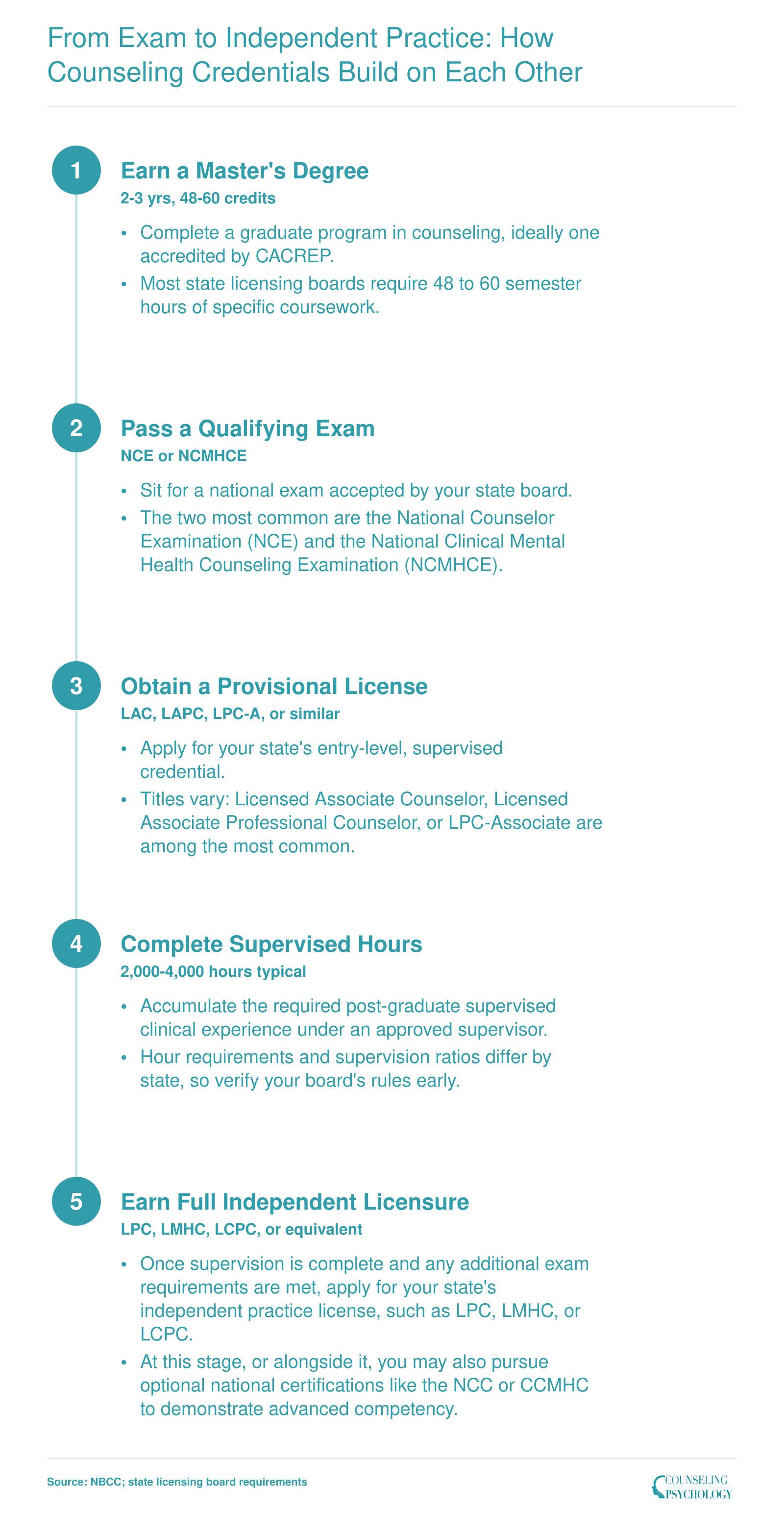
From Exam to Independent Practice: How Counseling Credentials Build on Each Other
Every state structures its counseling credential pathway slightly differently, but the core progression follows a predictable ladder. Understanding where each acronym falls on that ladder helps you plan your timeline and avoid surprises.
Common Licensed Counselor Abbreviations Explained
The "Big Six" Licensed Counselor Acronyms
When you explore clinical counseling careers, you encounter a handful of acronyms that dominate the field. Each indicates a state-issued license to practice mental health counseling. Here are the six most common:
- Licensed Professional Counselor (LPC): The most common title, used in about half of U.S. states. LPCs provide mental health counseling, assessment, and psychotherapy to individuals and groups.
- Licensed Professional Clinical Counselor (LPCC): A two-tier credential, primarily in California, Ohio, and Kentucky. The "clinical" marker signals independent scope after supervised post-degree hours are completed.
- Licensed Clinical Professional Counselor (LCPC): The independent-level license in Maine, Maryland, Illinois, and a few other states. It parallels the LPCC, indicating full clinical authority after supervision.
- Licensed Mental Health Counselor (LMHC): Often used in Florida, Iowa, Massachusetts, New York, and Washington. It is functionally identical to LPC, with the same scope and the same master's degree requirements, just a different name.
- Licensed Clinical Mental Health Counselor (LCMHC): Used in New Hampshire, Rhode Island, Utah, and Vermont. The "clinical" addition typically denotes the independent level in two-tier states, but in some it is the initial license.
- Licensed Independent Mental Health Practitioner (LIMHP): Nebraska's unique title for a fully independent clinical counselor. It carries the same scope as LPC in other states.
Each acronym reflects state law, not a national standard, which is why counseling credentials can seem confusing. Always verify the specific title used by your state's licensure board.
The Clinical Distinction: Two-Tier Licensure
In many states, the path to independent practice is two-step. You first earn a provisional or associate license, often designated with a "P" or "A" suffix, that allows you to work under supervision. After completing 1,500 to 4,000 supervised hours (depending on the state), you apply for the independent clinical license. The "C" in LPCC and LCPC stands for that clinical, independent status. Earning a licensed professional clinical counselor degree means you can diagnose, treat, and open a private practice without oversight. Without the "C," the acronym usually refers to a supervised-level credential (e.g., LPC in some states is the initial credential, while in others it is the full license; state rules vary, so always check). This two-tier system ensures that newly licensed counselors have structured mentorship before taking full responsibility for client care.
Nebraska's LIMHP: Same Scope, Unique Title
Nebraska stands out with a title that explicitly says "independent" and "mental health practitioner." Despite the different wording, the LIMHP is the state's equivalent of the LPC or LMHC independent license found elsewhere. LIMHPs hold a master's in counseling, pass the National Counselor Examination (NCE) or the National Clinical Mental Health Counseling Examination (NCMHCE), and complete 3,000 hours of post-degree supervised practice. They can diagnose and treat mental disorders, open private practices, and receive insurance reimbursement. If you plan to practice in Nebraska, you'll pursue the LIMHP; in any other state, you'll seek the local counterpart.
LPC vs. LMHC: Different Names, Identical Practice
One of the most persistent myths is that LPC and LMHC represent different levels of training or expertise. In reality, they are two names for the same profession. States that use LPC do so because their licensing law names the profession "professional counseling," while states that use LMHC call it "mental health counseling." The educational requirements (CACREP-accredited master's, specific coursework), national exam pass, and supervised hours are virtually identical. The choice of acronym is a historical and legislative accident, not a quality signal. When you see a clinician with either credential, you are seeing a fully qualified community mental health counselor.
Questions to Ask Yourself
State-By-State Counselor License Names and Abbreviations
The title a licensed counselor uses after their name depends entirely on which state issued the license, and no single abbreviation covers every jurisdiction.
Why License Titles Vary by State
Each state legislature independently names its counseling license, which is why a clinician doing identical work might be a Licensed Professional Counselor (LPC) in Texas, a Licensed Mental Health Counselor (LMHC) in New York, a Licensed Clinical Professional Counselor (LCPC) in Illinois, or a Licensed Mental Health Practitioner (LMHP) in Nebraska. The scope of practice attached to each title is often similar, but the abbreviation on the wall certificate and insurance panels differs. Assuming your home-state abbreviation translates directly when you relocate is a mistake that can delay billing and board endorsement. If you are still exploring the path to licensure, our guide on how to become a mental health counselor outlines the general steps that apply in most states.
A Snapshot of Primary License Titles Across the Country
The following list covers the full independent clinical counseling license in each state, not provisional or associate-level credentials:
- Alabama: Licensed Professional Counselor (LPC)
- Alaska: Licensed Professional Counselor (LPC)
- Arizona: Licensed Professional Counselor (LPC)
- Arkansas: Licensed Professional Counselor (LPC)
- California: Licensed Professional Clinical Counselor (LPCC)
- Colorado: Licensed Professional Counselor (LPC)
- Connecticut: Licensed Professional Counselor (LPC)
- Delaware: Licensed Professional Counselor of Mental Health (LPCMH)
- Florida: Licensed Mental Health Counselor (LMHC)
- Georgia: Licensed Professional Counselor (LPC)
- Hawaii: Licensed Mental Health Counselor (LMHC)
- Idaho: Licensed Professional Counselor (LPC)
- Illinois: Licensed Clinical Professional Counselor (LCPC)
- Indiana: Licensed Mental Health Counselor (LMHC)
- Iowa: Licensed Mental Health Counselor (LMHC)
- Kansas: Licensed Clinical Professional Counselor (LCPC)
- Kentucky: Licensed Professional Clinical Counselor (LPCC)
- Louisiana: Licensed Professional Counselor (LPC)
- Maine: Licensed Clinical Professional Counselor (LCPC)
- Maryland: Licensed Clinical Professional Counselor (LCPC)
- Massachusetts: Licensed Mental Health Counselor (LMHC)
- Michigan: Licensed Professional Counselor (LPC)
- Minnesota: Licensed Professional Clinical Counselor (LPCC)
- Mississippi: Licensed Professional Counselor (LPC)
- Missouri: Licensed Professional Counselor (LPC)
- Montana: Licensed Clinical Professional Counselor (LCPC)
- Nebraska: Licensed Mental Health Practitioner (LMHP)
- Nevada: Licensed Clinical Professional Counselor (LCPC)
- New Hampshire: Licensed Clinical Mental Health Counselor (LCMHC)
- New Jersey: Licensed Professional Counselor (LPC)
- New Mexico: Licensed Professional Clinical Counselor (LPCC)
- New York: Licensed Mental Health Counselor (LMHC)
- North Carolina: Licensed Clinical Mental Health Counselor (LCMHC)
- North Dakota: Licensed Professional Clinical Counselor (LPCC)
- Ohio: Licensed Professional Clinical Counselor (LPCC)
- Oklahoma: Licensed Professional Counselor (LPC)
- Oregon: Licensed Professional Counselor (LPC)
- Pennsylvania: Licensed Professional Counselor (LPC)
- Rhode Island: Licensed Mental Health Counselor (LMHC)
- South Carolina: Licensed Professional Counselor (LPC)
- South Dakota: Licensed Professional Counselor of Mental Health (LPCMH)
- Tennessee: Licensed Professional Counselor (LPC)
- Texas: Licensed Professional Counselor (LPC)
- Utah: Licensed Clinical Mental Health Counselor (LCMHC)
- Vermont: Licensed Clinical Mental Health Counselor (LCMHC)
- Virginia: Licensed Professional Counselor (LPC)
- Washington: Licensed Mental Health Counselor (LMHC)
- Washington, D.C.: Licensed Professional Counselor (LPC)
- West Virginia: Licensed Professional Counselor (LPC)
- Wisconsin: Licensed Professional Counselor (LPC)
- Wyoming: Licensed Professional Counselor (LPC)
Where to Verify Current Information
License titles and requirements can change when state legislatures update statutes, so always confirm details through primary sources before applying or relocating.
- State licensing boards: Go directly to the board website for your target state. The Texas Behavioral Health Executive Council, for example, publishes current LPC requirements, while the New York State Education Department oversees LMHC licensure. A quick search for your state name plus "counseling licensing board" will surface the official page.
- American Counseling Association (ACA): The ACA maintains a state-by-state license comparison resource that lists primary clinical counseling titles and abbreviations in one place, making it useful for preliminary research before you dig into individual board sites.
- Bureau of Labor Statistics (BLS): The BLS publishes a State Licensing and Certification Information section within its occupational profiles. It standardizes common license names by state and links to relevant regulatory agencies.
- Graduate counseling programs: Programs in your target state track licensure requirements closely because their graduates must meet them. Admissions and advising staff can often answer licensure questions quickly and accurately.
Cross-referencing at least two of these sources before making a program or relocation decision is worth the extra hour it takes.
School Counselor Acronyms and Credentials
School counseling credentials are quietly becoming more complex, as a growing number of states explore whether education-issued certifications alone are sufficient for counselors working in increasingly clinical school environments. Understanding this landscape starts with one foundational distinction: school counselor credentials are almost always issued by state departments of education, not by the same licensing boards that grant LPC or LMHC credentials.1
Who Issues School Counselor Credentials
When someone searches for the "licensed school counselor acronym," they often expect a single, universal answer. The reality is more fragmented. Most school counselor credentials are technically certifications or endorsements, even when the word "licensed" appears in the title. The issuing authority matters: in Michigan, the credential is called an SCL and is granted by the Michigan Department of Education.2 In California, the relevant credential is the Pupil Personnel Services Credential, known as the PPSC, issued by the California Commission on Teacher Credentialing rather than a counseling board.1 In Texas, the Texas Education Agency oversees school counselor certification, and the credential is simply titled "school counselor" rather than carrying a distinct acronym.3 Georgia uses the designation NCSC.4
This means the credential acronym you see after a school counselor's name depends almost entirely on the state where they practice.
Common Acronyms and What They Represent
Across states, a few credential names appear frequently:
- LSC (Licensed School Counselor): Used in states like Florida, though the term "licensed" here reflects an education department credential, not a clinical counseling license.
- PPSC (Pupil Personnel Services Credential): California's credential, covering school counselors among other pupil services roles.1
- CSC (Certified School Counselor): A title used in several states and also associated with the National Board for Certified Counselors' school counselor specialty.
- Type 73: Illinois uses this designation for its school counselor endorsement, with no traditional acronym attached.
- SCL: Michigan's credential, which requires graduate-level preparation and a supervised school internship.2
Most states require graduate school counseling education, a K-12 practicum or internship, and either a state or national exam as baseline requirements for any of these credentials.1
When Education Credentials and Clinical Licenses Overlap
A notable shift in recent years involves states that now allow or require school counselors to hold both an education department credential and a clinical counseling license. Ohio, through the Ohio Department of Education and Workforce, has moved toward frameworks that recognize the value of dual credentialing for school counselors who provide mental health services.5 Virginia has similarly created pathways where school counselors can pursue both a school-based license and an LPC. Some districts in states with this flexibility actively prefer candidates who hold both, particularly in schools with embedded mental health programming.
For students weighing a school counseling track against a clinical path, exploring how to become a school counselor can clarify the specific degree and practicum requirements involved. This dual-credential trend reflects a broader debate: as schools take on more responsibility for student mental health, the question of whether a purely education-focused credential is enough is unlikely to go away. For students deciding between these tracks, understanding this evolving overlap is increasingly practical, not just academic.
National Certification and Exam Acronyms Every Counselor Should Know
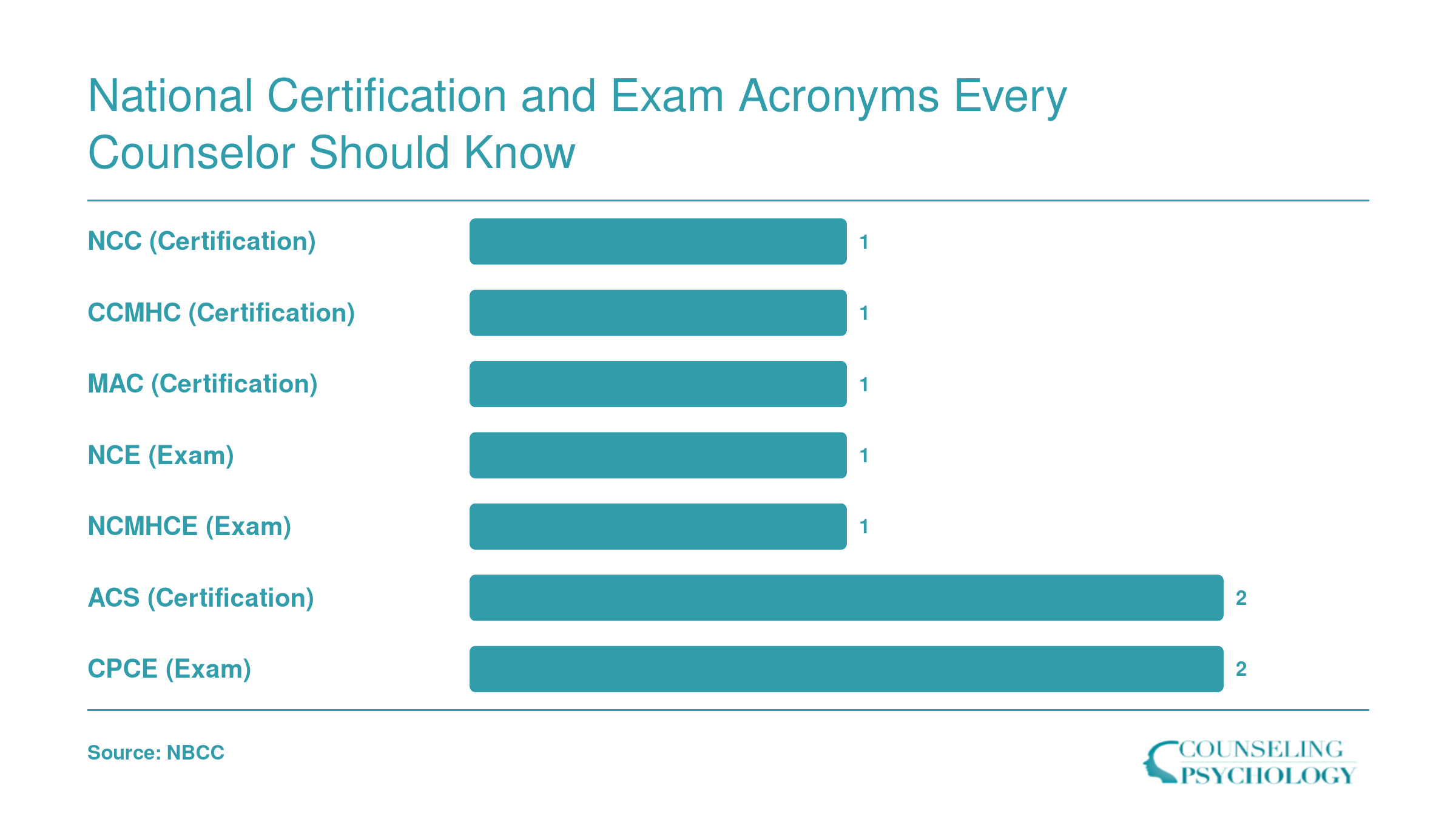
National certifications and exams serve different purposes in your counseling career. Certifications (NCC, CCMHC, MAC, ACS) are voluntary credentials you hold and maintain over time. Exams (NCE, NCMHCE, CPCE) are standardized tests you pass to qualify for those certifications or for state licensure. The chart below groups all seven by their issuing body so you can see at a glance who administers what.
How to List Counselor Credentials After Your Name
The order in which you list credentials after your name is not a matter of personal preference. It follows a recognized convention that signals your qualifications clearly to clients, employers, and colleagues.
The Accepted Ordering Convention
Both the American Counseling Association and the National Board for Certified Counselors point to the same sequence: highest earned degree first, followed by your state license, then any national certification, and finally specialty credentials.1 The logic is straightforward. Your degree represents your foundational education, your license establishes your legal authority to practice in a given state, your national certification demonstrates voluntary professional achievement beyond licensure, and specialty credentials show focused expertise in a particular area.2
A completed signature line following this convention looks like this: Jane Smith, PhD, LPC, NCC, ACS.
Formatting Examples at Different Career Stages
Seeing the convention applied at different points in a career makes it easier to follow in practice.
- New graduate: Maria Torres, MA, NCC (degree and national certification; no state license yet if still under supervision)
- Mid-career: David Chen, MA, LPC, NCC (degree, state license, national certification)
- Advanced practice: Dr. Priya Nair, PhD, LPCC, NCC, CCMHC (degree, state license, national certification, specialty credential)
In each example, the credential that carries the most weight comes first, and each addition layers on a distinct type of qualification.
Common Mistakes to Avoid
Several errors appear frequently enough to be worth calling out directly.
First, exam acronyms are not credentials. Passing the National Counselor Examination (NCE) is a requirement for certain certifications and licenses, but NCE itself is not a post-nominal you display after your name. The same applies to other licensing exams.
Second, do not list certifications that have lapsed, been revoked, or are still in progress. Displaying a credential you do not currently hold is both professionally misleading and, depending on your state's rules, potentially a disciplinary matter.
Third, avoid abbreviating your degree in a non-standard way. MA, MS, MEd, and PhD are universally understood; invented shorthand is not.
Credential display also matters on your counselor resume, where hiring managers look for properly formatted post-nominals at a glance. When in doubt, check directly with the NBCC's certification management resources or the American Counseling Association's published guidance on the topic.1 Both organizations address credential display in their member-facing materials, and staying current with those sources protects your professional reputation.
Counselor Vs. Therapist Abbreviations: What's the Difference?
The terms "counselor" and "therapist" often appear interchangeable in everyday conversation, but the abbreviations behind each credential tell a more precise story. Understanding these distinctions helps you choose the right educational path and communicate your qualifications accurately to employers and clients.
How the Credentials Differ in Practice
The abbreviations LPC (Licensed Professional Counselor) and LMHC (Licensed Mental Health Counselor) typically designate professionals who completed a master's degree in counseling, accumulated supervised clinical hours, and passed a state licensure examination.1 These credentials generally prepare practitioners for short-term, goal-oriented work with clients facing adjustment issues, career transitions, or specific life challenges.3
By contrast, LMFT (Licensed Marriage and Family Therapist) indicates a professional trained in a master's program specifically focused on marriage and family therapy. If you are considering this route, our guide on how to become a marriage and family therapist walks through the full requirements. LMFTs often engage in longer-term psychotherapy addressing relational systems and family dynamics.3
The LCSW (Licensed Clinical Social Worker) and its variant LICSW represent yet another pathway. Holders of these credentials earned a master's in social work and completed clinical supervision requirements.2 While social workers practice across many settings, the LCSW abbreviation signals authorization to provide clinical treatment, and many employers consider it a therapist credential for hiring and reimbursement purposes.
Educational Pathways Shape the Abbreviation
Accreditation bodies reinforce these distinctions. Programs accredited by CACREP (Council for Accreditation of Counseling and Related Educational Programs) prepare graduates for LPC or LMHC licensure. Programs accredited by COAMFTE (Commission on Accreditation for Marriage and Family Therapy Education) lead toward the LMFT credential. APA-accredited clinical psychology programs produce doctoral-level practitioners who use abbreviations like PsyD or PhD rather than the master's-level credentials discussed here.
Reviewing program curricula reveals meaningful differences. Counseling degrees emphasize developmental theory, career counseling, and brief intervention models. Marriage and family therapy programs focus on systems theory and relational assessment. Social work programs integrate clinical skills with community resource coordination and policy advocacy.
Employer and Insurance Perspectives
Employers and insurance panels often treat these abbreviations as functionally equivalent for clinical hiring, but subtle preferences exist. Some settings favor LMFTs for couples or family-focused roles, while community mental health agencies frequently seek LPCs or LMHCs for individual caseloads. LCSWs often have an advantage in hospital and integrated healthcare settings due to their training in care coordination.
When listing credentials, accuracy matters. Using "therapist" as a general descriptor while holding an LPC is acceptable in many states, but your official abbreviation should reflect your actual license.1 Check your state licensing board's guidelines and professional association resources from organizations like the American Counseling Association or American Association for Marriage and Family Therapy to confirm appropriate usage in your jurisdiction.
The same role, licensed professional counselor, carries at least five different abbreviations (LPC, LPCC, LMHC, LCPC, LCMHC) depending on where you practice. Always confirm your state licensing board's exact title before applying for jobs, ordering business cards, or signing onto insurance panels.
NCC Vs. LPC and Other Common Acronym Comparisons
Below are the questions counseling students and early career professionals ask most often when sorting through credential acronyms. Each answer is kept brief so you can scan quickly, but remember that your state licensing board is always the definitive source for title and scope details.
How do I find out which counseling license acronym my state uses? The only reliable source is your state licensing board, because the same clinical role can carry different abbreviations across state lines (LPC, LMHC, LPCC, or another title entirely). Bookmark your state board's website and the National Board for Certified Counselors at NBCC.org for the most current credential information. While the alphabet soup looks intimidating, it follows a logical structure once you see the license-certification-exam framework. Those letters are not random; they map to clear steps in your professional journey. If you are still early in the process, exploring careers in counseling can help you connect each credential to the path that fits your goals.
Explore More
- Best Counseling Schools Near Me
- Best Online Addiction Psychology Degree
- Best Online Graduate Certificate in Counseling
- Counseling Careers
- Counseling Degrees
- Counseling Master's Textbooks
- Counseling Psychology Master's Degree Guide
- Counselor Resume Guide
- Counselor Salary
- Online Counselor
- How to Get a Counseling License
- Should I Become a Therapist? How to Know If It's Right