Key Takeaways
- NBCC Foundation awards roughly 30 national counseling scholarships per year with acceptance rates between 5 and 15 percent.
- Enrolling in a CACREP-accredited program is the single most important step for maximizing scholarship eligibility.
- Specialty associations for MFT, school counseling, and rehabilitation counseling offer targeted awards rarely listed in broad databases.
- Layering assistantships, loan repayment programs, and scholarships together is the most effective strategy for full funding.
Counseling scholarships are competitive, merit- or need-based awards specifically for students pursuing graduate degrees in counseling fields, and they remain one of the most underutilized funding tools in mental health education. Master's programs in counseling typically run between $30,000 and $120,000 depending on institution type and residency status, which means most students cobble together two, three, or even four distinct funding sources to graduate without crushing debt.
Scholarships differ from fellowships, which often include research or teaching stipends, and from loan repayment programs, which kick in only after graduation and require service commitments. Each has a place in a sound financial strategy, but they operate on different timelines and eligibility rules. The NBCC Foundation and specialty associations like AAMFT and ASCA award roughly 200 named scholarships annually, yet application rates suggest fewer than half of eligible students ever apply.
Counseling Scholarships by Degree Level: Master's, Doctoral, and Post-Master's
Master's students enjoy the widest array of counseling scholarships, but doctoral and post-master's candidates often find award pools that are smaller and, by extension, less competitive. Lining up the right funding starts with choosing the right degree rung.
Master's-Level Scholarships
Most counseling scholarships target master's students, the largest group entering the profession. The NBCC Foundation runs several flagship programs. The Military and Rural Scholarships each provide $8,000 to graduate students committed to underserved populations.1 Students pursuing the Military Scholarship, in particular, may also want to explore how to become a veterans counselor for a broader look at career options in that space. For those pursuing clinical mental health or addictions counseling, the NBCC Foundation Minority Fellowship Program (MFP) offers $10,000 to $15,000 per year.1 These fellowships emphasize service to minority communities and often include professional development and mentorship. Other national funders like the American Counseling Association Foundation and Chi Sigma Iota also maintain multiple master's-level awards.
Doctoral Fellowships and Awards
Doctoral candidates in counselor education and supervision have access to dedicated funding streams, though the overall number of awards is smaller. The NBCC Foundation MFP for Doctoral Mental Health Counseling is among the most substantial, providing $20,000 to $25,000 annually.1 The Dr. Nicholas Vacc Scholarship, awarded by the National Board for Certified Counselors, grants between $5,000 and $10,000 to doctoral students demonstrating leadership and scholarly promise.1 Aspiring counselor educators should also explore awards through the Association for Counselor Education and Supervision (ACES) and APA-related divisions, which often fund dissertation research or conference travel.
Post-Master's and Licensure Funding
Post-master's students pursuing specialist credentials, licensure hours, or continuing education can tap a different set of resources. The Center for Credentialing & Education (CCE) sponsors several training awards that offset the cost of board certification. For example, the Approved Clinical Supervisor Training Award and the Board Certified TeleMental Health Provider Training Award each offer $500 to $1,000.1 The Global Career Development Facilitator Training Award provides $1,000.1 Beyond these, HRSA behavioral health workforce grants and state-level loan repayment programs frequently support post-master's clinicians working in high-need areas.
What to Expect Award-Wise
- Most individual counseling scholarships range from $1,000 to $8,000. Master's-level awards typically fall in this band, with a few like the NBCC Foundation MFP pushing toward $15,000.
- Flagship doctoral fellowships can reach $20,000 to $25,000. These are selective but offer substantial tuition and living cost support.
- Post-master's training awards are modest, usually $500 to $1,000. They function as cost-offset grants rather than full funding packages.
The size of the check often reflects the length of the program and the service commitment attached. Doctoral awards are larger partly because recipients commit to post-graduation service in high-need settings. The MFP's emphasis on BIPOC therapist training programs underscores how workforce diversity goals shape funding priorities. Post-master's grants are smaller but require less overhead, making them ideal for working clinicians adding a credential. State-level incentives, such as loan repayment for licensed professional counselors in rural areas, further supplement the post-master's funding landscape.
Top National Counseling Scholarships and Fellowships
A small group of national awards drives the majority of competitive funding for counseling graduate students, and knowing them by name is the first step to building a realistic application list. The NBCC Foundation runs the most visible portfolio in the field, followed by program-specific awards from the American Counseling Association Foundation, Chi Sigma Iota, and the American Mental Health Counselors Association.1 Most cluster their deadlines in fall (September through November) and early spring (January through March), and most expect applicants to be enrolled in a CACREP-accredited program.
NBCC Foundation: The Anchor of Field-Specific Funding
The NBCC Foundation administers the Minority Fellowship Program (MFP) on behalf of SAMHSA, making it the largest single source of identity-specific funding in counseling.2 The MFP runs three distinct tracks, each with its own application: master's-level mental health counseling, master's-level addictions counseling, and doctoral-level counselor education. All three require applicants to be from a racial or ethnic minority background and to commit to serving underserved communities after graduation. NBCCF also funds smaller targeted scholarships, including a Military Scholarship for master's students working with service members and veterans, and a Rural Scholarship for students committed to practice in rural mental health settings.1 If you are considering a military counseling degree, the Military Scholarship is one of the few awards designed specifically for that career path.
ACA Foundation, Chi Sigma Iota, and Professional Training Awards
Beyond NBCCF, several mid-range awards are accessible to a broader applicant pool. The Dr. Nicholas Vacc Scholarship through Chi Sigma Iota supports doctoral students focused on research and assessment, with the catch that you must be a CSI member in good standing.2 Chapter membership is straightforward if your program has a CSI presence, which most CACREP programs do.
For counselors who have already finished a degree and are pursuing additional credentials, CCE (the Center for Credentialing and Education, an NBCC affiliate) offers a cluster of professional training awards tied to specific certifications:1
- Approved Clinical Supervisor (ACS): For practitioners building supervision credentials.
- Board Certified Coach (BCC): For counselors expanding into coaching.
- Board Certified-TeleMental Health Provider (BC-TMH): For clinicians formalizing telehealth practice.
- Global Career Development Facilitator (GCDF): For those moving into career counseling.
Application Timing
NBCCF master's and doctoral fellowships typically open in late fall with deadlines in January or February. ACA Foundation and AMHCA scholarships tend to run on a spring cycle. CCE training awards operate on rolling or annual cycles tied to certification windows. Build your calendar backward from each deadline, allow at least six weeks for recommendation letters, and confirm CACREP enrollment status before you start, since it is the single most common disqualifier.
Questions to Ask Yourself
Scholarships by Counseling Specialization: MFT, School Counseling, Clinical Mental Health, and More
Five distinct counseling specializations each have their own professional associations, and those associations are among the most reliable sources of funding that never surfaces in broad scholarship databases.
Marriage and Family Therapy
The AAMFT Foundation, the philanthropic arm of the American Association for Marriage and Family Therapy, administers scholarship and fellowship programs specifically for MFT students. Award amounts and eligibility criteria change from cycle to cycle, so checking AAMFT.org directly is the only way to get current figures. Beyond the national level, state MFT associations frequently run their own pipeline awards that go largely unadvertised outside their membership networks. If you are enrolled in, or applying to, a state-approved MFT program, contact your state association early in the academic year. Many of these local awards have small applicant pools, which makes them more competitive in practice than their modest dollar amounts might suggest.
School Counseling
The American School Counselor Association maintains a scholarship page at ASCA.schoolcounselor.org that lists awards for graduate students pursuing school counseling licensure. State departments of education also run pipeline programs, sometimes funded through federal workforce grants, aimed at placing more school counselors in high-need districts. These programs can include stipends, tuition assistance, or both, and they often come with a service commitment requiring you to work in a qualifying district for one to three years after graduation.
Clinical Mental Health Counseling
The American Mental Health Counselors Association (AMHCA.org) is the first stop for students in clinical mental health counseling programs. AMHCA has offered awards for graduate students, and membership itself sometimes provides access to scholarship opportunities not visible to non-members. Because clinical mental health counseling is one of the largest graduate enrollment categories, competition for national awards tends to be higher here than in more specialized tracks.
Rehabilitation and Substance Use Counseling
Rehabilitation counseling has a dedicated federal funding stream. The Rehabilitation Services Administration's Section 21 scholarship program, administered through RSA-funded university projects, has historically provided stipends to students in qualifying rehabilitation counseling programs. The National Rehabilitation Counseling Association is another resource worth contacting directly.
For substance use counseling, SAMHSA has funded workforce development initiatives that include student stipends, and regional Addiction Technology Transfer Centers sometimes administer awards at the state level. Availability and amounts vary considerably by region and federal budget cycle.
A Strategy That Works Across All Specializations
Regardless of your track, the financial aid office of any graduate program you are seriously considering is an underused resource. Many programs hold unpublished assistantships or departmental awards tied to specific counseling concentrations. These do not appear in scholarship search engines. A direct conversation with the program coordinator or financial aid office, before you even apply, often reveals funding options that are not publicly listed anywhere.
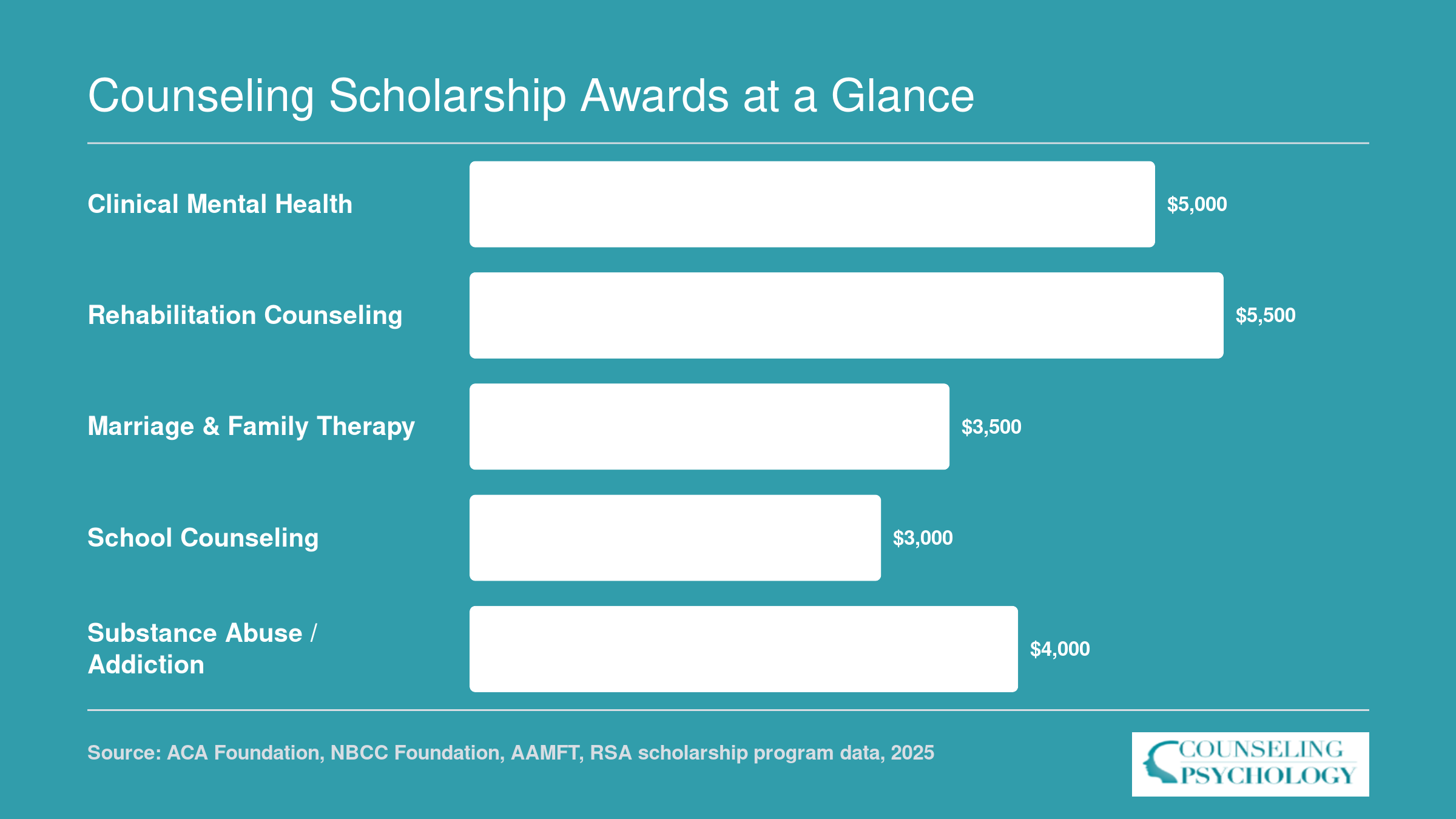
Counseling Scholarship Awards at a Glance
Award amounts vary meaningfully by counseling specialization. Clinical mental health and rehabilitation counseling scholarships tend to carry higher typical awards, partly because federal workforce-shortage funding supplements private philanthropy. MFT and school counseling awards cluster a bit lower but are offered by a wider range of organizations.
Scholarships for Underrepresented and Special Populations in Counseling
Funding for diversity-focused counseling programs has grown substantially in recent years, driven in part by federal agencies seeking to expand the pipeline of culturally competent providers. Several awards now offer both lower competition and stronger financial support than general-pool scholarships, making them strategic priorities for eligible applicants.
NBCC Minority Fellowship Program: The Flagship Diversity Award
The NBCC Foundation Minority Fellowship Program stands as the most generous diversity-specific funding in the field.1 For 2026, the master's-level track awards $12,000 each to 32 fellows, while the doctoral track provides $20,000 annually to 24 recipients.2 Both programs are funded through the Substance Abuse and Mental Health Services Administration (SAMHSA) and explicitly target students committed to serving racially and ethnically diverse and underserved populations, including LGBTQIA communities, rural areas, and tribal nations.
Eligibility requires full-time enrollment in a CACREP-accredited or CACREP-pending program, U.S. citizenship or permanent residency, and a two-year post-graduation service commitment.4 The master's-level application opens April 1 and closes June 30, 2026, with announcements in October. In 2024, the doctoral program named 20 fellows from a national applicant pool, suggesting acceptance rates in the mid-to-high single digits.5
Identity-Based and Population-Service Awards
Beyond the NBCC flagship, several organizations offer targeted scholarships:
- ACA Foundation diversity awards: Multiple scholarships prioritize BIPOC students, first-generation graduate students, and applicants committed to LGBTQ+-affirming practice. Award amounts typically range from $1,000 to $5,000.
- Rural and tribal behavioral health scholarships: NBCC Foundation opens separate Rural and Military Scholarship applications in November 2026.6 These awards frequently draw smaller applicant pools than urban-focused programs, improving odds for students planning careers in underserved geographies.
- Veterans and military-connected awards: Several state counseling associations and NBCC tracks prioritize student veterans or those serving military families, with lighter competition than general counseling scholarships. Students interested in this career path can explore what it takes to become a veterans counselor.
Strategic Advantage: Stacking Awards
Diversity scholarships typically permit stacking with general counseling awards. A student who wins both the NBCC Minority Fellowship and an ACA Foundation scholarship, for example, receives the full value of both. Applicants should submit to every relevant pool rather than self-selecting out of general competitions, maximizing total aid without penalty.
How Competitive Are Counseling Scholarships?
Counseling scholarships are moderately to highly competitive, with acceptance rates typically ranging from 5 to 15 percent at the national level. The NBCC Foundation, which administers the largest pool of counseling-specific awards, offers approximately 30 scholarships annually and historically receives well over 1,000 applications each cycle.1 While exact application volumes fluctuate year to year, counseling students should approach the process with the understanding that most major national awards select only a small fraction of their applicant pool.
What Does a Competitive Applicant Look Like?
Successful scholarship recipients share a consistent set of characteristics. Enrollment in a CACREP-accredited program is nearly universal among award winners, particularly for NBCC Foundation and ACA Foundation scholarships that explicitly require this credential.2 Active membership in professional organizations signals commitment: many awardees hold memberships in the American Counseling Association or Chi Sigma Iota, the international honor society for counseling students. The personal statement distinguishes finalists from the broader applicant pool. Reviewers prioritize narratives that articulate a clear clinical focus, commitment to underserved populations, or plans to address specific community mental health needs. A strong faculty recommendation from a program director or clinical supervisor carries substantial weight, especially when it speaks to both academic performance and counseling competencies demonstrated in practicum or fieldwork. If you are wondering how competitive is psychology at the graduate level more broadly, similar dynamics apply: selective programs and limited funding create stiff competition across the discipline.
Realistic Funding Expectations
Full-ride counseling scholarships are extraordinarily rare. The typical graduate student who secures scholarship funding pieces together one to two awards totaling between $2,000 and $8,000, which covers a meaningful but not comprehensive portion of tuition and fees. Many students supplement scholarships with graduate assistantships that provide tuition waivers and stipends, employer tuition reimbursement programs, or federal unsubsidized loans. Students pursuing doctoral programs may access larger awards such as the $5,000 NBCC Dr. Nicholas A. Vacc Scholarship, though this award is limited to one recipient per year and requires Chi Sigma Iota membership, full-time doctoral enrollment, and a dissertation focus on research or testing.3 The NBCC Foundation also offers master's-level scholarships of up to $8,000, targeted specifically at students serving military or rural populations.3 Students targeting specialization-specific scholarships in marriage and family therapy, school counseling, or clinical mental health counseling often find smaller applicant pools and modestly improved odds compared to broad national competitions.
A Concrete Strategy to Improve Your Odds
Applying to five to eight scholarships across national, state, and specialization categories meaningfully improves your likelihood of securing at least one award. Diversifying your application portfolio reduces dependence on any single competition and increases exposure to different selection committees. State counseling associations, regional mental health organizations, and university-specific endowments often receive fewer applications than marquee national scholarships, yet they still offer awards in the $1,000 to $3,000 range. Starting your search early in the fall semester and tracking deadlines systematically ensures you can tailor each application to the sponsor's mission without rushing generic materials at the last minute.
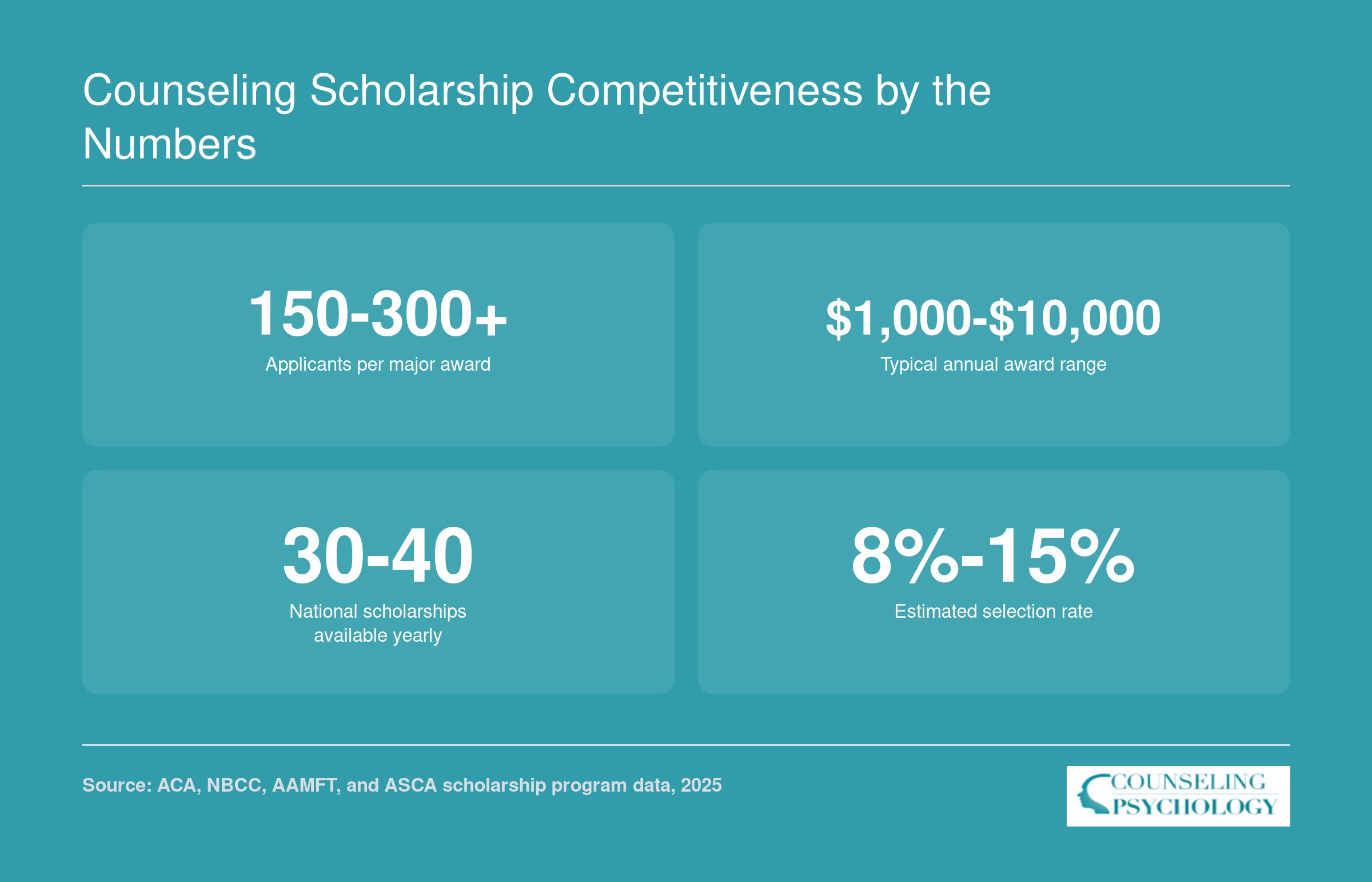
Counseling Scholarship Competitiveness by the Numbers
Landing a national counseling scholarship takes more than strong grades. These figures illustrate just how selective the process can be and what a successful award is actually worth.
Eligibility Factors: CACREP Accreditation, Online Programs, and International Students
CACREP accreditation has quietly become the baseline for most major counseling scholarships, reflecting the licensure boards' own alignment with national training standards. This section unpacks how accreditation status, enrollment format, and immigration status shape eligibility, along with the service commitments that sometimes come with the funding.
CACREP Accreditation: The Common Thread
For the largest national awards, enrollment in a CACREP-accredited program is non-negotiable.1 The NBCC Foundation's suite of scholarships, including the Minority Fellowship Program (MFP) for master's students and the general foundation scholarships, all require current or intended enrollment in a CACREP-accredited counseling program.2 The same rule applies to the Chi Sigma Iota Dr. Nicholas Vacc Scholarship, which also mandates active CSI membership. The A Dream Decided Scholarship, designed specifically for undocumented and DACA students, likewise requires CACREP accreditation.4
While some smaller university-specific grants or private foundation awards (including certain ACA Foundation scholarships) may waive the CACREP requirement, the trend is unmistakable: if you are targeting the most generous and widely recognized national scholarships, a CACREP-accredited program is a prerequisite. Exceptions are rare and typically found at the state or institutional level, not among the dominant national funders. Students exploring program options can start by reviewing accredited counseling masters programs to confirm a school's accreditation status before applying.
Online and Part-Time Students
A common worry is that online or part-time enrollment excludes applicants from scholarship consideration. In practice, the picture is mixed. All NBCC Foundation scholarships explicitly state that online programs are eligible, provided the program is CACREP-accredited and the student meets the full-time enrollment requirement. That full-time stipulation, however, is firm: every NBCC scholarship, including the MFP, demands full-time status at the time of award and during the funded period.6
Part-time students therefore find themselves in a gray area. While an online CACREP program qualifies, a part-time courseload does not. Some institutional or state-based awards designed for working professionals may accept part-time status, but these are far less common and rarely carry the same financial weight. For the NBCC Foundation programs specifically, the full-time requirement is absolute, making it essential to coordinate scholarship applications with a semester of full-time study.
International and DACA Applicants
Citizenship requirements vary sharply by scholarship type. Most federally funded or NBCC Foundation awards require U.S. citizenship or permanent residency. The NBCC MFP for master's students, the general NBCC Foundation scholarships, and the Dr. Nicholas Vacc Scholarship all fall into this category, effectively closing the door to international students on an F-1 visa.
However, targeted exceptions exist. Two NBCC Foundation scholarships, the Rural Scholarship and the Military Scholarship, explicitly accept F-1 visa holders. On the other end of the spectrum, the A Dream Decided Scholarship is open only to undocumented or DACA recipients and does not require citizenship. For international students without a pathway through these specific programs, the best strategy is to focus on university-level assistantships, private foundation grants that do not list citizenship as a restriction, or state-funded initiatives that occasionally waive residency requirements for certain visa categories.
Service Obligations and Payback Clauses
Some of the most lucrative awards come with strings attached, most commonly a post-graduation service commitment in an underserved setting. The NBCC Minority Fellowship Program, for instance, requires fellows to work in a Mental Health Professional Shortage Area or with an underserved population for a period equivalent to the funding duration, typically one to two years. Similarly, HRSA-funded state pipeline scholarships and loan repayment programs may impose multi-year service obligations in federally designated shortage sites, often with serious financial penalties for failing to complete the term. Before accepting any award, read the fine print carefully: a scholarship that fully funds tuition but demands two years of low-paying service in a high-need area may look very different from unrestricted grant money. When comparing offers, calculate the total value of the award against any mandatory service period and the associated opportunity cost.
Enrolling in a CACREP-accredited program is the single most impactful step you can take to maximize your scholarship options. The majority of national counseling scholarships and fellowships require CACREP accreditation as a baseline eligibility criterion, and attending an accredited program also simplifies the licensure process in most states. Before you apply anywhere, confirm accreditation status directly through the CACREP directory.
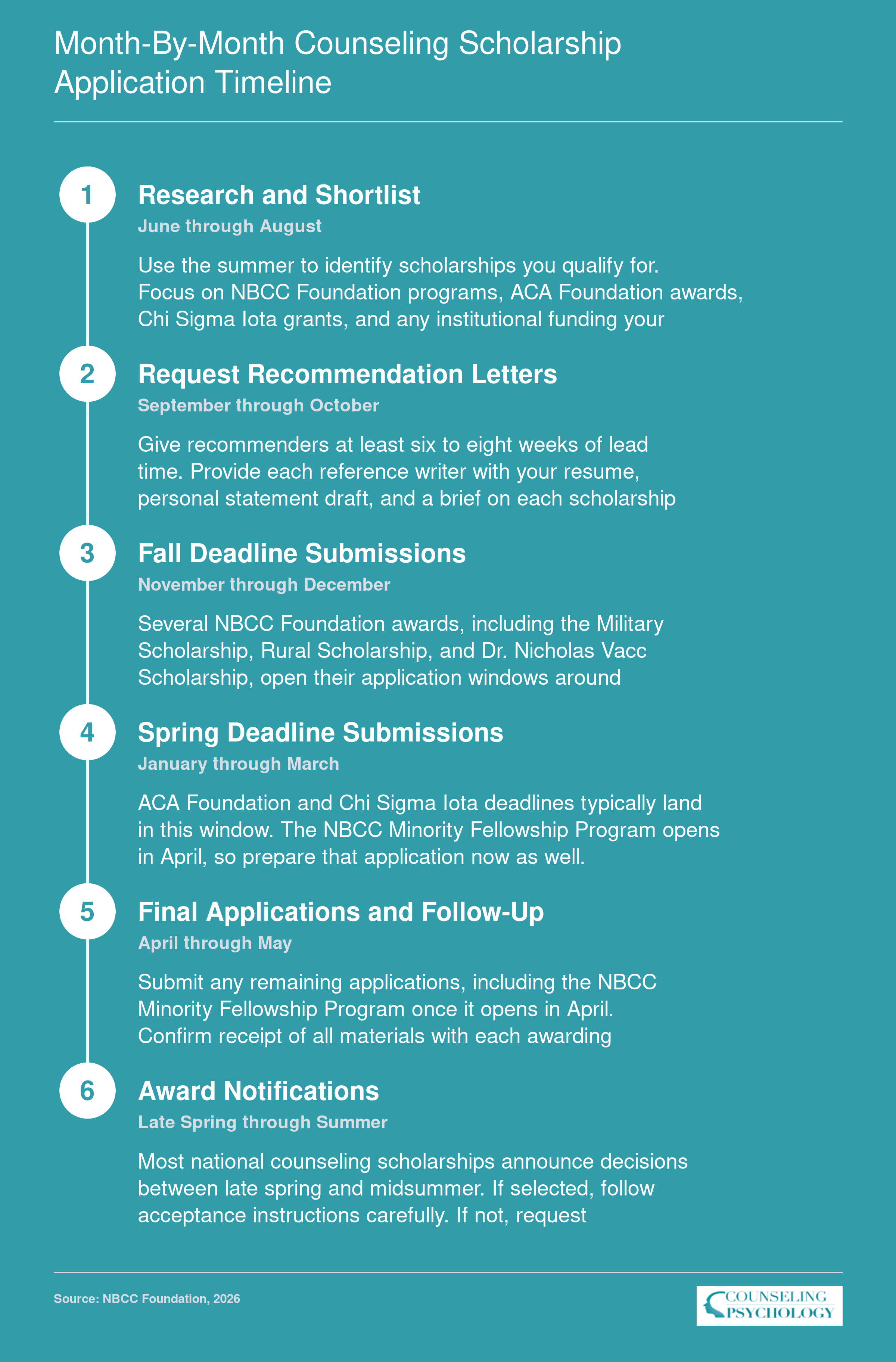
Month-by-Month Counseling Scholarship Application Timeline
Staying ahead of deadlines is half the battle when pursuing counseling scholarships. This timeline maps out a full academic cycle so you can pace your efforts, gather materials early, and never miss a window. Exact dates shift year to year, so always verify with each organization directly.
Beyond Scholarships: Loan Repayment, Assistantships, and Additional Funding
What funding options exist beyond traditional scholarships to help pay for a counseling degree? The truth is that scholarships alone rarely cover the full cost of graduate education. Smart students layer multiple funding sources, and some of the most valuable programs actually kick in after graduation. Understanding this broader funding landscape can mean the difference between finishing your degree with crushing debt or manageable payments.
The NHSC Loan Repayment Program: Often More Valuable Than Any Scholarship
For licensed professional counselors willing to work in underserved communities, the NHSC Loan Repayment Program offers funding that dwarfs most scholarship awards. The standard NHSC program provides up to $50,000 for a two-year full-time service commitment in a Health Professional Shortage Area, with options to extend for additional years.1 Counselors specializing in substance use disorder treatment can access even more generous terms: the NHSC Substance Use Disorder Workforce Loan Repayment Program awards up to $75,000 for a three-year commitment.2
These figures alone often exceed what students accumulate in total graduate school debt. The catch is timing: you apply after earning your license, not while enrolled. However, knowing this option exists should factor into your borrowing decisions during school. Taking federal loans with the expectation of NHSC repayment is a calculated strategy many counselors use effectively.
Graduate Assistantships: The Overlooked Campus Opportunity
Many counseling programs offer graduate assistant or graduate research assistant positions that combine partial tuition waivers with stipends ranging from $8,000 to $15,000 annually. These positions typically require 15 to 20 hours of work per week assisting faculty with research, teaching, or administrative duties.
Assistantships are not always advertised publicly. Contact your program's graduate coordinator directly and ask about availability, application timelines, and whether positions exist within affiliated counseling centers or research labs. Students who secure assistantships often find that the tuition waiver alone covers a substantial portion of their degree cost, effectively turning their program into a near-scholarship experience.
Employer Tuition Benefits and State-Level Programs
Community mental health agencies and hospital systems frequently offer tuition reimbursement for employees pursuing counseling credentials. If you are already working in a behavioral health setting, check whether your employer provides educational assistance before assuming you need to leave your job to attend school. Those drawn to agency-based roles may want to explore what it takes to become a community mental health counselor, since many of these employers actively invest in their workforce's clinical training.
State-specific programs also exist beyond the federal NHSC. West Virginia, for example, runs a Mental Health Loan Repayment Program offering $10,000 per year, renewable up to three times, for behavioral health professionals serving in designated shortage areas.3 Similar programs operate in California through MHSA workforce initiatives and in Texas through the Mental Health Professional Education Program. Searching your state's health department website for "behavioral health loan repayment" often reveals options that receive far fewer applications than national scholarships.
A Realistic Stacking Strategy
Consider how these sources can combine. A student might earn a $5,000 scholarship during enrollment, secure a graduate assistantship providing a $12,000 stipend plus tuition waiver, and then apply for NHSC loan repayment worth $50,000 to $75,000 after graduation. This combination can offset most or all of a counseling degree's total cost, which typically ranges from $30,000 to $60,000 at CACREP-accredited programs.
The key insight is thinking beyond the application cycle. Scholarships matter, but loan repayment programs and assistantships often deliver more financial value with less competition. Building your funding plan around all three creates a realistic path to graduating without the debt burden that drives many counselors out of lower-paying community settings where their skills are needed most.
Frequently Asked Questions About Counseling Scholarships
These are the questions counseling students ask most often when searching for financial support. Each answer draws on real scholarship details and eligibility patterns covered throughout this guide.