
What you’ll learn in this article…
- Four Indiana universities hold current CACREP accreditation for clinical mental health counseling master's programs.
- Indiana's two-tier licensure model requires an LMHCA credential before advancing to full LMHC status.
- BLS projects mental health counselor employment to grow 18 percent from 2022 to 2032 nationally.
- Net price and institutional aid weigh most heavily in this ranking of affordable Indiana programs.
What does it actually cost to earn a master's in counseling in Indiana, and which programs deliver online or hybrid flexibility without sacrificing licensure eligibility? Across the 13 ranked Indiana institutions, effective net prices stretch from roughly $6,000 at public universities like Purdue Northwest to over $36,000 at private campuses like Butler, a sixfold spread that reshapes the affordability calculation entirely.
Demand for licensed mental health counselors in Indiana continues to outpace supply, particularly in rural counties and adolescent-focused practice. Most programs now offer hybrid or fully online coursework paired with in-state practicum placements, which matters because Indiana's LMHC pathway requires supervised hours completed under a state-approved supervisor regardless of where you took your classes.
Best Master's in Counseling Programs in Indiana
Indiana offers a surprisingly diverse range of counseling graduate programs, from COAMFTE-accredited marriage and family therapy tracks to CACREP-accredited clinical mental health counseling degrees and specialized addiction counseling certificates. Whether you need a fully online option that fits around a full-time job or prefer a hybrid model with in-person clinical training, the programs below represent the strongest options for affordability, flexibility, and career preparation in 2026. Net prices, graduation rates, and program formats vary significantly across these schools, so review each card carefully against your own budget and professional goals.
- Net price and tuition affordability
- Program format and flexibility
- Accreditation and licensure alignment
- Institutional graduation rate
- Concentration and specialization breadth
- College Scorecard graduate earnings — collegescorecard.ed.gov
- NCES-IPEDS federal institutional data — nces.ed.gov
- Internal program database
- Independent program research

Purdue University Northwest
Purdue University Northwest stands out as Indiana's most affordable entry point for graduate-level counseling training, with an average net price of just $6,079. Its 67-credit Master of Science in Couple and Family Therapy is COAMFTE-accredited and follows a scholar-practitioner model that requires 500 hours of direct client contact and a thesis with oral defense. Delivered in a hybrid format from the Hammond campus, PNW's program is recognized as meeting licensure requirements in both Indiana and Illinois. The institution-wide graduation rate is 42.9%, so prospective students should plan for strong self-motivation and use of campus support services.
- COAMFTE-accredited scholar-practitioner program
- 67 credit hours required for completion
- 500 hours of direct client contact included
- 100 hours of clinical supervision required
- Thesis and oral defense capstone requirement
- Hybrid delivery blends online and on-campus work
- Meets licensure requirements in Indiana and Illinois
- Small cohort sizes support individualized training
Master of Science in Couple and Family Therapy — Hybrid

Indiana Wesleyan University-National & Global
Indiana Wesleyan University's National and Global campus delivers one of the broadest counseling program menus in the state, entirely online. Students can choose from a CACREP-accredited M.A. in Clinical Mental Health Counseling, an M.A. in School Counseling, an M.A. in Addictions Counseling, or a standalone Graduate Certificate in Addictions Counseling. At $602 per credit hour with locked tuition rates, the 60-credit master's programs total roughly $36,120 before aid. The institution-wide graduation rate (35%) reflects IWU's large nontraditional student body; however, the CACREP accreditation and NAADAC/NASAC recognition on the addictions track add strong quality assurance for licensure-seeking students.
- CACREP-accredited 60-credit online program
- $602 per credit hour with locked tuition
- 100% online or onsite delivery options
- Supervised clinical experience required
- Prepares for Indiana LMHC licensure
- Christ-centered curriculum with multicultural focus
- CACREP-accredited 60-credit online program
- Completion in 24 to 36 months
- Dual concentration option with clinical mental health
- 20 total courses with supervised practicum
- Prepares students for state school counselor license
- Multicultural and servant leadership emphasis
- 48-credit online program, completable in 24 months
- Accredited by NAADAC and NASAC
- 15 specialized addiction counseling courses
- Supervised clinical experience included
- Prepares for professional certification exams
- Christian worldview integrated into coursework
- 18-credit, 12-month fully online certificate
- $602 per credit hour, NAADAC approved
- Six courses covering psychopharmacology and family dynamics
- Requires bachelor's degree and 3.0 GPA
- Faith-integrated evidence-based curriculum
- Flexible for working professionals
Master of Arts in Clinical Mental Health Counseling — Online
Master of Arts in School Counseling — Online
Master of Arts in Addictions Counseling — Online
Graduate Certificate in Addictions Counseling — Online

Indiana University-Indianapolis
Indiana University-Indianapolis provides graduate counseling training through a respected urban research campus with a 13:1 student-to-faculty ratio. Its counseling programs include an MPCAC-accredited M.S.Ed. in Mental Health Counseling and Counselor Education (no GRE required) and a hybrid Graduate Certificate in Alcohol and Drug Counseling priced at $350 per credit for in-state students. The institution-wide graduation rate is 54.4%, and the median graduate debt of $20,000 sits well below many private alternatives in the state. In-state tuition runs $11,180 while out-of-state students pay $28,964, making residency status a key consideration.
- 18-credit hybrid program with on-campus practicum
- $350 per credit hour for Indiana residents
- No GRE required for admission
- Covers the 12 core functions of addiction counseling
- Prepares for Licensed Addictions Counselor Associate
- Fall and spring admission cycles available
Alcohol and Drug Counseling Graduate Certificate — Hybrid

Indiana Wesleyan University
Indiana Wesleyan University's residential Marion campus mirrors much of the National and Global arm's counseling catalog but adds an on-campus dimension and a tighter learning community. The CACREP-accredited M.A. in Clinical Mental Health Counseling and M.A. in School Counseling are each 60 credits at $602 per credit, and the 48-credit M.A. in Addictions Counseling carries NAADAC and NASAC accreditation. The institution-wide graduation rate here is 66.7%, with a 12:1 student-to-faculty ratio that supports more individualized mentoring. Median graduate debt is $24,250, a reasonable figure given the multiple licensure pathways the programs open.
- CACREP-accredited 60-credit program
- Online or onsite delivery available
- $602 per credit with financial aid options
- Supervised clinical experience component
- Licensure track for Indiana LMHC
- Multicultural competence integrated throughout
- 60-credit CACREP-accredited online program
- Dual-licensure concentration available in CMHC
- $602 per credit hour, financial aid eligible
- Prepares for Indiana school counselor licensure
- Background check required for admission
- 24 to 36 month completion timeline
- 48-credit online program at $602 per credit
- NAADAC and NASAC accredited
- Hands-on clinical experience required
- Multicultural competence and ethics focus
- 3.0 undergraduate GPA required
- Prepares for professional certification
- Six courses completed in 12 months online
- NASAC-accredited, locked tuition rate
- Bachelor's degree and 3.0 GPA required
- Covers addiction recovery and family counseling
- Faith-integrated practical counseling techniques
- Suitable for career changers and current practitioners
Master of Arts in Clinical Mental Health Counseling — Online
Master of Arts in School Counseling — Online
Master of Arts in Addictions Counseling — Online
Graduate Certificate in Addictions Counseling — Online

Indiana University-Bloomington
Indiana University-Bloomington brings flagship-level resources to its counseling offerings, including an MPCAC-accredited counseling program that requires no GRE for admission. The hybrid Certificate in Alcohol and Drug Counseling is an 18-credit program blending online coursework with an on-campus practicum, designed specifically for Indiana residents. IU Bloomington boasts the highest institution-wide graduation rate on this list at 80.2% and reports a median graduate debt of $19,509. In-state tuition is $11,756, though the average net price of $16,264 is higher than several public peers on this list.
- 18-credit hybrid program for Indiana residents
- Online coursework plus on-campus practicum
- No GRE required for admission
- Minimum 3.0 undergraduate GPA needed
- Covers the 12 core functions of addiction counseling
- Prepares for Licensed Addictions Counselor Associate
- Focus on prevention, intervention, and crisis management
Certificate in Alcohol and Drug Counseling — Hybrid

University of Southern Indiana
The University of Southern Indiana in Evansville offers a streamlined, fully online Addiction Science Certificate designed for students who already hold a Master of Social Work degree. At just 9 credit hours and $432.75 per credit, it can be completed in three semesters, making it one of the fastest and most affordable post-master's credentials in the state. USI's institution-wide graduation rate is 48.2%, and median graduate debt sits at $20,105. This certificate is best suited for practicing social workers who want to add addiction treatment competencies without committing to another full degree.
- 100% online, 9-credit-hour program
- $432.75 per credit hour
- Designed for MSW holders only
- Completable in three semesters
- Covers psychopharmacology and crisis intervention
- Addresses ethical standards in addiction treatment
Addiction Science Graduate Certificate — Online

Purdue University Global
Purdue University Global caters to nontraditional and working adult learners through a fully online platform with flexible start dates every 11 weeks. Its M.S. in Psychology with an Addictions concentration is a 70 to 75 credit-hour program accredited by NASAC, preparing graduates for the Master Addiction Counselor (MAC) certification. With an average net price of $7,770, it is the second-most affordable option on this list. The institution-wide graduation rate is 50%, and median graduate debt is $26,078, so students should weigh the total cost against the strong certification preparation the program provides.
- 70 to 75 credit-hour online program
- NASAC-accredited curriculum
- Prepares for MAC certification exam
- Practicum experience required
- Multiple program track options available
- Flexible start dates every 11 weeks
- Designed for working adults
- Fully online, NASAC-accredited program
- Prepares for NCAC Level I and II exams
- Credit for prior learning accepted
- Business Foundations or Practicum track options
- 180 credit hours with 10-week terms
- Military tuition reductions available
Master of Science in Psychology, Addictions Concentration — Online
Bachelor of Science in Psychology in Addictions — Online

Saint Mary-of-the-Woods College
Saint Mary-of-the-Woods College offers a hybrid M.S. in Clinical Mental Health Counseling that combines primarily online coursework with brief campus residencies. The 60-credit program includes 700 clinical training hours and requires no GRE, with a minimum 2.75 GPA for admission. The 9:1 student-to-faculty ratio is the lowest on this list, which translates into highly personalized mentorship. The net price of $31,872 is on the higher side, but median graduate debt of $19,512 suggests many students offset costs through financial aid. The institution-wide graduation rate is 46.6%.
- 60-credit hybrid program with brief residencies
- 700 clinical training hours required
- No GRE needed for admission
- 2.75 minimum GPA for eligibility
- Flexible 2 to 5 year completion window
- 9 prerequisite psychology credits required
- 9:1 student-to-faculty ratio
- Prepares for Indiana LMHC licensure
Master of Science in Clinical Mental Health Counseling — Hybrid

Huntington University
Huntington University's M.A. in Clinical Mental Health Counseling is a 60-credit hybrid program that meets Indiana LMHC licensure requirements and integrates a Christian counseling perspective. The curriculum features a three-day residency experience alongside primarily online coursework, supervised clinical training, and multiple counseling theory courses. With an 11:1 student-to-faculty ratio, an institution-wide graduation rate of 63.6%, and median graduate debt of $25,576, Huntington offers a mid-range option for students who value a faith-integrated approach.
- 60-credit hybrid program meeting Indiana LMHC requirements
- Three-day residency plus online coursework
- Supervised clinical training included
- Christian counseling perspective integrated
- Professional organization membership required
- Multiple counseling theory courses offered
- Multicultural awareness emphasis throughout
Master of Arts in Clinical Mental Health Counseling — Hybrid

Christian Theological Seminary
Christian Theological Seminary in Indianapolis offers a 63-credit M.A. in Marriage and Family Therapy accredited by COAMFTE since 1994. The hybrid program blends online learning with in-person components, and students gain hands-on experience from their very first course through the on-site CTS Counseling Center. The seminary reports a 100% job placement rate and an 85.7% licensure pass rate for graduates. Tuition runs $12,990 per year, and 85% of enrolled students receive financial aid, with over $1 million dispersed annually. Graduation rate and net price data are not published for this institution.
- COAMFTE-accredited 63-credit hybrid program
- 100% job placement rate reported
- 85.7% licensure pass rate for graduates
- On-site practicum at CTS Counseling Center
- Practical experience from the first course
- Average completion time of 2.5 years
- 85% of students receive financial aid
- Can be paired with a Master of Divinity
Master of Arts in Marriage and Family Therapy — Hybrid

Indiana Institute of Technology-College of Professional Studies
Indiana Institute of Technology's College of Professional Studies offers a B.S. in Addictions Counseling that prepares graduates for licensed addictions counselor status in Indiana. Available online and on campus, the 120 to 121 credit-hour program covers substance use treatment, ethical practices, and client rights. The net price is $20,473, with a median graduate debt of $26,391. The institution-wide graduation rate of 28% is the lowest on this list, a factor prospective students should consider alongside the program's practical counselor training and career track options.
- 120 to 121 credit hours, online or on campus
- Leads to Indiana licensed addictions counselor pathway
- Covers substance use treatment and ethical practices
- Experienced field instructors guide clinical training
- Multiple career tracks in counseling and social work
- Internships at treatment centers and mental health sites
Bachelor of Science in Addictions Counseling — Online

Indiana Institute of Technology
Indiana Institute of Technology's main Fort Wayne campus offers the same B.S. in Addictions Counseling as its College of Professional Studies arm, with both online and on-campus attendance options. The sticker tuition of $31,361 is substantially reduced to a net price of $23,206 for most students. The institution-wide graduation rate is 47.8%, and the median graduate debt is $26,391. Students interested in hands-on campus experiences in Fort Wayne may find the main campus setting valuable for building local clinical connections.
- Online and on-campus delivery options
- 120 to 121 total credit hours
- Comprehensive addiction treatment curriculum
- Pathway to Indiana licensed counselor credential
- State-aligned licensure requirements covered
- Experienced faculty with field expertise
Bachelor of Science in Addictions Counseling — Online

Butler University
Butler University rounds out the list with a 100% online Licensed Mental Health Counselor Certificate and a CACREP-accredited M.S. in School Counseling. The certificate program is just 12 credit hours at $580 per credit, making it an efficient path for school counseling graduates who want to add LMHC eligibility. The 60-credit school counseling master's runs $700 per credit and includes a dual-licensure option in mental health counseling. Butler's institution-wide graduation rate of 80.4% is the highest on this list, and the 11:1 student-to-faculty ratio supports close mentorship. However, the net price of $36,041 is the steepest here.
- 12-credit, 100% online graduate certificate
- $580 per credit hour
- Four courses covering LMHC foundations and skills
- 3.5 GPA and 700 practicum hours required
- Meets Indiana LMHC licensure requirements
- Federal financial aid available
- CACREP-accredited 60-credit online program
- $700 per credit, no GRE required
- Dual-licensure option in mental health counseling
- 700 hours of hands-on clinical experience
- Focus on diversity, trauma, and crisis training
- Study abroad option available
Licensed Mental Health Counselor Certificate — Online
Master of Science in School Counseling — Online
How We Ranked Indiana Counseling Programs
Affordability carries the heaviest weight in this ranking. Net price, published tuition, and institutional aid metrics drive roughly the top of the scoring model, with an online or hybrid delivery filter applied so every program listed offers some form of distance learning for working adults in Indiana.
What the Data Comes From
The ranking pulls from two public federal sources. College Scorecard supplies institution-level and program-level outcomes data, including reported earnings, completion rates, and student debt at the master's level. IPEDS (the Integrated Postsecondary Education Data System) supplies tuition and fee figures, enrollment counts, and institutional characteristics that are uniformly reported across every accredited school in the state.
Using federal data means the numbers behind each ranked program come from the same standardized reporting every Indiana university files with the U.S. Department of Education. No school submitted itself for consideration, and no school paid for placement. If you are comparing options beyond Indiana, our broader list of best online master's in counseling programs uses the same methodology at the national level.
What This Ranking Does Not Measure
A cost-weighted ranking has clear limits, and prospective students should treat the list as a starting filter rather than a final verdict. The methodology does not evaluate:
- Curriculum quality: Course sequencing, clinical training depth, and elective breadth are not captured in federal datasets.
- Faculty credentials: Research output, licensure status of instructors, and practitioner experience require school-by-school review.
- CACREP accreditation: Programmatic accreditation status is reported separately in this article, not folded into the score.
- Fit factors: Cohort size, supervision ratios, and specialization options (child counseling, addictions, school counseling) need direct comparison.
Many competing best-of lists publish rankings without disclosing weights or sources. Surfacing the methodology lets readers decide whether the order reflects their priorities, or whether they should re-sort the list on a metric that matters more to them.
Questions to Ask Yourself
Online Vs. On-Campus Counseling Programs in Indiana
Choosing between online and on-campus formats is one of the most consequential decisions you will make when selecting a master's in counseling program. Both delivery modes can lead to the same licensure credentials, but each comes with distinct advantages. Several Indiana universities now offer hybrid formats that combine weekend or short residencies with online coursework, giving students a practical middle ground. Regardless of format, every pathway to becoming a Licensed Mental Health Counselor in Indiana requires completing supervised in-person practicum and internship hours.
Pros
- Online programs offer scheduling flexibility that allows working professionals to complete coursework around existing commitments.
- Studying online often carries a lower effective cost because students avoid commuting, relocation, and some campus fees.
- Online enrollment opens access to counseling programs across Indiana, so students are not limited to schools in their immediate area.
- Hybrid formats with weekend residencies blend the convenience of online learning with periodic face-to-face clinical skill development.
- Online cohorts frequently include students from diverse geographic and professional backgrounds, enriching classroom discussions.
Cons
- On-campus programs typically maintain stronger relationships with local clinical placement sites, which can simplify practicum logistics.
- Face-to-face supervision during skills labs and role-play exercises provides immediate, nuanced feedback that is harder to replicate online.
- In-person cohorts tend to form tighter peer bonds, creating professional networks that support students well beyond graduation.
- All program formats still require in-person practicum and internship hours for licensure eligibility, so fully remote completion is not possible.
- Online students may need to independently secure their own clinical placement sites if the program lacks partnerships in their region.
Related Articles
Child and Adolescent Counseling Specializations in Indiana
Finding a graduate program in Indiana that specifically prepares you to work with children and adolescents takes some digging. Most Indiana universities embed child-focused coursework within a broader Clinical Mental Health Counseling (CMHC) degree rather than offering a standalone child counseling track. That said, a few pathways exist, and knowing the difference between a concentration and a post-master's certificate will save you time and money.
Concentrations Within a CMHC Degree
Several Indiana programs allow students to tailor elective coursework toward child and adolescent populations while completing a standard CMHC degree. This is the most common route for incoming graduate students. You graduate with a single credential that qualifies you to pursue licensure, and your transcript reflects relevant coursework in developmental psychology, child psychopathology, or family systems. Ball State University and Indiana University Bloomington, for example, offer enough elective depth that students can orient a substantial portion of their training toward younger clients, though neither currently advertises a formally named child and adolescent concentration. Always confirm the current course catalog directly with each program, as offerings shift.
Post-Master's and Bridge Certificates
Practicing counselors who already hold a master's degree have more targeted options for adding a child or adolescent specialty.
- Indiana Wesleyan University offers a Post-Master's Certificate in Counseling delivered online with required on-site intensives. At 15 to 18 credits, the certificate is customizable, and students with a child-focused interest can select coursework in Clinical Mental Health, Marriage and Family, or Addictions to build a coherent specialization.1 This is one of the more flexible post-licensure pathways available to Indiana residents in an online format.
- Indiana University Indianapolis offers a Mental Health Counseling Certificate at the post-master's level, designed primarily as a bridge to licensure for school counselors transitioning to clinical settings.2 It is not child-specific, but school counselors with existing experience working with youth may find it a practical next step.
- Indiana University Bloomington offers a 15-credit online Graduate Certificate in Addiction Intervention focused on substance use disorder prevention and treatment for adolescents and young adults.3 This is not a clinical counseling licensure program, but it pairs naturally with a CMHC degree for counselors who want to develop expertise in adolescent substance use. Those interested in broader options in this area can explore online graduate certificates in addiction counseling.
Professional Credentials That Complement This Specialization
Regardless of which program path you choose, earning the Registered Play Therapist (RPT) credential through the Association for Play Therapy is widely recognized as a meaningful marker of competency with younger clients. The RPT requires post-graduate supervised hours and continuing education in play therapy, so it is earned after licensure rather than during your master's program. Some Indiana supervisors and agencies specifically seek counselors who are working toward or have already obtained this credential. Counselors drawn to trauma-informed work with minors may also want to learn about the child abuse counselor career path. Pairing your CMHC licensure with an RPT designation positions you clearly in the child and adolescent market.
Indiana Counselor Licensure Requirements: Steps to Become an LMHC
Indiana uses a two-tier licensure model: you first earn the Licensed Mental Health Counselor Associate (LMHCA) credential, then advance to full LMHC status after completing supervised practice and a second national exam. Graduating from a CACREP-accredited program streamlines this path and strengthens licensure portability if you ever plan to practice in another state.
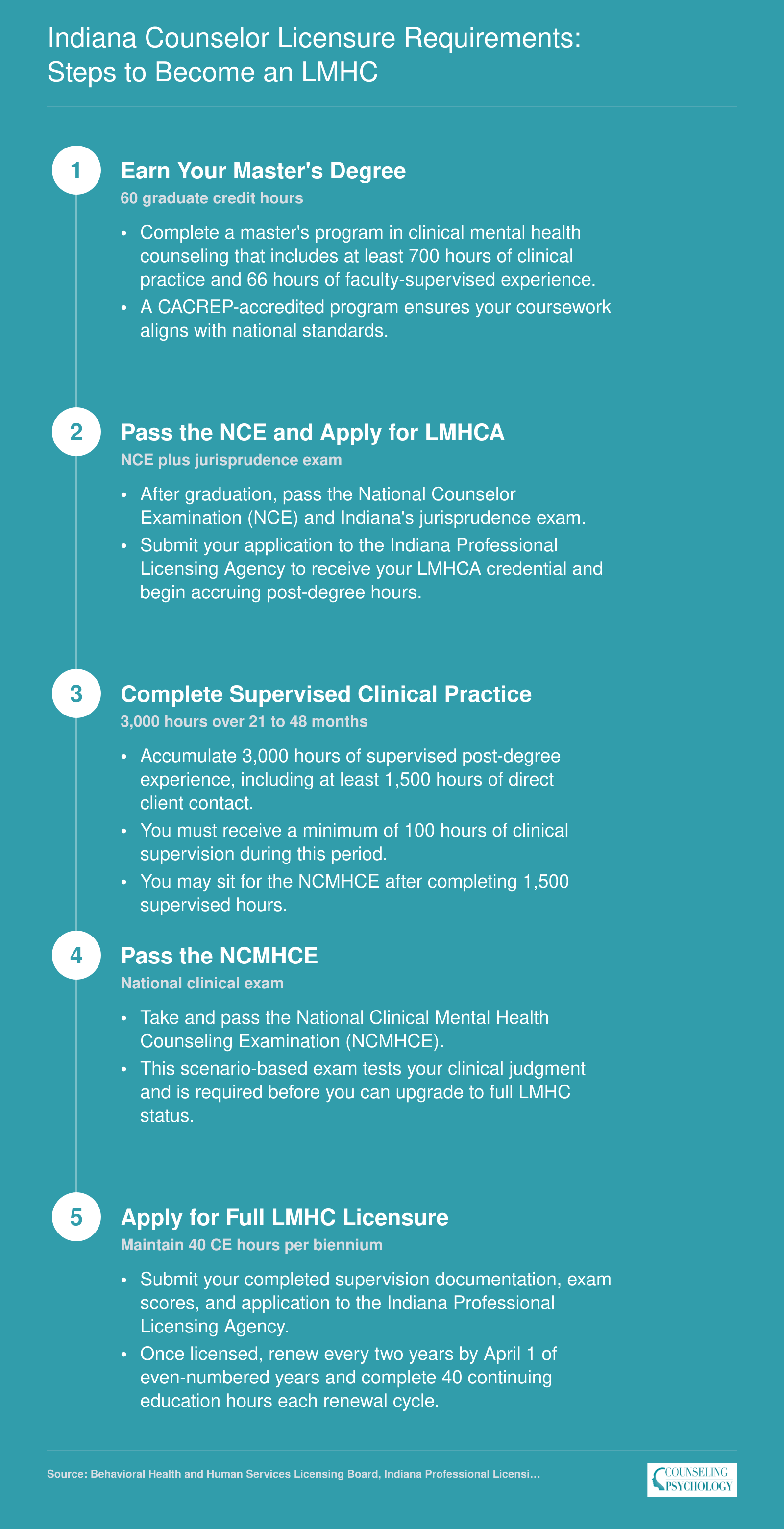
The U.S. Bureau of Labor Statistics projects employment of mental health counselors to grow 18 percent from 2022 to 2032, much faster than the 3 percent average for all occupations. This surge reflects rising national awareness of mental health needs and expanded access to counseling services across clinical, school, and community settings.
Counseling Program Costs and Financial Aid in Indiana
Understanding the full cost picture is essential before committing to a counseling program. The table below compares Indiana institutions by net price (sorted lowest to highest), in-state tuition, and out-of-state tuition. Keep in mind that net price figures are institution-wide averages reported to IPEDS and reflect undergraduate aid patterns; your actual graduate-level costs will vary based on your enrollment status, financial aid package, and residency. Several of these schools serve large shares of Pell Grant recipients, with Purdue University Global (86.2%) and Indiana Institute of Technology (85.5%) leading the way, signaling that many students at those institutions demonstrate significant financial need. Median graduate debt across these programs ranges from roughly $19,500 at Indiana University-Bloomington and Saint Mary-of-the-Woods College to about $26,400 at Indiana Institute of Technology, so comparison shopping and maximizing aid opportunities can make a meaningful difference over the life of your loans.
| School | In-State Tuition | Out-of-State Tuition | Net Price (Avg.) | Pell Grant Share | Median Graduate Debt |
|---|---|---|---|---|---|
| Purdue University Northwest | $6,638 | $11,960 | $6,079 | 61.1% | $21,229 |
| Purdue University Global | $10,101 | $14,412 | $7,770 | 86.2% | $26,078 |
| Indiana University-Indianapolis | $11,180 | $28,964 | $11,668 | 59.0% | $20,000 |
| University of Southern Indiana | $11,667 | $21,948 | $12,923 | 55.3% | $20,105 |
| Indiana University-Bloomington | $11,756 | $33,454 | $16,264 | 44.2% | $19,509 |
| Indiana Wesleyan University (National & Global) | $10,926 | $10,926 | $16,898 | 61.7% | $24,250 |
| Huntington University | $10,742 | $10,742 | $19,310 | 56.3% | $25,576 |
| Indiana Institute of Technology (CPS) | $9,896 | $9,896 | $20,473 | 85.5% | $26,391 |
| Indiana Wesleyan University | $10,620 | $10,620 | $22,866 | 61.7% | $24,250 |
| Indiana Institute of Technology | $31,361 | $31,361 | $23,206 | 85.5% | $26,391 |
| Saint Mary-of-the-Woods College | $14,100 | $14,100 | $31,872 | 60.3% | $19,512 |
| Butler University | $14,460 | $14,460 | $36,041 | 27.7% | $26,000 |
CACREP-Accredited Counseling Programs in Indiana
Four Indiana universities hold current CACREP accreditation for their clinical mental health counseling master's programs.1 This accreditation signals that a program meets rigorous national standards for curriculum, faculty, and clinical training. For students planning to practice as licensed mental health counselors, choosing a CACREP-accredited program can significantly ease the path to licensure, particularly if you may move to another state.
Why CACREP Accreditation Matters
CACREP (Council for Accreditation of Counseling and Related Educational Programs) is the leading specialized accreditor for counseling degrees. Many state licensing boards, including Indiana's, require or strongly prefer graduates from CACREP-accredited programs for licensure as a Licensed Mental Health Counselor (LMHC). Additionally, CACREP accreditation facilitates licensure portability through interstate compacts, making it easier to practice in multiple states. Employers, from community mental health centers to private practices, also often prefer candidates from accredited programs because they can be confident in the quality of training. If you are exploring the broader steps to earning your credential, our guide on how to become a licensed professional counselor covers the full process.
CACREP-Accredited Programs in Indiana
As of 2026, four Indiana schools offer CACREP-accredited master's programs in clinical mental health counseling:1
- Grace College: M.A. in Clinical Mental Health Counseling
- Indiana Wesleyan University: M.A. in Clinical Mental Health Counseling
- Purdue University Northwest: M.S.Ed. in Clinical Mental Health Counseling
- Indiana University Southeast: M.A. in Clinical Mental Health Counseling (newly accredited in 2025)2
All four are fully accredited; no programs are currently in candidacy status. While several other Indiana universities, such as Ball State, IU Bloomington, and the University of Indianapolis, offer respected counseling degrees, they hold accreditation through MPCAC rather than CACREP.3 If your long-term goals include licensure in multiple states or employment with federal agencies that often require CACREP, these four programs provide a clear advantage.
Career Outcomes and Salaries for Indiana Counselors
Indiana employs a substantial counseling workforce, with more than 15,000 professionals working across mental health, substance abuse, and school counseling roles statewide. The table below presents Indiana-specific salary benchmarks from BLS data. Notably, Indiana's median salary for substance abuse, behavioral disorder, and mental health counselors ($49,280) falls below the national median for this occupation, while educational, guidance, and career counselors in Indiana earn a median of $56,470, also slightly under the national figure. These numbers reflect the cost of living advantages Indiana offers relative to higher-paying but more expensive states.
| Occupation | Total Employment in Indiana | 25th Percentile Salary | Median Salary | 75th Percentile Salary | Mean Salary |
|---|---|---|---|---|---|
| Substance Abuse, Behavioral Disorder, and Mental Health Counselors | 10,400 | $41,860 | $49,280 | $62,780 | $54,630 |
| Educational, Guidance, and Career Counselors and Advisors | 5,450 | $47,480 | $56,470 | $67,990 | $59,040 |
Frequently Asked Questions About Counseling Programs in Indiana
Choosing a counseling graduate program involves practical questions about timelines, costs, accreditation, and licensure. Below are answers to the questions prospective students ask most often, drawn from program requirements and professional standards across Indiana.