
What you’ll learn in this article…
- Connecticut CACREP-accredited counseling programs typically require 48 to 60 credits and take two to three years to complete.
- The NHSC Loan Repayment Program offers up to $50,000 for licensed counselors serving in Health Professional Shortage Areas.
- Applicants matriculating after July 1, 2017 must graduate from a CACREP-accredited program to qualify for LPC licensure in Connecticut.
- Both online and on-campus formats lead to the same Licensed Professional Counselor credential when programs hold CACREP accreditation.
Connecticut requires a minimum of 3,000 supervised post-degree hours before granting full Licensed Professional Counselor (LPC) status, making program selection a decision with multi-year consequences. Choosing the wrong program, particularly one without CACREP accreditation, can delay or complicate that licensure path entirely.
For most prospective students in Connecticut, two factors dominate the decision: cost and format. Public university programs can run significantly less per credit than private alternatives, and online or hybrid delivery makes graduate study viable for working adults who cannot relocate or leave employment. Understanding the full landscape of counseling degrees and their requirements helps put Connecticut-specific options in context.
Demand for mental health counselors is rising at both the state and national level, driven by expanded insurance parity mandates, growing awareness of behavioral health needs, and workforce shortages in underserved Connecticut communities. That demand does not automatically translate to higher starting salaries, however. Entry-level LPC compensation in Connecticut varies meaningfully by setting, specialty, and employer type, which makes choosing a well-matched program, not just any accredited one, a practical rather than a symbolic distinction.
Best Master's in Counseling Programs in Connecticut
Connecticut offers a mix of public universities and private colleges with counseling programs that range from fully online to hybrid formats. The programs below were evaluated for affordability, flexible delivery, accreditation, and licensure alignment. Whether you are a working professional seeking evening or online classes, or a career changer looking for a CACREP-accredited pathway to licensure, these schools represent some of the strongest options in the state for 2026.
- Net price and tuition affordability
- Online or hybrid delivery options
- Accreditation and licensure alignment
- Program breadth and concentrations
- Institutional graduation and retention rates
- Internal program database
- Independent program research
- College Scorecard graduate earnings — collegescorecard.ed.gov
- NCES-IPEDS federal institutional data — nces.ed.gov

Central Connecticut State University
Central Connecticut State University anchors its counseling offerings around a COAMFTE-accredited Marriage and Family Therapy program delivered in a hybrid, evening-friendly format designed for working adults. With one of the lowest net prices among Connecticut institutions and no GRE or GMAT requirement, CCSU provides an accessible entry point into the counseling field. The 63-credit curriculum features clinical training through practicum and internship placements, and graduates meet Connecticut's licensure requirements for marriage and family therapists.
- COAMFTE-accredited 63-credit program
- Hybrid format with flexible evening classes
- No GRE or GMAT required for admission
- Practicum and internship clinical placements included
- Meets Connecticut MFT licensure requirements
- Financial aid available; three-year completion timeline
- Systemic therapy approaches and clinical lab training
Marriage and Family Therapy, MS — Hybrid

Western Connecticut State University
Western Connecticut State University stands out for the breadth of its counseling-related master's programs, offering CACREP-accredited tracks in both School Counseling and Clinical Mental Health Counseling, as well as a hybrid M.S. in Addiction Studies. All three programs blend online coursework with on-campus clinical labs, making WCSU a strong choice for students who want accredited training with geographic flexibility. The School Counseling track prepares graduates for Connecticut's Initial Educator Certification, while the CMHC concentration qualifies students for both Connecticut and New York licensure exams.
- CACREP-accredited 60-credit hybrid program
- On-campus clinical labs with role-play scenarios
- Prepares for CT Initial Educator Certification
- Flexible scheduling for working professionals
- Supports K-12 academic and social-emotional development
- Meets Connecticut school counselor licensure requirements
- CACREP-accredited 60-credit hybrid curriculum
- Three-year completion with online and on-campus components
- Prepares for both CT and NY counseling licensure
- National Counselor Examination eligibility upon completion
- Clinical lab components reinforce practical skills
- Licensure-focused training with hybrid flexibility
- Hybrid delivery with evidence-based interventions focus
- Prepares graduates for LADC licensure in Connecticut
- 200 to 300 hour internship requirement
- Fall and spring entry options available
- Training with diverse populations and community outreach
- Advanced standing option for qualified applicants
Master of Science in Counselor Education, School Counseling — Hybrid
Master of Science in Counselor Education, Clinical Mental Health Counseling — Hybrid
Master of Science in Addiction Studies — Hybrid

University of Bridgeport
The University of Bridgeport offers a fully online Master's in Clinical Mental Health Counseling that is CACREP-accredited and completable in two to three years. UB charges a flat per-credit rate for online students regardless of state residency, effectively removing out-of-state tuition surcharges and making the program accessible to learners across the region. The 60-credit, trauma-informed curriculum includes a 100-hour practicum and two 300-hour internships, with placements arranged in students' local communities. This combination of full online delivery, licensure preparation, and community-based clinical placements makes UB a practical choice for career changers and working human services professionals.
- CACREP-accredited, 100% online degree option
- 60-credit trauma-informed, evidence-based curriculum
- Completable in 2 to 3 years at a flexible pace
- Flat tuition rate with no out-of-state surcharge
- 100-hour practicum plus two 300-hour internships
- Prepares for the National Counselor Examination
- Emphasis on cultural humility and diverse communities
Master's in Clinical Mental Health Counseling — Hybrid

Southern Connecticut State University
Southern Connecticut State University positions itself as a lower-cost public alternative to Connecticut's private institutions for counseling education. Its fully online Graduate Certificate in Addictions Counseling is a focused 12-credit credential covering pharmacology, treatment theories, and ethical practices. SCSU also offers a hybrid Ed.D. in Counselor Education and Supervision for experienced clinicians pursuing leadership and supervisory roles. With a strong emphasis on diversity, social justice, and culturally responsive practice, SCSU's programs serve both early-career counselors and licensed professionals looking to advance.
- Fully online 12-credit program
- Covers pharmacology, treatment theories, and ethics
- Diversity and social justice framework emphasized
- Requires 3.0 GPA for graduation
- Designed for professionals adding substance use expertise
- Not eligible for financial aid or VA benefits
- Hybrid format combining online and evening classes
- 100-hour practicum and 600-hour internship required
- Aligns with CACREP doctoral standards
- Three-year completion designed for working professionals
- Comprehensive exams and dissertation required
- Culturally responsive supervision and advocacy focus
Addictions Counseling, Graduate Certificate — Online
Counselor Education and Supervision, Ed.D. — Hybrid

Albertus Magnus College
Albertus Magnus College in New Haven provides counseling-focused programs through a hybrid delivery model with evening classes suited to working professionals. The M.S. in Human Services with an Addiction Counseling concentration is a 57-credit master's degree that prepares graduates for LADC credentialing, while the 18-credit Post-Graduate Certificate in Addiction Counseling can be completed in a single academic year by those who already hold a counseling-related master's. Both programs emphasize evidence-based treatments, psychopharmacology, and multicultural competency. As a private institution, Albertus Magnus carries a higher price point, but its small class sizes and focused addiction counseling curriculum offer a specialized path not widely available elsewhere in the state.
- 57-credit hybrid master's with LADC preparation
- Small class sizes with experienced faculty
- Two-year program with internship placements
- Multicultural counseling focus throughout curriculum
- Requires 3.0 GPA for admission
- Evening classes designed for working professionals
- 18-credit hybrid certificate completable in one year
- Prepares for Connecticut LADC licensure
- Covers psychopharmacology and ethical counseling
- Evidence-based substance use treatment emphasis
- Requires an existing counseling-related master's degree
- Evening format accommodates busy schedules
Master of Science in Human Services, Addiction Counseling — Hybrid
Post-Graduate Certificate in Addiction Counseling — Hybrid

Sacred Heart University
Sacred Heart University offers two fully online master's programs in counseling: the M.A. in School Counseling and the CACREP-accredited M.A. in Clinical Mental Health Counseling. Both charge the same per-credit rate regardless of residency, making them equally accessible to Connecticut residents and out-of-state learners. SHU holds the highest institution-wide graduation rate among the schools on this list (73.5%), and its online counseling programs include brief on-campus residencies in Fairfield for intensive skills training. While tuition is significantly higher than public alternatives, the combination of small class sizes, no GRE requirement, and strong alignment with ASCA and state certification standards makes SHU a premium online option for students who prioritize institutional reputation and a structured online experience.
- Fully online with in-person residencies in Fairfield, CT
- 60 to 63 credit hours at $800 per credit
- Completable in approximately 2.5 years
- No GRE or GMAT required for admission
- Practicum and internship experiences included
- Prepares for Connecticut school counselor certification
- Focuses on social-emotional learning and career readiness
- CACREP-accredited, 60-credit online program
- $900 per credit with no out-of-state surcharge
- Completable in 2 to 3 years
- Two brief on-campus residencies required
- Prepares for licensure and the National Counselor Examination
- No standardized test scores required for admission
- Diverse faculty with real-world clinical experience
Master of Arts in School Counseling — Online
Master of Arts in Clinical Mental Health Counseling — Online
Affordability Comparison: CT Counseling Program Costs
Cost is one of the most important factors when choosing a counseling master's program in Connecticut. The table below compares annual tuition, average net price (after grants and scholarships), and median graduate debt across six Connecticut institutions that offer counseling or counseling-related programs. Public universities in the state offer a significant cost advantage for in-state residents, while private institutions vary widely in both sticker price and net cost.
| School | Type | In-State Tuition | Out-of-State Tuition | Avg. Net Price | Median Graduate Debt | Student-to-Faculty Ratio |
|---|---|---|---|---|---|---|
| Central Connecticut State University | Public | $14,562 | $18,920 | $16,857 | $22,300 | 14:1 |
| Western Connecticut State University | Public | $15,039 | $19,397 | $17,604 | $24,147 | 11:1 |
| Southern Connecticut State University | Public | $14,930 | $21,727 | $20,857 | $22,250 | 11:1 |
| University of Bridgeport | Private | $21,786 | $21,786 | $27,807 | $25,750 | 15:1 |
| Albertus Magnus College | Private | $24,528 | $24,528 | $34,028 | $30,964 | 17:1 |
| Sacred Heart University | Private | $34,394 | $34,394 | $46,174 | $25,000 | 15:1 |
Questions to Ask Yourself
CACREP-Accredited Counseling Programs in Connecticut
CACREP accreditation is a programmatic seal of approval granted by the Council for Accreditation of Counseling and Related Educational Programs.1 It signals that a counseling master's program meets nationally established standards for curriculum, clinical training, and faculty qualifications. Think of it as the field's equivalent of a professional license for the program itself.
Why CACREP Accreditation Matters for Licensure
Connecticut's licensure pathway for licensed professional counselor candidates strongly favors graduates of CACREP-accredited programs. While the state does not categorically bar applicants from non-CACREP programs, the licensure board scrutinizes coursework more closely for graduates of programs without it, which can slow down or complicate the process. Beyond Connecticut, CACREP status matters for portability: if you later move to a state where CACREP graduation is explicitly required for licensure, having that credential on your transcript eliminates a significant hurdle.
It is also worth understanding the difference between two types of accreditation that appear on program pages. Institutional accreditation, such as that granted by the New England Commission of Higher Education, applies to the university as a whole and confirms that the school meets broad educational standards. Programmatic accreditation, which is what CACREP provides, applies specifically to the counseling program and evaluates it against the profession's own benchmarks. A university can hold strong institutional accreditation while its counseling program remains unaccredited by CACREP, so checking both matters.
CACREP-Accredited Programs in Connecticut
As of 2025-2026, the following Connecticut programs hold CACREP accreditation:
- Central Connecticut State University: MS in Clinical Mental Health Counseling (New Britain)
- Fairfield University: MA in Clinical Mental Health Counseling. Note that this program's accreditation was listed with an expiration date of March 31, 2026; prospective students should confirm current status directly with the program or through the CACREP directory before enrolling.3
- Sacred Heart University: MA in Clinical Mental Health Counseling, available online
- Southern Connecticut State University: MS in Clinical Mental Health Counseling, accredited continuously since 19974
- University of Bridgeport: MS in Clinical Mental Health Counseling, available online
- University of New Haven: MA in Clinical Mental Health Counseling, offered on campus and online
- University of Saint Joseph: MA in Clinical Mental Health Counseling
- Western Connecticut State University: MS in Counselor Education
The CACREP directory is the definitive source for current accreditation status and expiration dates. Accreditation cycles change, and programs sometimes renew, expand, or let status lapse, so verifying directly before you apply is a practical habit rather than an optional one.
Online Vs. On-Campus Counseling Programs in CT
Online flexibility versus on-campus immersion is the central trade-off for most Connecticut counseling applicants. Both formats can lead to the same Licensed Professional Counselor credential, the same CACREP-accredited coursework, and the same supervised practicum hours. What differs is how you spend your time, what it costs, and how employers and licensing boards view the training behind your degree.
What changes between formats
- Schedule: Online programs typically run asynchronously with occasional residencies, while on-campus tracks meet weekly in New Haven, Storrs, New Britain, or West Hartford.
- Cost: In-state on-campus tuition at public institutions like UConn and Southern Connecticut State University is often lower per credit, but online students save on commuting, parking, and relocation.
- Networking: On-campus cohorts build tighter peer and faculty ties, which often translates into stronger practicum placements across Connecticut's hospital systems and school districts.
- Practicum: Both formats require in-person, supervised clinical hours at a Connecticut-approved site. Online students arrange placements locally; on-campus students often use established university partnerships.
How to compare them for yourself
Visit each program's page (UConn, Southern Connecticut State, University of Saint Joseph, Sacred Heart) to pull current tuition, graduation rates, and enrollment for both delivery modes. If you are still weighing broader options, our guide to the best online master's in counseling programs can help you benchmark Connecticut schools against national alternatives. The U.S. Bureau of Labor Statistics publishes Connecticut-specific wage and employment data for school counselors and mental health counselors, which lets you check whether salary varies by setting rather than by degree format. O*NET adds employer-preference signals for the specific roles you are targeting.
For employer perception, surveys from the American Counseling Association and the Connecticut Counseling Association have consistently found that CACREP accreditation and state licensure matter more to hiring managers than whether your coursework was delivered online or in a classroom.
Related Articles
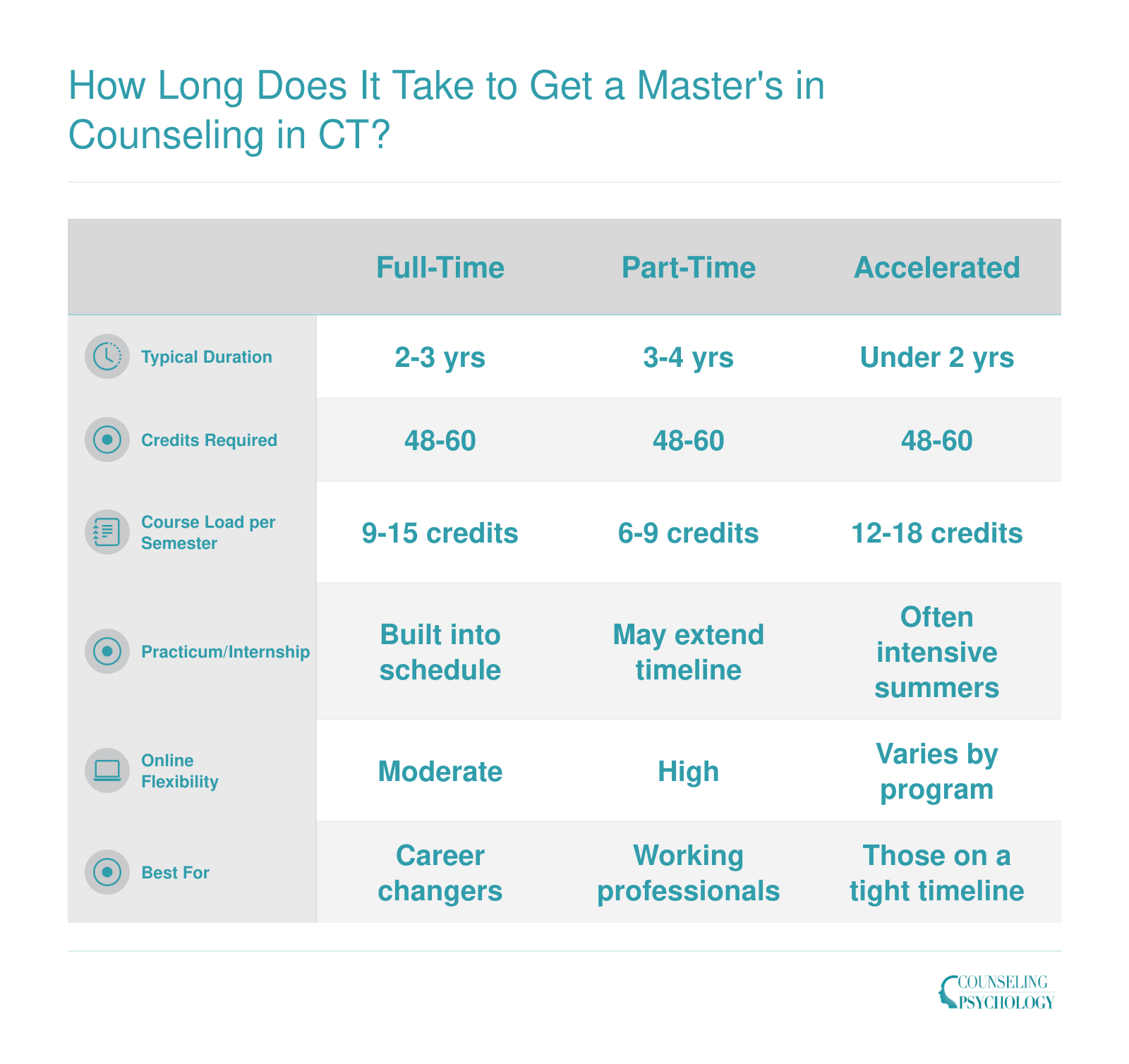
How Long Does It Take to Get a Master's in Counseling in CT?
Completion timelines for a master's in counseling in Connecticut depend on enrollment pace and program structure. Most programs require 48 to 60 credits, with CACREP-accredited clinical mental health counseling tracks typically at the higher end. To confirm exact credit counts and scheduling options, visit the official program pages for University of Saint Joseph, Central Connecticut State University, Fairfield University, and other CT institutions. You can also contact the Connecticut Counseling Association or the American Counseling Association for guidance on typical program structures in the state.
Child Counseling Specializations and Certificates in Connecticut
Connecticut universities embed child and adolescent counseling preparation inside their broader CACREP-accredited master's programs rather than offering it as a standalone concentration. Students who want to work with kids should look closely at required coursework, practicum placement options, and post-master's certificate add-ons rather than searching for a dedicated child counseling degree track. For a broader look at the profession, our guide on how to become a child counselor covers degree and certification requirements nationwide.
Where Child-Focused Coursework Lives in CT Programs
At the University of Saint Joseph, both the Clinical Mental Health Counseling M.A. and the School Counseling M.A. are CACREP-accredited and prepare counselors to work across the lifespan, including children, adolescents, adults, and families.12 The School Counseling M.A. specifically includes COUN 506: Counseling Children and Adolescents as part of its required coursework.2 Neither program currently offers a formal child or adolescent concentration, a play therapy specialization, or a dedicated child counseling graduate certificate, so child-focused training comes through course selection, electives, and fieldwork placement rather than a named track on the transcript.
Typical coursework that supports child counseling competency across CT programs includes child and adolescent development, family systems and family counseling, trauma-informed practice, group counseling with minors, and assessment of children. Programs that train school counselors generally go deeper on developmental and educational frameworks, while clinical mental health tracks lean toward diagnosis, treatment planning, and clinical interventions for youth presenting with anxiety, depression, ADHD, or trauma.
Practicum and Fieldwork With Children
Practicum and internship hours are where the child counseling specialization actually gets built. CT students pursuing this focus typically request placements in K-12 school counseling offices, pediatric behavioral health clinics, community mental health agencies serving youth, residential treatment programs, or family service nonprofits. Your program's clinical coordinator approves sites, so discuss your interest in child work early. Students interested in childhood trauma counseling may find practicum sites that specialize in abuse-related interventions particularly valuable.
Related Certificates Worth Knowing About
While dedicated post-master's child counseling certificates are limited in Connecticut, the University of Saint Joseph offers a graduate certificate in Applied Behavior Analysis, which is relevant for counselors who want credentials to work with children on the autism spectrum or with behavioral health needs.3 Counselors seeking play therapy credentials typically pursue the Registered Play Therapist (RPT) designation through post-graduate training and supervision outside the master's degree.
Becoming a Licensed Professional Counselor in Connecticut
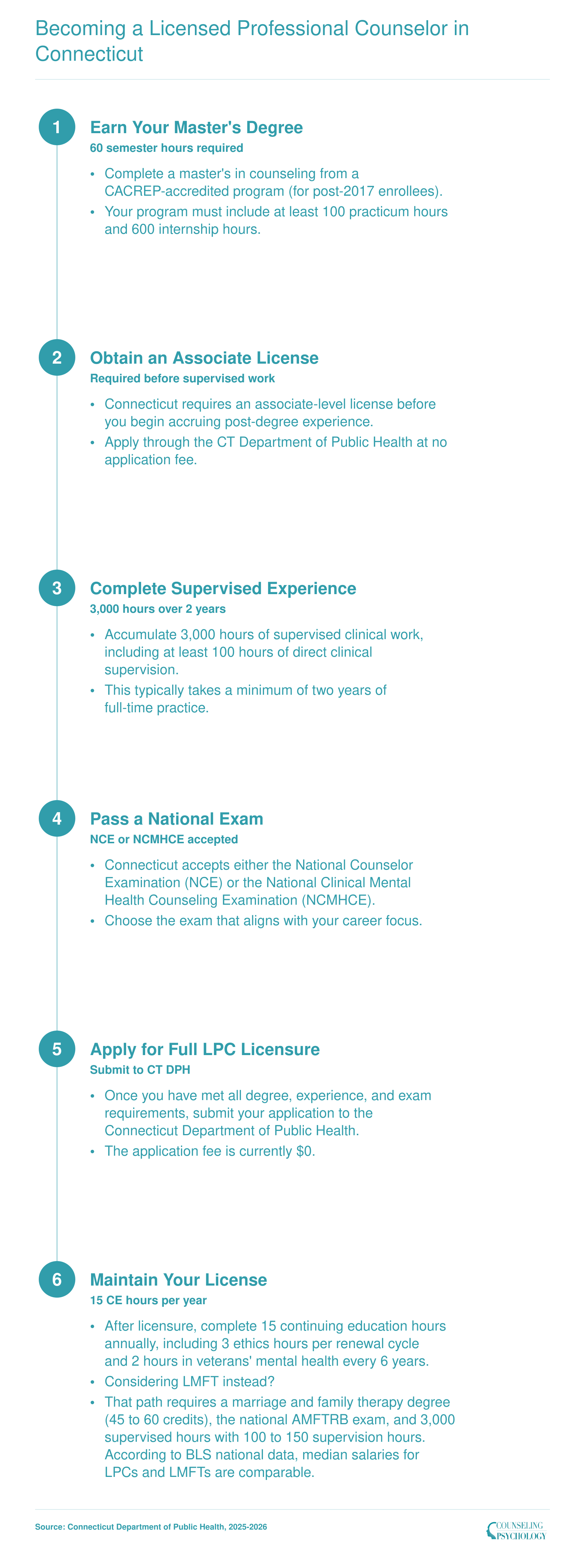
Connecticut's path to LPC licensure is straightforward but requires sustained commitment. Candidates who matriculated after July 1, 2017 must graduate from a CACREP-accredited program and complete additional coursework in addiction, trauma, and diagnosis. Here is how the process unfolds, along with a quick comparison to LMFT licensure.
Financial Aid, Scholarships, and Loan Forgiveness for CT Counseling Students
The NHSC Loan Repayment Program offers up to $50,000 in loan forgiveness for full-time licensed professional counselors who commit to two years of service at an NHSC-approved site in a Health Professional Shortage Area.1 This federal program provides substantial debt relief for mental health professionals willing to serve underserved communities, and awards are exempt from federal income and employment taxes.2 Half-time positions qualify for $25,000 in loan repayment. Connecticut hosts multiple NHSC-approved sites where counseling graduates can fulfill this service commitment while building clinical experience in high-need settings.3
Federal Loan Forgiveness Options
Public Service Loan Forgiveness (PSLF) represents another major opportunity for counseling graduates. Counselors employed full-time by nonprofit organizations or government agencies can have their remaining federal Direct Loan balance forgiven after making 120 qualifying monthly payments under an income-driven repayment plan. Many community mental health counselor employers in Connecticut, including school districts and public hospitals, qualify as eligible PSLF employers. Combined with the NHSC program, counselors working in shortage areas can accelerate debt elimination significantly.
Connecticut State Programs
The Connecticut Student Loan Repayment Program provides up to $50,000 for full-time behavioral health providers (including licensed counselors) and $25,000 for part-time practitioners.4 Eligibility requires working at an approved site serving underserved populations within the state. This state-funded initiative complements federal programs and targets Connecticut's specific behavioral health workforce needs. Applicants must hold a current, unrestricted professional license and have no defaults or judgments on federal debt.5
Institutional Aid and Net Price Reality
Published tuition figures rarely reflect what students actually pay. Institutional financial aid packages vary widely across Connecticut counseling programs, with some universities offering graduate assistantships, merit scholarships, or employer partnerships that reduce net costs by thousands of dollars per year. When comparing programs, request detailed aid package information and calculate the true out-of-pocket cost after grants, assistantships, and scholarships. The difference between sticker price and net price can shift which program offers the best value.
Additional Scholarship Opportunities
Several targeted scholarships support counseling students in Connecticut. The federal Scholarships for Disadvantaged Students program provides need-based awards through participating schools' financial aid offices.4 The APA Interdisciplinary Minority Fellowship Program supports behavioral health students from underrepresented backgrounds who plan to serve underserved communities. Regional awards like Big Y Scholarships serve students living in or attending school in Connecticut. Check with your program's financial aid office about school-specific awards, which often go underutilized because students don't know to apply.
Career Outcomes and Salaries for CT Counseling Graduates
Earning Power for Connecticut Counseling Graduates
While program-specific earnings data is not yet reported for the ranked schools, institutional median earnings 10 years after enrollment offer a reliable proxy for financial return. Among the highlighted Connecticut programs, median alumni earnings range from $50,323 (University of Bridgeport) to $75,059 (Sacred Heart University). These figures suggest that graduates of the state's counseling programs are well positioned to command solid salaries, with institutional prestige and program focus often correlating with higher earnings.
Mental Health vs. School Counseling Salaries
According to the Bureau of Labor Statistics, mental health counselors nationwide earned a median annual wage of $59,190 in 2023.1 In Connecticut, wages trend higher, particularly in metropolitan areas like Bridgeport-Stamford, Hartford, and New Haven, with many professionals earning in the mid-to-upper $60,000s. School and career counselors in the state typically see even stronger figures, with median wages often surpassing $70,000 in urban districts. The precise credential (LPC or LMFT) matters less for pay than the work setting: private practice, school systems, and substance abuse clinics each bring different compensation levels, and BLS data shows that marriage and family therapists earn salaries comparable to those of mental health counselors. Students interested in how to become a school counselor should note that Connecticut's school-based roles tend to offer competitive pay alongside strong benefits packages.
Job Market and Employment Rates
Program-level employment share data (the percentage of graduates working and not enrolled within one year) is currently unavailable for these programs. However, the overall institutional strength of the ranked schools, including high retention and graduation rates, suggests strong career preparation. All featured schools hold CACREP or COAMFTE accreditation, signaling rigorous training that aligns with licensure requirements and employer expectations. Graduates typically find roles in K-12 schools, outpatient care centers, hospitals, and private practices, where demand remains steady across Connecticut. Those considering specialization in substance use treatment may also explore addiction counseling degree options to expand their career prospects further.
Frequently Asked Questions About Counseling Master's Programs in CT
Choosing a counseling master's program in Connecticut involves weighing cost, format, accreditation, and career outcomes. Below are answers to the questions prospective students ask most often, drawn from current program data and state licensing requirements.