What you’ll learn in this article…
- Sixteen CACREP accredited counseling programs operate in Illinois, spanning clinical mental health, school, and rehabilitation specializations.
- Tuition ranges from under $25,000 at public universities to over $100,000 at private institutions across the state.
- Illinois licensure follows three tracks: entry level LPC, independent practice LCPC, and a separate school counselor endorsement.
- Salary varies significantly by specialty, with credential level and location influencing earning potential for Illinois counselors.
Affordable online programs and premium on-campus cohorts represent two very different paths into Illinois counseling, yet both can lead to the same LPC or LCPC credential. The state's behavioral health workforce gap is real: Illinois has designated more than 100 mental health professional shortage areas, and employer demand for licensed counselors continues to outpace the supply of new graduates.
That gap creates opportunity, but the cost of entry varies widely. Graduate tuition for CACREP-accredited counseling programs in Illinois ranges from roughly $10,000 per year at public institutions to over $47,000 at specialized private schools. For students still exploring the broader landscape, our guide to how to become a counselor covers the foundational steps. Choosing between net price, clinical placement quality, and format flexibility is the central tension most applicants face, and getting it wrong can mean years of unnecessary debt relative to early-career earnings.
2026 Best Master's in Counseling Programs in Illinois: Rankings
Illinois offers a broad range of counseling graduate programs, from public universities with rock-bottom net prices to prestigious private institutions with strong clinical placement networks. The 2026 rankings below weight affordability, financial aid generosity, and online availability so that working professionals and budget-conscious students can find programs that fit their lives. Where available, we include institution-level earnings and debt figures from the College Scorecard to help you weigh return on investment. Note that program-level earnings are not yet available for most of these programs, so the earnings figures shown reflect all graduates of each institution, not a single department.
- Net price and financial aid
- Online or hybrid availability
- Median graduate debt load
- Institution-wide graduate earnings
- Student-to-faculty ratio
- NCES-IPEDS federal institutional data — nces.ed.gov
- College Scorecard graduate earnings — collegescorecard.ed.gov
- Independent program research
- Internal program database

Governors State University
Governors State University in University Park delivers some of the lowest net costs in the state, with a net price near $12,329 and identical in-state and out-of-state tuition of $10,666. Its counseling offerings span addiction studies and school counseling, all in hybrid formats that blend online coursework with supervised field experiences. Median graduate debt sits at roughly $18,618, and institution-wide median earnings reach about $58,169 ten years after enrollment. The 11:1 student-to-faculty ratio means graduate students get meaningful access to advisors during practicum and internship planning.
- 27-credit hybrid certificate for existing master's holders
- Leads to Illinois Professional Educator License in School Counseling
- Covers crisis intervention, career coaching, and K-12 support
- Faculty interview and 3.0 graduate GPA required
- Multiple internship placement options across school settings
- Focuses on academic development and personal growth strategies
- 32-credit hour program with hybrid or online delivery
- Accredited by IAODAPCA and NASAC
- Evidence-based addiction treatment curriculum
- Addictions Counseling concentration available
- Criminal Justice Internship option for forensic settings
- Prepares graduates for state and national counselor certification
- Multicultural perspective on substance abuse integrated throughout
Post Master's School Counseling Certificate — Hybrid
Master of Health Science in Addictions Studies — Hybrid

Moody Bible Institute
Moody Bible Institute, located in Chicago's Near North Side, pairs affordable tuition ($539 per credit hour) with a faith-integrated clinical mental health counseling curriculum. The institution reports a 99% job placement rate and a 96% pass rate on the National Counselor Examination, signaling strong preparation for Illinois LPC licensure. Median graduate debt is approximately $18,149, one of the lowest figures on this list. The hybrid format lets students attend both on-campus intensives and virtual sessions, making it accessible to those balancing ministry or clinical roles.
- Hybrid format with on-campus and virtual class options
- $539 per credit hour, among the most affordable in Illinois
- 99% reported job placement rate after graduation
- 96% pass rate on the National Counselor Examination
- Integrates biblical wellness strategies with clinical practice
- Prepares students for Illinois Licensed Professional Counselor pathway
- 12 to 15 months of supervised clinical experience required
- Hybrid delivery with flexible scheduling
- Integrates biblical insight with counseling psychology theory
- Prepares graduates for professional licensure in Illinois
- Supervised clinical experience of 12 to 15 months
- $539 per credit hour
- Focus on cultural competence and spiritual dimensions of care
MA in Clinical Mental Health Counseling — Hybrid
MA in Counseling Psychology — Hybrid

The Chicago School at Chicago
The Chicago School at Chicago is a graduate-focused institution known for its CACREP-accredited counseling programs delivered primarily online with limited in-person residency requirements. Its MA in Clinical Mental Health Counseling boasts a 91% licensure exam pass rate and 700 clinical training hours, while the doctoral program in Counselor Education and Supervision prepares working clinicians for leadership and academic roles. Median graduate debt is around $20,000, and institution-wide ten-year median earnings are approximately $56,899. The 34.5% admission rate reflects a selective cohort model.
- CACREP-accredited, fully online with two in-person residencies
- 700 clinical training hours included
- 91% reported licensure exam pass rate
- Personalized faculty advising throughout the program
- Completable in under four years at standard pace
- Multiple career pathway options after graduation
- CACREP-accredited doctoral program, online delivery
- 100 practicum hours plus 600 internship hours required
- Focus on advanced counseling theories and telebehavioral health
- Two in-person residencies and a dissertation required
- 3.0 GPA minimum for admission
- Prepares graduates for academic, agency, and private practice leadership
MA in Clinical Mental Health Counseling — Online
PhD in Counselor Education and Supervision — Online

Concordia University-Chicago
Concordia University-Chicago in River Forest offers CACREP-accredited clinical mental health counseling alongside a school counseling track, both delivered in hybrid formats. Graduate tuition of $10,782 and a net price near $18,436 make it one of the more affordable private options in the Chicago suburbs. The clinical mental health program requires 700 hours of supervised training and 60 semester hours, positioning graduates for the Illinois LPC exam. The school counseling program leads to a Professional Educator License and emphasizes the ASCA National Model.
- CACREP-accredited, 60 semester hour curriculum
- 700 total clinical training hours required
- Hybrid format with evening and weekend options
- Prepares students for the Licensed Professional Counselor exam
- Strong multicultural counseling focus
- Covers crisis intervention and trauma-informed care
- 48-credit hour hybrid program
- Leads to Illinois Professional Educator License
- ASCA National Model integrated throughout coursework
- 400 to 600 clinical hours across two internship tracks
- Capstone counseling intervention project required
- Emphasis on multicultural and developmental counseling strategies
MA in Clinical Mental Health Counseling — Hybrid
MA in School Counseling — Hybrid

Bradley University
Bradley University in Peoria combines a strong institution-wide graduation rate of 76.2% with CACREP-accredited counseling programs available online and in hybrid formats. Its MA in Clinical Mental Health Counseling is fully online and requires 60 credit hours plus 750 hours of supervised experience. A graduate certificate in clinical mental health is also available for counselors who already hold a master's degree. Median graduate debt is about $27,000, and institution-wide ten-year median earnings reach roughly $66,852.
- CACREP-accredited, fully online program
- 60 credit hours with 750 supervised experience hours
- Prepares graduates for the National Counselor Examination
- Covers substance abuse counseling and crisis intervention
- Focus on serving diverse populations
- GRE or MAT required only if GPA is below 3.0
- CACREP-accredited hybrid program
- 60 to 61 total credit hours
- 750 hours of supervised school-based experience
- K-8 and secondary specialization tracks
- Flexible for both current teachers and career changers
- Comprehensive counseling curriculum with advanced clinical training
- 12 credit hours of focused coursework
- Meets Certified Clinical Mental Health Counseling requirements
- Covers ethics, diagnosis, and treatment of mental disorders
- Designed for counselors from 48 to 51 hour master's programs
- Clinical supervision coursework included
- Fully online delivery
MA in Counseling, Clinical Mental Health Counseling — Online
MA in Counseling, Professional School Counseling — Hybrid
Graduate Certificate in Clinical Mental Health — On-Campus

DePaul University
DePaul University brings the resources of Chicago's largest Catholic university to its counseling programs, offering both a clinical mental health counseling master's and a school counselor endorsement. The clinical track is a 90-quarter-hour hybrid program with practicum and internship components in diverse urban settings, and it meets Illinois LPC and LCPC requirements. DePaul's net price is approximately $30,902, offset by median graduate debt of about $23,168 and institution-wide ten-year earnings near $68,751. The school counselor endorsement is approved by the Illinois State Board of Education and includes a 700-hour internship.
- Hybrid format with weeknight, Saturday, and online options
- 90-quarter-hour program meeting Illinois LPC and LCPC requirements
- Hands-on practicum and internship in urban clinical settings
- Emphasis on multicultural counseling and social justice advocacy
- Crisis intervention and trauma counseling training included
- State-of-the-art training facility in Chicago
- Illinois State Board of Education approved
- 32 quarter hours of coursework
- 700-hour internship experience in school settings
- Flexible scheduling with online and hybrid delivery
- Designed for those with an existing counseling-related graduate degree
- Focuses on developmental school counseling and crisis intervention
MA in Clinical Mental Health Counseling — Hybrid
School Counselor Endorsement — Hybrid

Northwestern University
Northwestern University in Evanston offers a CACREP-accredited online MA in Counseling with a child and adolescent specialization, as well as a COAMFTE-accredited online MS in Marriage and Family Therapy completable in as few as 21 months. Despite a sticker price of $54,655, generous financial aid brings the institution-wide net price to about $29,167, and median graduate debt is only around $15,000, the lowest on this list. Institution-wide ten-year median earnings of roughly $89,363 also lead these rankings. No GRE is required for the MFT program, and synchronous online classes keep the experience interactive.
- CACREP-accredited, fully online program
- Child and adolescent specialization available
- 24 graduate-level courses, completable in 18 to 36 months
- 200-hour practicum plus 600-hour internship
- Faculty-approved clinical field placements
- Both live synchronous and asynchronous course components
- COAMFTE-accredited, fully online delivery
- 25 courses with 400 clinical hours, including 100 relational hours
- Full-time completion in as few as 21 months
- Part-time option extends to 36 months
- No GRE required for admission
- Synchronous live instruction in a cohort-based structure
- Placement assistance for clinical sites near students' communities
MA in Counseling — On-Campus
MS in Marriage and Family Therapy — On-Campus

University of Illinois Springfield
The University of Illinois Springfield is a public institution offering some of the lowest net costs in this ranking at approximately $9,833 for in-state students. Its graduate certificate in alcohol and substance abuse is delivered entirely online and prepares graduates for the Illinois Certified Alcohol and Drug Counselor exam. In-state graduate tuition runs about $11,938, with out-of-state tuition near $19,515. Median graduate debt is around $19,128, and institution-wide ten-year median earnings are roughly $57,103. The 13:1 student-to-faculty ratio supports individualized advising.
- 15 semester hours, fully online delivery
- Prepares graduates for the Illinois CADC exam
- Coursework covers substance abuse assessment and dual diagnosis
- Grade of B or better required in all courses
- Internship component included in the curriculum
- Requires an undergraduate degree in social work or behavioral science
Graduate Certificate in Alcohol and Substance Abuse — Online

North Park University
North Park University on Chicago's north side offers a fully online MA in Clinical Mental Health Counseling with concentrations in counseling children and adolescents or integrated behavioral healthcare. The program meets licensure requirements in 39 states, giving graduates geographic flexibility. Net price is approximately $16,948, while median graduate debt comes in around $25,500. The curriculum emphasizes spiritual and cultural sensitivity alongside evidence-based counseling techniques, and the 12:1 student-to-faculty ratio supports close mentoring.
- Fully online delivery with no on-campus residency
- Meets licensure requirements in 39 states
- Concentration in Counseling Children and Adolescents available
- Concentration in Integrated Behavioral Healthcare available
- Prepares students for the National Counselor Examination
- Emphasizes spiritual and cultural sensitivity in clinical practice
- Two professional recommendations required for admission
MA in Clinical Mental Health Counseling — Online

Illinois College
Illinois College in Jacksonville rounds out the list with a 100% online BS in Behavioral Health that can serve as an affordable stepping stone to a counseling master's program. At $375 per credit and with acceptance of up to 88 transfer credits, the program is designed for working adults. It prepares students for the Illinois Certified Alcohol and Other Drug Counselor exam or for advanced graduate study in counseling, social work, or clinical mental health. Median graduate debt is approximately $25,565, and institution-wide ten-year median earnings are about $52,575.
- 100% online, completable in roughly 24 months
- $375 per credit with up to 88 transfer credits accepted
- 48 credit hours of focused coursework required
- Prepares graduates for the Illinois CADC licensure exam
- Alcohol and Other Drug Counseling concentration available
- Pathway to graduate study in counseling or social work
- Hands-on practicum experience included
BS in Behavioral Health — Online
Illinois Counseling Program Tuition and Affordability Comparison
Tuition for master's-level counseling programs in Illinois varies dramatically, from under $25,000 at public universities to over $100,000 at private institutions. All six programs below hold CACREP accreditation, which is critical for licensure as an LPC or LCPC in Illinois. Rates shown reflect 2025-2026 published tuition and do not include fees, books, or living expenses.
| University | Sector | Per-Credit Cost | Total Credits | Estimated Total Tuition | CACREP Accredited | Median Graduate Debt (Institution-Wide) |
|---|---|---|---|---|---|---|
| Governors State University | Public | $413 | 60 | $24,780 | Yes | $18,618 |
| Northern Illinois University | Public | $533 | 60 | $31,980 | Yes | N/A |
| Concordia University Chicago | Private | $535 | 60 | $32,100 | Yes | $23,000 |
| Lewis University | Private | $670 | 60 | $40,200 | Yes | N/A |
| Bradley University | Private | $1,135 | 60 | $68,100 | Yes | $27,000 |
| Adler University | Private | $1,617 | 62 | $100,254 | Yes | N/A |
Questions to Ask Yourself
Online vs. Hybrid vs. On-Campus: Illinois Counseling Program Formats Explained
Illinois counseling master's programs come in three broad delivery formats, and the distinctions matter more than they might appear at first glance. The format you choose affects your weekly schedule, your commute (or lack of one), how you'll meet clinical training requirements, and even whether the program fits around a full-time job.
Fully Online Programs
A handful of Illinois programs are designed to be completed entirely at a distance, with no required campus visits. Bradley University's MA in Clinical Mental Health Counseling runs online with virtual residencies and a mix of synchronous and asynchronous coursework, meaning some sessions meet live on video while others can be completed on your own schedule.1 Adler University's online MA in Clinical Mental Health Counseling follows a similar pattern, blending live class meetings with asynchronous modules.2 Northeastern Illinois University also offers its Clinical Mental Health Counseling MA online, with synchronous class sessions built into the schedule.3
Fully online does not mean fully self-paced. Most CACREP-aligned programs require live participation for clinical skills courses, group work, and role-play exercises that can't be evaluated through a discussion board alone.
Hybrid and Low-Residency Formats
Hybrid programs combine online coursework with required in-person components. Northwestern University's online Master's in Counseling, for example, builds in mandatory on-campus immersions where students practice clinical techniques face-to-face with peers and faculty.4 Concordia University Chicago's Clinical Mental Health Counseling program also follows a hybrid model with some on-campus requirements.3 These immersions typically run a few days at a time, once or twice per year, and are non-negotiable for graduation.
On-Campus and Mixed-Delivery Options
Traditional on-campus programs remain a strong fit for students who want daily access to faculty, in-person cohort relationships, and proximity to Chicago-area practicum sites. DePaul University's MA in Counseling stands out by offering mixed delivery: students can choose among online, hybrid, and on-campus tracks depending on their schedule and learning preferences.5 Students interested in other Illinois-based specializations, such as marriage and family therapy masters programs, will find similar format flexibility at many of these institutions.
Practicum and Internship Placement
Regardless of format, every Illinois counseling master's requires supervised clinical hours at an approved site. Online students typically work with a program placement coordinator to identify a local agency, school, or clinic in their own community. Plan on 600 to 700 hours of practicum and internship combined, completed in person, even if every other course in your program is delivered through a screen.
CACREP-Accredited Counseling Programs in Illinois
Sixteen master's level counseling programs in Illinois currently hold CACREP accreditation, spanning clinical mental health counseling, school counseling, rehabilitation counseling, and college counseling specializations. This professional accreditation signals that a program meets national standards for curriculum, faculty credentials, and supervised clinical training, which matters significantly for licensure and employment prospects in Illinois.
Why CACREP Accreditation Matters for Illinois Students
Illinois licensing boards recognize CACREP accreditation when evaluating candidates for the Licensed Professional Counselor (LPC) and Licensed Clinical Professional Counselor (LCPC) credentials. Graduates from accredited programs often face a more streamlined licensure process and find their credentials portable across state lines. Employers in community mental health centers, hospitals, and school districts frequently prefer or require candidates from CACREP-accredited programs.
How to Verify Current Accreditation Status
The most reliable method for confirming a program's accreditation is visiting the official CACREP website at cacrep.org and using their directory search tool. Filter by state (Illinois), program level (master's), and program area to generate an up-to-date list showing accreditation expiration dates. Programs must renew their accreditation periodically, so checking expiration dates helps you avoid enrolling in a program that may lose its status before you graduate.
For additional verification, contact the Illinois Counselor Educator Association (ICEA) or the American Counseling Association's Illinois chapter. These organizations often maintain updated lists and can clarify a program's current standing.
Finding Online and Hybrid Options
The CACREP directory confirms accreditation but does not always specify delivery format. To determine whether a program offers online, hybrid, or fully on-campus options, visit each school's official website and navigate to the admissions or curriculum pages for the specific counseling program. Several Illinois institutions now offer hybrid formats that combine online coursework with intensive on-campus residencies for skills training. Students exploring broader options may also want to review available counseling degrees at different levels to understand how a master's fits into the larger educational landscape.
A Note on Career Data Sources
While the Bureau of Labor Statistics provides valuable career outlook and salary information for counseling professions, it does not track or verify program accreditation. Always confirm accreditation status directly through CACREP rather than relying on third-party career websites or school marketing materials. Accreditation standards change, and only the accrediting body maintains authoritative records of current program status.
Related Articles
Child, Adolescent, and School Counseling Specializations in Illinois
As demand surges for mental health support tailored to children and adolescents, Illinois graduate programs are expanding specialized training pathways outside the traditional adult-focused curriculum. Three institutions stand out for their child and adolescent counseling concentrations, each with a distinct delivery mode and focus.
Specialized Tracks in Illinois Master's Programs
Northwestern University's online Master of Arts in Counseling (Counseling@Northwestern) includes a dedicated Child and Adolescent Specialization.1 The curriculum features a Play Therapy Methods course, giving students direct exposure to a modality rarely offered at the master's level. This online format suits working professionals across Illinois who need flexibility without sacrificing depth in developmental practice.
Adler University in Chicago offers an on-campus M.A. in Counseling: Clinical Mental Health Counseling that allows tailored elective sequences toward child, adolescent, or school-based settings.2 While not a formal concentration, the program's structure enables students to build a focused portfolio through courses in family dynamics, trauma-informed care, and youth advocacy.
The University of Illinois Urbana-Champaign provides an on-campus M.S. in Mental Health Counseling (61 credits, typically completed in 24 months) that prepares students broadly.3 Although it does not advertise a child specialization, students can select elective placements in schools or pediatric behavioral health clinics to concentrate their clinical hours.
School Counselor Endorsement vs. Clinical Child Concentration
Choosing between a school counselor endorsement and a clinical child counseling concentration hinges on licensure goals. School counseling tracks in Illinois lead to a Professional Educator License (PEL) and are designed for K-12 settings, emphasizing academic guidance, crisis intervention, and collaboration with teachers. If you are weighing this path, our guide on how to become a school counselor outlines the steps and degree requirements in detail. In contrast, a clinical child concentration prepares graduates for the Licensed Professional Counselor (LPC) or Licensed Clinical Professional Counselor (LCPC) route, enabling work in community mental health agencies, private practice, or hospitals. Some programs, like those at Adler, offer elective pathways that can satisfy pre-practicum requirements for either direction, but formal endorsement requires a state-approved school counseling program.
Relevant Coursework for Child and Adolescent Practice
When evaluating programs, look for specific coursework beyond general counseling foundations. Core classes in child psychopathology, adolescent development, and family systems are essential. Advanced electives in trauma-informed care for minors, sandtray therapy, or parenting interventions signal a program's depth in this area. Northwestern's Play Therapy Methods course is a strong example. Adler's curriculum often includes group work with youth and social justice perspectives that inform child advocacy. Students drawn to childhood trauma counseling may also want to explore elective tracks focused on abuse recovery and forensic interviewing. Even in a generalist program like UIUC's, seek out opportunities for supervised clinical experiences in pediatric settings, which can shape your competency before licensure.
Stackable Certificates and Flexible Electives
While dedicated child-focused graduate certificates from Illinois universities are still emerging, some schools permit students to accumulate credits toward a certificate in child or adolescent counseling concurrently with their master's. These stackable credentials can strengthen a resume for roles in behavioral health or school-based services. Confirm with each program whether graduate certificate courses apply toward the degree and meet Illinois LPC educational requirements.4 For online learners, Northwestern's integration of child specialization coursework within the master's degree eliminates the need for an external certificate, while others may allow post-degree certificates that can be pursued later to specialize without a full second degree.
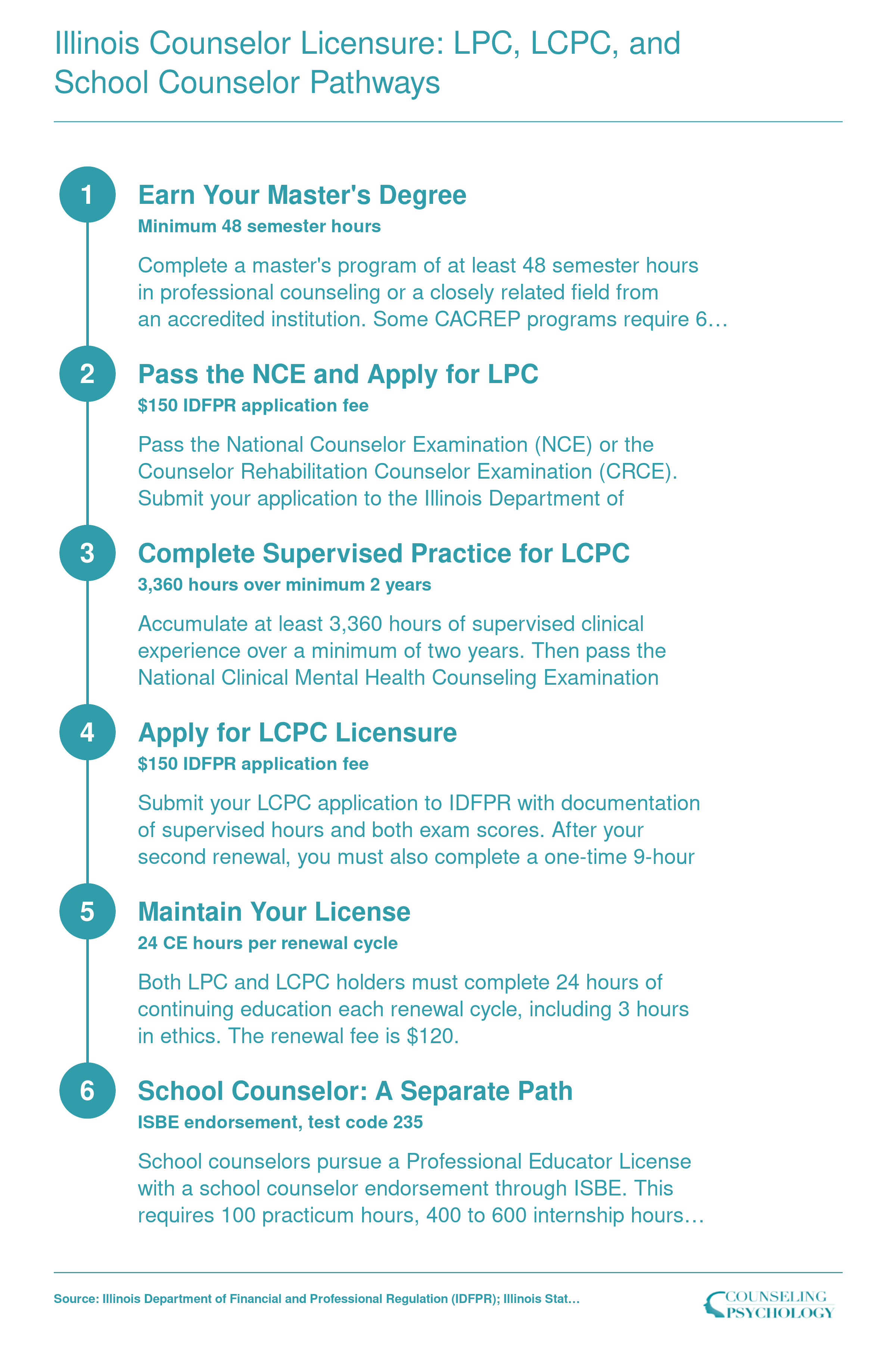
Illinois Counselor Licensure: LPC, LCPC, and School Counselor Pathways
Illinois offers three distinct credentialing tracks for aspiring counselors. The LPC serves as the entry-level clinical license, the LCPC unlocks independent practice after supervised experience, and the school counselor endorsement follows a separate pathway through the Illinois State Board of Education. Here is how each progression works.
Career Outcomes and Salary Expectations for Illinois Counselors
Career outcomes for counseling graduates in Illinois vary significantly by specialization, location, and program investment. Understanding what early-career professionals actually earn, and how those figures stack up against debt load, helps you make a more informed decision about which program to pursue.
What Graduates Earn Early in Their Careers
Program-level earnings data for Illinois counseling master's programs remain limited in federal College Scorecard records, with most ranked programs not yet reporting one-year or two-year post-completion earnings for graduates in counseling-specific CIP codes. Where institutional-level earnings are available, median earnings one year after completion for graduates of ranked institutions ranged from approximately $52,500 to $89,300 across all degree programs, though these figures reflect the entire institution rather than counseling programs specifically. This lack of granular program earnings underscores the importance of using occupational wage data and return-on-investment metrics to evaluate likely financial outcomes.
Illinois Counselor Salaries by Specialty
State-level wage data from the Bureau of Labor Statistics offers a clearer picture of what licensed counselors earn in Illinois. As of 2024, substance abuse and mental health counselors in Illinois earned a median annual wage of $59,570, with entry-level (10th percentile) wages around $42,500 and experienced practitioners (90th percentile) reaching $107,630.1 In the Chicago-Naperville-Elgin metro area, where demand is highest, the median climbed to $61,150, with the 90th percentile topping $114,400.1
School and career counselors in the Chicago metro area earned a mean annual wage of approximately $69,210 as of 2023, supported by steady employment in public and private K-12 settings.2 Marriage and family therapists, a smaller specialty with roughly 520 employed in the Chicago area, reported a mean annual wage of $55,270.2 If you're exploring that path, our guide on how to become a marriage and family therapist breaks down the steps from degree to licensure.
National job-growth projections through 2034 show strong demand for substance abuse and community mental health counselor roles (16.8 percent growth) and marriage and family therapists (12.6 percent growth), while school and career counselors are expected to grow more modestly at 3.5 percent. Illinois-specific projections from the Illinois Department of Employment Security generally mirror these national trends, with mental health and substance abuse counseling roles expected to outpace most other counseling specialties.
Weighing Cost Against Return
Return on investment varies widely across Illinois programs. Northwestern University's Master of Science in Marriage and Family Therapy carries tuition near $54,655 but shows a strong ROI ratio of 5.96, reflecting high earnings potential relative to debt. Governors State University's post-master's school counseling certificate, priced around $10,666, offers an ROI ratio of 3.12, making it a cost-effective path for those already holding a master's degree. Concordia University-Chicago's hybrid school counseling MA, at $10,782 tuition, shows an ROI ratio of 2.35, while North Park University's fully online clinical mental health MA ($14,417 tuition) comes in at 2.34.
Median 10-year debt payments for graduates of ranked programs ranged from $15,000 at Northwestern to $27,000 at Bradley, with most landing between $19,000 and $25,500. When evaluating affordability, compare each program's total cost and typical debt load against realistic starting salaries in your target specialty and geographic market. Chicago wages consistently run higher than downstate averages, but cost of living must also factor into your calculations. For a broader look at program options nationwide, see our overview of the best online master's in counseling programs.
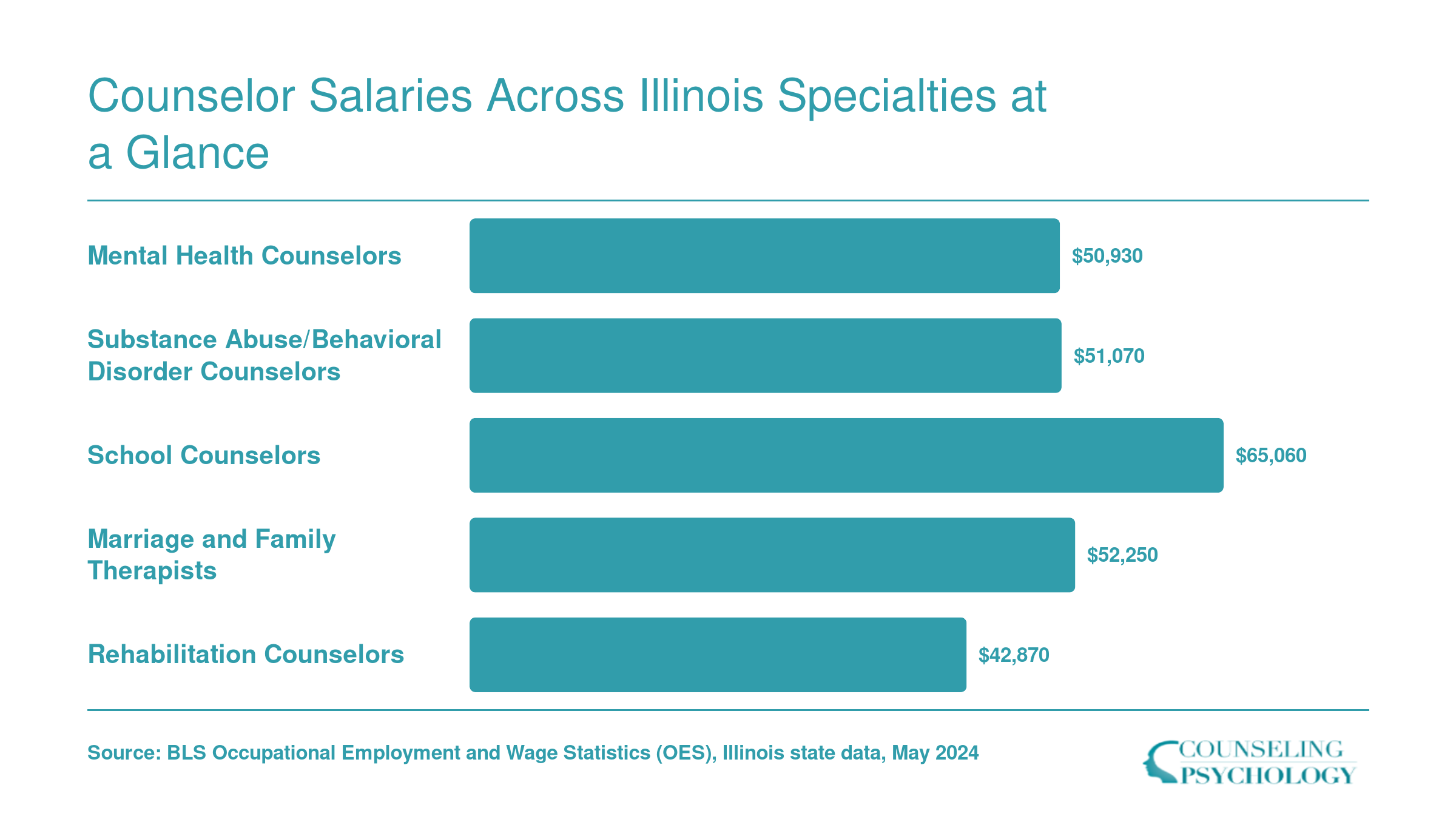
Counselor Salaries Across Illinois Specialties at a Glance
Earning potential in Illinois varies meaningfully by counseling specialty and credential level. The chart below compares median annual wages for five common counseling occupations in the state. Keep in mind that holding an LCPC credential or adding a clinical specialization can shift you into a higher pay band within any of these categories.
How to Choose the Right Illinois Counseling Master's Program
What is the best master's degree to get if you want to become a therapist in Illinois?
The short answer: a master's in clinical mental health counseling is the most direct route to the Licensed Professional Counselor (LPC) and Licensed Clinical Professional Counselor (LCPC) credentials in Illinois. But choosing the right program involves more than picking a degree title. A clear decision framework can save you years of frustration and thousands of dollars.
MA vs. MS: Which Degree Is Right for Aspiring Therapists?
Most clinical mental health counseling programs in Illinois award a Master of Arts (MA), and these are typically designed with clinical practice in mind. Coursework centers on therapeutic techniques, diagnosis, practicum hours, and the competencies that Illinois licensure boards expect. A Master of Science (MS) in counseling, by contrast, may place greater emphasis on research methodology and data analysis, which can be useful if you plan to pursue a doctoral degree or work in academic settings.
If your goal is to sit across from clients and provide therapy, an MA in clinical mental health counseling is generally the stronger fit. Look for programs that explicitly align their curriculum with LPC and LCPC requirements so you are not left filling gaps after graduation.
A Decision Framework That Works
When comparing programs, prioritize these factors in order:
- Accreditation: CACREP accreditation should be your starting filter. It streamlines the Illinois licensure process and, just as importantly, makes your degree portable if you ever relocate to another state.
- Format fit: Online programs offer scheduling flexibility, but in-person or hybrid formats often provide stronger local practicum networks. Consider how each format supports the supervised clinical hours you will need.
- Cost and return on investment: Compare net tuition after financial aid, not just sticker price. Factor in how quickly you can begin earning post-graduation and whether a program's alumni report strong employment outcomes.
- Specialization match: If you already know you want to work with children, couples, or substance use populations, look for programs with dedicated concentrations or elective tracks in those areas.
Verify Practicum Site Availability Before You Enroll
This step catches many students off guard, especially those considering online clinical mental health counseling programs. A program based in Chicago may have established practicum partnerships across Cook County but very few approved sites downstate, and vice versa. Before you commit, contact the program's field placement office and ask specifically about site availability in your region. If you live in a rural part of the state, confirm that the program has a track record of placing students outside major metro areas. For more detail on what the full licensure journey looks like, review our guide on how to become a mental health counselor. Enrolling first and discovering later that you need to drive two hours each way for practicum is a costly mistake that is entirely avoidable with a single phone call.
Frequently Asked Questions About Counseling Master's Programs in Illinois
Choosing a counseling master's program raises practical questions about degree types, costs, accreditation, and licensure. Below are answers to the questions prospective Illinois counseling students ask most often, drawing on program data and state requirements covered throughout this guide.
More Illinois Counseling Master's Programs to Consider
Here are additional programs in Illinois that offer counseling degrees or certificates, providing options beyond the ranked top 10.
- Master of Arts in Pastoral Care and Counseling (Chaplaincy and Spiritual Care, Clinical Track)
- Post-MSW Certified Alcohol and other Drugs Counselor Training Program (CADC) Certificate
- Master of Arts in Counseling in Clinical Mental Health Counseling
- Master of Arts in Counseling in Clinical Mental Health Counseling (Military and Veterans’ Behavioral Health)
- Master of Arts in Counseling in Clinical Mental Health Counseling (Substance Abuse Counseling)