What you’ll learn in this article…
- CACREP accreditation streamlines South Carolina LPC licensure and is offered by multiple public and private programs statewide.
- Annual graduate tuition ranges widely, with public in-state options considerably cheaper than private university programs.
- South Carolina requires a master's degree plus supervised experience for both LPC and school counselor credentials.
- Substance abuse, school, and clinical mental health counselors all show strong job growth projections across the state.
South Carolina requires a master's degree for every licensed professional counselor (LPC), making graduate education the non-negotiable entry point into the field. The state's mental health workforce shortage has pushed demand for qualified counselors into nearly every county, from rural Orangeburg to suburban Rock Hill, and enrollment in graduate counseling programs has followed.
The programs ranked here span seven schools and nine distinct listings, with annual graduate tuition ranging from roughly $11,500 to over $34,000 depending on institution type, residency status, and delivery format. Public universities like the Citadel and Winthrop offer in-state tuition well below the national average for comparable programs, while private institutions such as Southern Wesleyan and Anderson University price their online degrees competitively for working adults. For students still weighing whether this career path is right for them, our guide on how to become a counselor outlines the full process from degree selection through licensure.
Format, accreditation status, and specialization track are the three variables that separate a practical choice from a costly mismatch. A program that lacks CACREP accreditation may add supervised hours to your post-graduation licensure timeline. A specialization in school counseling leads to a state Department of Education credential, not an LPC, and those two credentials serve entirely different job markets.
Best Master's in Counseling Programs in South Carolina
South Carolina offers a diverse mix of public universities, private faith-based institutions, and historically Black colleges with graduate counseling programs. Whether you are looking for a CACREP-accredited school counseling track, an affordable clinical mental health counseling degree you can finish online, or a specialized certificate in addiction studies, the programs below represent the strongest options in the state for 2026. We evaluated tuition and net price, program format flexibility, licensure alignment, and available outcome data to help you compare.
- Tuition and net price affordability
- Graduate debt and earnings outcomes
- Accreditation and licensure alignment
- Online and hybrid delivery options
- Program concentration breadth
- College Scorecard graduate earnings — collegescorecard.ed.gov
- NCES-IPEDS federal institutional data — nces.ed.gov
- Independent program research
- Internal program database

Citadel Military College of South Carolina
The Citadel in Charleston pairs military-heritage rigor with accessible online delivery for its counselor education programs. Its in-state graduate tuition of roughly $12,780 makes it one of the most affordable public options in the state, and the institution-wide median graduate debt of about $21,096 is among the lowest on this list. With a 75% institution-level graduation rate and an 11:1 student-to-faculty ratio, The Citadel provides a high-touch learning environment even in its distance programs.
- Fully online 60-credit program for K-8 school settings
- Includes a 600-hour supervised school internship
- Prepares graduates for SC school counselor licensure
- Pathway to Licensed Professional Counselor credential
- Pathway to National Certified Counselor certification
- Emphasizes multicultural education and human development
- Requires a minimum 3.0 undergraduate GPA for admission
- Fully online 60-credit program for grades 9-12 settings
- 600-hour school internship embedded in curriculum
- Leads to South Carolina school counselor certification
- Specialization in adolescent development and guidance
- Prepares candidates for the National Counselor Exam
- Flexible scheduling designed for working professionals
M.Ed. in Counselor Education, Elementary School Counseling — Online
M.Ed. in Counselor Education, Secondary School Counseling — Online

Winthrop University
Winthrop University in Rock Hill holds full CACREP accreditation for its counseling programs, a credential that streamlines licensure in South Carolina and across all 50 states. The online M.Ed. in Counseling and Development is delivered in a cohort format over seven semesters, offering concentrations in both school counseling and clinical mental health counseling. Winthrop also extends a 30% tuition discount to PK-12 educators working in South Carolina or North Carolina, pushing its already competitive net price of about $15,343 even lower for qualifying students. Median graduate debt sits at roughly $26,975 at the institutional level.
- CACREP-accredited, 60-credit cohort program
- Online coursework with in-person practicum and internship
- 30% tuition discount for SC and NC PK-12 educators
- Prepares graduates for certification in all 50 states
- On-site counseling clinics for supervised practice
- No prerequisite courses required for admission
- Minimum 3.0 undergraduate GPA for admission
- Covers PK-12 academic, career, and personal counseling
M.Ed. in Counseling and Development, School Counseling — Hybrid

University of South Carolina
The University of South Carolina in Columbia is the state's flagship research institution, boasting a 78.8% institution-wide graduation rate and strong community partnerships in behavioral health. Its hybrid Certificate of Graduate Study in Drug and Addiction Studies is designed for students who want focused expertise in addiction prevention, intervention, and recovery, particularly with vulnerable populations such as adolescents, veterans, and LGBTQIA+ individuals. In-state graduate tuition is approximately $14,134, and the institution-level median graduate debt is about $21,500.
- Hybrid format blending online coursework and campus sessions
- Emphasizes addiction prevention, intervention, and recovery
- Focused training on adolescents, veterans, and LGBTQIA+ clients
- Community partnerships provide hands-on field experience
- Covers clinical evaluation and policy advocacy skills
- Builds professional and ethical responsibility competencies
- Designed as a complement to master's-level counseling study
Certificate of Graduate Study in Drug and Addiction Studies — Hybrid

South Carolina State University
South Carolina State University, a historically Black university in Orangeburg, offers a fully online Graduate Certificate in Addiction and Trauma built for working professionals. A standout feature is flat tuition regardless of residency, meaning out-of-state online learners pay the same rate as South Carolina residents. The 18-credit certificate can be completed in as little as one year through condensed eight-week terms, making it one of the fastest pathways to specialized addiction and trauma training in the state. Median graduate debt at the institutional level is approximately $31,000.
- Fully online with condensed 8-week terms
- 18 semester credit hours, completable in one year
- Same tuition rate for in-state and out-of-state students
- Evidence-based addiction and trauma counseling curriculum
- Designed for working professionals in human services
- Requires a bachelor's degree in a related field
- In-state tuition approximately $11,460 per year
Graduate Certificate in Addiction and Trauma — Online

Southern Wesleyan University
Southern Wesleyan University in Central, SC integrates a Christian worldview into its D. Clifton Wood Master of Science in Counseling Psychology. At roughly $500 per credit hour, the 60-credit online program is frequently cited among the most affordable accredited counseling degrees nationally. Graduates are prepared to sit for the National Counselor Exam and pursue LPC licensure in South Carolina. The university's small size supports a 10:1 student-to-faculty ratio and dedicated academic success coaching.
- Fully online 60-credit program, 24 to 30 months
- Approximately $500 per credit hour
- Prepares students for National Counselor Exam
- Faith-integrated curriculum with whole-person focus
- Dedicated academic success coach for each student
- Practicum and internship experiences included
- Eight core counseling exam preparation courses
- Minimum 3.0 GPA required for admission
D. Clifton Wood M.S. in Counseling Psychology, Mental Health — On-Campus

Columbia International University
Columbia International University in Columbia offers a hybrid Master of Arts in Clinical Counseling and a fully online PhD in Counselor Education and Supervision, creating one of the few in-state pathways from a master's degree through a doctoral program in counseling. The 60-credit MA is explicitly designed to meet South Carolina LPC requirements, with 700 total clinical hours built into the curriculum. Students can complete most coursework online, with two brief campus residencies. Median graduate debt at the institutional level is roughly $20,000, one of the lowest figures among private schools on this list.
- 60-credit hybrid program with two campus residencies
- 700 total clinical hours for SC LPC preparation
- Biblical worldview integrated into counseling training
- Online coursework with flexible scheduling options
- Minimum 3.0 GPA required for admission
- Up to 7 years allowed for program completion
- Online format with brief campus residency requirements
- 60 credit hours at $625 per credit hour
- Designed for already-licensed professional counselors
- Focuses on teaching, research, and clinical supervision
- Accredited by ABHE and SACSCOC
- Prepares graduates for higher education faculty roles
M.A. in Clinical Counseling — On-Campus
PhD in Counselor Education and Supervision — Online

Anderson University
Anderson University in Anderson, SC delivers its Master of Science in Clinical Mental Health Counseling entirely online, giving working professionals across the state a flexible two-year path to LPC licensure. The 60-credit program is currently pursuing CACREP accreditation, a status prospective students should monitor since it can affect licensure reciprocity in other states. Coursework covers counseling theories, grief counseling, and couples therapy, with a Christian foundation woven throughout. Median graduate debt at the institutional level is approximately $26,700.
- Fully online 60-credit program, about 2 years
- Currently pursuing CACREP accreditation
- Practicum and internship experiences required
- Christian foundation integrated into coursework
- Covers grief, couples, and diagnostic counseling
- Prepares graduates for SC LPC licensure exams
- Bachelor's degree required for admission
- Designed for diverse career settings including hospitals
M.S. in Clinical Mental Health Counseling — Online
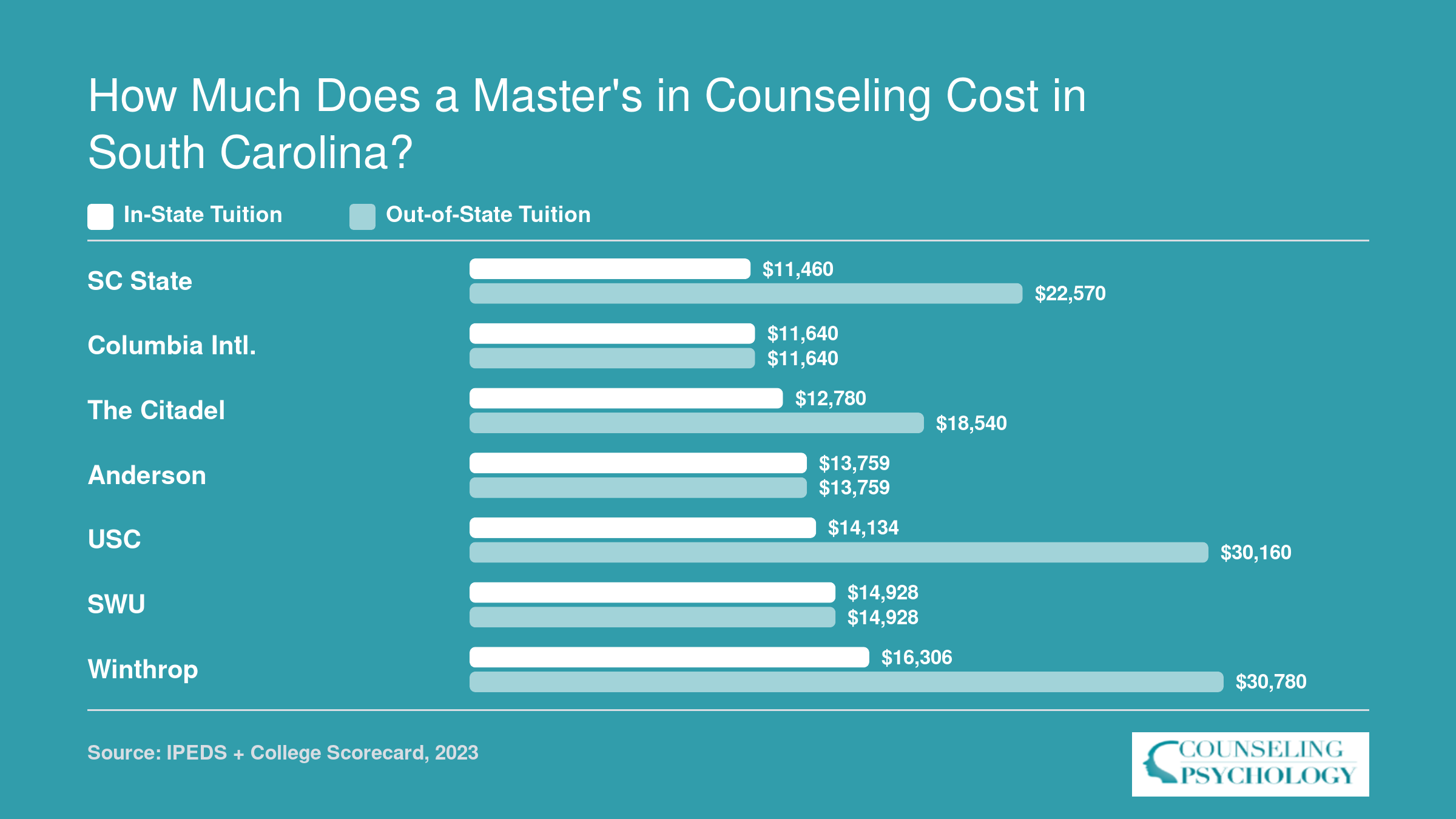
How Much Does a Master's in Counseling Cost in South Carolina?
Tuition for a counseling master's in South Carolina varies widely depending on whether you attend a public or private institution and whether you qualify for in-state rates. The figures below reflect annual graduate tuition reported to IPEDS. Keep in mind that institution-wide average net prices after financial aid run significantly lower, ranging from roughly $15,300 at Winthrop University to about $26,000 at Columbia International University. Program-level median debt and monthly repayment estimates are not yet published for most of these counseling programs, so use these tuition benchmarks alongside each school's net price to gauge your true out-of-pocket cost. Filing the FAFSA is essential for accessing federal loans and any state-based aid, including the Palmetto Assistance Loan for graduate students.
Online vs. On-Campus Counseling Programs in South Carolina
South Carolina's counseling master's landscape includes both online and on-campus formats, and the ranked programs on this page reflect that variety. Several CACREP-accredited programs in the state offer fully online or hybrid delivery, while others follow a traditional on-campus model. Choosing the right format depends on your professional obligations, learning style, and how you plan to complete required clinical hours.
Pros
- Online programs offer scheduling flexibility that allows working professionals to earn a degree without leaving their current jobs.
- Studying online can reduce total costs by eliminating commuting, relocation, and some campus fees.
- Online delivery gives students access to strong programs across South Carolina, from the Upstate to the Lowcountry, without moving.
- On-campus programs foster deeper in-person relationships with clinical supervisors and faculty mentors from day one.
- A structured on-campus schedule and consistent peer cohort create built-in accountability and professional networking opportunities.
- On-campus students often benefit from streamlined practicum placements coordinated directly through their program's local partnerships.
Cons
- Online students must still secure local practicum and internship sites in South Carolina, which requires self-advocacy and advance planning.
- Without a physical cohort, online learners may find it harder to build the peer relationships that support long-term career growth.
- On-campus programs typically demand a fixed class schedule, making it difficult to balance full-time employment during the degree.
- Relocating or commuting for an on-campus program can significantly increase the total cost of attendance beyond tuition alone.
- Some online programs use asynchronous formats that require strong self-discipline; students who thrive on real-time interaction may struggle.
- Are online counseling degrees respected? Yes. Employers and licensing boards in South Carolina recognize online degrees from CACREP-accredited programs on equal footing with on-campus credentials.
Related Articles
CACREP Accreditation and Why It Matters in South Carolina
CACREP accreditation is the gold standard for counseling programs, and it carries significant weight in South Carolina. Understanding CACREP can help you choose a program that meets licensure requirements from day one.
CACREP vs. Regional Accreditation
CACREP is a specialized accreditor that evaluates individual counseling programs, not whole institutions. Regional accrediting bodies like SACSCOC verify overall institutional quality. For counselor licensure, CACREP is what matters because it ensures your curriculum, clinical hours, and faculty meet the profession's standards. If you are still exploring your options across degree levels, our overview of counseling degrees covers the full landscape.
Why CACREP Matters in South Carolina
South Carolina's LPC board requires a degree from a CACREP-accredited program or one it deems equivalent. Choosing a program that already holds CACREP accreditation eliminates guesswork and extra documentation. If your degree is from a non-CACREP program, you may need to submit a course-by-course review to prove equivalency, which can delay your licensure. Starting with a CACREP degree provides the smoothest path to becoming a licensed professional counselor in the state. CACREP also streamlines licensure portability: many states accept CACREP credentials more readily during endorsement, making it easier to move your practice. For a broader look at online licensed professional clinical counseling programs, consider comparing CACREP-accredited options nationwide.
CACREP-Accredited Programs in South Carolina
These four South Carolina institutions offer CACREP-accredited clinical mental health counseling master's degrees:1
- Clemson University: M.Ed./Ed.S. in Counselor Education, Clinical Mental Health Counseling
- University of South Carolina, Columbia: M.Ed. in Counselor Education, Clinical Mental Health Counseling
- Charleston Southern University: M.S. in Clinical Counseling, Clinical Mental Health Counseling
- Webster University (South Carolina campuses): M.A. in Counseling with Emphasis in Clinical Mental Health Counseling
Always verify current accreditation status through the CACREP directory, as programs are periodically re-reviewed.1
Degree Type: MA vs. MS, Why CACREP Status Matters More
Prospective students sometimes worry about whether to pursue an M.A., M.S., or M.Ed. in counseling. From a licensure standpoint, this distinction is minor. The South Carolina board focuses on whether a program's content aligns with CACREP standards, not the specific degree abbreviation. An M.A. may be offered by a program with a theoretical bent, while an M.S. might emphasize clinical practice, but both can be equally valid as long as they hold CACREP accreditation. When evaluating schools, prioritize accreditation; the degree title follows naturally from the program's design.
Questions to Ask Yourself
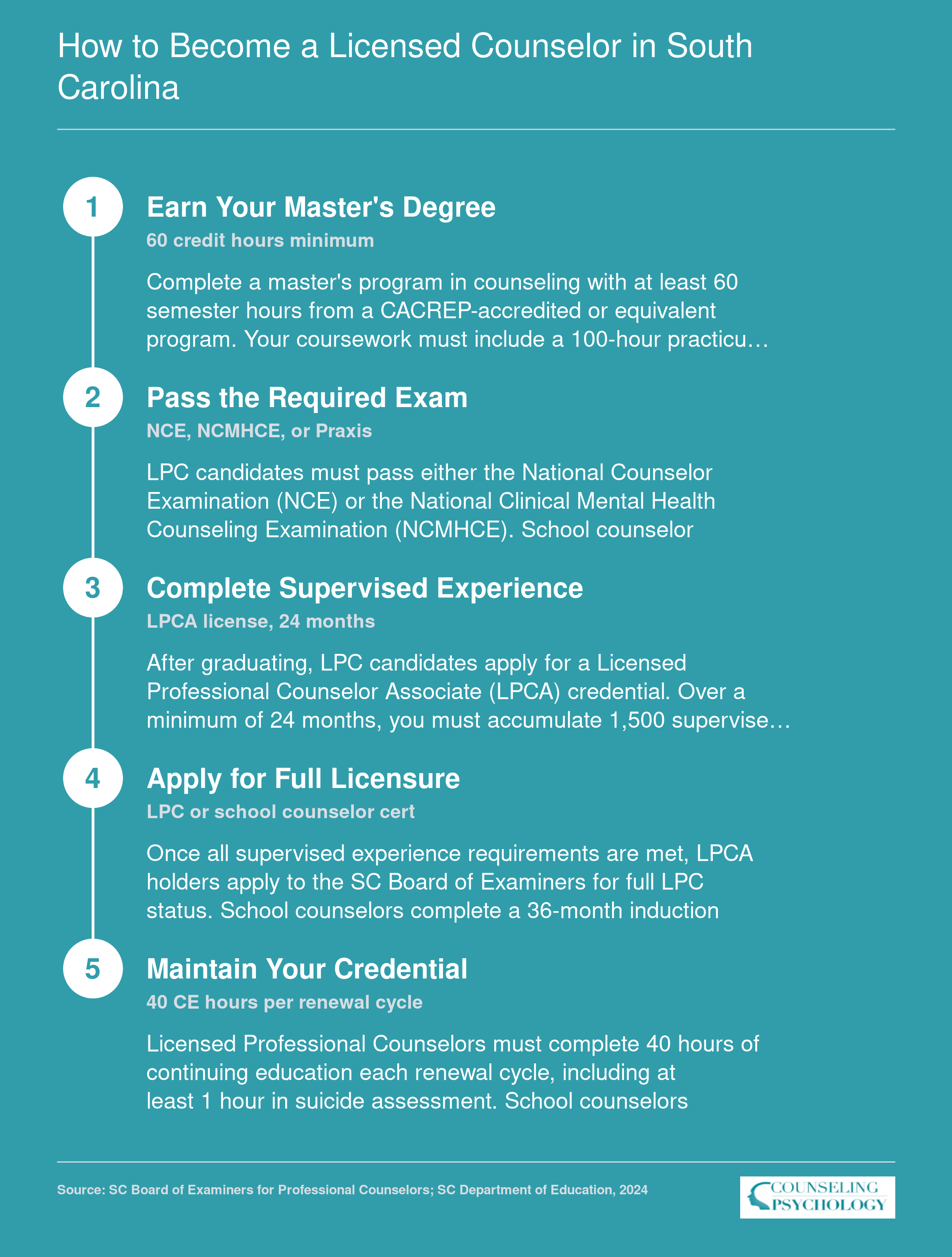
How to Become a Licensed Counselor in South Carolina
South Carolina offers two primary pathways into the counseling profession: the Licensed Professional Counselor (LPC) track for clinical practice and the school counselor certification track through the SC Department of Education. Both require a master's degree, but the exams, supervised experience, and oversight boards differ. The SC Board of Examiners for Licensure of Professional Counselors, Marriage and Family Therapists, and Psycho-Educational Specialists governs the LPC pathway.
Counseling Specializations Available in South Carolina
Demand for specialized mental health services is reshaping how South Carolina universities structure their counseling degree tracks. While the core curriculum remains consistent across programs, your choice of specialization directly determines the licensure path you can pursue after graduation.
Clinical Mental Health Counseling: The Most Common Path
The majority of accredited counseling programs in South Carolina prepare students for licensure as a Licensed Professional Counselor (LPC). Clemson University's on-campus M.Ed. in Counselor Education is a CACREP-accredited, 60-credit program that can be completed in two years of full-time study.1 Though it does not offer a formal child or play therapy concentration, students gain child-focused experience through elective coursework and supervised clinical placements.
Other notable CMHC options include the University of South Carolina's Ed.S. in Counselor Education with a Clinical Mental Health Counseling concentration (66 credits, also two years)2, Winthrop University's M.Ed. in Counseling and Development with a Clinical Mental Health Counseling track (60 credits)3, and several private programs with flexible formats. Anderson University delivers an online MS in Clinical Mental Health Counseling that is actively pursuing CACREP accreditation, while Southern Wesleyan University offers a fully online MS in Counseling Psychology with a Mental Health concentration, integrating a faith-based perspective. Columbia International University's hybrid MA in Clinical Counseling similarly combines online coursework with on-campus intensives and a biblical worldview emphasis.
School Counseling: Separate Licensure Requirements
If your goal is to work in K-12 settings, you will need a master's degree that leads to school counselor certification, a separate credential from the LPC. South Carolina State University offers an M.Ed. in Counselor Education with concentrations in Elementary and Secondary School Counseling (60-63 credits)4, while The Citadel provides an online M.Ed. in Counselor Education with an Elementary School Counseling concentration. Winthrop University also houses a CACREP-accredited, hybrid M.Ed. in Counseling and Development with a School Counseling track. All three programs incorporate extensive internship hours in school environments.
What About Child and Adolescent Specializations?
Students frequently ask which South Carolina programs offer a distinct child or adolescent counseling concentration. The reality is that formal tracks in this area are rare across the state's universities. Neither Clemson, UofSC, nor Winthrop has a standalone child and adolescent concentration.123 Instead, programs embed child and adolescent training through lifespan development courses, play therapy electives, and site placements in settings like pediatric behavioral health clinics or school counseling offices. If working with children is your primary interest, you can still tailor your degree through careful selection of practicum sites and elective courses, and then pursue post-graduate play therapy credentials or certifications after licensure. Students considering this path may also want to explore how to become a child counselor for additional guidance on degree and certification requirements.
Marriage, Family, and Other Niche Tracks
Marriage and family therapy (MFT) is another recognized specialization, though dedicated MFT master's programs are less common in South Carolina than CMHC or school counseling. A few universities offer relevant coursework or certificates that supplement a generalist degree. For instance, both the University of South Carolina and South Carolina State University offer graduate certificates in addiction studies and trauma-informed care, which can enhance a counselor's expertise in specific populations. If you are strongly drawn to systemic family work, you may need to verify that the program's curriculum aligns with MFT licensure requirements, as the path to becoming a Licensed Marriage and Family Therapist (LMFT) differs from the LPC route.
Timeline and Format Options
Full-time counseling master's programs online and on-campus in South Carolina typically require two years of study. If you need to continue working, many schools now accommodate part-time enrollment, which generally extends the timeline to three or four years. Online and hybrid delivery models have also become more prevalent. In addition to Anderson University's online CMHC and Southern Wesleyan's online program, The Citadel's school counseling degree is fully online, and Winthrop's school counseling track uses a hybrid blend of on-campus and online classes. Clemson's CMHC, however, remains entirely on-campus, emphasizing in-person skill development and face-to-face supervision.1
Career Outlook and Salaries for Counselors in South Carolina
South Carolina's counseling professions offer solid earning potential and strong job stability for master's-level graduates. The state's need for qualified mental health, school, and substance abuse counselors continues to grow, making this a sensible time to enter the field. Below, we break down the key salary data, demand indicators, and return on investment to help you gauge the financial payoff of a counseling degree.
Salaries for Key Counseling Roles in South Carolina
Statewide salary data from the South Carolina Department of Employment and Workforce paints a clear picture of what new graduates can expect.1
- Mental health counselors: Median annual wages fall between $45,000 and $50,000. Approximately 1,000 to 1,500 professionals work in this specialty across the state.
- School and career counselors: Median annual wages range from $50,000 to $55,000. With roughly 3,000 to 4,000 practitioners, this is the largest counseling occupation by employment in South Carolina.
- Substance abuse, behavioral disorder, and mental health counselors: This combined category reports median wages of $45,000 to $50,000 and employs an estimated 2,000 to 3,000 individuals.
Note that these figures reflect statewide medians. While metropolitan area breakdowns for Charleston, Columbia, and Greenville are not detailed here, wages in larger cities often trend slightly above state averages due to cost-of-living adjustments and higher demand.
What the Job Market Means for Your Earning Potential
Program-level earnings outcomes for recent graduates of South Carolina counseling programs are not yet published, so we rely on state occupational data to forecast your trajectory. The employment figures above signal steady demand: thousands of positions exist, and turnover plus population growth create ongoing openings.
National projections from the Bureau of Labor Statistics reinforce this outlook. Mental health and substance abuse counseling occupations are expected to grow much faster than average through the next decade, driven by greater awareness of mental health needs and expanded insurance coverage. If you are drawn to the substance use treatment side of the profession, a masters in addiction counseling can position you for this expanding segment. South Carolina is experiencing these same forces, and the state's workforce numbers suggest that employers across schools, private practices, and community agencies are actively hiring.
Managing the Cost: Debt vs. Income
A master's in counseling requires a financial commitment, but the return on investment can be strong if you manage debt wisely. Among the programs we ranked, median graduate debt levels range from about $20,000 to $31,000. When measured against typical counselor salaries, this debt load is manageable.
Consider a graduate with $25,000 in loans entering school counselor roles at the state median of $53,000. The debt-to-income ratio sits at roughly 0.5, leaving room for comfortable repayment on a standard plan. Even at the lower end of the mental health counselor salary range, a $47,000 income paired with moderate student debt keeps monthly payments affordable, especially if you pursue loan forgiveness options available through public service. Graduates of more affordable programs, where debt sits closer to $20,000, will find an even faster path to positive net worth.
The bottom line: South Carolina's counseling careers pay enough to justify the degree, provided you choose a program with a reasonable price tag and finish with debt you can realistically service on a counselor's starting salary.
South Carolina's affordable counseling programs represent a smart financial decision. With median graduate debt for these programs typically ranging from $25,000 to $45,000 and state counselor salaries offering solid earning potential, graduates can expect reasonable debt to earnings ratios. Choosing a CACREP accredited program at an in state tuition rate positions you to recoup your educational investment within a few years of entering practice.
How to Choose the Right Counseling Program in South Carolina
Seven programs appear in this guide, and each one represents a different combination of format, cost, and mission. The decision framework below helps you move from a long list to the right fit without second-guessing yourself later.
Start with Accreditation, Then Everything Else
CACREP accreditation is the first filter, not an afterthought. South Carolina's LPC board strongly favors graduates of CACREP-accredited programs, and some licensure pathways treat non-accredited degrees differently. Of the master's programs in this guide, Winthrop University holds CACREP accreditation for its school counseling track, while schools like Anderson University are actively pursuing it. Verify a program's current accreditation status directly with CACREP before you apply, because candidacy status and full accreditation carry different weight with licensing boards.
Format and Schedule
Once accreditation is confirmed, ask whether the delivery format fits your actual life. Fully online programs like those at Southern Wesleyan University and Anderson University suit working adults who cannot relocate or attend daytime classes. Hybrid programs at schools like Columbia International University and the University of South Carolina blend online coursework with required on-site components, which demands more scheduling flexibility.
Part-time enrollment typically stretches a 60-credit program from two years to three or four. That extra time has a real cost: it delays the supervised hours you need post-graduation, which in turn delays LPC eligibility. If licensure speed matters, full-time enrollment is worth the short-term sacrifice.
Clinical Placement Support
Every LPC-track program in South Carolina requires practicum and internship hours, typically 600 to 700 hours or more. The critical question to ask each admissions office is whether the program actively helps place students at local sites or whether finding a site is entirely your responsibility. In rural areas of the state, that distinction can determine whether you finish on time.
Net Price vs. Sticker Price
Published tuition figures can be misleading. The Citadel's net price after aid averages around $20,700, while Winthrop's drops to roughly $15,300, even though Winthrop's listed in-state tuition is higher. Southern Wesleyan, a private institution with a sticker price near $29,800, brings its average net price down to approximately $15,500 through institutional aid. Use each school's net price calculator before drawing any conclusions about affordability, and compare what you will actually pay rather than what is listed on the program page.
Selectivity and Specialization Fit
Admission competitiveness varies widely across these programs. The Citadel's institutional admission rate sits near 23 percent, making it the most selective school in this group. Anderson University admits roughly 55 percent of applicants, and Southern Wesleyan is nearly open-enrollment. Higher selectivity does not automatically mean a better counseling program, but it can signal cohort quality and faculty resources.
Finally, choose a specialization that matches your intended population. School counseling, clinical mental health counseling online programs, and addiction counseling each lead to different licensure tracks and job markets. Selecting a program whose concentration aligns with your long-term goals keeps you from completing a degree that requires additional coursework before you can pursue the license you actually want.
Frequently Asked Questions About Counseling Master's Programs in South Carolina
Choosing the right counseling master's program involves a lot of moving parts, from cost and format to accreditation and licensure. Below are answers to the questions prospective students in South Carolina ask most often.