
What you’ll learn in this article…
- Limited-license therapists risk losing $60 to $150 per session under Blue Cross policy change.
- Insurers reimburse licensed counselors less than psychologists, driving many out of insurance panels.
- Federal mental health parity enforcement remains weak, so counselors must appeal denials rigorously.
- Medicaid funding cuts threaten community mental health agencies that employ and train counselors.
In 2026, a convergence of insurance disruptions is hitting mental health counselors simultaneously: Blue Cross Blue Shield of Michigan ended coverage for limited-license therapists in private practice, federal parity enforcement remains inconsistent, and Medicaid funding cuts threaten community clinics. For LPCs, LMHCs, LCSWs, and MFTs, the central tension is whether to stay in-network for client access or exit for clinical autonomy, a decision that carries immediate financial and ethical weight. As the lines between counseling vs psychology vs social work credentials blur in billing systems, the landscape now demands that every practitioner master billing codes, credentialing tiers, and payer negotiation as baseline competencies.
Michigan's Blue Cross Policy Change: A Case Study in Carrier-Level Disruption
What concrete steps should limited-license therapists take right now to track the fallout and next moves following the Blue Cross Blue Shield of Michigan coverage cutoff? Staying informed through official channels is the first line of defense, and the situation in Michigan provides a blueprint for anticipating similar disruptions in other states.
The Policy at a Glance
Effective March 1, 2026, Blue Cross Blue Shield of Michigan stopped covering services provided by limited-license mental health professionals in private practice settings.1 This eliminated the "incident-to" billing pathway that many pre-licensed counselors, social workers, and marriage and family therapists relied on for reimbursement. BCBSM framed the change as a quality-of-care decision, not a cost-cutting measure, according to Dr. Amy Milewski, associate chief medical officer.1 The carrier pointed out that its HMO product, Blue Care Network, had never covered these providers, and the new policy aligns standards across all commercial plans. The move threatens to sink small practices that depend on supervisor-billed sessions and disrupts continuity of care for clients who have built relationships with their therapists.
Monitoring Professional Association Responses
For real-time updates, the Michigan chapters of the American Mental Health Counselors Association and the National Association of Social Workers should be your first stop. Both organizations typically post official statements, legal analyses, and guidance for members when carrier policies shift. AMHCA often provides advocacy toolkits, while NASW may coordinate with state coalitions to challenge decisions that limit access to care. Even if no formal filings are yet public, bookmarking their news sections and checking weekly can alert you to collective actions, such as joint letters to regulators or legislative briefings.
Tracking Regulatory and Legal Actions
The Michigan Department of Insurance and Financial Services plays the key oversight role. Its website may publish consumer alerts, market conduct examinations, or bulletins related to network adequacy and provider contracting. If a formal complaint or legal challenge arises (for example, a lawsuit arguing the policy violates parity or state access standards) DIFS filings and public meeting records will be the authoritative source. While no immediate enforcement action has been confirmed, practitioners should periodically search the DIFS docket for terms like "limited license" or "incident-to" to catch evolving regulatory positions.
Setting Up News Monitoring
Beyond professional circles, industry trade publications like Behavioral Health Business and Modern Healthcare often break stories about insurer policy shifts. Setting up Google Alerts with precise phrases (such as "Blue Cross Blue Shield Michigan limited-license therapists 2026") will push updates directly to your inbox. Pair this with broad keyword tracking on social platforms to catch practitioner reports from the ground level. Often, the earliest warnings come from providers sharing their experiences before official outlets report.
Comparing Other State Affiliates
Not all Blue Cross affiliates move in lockstep, but trends can spread. Reviewing the provider manuals and news pages of other large BCBS plans (for example, those in Massachusetts, California, or Texas) can help identify whether similar restrictions are appearing elsewhere. Look for sections covering supervision billing, incident-to services, or telemedicine. Data on the states with highest need for counselors can also help contextualize where workforce disruptions like these would hit hardest. Early detection of language changes may give you time to adapt your practice or join preemptive advocacy.
Staying Ahead of the Curve
The Michigan case underscores that carrier-level decisions can cascade with little warning. By committing to a routine of checking association announcements, regulatory filings, and news alerts, limited-license professionals and their supervisors can mobilize quickly. For those weighing alternative careers for counselors, disruptions like this are a reminder that diversifying your skill set adds resilience. In an environment where insurance changes can redefine practice viability overnight, proactive monitoring is not optional; it is a core competency of a resilient practice.
Federal Parity Rules vs. Non-Enforcement: What Counselors Actually Face in 2026
Understanding the Parity Mandate
The Mental Health Parity and Addiction Equity Act (MHPAEA) requires insurers to cover mental health and substance use disorder benefits on par with medical and surgical benefits. That means similar financial requirements, treatment limits, and prior authorization practices. For counselors, the law should translate into equitable reimbursement and fewer arbitrary barriers. In practice, however, enforcement has lagged, leaving many practitioners to navigate a patchwork of insurer behaviors that may not comply with federal standards.
Why Enforcement Often Falls Short
Regulatory gaps and under-resourced oversight agencies mean parity violations often go unaddressed. Insurers may use subtle tactics: stricter medical necessity reviews, narrower networks, or frequent authorization requests that are difficult to challenge without detailed data. Federal announcements of non-enforcement or rule rollbacks can further embolden payers. In 2026, counselors in private practice report ongoing challenges with visit caps, reimbursement delays, and administrative hurdles, even when policies appear parity-compliant on paper. Without proactive monitoring, many violations remain invisible to state and federal regulators. These dynamics are especially concerning for counseling specialties most in demand, where workforce shortages make every provider's sustainability critical.
Where to Find the Latest Information
Staying informed requires checking multiple authoritative sources regularly. State insurance commissioner websites publish bulletins, enforcement actions, and complaint portals that can reveal local trends. Professional associations like the American Counseling Association and the American Mental Health Counselors Association issue policy alerts and conduct member surveys on insurer practices. Federal agencies, including the Department of Labor and the Centers for Medicare & Medicaid Services, post guidance documents and parity reports, though they may not reflect day-to-day experiences. Cross-referencing these sources helps counselors identify patterns and advocate for fair treatment.
Practical Steps for Staying Ahead
- Track your own data: Document denial rates, authorization turnaround times, and reimbursement discrepancies. Aggregate anonymized data with peers to strengthen advocacy efforts.
- Use association resources: Many professional groups offer form letters, legal referrals, and legislative updates that simplify parity complaints.
- Engage with state regulators: File complaints when you suspect parity violations. Regulators rely on practitioner reports to trigger investigations.
- Monitor federal rulemaking: Watch for updates to MHPAEA implementing regulations through the Federal Register and professional association newsletters.
Parity is a powerful tool, but its effectiveness depends on counselors knowing how to wield it. By combining self-education with collective action, you can push back against non-enforcement and protect both your practice and your clients' access to care.
Federal parity laws promise equitable mental health coverage, but without active enforcement, counselors face insurers that systematically undervalue behavioral health. Effective documentation and persistent appeals are now critical survival skills for any practice.
Medicaid and CHIP Funding Cuts: How Counseling Practices Are Affected
The financial footing of community mental health services is shifting as federal and state Medicaid programs undergo the most significant restructuring in a generation.
Which Cuts Are Finalized and Which Are Proposed as of Mid-2026
The One Big Beautiful Bill Act, passed in 2025, enacted a 15% reduction in federal Medicaid funding and eliminated the enhanced Federal Medical Assistance Percentage (FMAP) for expansion adults as of January 1, 2026.1 These cuts alone are projected to strip coverage from 11.8 million people.1 Additional provisions are phasing in: non-citizen eligibility restrictions take effect October 1, 2026; work requirements (80 hours per month) become mandatory starting January 2027; and new cost-sharing rules begin October 2028, though mental health services are exempt from copayments.2 At the same time, the federal government has moved to redetermine eligibility every six months throughout 2026, a cadence that disrupts continuous coverage and floods practices with administrative churn.1
Meanwhile, 42 SAMHSA programs are proposed for elimination in the 2026 budget, including the Certified Community Behavioral Health Clinic (CCBHC) grant program, which funds integrated behavioral health in underserved areas.3 While these program cuts are not yet finalized, they signal a clear direction: behavioral health is increasingly treated as an optional Medicaid benefit, leaving states to decide whether to maintain or trim these services when facing budget shortfalls.1
How Macro-Level Cuts Translate to Practice-Level Strain
For counselors working in community mental health settings, these policy shifts create immediate operational headaches. States that face a $26 billion to $51 billion federal funding loss, as Illinois estimates, are forced to reduce reimbursement rates, impose longer credentialing wait times, or drop optional behavioral health benefits altogether. Tightened provider tax limits, also in the bill, further squeeze the administrative capacity of community agencies, leading to hiring freezes and delayed panel approvals for new counselors.5
In practice, a counselor who previously maintained a steady Medicaid caseload may see payment rates erode by 10% to 20% while documentation demands multiply to comply with six-month redetermination cycles. Group practices that rely heavily on Medicaid revenue often pause recruitment of pre-licensed clinicians, whose supervision hours and limited billable codes make them less viable under strained margins. These dynamics are accelerating the mental health professionals shortage already affecting communities nationwide.
Caseload Implications When Clients Lose Coverage or Face Reduced Limits
When clients disenroll from Medicaid, whether due to paperwork hurdles, work requirements, or eligibility changes, counselors are left with difficult choices. Some absorb the cost of uncompensated sessions to avoid disrupting a patient's treatment; others refer out to overburdened safety-net clinics that may have months-long waiting lists. Even clients who retain coverage may encounter stricter medical necessity reviews or session caps as states seek to control costs, effectively truncating the course of psychotherapy. For practitioners, this means a constant cycle of clinical justification paperwork and the demoralizing reality of terminating effective treatment prematurely.
The Disproportionate Burden on Early-Career and Community-Based Counselors
New graduates and provisionally licensed clinicians disproportionately serve Medicaid populations in community mental health centers, school-based programs, and non-profit agencies. When state budgets constrict, these are the first positions to vanish. The proposed elimination of the CCBHC program exemplifies the threat: without federal grants, integrated care sites that offer young professionals hands-on training may close their doors, drying up a critical pipeline for clinical experience. Experienced counselors in private practice who built a panel on a mix of commercial and Medicaid clients may find themselves suddenly unable to sustain that balance, forcing a pivot away from public insurance just when the need is greatest. This dynamic erodes both access to care for vulnerable populations and career viability for the practitioners who serve them.
Counselor Reimbursement Rates by Payer and Discipline: What the Data Shows
Reimbursement rates for mental health services in 2026 diverge sharply by payer and professional discipline, with licensed professional counselors (LPCs) and licensed marriage and family therapists (LMFTs) consistently earning less per session than psychologists and clinical social workers across many payers.
Medicare Reimbursement: A Two-Tier System for Counselors
Medicare only began covering LPCs and LMFTs in 2024, and their rates remain pegged at 75% of what psychologists and licensed clinical social workers (LCSWs) receive for the same services.12 For a standard 60-minute psychotherapy session (CPT 90837), the 2026 Medicare rate is $125.25 for counselors and marriage and family therapists, while psychologists and LCSWs earn $167.00.1 The gap is similar for diagnostic evaluations (CPT 90791): $130.01 versus $173.35. This disparity alone can mean tens of thousands of dollars in annual revenue difference for a full-time practice, making the difference between LPC and LCSW credentials a significant financial consideration.
Commercial Insurance Ranges: Narrower Gaps but Still a Hierarchy
Commercial payer reimbursement is typically higher than Medicare, often 120% to 200% of the Medicare rate, but the discipline-based gaps persist.3 For CPT 90837, LPCs, LMFTs, and LCSWs all fall within a common $100 to $165 range, while psychologists command $130 to $220.4 Actual rates depend on contract negotiations, geographic region, and plan design, but the pattern is clear: psychologists have a higher ceiling, and counselors rarely break into the upper tier.
Medicaid: A State-by-State Patchwork
Medicaid rates are set by individual states, making generalizations difficult.3 Some states align with Medicare, others set much lower fees, and a few have established rate parity across disciplines. In 2026, a handful of states have increased behavioral health rates through directed payment arrangements or legislated increases, but many counselors still report Medicaid rates below $80 per session.
Why Rate Differentials Matter for Practitioners
The cumulative effect of lower per-session revenue forces counselors to carry heavier caseloads, accept more self-pay clients, or exit insurance networks entirely. With health plans increasingly scrutinizing limited-license providers, as seen in the Michigan Blue Cross policy change, these reimbursement gaps not only affect take-home pay but also shape access to care. Understanding payer-specific rate differences is the first step toward advocating for fairer reimbursement structures.
Related Articles
Why Counselors Are Leaving Insurance Panels, and What That Means for Clients
The steady exodus of mental health counselors from insurance networks is not a matter of professional preference. It is a structural shift driven by sustained reimbursement stagnation, mounting administrative demands, and policy moves that unilaterally narrow the pool of eligible providers. For licensed professional counselors (LPCs) and licensed mental health counselors (LMHCs), the exit is particularly sharp, and the downstream effects on client access are already materializing.
The Reimbursement Squeeze: Why Licensed Professional Counselors Are Hit Hardest
Reimbursement rates for outpatient psychotherapy have barely moved in a decade. When adjusted for inflation, the real value of a standard 45-minute session (CPT 90834) has eroded significantly. Among behavioral health providers, LPCs and LMHCs consistently receive the lowest median allowed amounts, often 20 to 30 percent less than what clinical social workers (LCSWs) or psychologists command for the same service. This disparity stems from legacy fee schedules that value diagnostic testing and medical oversight above counseling-centric talk therapy, and from carrier credentialing policies that treat master's-level counselors as less essential despite identical scopes of practice. The gap becomes even more visible when you compare counselor salary by state, where reimbursement variation compounds geographic cost-of-living pressures. As a result, counselors working in private practice must carry larger caseloads to maintain the same revenue, or supplement with cash-pay clients.
- Median session reimbursement: LPCs frequently report allowed amounts between $60 and $90, whereas psychologists may receive $110 to $140 for the same CPT code.
- Credentialing hurdles: Many carriers require additional supervision documentation or restrict panel participation for provisionally licensed clinicians, further depressing counselor earning potential.
Administrative Burdens and Policy Shocks That Push Therapists Out
Reimbursement stagnation is compounded by an administrative load that counselors describe as unsustainable. Prior authorization requirements for routine outpatient sessions have expanded, and denial rates for common mental health diagnoses are rising. Appeals consume unpaid clinical time. The Blue Cross Blue Shield of Michigan decision in early 2026 to stop covering limited-license therapists in private practice, a change characterized by the carrier as a quality-of-care move, exemplifies how a single policy can instantly sever a pipeline of affordable care.1 Practices that built their business model around supervised associate-level therapists billing incident-to the supervisor's NPI found those revenue streams eliminated overnight, with no grandfathering. For many, the calculus shifted: it is simpler to leave the panel entirely and convert to a cash-pay model.
What Happens to Clients When Counselors Go Out-of-Network
When a counselor drops an insurance panel, the most immediate consequence is a loss of in-network access for clients who depend on that coverage. This burden falls disproportionately on rural communities and low-income households, areas already struggling with a therapist shortage. In regions where a single LPC may be the only in-network option within 30 miles, a network exit translates to a treatment gap: clients either pay out-of-pocket at prohibitive rates, commute long distances, or forego care. For Medicaid and CHIP populations, the problem is different. Reimbursement is already near break-even, and administrative overhead makes participation uneconomical for many solo practitioners. Even though some states enforce mental health parity, enforcement is weak, and network adequacy standards rarely account for actual appointment availability.
The Counselor's Dilemma: Stay or Leave the Panel?
Yes, mental health counselors do take insurance, but the percentage who accept private insurance is declining steadily. Recent practice surveys indicate that fewer than 60 percent of independently licensed counselors now participate in more than one commercial network. The decision is less about preference and more about math. Leaving insurance can increase effective hourly earnings by 40 to 60 percent once unpaid administrative time is factored in. However, it also narrows the client base to those who can afford full self-pay, undermining the very mission of accessible care that drew many into the profession. Staying in-network preserves breadth but demands relentless billing labor and perpetual anxiety over clawbacks and denials. There is no easy answer, which is precisely why the trend line continues pointing toward exit.
2026 Telehealth Billing Rules for Mental Health Counselors
Effective 2026, Medicare permanently covers audio-only telehealth for behavioral health services, giving licensed mental health counselors a reliable billing pathway for clients unable to use video.1 The rules around telehealth billing now depend heavily on the payer and the state where the counselor practices, so staying current is essential.
Medicare Telehealth Billing: Codes and Modifiers
Medicare has extended several pandemic-era flexibilities for mental health counselors through at least 2027, and some provisions are now permanent.2 Licensed professional counselors gained independent billing authority under Medicare starting in 2024 and are reimbursed at 75 percent of the psychologist rate.1 There are no geographic restrictions for behavioral telehealth, and the patient's home qualifies as an originating site.2
Place-of-service codes distinguish the setting: use POS 10 for services delivered to a patient's home or POS 02 for other locations.2 Two modifiers signal the communication method. Apply modifier 95 for audio-video sessions. For audio-only encounters, which Medicare now permanently covers for behavioral health, attach modifier 93.1 Federally qualified health centers and rural health clinics also have permanent telebehavioral health coverage, though an in-person visit requirement delayed until at least January 2026 may affect those settings.3
Medicaid and State-Level Variation
Medicaid telehealth policies vary by state, and counselors must navigate these differences carefully. Texas Medicaid, for example, also requires POS 10 for home-based services and POS 02 elsewhere.4 However, its modifier rules differ: audio-video sessions call for modifier GT or 95, while audio-only requires modifier FQ.4
The bigger challenge is that not all states grant LPCs independent telehealth billing authority. Some states require a formal supervision arrangement or a collaborative practice agreement for telehealth services, which can affect reimbursement rates and billing logistics. Before relying on telehealth revenue, counselors should confirm whether their state permits independent billing for their license type and whether any supervision conditions apply. Those considering becoming a telehealth therapist should research these requirements early in the process.
Commercial Payer Policies
Many commercial payers have aligned their behavioral telehealth policies with Medicare's expanded flexibilities, and payment parity is common: insurers often reimburse virtual sessions at the same rate as in-person visits.4 However, this is not universal. Some carriers limit audio-only coverage or impose stricter documentation requirements. Counselors should verify each commercial payer's telehealth policy individually, as contracts and coverage details differ.
Compliance Tips for Counselors
- Document the originating site accurately: This determines the correct place-of-service code and helps avoid claim denials.
- Confirm modifier requirements before submitting: Use 95 for video, and 93 or FQ for audio-only depending on the payer.
- Re-check payer policies quarterly: Telehealth rules continue to shift, and what was allowed last year may not be current. A quick review can prevent billing errors and lost revenue.
How Counselors Compare to Other Behavioral Health Providers Under 2026 Rules
As insurance policies tighten, the economic position of licensed counselors has diverged sharply from that of other behavioral health providers. The resulting gaps in compensation, job security, and professional recognition are shaping career decisions across the field.
Compensation Tiers Reflect Unequal Reimbursement
Behavioral health professions fall into distinct earning bands that largely mirror insurance reimbursement rates.1 Psychiatrists and psychiatric nurse practitioners sit at the top, commanding the highest compensation due to their prescribing authority and medical training. Psychologists occupy a high tier, while licensed clinical social workers rest in the middle. Licensed professional counselors and marriage and family therapists, by contrast, fall into the mid-low range, and substance use counselors consistently earn the lowest among behavioral health providers. These tiers reveal a reimbursement hierarchy that often disadvantages master's-level clinicians without the ability to bill for medical evaluation or management.
Workforce Shortages and Market Demand
National mental health professional shortage areas now affect 122 million people, with only about 26.4% of the need being met.2 Across the country, an estimated 6,200 additional practitioners are required just to close the gap in these designated areas. Utilization of behavioral health services grew by 60% in 2024, intensifying pressure on an already stretched workforce.3 In terms of projected shortfalls, addiction counselors face the steepest shortage at 114,000 providers by 2037, while licensed professional counselors are expected to be short by 88,000 by 2033, with a job outlook for a therapist showing a projected growth rate of 49%.2 These numbers underscore the demand, yet the compensation tiers persist, often making it difficult for counselors to build sustainable private practices in high-need regions.
Impact of Insurance Policy Changes
Recent insurance policy changes, such as Blue Cross Blue Shield of Michigan's decision to stop covering limited-license therapists in private practice, highlight how carrier-level decisions can disproportionately affect counselors. Since these professionals often rely on incident-to billing, the removal of that avenue directly threatens their income, whereas fully licensed psychologists and psychiatrists remain less affected. Licensed clinical social workers may face similar risks if parity rules are not enforced, but their broader scope for clinical billing under some plans offers slightly more protection. The variation in provider density, from 822 per 100,000 in Alaska to just 162.9 in Alabama, further illustrates that geographic access, insurance acceptance, and professional licensing rules combine to create vastly different practice realities for counselors compared to their peers.4
Salary and Employment Landscape for Mental Health Counselors
Counselor Pay by State: Where Insurance Pressures Hit Hardest
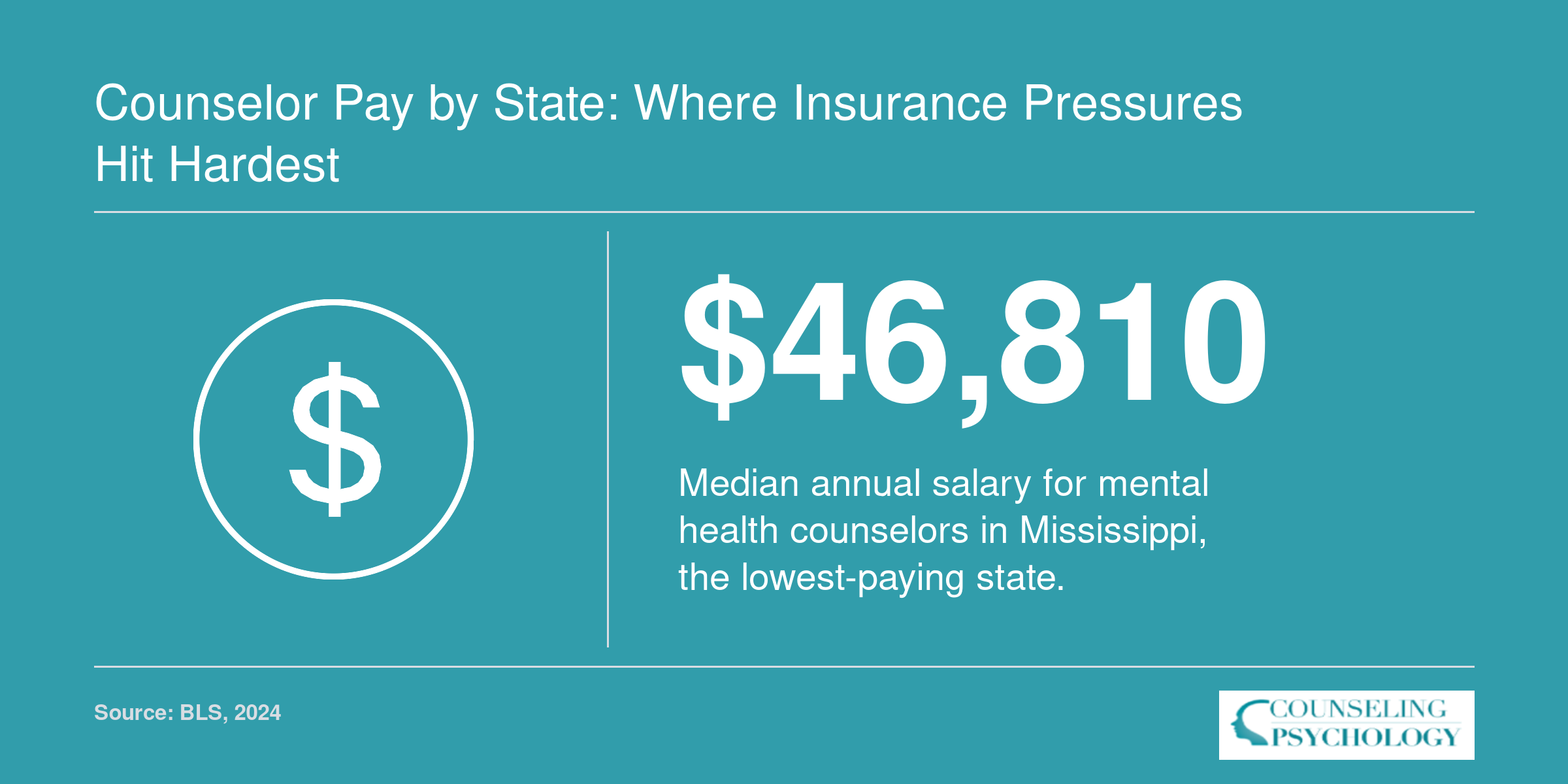
The median salary for mental health counselors varies dramatically by state. According to the Bureau of Labor Statistics, the top five highest-paying states are Alaska ($79,220), New Mexico ($70,770), Oregon ($69,660), North Dakota ($66,450), and the District of Columbia ($66,140). The bottom five are Mississippi ($46,810), Tennessee ($48,170), Alabama ($48,880), Indiana ($49,280), and Delaware ($49,680). In lower-paying states, insurance reimbursement rate stagnation can squeeze already thin margins for practitioners.
The Bureau of Labor Statistics projects 17% job growth for mental health and substance abuse counselors from 2024 to 2034, far above average, producing about 48,300 openings annually. This rapid expansion is colliding with insurance and loan policy changes that may shrink the pipeline of new practitioners precisely when demand is surging.
Practical Strategies: Billing, Advocacy, and Practice Sustainability
The central tension many counselors wrestle with today is whether to remain in-network for a steady stream of clients at negotiated rates, or to reduce insurance dependence for greater clinical autonomy and long-term financial stability. Either path demands deliberate billing and practice management strategies. The following approaches can help you navigate uncertainty, whether you stay paneled, go private-pay, or blend both.
Audit Your Payer Mix and Build a Buffer
- Run a concentration analysis: List your top three payers by session volume and total revenue. If any single carrier exceeds 40% of your caseload, you have significant concentration risk.
- Review contracts annually: Compare allowed amounts with neighboring practices and national benchmarks. If rates have not increased in three years, request renegotiation or consider whether that panel still serves your practice.
- Build a 90-day operating reserve: Set aside enough to cover rent, supervision, liability insurance, and personal draw for three months. This buffer buys you time to adjust if a major payer cuts rates or drops your credentials.
Documentation and Denial Management
- Use precise CPT codes: Always code to the highest level of specificity that accurately reflects the service. For example, 90837 for 60-minute individual psychotherapy is often reimbursed higher than 90834 for 45 minutes.
- Document medical necessity per payer criteria: Many denials stem from insufficient justification. Keep current copies of each payer's medical necessity guidelines and tailor your progress notes to show medical necessity clearly: symptoms, functional impairment, treatment goals, and progress.
- Track denial patterns: Maintain a simple log of denials by payer, reason code, and service type. After 10 to 15 denials for a single reason, you have a pattern worth appealing or reporting to your state insurance commissioner as a potential parity violation.
Hybrid Models That Work
A common sustainable ratio is 60% insurance and 40% private-pay or sliding-scale. This preserves a reliable referral flow while diversifying revenue. Some practitioners start with a 70/30 split and gradually shift toward 50/50 as their private-pay reputation builds. Consider offering a reduced sliding-scale rate for a defined number of pro bono or low-fee slots to maintain community accessibility without diluting your full-fee value. For clinicians exploring options beyond traditional therapy settings, non-traditional careers in counseling may offer additional revenue streams that reduce panel dependence.
Advocacy and Regulatory Avenues
- AMHCA's legislative toolkit offers step-by-step guidance on contacting legislators, writing op-eds, and organizing advocacy days. Many state counseling associations host annual Capitol days where you can speak directly with lawmakers.
- File parity complaints: If you suspect a carrier is violating mental health parity laws, submit a complaint to your state insurance commissioner. Provide documentation of disparate reimbursement rates, restrictive prior authorization requirements, or exclusion of master's-level practitioners. Collective complaints from multiple clinicians carry more weight.
Should You Leave Insurance Panels? A Decision Framework
Before dropping panels, calculate your true per-session cost: include no-show rate, billing time, and denied claims. If your net reimbursement after these hidden costs falls below your private-pay floor, the panel may be unsustainable. Next, assess your local market. Do you live in a region with a high density of self-insured employers or a strong cash-pay culture? Survey colleagues or use practice management software data to gauge demand. Finally, consider a phased exit: start by going out-of-network with one smaller payer for six months. Track client retention and new inquiries before making an across-the-board change. An abrupt departure can strand long-term clients and sever referral relationships, so plan the transition carefully.