What you’ll learn in this article…
- CACREP accreditation streamlines Michigan licensure and is offered by most top ranked programs in the state.
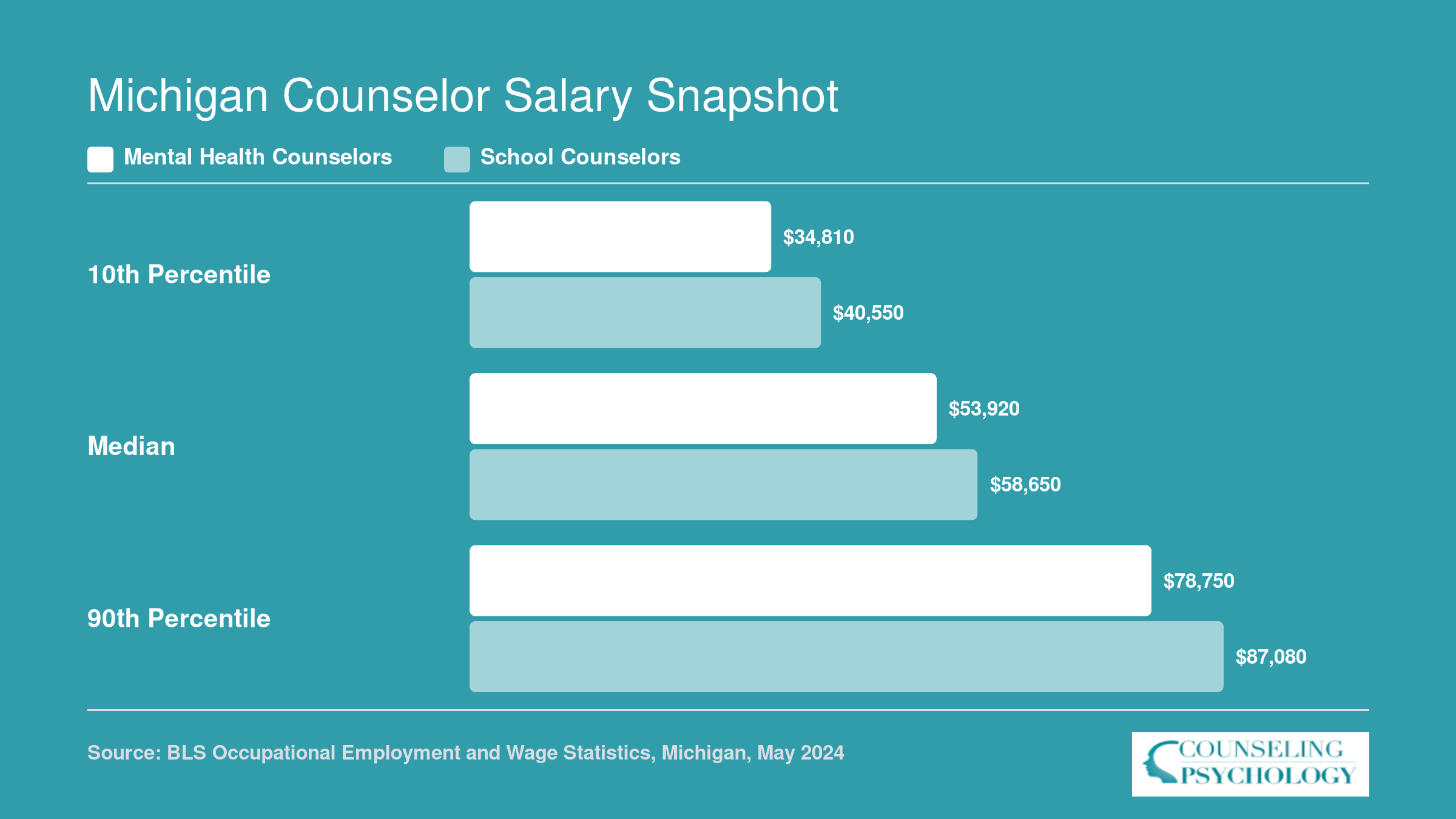
- Michigan mental health counselors at the 90th percentile earn over $78,000 annually according to BLS state data.
- Several Michigan universities offer fully online or hybrid counseling master's programs suited for working professionals.
- Graduate certificates in play therapy and child counseling are available at Oakland University and Eastern Michigan University.
Michigan's demand for mental health counselors has climbed steadily, with the Bureau of Labor Statistics projecting faster-than-average growth for the occupation nationally and state-level hiring trends reflecting that pressure across both urban and rural regions. For prospective students, the core tension is practical: CACREP accreditation status, total program cost, and clinical hour requirements vary enough between schools that the wrong choice can add years and thousands of dollars to the path toward licensure.
All programs covered here offer online or hybrid delivery, and affordability was weighted heavily in how they were evaluated. Students considering addiction counseling online programs or clinical mental health tracks will find that the field rewards preparation, and a well-matched, reasonably priced program beats a prestigious but debt-heavy one for most working adults entering this career.
Best Master's in Counseling Programs in Michigan for 2026
Michigan offers a strong mix of public and private institutions with counseling master's programs that range from fully online to hybrid formats, many carrying CACREP accreditation and designed around state licensure requirements. Whether you are a working teacher looking for a school counseling credential, a career changer pursuing clinical mental health counseling, or a professional adding a specialization in addiction or marriage and family therapy, the programs below represent the best combinations of affordability, flexibility, and career preparation available in the state for 2026.
- Program accreditation and licensure alignment
- Tuition affordability and net price
- Online and hybrid delivery options
- Graduate earnings and debt outcomes
- Clinical training depth and flexibility
- Internal program database
- Independent program research
- College Scorecard graduate earnings — collegescorecard.ed.gov
- NCES-IPEDS federal institutional data — nces.ed.gov

Central Michigan University
Central Michigan University delivers one of the most versatile counseling lineups among Michigan public universities, combining a CACREP-accredited 60-credit Master of Arts in Counseling with concentrations in clinical mental health, school counseling, and addiction counseling, plus a fully online 15-credit postgraduate certificate that bridges licensed counselors into school counseling roles. With tuition at $17,187 for both in-state and out-of-state students and a hybrid format built for working professionals across central and northern Michigan, CMU is a standout for cost-conscious students who need geographic flexibility. The institution-wide graduation rate is 58.7%, and median graduate debt sits at $27,000, while median earnings ten years after enrollment reach $55,874.
- CACREP-accredited, 60-credit hybrid program
- Faculty are licensed practicing counselors
- Hands-on practicum and internship requirements
- Access to CMU's Center for Community Counseling
- Prepares graduates for Michigan LLPC licensure
- Flexible part-time and full-time study options
- On-campus and online course delivery available
- CACREP-accredited with 60 credit hours
- Focus on K-12 advocacy and equity in counseling
- Hybrid format with evening scheduling options
- Internship includes a managed student caseload
- Aligns with ASCA National Model standards
- Licensed faculty with school counseling expertise
- 60-credit hybrid program with addiction focus
- Covers prevention, intervention, and recovery care
- Compulsory practicum and clinical internship
- Prepares for diverse addiction counseling settings
- CACREP-accredited curriculum
- Faculty hold active counseling licenses
- Fully online, 15-credit certificate program
- Designed for holders of a CACREP master's degree
- Prepares for Michigan school counselor licensure
- Completable in two to three semesters
- Onsite internship arranged in your local area
- Curriculum built around the ASCA National Model
Master of Arts in Counseling, Clinical Mental Health Counseling — Hybrid
Master of Arts in Counseling, School Counseling — Online
Master of Arts in Counseling, Addiction Counseling — Hybrid
Postgraduate School Counseling Certificate — Online

Western Michigan University
Western Michigan University stands out for the breadth of its counseling pathways, offering a 60-credit M.A. in Marriage, Couple, and Family Counseling, a Clinical Mental Health Counseling master's, and stackable graduate certificates in addiction counseling and school counseling. On-campus clinics in both Kalamazoo and Grand Rapids give students hands-on training with diverse populations, and the hybrid format with evening and weekend options keeps the program accessible for adult learners across West Michigan. In-state tuition is $20,103 (out-of-state $29,681), with median graduate debt of $26,188 and median earnings of $53,562 ten years after enrollment. Graduate assistantships and scholarships through the College of Education and Human Development can meaningfully offset costs.
- 60-credit program with family systems theory focus
- 100 practicum hours plus 600 internship hours
- Clinical sites in Kalamazoo and Grand Rapids
- Prepares for LPC and LMFT dual licensure in Michigan
- Emphasis on cultural awareness and evidence-based practice
- Scholarships and assistantships available
- Hybrid delivery with flexible scheduling
- Accredited counseling program in hybrid format
- Meets Michigan LLPC licensure requirements
- Multiple campus locations for clinical training
- Strong job market outlook for graduates
- In-person and online course options
- Prepares students for diverse clinical settings
- 18-credit hybrid program with weekend classes
- Meets Michigan addiction credentialing requirements
- Covers substance use, co-occurring disorders, cultural humility
- Field practicum or capstone option included
- Designed for post-bachelor's working professionals
- Financial aid eligible
- 9-credit hybrid program for CAADC credentialing
- Weekend and online course delivery
- Aligns with Michigan state requirements
- Flexible format for adult learners
- Builds on existing counseling education
- Efficient add-on credential for practicing counselors
- Post-master's pathway to K-12 school counselor licensure
- No teaching certificate required for admission
- Compliant with Michigan state regulations
- Designed for already-licensed professional counselors
- Efficient credential adjustment without a second degree
- Hybrid format for working counselors
M.A. in Marriage, Couple, and Family Counseling — Hybrid
Clinical Mental Health Counseling Master's — Hybrid
Clinical Addiction Certificate — Hybrid
Addiction Specialization Certificate — Hybrid
School Counseling Graduate Certificate — Hybrid

Grand Valley State University
Grand Valley State University's Master of Education in School Counseling is purpose-built for Michigan educators who want to transition into school counseling while continuing to work. The 36-to-42-credit hybrid program aligns with both Michigan Department of Education standards and the ASCA National Model, with evening, weekend, and online course options that accommodate full-time teaching schedules. As a public university, GVSU keeps tuition at $20,030 regardless of residency, and the institution-wide graduation rate of 67% is the highest among the public schools on this list. Median graduate debt is $24,500 and median earnings reach $56,118 at ten years.
- 36 to 42 credits in a hybrid format
- Accredited by Michigan Department of Education
- Curriculum aligns with ASCA National Model
- Evening, weekend, and online class scheduling
- Covers anti-racist practices and college readiness
- Admission requires teaching certificate or relevant experience
- Rolling deadlines in July, November, and March
- Experienced faculty with school counseling backgrounds
Master of Education in School Counseling — Hybrid

Siena Heights University
Siena Heights University offers a Clinical Mental Health Counseling M.A. through a hybrid model that blends on-ground and online coursework, making it accessible to working adults in southern Michigan and the nearby Toledo corridor. As a smaller private institution with a 14-to-1 student-to-faculty ratio, Siena Heights provides a more personalized graduate experience while keeping costs relatively moderate for a private school: tuition is $14,030, and the median graduate debt of $18,750 is the lowest on this list. Median earnings ten years after enrollment are a strong $57,529, and institutional aid can further reduce the net price.
- Hybrid format with on-ground and online coursework
- Develops assessment, intervention, and therapeutic skills
- Flexible course delivery for working adults
- Prepares graduates for Michigan licensure pathways
- Smaller class sizes with 14-to-1 student-faculty ratio
- Comprehensive training for diverse populations
- Lowest median graduate debt among listed programs
Clinical Mental Health Counseling M.A. — Hybrid

Cornerstone University
Cornerstone University's Master of Science in Clinical Mental Health Counseling is one of the most flexible online options in Michigan, delivering 60 credit hours primarily online with just two required in-person residencies. A Marriage and Family Therapy concentration allows students to pursue dual licensure as both an LPC and LMFT in Michigan. Tuition is listed at $9,522 per year, and the program allows transfer of up to 75% of credits, which can dramatically reduce overall cost for students with prior graduate coursework. Median graduate debt is $25,000, and the curriculum is CACREP-aligned and explicitly built around Michigan LPC requirements.
- 60-credit online program with two in-person residencies
- Dual licensure track for LPC and LMFT in Michigan
- Transfer up to 75% of program credits
- No entrance exam required for admission
- 100 practicum hours and 600 clinical internship hours
- CACREP-aligned curriculum with Christian worldview
- Flexible full-time and part-time enrollment options
- Prepares for the National Counselor Exam
Master of Science in Clinical Mental Health Counseling, Marriage and Family Therapy — Online

Spring Arbor University
Spring Arbor University's CACREP-accredited Master of Arts in Counseling offers three distinct tracks: school counseling, clinical mental health, and a dual track combining both. The 61-credit hybrid program integrates a Christian perspective with rigorous clinical training and is designed for working adults across Michigan, with significant online delivery supplemented by face-to-face sessions. Tuition is $8,364, though net price after aid runs higher at roughly $19,353. Median graduate debt is $26,375, and the 12-to-1 student-to-faculty ratio is the most favorable on this list for students who value close mentorship.
- CACREP-accredited, 61-credit hybrid program
- K-12 school counseling preparation for Michigan licensure
- Christian perspective woven into curriculum
- Clinical and practical internship experiences
- Culturally responsive counseling skill development
- Hybrid and online learning options for working adults
- CACREP-accredited with 61 credit hours
- Prepares graduates for Michigan LPC licensure
- Hybrid and online delivery for flexibility
- Focus on diverse clinical practice settings
- Emphasizes cultural responsiveness and ethical practice
- Christian worldview integration throughout coursework
- Combines clinical mental health and school counseling
- CACREP-accredited, 61-credit comprehensive curriculum
- Prepares for both LPC and school counselor credentials
- Face-to-face and virtual classroom options
- Unique dual-track flexibility within one degree
- Designed for students pursuing multiple career paths
Master of Arts in Counseling, School Counseling — Hybrid
Master of Arts in Counseling, Clinical Mental Health — Hybrid
Master of Arts in Counseling, Dual Track — Hybrid

Oakland University
Oakland University's counseling department is CACREP-accredited and centered on a 64-credit Doctor of Philosophy in Education: Counseling, a hybrid doctoral program with concentrations in addiction, career, child and adolescent, couple and family, and mental health counseling. Because the listed offerings are at the doctoral level and require an existing master's degree, Oakland is best suited for counseling professionals ready to advance into research, leadership, or counselor education rather than those seeking an initial master's. In-state tuition is $21,960 (out-of-state $24,648), median graduate debt is $22,750, and median earnings ten years after enrollment are $58,612, the highest among the schools on this list.
- 64-credit hybrid doctoral program, CACREP accredited
- Five concentrations including addiction and child/adolescent
- Requires a master's degree in counseling for admission
- GRE scores and professional experience required
- Cohort-based model with research methodology emphasis
- Covers ethical, legal, and diversity issues in counseling
- Focus on advanced clinical practice and leadership
- Prepares for administration and counselor education roles
Doctor of Philosophy in Education: Counseling — Hybrid
How We Ranked Michigan Counseling Programs
Some ranking systems prioritize institutional prestige; ours starts with what students actually pay and earn. Our goal is to spotlight programs that deliver strong career preparation without burying graduates in debt.
Affordability Takes Center Stage
Financial accessibility was the heaviest factor in our evaluation. We looked closely at net price, graduate tuition, and the share of students receiving Pell Grants as a proxy for economic diversity. Programs with lower out-of-pocket costs and a track record of serving a broad range of income backgrounds received higher marks. This does not mean we ignored quality. A program must still meet our editorial standards for curriculum and outcomes, but we believe cost should not be a barrier to entering the counseling profession.
Flexible Formats Only
Every program on this list offers online or hybrid delivery. We filtered out strictly on-campus options because working adults, career changers, and parents need scheduling flexibility. If you are also weighing broader national options, our guide to best online master's in counseling programs covers a wider pool. The presence of asynchronous coursework, evening intensives, or part-time pacing was a prerequisite, not a rank enhancer.
Using Institution-Wide Outcomes as a Signal
Because program-specific federal earnings data is not always available, we drew on institution-level Scorecard metrics (graduation rates, median earnings, and typical debt amounts) as a reasonable proxy for the overall student experience. We did not assume that counseling graduates earn exactly the university-wide median, but we valued schools where aggregate outcomes suggest solid return on investment.
Accreditation and Specializations: Editorial Screens
CACREP accreditation and the availability of a child counseling certificate or concentration were treated as quality markers, not algorithm inputs. Programs without CACREP were still eligible if they met other standards, but readers pursuing licensure should weigh accreditation carefully. Child-focused coursework was highlighted because of strong demand in Michigan school and community settings.
Tuition and Affordability Comparison for Michigan Counseling Programs
Cost is one of the biggest factors in choosing a counseling master's program, and Michigan offers a wide range of options. The table below compares graduate tuition rates, average net price after aid, and median graduate debt across seven programs featured in our 2026 rankings. Note that tuition figures reflect institutional rates reported to IPEDS and may differ from per-credit costs quoted on program pages. Net price represents the average cost after grants and scholarships for aided students.
| School | Graduate Tuition (In-State) | Graduate Tuition (Out-of-State) | Avg. Net Price | Median Graduate Debt | Student-to-Faculty Ratio |
|---|---|---|---|---|---|
| Spring Arbor University | $8,364 | $8,364 | $19,353 | $26,375 | 12:1 |
| Cornerstone University | $9,522 | $9,522 | $20,301 | $25,000 | 15:1 |
| Siena Heights University | $14,030 | $14,030 | $17,124 | $18,750 | 14:1 |
| Central Michigan University | $17,187 | $17,187 | $17,597 | $27,000 | 16:1 |
| Grand Valley State University | $20,030 | $20,030 | $16,317 | $24,500 | 15:1 |
| Western Michigan University | $20,103 | $29,681 | $15,273 | $26,188 | 16:1 |
| Oakland University | $21,960 | $24,648 | $9,120 | $22,750 | 17:1 |
Questions to Ask Yourself
Child Counseling Specializations and Graduate Certificates in Michigan
Does Michigan offer graduate certificates in play therapy or child mental health counseling that can stack into a master's degree?
Several Michigan universities provide graduate certificates and master's-level concentrations focused on children and adolescents. Oakland University, Eastern Michigan University, and Western Michigan University lead the way in child-focused credentials, though options vary widely in credit requirements, delivery format, and stacking potential.
Graduate Certificates in Play Therapy and Child Counseling
Oakland University offers a 12-credit Graduate Certificate in Play Therapy designed for professionals seeking specialized training in therapeutic play interventions.1 The program includes a fieldwork course and typically spans 12 months. Courses from this certificate may count toward master's-level electives with departmental approval, making it a stackable option for students planning to pursue or complete a master's in counseling. Fieldwork placements often take place in schools, youth agencies, or clinics, though specific partnerships are not publicly listed.
Eastern Michigan University provides several post-master's and graduate certificate options with child and adolescent components.2 The Post-Master's Certificate in Clinical Mental Health Counseling includes clinical placements serving child and adolescent populations, though it is not exclusively child-focused. EMU also offers a Post-Master's Certificate Program for School Counselor Licensure, requiring 14 to 30 credits depending on prior coursework and designed for professionals adding a school counselor endorsement. Additionally, the university's Graduate Certificate in Helping Interventions in a Multicultural Society (12 to 15 credits) provides foundational counseling skills applicable across age groups, including children.
Western Michigan University offers a Counseling Psychology Graduate Certificate on its Kalamazoo campus.3 This certificate is not child-specific; it serves professionals completing requirements for Michigan TLLP or LLP licensure, with individualized credit hours based on prior training.
Child and Adolescent Concentrations Within Master's Programs
Among the ranked programs on this list, several master's degrees include child and adolescent specializations or practicum opportunities. For students exploring how to become a child counselor, Grand Valley State University's Master of Education in School Counseling aligns with the American School Counselor Association (ASCA) model and prepares graduates to counsel K-12 students. The program is Michigan Department of Education approved and emphasizes anti-racist practices, college readiness counseling, and interventions for youth.
Spring Arbor University's Master of Arts in Counseling offers a School Counseling track that integrates a Christian perspective and prepares students for Michigan school counselor licensure. The 61-credit program includes clinical and practical internships in school settings.
Central Michigan University provides a 15-credit online Postgraduate School Counseling Certificate for graduates of CACREP-accredited master's programs. The certificate focuses on the ASCA National Model and includes onsite internships in Michigan schools, completing in two to three semesters.
Practicum Placements in Child-Focused Settings
Michigan counseling programs partner with a range of child-serving organizations for practicum and internship experiences. While specific partnerships are not always publicized, common placement sites include local school districts, children's hospitals, community mental health centers, and youth development agencies. Graduates interested in childhood trauma counseling should note that Eastern Michigan University explicitly references child and adolescent populations in its clinical mental health placements. Western Michigan University's Marriage, Couple, and Family Counseling program operates on-campus clinics in Kalamazoo and Grand Rapids, where students gain supervised experience working with families and children.
School counseling programs at Wayne State University, Oakland University, and Spring Arbor University are all approved by the Michigan Department of Education for School Counselor Endorsement, Preliminary School Counselor Certificate, and School Counselor License, ensuring that students complete required field experiences in K-12 settings as part of their training.4
Online Vs. On-Campus Counseling Programs in Michigan
Choosing a program format means deciding how you will actually experience graduate school day to day: where you attend class, how you complete required clinical hours, and how much flexibility you have around work and family commitments. Michigan counseling programs currently offer three main formats, and each involves real trade-offs worth thinking through carefully.
Format Options Across Michigan Programs
Several of the stronger programs in the state span multiple formats. Central Michigan University offers on-campus, online, and hybrid tracks, giving students genuine choices within a single institution.1 Spring Arbor University delivers its program fully online through a virtual classroom model.2 The University of Olivet takes a hybrid approach, pairing online coursework with required in-person residencies.3 This range means Michigan students are not forced to relocate or leave the workforce to pursue a graduate counseling credential.
Flexibility, Practicum, and Networking
For working professionals, online and hybrid formats reduce commute burden and allow more control over scheduling. That said, no format eliminates the supervised clinical practicum and internship hours that Michigan licensure requires. Central Michigan makes practicum compulsory across all of its delivery tracks, which is consistent with how every accredited program operates.1 Students in online programs typically arrange their field placements locally, which can actually be an advantage for building community ties in the area where they plan to practice.
Networking looks different by format. On-campus students have more incidental contact with faculty and peers, while online students often need to be more intentional about professional development through state associations and regional supervision groups.
Are Online Counseling Degrees Respected?
This question comes up often, and the straightforward answer is yes, provided the program holds CACREP accreditation. CACREP standards apply equally regardless of whether a program is delivered online, in person, or in a hybrid format. Eastern Michigan University, for example, holds CACREP accreditation, and that credential carries the same weight for licensure and employment whether a graduate attended classes on campus or remotely.4 Students exploring broader options may also want to review online clinical mental health counseling programs to compare accreditation standards across institutions.
The Michigan Department of Education makes no distinction based on delivery modality when reviewing program approval for school counseling tracks.5 Occupation eligibility for graduates is identical across formats. Employers in clinical and school settings focus primarily on licensure status and supervised hours, not on whether a candidate sat in a physical classroom.
Choosing What Works for You
- Flexibility: Online and hybrid formats suit students balancing jobs or caregiving responsibilities.
- Cost: Format alone does not determine affordability; per-credit tuition and available aid vary by institution regardless of modality.
- Practicum logistics: All formats require in-person clinical hours, so proximity to approved sites matters no matter how coursework is delivered.
- Community: On-campus programs offer built-in peer cohorts; online students benefit from actively seeking out professional networks in their local area.
The format that serves you best is ultimately the one that fits your schedule, your location, and your learning style without compromising on accreditation quality.
CACREP Accreditation and Michigan Licensure Requirements
CACREP-accredited programs versus non-accredited degrees carry starkly different consequences for Michigan counselors: the former streamlines your path to licensure, while the latter often adds years of additional coursework or supervised hours. Understanding Michigan's regulatory framework is essential before you enroll.
Michigan LARA Requirements for LLPC and LPC Licensure
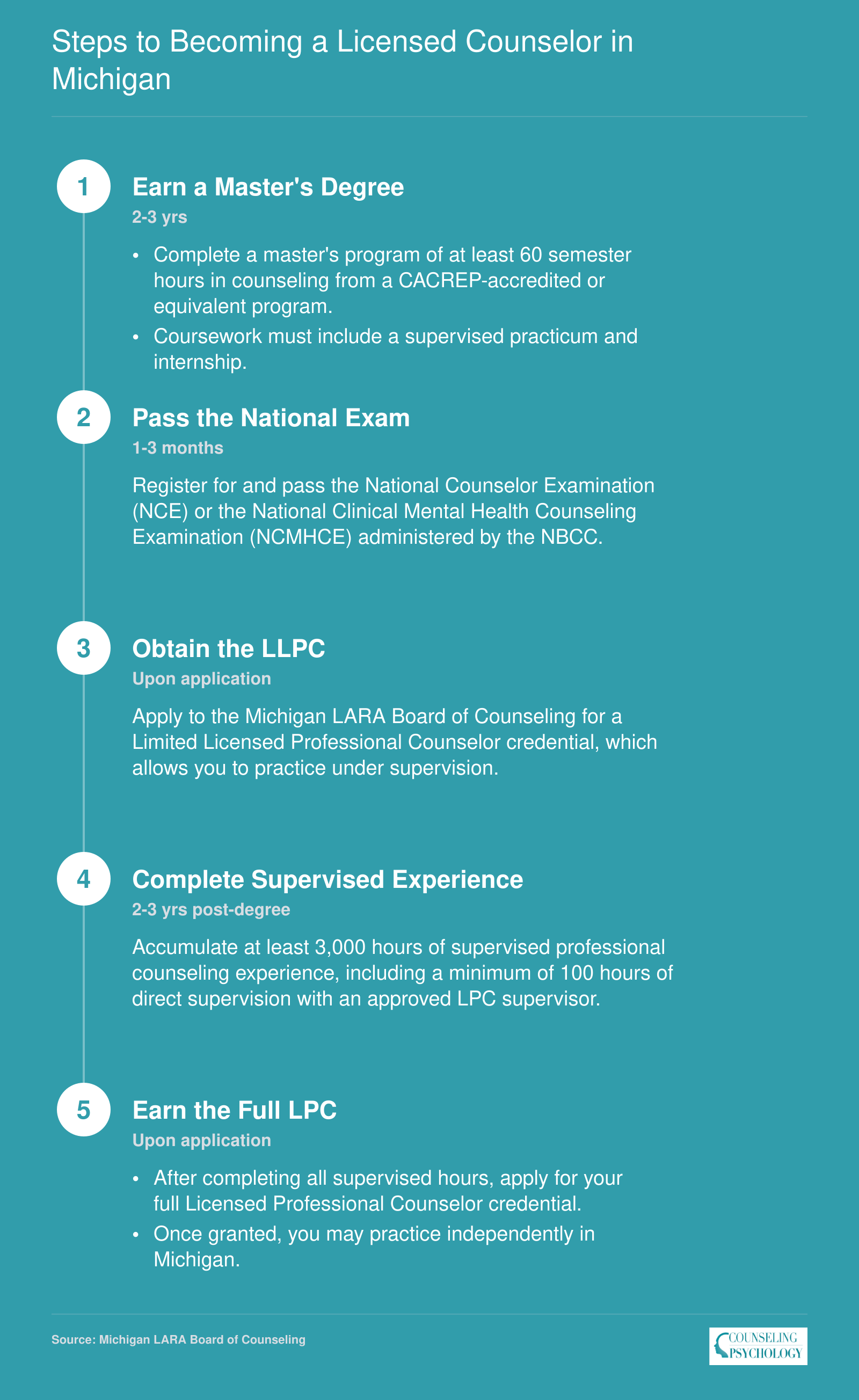
The Michigan Department of Licensing and Regulatory Affairs (LARA) governs professional counselor licensure in the state. To become a Limited Licensed Professional Counselor (LLPC), you must hold a master's degree in counseling or a related field that includes at least 60 semester credits of graduate-level coursework. Michigan strongly encourages CACREP-accredited programs because they align with the state's educational standards, though non-CACREP degrees may qualify if they meet specific coursework requirements.
After earning your LLPC, you must complete 3,000 hours of supervised clinical experience, including at least 100 hours of face-to-face supervision, before you can apply for full Licensed Professional Counselor (LPC) status. You will also pass the National Counselor Examination (NCE) or the National Clinical Mental Health Counseling Examination (NCMHCE). Because Michigan's requirements evolve through administrative rule changes, always verify current degree, supervision, and exam requirements directly with LARA's licensing board or through their official website.
School Counselor Certification Through Michigan MDE
School counselors follow a separate pathway overseen by the Michigan Department of Education (MDE). To earn a school counseling endorsement, you typically need a master's degree in school counseling (often CACREP-accredited), completion of a supervised school-based practicum and internship, and passing scores on the Michigan Test for Teacher Certification (MTTC) in school counseling. MDE publishes detailed educator certification guides and administrative rules that outline credit-hour distributions, practicum requirements, and renewal procedures. The Michigan Counseling Association (MCA) also offers overviews and policy updates for aspiring school counselors.
Child-Specific Credentials and Specialty Endorsements
If you plan to work with children and adolescents, consider credentials beyond basic licensure. The National Certified School Counselor (NCSC) credential, offered through the National Board for Certified Counselors, signals advanced competence in school settings. For play therapy and child trauma work, the Registered Play Therapist (RPT) credential from the Association for Play Therapy requires specialized training and supervised clinical hours. Those drawn to how to become a mental health counselor in pediatric or adolescent settings will find that many CACREP-accredited Michigan programs offer concentrations in child and adolescent counseling that prepare you for these credentials.
Confirming Requirements and University Program Details
The Bureau of Labor Statistics (BLS.gov) provides general occupational outlook and typical education paths for counselors nationwide, but it does not replace state-specific licensure guidance. Always confirm degree requirements, supervised hours, and exam prerequisites with Michigan LARA for clinical counselors and Michigan MDE for school counselors. University counseling programs at institutions such as the University of Michigan and Wayne State University often detail licensure prerequisites in their curriculum guides and advising materials, helping you map coursework to state requirements before you graduate.
Steps to Becoming a Licensed Counselor in Michigan
Michigan uses a two-tier licensing model that moves from a Limited License (LLPC) to a full Licensed Professional Counselor (LPC). Here is the typical credentialing ladder and the approximate time each stage takes.
Career Outcomes and Salary for Michigan Counselors
Demand for mental health counselors is growing faster than most healthcare-adjacent fields, and Michigan's labor market reflects that national momentum in concrete ways.
What the Numbers Show
According to the Bureau of Labor Statistics, the national median annual wage for mental health counselors was $53,710 in 2023.1 The spread across the field is wide: the bottom tenth of earners nationally took in around $36,700, while the top tenth reached nearly $90,000. The middle range, from the 25th to the 75th percentile, ran from roughly $44,600 to $70,130. These are national figures and should not be read as Michigan-specific benchmarks.
For Michigan specifically, O*NET data puts the mean annual wage for mental health counselors at $59,530 (2024), which sits noticeably above the national median.2 That gap suggests Michigan's market compensates counselors somewhat better than the national average, though mean wages can be pulled upward by higher earners at the top of the scale.
Growth Projections Worth Knowing
The Occupational Outlook Handbook projects mental health counselor employment to grow 17 percent nationally from 2024 to 2034, a rate the BLS classifies as much faster than average.3 That projection translates to roughly 48,300 job openings per year across the country over that decade, combining new positions and replacement demand.
For state-level projections specific to Michigan, the Department of Technology, Management and Budget publishes occupational outlook data that breaks down growth by region and occupation code. Checking those figures alongside the national data gives a more grounded picture of where openings are likely to concentrate.
Finding Current Salary Ranges in Michigan
Published wage statistics capture a moment in time and do not always reflect what employers are actively offering. A few practical ways to fill in the gaps:
- Job boards: Search Indeed or LinkedIn for mental health counselor and school counselor postings in metro areas like Detroit-Warren-Dearborn, Grand Rapids-Wyoming, and Ann Arbor. Many listings include salary ranges now that pay transparency is more common.
- Professional associations: The Michigan Counseling Association and the American Counseling Association periodically conduct salary surveys. Membership sometimes grants access to aggregated compensation data that published government statistics do not capture.
- University career centers: Graduate programs at institutions like the University of Michigan and Michigan State often track alumni employment outcomes and may share salary data through their career offices or program advisors.
Using these sources together gives a clearer picture than any single dataset, and it helps you benchmark specific roles rather than treating the field as a single salary category. For example, salaries and day-to-day responsibilities differ significantly between a how to become a school counselor track and a clinical mental health counseling path, so exploring each counseling career individually is well worth the effort.
Michigan Counselor Salary Snapshot
Understanding the full salary range helps you set realistic expectations. The figures below compare Michigan-specific wages for mental health counselors and school counselors at three key points: the 10th percentile (entry level), the median, and the 90th percentile (top earners).
Frequently Asked Questions About Counseling Master's in Michigan
Choosing a counseling master's program in Michigan involves weighing cost, format, accreditation, and admission requirements. Below are answers to the questions prospective students ask most often.