
What you’ll learn in this article…
- UNL offers the only COAMFTE-accredited MFT program near Lincoln, which streamlines Nebraska's LMHP with CMFT licensure path.
- Nebraska requires roughly four to six years from first graduate class to independent LMFT practice, including post-degree supervised hours.
- Lincoln's mix of university clinics, community agencies, and hospitals provides a deep bench of local practicum placements for MFT students.
- Nationally, BLS median pay for marriage and family therapists was approximately $58,510 in 2024, though early-career Nebraska earnings tend to start lower.
Nebraska's mental health workforce reports consistently strong demand for relational therapists, yet within commuting distance of Lincoln, only two accredited-degree pathways prepare students for licensure as a marriage and family therapist.
The University of Nebraska-Lincoln houses a COAMFTE-accredited specialization that has trained MFTs since 1993, while Concordia University in Seward offers a faith-based MA that aligns with COAMFTE standards but does not yet carry the accreditation seal.
Because Nebraska licenses MFTs under the LMHP credential with a Certified Marriage and Family Therapist (CMFT) designation, graduation from a COAMFTE-accredited program streamlines the path to the national exam and meets the state's education requirements without additional course review.
Ranked: Best MFT Master's Programs Near Lincoln, Nebraska
Lincoln-area students pursuing marriage and family therapy have two regionally accessible options, each with a distinct format and philosophy. The University of Nebraska-Lincoln houses a long-established, COAMFTE-accredited MFT specialization on its main campus, while Concordia University in nearby Seward delivers a hybrid MA that blends online coursework with short on-campus residencies. Below, we break down what each program offers, what it costs, and the outcomes data currently available.
- COAMFTE accreditation status
- Graduate debt and earnings data
- Clinical training hours and format
- Tuition and net price after aid
- Program completion timeline
- Independent program research
- College Scorecard graduate earnings — collegescorecard.ed.gov
- Internal program database
- NCES-IPEDS federal institutional data — nces.ed.gov

University of Nebraska-Lincoln
The University of Nebraska-Lincoln is a Research 1 public university enrolling a large and diverse student body at a 17-to-1 student-faculty ratio. Its College of Education and Human Sciences has housed a COAMFTE-accredited MFT specialization since 1993, giving graduates a well-recognized credential for Nebraska licensure. The institution-wide six-year graduation rate is 67%, and the school-wide median earnings ten years after enrollment are approximately $56,887 according to College Scorecard data.
- 49-credit master's requiring roughly 24 months to complete
- COAMFTE accredited since 1993, meeting Nebraska LMFT requirements
- 400+ direct client contact hours, including 150+ relational hours
- 12-month practicum at on-campus clinic and community agencies
- Small cohort model of 8 to 12 students per entering class
- Includes Gottman Level 1 and Attachment-Based Family Therapy training
- In-state tuition approximately $8,434/year; out-of-state roughly $20,944/year
- School-level median graduate debt at completion: $21,000
Marriage and Family Therapy Specialization (M.S.) — Hybrid

Concordia University-Nebraska
Concordia University is a private Lutheran institution in Seward, about 25 miles west of Lincoln, with a 14-to-1 student-faculty ratio and an institution-wide graduation rate near 65%. Its MA in Marriage and Family Therapy uses a hybrid delivery model, combining synchronous online sessions with three required on-campus residencies, making it accessible for students across Nebraska and beyond. Students arrange practicum placements in their own communities, which is a practical advantage for anyone already living or working in the Lincoln metro area.
- 62 to 64 credit hours at $500 per credit, completed in about 24 months
- Hybrid format with synchronous online classes and on-campus residencies
- 300-hour practicum secured in the student's local area during year two
- Curriculum integrates family systems theory with a Christian worldview
- Aligned with COAMFTE standards; full accreditation application planned
- Fall and spring entry terms with courses delivered in 8-week blocks
- School-level median graduate debt at completion: $25,750
- Net price after aid averages roughly $23,965 (not a guaranteed quote)
MA Marriage and Family Therapy — Hybrid
Program Comparison: UNL vs. Concordia and Online Alternatives
Choosing the right MFT master's program near Lincoln means weighing accreditation, cost, clinical training structure, and delivery format against your personal priorities. Below is a side-by-side look at the two local options and one nationally available online alternative. Nebraska's Board of Mental Health Practice accepts degrees from COAMFTE-accredited programs for LMFT licensure, and it also evaluates programs aligned with COAMFTE standards on a case-by-case basis, so accreditation status is a critical factor in your decision.
| University of Nebraska-Lincoln | Concordia University, Seward | Capella University (Online) |
|---|---|---|
| M.S. in Marriage and Family Therapy | M.A. in Marriage and Family Therapy | M.S. in Marriage and Family Therapy |
| Accredited since 1993 | Aligned with COAMFTE standards; accreditation application planned but not yet granted | COAMFTE-accredited |
| Hybrid (on-campus courses plus community placements) | Hybrid (online synchronous and asynchronous coursework with required on-campus residencies) | Fully online |
| 49 credit hours | 62 to 64 credit hours | Varies by specialization; confirm current catalog |
| In-state graduate tuition reported at approximately $8,434 per year | $500 per credit hour (estimated total: $31,000 to $32,000) | Varies; check current published rates |
| 400+ direct client contact hours including 150+ relational hours across a 12-month practicum | 300-hour practicum beginning in the second year | Clinical requirements set by COAMFTE standards; students arrange local placements |
| Approximately 24 months (cohort model, 8 to 12 students per cohort) | Approximately 24 months (8-week course blocks, fall and spring entry) | Self-paced within program guidelines; timelines vary |
| Research-oriented, housed in the Department of Child, Youth and Family Studies; training in trauma-informed care, Gottman Level 1, and attachment-based family therapy | Faith-based institution integrating a Christian worldview with family systems theory; affiliated with the Lutheran Church, Missouri Synod | Competency-based professional focus; designed for working adults seeking scheduling flexibility |
| Meets Nebraska licensure education requirements | Designed to prepare graduates for licensure; because COAMFTE accreditation is not yet granted, applicants should verify acceptance with the Nebraska Board of Mental Health Practice | COAMFTE accreditation satisfies the education requirement; students must secure a Nebraska-approved practicum site independently |
| 17:1 | 14:1 | Not directly comparable (large online enrollment) |
COAMFTE Accreditation and Why It Matters in Nebraska
The landscape of marriage and family therapy education is shifting as more states clarify their licensure pathways, and Nebraska is no exception. For prospective MFT students near Lincoln, understanding the role of COAMFTE accreditation can prevent costly missteps during the licensure process. Nebraska's rules offer flexibility, but they also place the burden on the applicant to prove their program meets specific educational standards.
What Is COAMFTE?
The Commission on Accreditation for Marriage and Family Therapy Education (COAMFTE) is the specialized accrediting body for MFT graduate programs. Unlike regional accreditation, which evaluates the overall institution, COAMFTE focuses specifically on whether the curriculum, clinical training, and faculty in a marriage and family therapy program prepare students for competent entry-level practice. This differs sharply from CACREP, which primarily accredits clinical mental health counseling programs. An MFT degree earned through a CACREP-accredited counseling track may lack the relational and systems-focused coursework Nebraska requires for LMFT licensure. COAMFTE ensures the program aligns with the profession's core competencies and the national exam blueprint.
Nebraska's Board Requirements
Nebraska's Board of Mental Health Practice does not mandate COAMFTE accreditation as the sole path to LMFT licensure. The state accepts COAMFTE, CACREP, CSWE, APA, or equivalent accreditation, provided the graduate program includes at least 60 semester hours and covers specific content areas.12 Applicants from non-COAMFTE programs must submit detailed course descriptions and worksheets to demonstrate equivalency.1 The required coursework includes nine semester hours each in marriage and family studies, MFT theories, and human development, plus three hours each in professional studies and research, along with a 300-hour practicum (at least 150 direct relational hours).1 While this equivalency route exists, it introduces extra documentation and subjective review that a COAMFTE-accredited program sidesteps entirely.
Why Accreditation Choice Matters for Licensure
A COAMFTE-accredited program is intentionally designed to meet the educational requirements for the Association of Marital and Family Therapy Regulatory Boards (AMFTRB) national exam, the standard Nebraska uses for LMFT licensure. This alignment virtually eliminates the friction of proving equivalency. Students who graduate from a program without COAMFTE or a clear equivalency path may face unexpected delays or even denial of their provisional license application. For Lincoln-based students, the University of Nebraska-Lincoln's M.S. in Marriage and Family Therapy has held continuous COAMFTE accreditation since 1993, offering a straightforward pipeline to licensure.3 Online programs from schools like Northcentral University or Capella University may also hold COAMFTE accreditation, but others do not, so geographic flexibility should not come at the expense of licensure readiness. Students exploring best marriage and family therapy graduate programs in neighboring states should verify that any out-of-state degree still satisfies Nebraska's specific content-area requirements.
Verifying Your Program's Status
Accreditation status can change, and a program's historical reputation is no guarantee. Always check the current COAMFTE directory and confirm directly with the program coordinator before enrolling. For Nebraska applicants relying on the equivalency pathway, contact the Board of Mental Health Practice early to obtain a copy of the current coursework worksheet and verify that your intended program's curriculum aligns.2 This small step can save months of frustration when you eventually apply for your provisional LMFT license.
Questions to Ask Yourself
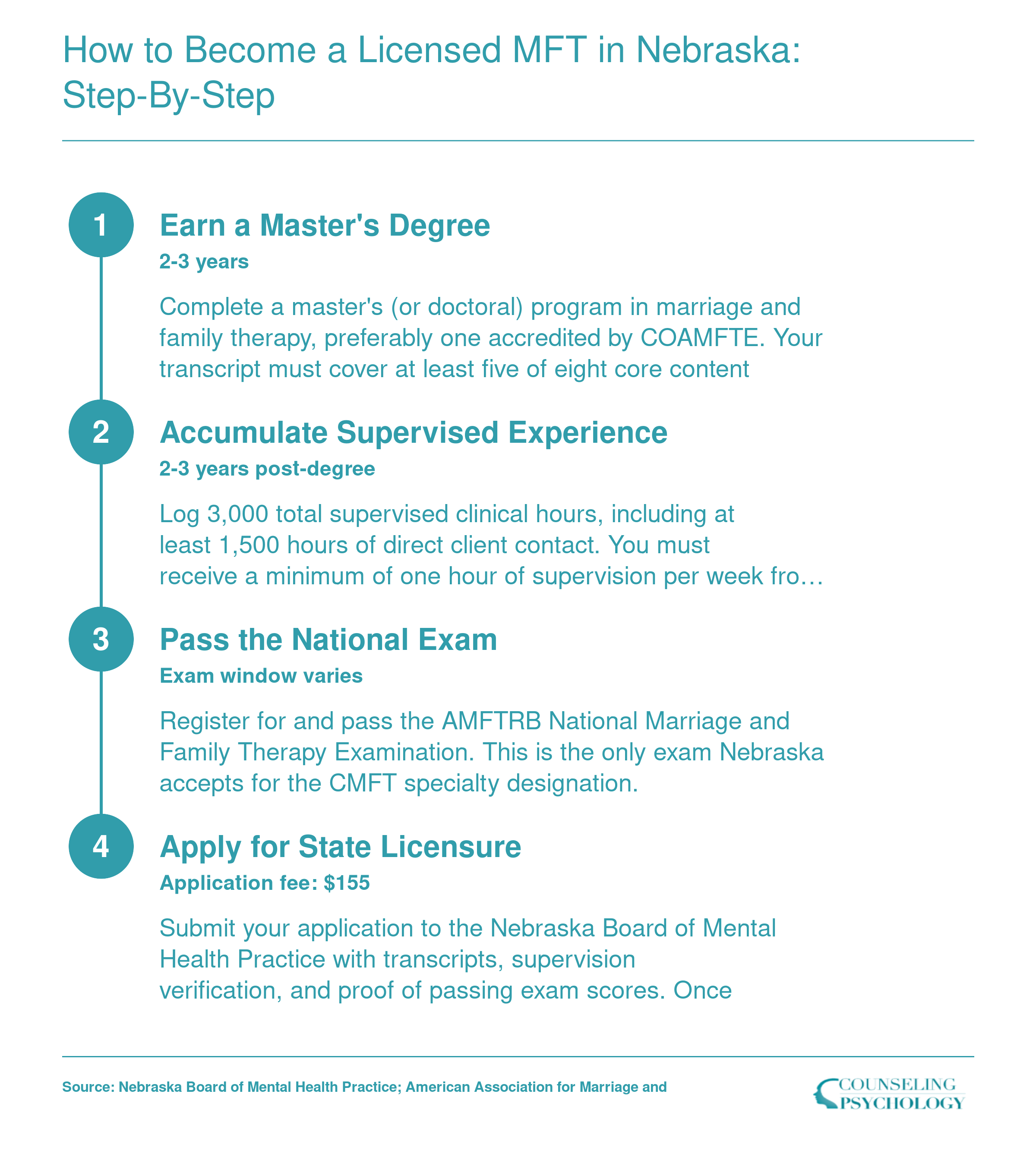
How to Become a Licensed MFT in Nebraska: Step-by-Step
Nebraska licenses marriage and family therapists under a two-part credential: Licensed Mental Health Practitioner (LMHP) with the Certified Marriage and Family Therapist (CMFT) specialty designation. The full pathway from your first graduate class to independent practice typically spans four to six years, depending on how quickly you accumulate supervised hours after graduation.
Tuition, Total Cost, and Funding Strategies for MFT Students in Lincoln
Understanding the full cost of an MFT master's degree is essential before you commit to a program. In the Lincoln area, tuition for a marriage and family therapy master's ranges widely depending on whether you attend a public university or a private institution. Public in-state programs typically charge between $350 and $550 per credit hour, while private programs can run $700 to $1,000 or more per credit. Since most MFT programs require 48 to 60 credit hours, your total tuition alone could fall anywhere from roughly $17,000 to $60,000.
Beyond tuition, factor in additional costs that add up quickly. Program fees, textbook expenses, liability insurance for clinical practica, background checks, and supervision fees for post-graduation licensure hours all contribute to the overall price tag. Students choosing online or hybrid formats should also account for technology fees, though they may save significantly on commuting and housing.
Funding strategies can substantially offset these expenses. Start by completing the FAFSA to determine your eligibility for federal loans and grants. Many MFT programs offer graduate assistantships that provide tuition waivers plus a modest stipend in exchange for research or teaching support. Scholarships from professional organizations such as AAMFT and state-level counseling associations are worth pursuing as well.
Employer tuition reimbursement programs are another underutilized resource, particularly for students already working in behavioral health or social service settings. Some students also pursue part-time enrollment to balance work and school, spreading costs over a longer timeline but reducing the need for large loans. If you are exploring broader counseling degree options in Nebraska, comparing tuition across related programs can help you gauge whether MFT-specific pricing aligns with the regional average. Whichever funding path you choose, building a clear budget early in the process helps you graduate with manageable debt and a solid foundation for your clinical career.
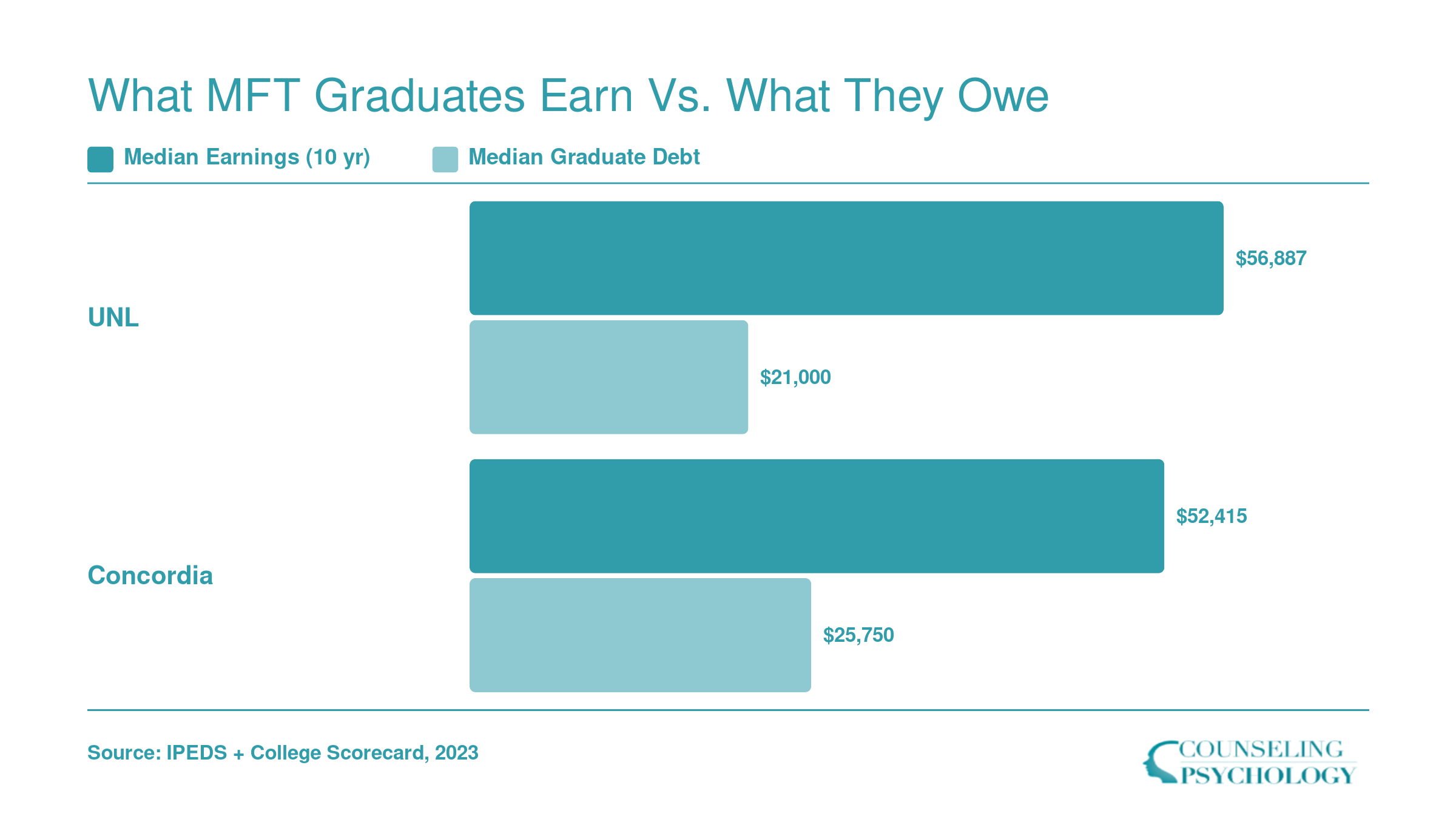
What MFT Graduates Earn vs. What They Owe
Program-level earnings data for these MFT programs are not yet published in the College Scorecard, so the figures below reflect each institution's overall median graduate debt and median earnings ten years after enrollment. Keep in mind that one-year post-completion earnings for MFT graduates specifically would be lower than these ten-year figures, because most new graduates are still accumulating supervised clinical hours toward full LMFT licensure and earning pre-licensure wages.
Clinical Training and Practicum Sites in Lincoln
Where will you actually log your supervised clinical hours as an MFT student in Lincoln?
Lincoln offers a surprisingly deep bench of practicum placements for a mid-sized metro area. The city's mix of university clinics, community agencies, hospitals, and specialty organizations means you can tailor your clinical training to the populations and settings that interest you most.
University Training Clinics
Most students begin their hands-on work close to campus. The UNL Psychological Consultation Center operates as a dedicated training clinic where graduate students see individual, couple, and family clients under direct faculty supervision.1 The center also offers telehealth sessions, which can be especially valuable for building competence in virtual service delivery, a skill employers increasingly expect.
Community and Specialty Agencies
Lincoln's practicum landscape extends well beyond the university. Community mental health agencies such as Family Services of Lincoln, Better Living Counseling Services, and Nebraska Mental Health Centers regularly host MFT trainees.2 Students interested in child and family work can pursue placements at CEDARS, Blessing of Hope Family Services, KVC Nebraska (which actively advertises internship positions3), or Behaven Kids, a behavioral health center focused on children and families.
For students drawn to specialized populations, Lincoln has notable options:
- Integrated care: Bluestem Health, a Federally Qualified Health Center, places trainees in an integrated primary care behavioral health model.1
- Forensic settings: Lincoln Regional Center (the state psychiatric hospital) and the Nebraska State Penitentiary offer exposure to forensic assessment, sex offender treatment, and psychoeducational programming.1
- Trauma-focused work: Project SAFE and the Child Advocacy Center provide supervised experience in childhood trauma counseling.1
- Cultural competency: El Centro de las Américas serves Lincoln's Latino community and offers practicum experiences grounded in culturally responsive mental health care.1
Hospital and Rehabilitation Settings
Madonna Rehabilitation Hospital places students in both pediatric and adult rehabilitation contexts, where family therapy is woven into recovery plans.1 This kind of multidisciplinary, medical-adjacent experience can set you apart when applying for positions in hospital-based behavioral health.
Private Practice Placements
Several Lincoln-area private practices also accept MFT trainees. Vine and Branch Counseling and Momentum Counseling and Consulting (which publicly advertises internship openings4) both provide supervised clinical hours in outpatient settings, giving students a window into what independent practice looks like day to day.
How Many Hours Do You Need?
COAMFTE-accredited programs typically require 500 direct client-contact hours before graduation, embedded across practicum and internship semesters. These program-required hours are separate from what Nebraska demands for full LMFT licensure after you graduate. Post-degree, the state requires an additional period of supervised practice (generally around 3,000 hours of supervised experience, with a significant portion in direct client contact) before you can earn independent licensure. Planning ahead for both milestones keeps you on track. For a broader look at the profession, explore the many MFT career paths available to graduates.
Beyond Lincoln: Rural Practicum Options
Nebraska's rural communities face persistent mental health workforce shortages, and many MFT programs allow (or encourage) students to complete practicum rotations in outstate locations. Better Living Counseling Services, for example, operates multiple sites across the state.2 Rural placements count toward your clinical hour requirements and expose you to the realities of community-based practice in underserved areas, a background that makes graduates highly competitive for positions funded through state and federal workforce initiatives. If you are still comparing programs statewide, our guide to MFT programs in Nebraska can help you weigh your options.
The bottom line: Lincoln's clinical training ecosystem is broad enough that you can graduate with experience across multiple settings, from a campus clinic to a correctional facility to a community health center, giving you both the hours and the versatility that employers and licensing boards want to see.
MFT Career Outcomes and Employers in the Lincoln Area
The honest tension for MFT graduates in Nebraska is this: the long-term earning potential for a licensed therapist looks meaningfully different from what you will likely earn during your first one to two years post-graduation, before you complete supervised hours and pass the licensing exam. Understanding that gap helps you plan realistically rather than feel blindsided.
What the Wage Data Actually Shows
National figures from the Bureau of Labor Statistics (May 2023) put the median annual wage for marriage and family therapists at $58,510.1 The spread is wide: the bottom 10 percent earn around $39,090, while the top 10 percent earn $104,710 or more.1 Nebraska-specific data tells a more modest story. CareerExplorer's state-level figures place the mean annual wage in Nebraska at roughly $47,040, with a salary range spanning from about $20,650 to $63,240.2 A 2026 Salary.com estimate for licensed MFTs in Nebraska lands near $45,221 as a mean figure.3
These Nebraska numbers are noticeably lower than the national median, which reflects several realities: a lower cost of living compared to coastal metros, a higher share of community mental health and nonprofit positions in the local job market, and the fact that many therapists counted in state surveys are still accumulating supervised hours before full licensure. For a broader look at how compensation varies across specialties and credentials, our counselor salary with masters breakdown offers useful context. Once you earn your LMFT and build a caseload, whether in an agency or private practice, your earnings have room to grow substantially.
Who Hires MFTs in the Lincoln Area
Lincoln's behavioral health employer landscape is anchored by a handful of major systems and a growing number of community organizations:
- Hospital systems: Bryan Health and CHI Health St. Elizabeth both operate behavioral health services and have historically employed licensed therapists in inpatient, outpatient, and integrated care settings.
- Community mental health centers: Federally qualified health centers and nonprofit agencies such as Region V Services serve populations with complex needs and often hire pre-licensed clinicians as they accumulate supervised hours.
- School districts: Lincoln Public Schools and surrounding districts employ mental health practitioners, though roles vary and may require or prefer school counselor credentials depending on the position.
- Group practices: A growing number of private and group practices in Lincoln recruit LMFTs, particularly those with specializations in trauma, couples work, or child and adolescent therapy.
Growth Outlook for the Lincoln Market
Nationally, the Bureau of Labor Statistics projects employment for marriage and family therapists to grow faster than average for all occupations, driven by increased recognition of mental health needs and expanded insurance coverage for behavioral health services.1 Lincoln is a smaller metro than Omaha, but it benefits from a university presence, a relatively young population, and sustained investment in community health infrastructure. Demand for bilingual therapists and those trained in trauma-informed approaches appears particularly strong given the region's refugee resettlement communities. Graduates exploring roles beyond traditional clinical practice can review what can you do with an MFT degree for a fuller picture of the possibilities.
The practical takeaway: entry-level wages in Nebraska will likely fall below national benchmarks, and the pre-licensure period requires patience. But the pathway to a sustainable, meaningful career in this region is well-supported by a diverse mix of employers and a behavioral health workforce shortage that shows no sign of resolving quickly.
Online vs. On-Campus MFT Programs: Trade-Offs for Nebraska Students
Choosing between an online and on-campus MFT program is rarely straightforward, especially when licensure rules and clinical training requirements add layers of complexity. Nebraska students should weigh logistics, cost, and professional development before committing to either format.
Pros
- Online programs offer schedule flexibility that lets working students or parents fit coursework around existing commitments.
- Enrolling online opens access to COAMFTE-accredited programs outside Nebraska, broadening your options beyond the limited local choices.
- Online tuition can run lower than on-campus rates, and you avoid relocation costs if you already live in the Lincoln area.
- On-campus programs in Lincoln come with built-in practicum site networks, making it easier to secure supervised clinical placements.
- Face-to-face supervision and faculty mentorship on campus tend to deepen learning and provide real-time clinical feedback.
- Studying on campus in Lincoln builds local professional connections that often translate directly into job referrals after graduation.
Cons
- Online students must still complete in-person clinical hours locally, which means arranging your own practicum sites in or near Lincoln.
- Remote learning can limit peer cohort bonding and spontaneous collaboration, both of which strengthen clinical skill development.
- Before enrolling in any online program, verify that the Nebraska DHHS licensure board accepts its curriculum and accreditation for LMFT eligibility.
- On-campus programs lock you into a fixed class schedule, which can be difficult if you work full time or have caregiving responsibilities.
- Lincoln has relatively few on-campus MFT program choices, so you may need to consider Omaha or broader regional options.
- Relocating to Lincoln for an on-campus program adds housing and cost-of-living expenses that can increase your total student debt.
Frequently Asked Questions About MFT Programs Near Lincoln
Choosing an MFT program involves sorting through accreditation standards, licensure steps, and cost considerations that are specific to Nebraska. Below are answers to the questions prospective students ask most often, drawn from current state requirements and program details.