
What you’ll learn in this article…
- BLS reports a national median of $97,160 for training and development managers, one of the highest paying paths for graduates.
- Educational psychology and school psychology differ sharply in scope, licensure, and day to day responsibilities.
- Not all online educational psychology masters programs lead to licensure, so verify your state's specific requirements before enrolling.
- Many programs no longer require GRE scores, making admissions more accessible for working professionals and career changers.
Educational psychology is the study of how people learn: how memory, motivation, development, and instructional design interact to produce (or undermine) learning outcomes. Professionals trained in this field work in K-12 schools, universities, corporate learning and development departments, EdTech companies, and research institutions.
Demand for that expertise is broad and, in some sectors, growing faster than the general labor market. Employers in workforce training and instructional design, in particular, have expanded hiring as organizations increasingly treat learning as a strategic function rather than a compliance checkbox. Graduates who understand their options across the wider landscape of careers in psychology can position themselves especially well.
Online master's programs have made the credential more accessible to working professionals, but program quality varies considerably. Accreditation status, specialization tracks, licensure alignment, and post-graduation salary outcomes differ enough across programs that choosing on name recognition or tuition alone is a real risk.
Best Online Master's in Educational Psychology Programs
The following online-eligible master's programs in educational psychology are ranked using a composite quality score that weighs online availability alongside institutional strength, program depth, and outcome indicators. Every school on this list offers at least one fully online or hybrid pathway, making these degrees accessible to working professionals across the country. Where available, we surface post-graduation earnings data and approximate costs so you can compare options side by side.
- Online delivery availability
- Institutional academic quality
- Graduate debt levels
- Student-to-faculty ratio
- Program depth and specializations
- NCES-IPEDS federal institutional data — nces.ed.gov
- College Scorecard graduate earnings — collegescorecard.ed.gov
- Internal program database
- Independent program research

Texas A&M University-Central Texas
Texas A&M University-Central Texas is a regional, open-admission institution in Killeen that serves a large population of nontraditional and military-connected students. It offers multiple educational psychology pathways, including a fully online M.S. in Educational Psychology with an experimental psychology concentration and an online M.S. in Applied Psychology with a teaching emphasis, both at 36 credit hours. A specialist-level school psychology program rounds out the lineup for students pursuing LSSP licensure in Texas. In-state graduate tuition is among the lowest on this list, and median graduate debt sits at roughly $17,750.
- 100% online, asynchronous delivery
- 36 credit hours required
- Non-licensure, research-oriented degree
- Prepares students for doctoral study
- Emphasis on statistical analysis and research design
- Faculty mentorship and independent research opportunities
- Fully online format with rolling admissions
- 36 credit hours required
- Concentration on instructional design and assessment
- Research-based teaching practices curriculum
- Admission available in fall, spring, or summer
- Designed for higher education and training roles
- Hybrid format combining online and on-campus learning
- 63 to 69 total program hours
- Prepares graduates for Texas LSSP licensure
- Two-semester supervised internship included
- Aligned with NASP accreditation standards
- Field experience in Central Texas school districts
Master of Science in Educational Psychology, Experimental Psychology — Online
Master of Science in Applied Psychology, Educational Psychology with Teaching Emphasis — Online
Specialist in School Psychology — Hybrid

Florida State University
Florida State University brings a nationally ranked College of Education to its online M.S. in Educational Psychology with a Learning and Cognition specialization. The 33-credit program is built for educators, corporate trainers, and instructional designers who want a research-grounded understanding of how people learn. Online research apprenticeships let students apply cognitive and motivational theory directly in their own workplaces. The institution posts a median graduate debt of $18,000 and institution-wide median earnings of about $61,675 at ten years after enrollment.
- Fully online, 33 credit hours
- Specialization in learning and cognition
- Ranked among top online education programs by U.S. News
- Workplace-embedded research apprenticeships available
- Open to applicants from any undergraduate major
- Accredited by SACSCOC
- Flexible pacing for working professionals
Educational Psychology MS, Learning and Cognition — Online

University of Wisconsin-Madison
The University of Wisconsin-Madison houses a top-ranked educational psychology department and offers two distinct online master's tracks. The Learning Analytics M.S. is a cohort-based, 30-credit program at $1,000 per credit with zero textbook costs, designed for professionals applying data science to educational settings. The Professional Educators M.S., also 30 credits at $800 per credit, aligns with Wisconsin teaching standards and includes an Instructional Coaching Certificate. Both programs are fully asynchronous and completable in about two years. Institution-wide median earnings reach approximately $73,792 at ten years post-enrollment.
- Fully online, asynchronous, 30 credits
- Flat $1,000 per credit for all students
- Zero textbook cost (Z-degree model)
- Cohort-based, 24-month completion
- Project-based work with real educational datasets
- No prerequisite courses required
- Designed for school, university, and ed-tech analysts
- 100% online, 30 graduate credits
- $800 per credit tuition rate
- Aligned with Wisconsin educator standards
- Includes Instructional Coaching Certificate
- Assignments tailored to your own classroom context
- Summer-term start, two-year timeline
- Designed for practicing K-12 teachers
Educational Psychology: Learning Analytics MS — Online
Educational Psychology: Professional Educators MS — Online

Texas A & M University-College Station
Texas A&M University-College Station's Department of Educational Psychology offers a fully online M.Ed. with concentrations in Developmental Sciences and School Counseling. The Developmental Sciences track is a 36-credit, non-thesis program focused on human development, creativity, and learning processes, while the School Counseling track prepares students for Texas school counselor certification with TEA-aligned coursework and a 400-hour field requirement. Students can cross-enroll in electives across EPSY concentrations. Median graduate debt is roughly $17,804, and institution-wide median earnings are about $72,097 at ten years.
- Fully online, 36 credit hours
- Non-thesis, practitioner-oriented degree
- Focus on development, intelligence, and creativity
- Holistic admissions review values field experience
- Admission open fall, spring, and summer
- Strong foundation for doctoral study
- Fully online with summer-only admission cycle
- Aligned with Texas Education Agency standards
- 400 on-site practicum hours required
- Estimated total cost $25,000 to $30,000
- No campus residency requirement
- Prepares for Texas school counselor certification
M.Ed. in Educational Psychology, Developmental Sciences — On-Campus
M.Ed. in Educational Psychology, School Counseling — On-Campus

George Mason University
George Mason University in Northern Virginia offers a hybrid Educational Psychology M.S. with an unusually wide menu of concentrations: Learning, Cognition, and Motivation; Assessment, Evaluation, and Testing; Individualized Studies; Learning Sciences in Diverse Contexts; Learning and Decision-Making in Leadership; and Teacher Preparation. Most tracks require 30 credit hours and blend online coursework with face-to-face sessions on the Fairfax campus. Virginia-licensed educators receive a 15% tuition discount. Institution-wide median earnings are approximately $76,343 at ten years, the highest among schools on this list.
- Hybrid delivery with Fairfax campus sessions
- Part-time or full-time enrollment options
- 15% tuition discount for Virginia educators
- Research-focused curriculum on cognitive processes
- Nationally recognized faculty
- Prepares for education data analysis and evaluation roles
- Hybrid format, 30 credit hours
- Focus on psychometrics and program evaluation
- 15% discount for VA-licensed educators
- Strong alumni network in DC metro region
- Career paths in testing organizations and agencies
- Flexible part-time scheduling
- 30 credits with customizable concentration
- 100% online and hybrid options available
- Combine coursework with graduate certificates
- Integrated capstone project required
- Multiple certificate stacking opportunities
- Tailored study plans with advisor support
- 30-credit interdisciplinary program
- Design-based research approach
- Blended learning format
- Emphasis on equity and diverse learning settings
- Competitive graduate tuition rates
- Diverse research and career pathways
- Hybrid format for education leaders
- 15% Virginia educator discount applies
- Curriculum blends psychology and leadership theory
- Practical application and research focus
- Flexible part-time or full-time pacing
- Prepares for school and organizational leadership
- Hybrid program with Fairfax campus components
- 15% tuition discount for Virginia educators
- Capstone project required
- Individualized program of study
- Focus on classroom-level educational psychology
- Flexible course delivery options
Educational Psychology MS, Learning, Cognition, and Motivation — Hybrid
Educational Psychology MS, Assessment, Evaluation, and Testing — Hybrid
Educational Psychology MS, Individualized Studies — Hybrid
Educational Psychology MS, Learning Sciences in Diverse Contexts — Hybrid
Educational Psychology MS, Learning and Decision-Making in Leadership — Hybrid
Educational Psychology MS, Teacher Preparation — Hybrid

The University of Tennessee-Knoxville
The University of Tennessee-Knoxville offers a 36-credit online M.S. in Educational Psychology with two concentrations: Applied Educational Psychology and Adult Education. No GRE is required, and evening class scheduling accommodates working professionals across Tennessee and beyond. The program reports a 99% graduation rate and emphasizes close faculty mentoring. In-state tuition runs about $744 per credit, while out-of-state students pay roughly $819 per credit. Institution-wide median earnings are approximately $60,249 at ten years after enrollment.
- Fully online, 36 credit hours
- No GRE required for admission
- In-state $744 per credit, out-of-state $819
- Evening weekday class sessions
- 99% program graduation rate reported
- Multiple admission terms (fall, spring, summer)
- Pathway to doctoral-level study
- Fully online, 36 credit hours
- No GRE required
- Same per-credit pricing as Applied track
- Focus on adult learning and workforce training
- High-touch faculty mentoring model
- Ideal for community college and corporate trainers
- Flexible for educators in rural settings
MS in Educational Psychology, Applied Educational Psychology — On-Campus
MS in Educational Psychology, Adult Education — On-Campus

California State University-East Bay
California State University-East Bay's School Psychology Graduate Program is a three-year, specialist-level hybrid sequence based in Hayward. Students earn a Master's in Counseling Psychology, a Pupil Personnel Services credential, and coursework toward Marriage and Family Therapy licensure, all within a 95-semester-unit program. Field placements are embedded in diverse Bay Area school districts, and a 1,200-hour internship is required. NASP accreditation and a cohort model anchor the program. Median graduate debt is about $16,544, and institution-wide median earnings reach roughly $71,401 at ten years.
- Hybrid model with Hayward campus coursework
- 95 total semester units over three years
- NASP-accredited specialist-level program
- Leads to California PPS credential
- 1,200-hour supervised internship required
- Cohort-based with multicultural curriculum focus
- Community Counseling Clinic training included
- Bay Area field placements in diverse districts
School Psychology Graduate Program — Hybrid

University of South Carolina
The University of South Carolina's M.Ed. in Educational Psychology and Research is a hybrid program that equips students with research design, statistics, and cognitive science fundamentals. Coursework covers motivation, instructional design, and program evaluation, preparing graduates for doctoral study or applied roles in school districts, evaluation firms, and nonprofit agencies. South Carolina-certified teachers receive a reduced tuition rate, and students can participate in faculty-led research projects focused on state educational settings. Institution-wide median earnings are about $62,177 at ten years, and median graduate debt is roughly $21,500.
- Hybrid on-campus and online delivery
- Research methods and statistical training core
- Reduced tuition for SC-certified teachers
- Faculty-led research collaboration opportunities
- Accepts students from diverse undergraduate fields
- Prepares for doctoral study or applied careers
- Flexible format for educators statewide
Educational Psychology and Research, M.Ed. — Hybrid

Oklahoma State University
Oklahoma State University's M.S. in Educational Psychology is a 36-credit-hour online program covering human learning, development, motivation, and research design. Most coursework is delivered online, making it accessible for rural Oklahoma educators and professionals elsewhere. Scholarships and graduate assistantships help offset costs, and the program is frequently used as a stepping stone to doctoral study. In-state tuition is about $9,092 per year, and median graduate debt is roughly $20,500. Institution-wide median earnings are approximately $57,413 at ten years after enrollment.
- Primarily online, 36 credit hours
- Focus on learning, development, and motivation
- 3.0 undergraduate GPA required for admission
- Scholarships and assistantships available
- Strong preparation for doctoral programs
- Research methods and design coursework
- Accessible for rural and remote professionals
Educational Psychology, MS — Online

Texas Tech University
Texas Tech University offers a hybrid M.Ed. in Educational Psychology with a School Psychology concentration requiring 45 credit hours. Up to six transfer credits are accepted. The program blends face-to-face and online learning, emphasizing research application, cultural sensitivity, and individual differences. GRE scores, a resume, three recommendation letters, and an academic writing sample are required for admission. Financial aid options include scholarships and assistantships. Median graduate debt is approximately $21,500, and institution-wide median earnings sit at about $62,454 ten years after enrollment.
- Hybrid delivery, 45 credit hours
- Up to 6 transfer credits accepted
- GRE scores required for admission
- Emphasis on cultural sensitivity and research
- Scholarships and assistantships available
- Nationally accredited program standards
- Prepares for school psychology practice
- Welcomes diverse professional backgrounds
Educational Psychology M.Ed., School Psychology — Hybrid
What Can You Do With a Master's in Educational Psychology?
A master's in educational psychology opens doors across at least five distinct sectors, and many of those roles require no additional licensure beyond the degree itself.
The persistent myth that this credential leads only to classroom support roles or requires a doctorate to be useful is simply wrong. Research, curriculum work, corporate training, and technology product development are all realistic landing spots for master's graduates.
K-12 Schools and Higher Education
Within traditional education settings, graduates move into roles that center on improving how learning happens at scale rather than providing one-on-one psychological services.
- Instructional coordinator: Works with teachers and administrators to develop curriculum and evaluate instructional materials. Most districts hire at the master's level for this role.
- Assessment specialist: Designs and analyzes student assessments to guide data-driven instruction. No additional licensure is typically required.
- Academic advisor (higher ed): Draws on knowledge of learning theory and student development to support college students through degree planning and academic challenges.
Note the distinction here: becoming a licensed school psychologist or licensed psychologist requires a specialist-level or doctoral degree.2 A master's in educational psychology is not the same credential, but that does not make it less useful. It simply leads to different roles.
Corporate and Nonprofit Settings
This is the fastest-growing employment lane for educational psychology graduates, and most candidates underestimate it. Professionals interested in applying behavioral science within organizations may also explore how to become an industrial organizational psychologist.
- Learning and development specialist: Designs and delivers training programs for employees, a field that has expanded significantly as organizations invest in workforce upskilling.
- Instructional designer: Translates subject-matter expertise into structured learning experiences, often for compliance training, onboarding, or professional development. Entry and mid-level positions in this area are consistently accessible with a master's degree alone.
- Educational consultant: Advises organizations, nonprofits, or school districts on program design and evaluation. Consultants often work independently or through firms.
Government, Policy, and Research
- Research analyst: Supports program evaluation and policy research at government agencies, think tanks, or university research centers. Many analyst positions explicitly list a master's as sufficient.
- Policy advisor (education-focused): Works within agencies or advocacy organizations to shape learning standards and funding priorities.
EdTech
- EdTech product designer: Applies learning science principles to the design of digital education platforms and tools. This role sits at the intersection of psychology, pedagogy, and user experience, and companies actively recruit candidates who understand how people learn.
Across all these paths, the common thread is applied knowledge of learning, cognition, and human development. The degree is broad by design, and that breadth is an asset when you understand how to position it.
Questions to Ask Yourself
Educational Psychology Vs. School Psychology: Key Differences
School psychology programs frequently dominate search results for educational psychology degree queries, yet the two fields serve fundamentally different roles within education systems.1 This SERP overlap creates confusion for students exploring graduate options, masking the fact that educational psychology and school psychology diverge in training, credentials, work settings, and daily responsibilities.
Degree Focus and Academic Orientation
Educational psychology centers on the science of learning itself, studying cognition, motivation, measurement, and instructional design through a research lens. Programs emphasize theory development, statistics, and empirical methods.2 In contrast, school psychology is an applied psychology discipline focused on direct student services: psychological assessment, individualized education plan (IEP) development, behavioral intervention, and crisis response within K-12 buildings. School psychology curricula integrate counseling techniques, special education law, and supervised fieldwork in school districts.
Typical Degree Level and Licensure Pathways
Most school psychologists enter the field with a specialist-level degree, such as an Education Specialist (EdS), Specialist in School Psychology (SSP), or similar 60-plus-credit credential, followed by state certification and often the Nationally Certified School Psychologist (NCSP) credential from the National Association of School Psychologists.2 Some pursue doctoral degrees (PhD, PsyD, or EdD) for advanced clinical or research roles. Educational psychology careers, by contrast, are accessible at the master's level in many contexts, including curriculum consulting, instructional design, and test development, and typically do not require licensure. Doctoral preparation is common for faculty and senior research positions, but state licensure as a psychologist is the exception rather than the rule.1
Career Settings and Job Titles
School psychologists work almost exclusively in K-12 environments, serving as in-house mental health and assessment specialists within district teams. Educational psychologists pursue more varied pathways: university faculty, learning scientists in ed-tech firms, measurement experts at testing companies, professional development coordinators in districts, and policy analysts in state departments of education or think tanks.2
Research Versus Clinical Emphasis
Educational psychology training prioritizes producing and consuming research, designing studies, analyzing large datasets, and contributing to the academic literature on learning processes. Clinical practica and internships are rare.1 School psychology programs, by contrast, require extensive supervised clinical hours, preparing graduates to administer standardized assessments, run counseling groups, and collaborate with teachers and families on student support plans. The distinction is not merely academic: one field generates evidence about how people learn, while the other applies psychological principles to help individual students succeed.
Educational Psychology Master's Salary and Career Outlook
Because "educational psychologist" does not map neatly to a single Bureau of Labor Statistics occupation, your earning potential after completing an online educational psychology masters depends heavily on the career path you choose. Two of the most common landing spots for graduates, instructional coordination and corporate learning and development, sit at meaningfully different salary and growth trajectories.
National Salary Benchmarks
The BLS reports the following national median annual wages (2024 data):
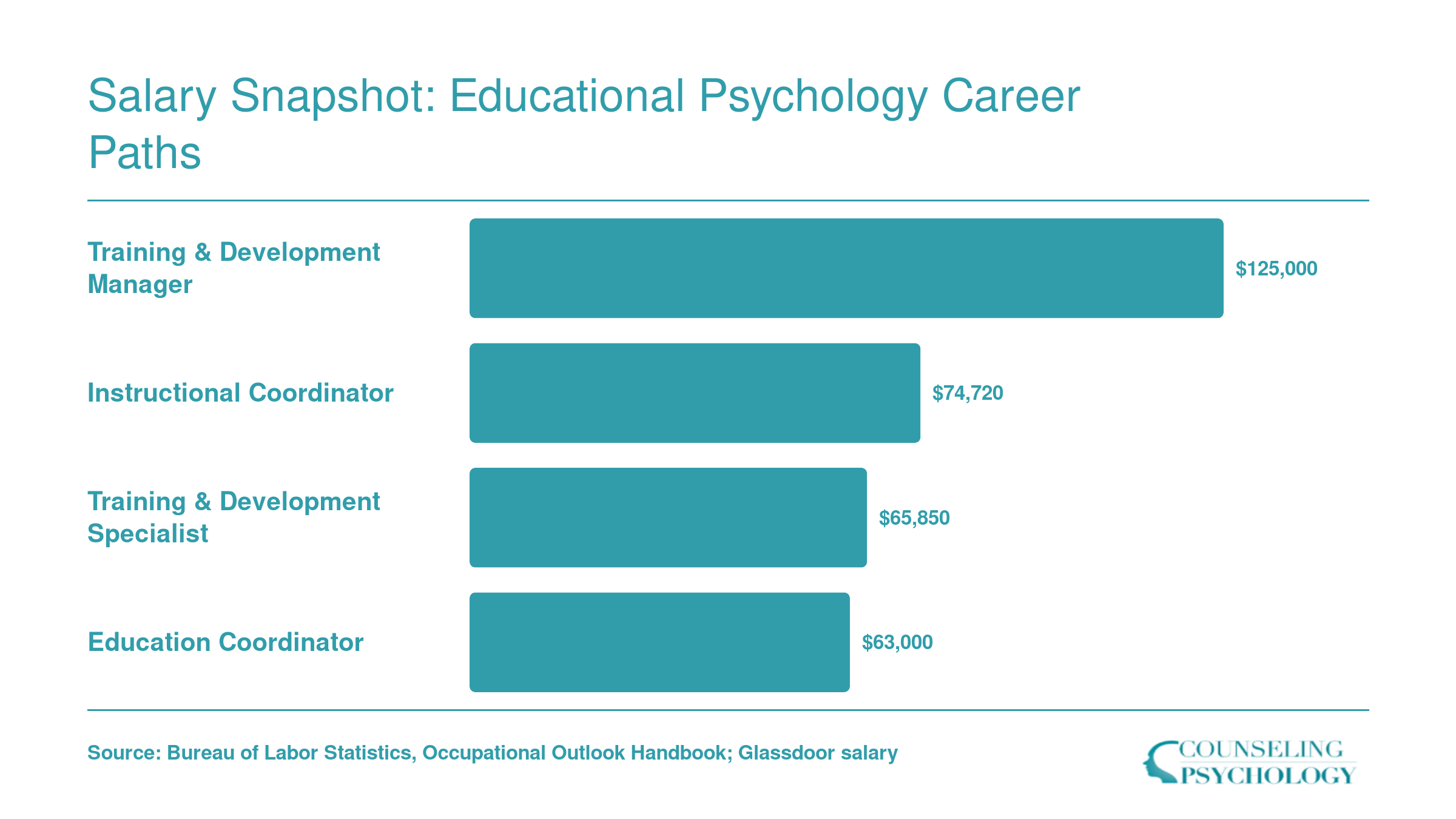
- Instructional Coordinators: $74,720 per year. These professionals design curricula, evaluate teaching methods, and train educators in K-12 districts, state agencies, and higher education institutions.1
- Training and Development Specialists: $65,850 per year. Roles in this category span corporate learning, government workforce programs, healthcare systems, and nonprofit organizations.2
These figures represent national medians; actual pay varies by state, employer type, and years of experience. Graduates who move into related research, assessment, or program evaluation roles may see different compensation ranges that the BLS tracks under other occupation codes.
Growth Projections
The outlook for these two paths diverges. Training and development specialists are projected to see 11% job growth from 2024 to 2034, well above the average for all occupations.2 Demand is fueled by ongoing employer investment in upskilling, compliance training, and digital learning platforms. Instructional coordinators, by contrast, face a projected growth rate of just 1% over the same period, reflecting tighter public-education budgets and slower turnover in existing positions.1
For students weighing return on investment, this distinction matters. A degree that positions you for corporate L&D or organizational development roles may deliver stronger long-term demand than one aimed exclusively at K-12 curriculum work.
Salary Variation by Setting
Setting is one of the biggest salary levers for educational psychology graduates. Corporate learning and development roles, particularly in technology, finance, and healthcare sectors, often pay meaningfully more than comparable positions in public school districts or community colleges. Leadership titles such as Director of Learning or VP of Talent Development can push total compensation well above the medians listed above, though those roles typically require additional experience beyond the master's degree.
Framing ROI Against Program Cost
When evaluating any program on the ranked list in this guide, weigh tuition and expected debt at graduation against realistic early-career earnings. Several of the programs featured report median graduate debt under $25,000, while four-year post-graduation earnings data, where available, suggest that most graduates recoup their investment relatively quickly, especially in private-sector roles. Programs that do not yet report detailed earnings outcomes note that explicitly in their profiles. The cost-to-earnings picture is strongest for graduates who target higher-paying corporate or government settings rather than entry-level K-12 positions.
Bottom line: an educational psychology masters opens multiple doors, but salary and job security vary widely by the path you walk through. Researching specific roles, not just the degree title, gives you the clearest picture of what your investment will return.
Salary Snapshot: Educational Psychology Career Paths
Salaries for educational psychology graduates vary widely depending on your career path. The figures below represent national median or mean annual wages drawn from BLS and Glassdoor data. Roles in management, such as learning and development leadership, command significantly higher compensation than coordinator or specialist positions.
What You'll Learn in an Educational Psychology Master's Program
The curriculum in an educational psychology master's program is designed to build a concrete, research-grounded understanding of how people learn, develop, and respond to instruction across the lifespan.
Core Coursework: The Foundation
Regardless of the school or specialization, most programs share a recognizable core. Expect coursework in:
- Learning theory and cognition: How memory, motivation, and metacognition shape academic performance
- Human development: Cognitive, social, and emotional development from early childhood through adulthood
- Research methods and statistics: Quantitative and qualitative approaches, data interpretation, and applied measurement
- Educational assessment: Designing and evaluating assessments, understanding psychometrics, and applying data to instructional decisions
- Foundations of educational psychology: The historical, philosophical, and scientific basis of the field
Programs typically run between 30 and 48 credits, depending on credit system and specialization depth.1 Ball State's online MA, for example, requires 30 semester credits2, while Capella's MS uses 48 quarter credits.3 That difference matters when you are comparing true time-to-completion.
Specialization Tracks: Where Curriculum Diverges
This is where programs differentiate themselves, and where your career goals should drive your choice. Common concentration areas include:
- Applied behavior analysis (ABA): Offered at programs like Ball State's MA, this track focuses on behavioral principles, reinforcement strategies, and intervention design2
- Instructional design and educational technology: Curriculum development, learning management systems, and technology-mediated instruction
- Gifted and talented education: Identification, programming, and advocacy for advanced learners
- Learning and assessment: The University of Alabama's MA frames this as its core identity, emphasizing measurement and data-driven practice4
- Applied educational psychology: The University of Tennessee's concentration targets direct application in school and community settings5
A word of caution on ABA coursework: some programs include ABA-focused courses as part of a broader curriculum, but completing an ABA concentration within an educational psychology program does not automatically qualify you to sit for the BCBA exam. That credential has its own verified course sequence and supervision requirements, and most ed psych programs are not BCBA-approved. More on this distinction appears in the FAQ section below.
Capstone, Thesis, or Practicum: Understanding the Difference
Most programs require at least one culminating experience, and the format shapes both workload and career readiness.
A capstone project is typically a structured, applied assignment, often a program evaluation, curriculum analysis, or research synthesis. It demonstrates competency without requiring original data collection. This format is common in practitioner-focused tracks and suits students heading into instructional design, corporate training, or educational consulting.
A thesis involves original research under faculty supervision, with a formal defense. It signals readiness for doctoral study and research-oriented roles. Students who anticipate pursuing a PhD or working in policy research should look specifically for thesis options.
A practicum or field experience places students in applied settings (schools, community organizations, or clinics) to develop supervised clinical or instructional skills. Not all online programs include this, and when they do, students typically arrange local placement themselves.
When evaluating programs, look at whether the culminating experience aligns with what you actually want to do after graduation. A practicum builds hands-on skills; a thesis builds research credentials; a capstone builds professional deliverables. None is universally superior, but one may be clearly right for your goals.
Not all educational psychology master's programs lead to licensure. If you plan to become a Licensed Educational Psychologist (a credential available in states like California and Texas), confirm the program meets your state's specific coursework, fieldwork, and exam requirements before enrolling. Programs designed purely for research or instructional design roles may not satisfy licensing boards.
How to Choose the Right Online Educational Psychology Program
California's Licensed Educational Psychologist (LEP) credential requires 60 semester units of graduate coursework, making program length a critical filter for prospective applicants in that state.1 Whether you plan to pursue licensure, a BCBA certification, or a research-focused role, your program choice must align with clear professional requirements.
Verify Accreditation and State Licensure Pathways
Regional accreditation is non-negotiable for degree credibility and financial aid eligibility. For school psychology pathways, programmatic accreditation from the National Association of School Psychologists (NASP) is often required for state credentialing.2 California's Board of Behavioral Sciences accepts online or on-campus master's degrees from any USDE-recognized accredited institution for LEP eligibility, but other states follow different rules.1 Only California issues the LEP title; every other state licenses practitioners as school psychologists or psychologists, and requirements vary widely.2 When evaluating online counseling or psychology programs, accreditation status should be the first item you confirm.
- Ask admissions: "Is this program regionally accredited, and does it meet the educational requirements for the specific license I plan to pursue in my state?"
Compare Total Cost, Not Just Per-Credit Rates
Per-credit tuition masks the full financial commitment. Program length, required credit hours, and hidden fees like technology or practicum charges can push the final sum well beyond an initial glance. Review the total tuition figures listed in each school's profile within our ranking, and factor in any in-state or out-of-state differentials for online students.
- Ask admissions: "What is the total estimated cost for the entire program, including all required fees, and are there financial aid opportunities specifically for this master's track?"
Pick a Format That Works for Your Life
Asynchronous programs offer flexibility for working professionals but demand self-discipline. Synchronous classes create real-time interaction and networking but require logging in at fixed times. Some programs mix both, blending recorded lectures with live discussion sections.
- Ask admissions: "What is the weekly time commitment, and are live classes required or can coursework be completed entirely on my own schedule?"
Align Your Specialization With Your Career Goal
Educational psychology programs often offer tracks in areas like applied behavior analysis, school psychology, or learning sciences. If you intend to become a Board Certified Behavior Analyst, verify the coursework meets BACB standards. For California LEP aspirants, ensure the program's units and content align with the 60-semester-unit mandate and the prerequisite PPS credential in school psychology.3
- Ask admissions: "Does this program offer a specialization or elective focus that aligns with my intended career path, and will it cover the coursework required for any credential I plan to seek?"
Map Out Your Licensure Plan Before You Enroll
Always contact your state licensing board directly to confirm that an online master's meets current educational and internship requirements. The Interstate Compact for School Psychologists, enacted in 2025, now streamlines multi-state licensing among seven participating states, but it does not eliminate state-specific requirements.4 Do not assume a program marketed as "licensure-track" will automatically qualify you everywhere.
- Ask admissions: "Can you provide a list of states where graduates have successfully obtained licensure, and do you have a dedicated advisor to help navigate state-specific requirements?"
Admissions Requirements and How to Apply
Graduate admissions in educational psychology have grown notably more flexible over the past few years, with many online programs dropping standardized test requirements and expanding start date options to attract working professionals and career changers.
Academic Background and GPA Expectations
Most programs require a bachelor's degree from a regionally accredited institution. While some prefer applicants with an undergraduate background in psychology, education, or a related social science, many accept candidates from any field. If you are exploring related graduate options, you may also want to consider a master's degree in psychology as a broader alternative. GPA requirements typically fall between 2.75 and 3.0 on a 4.0 scale, though programs may consider applicants slightly below the threshold if other materials are strong. A few competitive programs set the bar at 3.0 or higher, so check individual requirements before applying.
GRE Requirements: The Shifting Landscape
The majority of online educational psychology master's programs no longer require the GRE. This trend accelerated during the pandemic and has largely held, making graduate study more accessible to those who struggle with standardized testing or have been out of school for years. That said, some programs still request GRE scores, and a few waive the requirement only for applicants meeting a certain GPA threshold. Confirm each program's current policy, as requirements can change from year to year.
Prerequisite Coursework for Career Changers
Some programs expect incoming students to have completed foundational coursework in areas such as introductory psychology, statistics, or research methods. If your undergraduate transcript lacks these courses, you have several options:
- Complete prerequisites through community college or open enrollment university courses.
- Enroll in a program that allows conditional admission with prerequisite completion during your first semester.
- Take online bridge courses offered by the graduate institution itself.
Reach out to admissions advisors early to clarify what is required and how to satisfy any gaps efficiently.
Application Materials
Expect to submit the following with your application:
- Official transcripts: From all post-secondary institutions attended.
- Statement of purpose: Explaining your goals, relevant experience, and why you are drawn to educational psychology.
- Letters of recommendation: Typically two or three, from professors, supervisors, or professionals familiar with your academic or work abilities.
- Resume or CV: Highlighting education, work history, and any relevant research or teaching experience.
Some programs also request a writing sample or professional portfolio, particularly those with research-intensive tracks.
Application Timelines and Start Dates
Online programs frequently offer rolling admissions, meaning you can apply and be reviewed throughout the year rather than waiting for a single deadline. Many provide multiple start dates per year (sometimes every eight weeks), which allows you to begin when it fits your schedule. Programs with cohort models or fixed semesters may have firmer deadlines, often in spring or early summer for fall enrollment. Check each program's academic calendar and plan to submit materials at least four to six weeks before your intended start date to allow time for transcript processing and recommendation collection.
Frequently Asked Questions About Educational Psychology Master's Programs
These are some of the most common questions prospective students ask about online master's programs in educational psychology, especially around certification pathways, licensure, and career flexibility. Answers reflect current requirements as of 2026.