
What you’ll learn in this article…
- Arizona State University, Northern Arizona University, and Grand Canyon University rank among the top psychology programs in the state for 2026.
- Online psychology degrees in Arizona often cost less per credit than on-campus options and offer greater scheduling flexibility.
- Arizona grants three primary psychology licenses, each requiring a different degree level, exam, and supervised experience track.
- Clinical psychologists nationally earn a median salary roughly double that of bachelor's-level behavioral health technicians.
Arizona's need for mental health professionals has never been more urgent: the state's behavioral health workforce shortage leaves entire counties without adequate access to care, even as enrollment in psychology programs expands. A growing number of affordable online and hybrid programs are now available, widening access for working adults and rural students.
The seven ranked programs on this list span from Flagstaff to Tucson and from online-only to hybrid formats, with annual net prices ranging from about $14,000 at public universities to over $33,000 at private colleges.
Employers increasingly require licensure-eligible degrees for clinical roles, making program accreditation a non-negotiable checkbox.
2026 Best Psychology Programs in Arizona: Top Ranked Schools
Arizona's psychology landscape in 2026 stretches from doctoral clinical training to fully online bachelor's and master's programs, with options at every price point. The schools below are ranked by a blend of affordability and online accessibility, so cost-conscious and schedule-flexible students will find the most relevant programs near the top. Graduation rates listed are institution-wide figures, not specific to any single psychology program.
- Net price and affordability
- Online and hybrid availability
- Institutional graduation and retention
- Graduate debt and earnings outcomes
- Program breadth and specialization depth
- College Scorecard graduate earnings — collegescorecard.ed.gov
- Internal program database
- Independent program research
- NCES-IPEDS federal institutional data — nces.ed.gov

Northern Arizona University
Northern Arizona University is a public, Hispanic-Serving Institution in Flagstaff with a doctoral psychology program built around serving Arizona's rural, Indigenous, and Latinx communities. Its PsyD in Clinical Psychology operates through a Phoenix-area clinical training hub and requires 2,000 hours of hands-on practice, while graduate certificates in addictions research and autism spectrum disorders broaden options for clinicians already in the field. With a net price of $14,158 and median graduate debt of $19,000, NAU is one of the most affordable public paths to a psychology credential in the state.
- Hybrid format with Phoenix-area clinical training site
- 107 total units required for completion
- 2,000 hours of supervised clinical practice
- Individualized research component built into curriculum
- Designed for culturally competent care across diverse populations
- Leads to eligibility for professional licensure
- 15-unit hybrid graduate certificate
- Year-long interprofessional research experience included
- Focuses on substance use in culturally centered contexts
- Combines synchronous and asynchronous online learning
- Open to practicing clinicians and doctoral students
- Requires minimum 3.0 GPA for admission
- Fully online, 30-unit graduate certificate
- Focused on autism spectrum assessment and intervention
- No teacher certification required for enrollment
- Requires 3.0 GPA for admission
- Designed for educators and behavioral health professionals
- Flexible pacing for working professionals
Doctor of Psychology in Clinical Psychology — Hybrid
Culturally-Centered Addictions Research Training Graduate Certificate — Hybrid
Autism Spectrum Disorders Certificate — Online

University of Arizona
The University of Arizona, a public research university and Hispanic-Serving Institution in Tucson, delivers a fully online B.A. in Psychology that has earned a top-six national ranking for online bachelor's programs in psychology. Beyond the undergraduate degree, UA offers an online Master of Arts in Applied Behavior Analysis and a companion graduate certificate, both designed to prepare students for the BCBA exam. The institution-wide graduation rate sits at 67.5%, and the net price of $16,674 keeps it competitive among Arizona's public universities.
- Fully online, 120-credit bachelor's degree
- $525 per credit for online learners
- No on-campus attendance required
- Ranked among the top online psychology bachelor's nationally
- Emphasizes critical thinking and research skills
- Requires completion of a minor alongside the major
- Fully online, 36-credit master's program
- $650 per credit, completable in about 24 months
- Prepares graduates for the BCBA certification exam
- No GRE required for admission
- Includes a master's project component
- Minimum 3.0 GPA required
- 21-credit, fully online certificate
- Seven-course sequence aligned with BCBA requirements
- Intended for students who already hold a master's degree
- $650 per credit with financial aid available
- Focuses on ethical standards and practical skill building
- Serves as a standalone or add-on credential
B.A. in Psychology — Online
M.A. in Special Education: Applied Behavior Analysis — Online
Graduate Certificate in Applied Behavior Analysis — Online

Arizona State University
Arizona State University's Scottsdale-based online campus offers master's-level psychology programs with accelerated 7.5-week course terms and a single tuition rate regardless of residency, effectively removing the nonresident surcharge for out-of-state online students. The fully online M.S. in Psychology covers non-clinical career tracks such as human resources, marketing, and nonprofit management, while the M.S. in Forensic Psychology prepares students for doctoral study or applied roles in the justice system. ASU also offers a 15-credit positive psychology graduate certificate for those seeking a shorter credential. This campus is designated as a Hispanic-Serving Institution.
- Fully online, 36-credit graduate program
- 12 classes in 7.5-week accelerated terms
- Non-clinical focus suitable for HR, nonprofit, and business roles
- Flexible elective selection aligned to career goals
- Requires bachelor's degree and minimum 3.0 GPA
- Does not lead to clinical licensure
- Fully online, 33-credit graduate degree
- 11 classes covering criminal behavior and psychological assessment
- Can serve as preparation for doctoral programs
- No GRE required, holistic admissions review
- Requires bachelor's in a related field
- Accelerated 7.5-week course format
- 15-credit, fully online certificate
- Five courses in 7.5-week sessions
- Minimum 2.75 GPA for admission
- Personal statement and one recommendation letter required
- Suitable as a standalone or supplement to a master's degree
- Next cohort start date: August 2026
Master of Science in Psychology — Online
Master of Science in Forensic Psychology — Online
Positive Psychology Graduate Certificate — Online

University of Phoenix-Arizona
University of Phoenix, a private, for-profit institution headquartered in Phoenix, centers its psychology and counseling programs on flexibility for working adults. Its online M.S. in Counseling/Clinical Mental Health Counseling is a 60-credit program that includes internship hours and targets licensure readiness, while the M.S. in Marriage, Family and Child Therapy aligns with LMFT and LPCC requirements. A locked-in "Tuition Guarantee" protects students from rate increases during enrollment. The net price of $13,520 is among the lowest in this ranking, though the institution-wide graduation rate of 20.8% warrants close attention.
- Fully online, 60-credit master's program
- Includes internship and practicum experiences
- Designed to meet licensure requirements in many states
- Covers clinical assessment, ethics, and cultural diversity
- Tuition Guarantee locks in rate from enrollment to graduation
- Built for working adults with flexible scheduling
- Fully online, 60-credit master's degree
- Aligns with LMFT and LPCC credential requirements
- Covers human development, ethics, and multicultural counseling
- Includes practicum and clinical fieldwork hours
- Flexible pacing for mid-career professionals
- Emphasizes work in diverse clinical environments
- Fully online, 36-credit master's degree
- 12 core courses aligned with APA and SIOP standards
- $698 per credit with no application fee
- Courses run in 5- to 6-week sessions, one at a time
- Transfer credits and prior learning assessment accepted
- Scholarships and employer tuition benefits available
- Fully online, 120-credit bachelor's degree
- $398 per credit, no SAT or ACT required
- 14 core courses covering organizational behavior and HR
- Prior experience credit and transfer credits accepted
- Prepares graduates for training specialist and HR roles
- Aligned with APA undergraduate standards
M.S. in Counseling/Clinical Mental Health Counseling — On-Campus
M.S. in Counseling/Marriage, Family and Child Therapy — On-Campus
M.S. in Industrial-Organizational Psychology — On-Campus
B.S. in Industrial-Organizational Psychology — On-Campus

Prescott College
Prescott College is a small, private institution in Prescott known for integrating social justice and environmental consciousness into its psychology and counseling curricula. Its hybrid B.A. in Psychology blends online and on-campus components and offers accelerated pathways into master's programs. The CACREP-accredited M.S. in Counseling is available fully online with limited residency and includes concentrations in human sexuality counseling, marriage and family counseling, and social justice in counseling. An 8:1 student-to-faculty ratio gives students unusually direct access to clinically active faculty.
- Hybrid format combining online and on-campus learning
- Accelerated pathways available into Prescott's master's programs
- Emphasizes critical thinking and ethical applications
- Social justice orientation woven throughout curriculum
- Financial aid available to eligible students
- Holistic approach integrating emotional, cognitive, and social perspectives
- Fully online with limited residency requirement
- CACREP-accredited program
- No GRE, GMAT, or application fee required
- Small class sizes with clinically active faculty
- Multiple start dates throughout the year
- Concentration focuses on human sexuality counseling
- CACREP-accredited, fully online with limited residency
- No standardized test scores required for admission
- Social justice lens applied to family systems work
- Small cohort model for personalized mentorship
- Flexible online learning with multiple entry points
- Prepares graduates for state licensure
- CACREP-accredited, delivered online with limited residency
- No GRE, GMAT, or application fee
- Designed for students committed to equity-focused practice
- Clinically active faculty with social justice expertise
- Small class sizes support individualized attention
- Flexible scheduling with multiple start dates
B.A. in Psychology — On-Campus
M.S. in Counseling (Human Sexuality Counseling) — On-Campus
M.S. in Counseling (Marriage, Couple, and Family Counseling) — On-Campus
M.S. in Counseling (Social Justice in Counseling) — On-Campus

Ottawa University-Surprise
Ottawa University's Surprise, Arizona campus offers a hybrid Master of Arts in Counseling that combines online coursework with on-campus sessions and 900 hours of client contact through local field placements. The program is structured to meet licensure requirements in Arizona, Kansas, and Wisconsin, giving graduates geographic flexibility. With 39 core credit hours and 15 elective hours, the curriculum covers counseling theories, professional ethics, and social and cultural concerns. The net price of $33,393 is higher than several competitors, and the institution-wide graduation rate of 18.2% is a factor prospective students should weigh carefully.
- Hybrid format blending online coursework with on-campus sessions
- 900 client contact hours through Arizona field placements
- 54 total credit hours (39 core plus 15 electives)
- Structured for licensure in Arizona, Kansas, and Wisconsin
- Covers counseling theories, ethics, and cultural competency
- Bachelor's degree required for admission
- Designed for working professionals seeking career changes
- Hands-on community behavioral health experience included
Master of Arts in Counseling — Hybrid

Grand Canyon University
Grand Canyon University is a large, private institution in Phoenix offering multiple online and hybrid clinical mental health counseling tracks, including concentrations in trauma and childhood and adolescence disorders. Its MS programs range from 62 to 74 credit hours and include practicum and internship requirements aligned with national counselor credentialing standards. GCU also offers online master's degrees in forensic psychology and industrial-organizational psychology at $600 per credit. The institution-wide graduation rate is 43.5%, and the net price of $22,472 positions GCU as a mid-range private option.
- Fully online, 74-credit master's program
- Supervised clinical fieldwork including practicum and two internships
- Trauma-focused curriculum with evidence-based interventions
- Meets national counseling credentialing requirements
- $600 per credit tuition rate
- Minimum 2.8 GPA required for admission
- Fully online with practicum and internship components
- Focus on developmental theories and family dynamics
- Includes trauma counseling and ethical care coursework
- Prepares graduates for Arizona and national licensure
- Covers childhood psychopathology and intervention strategies
- Admission requires undergraduate degree and 2.8 GPA
- Hybrid format, 62 credit hours
- Practicum plus two internship placements required
- Meets NCC credential requirements
- Emphasis on multicultural counseling and legal standards
- Structured to prepare for Arizona licensure
- Flexible scheduling for working professionals
- Fully online, 36-credit master's degree
- $600 per credit, no campus visits required
- Covers criminal behavior theories and offender rehabilitation
- Includes research methods and professional capstone
- GRE and GMAT optional for admission
- Transfer up to 12 credits from prior graduate work
- Fully online, 36-credit master's program
- Covers organizational behavior and human resource management
- Aligned with APA guidelines for I/O psychology
- 8-week online course format
- Capstone project required for completion
- Evening class options available
MS in Clinical Mental Health Counseling (Trauma) — Online
MS in Clinical Mental Health Counseling (Childhood and Adolescence Disorders) — Online
MS in Clinical Mental Health Counseling — Online
MS in Psychology (Forensic Psychology) — Online
MS in Psychology (Industrial and Organizational Psychology) — On-Campus
Online vs. On-Campus Psychology Programs in Arizona
Arizona's major universities and several private institutions offer psychology programs in formats ranging from fully online to hybrid to traditional campus delivery. The format you choose affects not just scheduling flexibility but also your tuition bill, practicum logistics, and the depth of peer connections you build. Below is a side-by-side look at the key differences across the formats available from ranked Arizona programs in 2026.
| Factor | Fully Online | Hybrid | On-Campus |
|---|---|---|---|
| Programs using this format | ASU Online MS in Psychology, University of Arizona BA in Psychology, University of Phoenix MS in Clinical Mental Health Counseling, Grand Canyon University MS in Clinical Mental Health Counseling | Northern Arizona University PsyD in Clinical Psychology, Prescott College BA in Psychology, Ottawa University MA in Counseling | Traditional campus sections at NAU (Flagstaff), U of A (Tucson), and ASU (Tempe) for programs that require in-person lab or clinic work |
| Tuition structure for out-of-state students | ASU Online charges a flat per-credit rate of roughly $605 regardless of residency. NAU Online similarly uses a flat online rate of about $504 per credit. University of Arizona Online lists $525 per credit for its BA, also without a residency surcharge. These flat rates can save out-of-state learners thousands compared to campus tuition. | Hybrid programs vary. NAU's PsyD lists differentiated graduate tuition (approximately $13,000 in-state vs. $19,300 out-of-state for the 2025-2026 year). Ottawa University and Prescott College each set a single tuition rate for all students. | Campus students at Arizona's public universities pay standard in-state or out-of-state rates set by the Arizona Board of Regents, which can differ by more than $16,000 per year at U of A. |
| Flexibility for working adults | Asynchronous coursework is the norm. ASU Online uses accelerated 7.5-week sessions, and both ASU and NAU explicitly offer part-time pacing so you can continue working full time. | Typically combines asynchronous online modules with periodic on-site intensives or weekend residencies. Ottawa University's MA in Counseling, for example, blends online coursework with hands-on field placements arranged locally. | Fixed class schedules during weekday hours. Some evening sections exist, but full-time employment alongside full-time campus enrollment is difficult. |
| Practicum and fieldwork logistics | Students arrange supervised hours at approved sites near their home. This offers geographic flexibility but requires self-advocacy in securing placements. Programs like GCU's MS in Clinical Mental Health Counseling include a practicum plus two internships coordinated with the university. | Hybrid programs often maintain clinical training partnerships in specific metro areas. NAU's PsyD requires 2,000 hours of clinical practice, with many placements concentrated in the Phoenix North Valley area. | On-campus programs typically place students at university-affiliated clinics and local partner agencies, streamlining the matching process but limiting you to that region. |
| Peer networking and faculty access | Discussion boards, virtual study groups, and scheduled video office hours. Student-to-faculty ratios at large online providers can be high (University of Phoenix reports a 147:1 ratio institution-wide). ASU Online and NAU Online maintain smaller cohort structures within individual programs. | Blends online interaction with face-to-face cohort weekends, creating stronger peer bonds than fully online formats. Prescott College's intimate 8:1 student-to-faculty ratio carries over into its hybrid offerings. | The richest in-person interaction: daily access to labs, faculty offices, and study groups. Campus cohorts tend to build the strongest professional networks during the program itself. |
| Best suited for | Professionals who need maximum schedule control, out-of-state learners seeking flat-rate tuition, or students in programs that do not require clinical hours | Students who want some in-person clinical mentorship while retaining weekday flexibility, especially those pursuing licensure-track counseling or clinical psychology degrees | Traditional-age students, those who thrive with in-person structure, or anyone entering a research-intensive doctoral program that depends on campus lab access |
Questions to Ask Yourself
Arizona Psychology Program Costs and Affordability
Cost is one of the biggest factors in choosing a psychology program, and Arizona offers a wide range from budget-friendly public universities to smaller private colleges. The table below sorts programs by published in-state tuition (lowest first) and includes institution-wide net price estimates and median graduate debt from federal data. Keep in mind that net price figures are institution-level averages, not guaranteed per-student amounts; your actual cost will depend on your financial aid package, residency status, and enrollment intensity. Program-level earnings and debt data are not yet available for these specific psychology programs, so the median debt and earnings columns reflect institution-wide figures. On the financial aid front, Arizona's public universities offer meaningful support for graduate psychology students. ASU provides doctoral assistantships worth roughly $26,544 per year plus full tuition coverage for students holding 20-hour-per-week appointments, and the department awards two $1,500 scholarships annually. The University of Arizona funds graduate students through teaching and research assistantships, fellowships, and external grants. NAU makes graduate assistantships and tuition waiver scholarships available in its educational psychology department, and out-of-state students may qualify for the Western Regional Graduate Program (WRGP), which can reduce tuition to the in-state rate. Beyond individual schools, the American Psychological Foundation offers nine scholarships of $5,000 each (applications due June 2026), and the APA provides research grants ranging from $1,000 to $5,000 through its Science Directorate. The Arizona Psychological Association also funds student research grants and travel awards. These opportunities can meaningfully reduce the debt load shown below.
| School | In-State Tuition | Out-of-State Tuition | Net Price (Approx.) | Median Graduate Debt | Median Earnings (10 yr) |
|---|---|---|---|---|---|
| Grand Canyon University | $10,015 | $10,015 | $22,472 | $22,114 | $42,186 |
| Ottawa University, Surprise | $12,562 | $12,562 | $33,393 | $21,500 | $55,552 |
| Northern Arizona University | $13,023 | $19,306 | $14,158 | $19,000 | $54,384 |
| University of Arizona | $13,573 | $39,903 | $16,674 | $19,620 | $59,979 |
| University of Phoenix, Arizona | $15,208 | $15,208 | $13,520 | $31,553 | $37,752 |
| Prescott College | $34,490 | $34,490 | $22,583 | $16,300 | $42,359 |
Psychology Specializations Available in Arizona
Choosing a psychology program often comes down to a single practical question: does this specialization lead to the license and career you actually want? Arizona programs span a wide range of concentrations, and matching your focus area to your career goals early saves you from expensive course corrections later.
Clinical and Counseling Tracks
The most widely available specializations across Arizona's ranked programs are clinical psychology and counseling/clinical mental health counseling. Northern Arizona University offers a doctoral program in clinical psychology, a hybrid format that combines online coursework with in-person clinical training at a Phoenix location. This is a licensure-eligible path for students aiming to become licensed psychologists in Arizona, a credential that requires a doctorate.
On the master's side, University of Phoenix-Arizona offers an online MS in Counseling/Clinical Mental Health Counseling, structured for working adults who need flexibility. Ottawa University-Surprise provides a hybrid MA in Counseling that logs 900 client contact hours and prepares graduates for licensure in Arizona, Kansas, and Wisconsin. Grand Canyon University rounds out the counseling tier with a fully online MS in Clinical Mental Health Counseling, distinguished by a trauma concentration that relatively few programs in the state offer at this level.
Counseling master's graduates typically pursue licensure as Licensed Professional Counselors (LPC) or Licensed Associate Counselors (LAC) in Arizona. The doctoral path from NAU points toward licensure as a psychologist. For a broader look at how these degrees compare nationally, see our guide to online master's in psychology programs.
General Psychology and Research-Oriented Programs
Not every program is built around licensure. Arizona State University's fully online Master of Science in Psychology is designed for students interested in research, organizational roles, or doctoral preparation rather than clinical practice. The program explicitly does not lead to clinical licensure, which is worth understanding before you apply. Similarly, the University of Arizona's online Bachelor of Arts in Psychology and Prescott College's hybrid Psychology BA are foundational degrees that open doors to graduate study, human services work, or adjacent fields like education and public health.
Standout and Differentiated Concentrations
The trauma concentration at Grand Canyon University is a notable differentiator. Trauma-informed practice is increasingly in demand across behavioral health, veteran services, and school settings, and few Arizona programs bake it into the curriculum at the master's level.
Prescott College takes a different approach, weaving social justice, holistic psychology, and diverse cultural perspectives into its general psychology curriculum, which appeals to students drawn to community-based or advocacy-oriented careers.
Forensic psychology, applied behavior analysis, industrial-organizational psychology, and school psychology are specializations some students search for specifically. Among the programs in this ranking, none list those concentrations directly. Students with a strong interest in applied behavior analysis may want to explore ABA doctoral programs online, while those drawn to other niche fields should look at doctoral programs at the University of Arizona and Arizona State University's on-campus graduate offerings, which have historically housed I-O and school psychology tracks (though program availability changes year to year).
Online vs. Campus Availability by Specialization
- General psychology (bachelor's): Online available at University of Arizona; hybrid at Prescott College.
- General psychology (master's): Fully online at Arizona State University.
- Counseling/clinical mental health counseling (master's): Fully online at University of Phoenix-Arizona and Grand Canyon University; hybrid at Ottawa University-Surprise.
- Clinical psychology (doctorate): Hybrid only at Northern Arizona University, with required in-person clinical components.
Working students with scheduling constraints will find the most flexibility at the master's counseling level, where two fully online options exist. Doctoral clinical training requires hands-on hours that cannot be completed entirely at a distance, regardless of how coursework is delivered.
Licensure Pathways for Arizona Psychology Graduates
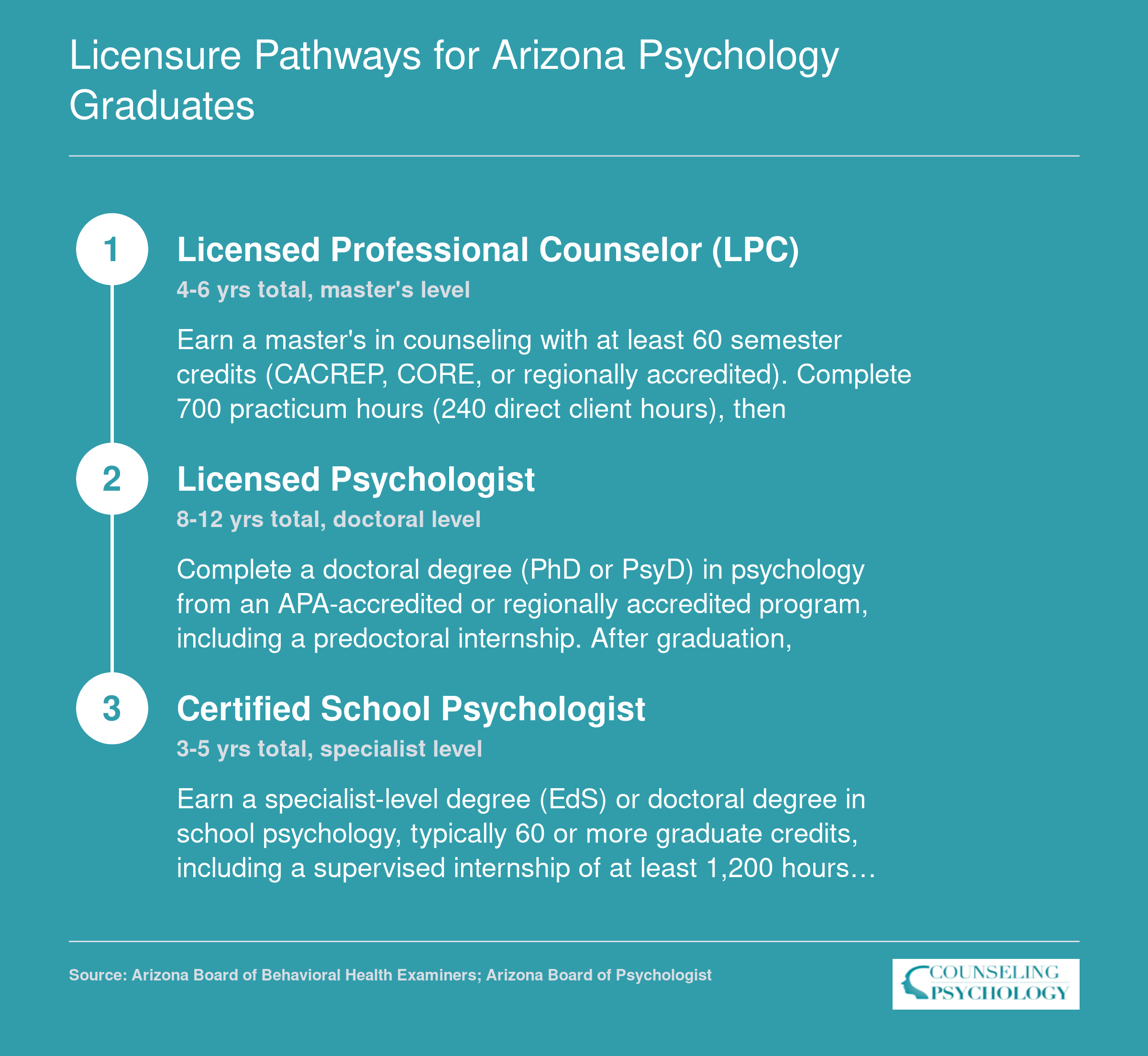
Arizona offers three primary licensure tracks for psychology graduates, each governed by a different board and carrying distinct education, exam, and supervised-experience requirements. Understanding the credentialing ladder before you enroll helps you pick the right degree and program format from the start.
Which Programs Lead to Which License?
Your program type determines your licensure destination. Choose the wrong track and you may spend years completing a degree that does not qualify you for the credential you actually want. Here is how Arizona's major program types map to specific licenses.
Counseling Master's Degrees and the LPC
A master's degree in counseling, clinical mental health counseling, or counseling psychology is the standard path to becoming a Licensed Professional Counselor (LPC) in Arizona. The Arizona Board of Behavioral Health Examiners requires at least 60 semester credits, coursework spanning eight core content areas (a minimum of 24 semester hours), and 700 practicum hours that include at least 240 hours of direct client contact.1 That clinical work must take place in real, in-person settings regardless of how the rest of your coursework is delivered.1
Programs like the Master of Arts in Counseling at Ottawa University and counseling-focused master's programs at Arizona State University are designed as terminal licensure-track degrees, meaning they lead directly to clinical practice rather than serving as stepping stones to a doctorate.2 University of Phoenix's online MS in Counseling/Clinical Mental Health Counseling follows the same 60-credit structure. These degrees are built around licensure, not research careers.
Some master's programs, by contrast, are explicitly doctoral-prep tracks. ASU's online Master of Science in Psychology, for example, notes that it does not lead to clinical licensure. If your goal is the LPC, confirm before enrolling that a program is structured for licensure, not just psychology knowledge broadly.
PsyD and PhD Programs and the Licensed Psychologist Credential
Becoming a licensed psychologist in Arizona requires a doctoral degree, either a PsyD or a PhD, from a program accredited by the American Psychological Association (APA).3 Northern Arizona University's Doctor of Psychology in Clinical Psychology is the most prominent PsyD option in the state, offered in a hybrid format from its Phoenix-area campus. You can explore the broader landscape of clinical psychology doctorate programs to compare APA-accredited options nationwide. The program requires 107 units and 2,000 hours of clinical practice. Doctoral candidates also complete a supervised internship and postdoctoral hours before sitting for licensure exams.
The Arizona Board of Psychologist Examiners does not categorically ban distance education, but it requires that clinical training be completed in person.3 A fully online doctoral path to psychologist licensure in Arizona is not currently viable for this reason.
Online Degrees and Arizona Licensure Eligibility
For the LPC specifically, Arizona's licensing board places no prohibition on online degree delivery.1 As long as your program meets accreditation standards (CACREP, CORE, or board-approved equivalents) and you complete the required in-person clinical hours, an online or hybrid counseling master's qualifies you to apply for licensure.2 This is a meaningful distinction from the doctoral track, where in-person program components remain essential.
The practical upshot: if LPC licensure is your goal, a well-accredited online program is a legitimate and recognized path in Arizona. If becoming a licensed psychologist is your target, plan for a hybrid or residential doctoral program with structured, in-person clinical training.
What Arizona Psychology Graduates Actually Earn
How much will you actually earn after completing a psychology program in Arizona? Salary outcomes depend on your degree level, specialization, and whether you pursue licensure, but concrete data can help you plan your return on investment.
Occupational Wage Benchmarks in Arizona
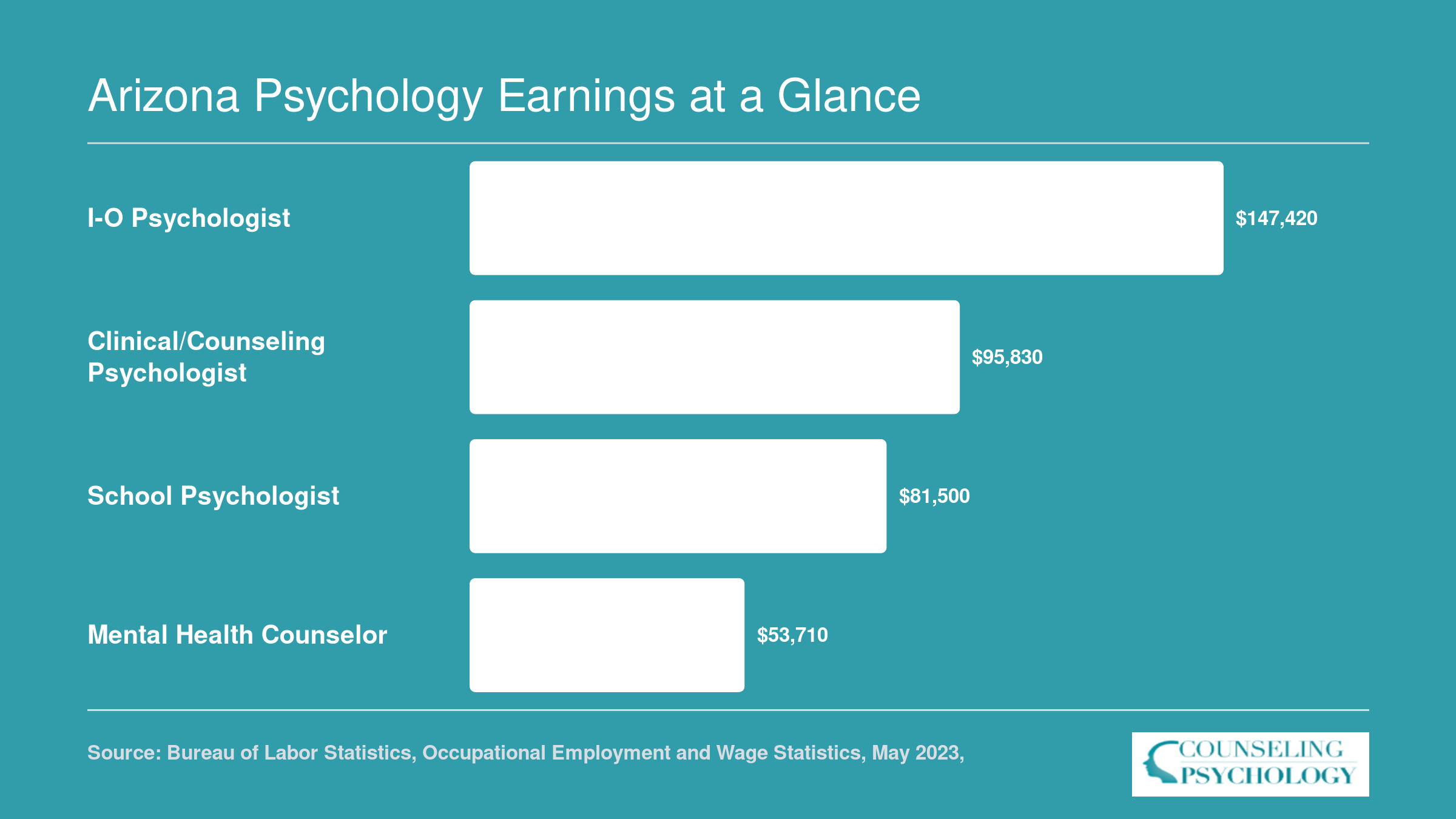
According to Bureau of Labor Statistics data (May 2025), licensed clinical and counseling psychologists in Arizona earn a median annual wage of $103,410 statewide, with Phoenix-Mesa-Chandler metro area psychologists earning slightly more at $104,500.1 Industrial-organizational psychologists command the highest median wages at $124,320 annually in Arizona. School psychologists earn a median of $82,080 statewide ($80,770 in the Phoenix metro).2 Mental health counselors, a common career path for master's-level graduates, earn a median of $54,390 in Arizona and $54,900 in Phoenix.
These figures represent the middle of the pay scale for each occupation; entry-level salaries typically start lower, while experienced practitioners and those in private practice or specialized settings often exceed these medians significantly.
Program-Level Earnings and Return on Investment
Program-level earnings data are not yet available for most Arizona psychology programs in the College Scorecard dataset, which means we cannot currently report exact median incomes one or four years after graduation for specific programs. However, the data do reveal important patterns in earnings-to-debt ratios that help frame value.
Arizona State University's online Master of Science in Psychology leads the state with an earnings-to-debt ratio of approximately 3.2, meaning typical early-career earnings are more than three times median graduate debt. The University of Arizona's bachelor's program in psychology follows closely with a ratio near 3.1. Northern Arizona University's Doctor of Psychology (PsyD) in Clinical Psychology shows a ratio of 2.9, reflecting higher debt loads typical of doctoral training but still indicating solid earnings potential relative to borrowing.
Master's programs in counseling psychology show more variable ratios. Ottawa University-Surprise's hybrid MA in Counseling posts a 2.6 ratio, while Grand Canyon University's online MS in Clinical Mental Health Counseling sits at 1.9. University of Phoenix's counseling master's program reports the lowest ratio at approximately 1.2, suggesting graduates may face longer debt-payoff timelines.
Framing Your ROI Decision
Compare median program debt against both starting salaries in your target occupation and the earnings-to-debt ratio. A program with a ratio above 2.5 generally indicates that early-career earnings will comfortably exceed debt obligations, while ratios below 2.0 warrant careful scrutiny of your post-graduation employment plan and whether additional certifications or licensure will meaningfully boost income. Exploring bachelor's degree in clinical psychology options or counseling master's programs online can help you compare pathways at different degree levels. Remember that licensure as a psychologist or professional counselor typically raises earning potential well beyond entry-level counselor wages, so factor in your full career trajectory when evaluating program cost.
Arizona Psychology Earnings at a Glance
How do national median salaries compare across common psychology career paths? The grouped bar chart below shows 2023 BLS national median annual wages for four psychology occupations. Arizona-specific wage data was not available at time of publication, so these national figures serve as a useful baseline when evaluating earning potential after completing a psychology program in Arizona.
How to Choose the Right Psychology Program in Arizona
Choosing a psychology program in Arizona means aligning your degree path with the specific license you intend to earn, because a counseling master's won't qualify you to become a licensed psychologist, and a general psychology bachelor's alone won't lead to any clinical license. Make the wrong choice early, and you could add years of extra coursework and supervised hours before you're eligible to sit for a licensing exam.
The 5-Factor Decision Framework
Use these criteria to narrow your options quickly.
- Licensure alignment: Start with the Arizona Board of Psychologist Examiners or the Arizona Board of Behavioral Health Examiners website. Confirm that the program's degree type (PhD, PsyD, EdS, MA, MS) and curriculum meet current requirements for the license you want. Even a single missing course can delay your application.
- Accreditation: Look for APA accreditation for doctoral psychology programs, CACREP for counseling degrees, and NASP for school psychology. Arizona licensing boards rely heavily on these accreditors; many applications are denied because a program lacked the right stamp. Verify accreditation status directly on the accreditor's website, not on a school's word alone.
- Format and flexibility: Online and hybrid options are widely available, but not all are licensure-compatible in Arizona. For example, a fully online doctoral program may not offer the required in-person clinical training sites. Check with the program and the board to ensure the format doesn't limit your eligibility.
- Total cost and debt load: Graduate debt can reach six figures. Compare tuition, fees, and the typical time to completion at public universities (like Arizona State University, University of Arizona, Northern Arizona University) against private institutions. Factor in assistantship opportunities and potential loan forgiveness for public service roles.
- Specialization fit: Whether you want to work in neuropsychology, addictions, or marriage and family therapy, the program's clinical placements and faculty expertise must match. A program with a strong research focus may underprepare you for direct practice, and vice versa.
Verify Before You Enroll
Before sending a deposit, contact the relevant Arizona licensing board by phone or email. Ask:
- Does this program's current curriculum meet all educational requirements for licensure?
- Have graduates of this program had any recent issues with licensure applications?
- If the program is new or recently changed, what additional documentation will I need?
Boards update requirements periodically, and program websites can be outdated. A quick check now can save you from discovering a gap after graduation. If you're leaning toward a clinical track, reviewing the best online clinical psychology programs can help you benchmark what strong programs include. Similarly, students interested in specializing early may want to explore child psychology doctoral programs. Planning ahead ensures your degree leads directly to the career you want in Arizona.
Frequently Asked Questions About Arizona Psychology Programs
Choosing a psychology program in Arizona involves weighing cost, format, licensure goals, and career outcomes. Below are answers to the questions prospective students ask most often, drawn from 2026 program data and current Arizona licensing requirements.