
What you’ll learn in this article…
- Arkansas master's psychology programs consistently fall below national average net prices, with all offering online or hybrid formats.
- Licensure splits into two tracks: master's level for LPC status and doctoral level for Licensed Psychologist credentials.
- Applied behavior analysis, clinical mental health counseling, and general psychology are the primary specialty tracks available statewide.
- Rankings prioritized affordability, flexible delivery, and accreditation using federally reported tuition and outcome data.
Arkansas employs roughly 1,500 mental health counselors and a smaller cohort of licensed psychologists, and the state's workforce shortage designations cover most rural counties. That demand, combined with online delivery from regional institutions, has made the master's-level counseling and behavior analysis pipeline the practical entry point for most Arkansans entering the field.
The ranked set here is deliberately narrow: four institutions, five program listings, ranging from a $282-per-credit-hour online bachelor's at Arkansas State to a $750-per-credit-hour ABA master's at Ouachita Baptist. In-state tuition stays competitive, but the gap between sticker price and effective net price is wide enough to change which program actually fits a given budget.
Licensure pathways in Arkansas remain the binding constraint. Coursework alignment with state board requirements matters more than rank order.
2026 Best Psychology Programs in Arkansas: Rankings
Arkansas offers a small but varied set of psychology and behavior analysis programs that span bachelor's through graduate certificate levels, with several fully online options that keep costs well below national averages. The four programs below were evaluated on affordability, institutional outcomes, and program flexibility. Keep in mind that graduation rates listed reflect the institution overall, not the psychology department specifically.
- Net price and tuition affordability
- Institutional graduation and retention rates
- Online delivery and program flexibility
- Program relevance and specialization depth
- Graduate earnings outcomes
- NCES-IPEDS federal institutional data — nces.ed.gov
- College Scorecard graduate earnings — collegescorecard.ed.gov
- Internal program database
- Independent program research

Arkansas State University
Arkansas State University pairs one of the lowest net prices in the state ($12,366) with a fully online B.A. in Psychology that charges the same per-credit rate regardless of where you live. The program accepts up to 90 transfer credits and offers multiple start dates per year, making it an especially practical choice for working adults or community college transfers. With a 17:1 student-to-faculty ratio and a 55.4% institution-wide graduation rate, A-State balances accessibility with solid support.
- Fully online format with $282 per credit hour tuition
- Accepts up to 90 transfer credits from prior institutions
- 120 total credit hours required for degree completion
- Same tuition rate for in-state and out-of-state online students
- Multiple start dates each year for flexible enrollment
- Curriculum emphasizes research design and data analysis
- Elective courses allow students to tailor their focus
- 2.0 GPA required for transferring credits
Bachelor of Arts in Psychology — Online

University of Arkansas at Little Rock
UA Little Rock's B.A. in Psychology is available both online and on campus, giving students the option to blend formats depending on their schedules. The program emphasizes hands-on research and internship opportunities, which can strengthen graduate school applications. At a net price of $17,248 and a 13:1 student-to-faculty ratio, it offers more individualized attention than many larger Arkansas institutions, though its 41.7% institution-wide graduation rate is worth considering alongside its strong median earnings of $45,265 at ten years post-enrollment.
- Offered in both online and in-person formats
- Internship placements provide applied professional experience
- Curriculum builds scientific reasoning and critical thinking skills
- Research opportunities integrated into undergraduate coursework
- 13:1 student-to-faculty ratio for closer mentorship
- Designed to prepare students for graduate-level psychology studies
Bachelor of Arts in Psychology — Online

Ouachita Baptist University
Ouachita Baptist University stands out as the only private institution on this list, and its online M.S. and M.A. in Applied Behavior Analysis were among the first ABA degrees offered in Arkansas. Both programs are designed to prepare graduates for the BCBA certification exam, combining online coursework with a brief on-campus intensive. At $750 per credit hour for a 36-hour program, the total cost is competitive for a private master's degree, and OBU's 61.4% institution-wide graduation rate and 83% retention rate reflect strong student engagement.
- Fully online coursework with integrated fieldwork component
- 36 credit hours total at $750 per credit hour
- Meets BACB certification exam requirements
- First ABA graduate degree program offered in Arkansas
- Curriculum covers behavioral assessment, ethics, and interventions
- 3.0 GPA required for admission
- Practicum training in autism therapy and special education settings
- Online format with a 3-day on-campus intensive requirement
- 36 credit hours at $750 per credit hour
- Designed as an alternative pathway alongside the M.S. option
- Coursework covers behavioral assessment and ethical practice
- Prepares graduates for BCBA certification eligibility
- Specialized topics and evidence-based intervention training
Master of Science in Applied Behavior Analysis — Online
Master of Arts in Applied Behavior Analysis — Online

University of Arkansas
The University of Arkansas at Fayetteville offers a 100% online Graduate Certificate in Applied Behavior Analysis verified by the Association for Behavior Analysis International. At roughly $446 per credit hour for 21 credits, the certificate can be completed in about one year and aligns with BACB requirements. The university boasts the highest institution-wide graduation rate on this list at 70.5%, but prospective students should note that financial aid is not available for certificate programs.
- Entirely online, 21-credit-hour program
- Verified by the Association for Behavior Analysis International
- Aligns with Behavior Analysis Certification Board requirements
- Practicum available at the university's ABA Family Service Clinic
- Estimated completion in approximately one year
- GRE is not required for admission
- Minimum 3.00 GPA in last 60 undergraduate hours required
- No financial aid available for certificate-level programs
Graduate Certificate in Applied Behavior Analysis — Online
How We Ranked Arkansas Psychology Programs
The tension between cost and convenience is real for many Arkansas students. You want a respected degree, but you can't ignore the price tag. Our ranking tackles that head-on by putting affordability and flexible delivery at the center. Here's how we built the list.
Affordability as the Priority
Cost is the biggest barrier for most graduate students, so we weighted net price and financial aid metrics heavily. The affordable filter means programs that leave students with lower out-of-pocket costs after grants and scholarships rise to the top. We looked at the net price for in-state and average students, not just sticker tuition, because what you actually pay matters more than the advertised rate. This approach surfaces programs that minimize debt without sacrificing quality.
Online and Hybrid Learning
Flexibility is a close second. Every program that made the cut offers online or hybrid options: fully remote, low-residency, or blended formats that accommodate working adults and Arkansas residents living far from campus. The filter ensures you're not stuck choosing between advancing your career and keeping your current job or family commitments. If you're also exploring related fields, our guide to counseling programs Arkansas covers similar flexible options in the state.
Data You Can Trust
We pulled the numbers from publicly available federal sources: the College Scorecard provides institution-level data on average annual cost, graduation rates, and median earnings after school; IPEDS supplies detailed tuition figures and enrollment counts. These datasets are updated regularly, allowing us to compare programs on a level playing field. When program-level data (like earnings for psychology graduates specifically) was unavailable, we noted it plainly so you can see where information is limited.
Honest About Limitations
No ranking is perfect. Graduation rates reflect the entire institution, not just psychology majors, so a high rate doesn't mean every psych student finishes on time. Net price is an average, heavily influenced by individual financial aid packages; your actual cost may be higher or lower depending on your eligibility. Employment outcomes at the program level are not yet reported for many schools, so we rely on institution-wide median earnings as a proxy. Keep these gaps in mind as you compare.
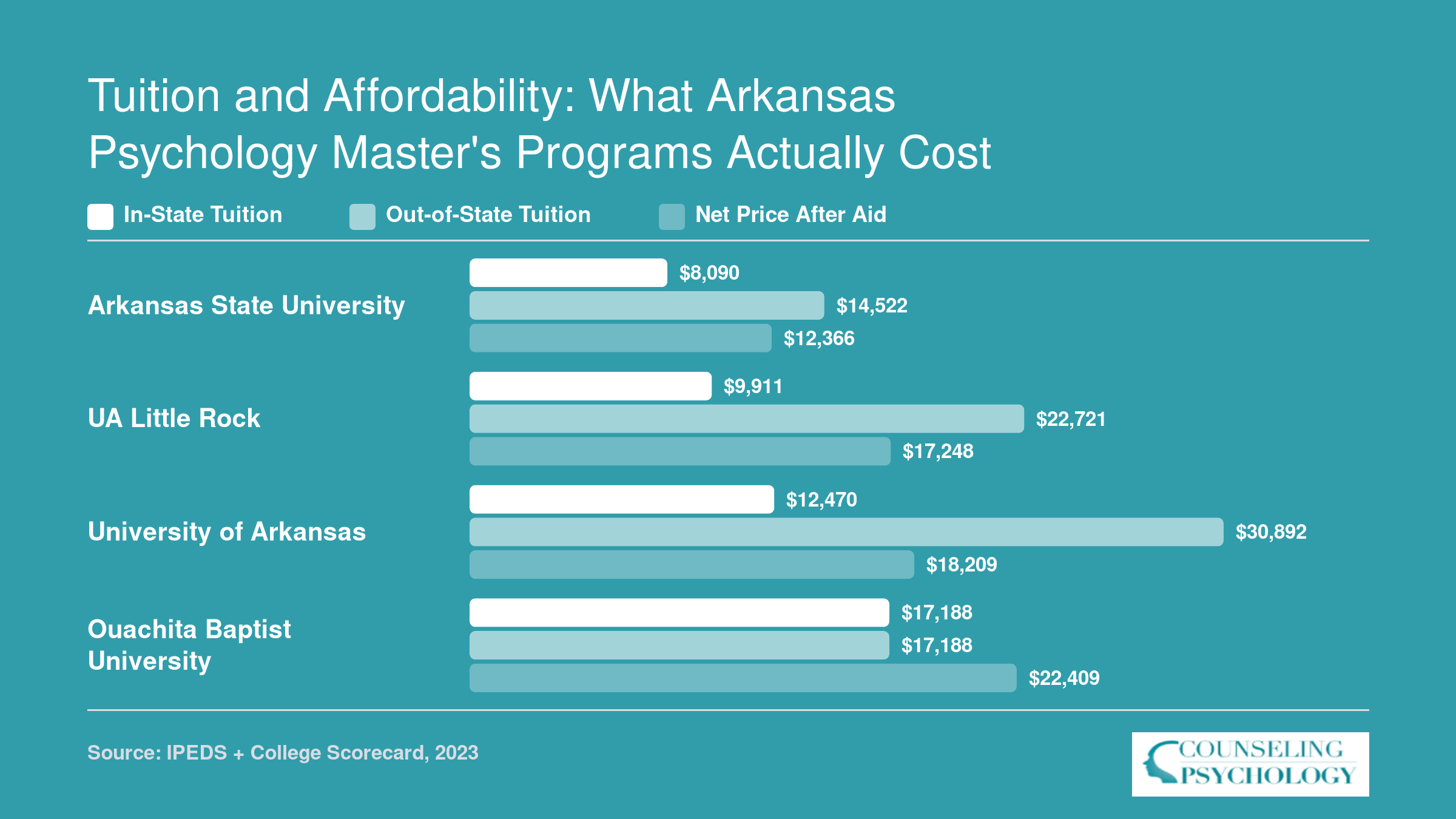
Tuition and Affordability: What Arkansas Psychology Master's Programs Actually Cost
The figures below reflect graduate-level tuition rates reported to federal databases, not undergraduate sticker prices. Because financial aid, assistantships, and employer tuition benefits can lower your actual cost significantly, we also include the effective net price each school's students typically pay after all aid is applied.
Online vs. On-Campus Psychology Programs in Arkansas
Choosing between online and on-campus formats is one of the most consequential decisions you will make when selecting a psychology program in Arkansas. Both paths can lead to licensure and a fulfilling career, but each comes with tradeoffs that matter more or less depending on your circumstances. Here is how the two formats compare across the programs in our 2026 rankings.
Pros
- Online programs offer scheduling flexibility that lets working professionals and parents complete coursework on their own time.
- Students in rural parts of Arkansas, far from Fayetteville or Little Rock, can earn a degree without relocating or commuting long distances.
- Online tuition is often lower overall; Arkansas State University's online B.A. in Psychology, for example, runs about $282 per credit hour.
- Programs like UA Little Rock's online MA in Counseling and Ouachita Baptist's online M.S. in Applied Behavior Analysis let you start graduate work from anywhere in the state.
- On-campus programs at schools like UCA provide built-in practicum site networks through regional Arkansas partnerships, simplifying fieldwork placement.
- In-person cohorts foster stronger peer relationships and professional networking that can translate directly into job referrals after graduation.
- A structured campus schedule helps students who thrive with consistent routines and face-to-face accountability from faculty.
Cons
- Online students still must complete supervised fieldwork in person at a local clinical site, and some programs (such as ASU's) expect students to locate placements on their own.
- Practicum logistics can be especially challenging for online learners in underserved counties where licensed supervisors and approved sites are scarce.
- On-campus programs require commuting or relocating, which adds housing, transportation, and opportunity costs that online students largely avoid.
- Campus-based schedules at UCA and similar schools are less flexible, making it harder to hold a full-time job while enrolled.
- Online learners may miss informal mentorship and spontaneous clinical discussions that happen naturally in campus hallways and labs.
- Hybrid requirements can catch students off guard: UA Little Rock's online counseling MA still mandates on-site practicum hours under a qualified licensed professional.
Questions to Ask Yourself
Career Outcomes and Earnings for Arkansas Psychology Graduates
Program-level earnings data (such as median salary at one, two, four, and five years after completion) and detailed workforce outcomes like employment share and share earning above the poverty threshold are not yet available for the specific psychology programs at these Arkansas schools. The table below therefore focuses on what we can confirm: institution-wide median earnings ten years after enrollment, median graduate debt, and Arkansas-specific occupational wage benchmarks from the Bureau of Labor Statistics (May 2025). These figures give you a realistic sense of ROI and salary potential in the state.
| School or Occupation | Median Earnings (10 Yr Post-Enrollment) | Median Graduate Debt | Estimated 10-Year Monthly Payment | Net Price |
|---|---|---|---|---|
| University of Arkansas | $58,191 | $21,500 | Approx. $220 | $18,209 |
| Ouachita Baptist University | $51,673 | $21,050 | Approx. $215 | $22,409 |
| University of Arkansas at Little Rock | $45,265 | $22,000 | Approx. $225 | $17,248 |
| Arkansas State University | $42,617 | $20,500 | Approx. $210 | $12,366 |
| Clinical and Counseling Psychologists (Arkansas, BLS May 2025) | State-specific median not yet published for this occupation | N/A | N/A | N/A |
| School Psychologists (Arkansas, BLS May 2025) | State-specific median not yet published for this occupation | N/A | N/A | N/A |
| Mental Health Counselors (Arkansas, BLS May 2025) | State-specific median not yet published for this occupation | N/A | N/A | N/A |
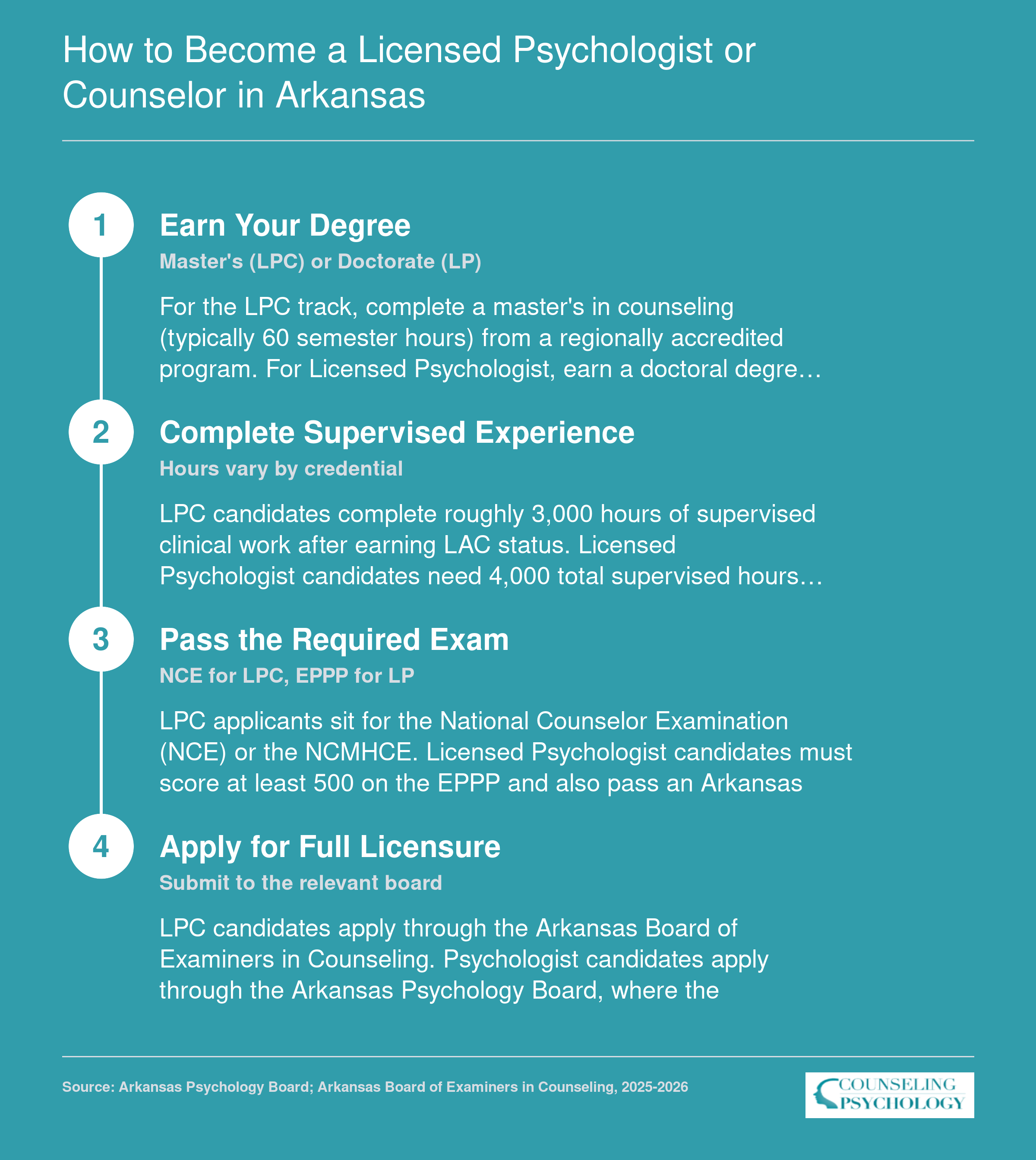
How to Become a Licensed Psychologist or Counselor in Arkansas
Arkansas offers two distinct licensure tracks depending on your degree level. A master's degree qualifies you for Licensed Associate Counselor (LAC) and, ultimately, Licensed Professional Counselor (LPC) status. Becoming a Licensed Psychologist requires a doctoral degree, significantly more supervised hours, and a different exam. Understanding which path fits your goals is essential before you enroll.
Choosing a Psychology Specialty in Arkansas
Selecting the right psychology or counseling specialty shapes your entire career path, from the courses you take to the populations you serve and the license you pursue. Arkansas offers several distinct tracks, and understanding the landscape helps you make a decision that aligns with both your interests and the state's employment needs.
Start with Program Verification
Program offerings change more often than most students realize. Before committing to any school, visit the graduate admissions pages of Arkansas universities directly. Arkansas State University, University of Central Arkansas, and Harding University each maintain updated information on their counseling and psychology options, including whether programs are fully online, hybrid, or campus-based. Do not rely solely on third-party aggregators, as they often lag behind institutional changes.
For counseling programs specifically, use the CACREP directory at cacrep.org/directory to confirm accreditation status. CACREP accreditation matters because it streamlines licensure reciprocity and signals program quality to employers. If you are pursuing a doctoral path in psychology, check the APA accreditation database at apa.org/ed/accreditation. Attending an accredited program is not just a credential boost; in many cases, state licensing boards require it.
Track Institutional and Labor Market Changes
Arkansas institutions occasionally launch new programs or discontinue existing ones based on enrollment trends and workforce demands. Stay ahead of these shifts by monitoring state higher education news and joining professional networks like the Arkansas Counseling Association. These forums often surface program updates before they appear in national directories.
For career outlook data, the Bureau of Labor Statistics Occupational Outlook Handbook provides national projections for roles like clinical psychologists, school counselors, and marriage and family therapists. Cross-reference these projections with Arkansas-specific employment data when available. The state's mental health workforce needs, particularly in rural areas, may create stronger demand for certain specialties than national averages suggest.
Match Specialty to Licensure Requirements
Arkansas licenses several types of mental health professionals, and each pathway has distinct educational requirements. Exploring the full range of counseling degrees available can help you understand how these tracks differ at every level:
- Clinical Mental Health Counseling: Requires a CACREP-accredited master's degree and leads to Licensed Professional Counselor (LPC) status.
- School Counseling: Typically requires state-approved graduate coursework and leads to K-12 school counselor certification.
- Marriage and Family Therapy: Requires specialized graduate training and leads to Licensed Marriage and Family Therapist (LMFT) credentials.
- Psychology (Doctoral): Requires a doctorate from an APA-accredited program for licensure as a psychologist.
If clinical mental health counseling interests you, reviewing the best masters in mental health counseling programs will give you a sense of what CACREP-accredited options look like nationwide. Choosing a specialty without understanding these pathways can result in additional coursework or delayed licensure. Review the Arkansas Psychology Board and the Arkansas Board of Examiners in Counseling websites for current requirements before finalizing your program choice.
The ranked Arkansas master's programs in psychology consistently come in below national averages for net price, and every one of them offers online or hybrid coursework. That combination of affordability and flexibility means students across the state, from Fayetteville to Jonesboro and everywhere in between, can pursue an accredited graduate degree without relocating or breaking the bank.
Frequently Asked Questions About Arkansas Psychology Programs
Choosing a psychology program in Arkansas raises practical questions about cost, format, and licensure. Below are answers to the questions prospective students ask most often, drawn from program data and state licensing requirements current as of 2026.